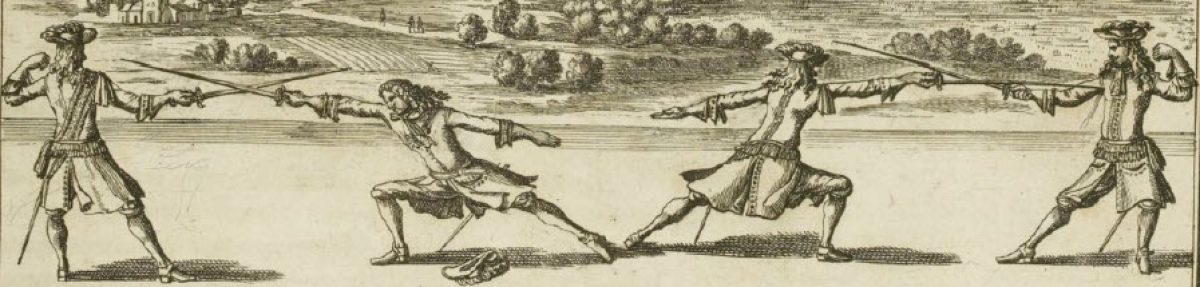

It seems only fair, given how often I have complained about the issues plaguing tournaments, that I should say something about the positive side of these events, and, offer some advice for those who compete in them. I’m not anti-tournament or competition, but I have high standards for them and for several reasons. First, they should be well-run and officiated. Second, they should be safe and the chance of injury reduced as much as possible. Lastly, however important medaling is, however much fun fighting is, tournaments are also learning tools, a chance to see what is working, what needs additional drill, and to test our strategies, tactics, and skill against other fencers.
With few exceptions, my competitive days are behind me, and no, I’m not happy about it. It’s less age than mileage—we pay for the fun of our teens, twenties, and thirties beginning in our forties (if we’re lucky it doesn’t start before then). It’s downhill from there. It’s not just stupid things we did when younger, though that is definitely in the mix, but decades of repetitive motion and too often not healing before starting up again. In one college event, for example, I rolled my ankle the night before, but wanted to compete so just wrapped the affected spot and fought anyway. Sometimes we’re just unlucky—I was in a serious car-accident in 2001 and not only injured my right arm, but in doing so unlocked all the existing trauma that was lying dormant. In an effort to prevent the crash I kept my hands on the wheel, which stretched out my supraspinatus tendon when we rolled, tore the rotator cuff, and released some lovely tennis elbow, the last a result of over-compensating when fencing and playing racquet sports thanks to a poor bone set. We can do a lot for a long time until something happens and we can’t.
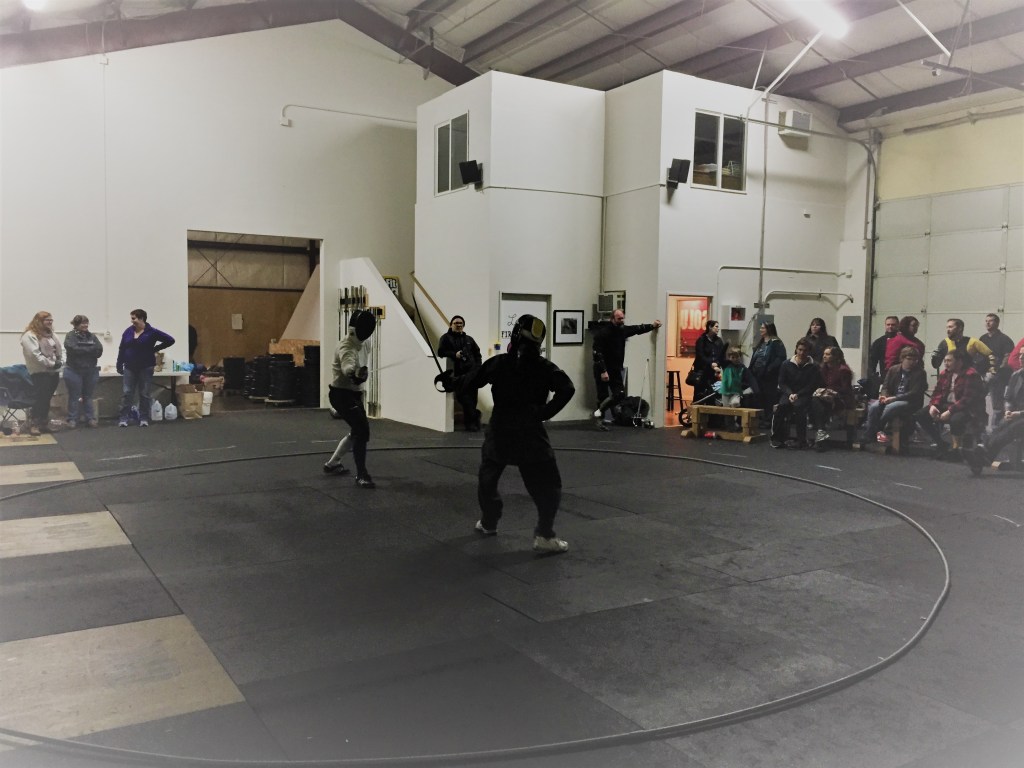
If time, injuries, and finances allowed, I would still be competing. I enjoyed it until sabre went electric and the flick took over foil. One of my attractions to what would become “HEMA” was the prospect of being able to compete again, but as things have turned out HEMA added new problems to the age-old issues so common in many tournaments. This is not to say that there are not well-run events, because there are—Sabre Slash, held in October each year in Prague, Czechia, and run by my friend Michael Kňažko, is an excellent example. [1] Likewise, I have heard that the Smallsword Symposium is worth attending, though I have yet to make that event. [2] By and large, however, most tournaments are poorly run collections of single-tempo doubles and abysmal officiating.
Until things change, if they do, one can still get something out of tournaments. It’s important to know what one is getting into, but with that caveat, there are several steps one can take not only to have fun at them, but also learn something.
Intelligence Gathering
Obtaining intel about other fighters is far easier to do now thanks to the internet and the tons of footage people share of their bouts on sites like Youtube. Pre-internet the typical way to check out other fighters was to show up at events and watch bouts when one wasn’t fighting. If one was super lucky, maybe there was a VHS tape around with footage, but that could be fishy—was this something the coach saved from a previous event? Hopefully. Or, was it some footage someone shot during another person or team’s training? Far less savory. Today, though, people share their bouts willingly and literally on platforms open to most of the world. Why not use it?

The value in studying other fencers is not just to see what they do, but how they do it. While super helpful when we fight them, watching better fencers and/or successful tournament fighters (not always the same thing), can helps us improve our own game. One doesn’t have to engage in intel gathering, but it’s a tried and true part of the game. Yes, game. There is a persistent, but false, notion that tournaments are somehow a “real” test of skill. They are, but not in the way most people think. There are rules, and where there are rules, there are ways to bend or break them, or, manipulate those who are there to enforce them. Thus, familiarizing yourself not only with the rules, but the officials, and players only helps.
The closest affinities between a tournament bout and an actual duel are in psychology and the role of chance. It is a lot easier to be calm, to think clearly, and use what we know when the situation we’re in is known, predictable, and subject to analysis that isn’t spur of the moment. In a sudden fistfight, in contrast, we gather intel as the fight progresses or once it’s over. If we’re smart, we size up a bar, theater, shopping center, etc. and assess potential threats, but that could be my natural bias as an American [3]. Put another way, tournaments provide us an opportunity to gather the same information without pressure and with ample time.
What to Look For: Intangible and Tangible
What should we examine? Start with general aspects. The easy things to assess are physical, such as height and thus reach. We can assess speed, the length of weapon, and the general composure of a fighter under pressure. Are they calm? Are they nervous? Do they rush right in at “allez!” or are they more calculating? If losing, do they lose composure and become wilder? Do they seem able to change tactics? Even knowing what club they’re from will tell you a lot—the fight-club style home to bruisers tend to fight a certain way, as do those from technique-driven schools, those with an Olympic background, etc.
Next, one can examine a fencer’s game and tactics. This is more successful if one knows what one’s seeing. Even sans a deep background and experience, one should be able to tell if a fencer tends to favor feints or actions on the blade or if they just wade in swinging. Does the fencer favor certain attacks? Guards? How well do they use the space in the ring or on the piste? Do they know when to attack or do they just attack whenever they feel like it? [4] Are they open in any line? Is their guard position correct and sufficient to protect them? Do they make a mistake consistently that one might exploit?
Tournaments as Pedagogical Tool
Tournaments should be fun. Ideally, they’re a chance to square off with opponents new and old, and test one’s game. Even in poorly run, shoddy events it’s possible to get something out of it, even if that means only adding another event to the list of those to avoid. Let’s assume the tournament is well-run and large enough to include a range of skillsets. Perhaps one makes it to the finals, perhaps not, but regardless each bout in the event is a learning opportunity. We often talk about competition as the crucible or pressure-cooker for what we’ve been learning, and in large part that is thanks to both the fact we tend to face new opponents and have the added pressure of rules, a clock, and ranking. Much fun as bouting with our weekly foes is, we get comfortable, complacent, and in the worse cases, cocky. Just because our favorite attack always works at home doesn’t mean it will work against unfamiliar opponents.
Competitive fencing, of any kind, can make or break people, and much of it comes down to how they view competitions. If the only goal is to win, and one isn’t winning, then it’s a lot easier to become discouraged. The top fencer at Podunk Sword Club is often shocked by a poor showing at Prominent Sword Club’s major event. Some quit after that, convinced they will never get better or that they are just not “naturals.” Others, however, seek out low-level competitions and sweep them; they like winning and it feds their self-worth needs—this may be the equivalent of an adult beating up a toddler, but somehow they see past that. A better path is to seek out better competitors, because they will push you and force you to grow; this requires, though, an awareness that initially at least one is going to lose a lot. A LOT. Be okay with that and learn from each bout, each fencer. In turn, as one advances, it helps everyone if we do our part to raise others up. Maybe you offer to be a ring-coach for a new fencer; maybe you experience the horrid martyrdom of officiating to help newer fencers see how things should be done; maybe you just offer advice to someone between pools. How we do this is everything—people can get on the ear fast when anyone suggests that they might need help, so be kind, open, and most of all only offer help if you can actually give it.
Over time, with patience, practice, and persistence, we improve, and our tournament experiences change. We’re grateful for the harder, more challenging opponents, and we realize we can never, ever underestimate anyone. Least we shouldn’t. [5] Each opponent is a teacher, each bout a chance to improve or see what needs shoring up, and if we’re really lucky, we have fun at the same time.
NOTES:
[2] My friend and colleague, Dr. Patrick Bratton, has attended this event for several years and has had good things to say about it. Smallsword, far as I can tell, tends to attract people for whom technical ability holds merit, and so while one can—and people have—won by buffaloing their way through the pools, the fencers who stand out are those who are skilled win or lose. Remember, competition = rules = ways to game the system.
[3] I jest, but also, well, depending on where one is this is an important skill. We shoot people at schools and theaters here, so…
[4] For example, there are ideal and less ideal time to attack. Some modern masters refer to looking for moments when the opponent is in “negative balance,” that is, as they just begin an action (especially if just out of distance), if they’re taking a step, or if they’ve just attacked and fallen short, since upon recovery from the lunge they’re less capable of covering themselves. [5] One of the axioms I teach is that we should never underestimate anyone. The best fencer can have a bad day, the worst a great day. History has plenty of examples where underestimating an opponent had dire consequences. Remember Signore Cavalotti, https://trove.nla.gov.au/newspaper/article/66694588

 Capitale Escrime Historical Fencing
One thought on “How to Tournament”