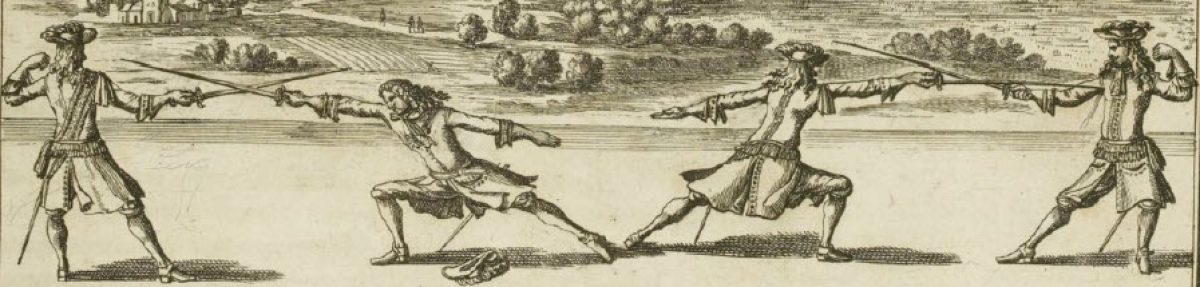

One of the best things about fencing are the interesting people one meets along the way. Say what one will about “nerds” and niche interests, rarely are they boring, and in some cases it’s precisely their eccentricity that bridges the gap between niche-folk and those just other side the creative wall. For example, a few years ago a writer contacted me with questions about sabre for a project he had in hand. Over the course of our many conversations, we became friends. In a discussion this morning, he asked me for my take on the issue of true teachers versus the McDojo sort who just out to make a buck.
One point I made was that there is often, sadly, a gulf between what we can actually use in martial arts, should we need it, and what a school or teacher makes their focus. For example, in one ruleset for competitive Tae Kwon Do, one can kick at the head, but not punch. [1] If one is studying at a school adhering to this ruleset, they may be doing themselves a disservice if the goal is training to keep themselves and others safe. This is not to say that competitively focused schools are inherently bad, they can be fun and build one’s confidence, etc., but one should not mistake them for what they’re not, either.
As we continued to chat, I brought in a few examples from historical fencing, and this raised a related set of questions. Do we try to share all aspects of a particular treatise? Should we? What if an action is dangerous? What if it’s safe to do in our context, but would be dangerous were the blades real? My short answer is “it depends.” There are sometimes reasons to teach dangerous maneuvers, but any time one does considerations of safety must come first.
Not all Masters Agreed; Not all were Equal
One of the most “medieval” aspects of historical martial arts, and “HEMA” in particular, is an almost blind faith in written words of the past. Textual authority, given that it is 90% of our evidence, makes sense, but reason must still be applied. Modern doctors do not rely on ancient Greek medicine for guidance in obstetrics, and it would be both unethical and criminal if they did. [2] Not everything written in the past was good.

It can be difficult to assess the worth of an old fight manual. Our distance in time, methods of conducting violence, notion of law, everything is different. This said, there are times when we get help from within the texts themselves. For example, in de Liancour’s Le maitre d’armes/The Master of Arms, 1692, he says of the counter attack that
C’est une chose si difficile à prendre que les Temps, l’Epée à la main, que je ne conseille personne de s’y trop hasarder. J’estime mieux une bonne parade, ou un bon battement sec & tiré droit le long de l’Epée ennemie, sans oster la sienne de devant soy…
Je m’étendrois beaucoup sur ce Chapitre, mais comme j’ay résolu de ne parler que des choses essentielles, je dirary seulement que c’est in jeu de Salle, où ces coups se pratiquent allez souvent, mais fort rarement l’Epée à la main.
It is such a difficult thing to take on the Times, sword in hand, that I do not recommend anyone to risk it too much. I consider a good parry better, or a good dry/sharp beat & thrust along the enemy’s sword without removing his from your own.
I would dwell long on this Chapter, but as I have resolved to speak only of essential things, I will only say that it is a Salle game, where these blows are often practiced, not often sword in hand. [13 in the pdf of 1692; Lynch, 36] [3]
Here is a master pointing out the inherent danger in choosing a counter-attack over a solid defense. It’s an important point, and one I am quick to mention when I cover counter-attacks, but I still teach it. For one, though we aspire towards realism, the fact is we do this for fun and no one is in danger of actual injury. Second, and more importantly, though I advise students not to select a counter-attack save under specific circumstances, they need to know how to recognize them and practice defeating counter-attacks when this action is used against themselves.
For another example, Capt. John Godfrey, in his A Treatise upon the Useful Science of Defense, 1747, rails against an action common to most small sword works, the flanconade:
That Thrust called the Flanconade, I pronounce an Anathema upon, as being easily proved to be the most lewd and vile Debaucher of the Art, the Dignity of which consists chiefly in its generous Allowance of a proportionable Chance to the weak man. The other Thrusts depend upon a timely Swiftness mostly: Though to say, that equal Knowledge with more Strength has not the Advantage, would be preposterous, as certainly the greater the Velocity is, the greater the giving Strength must be… [12ff]
Godfrey’s argument is that a weaker person will be less likely to pull off the flanconade than a strong person. He was correct. His pro-English and anti-French bias, given his background, are not surprising but likely informed his position as well. He published, after all, during the War of the Austrian Succession (1744-1748), where the two nations were in conflict over territory in North America (among other theaters). One example should suffice:
The Art we had from the French; no Flaconade was thought of for some Time; but upon finding us very apt Scholars, and being willing to be our distinguished Masters, they brought the Flanconade and many tawdry Embroideries, which they are as famous for inventing, as, I am sorry to say, we are degenerate enough to imitate, and even mimick. Pity! that we should be so fond of imitating a Nation, who have always been deceiving us. Rouse then, though noble British Spirit! (for sure no Time more calling than the present) lift up they brave fronted Head above these dandling Actions, and become thy wonted self! Love thy King, love the Country; stay they Heart his these, and thou art safe.
Thus I take my hearty farwel[sic] of the Flanconade. [13] [4]
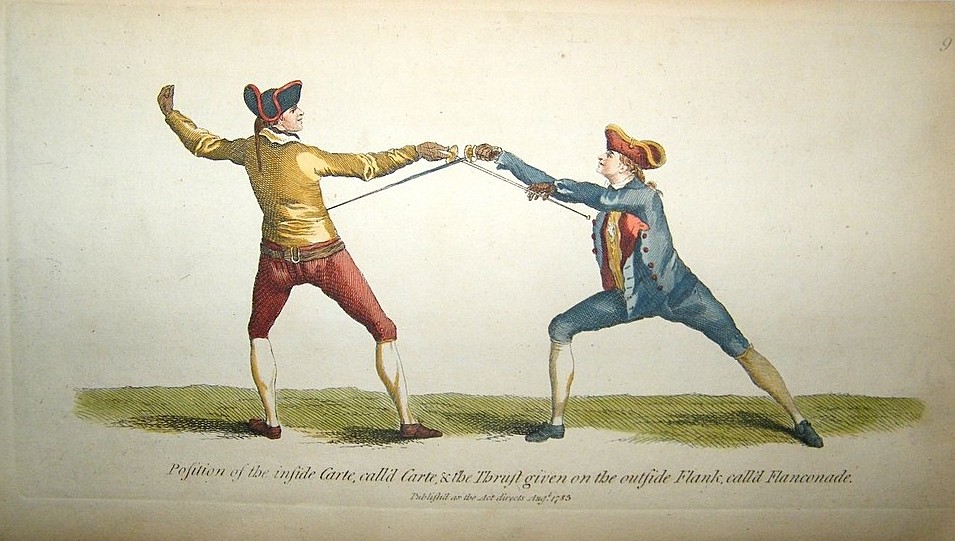
Tin-foil tri-corn hats aside… the flanconade is a relatively difficult action to learn at first, but easier with practice. It does require, as Godfrey points out too, that the off-hand must come into play to stay the opposing blade after parrying in order that one doesn’t double as they go to target. [5] I teach this action too, and as with counter-attacks, because while difficult one must still know how to defend against it.
For a last example, this time in re position, James Underwood’s The Art of Fencing or the Use of the Small Sword, 1798, is instructive. In many, maybe most treatises the author advises one to be back-weighted while on guard. Underwood, however, disagreed:
I am of opinion, that the distribution of the duty laid upon each leg ought to be equal, and the more equally they share in the weight, I will venture to say the body will be so much more supported. But let us examine into the consequential practice, by the disadvantage of laying a greater stress upon one leg than the other, or the advantage to be expected from the strength accruing from the proper weight given to both. If too great a stress lie upon the left leg, your retreat must be obviously the more unsteady, and weaker; if upon the right, you are crimped and checked in your advancing. If the greater share of weight lie upon the right, the left leg must take that share off, before you can advance, and so, vice versa, the right must act for the left in the retreat. But then this is the loss of your time, upon which every thing depends; whereas by equilibrial weight upon the legs, that time is saved. Here your body will be equally supported, therefore stronger and steadier; but by recovering and shifting in the other way, the motion of the body must be so much greater, that your arm is more likely to be thrown out of line. [4-5]
Many fencers are taught this way today, that is, instructed to distribute their weight equally. It works fine. However, the rear-weighted stance was common and works equally well provided one distributes one’s weight properly. I had doubts about it myself, but in discussion with Russ Mitchell, and especially after his how-to-lunge class, I finally understood how it is supposed to work. [6] I teach students both. First, I show them what a majority of the texts advocate and why—our en garde position, and the lunge especially, are compromises between proximity to target and removal of our own target. Next, I show them the equi-weighted stance. Purists may balk, but I focus on the goal of our stances, not the letter of the law—bodies are different and so supplied with a few principles, I advise students to find a position that is comfortable and yet still meets the critical aspects. The front foot should be straight ahead, their bodies turned about 3/4, and fist and weapon just outside the body if on guard in tierce. If the rear heel is not precisely on the line of direction and in line with the front, no matter—are they stable, balanced, and can they move in any direction required? That’s what’s important.
Selective Reading & Teaching
When using a fencing treatise, I read it all and more than once, but I do not necessarily include all I read in class. I am selective in what I use—not in what I read. I read page to page, because I need to see the author’s approach in toto, and, compare it to other, related works—but not everything is equally important. I rely on Girard’s Traité des arms/Treatise on Arms, 1740, for much of my small sword curriculum, but I have no plan to include his short section on defense against grain flails. I use Domenico Angelo’s L’École des armes/School of Fencing, 1763/1787, as well, but spend very little time if any on weapon seizures outside demonstrations. They are, again to quote dance master Les Kendall in “Strictly Ballroom,” largely “flashy, crowd pleasing steps,” and less secure than a firm grounding in parry-riposte and thrusts made in opposition.
There are things I include for reasons of completeness or because it explains or aids core material. For example, there is good reason to believe that prime in small sword derives from broadsword practice. Angelo says as much, and this guard and parry are redolent of the hanging species of guard often used in sabre and broadsword, but I share that fact, if I do, because someone asked or because of some similar prompt. Girard covers the use of multiple feints, actions like the 1-2-3, but rarely does one need to resort to three feints in an actual bout. Complicated maneuvers like this are what we call “medicine for the hand:” we drill a triple feint because it will, we hope, make our single feint that much sharper and crisp. Have I seen anyone use a triple feint in a bout? Yes, among high level foilists thirty years ago, but in historical fencing circles? No. We still have to contend with people who believe feints are not “martial” enough (despite how often they pop up in the military sources…).
My goal is two-fold in most lessons and classes. First, I want to present and teach as accurately as I can either the tradition I was taught, or, those from the past I have studied. For the latter I always provide the caveat that we can never recreate these extinct fight systems perfectly, but we can, hopefully, get a good idea of how they might have worked. Second, I want what students learn to be both reflective of its sources and useful—I see no reason to teach anyone actions that are more likely to get them hit than not, so when I teach counter-attacks, when I teach the flanconade, I do so at the appropriate time and with the necessary warnings.
Curriculum building is selective, personal, and should be subject to revision as new insights, ideas, and flaws in the existing approach appear. Historical fencing is a research and experimental archaeology driven field. Unlike colleagues in the Olympic world, who are not uncovering hitherto unknown material or inventing new actions, our understanding changes with newly discovered texts and better interpretations. [7] If we are not open to new, better information, our programs become moribund and stagnate. Moreover, what we choose to teach and how is everything, but it depends on what our goals are. Unless we wish to produce graceful puppets, we should know not only what to teach, but why. What one selects is up to the individual instructor, but have a reason and be able to explain your choice.
NOTES:
[1] See for example https://olympics.com/en/news/know-your-sport-taekwondo-rules-scoring-equipment, “Scoring,” and “Penalties and Prohibited Acts.”
[2] To name only one example, the Hippocratic school concluded that most illness women faced was due to the uterus. From a very large sample, see Lesley Dean-Jones, Women’s Bodies in Classical Greek Science, New York, NY: Oxford University Press, 1994; Rebecca Flemming, “Women, Writing, and Medicine in the Classical World,” In The Classical Quarterly 57: 1 (2007): 257–79; Helen King, Hippocrates’ Woman: Reading the Female Body in Ancient Greece, New York, NY: Routledge, 1998; Vivan Nutton, Ancient Medicine, New York, NY: Routledge, 2005; Soranus, 1927.Gynecology. Edited by Ioannes Ilberg, Corpus Medicorum Graecorum/Latinorum, Berlin, DE: Teubner, 1927. [what, historians gonna history 😉 ]
[3] French speakers I ask your apologies for my loose translation. M.P. Lynch put out an edition in English (2021), which is useful, but which also has some translation choices that one might find less ideal, e.g. p. 110 where he uses “snafu;” for the original passage, see Ch. 17, p. 64:
Je répons que si l’on étoit affeuré que ce fùt un veritable coup tiré de droite ligne, sans feint, on pourroir y parer en opposant la main gauche, comme je l’ay fait voir dans mes autres Planches. Mais l’on peut étre trompé par des feintes, ou par des demy coups, & étant surprise, cette parade de cercle enveloppera tous ces coups qui pourroient vous étre poussez, & même fera perdre tous les desseins de vostre ennemy.
[4] American sentiment, which has long baffled me given our long friendship with France, tends to back the English view on everything from the Hundred Years War to the colonial contests of the 18th and 19th centuries. Had it not been for French support, we may well have lost our rebellion against England. More recent history makes this all the odder given that England and France were allies, as were we with both nations, in the world wars. Just something to think about.
[5] The flanconade, often called a “high-low” attack in modern epee, is effected by parrying a thrust in the high line in fourth, then dropping the point to the outside over the opponent’s weapon. One then thrusts to the outside low line. Many earlier works advocate using the off-hand to secure the opposing steel after beginning the thrust to avoid a double. For a useful modern example, my go-to is professionescherma.org’s channel on Youtube: https://youtu.be/4G63pNHS90M
[6] See Russ Mitchell, Basic Body Mechanics for Martial Artists, 2018.
[7] One outcome of the unfortunate merger between the USFCA (the US Fencing Coaches Assoc.) and the USFA (US Fencing Association, the body that governs the sport; the US branch of the FIE), is that instructors are encouraged to “renew” their certifications yearly, much as someone say in a profession like pharmacy might with CEs (continuing education courses). While admirable that the organization(s) are interested in ensuring a higher degree of ability among instructors, there are issues with this decision. For one, this is expensive and assumes—as ever—full-time coaches with some manner of decent pay. That is not true for most coaches. Second, unlike pharmacy, no one is inventing new ideas or actions that we must learn to stay current. It’s difficult not to see this measure as a money-grab.

 Capitale Escrime Historical Fencing
One thought on “Curricula, Completeness, & Choice”