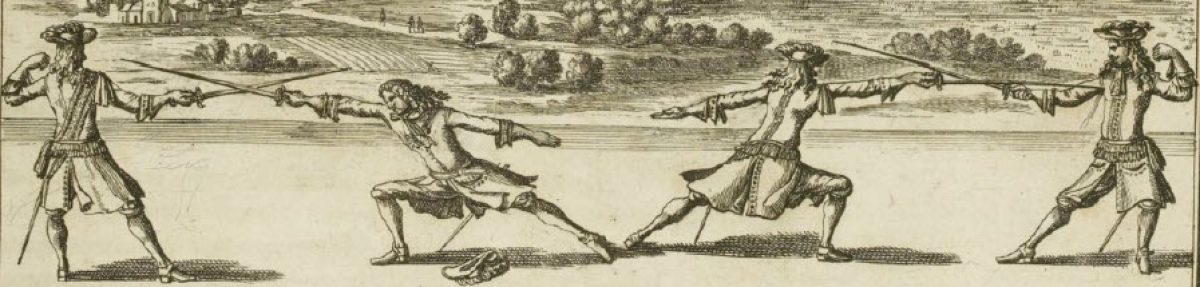
One of the benefits of not having to suffer the tempests in teapots that boil over on social media is that I only hear of them second-hand. I’ve heard a lot in the past few days about an unfortunate debate on one of facebook’s smallsword pages concerned with a particular action. Controversies like this have a way of forcing people to show their colors, and this latest hullabaloo is no exception.
The lines, as I understand it, are drawn between those upset by the inclusion of a passing attack, a collection of enthusiasts including a number of English fencers, at least one sword-maker, and a few vocal students, largely American. Their opposition consists of an assortment of historical fencers who have argued for this attack based on the sources. If one is familiar with my posts here it will not be difficult to determine where I land in this debate (not that what I think will matter to many participants). However, as an instructor and historian I feel a duty to those I work with to say something.
False Equivalencies & the Fleche
The action in question is a rapid attack meant to surprise an opponent and one made by passing the back foot in front of the lead foot. To work, one chooses the right measure and tempo, and then applies the right speed and weapon angle to close the line. Whatever the name, these are the component features. It is, in truth, a dangerous action, especially if made poorly or at the wrong time or distance, but the fact that it shows up in so many works means it is worth study.
The criticism aimed at the passing-step proponents centers upon this action being too “sporty,” too “modern,” and since that first generation of classical and historical fencers arose in large part because of the excesses in the sport, anything remotely whiffing of the modern piste is immediately suspect. I know because I was there, and like these poor folks, once over-compensated and over-corrected. This was easy to do in the 1990s and early 2000s for several reasons. The complete lack of concern and disdain from fellow fencers about over-use of the fleche, of the flick in foil, of duck and cover, or any of the other aberrations was hard to understand and unpleasant to face. Second, and in ways that echo in the current debate, none of the evidence–and there was plenty–proving that these were departures from the point of fencing and ahistorical made the slightest dent in their resolve. On the one hand, older fencers unaffected by much of this failed to see the danger. On the other, many newer fencers, having made their reputations on these dubious actions were loath to condemn them; to do so would be to condemn themselves, to call into question their own position.
Ego drove much of this, and, ego drives the anti-passing step side now. Combined with misunderstanding of the problem the anti-passing step faction has taken the suggestion that a move like the fleche is viable as a personal affront. Ironically, they decry the action despite the evidence from the very sources they claim to use. Ego is the first barrier: an inflated sense of self and one’s importance tends to blind one to reason. The second barrier is mistaking issues with a particular action for the action itself. Memories of fleche after fleche in the late 1990s and all the daft measures the FIE took have made any attack like it, never mind the fleche itself, anathema.
Of note, the pro-fleche camp, for lack of a better term, has not argued that the passing attack in Vadi or L’Abat is exactly the same as the flying leap sabreurs so took advantage of in the 1990s. Contexts are different, the weapons different. This said, the idea of a rapid, surprise attack made by throwing the weapon forward and passing the rear leg past the lead one is present in our sources. Whether one chooses to use it or not is another question. Whether one makes the attack well is another matter. Whether a master advocated it or merely included it is an additional consideration. Some masters specified that they didn’t care for an action, or, that it was dangerous outside the salle, but often we don’t know where they stood on its effectiveness or safety for actual fighting. [1] There is ample precedent for fleche-like actions on the record, so to poo poo the use of an effective passing attack in modern historical competitions, which we do for fun, is about turf and ego, not the sources.
Why the one faction should stubbornly argue against the evidence of the sources should make one pause. For smallsword works alone, the inclusion of the passing-step attack is common. It should be little wonder as to why. Given the place of cross-steps forward and back in earlier works (de Liancour, 1686, is a good example), adding speed to the same method of advancing follows logically. The same attack, however, appears earlier in the sources, from Vadi to many rapier treatises. What separates historical fencing from other branches is, supposedly, reliance on the sources, so to ignore the basis for interpretation, particularly when we can trace this action over time and across masters, is odd. If the source tradition isn’t their basis for support, then what is?
The Problem of Authority
One of the bugbears within “HEMA” is a blind appeal to assumed authority. In this case, a number of early researchers and their fan-base appeal to the early success and acclaim these luminaries enjoyed in the belief that it’s as valid now as it was in the early 2000s. That is, sadly, not often the case. Research has not stopped since their time, yet many of these same people stick to outdated theories and flawed interpretations.[2] Their argument, thus, is not made from evidence and analysis, but from ego, from fear of losing the status they depend upon from their acolytes. They fear being eclipsed. The last has already happened as this latest fracas, one skirmish of many in the past twenty to thirty years, demonstrates.
Time-in is another supposed source of authority. It can lend one credibility, but depends on other factors. On its own time-in means absolutely nothing. If one has been in “HEMA” for thirty years and has not only been working from poor theories, but also continues to argue that they were correct despite the evidence, then time-in means very little. This happens a lot–I’ve met many people who have wasted years with charlatans or in glorified fight-clubs or working from once key interpretations that have been superseded.
Complicating the stagnation is an often surprising lack of understanding of fundamental actions and concepts. For example, a well-known fencer recently quoted de Bazancourt with respect to rushing in, which not only demonstrates a failure to understand the intended use of the action, but also serves to corroborate the fact they are basing their view on misuse of the action. Preparation is everything in fencing, and attacks like the passing step and even its much abused 1990s version (ideally…) relied on setting an opponent up for it. The sabreurs who flung themselves stupidly at “allez!” and who never varied the game are a different animal. In the footage I’ve seen from a recent Canadian event, the fencer employing the “fleche” used it wisely, and, as intended: as a surprise against an unprepared opponent. I am a fan of much of de Bazancourt’s wisdom, but the quotation supplied is misapplied. Used at the appropriate time and in the right setting, the passing step or fleche is no more dangerous than a lunge. Both put one at risk. Every form of attack potentially does.
Another issue plaguing “HEMA” is the echo-chamber effect. Adherents to this idea or that group focus increasingly only on what those within their section of the community teach, believe, and use. Their views become myopic, limited, and prone to precisely the ego-driven arguing we see in this current example, because for them the debate is less about sources than it is their reputations as “authorities.” They view the shadows cast on the wall by the tiny flame in their hands or in those of their heroes and take those shadows for reality. It seems real and legitimate to them because they refuse to consider any other well-made argument. In like vein, if any light is cast from someone they don’t know or who fails to pass the anemic view of authority they employ, they ignore it, or, call them heretics.
Proof is in the Teaching
Perhaps it is the Hollywood notion of 18th century manners, of high style, and the romance around the waning influence and power of European aristocracy, but many of the interpretations from the anti-passing-step camp are wooden, slow, and lacking in vigor. They present more like demonstrations or dance than a fight. It’s form over function. For all the formality and etiquette that people of the past attempted to apply to personal conflict, in the end it was a sword fight. The intent was bodily harm or semi-acceptable ritual murder, and no evidence we possess suggests that two people, potentially angry and emotional, fighting fear, and terrified of public opinion, were more likely to square off and fight as if dancing. All evidence is to the contrary. Surviving footage of late period duels is no exception, and many of those were first-blood affairs, not to the death. For all the blather about “realism” few in “HEMA” spend much time if any pondering what that means, or, what it should mean in our context. [3]
The flaccid yet florid approach these fighters take to fencing reveals too much concern for aping the elegant plates within the treatises rather than what those treatises were meant to help teach: fighting. I am not the only one cautioning fencers about over-reliance on images, but time and again many in the community gravitate to the images because they don’t understand the text. [4] While language and diction are often challenging, the deeper issue is that these same fencers lack sufficient understanding to read the text. The one place they might go for help, a solid Olympic or traditional fencing program, is anathema among them, and so, they do their best to adopt what they see in the illustrations and produce pretty bouts largely devoid of any intent.
In the footage of their bouts, in their instructional videos, and especially in their attempts to shout down opponents, the shallowness of their understanding and skill emerge vividly. The inability to fence beyond a snail’s pace, the poor use of measure, and the more choreographed timing are red flags. No one fought in slow motion. It’s hard not to conclude that this is one reason that the clubs and cliques against passing step attacks avoid bouting anyone outside their little world. Against fencers with legitimate training and armed with sufficient knowledge they come up short. Such defeats should suggest to these fencers that maybe there is more to learn or better ways to learn it. In fairness to the newer students among them, hearing from their clubs that these defeats don’t count because others are wrong or too dangerous etc. is easier to accept within their echo chamber, when the only voices they hear are all part of the same program. [5]
Make the Bold Move
It takes courage to accept new ideas, even when well-presented and argued, but it remains the right choice if one wishes to retain any respectability. Lacking any official organization to manage these things, we are left only with each faction’s arguments and how to evaluate them. The best approach is to evaluate the respective arguments in light of the evidence, and, against what the purpose of fencing used to be. The masters who wrote these works, many of them anyway, meant for their books to help teach students how to fight. Sure, some, especially later, were more concerned with salle play than with duels, but for those clearly self-defense oriented, like many mentioned in the debate over the passing attack, the goal was effectiveness first and foremost. There was ample attention to deportment and conducting oneself with grace in many works, but this was, outside a fencing hall, a secondary goal. No master stayed employed long if their students died or were maimed for life. [6]
Those quick to condemn historical fencers using the passing step attack should take their example from other members of the older guard, people like Paul Wagner, Stephen Hand, and Dave Rawlings, all of whom have continued to learn, adapt, and alter their thinking based on new and better information. Though well-known, they have remained humble and thus open to learning, and between these factors and being gracious opponents, they have stayed relevant. They have not been eclipsed.
When it comes to past fight systems, no one has a monopoly on the truth. Every interpretation must be tested and compared against the sources, and when new and better ideas make sense, when they follow from the sources, then they’re worth consideration however much that may disappoint one. At such times, hard as it is, once those shadows on the cave wall have been revealed for what they are, it’s time to do the hard thing and turn around. When one does, one sees better and grows, and often, one finds that those they have perceived as enemies turn out to be staunch allies.
Notes:
[1] De Liancour, for example, believed counter-attacks better suited for salle play than affairs on the ground (Le maitre d’armes/The Master of Arms, 1692, 13 in the pdf, 29; in Lynch’s translation, 36); Capt. John Godfrey, in his A Treatise upon the Useful Science of Defense, 1747, 12-13, expresses his dislike of the flanconade.
[2] A prime example is the demi-pointe lunge. See my papers related to this topic in the “Research” section found at the bottom of the Instructor page.
[3] I’ve spent a lot time on this in previous points, so here I’ll only add that while we strive to be historically accurate and as “realistic” as possible, the fact remains that we do this for fun, wear protective gear, and have no real need for this skillset in our own time and cultures.
[4] See my pieces on using and misusing images in historical fencing under “Research” in the Instructors section.
[5] Most fencing schools, most of the better martial arts programs, include working with and/or competing against those outside one’s own school. It’s critical for growth. It is never a good sign when instructors fear this or actively preach against it.
[6] Even in self-proclaimed self-defense works we see concern for deportment. In James Underwood, The Art of Fencing, Dublin, 1798, p. 7, he explains that he doesn’t like the off-hand arm forward because “I think the beauty of the figure is strangely disfigured by it, and that all fencers will allow that they cannot help being pleased with a symmetrical posture.”

 Capitale Escrime Historical Fencing
2 thoughts on “Shadows in Caves”