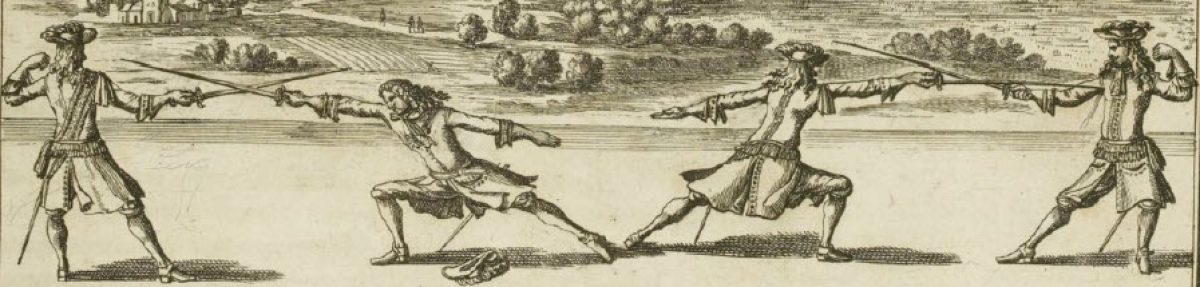

I started the day off in a rapier lesson with one of the students with whom I’ve worked longest. I have often said that teaching is a two-way street, that both instructor and student—ideally—learn, grow, and improve as they work together. During one drill, my friend stopped, said “question,” and we stopped to chat. “Is there a reason you’re taking such a big second?” It was an easy observation, but one I had not made—was I? Was I taking too large a parry? He then asked “what else are you working on right now?” and then it hit me. What followed was a lovely chat about the ways in which different weapon tracks can “leak” into one another, something that can be a benefit, but in good cosmic equilibrium, can also work against us.
In this case, it was the latter, and I was grateful for his observation and said so. Focused as I was on the lesson plan, and on making purposeful mistakes, I didn’t notice an unintentional one, another insight Ken shared with me. There are many instances in which the instructor makes mistakes on purpose—it’s critical for teaching a fencer what to look for, how to take advantage of such issues, and it’s all valuable, but it’s sometimes a difficult thing to switch off, which is to say that a lot of us find ourselves struggling not to be in teacher mode when we’re bouting to bout.
The Drill
Here, the danger was not only my own overblown parry of second, but also undermining an otherwise valuable drill. At Ken’s level, we work on a lot of tactical set-ups, on second intention, traps, and ways to conserve energy. For me to drop the ball in any one section breaks the drill, and, potentially—were Ken not so aware—upsets the student’s learning. The drill in question started with a classic, workaday action:
Student: feint thrust to hand from 2nd or 3rd
Instructor: parries 4th
Student: disengages to strike outside of the hand or arm
Next, we added a second exchange:
Student: feint thrust to hand from 2nd or 3rd
Instructor: parries 4th
Student: disengages to strike outside of the hand or arm
Instructor: takes a half-step back, parries 2nd, thrusts with opposition
Student: transitions from 2nd to 3rd to block, ripostes over the instructor’s weapon
In taking my parry of 2nd so vertically, I made it a lot easier to hit me, something someone on their game would be less likely to do. After Ken’s correction, my parry reverted back to what it should be in this case, shallower, point closer to him, and danger way more real should he not cover.
Whither yon Leak?
It didn’t take me long to figure out what was happening. What I was doing in the instant was not so much taking 2nd as it was dropping into what broadsword sources refer to as an “outside half-hanging” parry, that is, a block defending the same area as 2nd, but which has the blade hanging more vertically. The “outside hanging” parry defends the upper half well in the same way.
For some time now I’ve been spending more time on “Old Style” broadsword. Thomas Page is the major source I am using, and the nature of that style of fight, never mind the change in heft and balance with a baskethilt, enables one to drop the blade more to parry in an outside half-hanger because the axis of rotation is the wrist, and, it’s thus quick for a riposte.

In rapier, such a deep parry is to invite a counter-attack or fail to cover a line, and so while there are similarities between them, they work differently. With Ken’s help, I now can start to work on better compartmentalizing these weapons.
Stopping the Leak
Awareness is the first step. Thanks to Ken, I am aware of that issue, and best of all, will double-check everything else I am doing.
Next, I drill both weapons with specific attention to the techniques unique to them. It always comes down to drill, more and more drill. I will also be far more mindful now, which is never bad, and with work not only will I fix some of these issues, but better serve my students.
As a coach of other fencers, and thus responsible for raising them up, challenging them, helping them reach the next goal, correct technique, just like proper timing, distance, everything, is a must. As a coach to other coaches, there is also benefit—each pitfall I encounter is another lesson for my colleagues, especially those starting out and yet unaware of problem X or issue Y. We are never finished learning, and, so long as we retain a “beginner’s mind,” we will continue to grow and be better able to make corrections as we discover places that require them.

 Capitale Escrime Historical Fencing