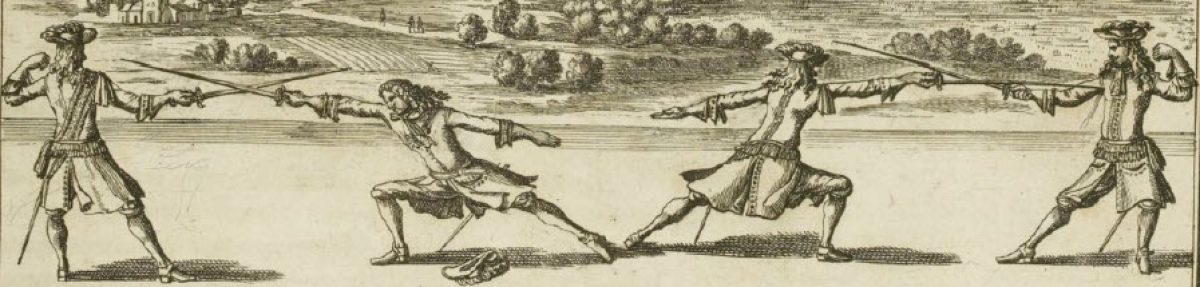
It’s not a lack of fencing-related topics that has prevented me from writing more on this page, but the sorrow, anger, and consequent insecurity of watching one’s country take a bad turn that has occupied me. I’ve never been one to say “it can’t happen here,” because having taught history for so long I knew that tyranny can happen anywhere. Yes, even here. One might think that narcissists greedy for power and attention might give more thought to their legacy, but if the Nuremberg trials proved anything it’s that many such people go to the gallows still convinced their choices were correct. Evidence, reason, decency, these have no effect on such people.
Montesquieu wrote
“In our days we receive three different or contrary educations; namely, of our parents, of our masters, and of the world. What we learn in the latter effaces all the ideas of the former,”
and I have found this to be, in many ways, true. [n] Experience, especially disappointment, failure, and hardship work effectively against false positions, assumptions, and prejudice, at least if one is open enough to admit when one is wrong. My own partnership with these challenges has made me a different person than I was when I was younger. Contrary to form, as I’ve aged, I’ve grown more tolerant, less quick to judge, and more open-minded because having lived in the world, and having seen a bit of it, I know few things are as black and white or easy as we might wish to think. This is an approach to thing I take to everything and that includes my work as a fencing coach.
For the patient, what follows explains why my club values what it does today, and, why I think I think it’s important. If you don’t feel like a “long” read, then stop here, go to the “About Us” page, and scroll down to the various icons at the very bottom of the page and you will see where what follows leads.
Moments of Intense Clarity
Many of the people we meet in our lives become teachers in one fashion or another. One of the more important such people in my life was a female friend I first met at church in high school. One winter evening, between college semesters, we had a conversation about tolerance, equality, and Christian notions of morality. This friend, I should say, is extremely intelligent, but more than that she had a deep sense of justice and compassion. Though we have not stayed in touch much, I know her career as an academic took off, as it should have, and that she is doing good in the world.
As embarrassing as it is to admit, at that time, in my early 20s, I had a traditional view of certain things. With homosexuality, for example, the bible had some lines that it was a no-no, and I didn’t think about it beyond that. However, because I did my best to embrace the Second Great Commandment of the NT, I did not persecute, avoid, or mistreat anyone. “Tolerance,” to me then, was just that–I might find something “wrong,” but it wasn’t my place to judge it. My friend, however, pointed out that I was, in fact, judging them, and worse, I had not examined why. “It’s in the bible” is not an argument. Thanks to her I grew a little that night.
We debated back and forth a bit, but even then I knew she was right. IF the deity we believe in is all good, all knowing, all powerful, then it’s beyond our ability to comprehend save through metaphor. It’s a thing we can understand poetically, not scientifically. Does it make sense that this being would be so concerned with sexual preference? This idea of god as a middle-aged white male golf club president is not only simple, but insulting to that being.
Moreover, the admonitions against homosexuality are in OT law books, the same books that say we shouldn’t eat shellfish or be near mensurating women. The NT had two main commands, ones importantly upon which all the others hang, namely to love god and treat other people the way we wish to be treated. In truth, I can’t think of anything Jesus could have ordered people to do that is harder than these two things, the first because we cannot sense it or experience it in the way we do literally everything else, and the second, because people are sometimes complete bastards.
My friend, let’s call her JK, opened my eyes to hypocrisy I wasn’t even aware I suffered. The initial discomfort of being wrong was brief, and then the real work began: how do I interact with others in a way that abides the Golden Rule, really abides it? Love. Compassion. Empathy. These are the things that allow us to see others as fellow travelers, our fellow humans, each of us bumbling along just trying to make it all work. It means finding the common thing we all share and honoring it. We are all fragile, imperfect, and deeply flawed, and, we’re beautiful because of it.
I have been fortunate to travel, to live outside my own culture, and to spend sufficient time with others to know, without a doubt, that I do not know everything, and, that my way isn’t the only way or necessarily the best. It is hard to hate people once you know them, and this is one reason it is vital to leave a place of comfort and do the hard work. I have mixed so often with people who are a different color from me, who worship differently than me, who think in languages different than mine, who love differently than I do, that the differences–while there and a part of who they are–are less important than one, single, all important fact: they’re people too. We are, in the end, the same, bags of water that turn to dust.
More than once on this page I have talked about inclusion, equality, and doing our part to do right by others. Now, perhaps more than before, this is important–it is certainly more important than teaching them how best to make a counter-beat or 1-2 feint. Many of my students will fence for a while, then go on to other things, but if I’ve done my work well, the real work, they will remember the environment in which they learned how to lunge or use contre-temps.
Unfortunately, my nation stands at a line in the sand, a point of definition. Will we be complicit in evil, or, will we fight it? The efforts to remove DEI measures, for example, are not about focusing on merit, but erasing certain people in symbolic, official ways–it is the first step to removing them… permanently. The parallels between the USA in 2025 and Germany in the late 1930s are many, and some are worth a close look: fascists then and fascists now both targeted people they deemed “undesirables” at first to exclude them, then to eradicate them. It was not just Jews, but queer folk, gypsies, the mentally and physically challenged, and, intellectuals and teachers. Fascists are enemies of humanity–the only acceptable people in their eyes are themselves, regardless of how unscientific, ahistorical, and nonsensical that is. It is fantasy and really really bad fantasy at that.
“Silence in the face of evil is itself evil: God will not hold us guiltless.
Not to speak is to speak.
Not to act is to act.”
― Dietrich Bonhoeffer
This nation began as a democratic experiment, and there is a lot we got wrong, but representative democracy wasn’t one of those mistakes. Likewise, as a nation of immigrants–if you are not First Nations then sorry Skippy, you’re either an immigrant or the descendant of immigrants–the old notion of a a melting pot, a pluralist state where people regardless of background, faith, color, etc. could live their lives, where equality, the rule of law, the separation of powers, and the freedom to speak, think, and worship as they like allowed disparate people to unite around these common values was a noble ambition. We achieved it at times, and utterly failed at others, something our current plight places in high relief.
My club will remain open to people of good heart. I don’t care what color you are, what language you first spoke or speak at home; I don’t care what your sex or gender is; I don’t care how you love or who; I don’t care what religion you practice or if you practice none at all; I don’t care if you’re first generation or if you’re the fifth. You’re a person, a fellow human, my brothers and sisters, my sword family. The only people I do not welcome, and will actively repel, are bigots. But even they, should they examine their prejudice honestly, should they compare what they think they know against what has been demonstrated over and over again by science and history, should they find that they are just a person like everyone else, they’d be welcome too.
Notes:
[n] Charles Louis de Secondat, Baron de Montesquieu, The Complete Works of M. de Montesquieu (London: T. Evans, 1777), 4 vols. Vol. 1.. Bk 4, Ch. 4.

 Capitale Escrime Historical Fencing