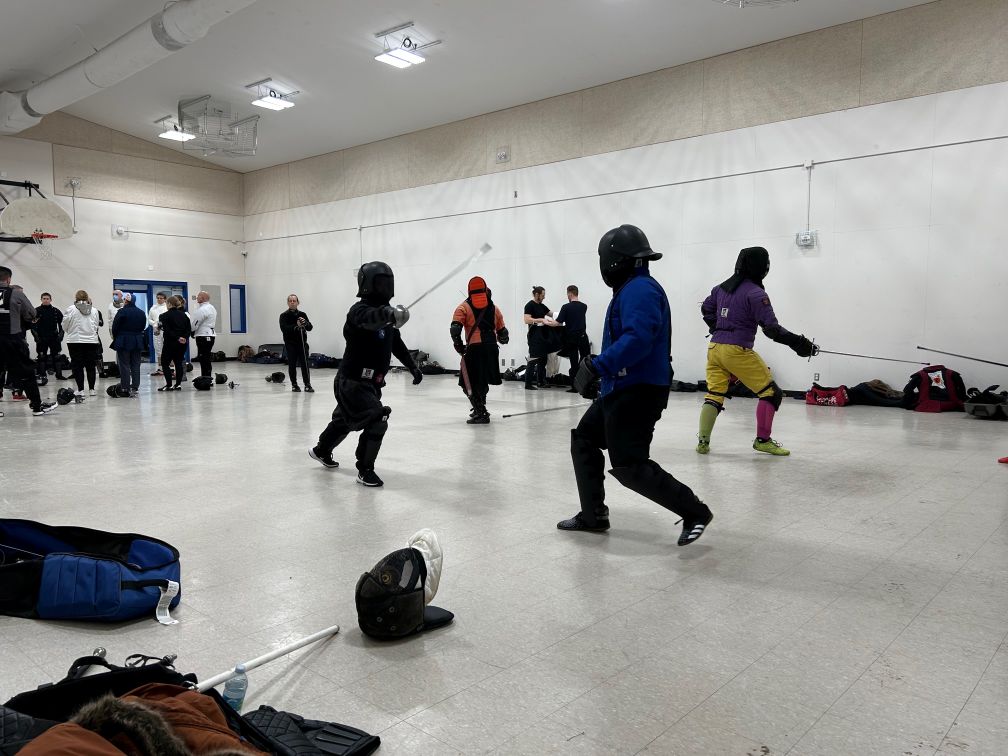
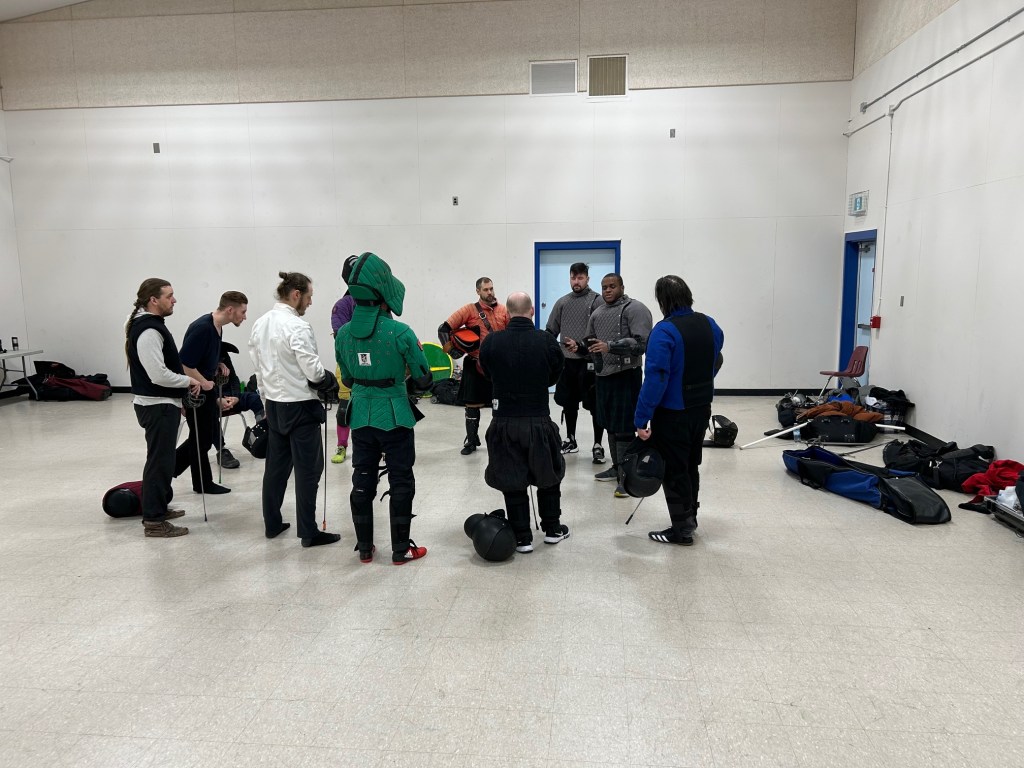
I had the great pleasure to visit old friends and make new ones a few weekends ago in Winnipeg, Canada, at the Historical Fencing Coaches Clinic sponsored by Storica Defensa. I’ve been to a fair number of coaching clinics, many Olympic, far fewer historical, but this one stood out, and no, not just because I am a Storica Defensa coach. This two-day event showed what is possible, and, perhaps a better path than typical in historical fencing.
In part, it was the mix of coaches, both in terms of experience and position, and in terms of background and focus. We had two masters from the excellent Sonoma Military Masters’ Program, David Coblentz and Eric Myers; we had Prevot Tim Guerinot from Texas; and we had two of our SD coaches, Xian Niles and myself, representing our organization. If I had any complaint it was that time demanded we have two classes run at once–I really wanted to take each one, start to finish. Even recovering from RSV and nursing a damaged Achilles’ tendon, which meant I wasn’t fencing, didn’t allow me enough time to devote to each class as they were running.
It’s all in the Details
Granularity. This was the leitmotif of the event. With many attempts in historical circles to improve fencing, from judging to technique, what’s missing is granularity, the specifics, all the step-by-step movement and thought behind all that we do. Much as it pains me to say it, this is often due to the fact that those teaching possess only a surface understanding of what it is they’re trying to teach. To the untrained eye, for example, a cut-1 in broadsword or a disengage in smallsword look simple enough, but to make either well and with consistent effectiveness demands deeper understanding, at least if one is facing an opponent better than oneself who will take one apart for the slightest mistake.
Despite the triumph of ignorance now prevailing in my nation (what sensible nation keen for equality dismantles the very agency designed to oversee that?), education and learning are difficult. The moronic maxim “those who can’t, teach,” underscores just how poorly people understand how difficult teaching is.
A lot of people can: but few can teach.
There is also great merit in incorporating different teaching and learning styles. Not everyone learns the same way, not everyone teaches a topic the same way. To have classically trained masters as well as people more on the coaching side only strengthens the approach, especially if well-organized.
The Classes
Space and reader patience doesn’t allow for a full description of the classes, but here are the topics:
SAT
9am
Maestro Eric Myers: “Better Fencing through using and Exploiting Fundamental Concepts of Fencing, Part 1.”
Coach Xian Niles: Strategos
11am
Maestro David Coblentz, “Setting up Students for Success”
Prevot Tim Guerinot, “Intention, Provocation, and Second Intention”
2pm
Coach Jim Emmons, “Text & Technique–From Description to Practice”
SUN
9am
Maestro Eric Myers: “Better Fencing through using and Exploiting Fundamental Concepts of Fencing, Part 2”
Prevot Tim Guerinot, “Intention, Provocation, and Second Intention, Part 2”
11am
Maestro David Coblentz, “Helping Students make Good Decisions”
Coach Xian Niles, “Am I still Doing the Thing?”
2pm
Coach Jim Emmons, “Concluding Remarks” [1]
The success of this year’s event has encouraged us to make this happen again, and if possible, often. We haven’t settled on a yearly or biannual schedule, but one way or another, the value of this type of meet-up was obvious in the marked-improvement in the attendees even over two days.

Why this Matters
Historical fencing is not so much a community as it is a collection of micro-communities, and so when it comes to any future forecasting there must be some qualification. I cannot speak to 99% of the community–I work with a small fraction of it. This said, for that sliver of the pie, I have some ideas for where it looks like we are headed.
SD, because it doesn’t seek ownership or control, will continue to reach out to recognized authorities for help in improving coaching and fencing. Many of these people may hold a master of arms, many will not. Expertise comes in different forms, and the ability to recognize that, and harness it, is what makes an organization like Storica Defensa both flexible and strong. Moreover, some fencers respond better to certain teaching styles, and since our goal is student and coach success, this means including any skilled fencer with sufficient depth and knowledge to assist us.
Not everyone cares about qualifications. Worse, many ascribe the wrong set of rubrics to what they call qualifications. Again, this is not just my sorrow and frustration over the anti-expert and anti-intellectualism so pervasive in the United States–it is painful and terrifying watching how this anti-expertise idiocy is helping destroy the nation we were and might yet have been to create a plutocrat’s playground.
It is also a known fact within “HEMA” that many favor things like “HEMA Ratings” or the over-confidence of play-acting scholars. They can do whatever they like, but few such people will get an invite to help us, because failure to understand the relative nature of tourney success and aping actual scholars only takes one so far, and, not as far as we wish to go.
This said, there is a LOT of talent in the wider community, but few truly effective means of harnessing it. Different foci, geographical distance, jealousy, arrogance, and even the innocent failure to understand that there is more to all this than one sees do much to prevent not only better unity, but also the sort of improvement we see in better developed branches of fencing, Olympic most of all. THIS is why my comrades to the north created Storica Defensa–we need it.
As a final word, but an important one, it is vital to note that SD is not a vanity project, certificate factory, or attempt to overthrow any other viable and worthy program. Over time, as people see the events we put on, as they see how we run tournaments, how we approach teaching; as they see how their coaching improves, how their students improve; as they see the caliber of fencer we ask for help, as they see the maestri and other experts we have asked to oversee and guide SD; all of these things will be the proof of that. [2]
There has been, sadly, considerable suspicion around what we are trying to do, and I’m happy to say none of it has any foundation. We’re literally doing what we say we are doing. It says a lot, and little of it positive, that such suspicion so naturally arose around an honest effort to make things better. In some cases, personal beef with one or more organizers, fear, and concern for turf explains these concerns, but I suspect a lot of it too is just curiosity poorly expressed.
I know I speak for all of SD’s organizers and coaches when I say this, but let me assure you that
- we are not trying to overturn your program or replace it
- we are not granting ourselves titles, authority, or certification
- we will not tell you how to run your club, curriculum, or what events to attend
We are, though, doing the following:
- working to improve coaching in historical fencing
- working to improve fencing in historical fencing
- working to create a viable, varied, and robust program to train coaches irrespective of any other program with which they may be involved
- working to build bridges internationally and within North America
NOTES:
[1] I had a class prepared for the afternoon slot on Sunday, but one part of teaching is reading a room. People were fried. At least one person, no kidding, was on a knee, head on their hand, looking like they needed a nap. There was also nothing in what I had planned to do that had not already been covered in depth by the other coaches.
So, I opted to scrap my class and sum up–this included a very brief reminder of how we can approach a given technique, in this case a beat attack, and build not only possibilities from it technique-wise, but also tactically. I could tell from peoples’ faces that they were a little confused that I had scrapped my class, but I lack sufficient vanity to put tired, mentally exhausted people through another in-depth class when what they really want to do is relax, free bout, or hit up our guest coaches for lessons. And, it turned out, that Javier, one of our attendees from Calgary, was celebrating his birthday that Sunday and wanted birthday bouts.
I never really know how well or poorly a class goes–few people offer a lot of feedback–but I stand by the decision.
[2] SD has approached and enlisted the help of several well-respected, certified experts to assist us as we grow. We have the honor to have the experience, knowledge, and guidance of:
Maestro Michael Knazko, Ars Dimicatoria/Barbasetti Military Sabre since 1895, Prague, Czechia, EU [Chief Advisor to SD]
Maestro Francesco Loda, PhD (x2), Cinecittà-RFA-UniTeramo, Rome, Italy, EU [Advisor]
Maitre Steve Symons, former President and CEO of the Canadian Fencing Federation (2004-2012), Winnipeg, Canada [Advisor]

 Capitale Escrime Historical Fencing