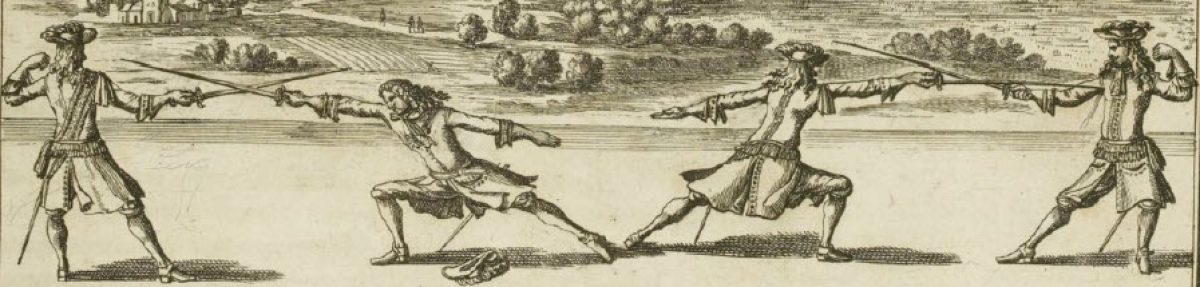

I have had less time to post thanks to a demanding day-job, but with the return of one of my advanced sabre students I had the joy to teach an individual lesson this morning. As so often happens when we have an hour, we drilled but also had time to explore the whys and hows of aspects of the drill in great detail. This student is a quick study–she is extremely intelligent, athletic, and possesses a solid background in foil, all of which mean she has questions. I like questions.
Coming up, no master I’ve studied under brooked questions during the lesson, but most of these lessons were short, 15 to 20 minutes, 30 depending on how many of us were in attendance. Questions were for after the lesson. My student this morning drives in from the city and we meet half-way–given the distance and the fact we only meet once a week the lessons are longer, usually an hour, and so there is time for discussion. I want to make it worth her while and provide her enough material to practice on her own.
We covered some difficult material this morning, Barbasetti’s counter-prime and counter-quinte (pp. 45-46), and since I am deep into study for my master’s exam, I have had more occasion to think about these in detail. The description of them is brief as they assume the reader either has a working knowledge of them, is studying to become a master, or is working with a coach as well as reading the text. [1]
To dive straight into these useful but rarely covered techniques, even for an advanced student, is unwise. It is better to lead up to them, to show one’s math as it were, and so our warm-up consisted of exploring simple parry-ripostes in each line. Next, we examined two of the circular parries, “counter-parries” in Barbasetti, namely counters of tierce and quarte. We had not covered these for a while, so it was good drill. Once we added movement, things changed, and this afforded me a chance to introduce counter-quinte and counter-prime.
The Master’s words explain them better than I can:

The key aspects to note at the start are first that one employs these measures at close distance, often while while still in the lunge. Second, they work best advancing, which means a recovery forward into guard as one executes the counter. As I explained to my student, these two measures are sort of in between static, simple parries, and parries via molinello. They are, however, “active” parries, more cuts into the riposte than blocks.
My student asked me why we would use circular parries or these two counters. Excellent questions. Again, the master has an answer, but one I might expand upon a bit. Barbasetti wrote
But why not employ simple parries, since the counter-parries offer so many difficulties?
The object of these two parries is to put you in an advantageous position for the defense by means of unexpected movements.
The regular study of these parries trains your mechanism to such an extent that all complicated movements afterward seem easy to perform. [p. 46]
These are important considerations. Maestro Couturier made a similar point, as did his assistant Brian Peña, when I asked about some seriously complicated drills they had us do, ones with multiple feints, change beats, everything. It was, as I now say too, “medicine for the hand,” meaning that drilling complicated actions helps sharpen simpler ones. When I asked Brian when I would use this set of actions, he said “Oh, you wouldn’t; that isn’t why we do this type of drill.” Looking back on it, that was a key moment for me in my development as a fencer, one of those times were I realized just how much more to fencing there is than technique or actions.
It is the same here. Barbasetti also remarks that these counter parries improve our simple ones. He adds, however, that they can be “unexpected movements,” which is to say options when simple parries aren’t working and/or tactical choices. For example, if my opponent feints to my inside line and I parry quarte initiating their disengage, the simplest response is to return to tierce. Let’s say I do that twice during a bout. My opponent, if I’m lucky, believes that this is my response–if I have made that action on purpose to set them up (a species of second intention), I will surprise them when the third time I used the counter-parry of quarte.
It was a good lesson, one that generated considerable discussion about the actions themselves, but also and significantly putting them to work in real time. One of our primary goals is not to be hit at all versus considerations of right-of-way, so exploring how to make counter-parry-ripostes and use counter-prime or quinte and avoid being hit made for specific choices in terms of both the line the riposte would take as well as considerations of footwork. Though we do not read about it much in the Radaellian corpus, traverse steps, off-line footwork is implicit in the system. Sure, the intagliata and inquartata were and are standard subjects in Italian fencing, but there are options akin to them we can employ too. [2]
Much of what we covered today is material I’ve taught countless times at this point, but what stood out to me, and the reason for writing this post, is how much better the lesson went today because of my current study. At least as early as Fiore dei Liberi (fl. 1400) masters have advocated adding the study of treatises in one’s training, and today reminded me of the value in doing so. Because I teach historical fencing, I most often work from texts, but my study of Barbasetti is, in many ways, closer because I have to be able to answer, best I can, anything my masters in Prague ask me. [3]
Continuing education, study, is not just for exams. It’s something we should do all the time, forever, as long as we fence and teach. One of today’s lessons, for me, was to take this same granularity of study and apply it each week. This means spending more time pondering, examining, and experimenting with the ideas, techniques, and actions in all that I am teaching, from sabre to smallsword, from rapier to bayonet. Doing this, taking it all apart and examining it before putting it back together, increases understanding and lends depth to our approach. It will make us better coaches, and, better fencers.
NOTES:
[1] Barbasetti, The Art of the Sabre and Epee, 1936, xvii explains that his book is a guide for preparing masters, for masters whose training may have been incomplete, and for fencers who wish to understand better what they’re learning.
[2] Often-line footwork, such as traverse steps, is a commonplace in works on Insular broadsword, but I’d argue that the same footwork is useful for sabre. In the video series I am putting together on Master Barbasetti’s sabre methodology, I will explore examples.
[3] We have not yet set a date, by my mentor at Barbasetti Military Sabre (since 1895), Maestro Michael Kňažko, as well as his colleagues Masters Leonid Křížek, Michal Kostka, and Josef Šolc possess deep knowledge and decades upon decades of experience, and the nature of a master’s exam, both the written or oral exam as well as the practical one, are open to anything they should choose. It is a daunting, and at times I’ll admit it terrifying, experience, but one I look forward to. Pass or fail it will be valuable and I shall learn a lot and become a better coach. Should I pass (there are no guarantees with such exams), in truth the journey really only begins. I look at it the same way my elder son’s TKD master put it to him when he passed his black belt exam–“Now you’re ready to start learning.”

 Capitale Escrime Historical Fencing