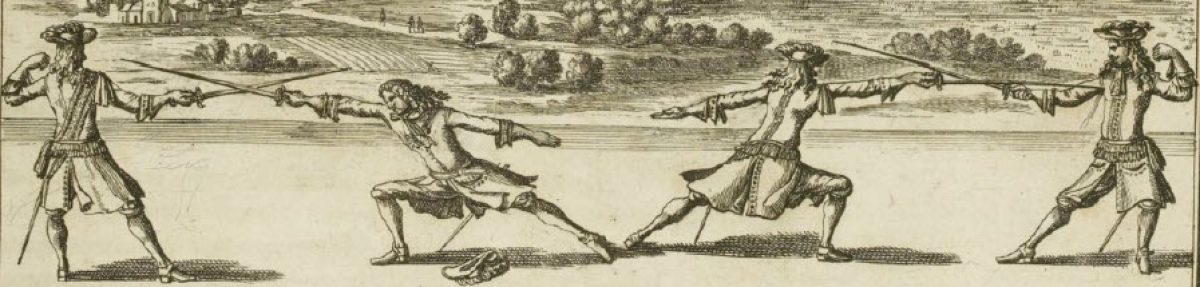
A major benefit of study and review is the pleasure of reacquainting oneself with ideas and practices that one knows, maybe even relies on all the time, but which one less often articulates or thinks of the way a text might explain them. I should rather have titled this post anatomies of the lesson as in fencing there are actually a variety of lesson types. This is a topic I’ve covered in various ways before, but it’s one worth revisiting and/or tackling from different angles.
In my case, accidents of the environment in which I teach have led me to extend the duration of the usual lesson, and when I’m prepping for a more typical length of time, I’m sometimes painfully reminded of this fact. Living in a relatively rural area, a lot of my students drive in from the city or other areas, often 45 minutes to an hour away, and given the time, expense, and hassle of travel (highways here can be pretty jammed), the usual 15-20 minute, maybe 30 one often gets from a coach at a salle seems disproportionately short for the effort. I normally teach in hour blocks, but this means stretching out the 15-20 minute lesson rather than cramming the hour full of material. It means more time for drill, to explore specific actions and ideas, and, time to discuss what we’re doing.
An hour lesson is not normal, least, not in most settings. Every master with whom I’ve studied expected (if they did not outright demand) silence during the lesson. If they asked a question, one responded, otherwise one remained quiet and focused. The single greatest reason for this was time—they have a lot of students to work with and little time for lengthy discussions. Some of them, happily, are happy to talk about things or answer questions out of a lesson. Before this sounds extremely old-fashioned and doctrinaire, it might help to remember that most masters or their provosts giving lessons are giving multiple, even many lessons, and often within a short window of time. Even at those salles that are open all day, a coach may teach dozens of lessons, at all levels, and they need breaks.
In addition to time and numbers, another reason that lessons tend to be short is retention of material—people can only take in so much information. Fencing is as mental as it is physical, it’s a complex of thought, action, and expression in space, which can vary in tempo, speed, and distance. It’s a lot. To add too much to a lesson is to make the lesson worthless. Thus, one reason for different types of lessons.
Types of Lesson
Warm up: these are often mechanical, and maybe most often used before competition. It’s a way of warming up the fencer. Simple attacks, parry-riposte, counterattacks, maybe even actions they tend to favor might be the topic.
Teaching: this type introduces new actions or ideas, or, helps the fencer perfect something that needs work.
Options: in this version, one uses actions the fencer knows, but in different situations. The coach may initiate action, but the student might too. Sometimes both will depending on the topic. There are many things one can vary to explore the material—one can vary timing, distance, speed, type of footwork, initial action, final reactions, etc.
Bouting: these lessons tend to be used more with intermediate to advanced students, though there are ways to modify them for the less experienced depending on what it is one is covering. [1] Often, the coach will make some action a few times, and give the student opportunities to respond appropriately. There are a variety of ways to do this:
- Blocked Exercises (what I refer to as “Coach as Pell”)
- Blocked Exercises with a Simple Reaction
- Choice Repetition (more like an Options Lesson)
- Surprise or Switching Actions
- Foreseen vs. Unforeseen
- Coach or Student Initiated
What type of lesson we employ depends on the student’s level of training, the weapon they are studying, and something often left out of the mix, that student’s natural inclinations and strengths.
The demands on the coach are, to be honest, significant. This is one reason that there are traditionally three coaching levels. A moniteur d’escrime, for example, often teaches fundamentals of technique and footwork. In the US, much of the training for a moniteur centers around coaches who teach at small community clubs or school programs—most often these are coaches introducing students to fencing and giving them a solid grounding in technique and tactics. A Prévôt or Provost, is similar to a master, but is a coach who focuses mostly on training fencers rather than coaches. A Maitre d’armes or Maestro di Scherma in Italian, is normally a coach with long experience and able to teach not only fencers of all levels, but importantly, coaches as well. What they do will depend largely on the size and purpose of their program and where they teach.
Not all levels of coach will teach all types of lessons. It tends to be compartmentalized. Why people fence, and the degree to which they dive in, determines a lot about their coaching. For me, I have some dedicated students who want to learn all they can, but I also have some for whom fencing is just one of many hobbies. Some work with me for years, others for a few weeks. [2] I do my best to help each meet their goals, whatever they are, and I’m also lucky to work within a network of other coaches who can further the study of my own students. Locally, there are several historical clubs as well as Olympic clubs, to which I sometimes direct students. [3] I also work with two international organizations: I represent and teach the curriculum of my home salle, Barbasetti Military Sabre (since 1895), based in Prague, Czechia, and I have the honor to work with three masters, two in Canada, one in the US, who head Storica Defensa. [4]
What Lesson When?
I teach in two formats—classes and individual lessons. Both are challenging and while there is overlap, the differences shape each one. For individual lessons, which not all my students take, the first might be an assessment lesson or a teaching lesson. The former we use to gauge the level of a person with previous experience. It varies—some fenced ten or twenty years ago, but remember a lot; some are active competitors now. What we end up covering moving forward is largely built on the conclusions reached in that initial lesson. In the latter, a teaching lesson, it either starts from scratch or from the next logical step in an experienced fencer’s progress. It takes considerable training and experience to assess any of this with accuracy.
Once a fencer has command of the fundamentals, so once they can move comfortably, have decent blade handling, and a good grasp of the basic tactics to date, we start to explore new and more advanced material. These lessons might be teaching or option lessons; sometimes it’s a mix of both. It is not often I give warm up lessons, but I do when assisting fencers at events. Bouting Lessons, on the other hand, I use quite frequently with my advanced students. Over time, it should look and feel like a bout might in the salle or in competition. This lesson style in particular requires an ability to calibrate not only what one throws at a student or responds to, but how, in what tempo, speed, at what distance, and with a thought for any follow-up action if applicable.
Adapting Formats
How does one take one of these lesson types and expand it for an hour? Well, first, if you don’t have to do that, don’t. It’s better to stick to shorter lessons if at all possible. However, if like me, it’s the fairest option for a long-distance student, then pacing is everything. I literally stretch out the normal format.
In the first ten minutes or so, we warm up—this includes stretching, footwork, and some basic actions such as parry-riposte, simple attacks, disengagements, maybe stop-cuts or thrusts.
Next, we spend 15-20 minutes on the topic of the lesson. It can be tempting to try to cover a lot in an hour, but don’t—keep it simple. Find an action, technique, and/or tactic to focus on and a few permutations following from that basic topic. For example, maybe the topic is attacks by coulé or filo, by graze. Depending on the student, I might demonstrate it first, then have them do it. That might be all we do. If they have covered it before, we add to it. First, we switch roles—if I have them attack using it first, I then have them defend themselves against it. Second, and again, dependent on level, we build from there, maybe add a feint after the initial graze, then a disengagement. We then reverse roles again—a student needs to know how to defend as well as use an attack, and in covering both their understanding deepens.
For my advanced students, the next portion of a lesson usually follows whatever we explore in a teaching or options format; the purpose of it is to allow them a chance to work on and perfect what we covered in real time and depending on level, in as real a fashion as possible. [5] Using the previous example, we would bout and explore using the graze in real time. Initially, especially with someone new to it, I set them up to make it—this may be very obvious, but it helps train them to see what it is they are looking for, and, when to use it. Next I might make it a bit more difficult, or, vary the set up. I may remove the set up, in which case they might try to create an opportunity to use the action, or, decide on a different approach. My job is to help them learn how to do that. In this style of lesson, the coach must act not only as a teacher, but a fencer capable of presenting any potential skill level the fencer may face.
We end with a cool down, normally for sabre either stop-cut/parry-riposte or arrests, or, parry-riposte.
There is ample opportunity for students to ask questions, to explain aspects of what we’re covering, and make corrections. It is vital to make it safe for students so that they’re comfortable asking questions—with an hour, we have time. In a class or shorter lesson I will announce that I’m happy to chat in more detail once we’re through with things. Explanations must be clear, germane to the topic, and constructive. Corrections, the topic for another time, should be given compassionately, without emotion, and focus on the issue. It is never okay to disparage or strike a student, practices not uncommon when I was coming up. It’s unnecessary and unhelpful—our job as coach is to build them up, not tear them down.
In historical fencing, many more experienced students may dabble in other weapons, though this is as true in the sport. [6] When this is the case, and if the coach actually knows the other weapon, comparisons across them can be helpful in explanation, even correction. Some of my smallsword students study rapier too, and so when applicable we may cover how something is handled in each case. Ditto sabre and broadsword, Radaellian or contre-pointe. The caveat here is the coach truly having the familiarity and depth within different weapons to make those comparisons constructively. “HEMA” is full of people who think they know more than they do, and so students must be particularly wary. It goes beyond the purpose of this post, but I have met a lot of students coming from schools where the coach acted as if, maybe even believed they knew a subject, but clearly did not. One advantage to being source-based is fact-checking is relatively easy, assuming one reads, and, reads widely. This is all the more true when one knows credible coaches that teach weapons one does not. When I have students interested in longsword, I send them to the coaches I know that are worth their time—I’ve dabbled in longsword, and could teach the very basics, but beyond that it would be irresponsible. It is far easier to send them to my colleagues, and, better for them.
Use What Works
Not all students need all lesson types. That’s okay. It’s best to find out what they want, then tailor things to help them get what they seek. One of the tasks I’ve enjoyed most the last few years is helping other instructors learn how to use these lesson formats. As a student myself, it helps me too, because like any coach I can always improve and will always need practice. If I’m lucky, and live to be the same age as some of the masters under whom I studied, maybe I’ll provide lessons as fluidly and expertly as they did. For now, each lesson is study for me as well as the student, and that seems fitting to me.
NOTES:
[1] With newer students, a “bouting lesson” may consist only of repeating the same simple action, both as attacker and responding as defender, but in real time as appropriate. Every drill, to the degree possible and in alignment with that student’s skill level, should emulate the conditions of an actual bout best it can.
[2] Turn-over in fencing can be high, especially if one teaches children, and this is normal. Not everyone ends up loving it, and that’s okay. We do our best to represent the Art and make it fun, and hopefully, to project the values that accompany its study. We do not all agree about those values, but if the Art teaches us anything, it is that it belongs to all.
[3] I teach historical fencing, but have students that either wish to study Olympic or already do. So long as their coaches are good, great—do both! It will only make them better fencers. This said, for beginners it’s best to stick to one track, get it down well enough, and then study the other. Far less confusing and better chances of success.
[4] For Barbasetti Military Sabre (Since 1895), see https://www.ars-dimicatoria.cz/en/barbasetti-military-sabre-since-1895-2/ ; for Storica Defensa, the facebook page is the best source of information at this time.
[5] Outside of some very basic mechanical drills, I am not a fan of any drill too divorced from the requirements of an actual bout. Drills, ideally, however simple or complicated, should be snapshots of the actions and exchanges fencers actually make.
[6] It has always varied really, but there are many “three-weapon fencers” in the Olympic sphere. There are also some specialists. Changes in competition over the last thirty years have trended towards specialization, but it is not the rule.

 Capitale Escrime Historical Fencing