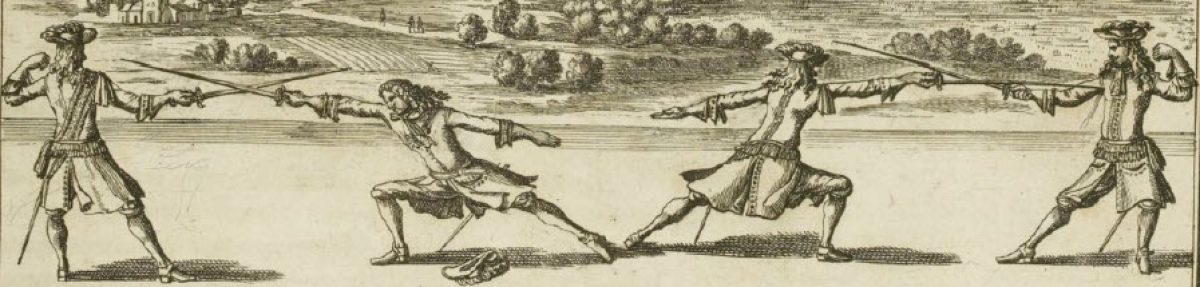
Liancour’s 1686 Le Maitre d’Armes presents a plate with five figures, each of which illustrates core principles of his approach. So far as I am aware, no one to date has pointed out that the descriptions and images for figures four and five are reversed. It is a minor point, perhaps, but important when reconstructing Liancour’s method. Historical fencers rely heavily on text and plates (when the latter are present), but in this case they may be confused and juxtapose these two core actions.
Author: Jim Emmons
Vis enim vincitur Arte.
Ft. Ligonier/Carlisle, PA, Pt. II
While there were a number of Carlisle, PA, adventures with my friend and host, Patrick Bratton, among them were a few with other coaches and some of his students. As another example and proof for the value of cross-fertilization in fencing, I’d like to talk about the morning I spent watching a fantastic lesson by an Olympic coach, the excellent Tony Alvarez.
Excellence in Coaching: Tony Alvarez
I’ve known about Tony since the Pandemic–he worked with Patrick online in the epee class with Maitre Robert Handelman we all took–but this was the first time I had met him in person. Knowing my background, or at least my current focus, he was quick to remind me that the lesson sample I was about to watch was modern. While I cannot say I enjoy modern sabre, I do recognize that there is much to learn there despite the problems, if for no other reason than smart fencing coaches like Tony adapt well.
I’ll not lie–I have been quick to criticize modern sabre, and I likely still will, but this said I gained a new vantage point on it thanks to Tony and Patrick this past Monday morning, and I’m grateful for that. First, and to honor Tony’s skill, he showed very few actions, but actions used in different measures and tempi, in different set-ups.
He started with actions in the box, between the two en garde lines, then outside the box. Watching Patrick and Tony, both of whom know what they’re doing, made it seem as if very little had changed since the days of my early training save in one respect: speed. The modern game relies on speed in a way that one could mitigate more easily before the end of proper edge-alignment in sabre. There simply is not time to make some actions, most especially ripostes, in every instance.
Everything is a distance game played at the right time and correct speed. Here’s the pinch–that has always been true. What differs is method and tool. A lighter, fast weapon that can score with any part of the blade demands tighter timing. This is one reason the age of competitors has dropped so significantly in the past three decades.
I learned A LOT watching Tony teach, and his advice for working with children–the majority of his clientele–is invaluable.
Quick Studies-A Radaellian Lesson with one of Patrick’s Students, “J.”
One of the things I most looked forward to was working with Patrick’s folks. One student, a young high-schooler, wanted a sabre lesson and the last day at the fort we were able to have a short one. Important things to note: this young man started fencing last August; he is a big man, but super quick and flexible (day one in Justin’s Besnard class he dropped effortlessly into a de la Touche lunge…).
I gave him a very traditional outline, but with Radaellian elements, meaning we started with some point in line/disengage work, then some parry/riposte to warm up. Then, I took him through two set-ups with feints. Finally, as a cool down, we did a stop-cut/parry-riposte drill. He made all of it look easy.
I have adult students who struggle with some of these set-ups, but J. looked like he had been doing these drills for years. Even in the cool-down he opted to use an arrest half the time, an action that takes considerable point-control and timing. I was so impressed and told him so.
J. is as good as he is because he has a great coach, and, because J. is motivated, keen to fence, and found the right place to learn. I have written a lot about the importance of the universals in teaching, of starting with and honing fundamental actions, and J. is proof of how sound an approach that is. Moreover, J., and Patrick’s other students, are working within a mixed community, diverse in many senses but also in the sense of fencing styles and influences. It shows.
Why is this important? It’s important because it reveals another layer of diversity within Patrick’s club–put simply, his students are getting tools for their toolbox not only from different stores, but different lines of work. In the U.S. now there are people keen to erase diversity and downplay its importance. They do this out of fear and ignorance, for there is no science, reason, or morality behind any of their claims.
A diverse club is a healthy club, one guaranteed to push people and help them grow, and not just in terms of their ability to lunge or parry well. Exposure to people different from us, in large ways and small, reveals that they are people like us, just fellow humans trying to make their way through life.
Diversity fosters strength–it is harder to accept the idiocy of race-politics, for example, when one spends a lot of time with different “races” etc. and therefore knows what politician A or pundit B says is complete horseshit.
Working in Pennsylvania, and in an area rather “red” as it were, what Patrick has achieved at Sala della Spada is remarkable. Under his roof you will find not only the usual notions of diversity, but also political diversity. Now, like many of us, politics is not a topic there is time for in a salle, so they focus on fencing, but everyone in the club knows that they are working with people who see the world differently in key ways and work together nonetheless. In this there is hope. It is hard to remain divided when we spend with people ostensibly on the “other side” from us. We find our common humanity, we find common ground. If nothing else, we all love to fence.
Ft. Ligonier French Fencing Weekend
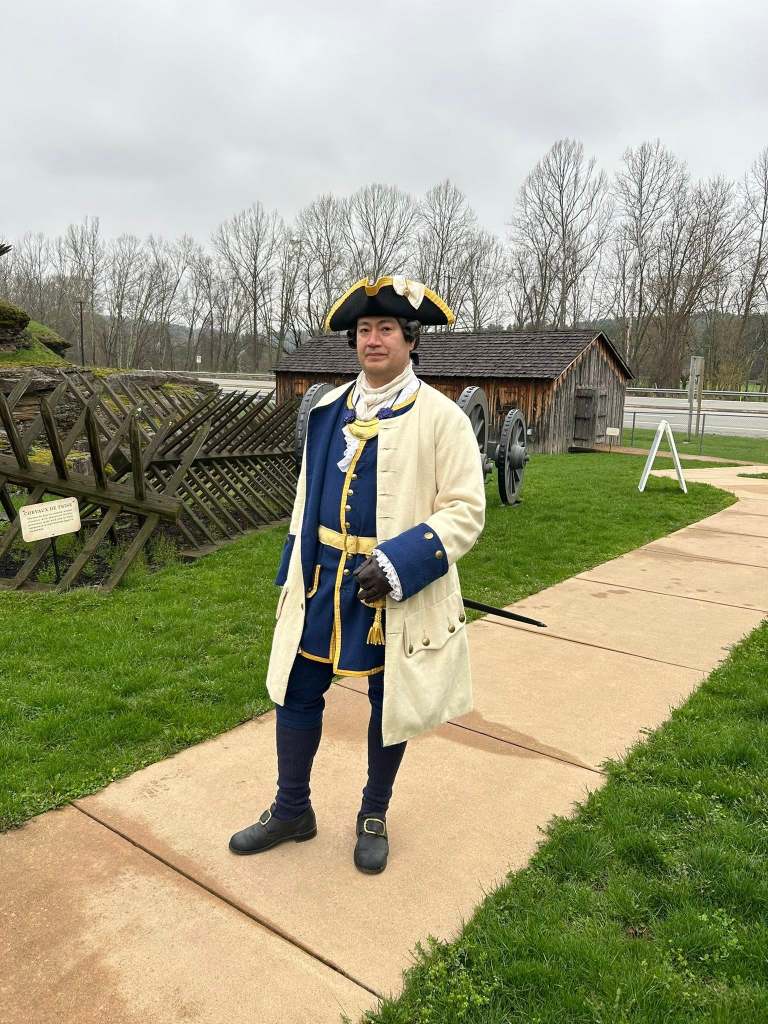
I’ve been meaning to write something up since I returned late Tuesday, but between work and an unexpected veterinarian adventure, I’ve not had time to do this event justice. It was, in a word, amazing, and so much so that I truly hope it becomes a regular event. Patrick Bratton and team put on one hell of a seminar–it was not just the classes, though those were great, but that the setting was apropos and unique, we had behind-the-scenes access to some of the museum, and ample chances to eat, laugh, and get to know one another. Yes, we also fenced, or many did–it was all I could do not to break my doctor’s orders and jump in, but for once I was a grown-up about it (and appropriately as bitter as a toddler told “no”).
By most definitions, I don’t think people would consider me particularly “lucky,” but when it comes to finding myself at truly impressive, informative, and fun events, I’m as rich as Croesus. To the list of favorites–SabreSlash, The St. George’s Day Exhibition of Arms, Rose and Thorns Historical Fencing Symposium–I can now add a fourth, Patrick’s French Fencing weekend. One reason, beyond the obvious draw of all things hoplological or fencing-related, is that it combined three branches of the community: historical, Olympic, and reenactment. The benefits of such cross-over should be obvious, but may not be, so to illustrate this I cite the example of a fascinating chap, Matthew Schlicksup, an artisan of historical footwear currently working at Ft. Ticonderoga in New York.
Historical Artisans
Matthew makes historical footwear, among other period items, and is a master craftsman. Trained in Williamsburg, Virginia, he has made shoes, attended events, and conducted research that most of us might not think about, and, despite the fact we all wear shoes. We take them for granted. Ft. Ligonier, however, has the world’s largest collection of period shoes thanks to the accident of 18th century castoffs and the powers of anaerobic preservation. An archaeologist in initial training, Matthew brings science to his craft, and with impressive results.

This weekend he shared, and wore, his version of the fencing shoes or sandals depicted in de la Touche’s seminal treatise, Le vrays principes de l’espée seule (1670). So, here we are at an historical fencing seminar with a man who makes shoes from the period for that very purpose. This may not seem important, but it is. A few years ago I spent considerable time researching the development of the lunge and this included a look at footwear–would that I had known Matthew then! In discussion with him about de la Touche’s sandal, I learned so much more than I might have, not only about construction, but also about how such shoes function. Put simply, this was a window into period fencing via a single often unconsidered artifact.
Museum
Our host at Ft. Ligonier, Matthew Tristan, was accommodating, supportive, and generous with his time. It was he who gave us the behind-the-scenes tour. It says a lot that he and the foundation were open to having us there: a busy historical site and nuts with swords sounds like an insurance adjustor’s nightmare. With Patrick and others in period dress, and quick to chat with visitors, it went well and we hope added something to the experience. When trusted with the safety of the site and its guests, one wants to do all one can to make it go well, and under Patrick’s excellent leadership this was not even in question. With all the discussion of clubs losing insurance because of unsafe and/or stupid activities, with some unfortunate high-profile legal cases, a win like this is easy to dismiss. We shouldn’t–this was a success and a sign that things can be done correctly.
Classes
In terms of classes, I participated as much as I was able–stupid injury maintenance–but was super keen to see what Justin Aucoin did with the work of Charles Besnard, one of my favorite masters. Justin has long experience with fencing and the SCA, and runs a seriously fantastic class. People loved his classes. I loved his classes. He taught one on Besnard and a second on the bâton à deux bouts or French double-spear in Pascha. I had been looking forward to meeting Justin for some time–Patrick spoke highly of him, I liked what I saw in his videos, and he is a die-hard fan of Dumas and The Three Musketeers, that last fact which immediately endeared him to me.

Justin combines deep knowledge with obvious skill and a passion for his topic. It’s infectuous. Moreover, he works with a diverse student population–always a good sign–and so was quick to suggest work-arounds and ideas to make each thing he covered work for different folks. If he is teaching anything near you or you have the chance to travel to work with him, do.
Bridge-Building
I tend to gravitate towards and work with other folks interested in bridge-building. It’s not just the strengths that collaborative work brings, but the sort of people that go in for it. Among these, I have worked most often outside my immediate surroundings with Patrick. He is, quite honestly, a model coach and advocate for what we do. As a trained teacher (he’s a professor at a college in Pennsylvania), researcher, fencer, and man of eclectic and fascinating interests, from vintage fashion to hunting lore, Patrick perhaps more easily combines disparate strings together to make a viable tapestry.
The historical reenactment group he is involved in, a detachment of mid-18th century French marines, has worked at Ft. Lignonier, among others, before, and it was an ideal location for a look at several late 17th century fencing masters. Some students were in costume, some not, but the addition of period appearance added a lot. Having good relations with the museum staff meant not only a chance to hold the seminar on site, but also see parts of the museum most people do not see. The historian and former archaeologist in me was seriously thrilled about that, but I wasn’t alone.
The only other event that I have attended that combined all these elements so successfully was my mentor Master Michael Knazko and company’s SabreSlash–we had fencers from all walks, reenactors from Krakow (17th Polish hussars), and tours of various sites within Prague relating to fencing (among other historical subjects). In both cases the camaraderie was the finest.
A Model for Future Events
Until recently, until this latest trip actually, I had planned some invitational tournaments. Now, while there may be a tournament element, I am planning to put together something closer to what Patrick and Maestro Knazko have done. It’s a good mix–class for those who like it, some history and other activities (we ate well for example), and some fencing or lessons. It is my hope that Patrick makes this event a regular one–we’ll be lucky if he does.

Continuous Education is for Everyone

I have had less time to post thanks to a demanding day-job, but with the return of one of my advanced sabre students I had the joy to teach an individual lesson this morning. As so often happens when we have an hour, we drilled but also had time to explore the whys and hows of aspects of the drill in great detail. This student is a quick study–she is extremely intelligent, athletic, and possesses a solid background in foil, all of which mean she has questions. I like questions.
Coming up, no master I’ve studied under brooked questions during the lesson, but most of these lessons were short, 15 to 20 minutes, 30 depending on how many of us were in attendance. Questions were for after the lesson. My student this morning drives in from the city and we meet half-way–given the distance and the fact we only meet once a week the lessons are longer, usually an hour, and so there is time for discussion. I want to make it worth her while and provide her enough material to practice on her own.
We covered some difficult material this morning, Barbasetti’s counter-prime and counter-quinte (pp. 45-46), and since I am deep into study for my master’s exam, I have had more occasion to think about these in detail. The description of them is brief as they assume the reader either has a working knowledge of them, is studying to become a master, or is working with a coach as well as reading the text. [1]
To dive straight into these useful but rarely covered techniques, even for an advanced student, is unwise. It is better to lead up to them, to show one’s math as it were, and so our warm-up consisted of exploring simple parry-ripostes in each line. Next, we examined two of the circular parries, “counter-parries” in Barbasetti, namely counters of tierce and quarte. We had not covered these for a while, so it was good drill. Once we added movement, things changed, and this afforded me a chance to introduce counter-quinte and counter-prime.
The Master’s words explain them better than I can:

The key aspects to note at the start are first that one employs these measures at close distance, often while while still in the lunge. Second, they work best advancing, which means a recovery forward into guard as one executes the counter. As I explained to my student, these two measures are sort of in between static, simple parries, and parries via molinello. They are, however, “active” parries, more cuts into the riposte than blocks.
My student asked me why we would use circular parries or these two counters. Excellent questions. Again, the master has an answer, but one I might expand upon a bit. Barbasetti wrote
But why not employ simple parries, since the counter-parries offer so many difficulties?
The object of these two parries is to put you in an advantageous position for the defense by means of unexpected movements.
The regular study of these parries trains your mechanism to such an extent that all complicated movements afterward seem easy to perform. [p. 46]
These are important considerations. Maestro Couturier made a similar point, as did his assistant Brian Peña, when I asked about some seriously complicated drills they had us do, ones with multiple feints, change beats, everything. It was, as I now say too, “medicine for the hand,” meaning that drilling complicated actions helps sharpen simpler ones. When I asked Brian when I would use this set of actions, he said “Oh, you wouldn’t; that isn’t why we do this type of drill.” Looking back on it, that was a key moment for me in my development as a fencer, one of those times were I realized just how much more to fencing there is than technique or actions.
It is the same here. Barbasetti also remarks that these counter parries improve our simple ones. He adds, however, that they can be “unexpected movements,” which is to say options when simple parries aren’t working and/or tactical choices. For example, if my opponent feints to my inside line and I parry quarte initiating their disengage, the simplest response is to return to tierce. Let’s say I do that twice during a bout. My opponent, if I’m lucky, believes that this is my response–if I have made that action on purpose to set them up (a species of second intention), I will surprise them when the third time I used the counter-parry of quarte.
It was a good lesson, one that generated considerable discussion about the actions themselves, but also and significantly putting them to work in real time. One of our primary goals is not to be hit at all versus considerations of right-of-way, so exploring how to make counter-parry-ripostes and use counter-prime or quinte and avoid being hit made for specific choices in terms of both the line the riposte would take as well as considerations of footwork. Though we do not read about it much in the Radaellian corpus, traverse steps, off-line footwork is implicit in the system. Sure, the intagliata and inquartata were and are standard subjects in Italian fencing, but there are options akin to them we can employ too. [2]
Much of what we covered today is material I’ve taught countless times at this point, but what stood out to me, and the reason for writing this post, is how much better the lesson went today because of my current study. At least as early as Fiore dei Liberi (fl. 1400) masters have advocated adding the study of treatises in one’s training, and today reminded me of the value in doing so. Because I teach historical fencing, I most often work from texts, but my study of Barbasetti is, in many ways, closer because I have to be able to answer, best I can, anything my masters in Prague ask me. [3]
Continuing education, study, is not just for exams. It’s something we should do all the time, forever, as long as we fence and teach. One of today’s lessons, for me, was to take this same granularity of study and apply it each week. This means spending more time pondering, examining, and experimenting with the ideas, techniques, and actions in all that I am teaching, from sabre to smallsword, from rapier to bayonet. Doing this, taking it all apart and examining it before putting it back together, increases understanding and lends depth to our approach. It will make us better coaches, and, better fencers.
NOTES:
[1] Barbasetti, The Art of the Sabre and Epee, 1936, xvii explains that his book is a guide for preparing masters, for masters whose training may have been incomplete, and for fencers who wish to understand better what they’re learning.
[2] Often-line footwork, such as traverse steps, is a commonplace in works on Insular broadsword, but I’d argue that the same footwork is useful for sabre. In the video series I am putting together on Master Barbasetti’s sabre methodology, I will explore examples.
[3] We have not yet set a date, by my mentor at Barbasetti Military Sabre (since 1895), Maestro Michael Kňažko, as well as his colleagues Masters Leonid Křížek, Michal Kostka, and Josef Šolc possess deep knowledge and decades upon decades of experience, and the nature of a master’s exam, both the written or oral exam as well as the practical one, are open to anything they should choose. It is a daunting, and at times I’ll admit it terrifying, experience, but one I look forward to. Pass or fail it will be valuable and I shall learn a lot and become a better coach. Should I pass (there are no guarantees with such exams), in truth the journey really only begins. I look at it the same way my elder son’s TKD master put it to him when he passed his black belt exam–“Now you’re ready to start learning.”
Historical Fencing Coaches Clinic–Post-Event Thoughts
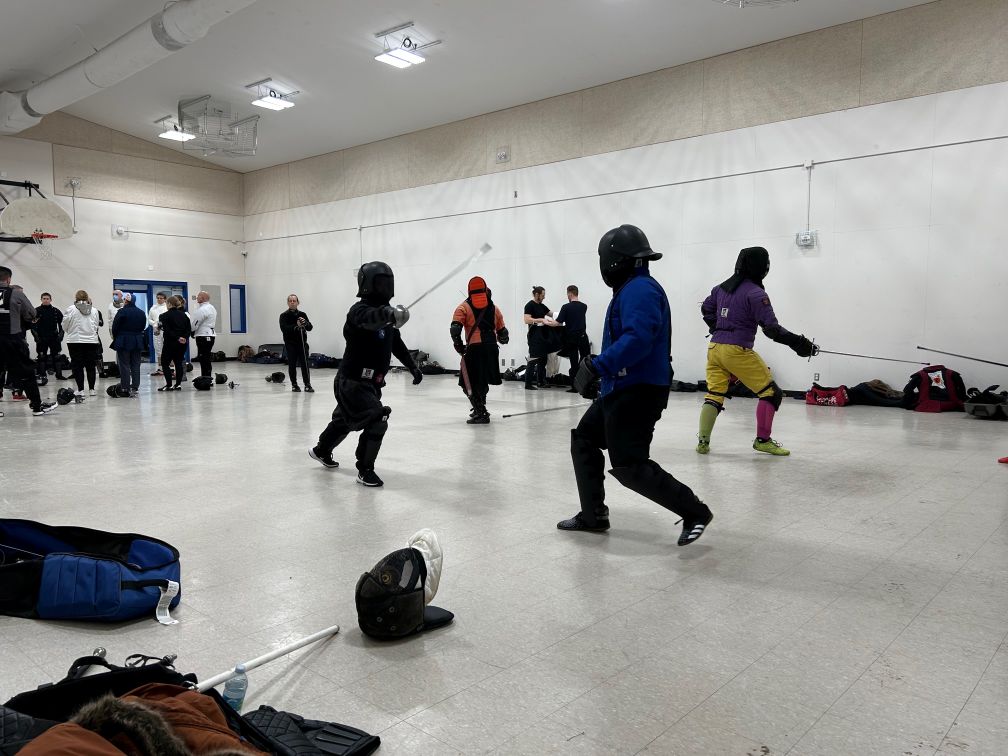
I had the great pleasure to visit old friends and make new ones a few weekends ago in Winnipeg, Canada, at the Historical Fencing Coaches Clinic sponsored by Storica Defensa. I’ve been to a fair number of coaching clinics, many Olympic, far fewer historical, but this one stood out, and no, not just because I am a Storica Defensa coach. This two-day event showed what is possible, and, perhaps a better path than typical in historical fencing.
In part, it was the mix of coaches, both in terms of experience and position, and in terms of background and focus. We had two masters from the excellent Sonoma Military Masters’ Program, David Coblentz and Eric Myers; we had Prevot Tim Guerinot from Texas; and we had two of our SD coaches, Xian Niles and myself, representing our organization. If I had any complaint it was that time demanded we have two classes run at once–I really wanted to take each one, start to finish. Even recovering from RSV and nursing a damaged Achilles’ tendon, which meant I wasn’t fencing, didn’t allow me enough time to devote to each class as they were running.
It’s all in the Details
Granularity. This was the leitmotif of the event. With many attempts in historical circles to improve fencing, from judging to technique, what’s missing is granularity, the specifics, all the step-by-step movement and thought behind all that we do. Much as it pains me to say it, this is often due to the fact that those teaching possess only a surface understanding of what it is they’re trying to teach. To the untrained eye, for example, a cut-1 in broadsword or a disengage in smallsword look simple enough, but to make either well and with consistent effectiveness demands deeper understanding, at least if one is facing an opponent better than oneself who will take one apart for the slightest mistake.
Despite the triumph of ignorance now prevailing in my nation (what sensible nation keen for equality dismantles the very agency designed to oversee that?), education and learning are difficult. The moronic maxim “those who can’t, teach,” underscores just how poorly people understand how difficult teaching is.
A lot of people can: but few can teach.
There is also great merit in incorporating different teaching and learning styles. Not everyone learns the same way, not everyone teaches a topic the same way. To have classically trained masters as well as people more on the coaching side only strengthens the approach, especially if well-organized.
The Classes
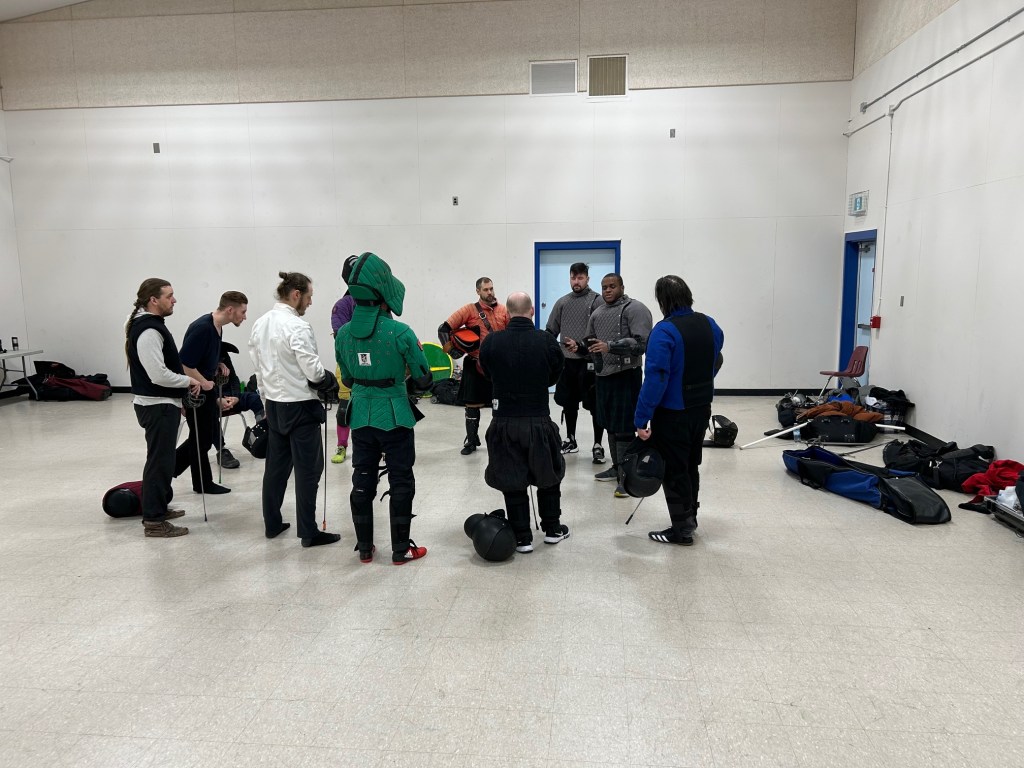
Space and reader patience doesn’t allow for a full description of the classes, but here are the topics:
SAT
9am
Maestro Eric Myers: “Better Fencing through using and Exploiting Fundamental Concepts of Fencing, Part 1.”
Coach Xian Niles: Strategos
11am
Maestro David Coblentz, “Setting up Students for Success”
Prevot Tim Guerinot, “Intention, Provocation, and Second Intention”
2pm
Coach Jim Emmons, “Text & Technique–From Description to Practice”
SUN
9am
Maestro Eric Myers: “Better Fencing through using and Exploiting Fundamental Concepts of Fencing, Part 2”
Prevot Tim Guerinot, “Intention, Provocation, and Second Intention, Part 2”
11am
Maestro David Coblentz, “Helping Students make Good Decisions”
Coach Xian Niles, “Am I still Doing the Thing?”
2pm
Coach Jim Emmons, “Concluding Remarks” [1]
The success of this year’s event has encouraged us to make this happen again, and if possible, often. We haven’t settled on a yearly or biannual schedule, but one way or another, the value of this type of meet-up was obvious in the marked-improvement in the attendees even over two days.

Why this Matters
Historical fencing is not so much a community as it is a collection of micro-communities, and so when it comes to any future forecasting there must be some qualification. I cannot speak to 99% of the community–I work with a small fraction of it. This said, for that sliver of the pie, I have some ideas for where it looks like we are headed.
SD, because it doesn’t seek ownership or control, will continue to reach out to recognized authorities for help in improving coaching and fencing. Many of these people may hold a master of arms, many will not. Expertise comes in different forms, and the ability to recognize that, and harness it, is what makes an organization like Storica Defensa both flexible and strong. Moreover, some fencers respond better to certain teaching styles, and since our goal is student and coach success, this means including any skilled fencer with sufficient depth and knowledge to assist us.
Not everyone cares about qualifications. Worse, many ascribe the wrong set of rubrics to what they call qualifications. Again, this is not just my sorrow and frustration over the anti-expert and anti-intellectualism so pervasive in the United States–it is painful and terrifying watching how this anti-expertise idiocy is helping destroy the nation we were and might yet have been to create a plutocrat’s playground.
It is also a known fact within “HEMA” that many favor things like “HEMA Ratings” or the over-confidence of play-acting scholars. They can do whatever they like, but few such people will get an invite to help us, because failure to understand the relative nature of tourney success and aping actual scholars only takes one so far, and, not as far as we wish to go.
This said, there is a LOT of talent in the wider community, but few truly effective means of harnessing it. Different foci, geographical distance, jealousy, arrogance, and even the innocent failure to understand that there is more to all this than one sees do much to prevent not only better unity, but also the sort of improvement we see in better developed branches of fencing, Olympic most of all. THIS is why my comrades to the north created Storica Defensa–we need it.
As a final word, but an important one, it is vital to note that SD is not a vanity project, certificate factory, or attempt to overthrow any other viable and worthy program. Over time, as people see the events we put on, as they see how we run tournaments, how we approach teaching; as they see how their coaching improves, how their students improve; as they see the caliber of fencer we ask for help, as they see the maestri and other experts we have asked to oversee and guide SD; all of these things will be the proof of that. [2]
There has been, sadly, considerable suspicion around what we are trying to do, and I’m happy to say none of it has any foundation. We’re literally doing what we say we are doing. It says a lot, and little of it positive, that such suspicion so naturally arose around an honest effort to make things better. In some cases, personal beef with one or more organizers, fear, and concern for turf explains these concerns, but I suspect a lot of it too is just curiosity poorly expressed.
I know I speak for all of SD’s organizers and coaches when I say this, but let me assure you that
- we are not trying to overturn your program or replace it
- we are not granting ourselves titles, authority, or certification
- we will not tell you how to run your club, curriculum, or what events to attend
We are, though, doing the following:
- working to improve coaching in historical fencing
- working to improve fencing in historical fencing
- working to create a viable, varied, and robust program to train coaches irrespective of any other program with which they may be involved
- working to build bridges internationally and within North America
NOTES:
[1] I had a class prepared for the afternoon slot on Sunday, but one part of teaching is reading a room. People were fried. At least one person, no kidding, was on a knee, head on their hand, looking like they needed a nap. There was also nothing in what I had planned to do that had not already been covered in depth by the other coaches.
So, I opted to scrap my class and sum up–this included a very brief reminder of how we can approach a given technique, in this case a beat attack, and build not only possibilities from it technique-wise, but also tactically. I could tell from peoples’ faces that they were a little confused that I had scrapped my class, but I lack sufficient vanity to put tired, mentally exhausted people through another in-depth class when what they really want to do is relax, free bout, or hit up our guest coaches for lessons. And, it turned out, that Javier, one of our attendees from Calgary, was celebrating his birthday that Sunday and wanted birthday bouts.
I never really know how well or poorly a class goes–few people offer a lot of feedback–but I stand by the decision.
[2] SD has approached and enlisted the help of several well-respected, certified experts to assist us as we grow. We have the honor to have the experience, knowledge, and guidance of:
Maestro Michael Knazko, Ars Dimicatoria/Barbasetti Military Sabre since 1895, Prague, Czechia, EU [Chief Advisor to SD]
Maestro Francesco Loda, PhD (x2), Cinecittà-RFA-UniTeramo, Rome, Italy, EU [Advisor]
Maitre Steve Symons, former President and CEO of the Canadian Fencing Federation (2004-2012), Winnipeg, Canada [Advisor]
Review: Alessando Senese, _The True Use of the Sword_ 1660
[21 Feb. 2025]
Senese, Alessando. The True Use of the Sword. Bologna, IT: Herede di Vittorio Benacci, 1660. Translated by Christoper A. Holzman, 2025, Lulu Press.
Though a fencing text long-dismissed as poorer than most (Iacopo Gelli referred to it as “a work of limited fencing value”), Senese’s True Use of the Sword, despite its flaws, nonetheless contains considerable value. Not only does it contain some useful insights into the Art, but it also contains contemporary concerns that resonate today within the historical fencing community. Beyond this, while the True Use of the Sword will frustrate readers keen for detailed explanations of individual techniques or actions, it is surprisingly insightful with regard to combat psychology and preparedness, as well as some of the deeper truths that arise after long study of the Art.
I had the pleasure to assist Christopher Holzman with the Latin portions of this translation, and came to understand his doubts about it in the process. [n] Most of the works that Chris has translated into English, to date, have been stand-out treatments in one way or another. Marcelli, Rosaroll & Grisetti, and Del Frate are major works within the Italian fencing tradition; even less significant works, such as Terracusa e Ventua’s True Neapolitan Fencing is important for what it reveals about the survival of the Neapolitan system, and, as one of the only Italian works on fencing from the 18th century.
Senese’s text, in contrast, is a curious book. As with his previous work, Chris does his best to stay as close as one can to the original phrasing and vocabulary, a particularly daunting task when the original author was not, to put it mildly, a great writer. If anything, Chris has improved the readability of the original, an impressive feat given the sometimes-convoluted modes of expression Senese favored. Footnotes, courtesy of Chris, will help explain some of the terms and clarify some of the denser explanations the author offered.
Organization
The book is organized around Senese’s chief tenets for fencing. There is considerable front-matter, mostly dedicatory, and much of it in Latin. Senese informs the reader in a short epilogue that a friend provided the florid Latin encomia to Charles Ferdinand, Archduke of Further Austria (d. 1662) and the Latin summary in the last part of the book. The initial dedication appears in Latin and Italian, but is followed by an ode, an epigram, and a distichon, all in Latin.
For students of history and early modern literature, the inclusion of the seven liberal arts to frame the ode will be unsurprising, but the ways in which Senese (or his friend) link each one to aspects of fencing is perhaps novel. The epigram is rich in classical imagery and in a way echoes the use of the liberal arts in the ode, though here the author enumerates his specific concepts of fencing and their value.
A note to the reader follows and in it Senese explains his position:
The art of using the sword for the defense of one’s body is the true art; not that which is commonly practiced in the schools and taught by the professors, let alone those particular blows that I read from the writers; but for that which the most famous swords of my country already practiced, and for those precepts that I offer to you to read in this present work.
The true art is that which offers a determined end to be infallibly obtained with the exact observance of its precepts.
The letter to the reader informs what follows in his rules; it is the why to his how, as it were, and beyond that gives at least one master’s view of his contemporaries. Fencing treatises were often resumes of a sort, and naturally Senese ‘s poor opinion of the efforts of all other masters was meant to push himself forward, but at the same time some of what he says was also true. This is not to say that one could make oneself unbeatable or invincible, nice as that would be, but that there were issues within many schools that led their students to losses, even death, when it mattered. Senese was hardly alone in such complaints.
The first few chapters define terms and provide key explanations of his ideas. Chapter 2, for example, explores what Senese calls “the long game,” what we would today call working from critical distance versus fighting in distance. The next chapter takes up “weight,” what we would call “guard” or the guard position today. Like many 17th, even 18th century works, Senese wanted the weight on the rear leg (cf. Besnard, Marcelli, Girard, etc.). Measure and its navigation, motion and movement, line, perspective, finding the sword, and what he calls “the indivisible tempo” follow.
His chapters on the “true wound” and “true parries” reveal a far more conservative approach to defense than that of many of his contemporaries. It is not that other masters failed to take this perspective, but that they less consciously call out the issues and problems around them. This perspective is one of the chief attractions to The True Use of the Sword: it is less a book on fencing than it is a book on how to approach actual fighting with a sword.
Chapter 11, on the feints, is likely to excite the simple-minded and kindle useless debate and discussion in some circles of historical fencing, but nothing he says there is untoward. Readers who stop at the first line, however, will miss the point. The feint, to be effective, must appear to be a credible threat and not, as he remarks, motions that are basically probing actions. A proper feint forces the opponent to parry. Cuts, the subject of Chapter 12, will read a bit differently from some masters, too. In Senese’s view, cuts are used in two instances: as a riposte or as an attack. An obvious point, but one he makes as a way to attack those who use cuts poorly. The example he gives, a feint to the face to draw the parry, and then a cut to the torso or leg, illustrates his meaning. Here, as in most places, Senese reminds us that measure, timing, etc. must be correct as well.
Of particular interest is his chapter (Chapter 13) on the use of the sword alone against someone using sword and dagger. Much of what Senese says here provides a window into the thinking that typifies “transitional rapier” and ultimately, smallsword. For Senese, if one relies on a dagger for defense, one is handicapped. In this he is not wrong, but he was not alone in stating this either. Marcelli, among others, covered the sword alone first for a reason. In Senese what we see is a 17th century master attacking common problems of the day—this is important, because we have a tendency to think fencers were “better” in the past, that masters were as effective at fighting as they were in teaching, and in putting forth their own views it can be easy to miss the reality. Then as now some were better teachers, more effective fighters, than others.
Chapter 14 provides a brief summary of his key tenets; chapter 15 the key faults in poor fencers.
The remaining portions of the book, the first on “the necessary and infallible rules of the proper handling of the sword” and the second on “a figure explaining the theory of a would to the opponent’s left,” were written in Latin. The rules, via fourteen individual sections, repeat, again, the principles by which Senese teaches the Art. The explanation of the figure is rough reading, but will prove useful for the patient reader who takes the time to explore it in space.
Significance
Unlike most works of the time, Senese does not include detailed descriptions of technique or list a multitude of various actions. He states, then repeats, a set of guidelines that should inform how one uses the repertoire of fencing. By analogy, Senese is more akin to Zbigniew Czajkowski’s Understanding Fencing than he is Gaugler’s Science of Fencing. For example, Senese states that anyone who wishes to teach the sword professionally must be able to “operate respectively in four cases:” in courteous bouts for amusement and as exhibition; effectively in bouts where they demonstrate their superior skill against strangers; in actual fights where harm or death are possible; and in those cases where the teacher is out in the world in difficult terrain. The reason is that
In each of these four cases, the person must have meditated and prepared what he must do, because he has to operate differently in each of the aforementioned ways, since it takes more than knowing how to put oneself in beautiful perspective on guard and performing a pretty thrust to the target, however, the perceived opinion of the common people against the professors is now wonder.
The True Use of the Sword contains many such asides that highlight different cultural attitudes. For another example, Senese is quick to call out those untutored but nonetheless teaching, a problem that resonates all the more now:
they remain blind and learn all that can be learned in six months, which has nothing to do with the perfect science that is learned with effort and not in months but in years. So, sparing the effort, they also spare the science…
Therefore, take it as the most certain vanity every time that someone will be persuaded to want to teach this profession in a short time, or rather, some particular blows, because he will really teach being killed by some hasty, bestial ignoramus.
In like vein, Senese laments the common incidence of the incontro, or double, in bouts and duels of his time. Today’s historical fencers—for sometimes different reasons—wrestle with the same problem. One explanation as valid then as now is that
many fencers with a singular and artful game who, having arrived so that they are at a certain mark, stop themselves there as if no more remains for them to learn and in the occasions they remain either confused or doubtful and they always have questions to ask according to the diversity of encounters, a sign that they lack the true rule that resolves all the questions and hinders all the vanity.
Tourney-“HEMA,” for example, is rife with fencers rushing to measure and doubling; some even game doubling just as their Olympic cousins do. All of this is to say that Senese demonstrates that nothing is new and that the problems we see now are merely the same issues in different costume.
This text, however, is not without practical advice for given situations. Sense, wisely, recommends that the “most secure” wound is one that follows a parry. He reminds us that in seeking another’s blade we should only do so when it is out straight before us. Read together with other fencing treatises of the time is perhaps the best way to read Senese. At the very least, having read him, a fencer will read Giganti, Pallavicini, and Marcelli with a better grasp of the larger picture informing their respective approaches.
Do not read Senese for technique—this will be a disappointment. Read Senese first for the view it gives one of 17th century fencing culture. Second, read Senese for the sound tactical advice he shares, advice that in this reviewer’s opinion would do much to improve historical fencing today. His defensive mindset, his abhorrence of the double, and his wisdom in advocating that one does best who fences as if the swords where “white” (i.e. sharp) rather than “black” (practice weapons) is as sound now as it was in 1660.
[n] My close friend and colleague, Dr. Antone Minard (Simon Fraser University & UBC), and I had the pleasure to manage the Latin portions.
In Memoriam
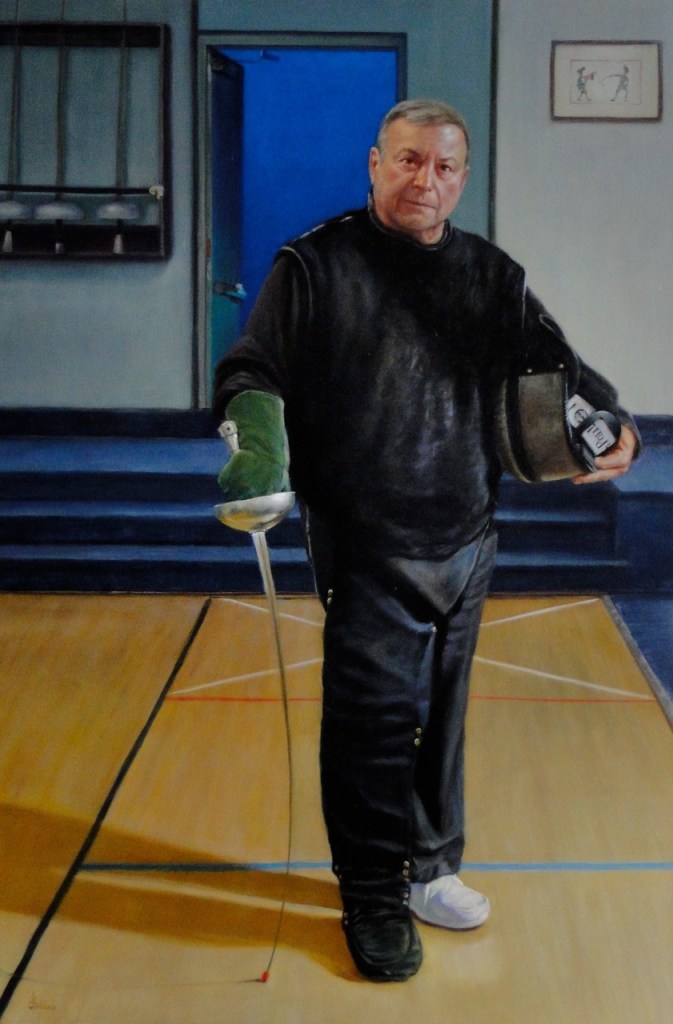
I learned today that the first master with whom I worked, Edwin “Buzz Hurst, passed away last month at the age of 84. My good friend Patrick Bratton (Sala della Spada, Carlisle, Pennsylvania, USA) shared the USFA’s fb page about it:
Before working with Buzz, I had studied foil with a gentleman in the DC area, one who split time between Olympic Fencing, SCA, and work. Working with Maestro Hurst was far more regimented, and true to his navy roots, more like working with a drill sergeant than a coach. He was somewhat notorious for berating fencers he didn’t think were trying hard enough, smacking them across the mask, and often expressing his opinions about one’s ability and/or ancestry. Having grown up in a military family, I didn’t take any of it to heart, so was better able to focus on the lesson, but I will say it was often as funny as it was mean. Some favorites:
“You move like a bovine.”
“Look, grow a pair, and hit that guy. My grandmother could hit him.”
“What’s your major?” [Buzz would often try to use our study track for analogies]
“Archaeology.”
“Damn. Uh… do you know boxing?”
“Yes sir.”
“Okay, we’ll go with that.”
I learned a lot from Buzz–he provided me a solid foundation upon which Al Couturier and his assistants, and later Delmar Calvert, constructed more of a building (one still very much in the process of being built).
Buzz had some fantastic stories. One of my favorites was about a collegiate bout he was in while at the Naval Academy in Annapolis, Maryland. One of his opponents, no kidding, was Neil Diamond, the pop star. In this particular tournament Buzz lost to Neil and it still bothered him. I heard this story in 1991 or 1992, and if I recall correctly he concluded with “Can’t believe I lost to the Jazz Singer.” Funny chap.
Rest in Peace Buzz, and thanks
*Being a club team, we couldn’t easily afford a coach of Buzz’s caliber, and so I think by 1994 he was in San Diego. He didn’t say much about it, least not that I have heard or read, but he was the first coach to get our team to first place, something a club team had not been able to do in at least 25 years.

Challenge, Growth, & the Line Drawn in the Sand
It’s not a lack of fencing-related topics that has prevented me from writing more on this page, but the sorrow, anger, and consequent insecurity of watching one’s country take a bad turn that has occupied me. I’ve never been one to say “it can’t happen here,” because having taught history for so long I knew that tyranny can happen anywhere. Yes, even here. One might think that narcissists greedy for power and attention might give more thought to their legacy, but if the Nuremberg trials proved anything it’s that many such people go to the gallows still convinced their choices were correct. Evidence, reason, decency, these have no effect on such people.
Montesquieu wrote
“In our days we receive three different or contrary educations; namely, of our parents, of our masters, and of the world. What we learn in the latter effaces all the ideas of the former,”
and I have found this to be, in many ways, true. [n] Experience, especially disappointment, failure, and hardship work effectively against false positions, assumptions, and prejudice, at least if one is open enough to admit when one is wrong. My own partnership with these challenges has made me a different person than I was when I was younger. Contrary to form, as I’ve aged, I’ve grown more tolerant, less quick to judge, and more open-minded because having lived in the world, and having seen a bit of it, I know few things are as black and white or easy as we might wish to think. This is an approach to thing I take to everything and that includes my work as a fencing coach.
For the patient, what follows explains why my club values what it does today, and, why I think I think it’s important. If you don’t feel like a “long” read, then stop here, go to the “About Us” page, and scroll down to the various icons at the very bottom of the page and you will see where what follows leads.
Moments of Intense Clarity
Many of the people we meet in our lives become teachers in one fashion or another. One of the more important such people in my life was a female friend I first met at church in high school. One winter evening, between college semesters, we had a conversation about tolerance, equality, and Christian notions of morality. This friend, I should say, is extremely intelligent, but more than that she had a deep sense of justice and compassion. Though we have not stayed in touch much, I know her career as an academic took off, as it should have, and that she is doing good in the world.
As embarrassing as it is to admit, at that time, in my early 20s, I had a traditional view of certain things. With homosexuality, for example, the bible had some lines that it was a no-no, and I didn’t think about it beyond that. However, because I did my best to embrace the Second Great Commandment of the NT, I did not persecute, avoid, or mistreat anyone. “Tolerance,” to me then, was just that–I might find something “wrong,” but it wasn’t my place to judge it. My friend, however, pointed out that I was, in fact, judging them, and worse, I had not examined why. “It’s in the bible” is not an argument. Thanks to her I grew a little that night.
We debated back and forth a bit, but even then I knew she was right. IF the deity we believe in is all good, all knowing, all powerful, then it’s beyond our ability to comprehend save through metaphor. It’s a thing we can understand poetically, not scientifically. Does it make sense that this being would be so concerned with sexual preference? This idea of god as a middle-aged white male golf club president is not only simple, but insulting to that being.
Moreover, the admonitions against homosexuality are in OT law books, the same books that say we shouldn’t eat shellfish or be near mensurating women. The NT had two main commands, ones importantly upon which all the others hang, namely to love god and treat other people the way we wish to be treated. In truth, I can’t think of anything Jesus could have ordered people to do that is harder than these two things, the first because we cannot sense it or experience it in the way we do literally everything else, and the second, because people are sometimes complete bastards.
My friend, let’s call her JK, opened my eyes to hypocrisy I wasn’t even aware I suffered. The initial discomfort of being wrong was brief, and then the real work began: how do I interact with others in a way that abides the Golden Rule, really abides it? Love. Compassion. Empathy. These are the things that allow us to see others as fellow travelers, our fellow humans, each of us bumbling along just trying to make it all work. It means finding the common thing we all share and honoring it. We are all fragile, imperfect, and deeply flawed, and, we’re beautiful because of it.
I have been fortunate to travel, to live outside my own culture, and to spend sufficient time with others to know, without a doubt, that I do not know everything, and, that my way isn’t the only way or necessarily the best. It is hard to hate people once you know them, and this is one reason it is vital to leave a place of comfort and do the hard work. I have mixed so often with people who are a different color from me, who worship differently than me, who think in languages different than mine, who love differently than I do, that the differences–while there and a part of who they are–are less important than one, single, all important fact: they’re people too. We are, in the end, the same, bags of water that turn to dust.
More than once on this page I have talked about inclusion, equality, and doing our part to do right by others. Now, perhaps more than before, this is important–it is certainly more important than teaching them how best to make a counter-beat or 1-2 feint. Many of my students will fence for a while, then go on to other things, but if I’ve done my work well, the real work, they will remember the environment in which they learned how to lunge or use contre-temps.
Unfortunately, my nation stands at a line in the sand, a point of definition. Will we be complicit in evil, or, will we fight it? The efforts to remove DEI measures, for example, are not about focusing on merit, but erasing certain people in symbolic, official ways–it is the first step to removing them… permanently. The parallels between the USA in 2025 and Germany in the late 1930s are many, and some are worth a close look: fascists then and fascists now both targeted people they deemed “undesirables” at first to exclude them, then to eradicate them. It was not just Jews, but queer folk, gypsies, the mentally and physically challenged, and, intellectuals and teachers. Fascists are enemies of humanity–the only acceptable people in their eyes are themselves, regardless of how unscientific, ahistorical, and nonsensical that is. It is fantasy and really really bad fantasy at that.
“Silence in the face of evil is itself evil: God will not hold us guiltless.
Not to speak is to speak.
Not to act is to act.”
― Dietrich Bonhoeffer
This nation began as a democratic experiment, and there is a lot we got wrong, but representative democracy wasn’t one of those mistakes. Likewise, as a nation of immigrants–if you are not First Nations then sorry Skippy, you’re either an immigrant or the descendant of immigrants–the old notion of a a melting pot, a pluralist state where people regardless of background, faith, color, etc. could live their lives, where equality, the rule of law, the separation of powers, and the freedom to speak, think, and worship as they like allowed disparate people to unite around these common values was a noble ambition. We achieved it at times, and utterly failed at others, something our current plight places in high relief.
My club will remain open to people of good heart. I don’t care what color you are, what language you first spoke or speak at home; I don’t care what your sex or gender is; I don’t care how you love or who; I don’t care what religion you practice or if you practice none at all; I don’t care if you’re first generation or if you’re the fifth. You’re a person, a fellow human, my brothers and sisters, my sword family. The only people I do not welcome, and will actively repel, are bigots. But even they, should they examine their prejudice honestly, should they compare what they think they know against what has been demonstrated over and over again by science and history, should they find that they are just a person like everyone else, they’d be welcome too.
Notes:
[n] Charles Louis de Secondat, Baron de Montesquieu, The Complete Works of M. de Montesquieu (London: T. Evans, 1777), 4 vols. Vol. 1.. Bk 4, Ch. 4.
Wait, I thought you were a Sabreur?

Social media may herald in the end of the world as effectively as it has poisoned politics, but it’s fantastic where fencing is concerned. A recent post on smallsword garnered questions about what it is, exactly, that I do–am I a foilist? A sabreur? Both? Something else?
The simple answer is “yes,” all of the above, but we focus on different things at different times. There can be many reasons for this. To the person’s first question, yes, I am still a sabre fencer, though more coach than anything else at this point. My main source is Luigi Barbasetti’s _The Art of the Sabre and Epee_ (1899/1936), not only because it is the text I’ve come back to time and again since the 1990s, but also and especially because his work formed the foundation for the school in which I am a student, Barbasetti Military Sabre since 1985, headquartered in Prague, Czechia.

Between some injury maintenance and a brutal schedule in my day job, Barbasetti’s approach has, as ever, proved solid and rewarding. Nearly all my students use s2000 Olympic blades, though several use historical trainers (two have Swordsmithy’s, two those by other makes, but all hovering around 650-700g). The system is such I could use sticks.
I am not taking new students for sabre, that is true, but mostly due to time constraints–I am unable to teach as often as I was and the larger the class, the less effective the instruction. I make exceptions for visitors and for the few people who seek me out from out of town, but otherwise my focus has been on related projects, teaching, and working on some international efforts to improve both coaching and fencing.
As ever, I’m happy to answer questions, so please feel free to do so–as I did here, I’ll do my best to answer promptly and succinctly.
Early & Later Smallsword Treatises: A Note
[originally posted 30 July 2023 on the old CEHF site]
It’s customary to discuss particular weapons in somewhat monolithic terms. We speak of “foil,” “smallsword,” “sabre,” or “longsword,” to name a few, as if these constitute a tidy, discrete facet of sword-types. In some ways, this is true: sabre is different from spear, longsword from smallsword. However, as convenient as compartmentalization is, despite how necessary it is to organize a topic as gigantic as swordplay, we can easily forget that within each division there exists both variety and change over time.

For smallsword, a cursory glance at earlier and later texts will reveal some critical differences. There is overlap to be sure, but the differences are important. Even among texts of the same general time one should compare them. De La Touche’s seminal work from 1670, Les vrays principes de l’espée/The True Principles of the Sword, for example, reads differently from de Liancour’s Le Maistre d’armes/The Fencing Master (1686), but both read very differently from Sir William Hope’s The Scots Fencing Master (1687) and A New Short and Easy Method of Fencing (1707).

The works of Sir William Hope, Zachary Wylde, and Donald McBane tend to read as primitive, unsophisticated works to many fencers with more traditional training. It’s easy to see why. These works contain fewer actions, seemingly odd things like weapon-seizures and guards other than tierce/sixth, and are often less well-written. Compared to the succinct descriptions in Le Sieur P.J.F. Girard’s Traité des armes (1740) or Domenico Angelo’s L’École des armes/The School of Fencing (1763/1787) one might conclude–erroneously–that these later works are “better” than those which preceded them.
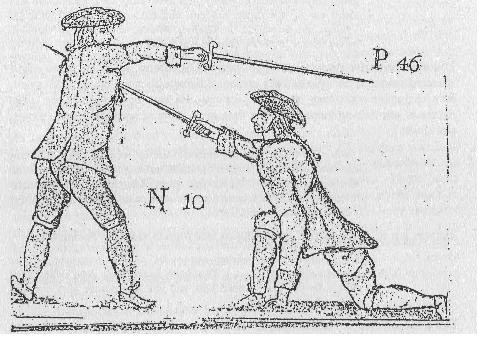
The answer is context. The earlier works reflect a different set of concerns. These are largely works of self-defense first and foremost. While Girard and Angelo also offer solid advice for the duelist, they also reflect a different culture, one in which smallsword was already transforming into the game of foil (originally a training tool for smallsword), that is, a polite game where beautiful execution and grace were often as or more important than actual combat effectiveness.

It behooves any student to study earlier and later works, because together they provide a far more complete examination of how smallswords were used. This is easier to do without bias: to apply the filter of late 19th/early 20th foil to 17th and 18th century foil jaundices our view and can lead us to the wrong conclusions.
 Capitale Escrime Historical Fencing