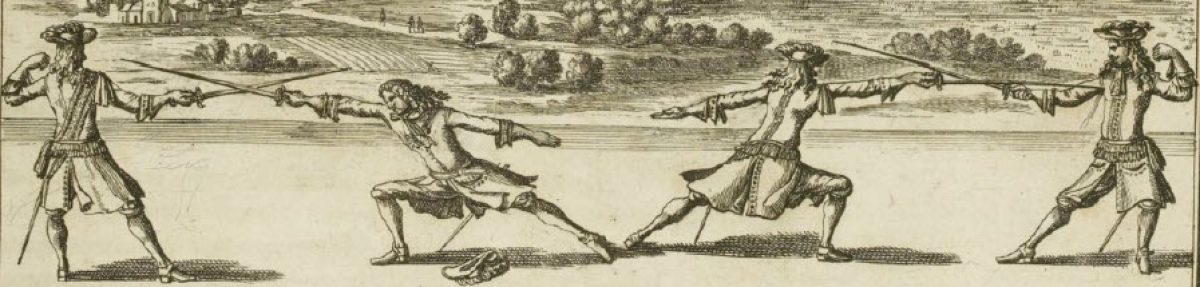
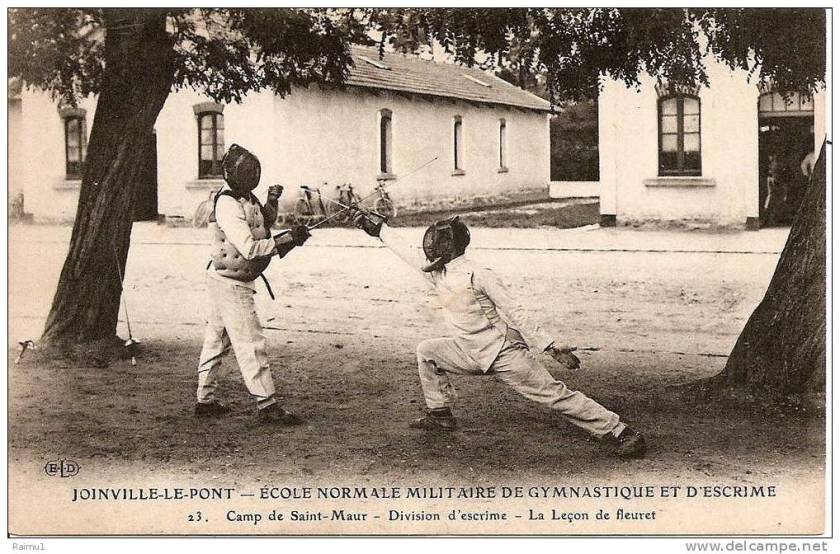
Coaches use a variety of types of footwork and positioning when teaching. Watch a typical Olympic lesson and you will notice quickly that the coach isn’t necessarily on guard, but more often than not standing. Rather than advancing and retreating they are walking. The reason for this is obvious, or should be, but a lot of people new to coaching do as they were taught and use the same footwork they do when fencing. That isn’t wrong, and in fact, most coaches will drop into those positions when necessary too, but they rarely stay in stance the entire time. The reason is that it’s fatiguing, especially over the course of the day.
If one is teaching a single solo-lesson, then walking steps and a more upright posture are less critical, but even there it can be helpful. If one is teaching multiple students in a day, then sparing one’s body is all the more important. Fencing is all about repetitive motion, and over time, especially over decades, some of that motion takes a toll. We can reduce wear and tear, as well as fatigue, if we take a few steps to make it easier on ourselves when we teach.
Walking Steps
I’m starting with walking as it can be the hardest to adopt, but also because most other changes follow naturally from it. Yes, walking. It was hard for me initially to walk rather than advance and retreat, not because I struggle with it physically, but because I wasn’t sure just when I should use it. For warm-ups and cool-downs walking is more natural, so start there—if you begin with wrist picks/arrests, stop-cut parry/riposte, disengage and thrust, etc., these are good times for the coach to walk versus adopt a proper guard.
In some drills one may walk as well—context is a good guide. If one is demonstrating aspects of the lunge, then it makes sense to adopt a proper guard, use appropriate footwork, and lunge as one does. This said, the coach in most other cases can substitute walking for all of this—for the lunge, we might just walk a bit faster.
Surface & Terrain
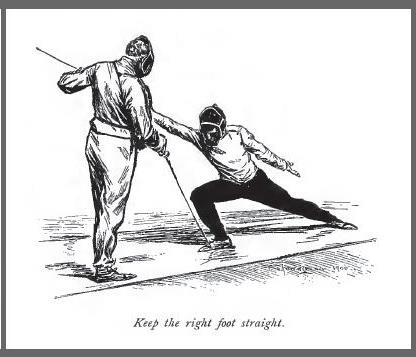
Generally, fencing is an indoor activity, and in Olympic circles almost always, but in historical fencing for a variety of reasons we are often fencing and teaching in mixed environments. If you have the good fortune to work indoors, and have proper flooring, such as wood, the springy artificial rubber stuff I don’t know the name of, or the like, then terrain is less a concern.
If you are outside, however, the coach has to take into account how terrain will affect both how they move and how the student does. I use these opportunities to expand what a student might find comfortable. Practice on gravel, sand, grass, blacktop, or concrete will test one’s mobility, balance, and endurance. Work accordingly. So, if your lesson is on a slippery surface, work on tighter footwork (cross-steps are good), and shorter lunges. If on super hard surfaces, such as concrete, make sure you include more frequent breaks, and depending on the type of fencing, limit anything that will mean more concentrated impact. When on concrete, I do not include as much footwork in the warm-up portion, for example.
Ambidexterity
Not everyone develops the ability to fence with their off-hand, but it’s something I encourage. Not only will it help you as coaching those in class who are in the minority handedness-wise, but it also provides the coach a break. When the dominant arm starts to tire, one can switch. After a time, it’s easy to forget which side one is using, and in that case changing more regularly can help balance out things.
Being able to move, to use footwork with the opposite side, also helps. The muscles etc. engage differently, and allow those on the dominant side a chance to work less strenuously. As a perk, one is far less likely to develop one side of the body overmuch.
Breaks
It may be obvious, but the coach shouldn’t be moving, let alone fencing, the entire time. Take breaks. It is not always easy to do, but they’re vital to focus and the longevity of one’s teaching career. We are not necessarily conditioned to do this; often in fencing we’re under pressure or feel that we are, and so will push on when we should not. To use myself as an example, a few years ago at a weekend coaching clinic at Halberstadt Fencing Club in San Francisco, Maitre Handelman approached me and told me “Take a break.” Both myself and the other not-young instructor had been going all day, and it was starting to tell in how we moved. We sat down, mutually lamented the horror of aging, but we did as ordered. I don’t think I could pick one thing that Matire Handelman shared as a favorite kernel of wisdom—he’s a consummate teacher and one of the best I’ve met—but this aside has stuck with me. Until recently, I was teaching every day, and had I not followed this sage advice, I’d be in worse shape than I am.
Take breaks between lessons, take them between classes. Right now, with only a three-hour block to teach on weekends, there is no gap between the three sections. So, what I do is use the footwork drills we start with to rest. In a class, and mine are mercifully small, the coach normally circulates between pairs as they work through drills, and depending on the walking surface this can be a long time to stand. When you can, sit. When you can, stretch.

Pacing
Just as we can with traditional fencing movement, we can speed up or slow down when walking. I was surprised at how much walking can affect distance, but it can, so some adjustment may be required in order to chase a student or retreat in turn if walking. This is stating the obvious, but it’s worth mentioning because if we’re not mindful about it students attacking can be in grappling range super quickly, and in attacking them it’s easy to feel like they’re sprinting away from us.
Benefits of Coaching Footwork
To explain this I’d like to point out, again, that fencing is one of those pursuits that many people pursue into their later years. This isn’t just as participation or a movement exercise–there are competitors who are elderly; coaches who teach all the time. They FENCE.
The reason they are able to do this is, no doubt, partly owing to the luck of genetics, but it’s also because most have taken care of themselves. Even if you come to this late, as I did, it will save you some hassle down the road. Having had the pleasure to learn from and compete against people decades older than I am, I know firsthand just how formidable these folks can be. The worst thrashing I ever experienced in competition was against an 80 year old man when I was 23. Al Couturier, who at the time was in his 70s, enjoyed turning on the speed during lessons as we cooled down–soon as we saw the smile in his mask and his arm take on a life of its own, we know we would be parrying like mad. It didn’t matter–he got us each time. Maitre Calvert was in his 90s when I worked with him, and would sometimes, in foil, pull off a behind the back shot as illustrated in Angelo. More recently, during my master’s exam, I had the pleasure to work with Grand Master Josef Šolc, who is 90, and can lunge a lot farther than I can and recover just as quickly. These elder fencers remind us of what is possible.
We can do it too, if we’re lucky, but that starts with taking responsibility for ourselves, setting a good example for younger fencers, and in managing our time, bouting or teaching, well.


 Capitale Escrime Historical Fencing