Manitoba Highland Gathering Tournament, East Selkirk, Manitoba, Canada, 22-23 June 2024
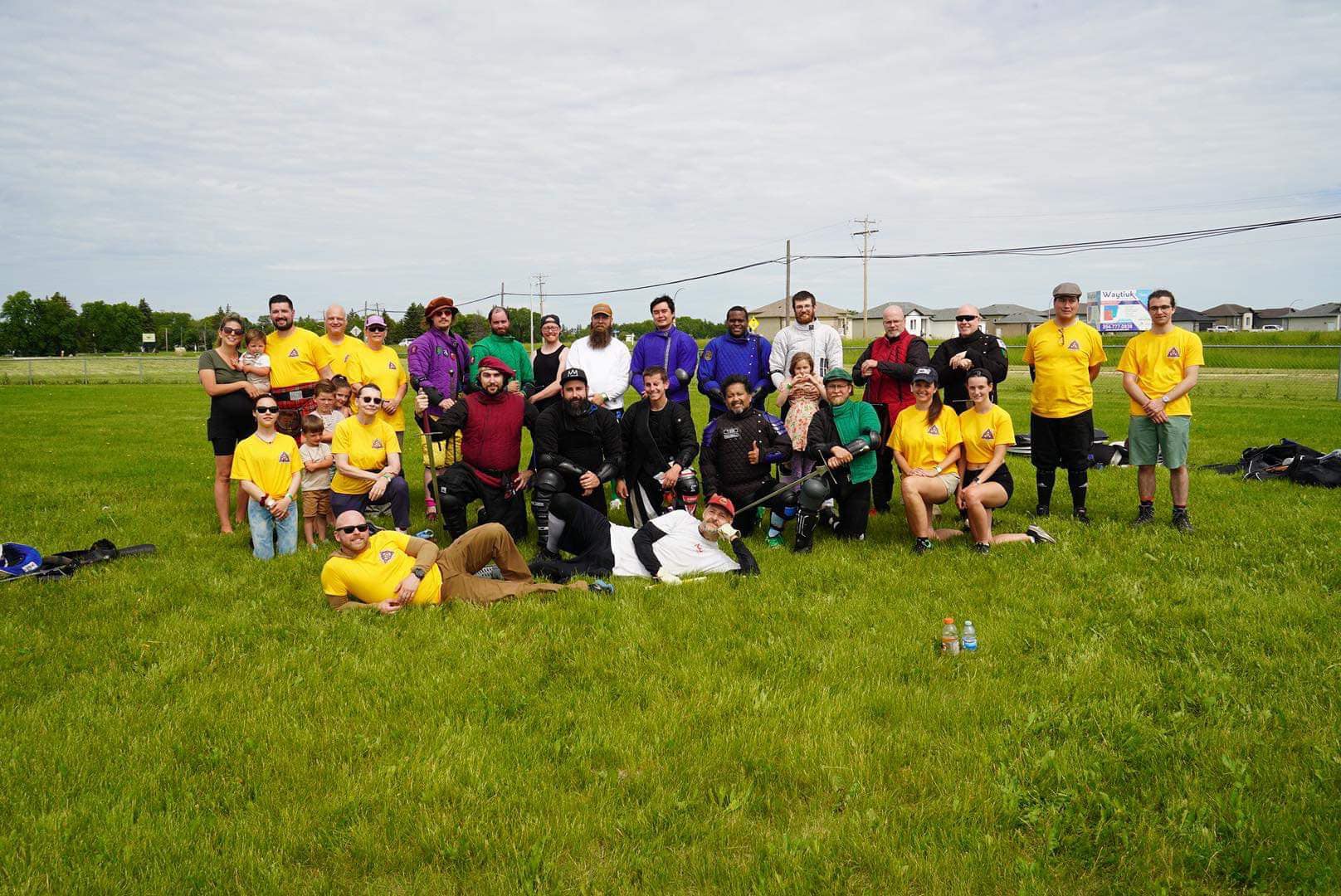
This past weekend, I had the great privilege to attend and assist my Storica Defensa colleagues in the various tourney pools at the Manitoba Highland Gathering in East Selkirk, Canada (held June 22nd and 23rd). This two-day event included longsword, veteran’s sabre, broadsword, and women’s smallsword. Despite some truly warm weather, some swampy fields, and a few moves between gyms, everything went amazingly well. The MHG Tournament marks the seventh SD event and serves to add another data point in support for the approach we are taking to competition.
In terms of safety, no one was hurt. Not one. To date, there have only been two minor injuries in SD events, both involving a failure in gloves to protect forefingers. This is more a kit issue than one of safety culture, and no such injuries occurred last weekend. We place heavy emphasis on safety and no hard-hitting is permitted. So far as I know, not one judge had to remind anyone about force levels. Club members, especially Eric Elloway, army veteran and first-aid certified, brought a giant cooler of water and officials pushed hydration hard. In fact, my friend Xian Niles noticed I was starting to stare off and had me get water, then go sit in the shade (thank you my friend, that was a wise decision). Best of all, the fencers looked out for one another—on two occasions I witnessed, fencers halted action so their opponents could fix gear.
Very Serious Fencing…
The camaraderie was visible and honestly endearing. Most bouts ended in hugs as well as handshakes, and people were keen to keep fencing post event. This is not to say that the competition wasn’t high, because it was as any clip of footage will demonstrate. The hush that fell upon us all watching some of those final matches… I don’t think anyone made a peep during the final broadsword match between Xian Niles (Niles’ Fencing Academy, Halifax, Nova Scotia, Canada: https://www.nilesfencingacademy.com/) and Zach Brown (Superior HEMA, Thunder Bay, Ontario, Canada: https://www.superiorhema.com/?fbclid=IwZXh0bgNhZW0CMTAAAR0noPMDPX7PaM8kxh8SpQdf-e15Ie53xzsJucV58BZno1pycKsN_r25q9I_aem_yB6MUK3J6OWM7jK68jGjaQ). People were quick to concede points and generally did so appropriately, and were gracious when calls didn’t go their way. If anyone needed gear, another fencer was happy to help. Rarely have I seen so many competitors as generous in assistance to one another as I have here.
The level of skill was high. The pools were designed around Storica Defensa competitive levels as much as possible. Most action was easy to follow, and thus, easy to judge (comparatively speaking—judging is never easy). The timbre of an event, the expectations that are set, do much to determine how an event goes. SD’s rules and expectations are clear in the ruleset, and so from the off everyone was more or less on the same page. In specific terms this means that people knew any hard-hitting would be called out, that fencers were honor bound to admit a hit, and that there would be zero tolerance for poor behavior. We also hit the safety aspect hard. I mean, HARD. To put this another way, these expectations attract a particular type of fencer, and in doing so, discourage those fighters keen for garbage like heavy-hitting, use of the afterblow to gain points, and other b.s. Free-fencing post pools was common, and speaks again to the level of positive interaction—people wanted to keep fencing one another.
Eric Elloway with a beautiful running attack in the vets’ sabre event
Organization is critical to running a good tournament, and it is a testament to the planning Jay and crew had that even with a few hick-ups everything went smoothly. Day one was super hot, not a cloud in the sky, and in the morning the ground was a bit damp; day two we had to switch gyms. In each case everyone just got to work and made things happen. We carried tables, gear, scoring placards, everything, and neither day went late. In fact, on both days we ended in time for people to free fence for hours before the Gathering shut down for the night.
SUMMARY:
The MHG Tournament is growing, and in time I suspect will double in size. It’s not just the fact that winners in each event received lovely prizes—sharps, training weapons, and discounts for gear—but that people were safe, enjoyed the fights, and were eager to socialize afterwards. This event is one I am adding to my list of go-to, must-attend events (the others being SabreSlash in Prague, Rose & Thorns Historical Fencing Symposium, and the St. George’s Day Exhibition of Arms).
Following fast on the heels of another two-day tournament I attended, this time as a live-stream announcer, the contrasts stood out starkly. That first event was large, and in most respects typical of “HEMA” events. [n] For example, I witnessed a fencer injure another—twice. The offender was barely censured, but should have been black-carded, and the victim, though evaluated by a medic, was not taken to the hospital. He should have been as he received a pommel-strike, full on, from a running opponent, and was visibly shaken, never mind nursing a mask-waffle print on his nose. The judging was also poor. The silver medalist in rapier, for example, should have taken gold, but the judges failed to call the action correctly. Many, I found out later, were pretty new fencers.
One of Storica Defensa’s goals is to provide better tournaments, not only safer ones, but better run, better judged ones. In this it is exceeding expectation, and I’m keen to see this develop. True, I have a stake in it as a coach for SD, but I stand by what we’re doing. It’s working.
[This is a continuation of the post “How to Tournament” posted yesterday (19 June 2023)–much of what I say here has been said before, including by me, but since it is on theme, here it is anyway]
In part one of “How to Tournament,” I focused mostly on intelligence gathering and assessing the competition. Here, I’d like to discuss mental preparation, a topic covered earlier in part by the “The All-Important Place of Calm” [15 May 2023, https://saladellatrespade.com/2023/06/19/how-to-tournament/]. The approach to managing emotion is key here too, because nerves, excited or fearful or nervous, can derail us no matter how well-trained we are or ready we are to compete and succeed. One way to think of it is akin to drill. We tend to fight as we drill, because we condition ourselves to respond to certain actions and situations and reinforce this via repetition. We can do the same thing mentally—without meaning to sound like Moonbeam the Hippy or some faux guru on tele, cultivating calm and simultaneously picturing ourselves in an event, start to finish, and in specific instances of action, can do much to help us the day of the event. What is familiar is less likely to unsteady us, so from physical training to mental training, we can make even competition just another day sword in hand.
Calm, Revisited
Not to repeat the earlier post, but calm is something we can choose and practice like anything else. In this instance, this means consciously focusing on one’s place in the event and when necessary supplanting negative emotions (nerves, anxiety, fear, whatever) with concrete thought. For the first, visualizing our performance, from the moment we enter the event to specific actions, beforehand can do a lot to prime us. It’s not magic (sorry Moonbeam). Whatever other benefits visualization may have, the process of making something familiar helps remove uncertainty. The more we know something, the more comfortable we are with it, and thus, the less likely nerves take over. [1] [yes, I did just repeat this… see? repetition!]
Duel between an unfortunate braggart and Kyuzo, “Seven Samurai,” 1954
When nerves pop up, and they sometimes will, we’re better prepped to manage them having already envisioned the situation, but we can apply active replacement too. This requires noticing, consciously, that we feel nervous, and then pausing to distance ourselves long enough to set that emotion aside and replace it with something more useful. For example, Fencer X has just completed the first pools, and is nervous about the second. The competitors here are strong and Fencer X begins to doubt. Noticing this, Fencer X stops, takes a deep breath, and says to themselves “No. Focus on what you know. You’ve seen these people fight; you know how to counter them. Relax and have fun.” Conscious thought, that focus, can—with practice—remove some degree if not all of the negative emotion that undermines us in a fight.
Constructive Visualization
In no way is this a nod to crystal-thumping charlatans; I draw upon a few sources for this, but maybe the most important being well-attested memorization protocols. [2] Self-help books from the 1980s aside, all this is really is a form of meditation, just very focused meditation. Simply put, one focuses on imagining oneself at the event. If one can visit the venue first, that helps—gives a face to things. It might help to visualize oneself entering the facility, full of calm, and warming up. Next, one might visualize a specific action one’s been working on lately and successfully executing it in a bout. Perhaps an entire bout, maybe even against a specific opponent, is worth contemplating.
None of this determines the outcome, but what it does do is prime the mind for action and reduce potential nerves. Ideally, one gets on the strip or steps up to the ring and is utterly calm or maybe just in state of happy excitement. One can tell, by the way, when this happens. It shows. I have found in competition, as well as in at least two actual fights (fists, not swords), that steady calm can utterly unnerve some opponents. Calm suggests confidence, and with that, skill. This can affect what judges see too (remember: competition is a game, as psychological as physical if not more the former). [3]
Pre-Tourney Practice
In conjunction with mental preparation, one normally trains physically before an event too. This exercise may take place during regular practices or within individual lessons if one is taking those, but people often add additional drill in the mix too. Much of this may be one’s normal cardio and/or weight etc. training—all ideal times by the way to visualize things the day of.
?
For those practices focused on fencing, emulating the warm-up or pre-competition lesson tends to work best. This style of lesson is similar to a technical lesson, but the goal is to build confidence in the fencer, not to impart new skills. Keep things simple and focus on those actions a fencer does best—drill so as to make these actions as crisp, tight, and well-timed as they can be. Warm-up lessons are also typically short, maybe 10 minutes, tops 15. My approach in the past has been to include some of these types of lesson a few times in the weeks leading up to an event. The week of, we focus hard on these things, and, anything that the fencer may have had trouble with in the past. [4] The day of the event, I would have them warm up, then put them through the same short, 10 minute warm-up. Like contemplating success, this style of lesson has them work things they do well, all of which build confidence and ready them for the pools.
Intent, Expectations, and Take Aways
As in so many things, we get out of them what we put into them, but added to this much comes down to how we do this, what it is exactly that we invest. I tell my students and any colleague I prep for an event, to set goals. What do they want out of this event? How does it fit into their growth and experienced as a fencer? Laying all that out helps set expectations for an event, and thus, helps prevent the common distractions that come up when things don’t go as planned.
Versatility is a vital skill for any fighter—if weapons break, does one have a backup? If one’s tactics are failing, can one notice, adapt, and continue the fight? How does one handle victory in a bout? How does one handle defeat? The culture we create in a club or school goes a long way in shaping and cultivating this skill.
Be gracious, be courteous, and show largesse win or lose. I’m a strong advocate for managing both victory and defeat with a becoming grace and humility. Today it went one’s way—great; tomorrow it might not. No one with any aspiration to sanity dislikes a generous, gracious fighter. In fact, people will want to fight with that person because their heads are screwed on right and they make it fun. Fencers like that make the bout about the bout; they think in terms of a shared, dare I say it intimate experience and not just what these tiny victories might do for their self-worth. Officials like them too, because they don’t whine when they lose a point, even if unfairly, and use proper channels to protest something they find illegitimate or untoward.
After the Event
Conducting a post mortem after the tournament is important. With any fencer I have prepped, I like to follow up with them and see what they thought went well, what not so well, and how the experience might guide future training. This helps me, as their instructor, but it helps them too. It’s a chance to see that what they’ve learning is working as well as those areas that might benefit from additional practice.
Lastly, I always asked them if they had fun. Fencing tournaments, of any kind, are not famous for making any participant rich. We don’t have pay-per-view prize fights with purses to match. In the U.S. one never sees fencing on tele unless it’s the Summer Games and we have high level fencers in the run for medals.
We fight in tournaments, for the most part, because they’re fun. I have written a lot about tournaments and bouting as learning tools, and they are, but they should be enjoyable as well. Looked at in this way, a good tournament (emphasis on good events…), can push our skills forward and be a blast at the same time, and there are not many areas in our lives to day to day where we can often say that.
NOTES:
[1] We are resilient creatures. One of the best, if more extreme examples of this, emerges powerfully from combat and the process by which many military folks become accustomed to the extremes of life-threatening horror. I leave it to those military personnel and veterans willing to talk about it to explain this as they can do so better than I can.
[2] I mean no offense to modern spiritualists etc., just those trying to make a buck off of people. There was a spate of new-agey self-help books in the 1980s that mixed decent advice with a lot of b.s. Check the shelves of most any bookstore and these scams are still on the shelves. There has been a lot of work on how we can use, even improve memory, and condition ourselves. One of the more influential books for me, odd though it may sound, is M. T. Clanchy’s From Memory to Written Record, England 1066-1307, Hoboken, NJ: John Wiley & Sons, 2009. I also recommend, for a broader look, Fances A. Yates, The Art of Memory, Chicago, IL: University of Chicago Press, 1974.
[3] I remain convinced that I will never acquit myself better in a fight than I did in the last one I had, or didn’t have rather, in college. A sub-letter got nasty with my girlfriend at the time about rent, and I told him to knock it off. He decided to take it outside, and once outside, kicked off his shoes and danced about posturing. I stood across from him, ready, and waited. At one point he started to approach, so I started to raise my hands and smiled. He stopped, and a few second later walked over with his hand outstretched. Having had excellent masters, I didn’t trust this gesture and made it clear that if it was a ploy it wasn’t going to work. He was, happily, sincere. So, we walked away from the small crowd that had gathered and talked it all out. I was just looking after my girlfriend, and he was trying to save face, both understandable places to land, and since I had no ill will toward him, nor he toward me so far as I know, it was easy to fix.
[4] I didn’t invent this style of lesson. They’re well-known in Olympic circles. For a solid explanation of warm-up lessons, among other types, see Maitre Robert Handelman and Maitre Connie Louie, Fencing Foil: A Practical Training Guide for Coaches, Parents, and Young Athletes, San Francisco, CA: Pattinando Publishing, 2014, 324-325.
[what follows is a very bare-bones, big-picture look at running a tournament, but hopefully helpful]
After the bout
Tough as it can be competing in a tournament, running one is almost as hard if not as hard as being in the pools, and in some ways it’s a lot more challenging. People may not remember Fencer X’s performance, but they tend to remember whether they thought a tournament was well-run or a waste of time. Importantly, they also remember if an event was particularly biased or inconsistent in judging. Having run tournaments, I know firsthand the obstacles to a successful one, and, a few things that help. So, continuing the tournament theme, this post looks at this from the organizer’s point of view.
Planning
Organization is everything. There are typically a few essentials for a tournament and few without cost. Among the major considerations are:
Funding
event location
officials
awards
food & beverages
accommodations
advertising
Not all tournaments will include all of these. At most, one brings their own food, lunch money, and water, though water-bottles or access to fountains or sinks is normal. Likewise, few tournaments can afford to fly in and board competitors. [1]
I start with event type, then consider whom to invite. For example, in the pre-pandemic sabre invitational, my buddy Brent Lambell and I decided to team up. He had a space and I had a good idea of whom we should invite. [2] Not everyone will show, and even those who r.s.v.p. may change their minds for one reason or another, but knowing what you plan to do and how many people will likely be there determines most everything else.
Funding
Most clubs fund their own events, but if one can acquire sponsors it helps. Some may be local businesses, some well-known suppliers like Purpleheart Armory. It can be decent advertising for those who chose to assist, and even if all a sponsor covers are the awards or morning coffee, those are things that don’t come out of the club’s budget and help reduce the overall cost.
Approach sponsors respectfully and with an eye for partnership. They may have questions, especially for historical fencing events, so be ready to answer questions, direct them to your website or instatwitterface, or hand them a brochure your club has them. If their answer is no, thank them for their time and leave a good impression. Maybe next time they will agree.
Location
Depending on where one lives, there are often fees or legal aspects to renting a space and running a sporting event. In the United States, for example, proof of insurance coverage is standard. The venue will tell one what the requirements are, and since these can sometimes take time securing the location early is wise.
For larger events, one needs more space, and in the U.S. anyway that means additional costs. Locally, the larger tournaments we have had here have been hosted by several schools versus one; this helps spread out the cost and with luck increases the number of volunteers. The events I’ve put on have been small, so a gym has sufficed, but I’ve worked with tournaments that have rented entire buildings as well.
Bathrooms and/or changing rooms are usually available, but for some events one may have to rent portable toilets etc., an additional cost. Whenever possible, access to restaurants, hotels, and other amenities help. These should be listed and shared with attendees and staff—I typically include it on the flyer and in the individual messages to participants.
Officiating
With the caveat that some clubs are isolated and have little choice, it is always best to employ officials from outside one’s own club. For example, in the invitational, the director was an old friend and colleague of mine unassociated with the school. An experienced Olympic fencer, he was an ideal choice, and impartial as he knew none of those competing.
As the organizer, I likewise had nothing to do with officiating lest the event appear biased for my fencers or friends. My job was managing the event, from problem-solving (the guy with the movable rings was a no-show so we had to have someone run to the store for tape and create some manner of piste), helping people find spots for gear, and assisting with the clock and scoring table. Another friend and fencer, also unassociated with anyone fencing that day, worked with me to ensure further that nothing might appear untoward.
Tim D and Patrick B, 2nd Sabre Invitational, 2019; director, Dennis Le, judges Richard Lowrey (gray pants) and Daniel Ma (black pants)
Even with the best intentions, one can be favorably biased towards those one knows; it’s easy to read intent behind an action because Fencer X “always does that” versus what that fencer actually may have done. For this reason, if not just for appearances, it’s best not to officiate one’s own fencers or friends. If the event is isolated or in other ways unable to get sufficient outside help, then local officials may have to suffice. In that case, every effort should be made to ensure that anyone directing or judging isn’t presiding over bouts their best friends are in, and, that they are calling what they see, not what they think they saw. When in doubt, abstain.
No one wants to pay, travel, and devote time and energy to a tournament that appears rigged let alone is rigged. I have witnessed systemic cheating myself, and just this weekend chatted with a friend in Canada who attended an event that was horribly inconsistent with calls at best, and wholly ignored some actions at worst. [3] If one hopes to run an event more than once, consider not alienating and aggravating visiting competitors. It makes the host school look bad, well, to fencers who don’t favor cheating anyway.
Experience means different things. A local fencer who has judged a few longsword opens has, relatively speaking, experience, but that is not the same as the former Olympic fencer who was trained in an environment geared toward competition and who may have taken courses on officiating. I’ve found that any Olympic fencer willing to help out is open to the rule changes that come with historical fencing. If nothing else, ensure that judging is consistent. Bad, but consistent trumps bad and inconsistent. Seek out seasoned fencers, people with considerable experience, to officiate if possible.
Awards, Prizes, etc.
2019, SdTS Sabre Invitational, finalists
What one chooses for awards varies considerably. Trophies and medals can be ordered locally in many places or online. [4] These are not inexpensive considerations, so if sponsors can help, great, if not then club money will need to be set aside to cover the cost. If and when possible, something different and unique can spice things up—for example, in the invitational my club hosted we had a technical award decided by all participants. The winner of the technical award year two was presented with a page from Major Alexandre Muller’s Théorie sur l’escrime a cheval (1816) [5]. The winner of SabreSlash 2021 was awarded a beautiful sabre. If and when possible, extras like this add excitement and a little color.
Food & Beverages
With few exceptions most places I’ve used or which I have visited do not have kitchens, though when a site does it can solve a lot of problems food-wise. In the Pacific Northwest, for example, we are lucky to have a chap named Sven who loves cooking, knows how to cook for a small army, and makes seriously delicious food. Some venues will not allow food or anything save water, so best to find out ahead of time versus day of.
I try to have ample supplies of water on hand at a minimum. Fencing kit makes for a hot, sweaty day, and people need water. I’ve also done my best to bring some coffee and breakfastish pastries for guests and officials. Listing local food options is helpful as well, especially those within walking distance.
Accommodations
Housing attendees can be one of the most expensive aspects of a tournament, and, it isn’t a requirement. In the past I’ve listed inexpensive hotels as well as forming part of a pool of people happy to host out of town guests. Travel can be expensive and most people are grateful for a couch or spare room. Hosting is also a great way to get to know people, and the better ties one has with one’s community, typically the more we enjoy time in that community.
Advertising
The inexpensive ways to do this are via social media, email, and word of mouth. Posters and fliers can help, and I imagine radio or t.v. spots would too, though I don’t know any schools that can afford to advertise on radio or tele. Some, like my friend Mike’s club, Northwest Armizare, have been on television a few times, but most of us are not so lucky.
Joining events like the local Renaissance Faire or offering demonstrations at schools, festivals, and other events are other ways to advertise. Personally, I’ve found most such festivals to get more work out of us than we get new students in turn, but advertising and boosting school numbers aren’t the only reason to attend these events. A good demonstration can make an impression and one never knows where it might lead.
Officiating, again, and a Word on Rule-sets
Choice of rule-set determines a lot. Whichever rule-set one decides upon, learn it well, and enforce it as consistently as possible. Make sure competitors are aware of the rules before the tournament, and, rehash them briefly before the event starts.
No one will remember what brand of coffee an event had on hand, and no one will remember if the bathrooms were worse than any other public one, but they will remember a poorly run event and terrible officiating. For all the amenities, fencers will remember good or bad calls; they will remember fairness. If you want a tournament to become a regular occurrence, then ensure the best officiating you can obtain.
Post Script: I neglected to mention having a first-aid person on site. Some insurance carriers and/or facilities will demand it, but it’s a good idea anyway. The goal in any tournament, from my view, is to keep the first-aid person as bored as possible and then reward them nicely with public thanks, some token of appreciation if your budget allows it, on top of any fee they may collect (some volunteer, some one must hire).
Many events are staffed and succeed thanks to volunteer efforts, so be sure to thank them, publicly, for their help.
Notes:
[1] Few events can do this, and those I’ve attended that do usually offer one or the other, save for a headliner.
[2] Brent’s club has changed hands and he moved, but my hope it to get the invitational rolling again and likely as a charity event. The plan is to expand it as well. Day one will be sabre, and day two a mixed steel accolade for later period thrusting weapons. Experience taught us that a sabre open tended to invite people not ready to complete, so I pushed for an invitational where we would attempt to attract well-established, skilled fencers.
[3] Enough time has passed, I feel I can speak about the Rose City Classic in 2017 and the egregious cheating that took place. It was a larger tournament for Portland, but was co-hosted by the infamous Blood & Iron club out of Vancouver, BC, Canada. The directors were all B&I, and two of the three judges were as well. I wasn’t competing, but visiting Gus Trim—one of the vendors there—and so had an ideal seat to watch several of the competitions. There were shots the B&I judges ignored, doubles they awarded to their own, and other more subtle ways they manipulated the rules. Moreover, there was zero accountability for hard-hitting, and worse, for clearly ill-intentioned shots after the halt, the standout example being a bout between B&I’s cult leader, Lee, and another fencer, cf. https://youtu.be/3r86pARypTo
[5] In the estate that selected my club for a non-profit donation, there were among the books several loose pages out of Muller’s 1816 manual. They’re in poor shape—not acid-free paper—and weren’t housed properly, but I’ve stabilized them and will continue to use them for the technical award until I run out of them.






 Capitale Escrime Historical Fencing