The question asked of sound and trees falling in the woods works for many situations. It’s especially apt as so many of us work alone thanks to the pandemic, but even in the best of times fencing is—be it conducted within a club, school, or team—a solitary pursuit. Our training partners and opponents are instrumental in our growth, and we cannot progress far without them, but the hours of footwork, conditioning, and drill honing technique is a responsibility on the individual fencer. All the flash and fire, all the joy experienced in flow during a bout, little to none of that does one enjoy advancing, retreating, and lunging, doing point-control drills, or performing molinelli against a pell. At its best it can be meditative, but normally, about as good as it gets is merely the awareness that the dull work matters, that one has successfully executed the necessary discipline, and that it’s all important. Unlike bouting, it is not “fun,” though absolutely crucial in our development.
Solo Drill & Isolation
On a another level, however, there is or can be a loneliness in fencing. In most ways it’s a journey we take alone, so that makes sense, but in the deeper waters of the Art and in trying to find other explorers at that depth the isolation, if we’re not aware of it and careful, can be detrimental to our study. With the pandemic, when most of what we can do safely is solo drill, it’s hard enough to find motivation to do the grunt work let alone fight that added sense of isolation if it assails us. Thanks to the internet this is a problem we can alleviate in some degree—few days pass where I don’t chat with the few people I know who are as keen to plumb the Art’s depths, explore texts, and learn as I am. After all, few people in our community, never mind people outside of it, enjoy the deep dive and can discuss the Art for hours on end. I know I’m not the only one who has watched a hapless friend’s eyes glaze over with the unmistakable look of a person that realizes they should never have asked us about fencing. The ability to chat with people far distant is a lifeline we’ve not always had and we should be grateful for it.
“The IT Crowd,” BBC, on sports
On a public level too fencing can be lonely. Like any more or less obscure pursuits fencing is not one of the typical dinner-party topics or likely to come up at a rave, farmer’s market, or appropriately distanced line at a grocery checkout (the six feet rule protects us not only from the virus, but small talk 😉 ). [1] American football, however, or the other sports-ball games, the latest shows on television, etc. are far more likely as topics of conversation. In short, most fencers have no one else to discuss the Art with apart from other fencers, not all of whom devote the same amount of time to it.
Moreover, with all that is going on in the world, with the dire challenges of climate change, Covid-19, social and political turmoil, and every person’s own trials, devoting time to a complicated, obsolete martial art probably seems silly or irresponsible to many people. Even assuming the fears of the conspiracy-minded sorts out there panned out, it would be a long, long time before anyone needed to use a sword again in earnest–in the US alone it will take centuries to run out of bullets–so in terms of the “practical” side to fencing it’s a hard sell. Not impossible–a cane, umbrella, or stick in the hands of a decent fencer is not something anyone should want to experience. So, maybe studying a dead martial art ranks low among the wines and spirits, but the Art can also be a healthy diversion, decent exercise, and intellectual entertainment, which are reasons enough to pursue it. It can be more than that too. The combination of physical and mental stimulation and exertion can be great stress relief.
Of the various perspectives perhaps one of the hardest is the lack of interest or even censure from other fencers. It’s hard enough to feel isolated generally, but when it comes from seemingly like-minded people it is that much harder. Typically this is something, when I’ve experienced it myself, that comes from either Olympic fencers or from similarly narrow-minded sections within “HEMA.” Truth is that everyone filters things through their own experience; reason, evidence, all that has little to do with it.
For example, in the 1990s when some of us defected from Olympic fencing to explore ways to make fencing about swordplay again, there was little support from our comrades. Impassioned appeals were usually met with laughter or hostility. I know my own disappointment and frustration with the poor decisions the FIE was making were made worse by the near complete lack of sympathy from teammates. Our vocal complaints about the system, especially with newer fencers in the mix, were not conducive to group cohesion, but we wanted those newer fencers to know there was a difference between defense-minded approaches and the slap-happy b.s. then in vogue. This is something that typically hits harder as one has more perspective. As it turns out, those of us upset about some of these changes were correct, and this is maybe one reason that to this day some former teammates haven’t forgiven us. [2]
Scene from “Gaslight,” 1944
It is extremely easy to feel gas-lighted in situations like this. I tend to hate terms like “gas-light,” but having had too much experience with it, even in fencing, it’s appropriate. Like many things, there is a spectrum for gas-lighting, but one of the most difficult to manage and overcome is the particular species wherein people believe that you believe something, but do not believe you’re correct and actively do things, wittingly or unwittingly, that make one feel like they’re losing their mind. [3] They offer what seems like positive reinforcement but which really only confuses everything–one comes away under the false assumption that they agree, when they don’t. We discover that the face they present to us is not the one they share with everyone else, the result of which breeds further confusion when in company with shared associates and it becomes clear there is a difference in what they’ve heard.
For fencing, an illuminating example is where people stand with regard to a silly rule that to this day affects Olympic sabre, t. 70 1 & 2, which states:
METHOD OF MAKING A TOUCH t.70
The sabre is a weapon for thrusting and cutting with the cutting edge, the flat and the back of the blade.
All touches made with the cutting edge, the flat or the back of the blade are counted as good (cuts and back-cuts). [4]
It should be obvious why this is a problem. The decision to allow the flat of the blade to score was the FIE/USFA’s “solution” to the problem of whip-over in sabre. The logic was apparently that an attack made with right-of-way, even if it hit the guard, was valid if the light went off. Since the director cannot overrule the light (see for example t. 73.1), the only arbiter of the validity of a touch is the box, so despite the idiocy of attacking literally the strongest area of defense, one can–and people do–score by slapping the bell-guard. Because competition reflects responses to a rule-set, the nature of fencing and in time instruction (in some areas) changed.
Those of us unhappy about this were ignored, ridiculed, or told to shut up. Of these the response easiest to manage was ridicule–at least that was honest. We mined older works on fencing and photographs and illustrations of sabres with wider blade profiles. At one point, I collaborated with a close friend and fellow sabreur, an engineer, and we rigged up electric sabre kit with the closest thing we could find to period blades, schlager blades, and demonstrated that fixing the problem was as simple as returning to an earlier blade style. Whip-over disappeared. We even had one of our master’s assistant coaches try it, and while he agreed that it was better, he shrugged it off. It didn’t affect him at his level of competition–where training reflected a pre-electric mindset–so he didn’t see the issue. In his mind, the problem with whip-over wasn’t anything other than the fact that most people experiencing it were just “bad fencers.” To those of us trained as he was, but having to fence people increasingly taught to exploit this rule, it was maddening. One either adapted and did the same or quit.
The facts, evidence, the goal of helping the community fix an error meant nothing. A lot of us, myself included, felt abandoned, and it was easy to feel like it was all in one’s head. Rationally we knew the evidence supported us, but it didn’t matter to anyone else. What does one do when that happens? Our solution was to press on, and apparently a lot of other people did too, because now there are multiple companies making blades along earlier lines. There is also the classical/historical community that mushroomed in the wake of the exodus from Olympic competition.
So What?
The take away lesson is this: pursue the Art for you, for the reasons that make sense to you, and close your ears to those who mock, attack, or play Janus with you. If Olympic is your thing, do that; if classical/historical is, do that; if it’s bohurt, LARP, SCA, or anything else, go for it. So long as you’re honest in your study, with yourself, and with everyone else it’s hard to go wrong. Not everyone will see it that way, but the right people will and they are the ones who matter. They are your community even if they live half way around the world. As the pandemic continues, as we are forced to train more or less in isolation, we may as well do that the best way possible, and use this time to examine our study more closely, more honestly, and separate wheat from chaff, not only in terms of the Art, but of those who help or hinder us in our pursuit of it.
NOTES:
[1] Yes, I know, no one is going to raves or anything, but still.
[2] One of the hardest parts about owning one’s own share of the responsibility in a bad situation is that other parties will take advantage of it even so far as to use your admission against you. In this instance, both my close friend and I apologized for “souring” younger sabre fencers, but it did no good. It doesn’t matter that we were correct, it doesn’t matter that we did the right thing in owning our share of things, it changed nothing. It neither fixed that relationship or any other, and arguably it made some worse. This said, it was still the right thing to do.
In a recent conversation with an old friend and fellow fencer, one on the Olympic side of things, I realized just how poorly understood “historical” fencing is. To be fair, what most people consider to be historical is horribly inaccurate—it takes a part for the whole. This is not completely their fault; it’s mostly a result of what they’ve seen. The most publicized and well-known aspect of it is the black-clad longsword tournament sect, and balk at it though the SPES-donned might, they’re not representative. Much of what falls under the umbrella term of “HEMA” is much older than that; as much rests on better premises as well. [1]
Trying to explain to this friend what historical fencing is (or ought to be) was difficult. It was not only that historical fencing encompasses so much, over so long a time, but also that his preconceived notions were hard to refute given the one example he knows. Reflecting on that conversation I’ve been devising a short list of features to help round out the limited picture my friend and others have of historical fencing.
If you are easily offended it may be best if you stop reading here, for what I am about to say, however true, might upset some people. Happily, my readership is small, more inclined to agree than whine, and realistically what one obscure fencer thinks about HEMA makes no never-mind to those most likely to take umbrage.
HEMA to Your Standard Olympic Fencer
Silly meme made for some others in no-man’s land
Much of competitive longsword is bad. To a trained fencer it looks like apes with sticks whacking away at one another with little regard for art or safety. There are several reasons for this. Too many people begin competing too soon. Coaching is inconsistent and sometimes outright horrible. Rulesets, though they continue to evolve, tend to reveal the state of current opinion in re some pet concern (e.g. the “after-blow”) more than they do the logic of not being hit. Directing and judging, so often staffed by the same new folk, is dicey. Put together, to anyone who has fought within the Olympic world competitive longsword is one codpiece away from LARP and more closely resembles bohurt save that for some reason longsworders detest metal armor.
This is not to say that there are not skilled fencers among competitive longsworders. There definitely are. I know a few and know others by repute from credible witnesses and mutual friends. Likewise, this is not to say that competitive “sport” fencing is devoid of problems—nothing could be farther from the truth. HEMA, as such, would not have grown as it has from the late 1990s on had the Olympic world had its act together. Among the many similarities between competitive “sport” and “historical” fencers is that too many of them either fail or refuse to see the problems within their own camp. It’s a lot easier to point at the flaws in the other and count oneself and one’s view as the correct one.
So, what is “Historical Fencing” then?
Setting aside, for now, the mutual dislike and focusing instead on the easily demonstrable, here is what my Olympic friends tend to miss about historical fencing:
it is not just competitive longsword (skilled or apish)
it is source-based
it attempts to approach the Art as a martial art more than a sport
it encompasses sources from the High Middle Ages to the early 20th cen. [2]
it increasingly incorporates more than European systems [3]
modern fencing would not exist without some of these sources/systems
like anything some of it is really good; some of it really bad
This is a short list, but it’s important and contains most of the key details my Olympic friends miss.
HEMA ≠ longsword
This view again mistakes a tree for the forest. While arguably the most popular weapon among those interested in competition, longsword is merely one weapon and maybe the most visible of those systems people tend to see. Many if not most of the surviving sources which cover longsword also cover other weapons, such as spear, pole-axe, sword in one-hand (or single-sword), dagger, wrestling, dussack, Messer (a large, usually single-edged knife), agricultural tools turned weapons (e.g. sickles and scythes), and sword and buckler; some include material for fighting in armor as well as out of it. Many if not most of these have their competitive side too, though with allowances necessary for safety—fighting in armor, for example, and with weapons like poleaxes which greatly multiply force, requires excising those maneuvers intended to end fights. [4]
There is no “HEMA” without Sources
Unlike traditional and competitive fencing, historical fencing—by and large—focuses on extant sources. These can, however, take many forms. Not all are crusty old manuscripts or obscure books. The techniques one sees within any weapon class are—or should be—interpretations of techniques, ideas, and plays found in these sources. Due to the difficulties and vagaries inherent in interpretation there are often differences of opinion about even seemingly simple things. A researcher’s background and training have a significant effect on what they see, and thus in how they interpret what they find. The disdain many Olympic fencers have toward sources is, oddly enough, not uncommon among people in HEMA either, at least as expressed in the wide-spread dislike and distrust of formal academics. [5]
Not everyone in historical fencing reads the source material. Ideally, they would, but to be fair some of it is challenging to read, some poorly written, and much of it dull to modern eyes and ears. To name one example, long expositions on geometry couched as a discussion between a learned master and an eager student tend to be tedious to modern readers. Moreover, not all translations are equal, and there is little formal training or attention paid to teaching students how to separate wheat and chaff. [6] As in most things, politics and cliques often attend one’s choice of translation—it’s ridiculous, but remember while based on sources historical fencing is not populated by scores of trained historians or paleographers. Most people, probably 99%, “do HEMA” as a hobby, for fun; doing homework for a hobby after a long day at school or work doesn’t appeal to most of them. These students look instead to an instructor for guidance, drills, and a chance to try out what they’ve learned with others. This is a major difference from Olympic fencing where an instructor, most often certified, hands down a tradition passed on to them the same way. [7]
Combat Art vs. Combat Sport
Historical fencing is, depending with whom you speak, one or the other, or, both. There is a competitive wing, but being competitive is by definition less combat oriented. This is true however much one desires for it to be “martial.” It’s the nature of the beast. One cannot use, for example, all of Fiore’s Armizare or people would be maimed or killed (Master Fiore really liked breaking joints and thrusting the pommel and cross into people’s faces). This said, for the most part historical fencers try to approach these old fight systems as a martial art. Some attempts are more successful than others. Not everyone competes either, and this is an important point—”HEMA” is far more recreational than it is competitive.
MS Ludwig XV 13 28v-a
In Olympic fencing, just to illustrate the difference a little more clearly, the rules and training reflect a sport based on a former martial art. Off-target touches, some uses and interpretations of ROW (“right of way”), and the weapons themselves all demonstrate this well. There is no off-target in historical fencing—if one is hit, one is hit. [8] Hitting first or with priority—depending on rule-set—tends to take second place to being hit at all. Lastly, the weapons, while blunt, are meant to approximate more closely their historical predecessor. So, rather than foils we use smallswords or spada, which are still light and quick; in sabre we use 16mm wide blades or larger that weigh anywhere from 650g to 1000g. [9] Then there are the weapons that didn’t survive into the modern world, such as rapier, longsword, the knightly sword, the so-called “side-sword” and buckler, and pole-arms.
Historical Fencing & Non-European Systems
Strictly speaking HEMA, as named, refers to “historical European martial arts,” thus the acronym. This is one reason I do not favor this term, but instead use “historical fencing” or “historical martial arts.” As someone who values and incorporates the research that colleagues are producing in the study of various African, Persian, or Asian systems, I prefer a more inclusive term. In addition, as in so many fields, “European” can be and is defined a variety of ways. Most of our extant medieval works are in Latin, early German, French, Italian, or Spanish, so what about those in other languages that are less well-known? What about those from regions that are partly European, but heavily influenced by non-European peoples, such as the Republic of Georgia? [10] Happily, aside from the fools within the community who embrace ultra-nationalist notions, most people are pretty open, even excited to see what students of other regions are discovering.
Even within “HEMA,” however, there is a wide variety of difference in source type and purpose. Some works were hand-made and illustrated where later period ones were printed; some were meant for the aristocratic warrior caste, others for civilians; some were personal gifts to a patron, some mass-produced manuals from a government print house; some cover one weapon and context, some a multitude of weapons for a variety of contexts. We have some complete works, and some that are fragmentary. We have groups that identify a master or school, such as the Mss. that cover aspects of Fiore’s Armizare or the various masters associated with the later Dardi School. There are works written in simple language such as most 18th and 19th century sabre manuals, and then there are those written in purposefully obscure language to protect a master’s ideas from non-students, like “The Zettel.” To these we can add some rather poorly written works as well.
Modern and Ancient
Guard positions, Del Frate 1876; photo by Sarahorsomeone, Deviant Art, from the 2012 Olympics
Like it or not Olympic fencers learn and use a system that was the product of those that came before, especially those from 18th and 19th century Italy and France. Today’s foil and epee look back, each in its own way, to smallsword; sabre to 19th century works. It’s obvious to anyone watching modern fencing that a lot has changed, and not always for the best.
An explanation for how these changes occurred is lengthy and not one we need to dwell on here. In short, the requirements of sport are different than those for the dueling ground or battle field, and that meant changes in the rules, in the very weapons, that allowed for and in some ways created fencing today, good and bad. Competition, especially between nations, meant not only cheating but mutations in technique to exploit vulnerabilities and loopholes in the ruleset. Ridiculous attacks like the “flick” in foil a while back and the still undeniably stupid ability to score with the flat of the sabre blade are two such examples.
I urge anyone I know interested in fencing, really interested, to start with foil. It’s one reason I normally start my own students with foil. A good sport coach will provide any fencer with the fundamentals they need to pursue any other branch of fencing. Foil imparts the universals of swordplay and develops the core principles upon which all hand-to-hand fighting rests, distance/measure, timing, and judgment.
The Good, the Bad, the Ugly, and People
Olympic fencers may look down their noses at some interpretations within historical fencing (historical fencers certainly do), but they should understand that more often than not that smallsword or sabre fencer is working from texts either directly or indirectly related to what they themselves have learned and fence. Not all interpretations are equally good. Some are flat-out bad. This is to say that if some meathead is doing something that seems odd, it may be that meathead and not the system which is at fault. Don’t make the mistake of assuming all historical fencing is bad based on one practitioner or one clip of longsword tourney footage. There are many people who’ve made names for themselves and inspired a following who have some things demonstrably incorrect.
My caution to any fencer, especially my Olympic friends, is to ask questions before passing judgment. This list should help a little—if nothing else one can ask what sources that historical fencer is using and look into their instructor’s background. Unlike “sport” historical fencing is largely an amateur pursuit, in the best sense, which is to say that most instructors are not certified maestri. HEMA has no such program, and the attempts to create them have come to little in part due to the variety of sources and interpretation that make up HEMA and in part because of a lack of leadership. [11] The historical fencing community, as such, is decentralized, fragmented, and outside of a few major events most clubs work in isolation from others.
Just as in the Olympic world the historical community can claim some gifted fencers and some clowns. As someone who has lived in both populations, and currently occupies some strange no-man’s land in between them, I work hard to explain both sides to both branches. To be honest I don’t believe this has been particularly successful either way—the historical fencers who agree with me either have similar backgrounds to my own or some analogous path; those who disagree most likely don’t really care what the other camp does or thinks; they’re content with their own view. It’s the same for Olympic fencers.
Multae Viae, Una Ars The Art is one, but there are many roads that lead to it. None of this may matter to you. That’s okay. I believe, however, that any true student of the Art will look for wisdom and help wherever it may be found. We have, potentially, a lot we might learn from one another, but it requires humility, curiosity, and a willingness to retain a beginner’s mind.
It means setting aside the concerns of affiliation or what one’s peers think. I hate to say it, but fencers, wherever they are, could give most middle schools a run for the money when it comes to cliques, cattiness, and drama. All that rot just gets in our way. The Art is hard enough to chase without those added pressures. They add little, detract a lot.
I’m due to have another Zoom call with my old comrade from our college fencing team. He may likely fire another shot at me for my “LARPing,” but that’s okay—this time I’m a little better prepared to set him right 😉
NOTES:
[1] Ignoring earlier efforts at recreating historical arts, such as those that took place in the Victorian Age with people like Hutton, much of todays’ “HEMA” derives from two things, the exodus of Olympic fencers in the 90s unhappy with changes in competition and the creation of the internet. HACA, ARMA, etc. all came about in the late 90s and started sharing texts. Those of us already doing that research were thrilled—in what felt like a change overnight many of the works we had read about in Thimm’s bibliography were suddenly available in pdf.
[2] The sources for HEMA are legion. Some are medieval, many renaissance and early modern, and still more produced in the last two or three centuries. Though it must be used with caution, one can gain some sense of this from a visit to Wiktenauer, a wiki attempting to collate and share many past works on martial arts. Some translations shared there are good, others less so. It is popular because it is free, which is great, but the lack of academic rigor means that it’s best used like most wikis, as a place to start.
[3] Two standout, non-European projects include the excellent work of Dr. Manouchehr Moshtagh Khorasani, researcher, author, instructor, and the force behind Razmafzar, a world-wide group of practitioners who rely on his work (see for example https://www.moshtaghkhorasani.com/books/persian-archery-and-swordsmanship/). There are also the various projects under HAMAA, the “Historical African Martial Arts Association.” One of the best places to go for current research within HAMAA is its fb page, but Da’Mon Stith’s school site, http://www.silentsword.org/, is also a great resource.
[4] Polearms, because of the physics involved, are dangerous, and any researcher working on them should be quick to say this. Even in harness, never mind within a class where people are in workout clothing, there are risks. Be wary of anyone or any school that doesn’t take these dangers seriously.
[5] Yes, I know, there are many people in “HEMA” who do value the work and contributions from academics. However, this said, if social media is any guide, there is a sizable voice within the community that not only thinks little of academic training, but also dismisses any criticism they don’t agree with, however correct. I’ve encountered this hostility myself from people popular within HEMA’s ranks. To borrow an analogy from “Firefly,” it’s like Patience running her little moon: they’re rather impressed with themselves and do not want anyone from “off-world” meddling in the fantasy. The difference is that unlike a tv show, assuming that they have the same skill as someone who spent a decade learning how to handle and interpret historical sources is as prone to error as it is presumptuous. I’ve watched shows about doctors, read books by them, and have had to use first aid, but I don’t think that qualifies me as a cardiologist. Training matters.
[6] Most students of historical fencing rely on translations or someone else reading translations. Any translator will tell you that the work is as much art as science, and the uncritical too often assume that a translation is good merely because it exists. This isn’t so. To name one example, there are two major translations of Giganti’s rapier text. One is really bad, and the other is Tom Leoni’s. Those who favor the former do so out of misplaced loyalty, not based on rigor or skill. Locally, I’ve worked with Mike Cherba of Northwest Armizare, who shares this concern about translations, to help people in selecting and using translations. I have transcripts of these lectures, with slides, on my academia.edu site, but will happily share them with anyone if they want them and don’t have access to that one.
[7] HEMA is mostly amateur led, that is to say that most people instructing are people who have spent more time with the material than others rather than certified fencing masters or experts in that time period or source tradition. One reason that HEMA has retained its appeal is because this diversity of expertise is more inclusive than exclusive. Had only a bunch of academics been in charge, fewer people would be working on this stuff and we’d make less progress. We need both, experts and amateurs, and we need them to work together better. In contrast, within the Olympic world there are very few people teaching fencing, at least teaching it well, who have not been to coaching school or who haven’t spent decades learning and teaching.
[8] I’m giving this complex issue short shrift for the sake of brevity, but for those interested there is a sizable collection of articles, books, and diatribes bemoaning or celebrating ROW and the use and abuse of the FIE/USFA rule book. Ping me if you’re interested.
[9] Despite a plethora of historical examples, there is a dedicated section within historical sabre that idolizes ridiculously heavy sabres. Most—not all, just most—meant for use on foot fall into the 650-900g range. Those at the top-end, however, more often than not are weighted for horsemen or systems of combat that were as simple. While one “can” make more sophisticated actions with a 1000g sabre, one cannot do so for long, and so the use of such a weapon for much beyond a sharp club is limited. There is an ever-growing list of extant sabres with specs that Chris Holzman, Kevin Murakoshi, and others maintain that I can share with you if you’re interested. There is also an excellent, but difficult to find article by Christoph Amberger on sabre weights.
[10] This is a shameless plug for my friend Mike’s hard work on a Georgian system that survived, no kidding, into the 1990s. Mike shares his research freely—you can find some of it here:
[11] There are a number of organizations that attempt to organize the community, such as the HEMA Alliance (https://www.hemaalliance.com/), but not everyone follows their lead or accepts their decisions. Fb is one of the best places to look for these groups, but many have webpages too. Some are specific to one area, like IAS, the “International Armizare Society” (www.armizare.org, though as of today the site seems to be down), and for most anyone not interested primarily in competitive longsword it is to these smaller groups that they should probably look to.
It’s a commonplace that criticism is one of the hardest
things we face. No one enjoys it, but shared correctly and viewed appropriately
criticism is a powerful tool. For the fencer it can help to “unpack”
criticism as it applies to us as student. This is as true for the researcher. Just
as important as these two situations is an instructor’s ability to offer
criticism well. In each role we approach
this differently, experience it a little differently, but in each case—as
student, teacher, researcher—we’re in an endeavor that by definition includes
correction. So, it’s worth reflecting on some of the ways we give and receive such
evaluation.
Despite its etymology “criticism” generally
connotes something negative. [1]
There are probably multiple reasons for this, but one reason must be that so
often people don’t offer these observations well, either in terms of kindness
or effectiveness. It’s easy to take criticism personally, as an attack on our
character, and when criticism is offered poorly it’s small wonder. One of my
instructors many years ago—and since he’s still active I’ll not share his
name—was notorious for his meanness in lessons. More than one student left a
lesson in tears. He was less liked than he was feared, and while many of us did
well, many more of us might have had he been more amiable. For me, having grown
up within military culture, it was a little easier to deal with some of what he
said (while my father was not draconian, I certainly heard a lot of orders
given elsewhere that were brusque). I didn’t take it personally, not that it
was easy sometimes. Two of the more memorable comments he made to me were
“you move like a bovine,” during a lesson, and in coaching piste-side
at one tournament “Grow a pair and hit that guy—my grandmother could do
this.” Hardly inspiring.
In comparison to my other instructors, all of whom were
task masters in their way, this one sharp-tongued coach stood out. He’s not
unique. A friend of mine here in Portland was so scarred by a foil coach as a
teenager than he left fencing all together until discovering HEMA. Hopefully
your instructor isn’t like this—if so, I encourage finding a better one if
that’s possible. If you’re stuck with a lemon, or, if you struggle with
criticism generally, there are a few things to keep in mind that might help.
As Student
Looking first at proper criticism, i.e. the constructive, meant-to-help sort,
the most important thing to remember is that learning includes getting things
wrong. Correction is thus part of the learning process. We make mistakes, we
mishear, we struggle, we forget, etc. and a good teacher points these out and
helps us get them right. Usually our problem is less being corrected than how we are corrected. This is as true in
fencing as it is at school or at work.
This said, even the kindest criticism can be hard to
swallow. This is all the more true when we feel like we’re doing our best. We
expect results from hard work, and that’s not wrong, but as a working
hypothesis it needs refinement. Hard work on its own does little—it needs to be
consistent, it needs to focus on the correct things, and hardest of all it
takes time. Fencing is difficult. It is a highly technical art. If you’re going
to assume anything—and assumptions are generally a bad idea—then assume years
of constant, persistent practice. Be kind
to yourself and give yourself room to mess up.
No one masters this stuff right away. Being armed with more realistic expectationshelps a lot. Knowing that what you’re
studying is difficult and time-consuming should temper the impact of criticism.
When you expect it, it feels less about you and more about the process. Just
keep at it. However dressed the critical assessment of your skill is at that
moment looks less awful seen against the backdrop of long-term development. It’s
a moment of time—you will learn to do X, and then find some new challenge. All
of this requires that your ego is in check, that you’re less concerned with how
you look in front of your peers, and that too takes work. Focus on the Art, not
the perception others may have of you.
If your instructor is like that one I describe above,
then you’ll need to separate out the emotional
chaff from the constructive grain. This means ignoring any comment that
touches on feelings and focusing instead on those that treat substantive
issues. In the case where my instructor referred to my movement as
“bovine,” he went on to have me do footwork for the rest of the
lesson. I was plodding, not advancing, and so I spent a lot of time trying to
make my front and back foot land at the same time (back foot to floor as front
toes land). [2] I ignored his nasty
comment and just focused on the skill. Easier said than done, true, but with
practice and a good attitude it’s possible.
As Instructor
It’s in our own best interest to be kind when offering
advice or criticism. Kind doesn’t mean talking around an issue or walking on
egg-shells; it means sharing your evaluation in a way more likely to reach that
student. Often the best policy, a la the Golden Rule, is to mix whatever
analysis you have for them with encouragement. We know this stuff is difficult,
we know it takes time, because we were at the same stage of development
once—this should make us sympathetic.
Like anyone we can get frustrated. Maybe you’ve had a bad
day, maybe the student doesn’t seem to be trying. Your job is to recognize that
emotion, put it in place, and proceed without expressing whatever vexation
you’re experiencing (if you are). It doesn’t help your student, and more than
likely will only stymie them. As important as criticism is, so too are
compliments were appropriate. Initially you may only compliment their effort or
an aspect of one action, but with encouragement students are far more likely to
press on, because they know you believe they can do it. This support is especially
critical as they start—many new fencers quit not because they don’t like what
they’re doing, but because it feels impossible. No coach should reinforce that
idea. Your own training is proof it isn’t impossible, and with that insight
your support is not empty, but informed.
Expect to repeat yourself, a lot, especially with younger
students. Expect to repeat the same lesson often. Expect to work at new ways to
explain the same thing. Patience is worth cultivating, and, it will help you
and your students. Our enthusiasm, patience, our can-do attitude is everything,
and it’s not a race: if it takes student X longer to master a specific
technique, then it does.
Returning to my gruff former instructor, how else might he have addressed my poor footwork? Here is one approach, least it is close to the sort of thing I have found useful:
Halt! Okay, now when you advance listen to the sound. Good—you’re making a single advance, right? How many steps did you hear? Not sure? Okay, do it again. How about now? Two! Did you feel like you were smooth or sort of bopping up and down? Correct, kinda bobbing, right? This time try to coordinate the landing of the back foot with the front toes as they touch the floor. Watch me—I lift the toes, I glide just over the floor, and as my front toes lands so does my back foot. How many steps did you hear? One. And I wasn’t bobbing, right? Now your turn.”
In this example there were no ad homines; no questions as to the student’s simian ancestry,
relation to barnyard animals, or quips about the student’s masculinity or
femininity. This example focuses on the skill-set, on the specific actions, and
explains them. The instructor demonstrates it, and then encourages the student to
try again.
There are a lot of ways to do this, but whatever words
you choose it’s best to build up, not tear down.
As Researcher
If you’re a researcher or translator you’re going to run
into critics. There are different sorts, and happily many you can ignore. The
ubiquitous internet “troll,” for example, the dolt who just has to
pick something apart or disagree, isn’t worth your time. There are a lot of
people in the historical fencing community with over-inflated notions of their own
brilliance and/or importance, so chances are good if one of them attempts to
heckle you that you’ve somehow put them in touch with their own insecurities.
Not your problem. Be above that and avoid the intellectual squalor to be found
in the fetid fen of the comments section. [3]
The only criticism worth troubling yourself about is
proper, subject-driven, constructive criticism by credible people. You may disagree, or, have information that your
reader doesn’t, and the situation may or may not warrant a rebuttal, but if you
put your work out there you should expect that some aren’t going to like it or
agree with your conclusions. For a quick example, an article I wrote for my
graduate advisor’s Festschrift
received some decent criticism. Now, the reviewer, since they didn’t deal with
the editor of this book, couldn’t know what I did, namely, that the stuff the reviewer
wanted to see in my article had been there, but had been excised for length. I
wasn’t happy about that, but as the first academic article I had in print I
didn’t know to push back, or, time-allowing, edit it so that all that could be
there. The reviewer’s point is a good one, and my article would’ve been better
with that information still there. We learn.
The public nature of this criticism makes it all the
harder to take. Where even a decade or two ago a review might only be read by
those with subscriptions or access to the periodical that published it, today a
quick search of your name and a title on Google allows the entire world to find
it. Add social media sharing and that many more eyes are likely to see it.
How we react to criticism says a lot about us, so it’s
worth reflecting, even preparing for various scenarios. Good criticism is
always nice, and being gracious about it is important. However, dignity, grace,
and measured reactions to a bad review or criticism are as important, maybe
more so since people are far more likely to notice and remember fireworks than
a thank-you. If the evaluation is accurate and fair, if the criticism leveled
at your work stands up, then it behooves you to make changes and re-share the
work. Own it—there is no shame in admitting we’re wrong when we actually are.
If it’s not possible to fix or reshare the work, then you can write something
else and discuss it there. I’ve had to do this, even preemptively, when I’ve
noticed an issue in my own work. [4]
Allowing poor work or a mistake to stand or worse digging-in and trying to
justify it are unwise. Maybe you have supporters, maybe you don’t, but if an
error you’ve made has been demonstrated sufficiently, the better part of valor
(and scholarship) is to own it, then fix it. [5]
Knowing what is fair criticism or not, what is accurate
or not, can be difficult. To state the truth not all professional reviewers are
as balanced, fair, or objective as they should be. Some have their own agenda
and their criticism, as such, is more “you didn’t do what I would have
done” than anything substantive about what you actually produced. It’s not
fair, but nothing is fair. In cases like these it can sometimes be important to
write a rebuttal. One must be careful to separate personal embarrassment in
making errors from chagrin with one of these critics. Each situation is handled
differently.
Understood, accepted, and used as a tool for growth
effective criticism can be valuable. It helps when that criticism focuses on
the task, not our character, and when it is shared in a supportive fashion. If
you fence, and it doesn’t matter what style, you will have to find ways to
handle being evaluated. The good news is that it does get easier over time. With
practice it’s far easier to focus on what they’re attempting to help us do than
anything else. Pick your instructor well, realize that they’re doing what your
hired them to do (teach), and remember that there is “no growth without
assistance.” [6]
———-
NOTES:
[1] Our word “critic”
derives from Latin criticus, itself a
loan from Greek kritikos,
“capable of judging.” Context is everything, but as a general rule,
for most American speakers of English anyway, “criticism” is a word
that most interpret negatively without further clarification.
[2] This is a
very useful pedagogical tool. Students tend to make smaller steps, tend to
coordinate their feet better, and in time improve their advance as well as
retreat. In practice, during a bout, one doesn’t necessarily move as nicely as
this, but one will move better for having worked so hard at it.
[3] I’d rather
not name the people, one in particular, that seem to make an effort to disagree
or undermine anything I say or post on social media or elsewhere, but they’re
good examples of insecure people with ego needs that outweigh their ability to
reason or play nicely. Unless there is a reason to correct them, I ignore them.
Arguing with the village idiot, as the old saying goes, only creates two
idiots.
[4] A fun
example, and one hard for me not to enjoy given the irony of my interest in
historical fencing, is a line that was misprinted in Artifacts from Medieval Europe (2015). On page 32 the line
“Like the sword discussed here, they were still broad enough to cut, but
also had a strong, rigid diamond shape that enabled the sword to punch through
plate like an awl.” The word “plate” should have been mail, for
while it is possible to pierce armor with poor heat-treat—a friend of mine has
done this with a dull spear-head—swords in the age of plate weren’t used
against armor, and when they were, they were used like a pole-arm to stab into
those sections not as well-armored, generally of cloth and/or mail.
[5] A good
example of this problem is the debate, such as it is, between two translators
of the same rapier text. One of these translations, made by a well-respected
scholar, is certainly freer in expression in some places, but is far and away a
better version than the other. The author of the less successful translation
has attacked his rival on a number of occasions, but to little effect outside
of his little collection of supporters. I’ve read through the criticism of his
work and the complaints hold up. Even when called on it he refused to accept
it. Don’t be that guy.
Αισχύλον Εύφορίωνος Άθηναιον τόδε κεύθει μνήμα καταφθίμενον πυροφόροιο Γέλας· άλκήν δ’ εύδόκιμον Μαραθώνιον άλσος αν εϊποι και βαθυχαιτήεις Μήδος έπιστάμενος.
This tomb in grain-bearing Gela covers an Athenian, Aeschylus son of Euphorion, who died here. The famous grove of Marathon could tell of his courage and the longhaired Mede knew it well. [1]
The Greek playwright Aeschylus (d. 456 or 455 BCE), one of the luminaries of Athenian drama, is remembered today for his poetry, sophisticated plots, and stage-craft. His “Oresteia,” to name one example, has been standard reading in many college literature and classics classes for decades. However, his epitaph says nothing of these accomplishments, achievements for which he was celebrated even in his own lifetime, but for his participation in the Battle of Marathon (490 BCE). Either the poet himself or his family wished for him to be remembered for his military service, not his contributions to world literature. There is a lesson in this for us fencers, for any martial artist.
For many fencers the Art is a game, a sport, and in certain iterations that’s absolutely true. I think it is, potentially, much more than that. As a caveat I should say that my first exposure to martial arts was Asian—my father, who had been stationed in Korea, took up Tang Soo Do while there and began teaching me as a child. In late elementary school I started formal training in Tae Kwon Do. Later, as an adult, I studied Kendo, Gumdo, and Tai Chi (including some sword forms), all after long exposure to western fencing. In short, much if not most of my thinking about the value and purpose of martial arts, any martial art, is “Eastern,” which is to say heavily influenced by Buddhist notions of ego-annihilation, humility, and self-improvement. These values will not appeal to everyone, and that’s okay, but they’ve shaped much of my path as a student and I’ve found them useful even outside of philosophical considerations.
For example, focus on improvement versus more easily-met
ego needs, like trophies and rankings, is one such way that this more
“Eastern” approach is beneficial. This isn’t to knock those
successes, but to see them in their proper light. Sure, be proud of what you’ve
accomplished, but appreciate the realities of competition too. What worked?
What didn’t? What areas should you work on? What did you learn from your opponents?
Too much concern about medaling, fame, all that distracts from study; it’s easy
to take these nice things too far and rest on your laurels. When people believe
that trophies and notoriety are the best proofs of skill and worth they often
start thinking they’re superior fighters and have nothing left to learn. There’s
always more to learn, always ways to improve.
Another benefit of cultivating humility is that it makes
it easier to work with others, to share information without one-ups-man-ship,
and collaborate. For those who think they have it all figured out, others are
either dead wrong or mostly wrong; they’re far more quick to criticize what
another is doing than consider that there may be lessons there. This is
particularly odd in historical fencing, because by its nature reconstruction is
tentative. In so many cases there is no proof one way or another, just the best
case to be made from the evidence, any product of which might be overturned
should new evidence be found. That should engender more excitement than dread,
and generally does unless one has a lot riding on a particular interpretation.
Lastly, what is fencing if not a form of self-improvement, a constant process of refinement in action and thinking? The plateaus and peaks we spend so much time on are a lot less rocky knowing that the path goes on, sometimes through rough terrain, sometimes on grass. That one action we believe we do well is always something we can make even better. The sensei with whom I studied kendo briefly told this story—each year he joins his master at a Zen retreat in New York. They train, meditate, train, meditate. Each year his master fixes something “basic” such as his grip on the shinai or boken. In sharing that story Yan Sensei wasn’t complaining, but making a point. We can always do what we do well, better.
If this seems completely foreign, e.g. “non-Western,” it might be worth considering some of the western sources we have on the role that the study of arms plays in developing a person. There are a number of medieval and later works that treat this. The works on chivalry that we have, chivalry as a code of ethics, an approach to life, while they don’t lay out tenets the way some Asian manuals do, nonetheless make a connection between the study and practice of arms and virtue. Why? Was it merely ecclesiastical and royal concern about public violence? Was it just a way to fancy up what was, in essence, the truly bloody business of what today we’d call organized, state-sponsored murder? I don’t think so, not to read Lull, Gower, de Charny, Loyola, and others. It was more than that to them. Some, like de Charny, not only lived by this code, but famously died by it. [2]
Medieval notions of chivalry in time combined with more urbane concerns about court life, political involvement, and a shift in the way in which some authors, especially renaissance humanists, viewed humanity. Few works exemplify this like Baldassare Castiglione’s Il Libro del Cortegiano (The Book of the Courtier). Published in 1528, Castiglione contributed to the idea of the “renaissance man,” that is, a polished, educated, multi-talented individual who was at once self-reliant and a dutiful, skilled courtier. In discussing martial arts, he famously wrote:
But to come to some details, I am of opinion that the principal and true profession of the Courtier ought to be that of arms; which I would have him follow actively above all else, and be known among others as bold and strong, and loyal to whomsoever he serves. And he will win a reputation for these good qualities by exercising them at all times and in all places, since one may never fail in this without severest censure. And just as among women, their fair fame once sullied never recovers its first lustre, so the reputation of a gentleman who bears arms, if once it be in the least tarnished with cowardice or other disgrace, remains forever infamous before the world and full of ignominy. Therefore the more our Courtier excels in this art, the more he will be worthy of praise; and yet I do not deem essential in him that perfect knowledge of things and those other qualities that befit a commander; since this would be too wide a sea, let us be content, as we have said, with perfect loyalty and unconquered courage, and that he be always seen to possess them.[3]
There is much of interest in this short passage, but for
our purposes the emphasis on the study of arms being the “principal”
and “true profession” of the courtier is instructive. Here,
Castiglione has one foot in the Middle Ages and one in the
“Renaissance,” the combined stance of which shaped the idea of the gentleman
in western thought for centuries afterward. In some circles today it still
does. But what to make of it? If arms are the
occupation, how does it relate to a person’s experience of other arts, of knowledge
of literature, skill in music, their devotion to a prince and excellence as a
servant? What is it that the Art provides that is so important? The more
obvious answers, outside the physical benefits, are discipline, tenacity, and focus.
Done right, pursuing the Art can do much to improve how we interact with
others, from how we assess them and ourselves to fostering respect and a sense
of fair play. Cultivating these qualities can extend beyond the ring or piste.
Castiglione discusses this too. He goes on to describe some of the virtues of the study of arms, but of note with balance. Significantly, he doesn’t favor braggarts or thugs:
Therefore let the man we are seeking, be very bold, stern, and always among the first, where the enemy are to be seen; and in every other place, gentle, modest, reserved, above all things avoiding ostentation and that impudent self-praise by which men ever excite hatred and disgust in all who hear them. [4]
Though he doesn’t spell it out in 12 convenient steps,
Castiglione suggests that even in the study of arms, as elsewhere, the goal is
self-control, balance, and a keen sense of what is appropriate when. In other
words: self-improvement.
I’ll confess that The
Book of the Courtier is a favorite book, one with great meaning to me, but
beyond that there are lessons there that are on par with the best out of Asia.
Castiglione would no doubt have found much to like, and dislike, in Yamamoto
Tsunetomo’s Hagakure, but I think he
would have understood it well, not only the courtly aspects, but also the
emphasis on self-control, humility, and service. [5]
Fencing should be fun, it should provide a work-out for
your body and your mind, but it can also be a path to self-improvement. Can be,
doesn’t have to be. In historical fencing we’re often worried about
“contamination” from other traditions, even other western traditions,
and that’s fair. One reason I’m laying this out as I am is to own up to at least
one way I commit that sin. However, to my mind there is precedent generally
within martial arts, and even specifically within the western tradition, that
allows for if it doesn’t outright encourage the study of arms as a way to
improve ourselves. Put to it, one can find examples from Greece, not only for
the idea of moderation in all things, but also for the place of physical
activity, especially martial training, in cultivating the self.
As fencers, we are not warriors, but enthusiasts; serious
as we may be we play at fighting. There is value in doing so, value that goes
beyond practical skills, beyond historical insight and appreciation, beyond
enjoyment. We can find ourselves, test ourselves, and hone the way we approach
challenges, other people, and our world. As the example of Aeschylus
demonstrates, while to focus solely on martial arts, especially those with less
practical utility today, would leave out the other arts, other avenues for
growth, we should nonetheless remember, as he did, that there is virtue in the
study of arms, something worthy enough for an epitaph.
———-
[1] There is
debate about whether Aeschylus or his surviving relatives chose his epitaph,
but linguistic studies indicate that the language hails from his time, not the later
Hellenistic era as some have suggested. Among other sources, see Todd M.
Compton, “Aeschylus: Little Ugly One,” in Victim of the Muses: Poet as Scapegoat, Warrior and Hero in Greco-Roman
and Indo-European Myth and History, Hellenic Studies Series 11., Washington,
DC: Center for Hellenic Studies, 2006, avail. online at https://chs.harvard.edu/CHS/article/display/4923.part-i-greece-12-aeschylus-little-ugly-one#n.4
Regardless, it’s telling that for all his fame that this is what he or his
family emphasized as his legacy.
[2] See on
this site “Mindfulness and the Illusion of Inclusion,” August 30,
2019, n. 5.
While not universal, there’s a general tendency toward
inclusion in historical fencing, and where I live—the Pacific Northwest—it’s
become a key part of our fencing culture. It will surprise no one that I value
inclusion—hard to favor collaborative teaching and learning if one doesn’t. Now
more than ever perhaps it’s important to know where one stands—in the US, beset
as it is with the reemergence of public
racism among other evils, the lines are increasingly drawn in sharper contrast.
This may help delineate the various positions well, but as someone trying to
support, encourage, and create a safe place for people to train, I worry about
this, because there is inclusion, and, then there’s the semblance of inclusion.
One reason I think about this is that as a middle-aged white hetero male I can rest in my privilege or use it for good. I’d like to do the latter. Lip-service to a position or cause is not enough. We have to live it, be the example, take the sometimes unpopular step and suffer whatever eye-rolling, insults, or worse come our way. To do this well, to “show up” as it were, means we need to be self-aware and mindful about what we’re doing. It’s easy enough to post a nicely-worded “we like everyone” mission statement, but in terms of the day-to-day operation of a sala, what does that look like? How do we actually do that? I don’t have all the answers, and will happily direct people to those I know, even obliquely, who have more answers than I do, but the instances in which this has come up for me have been instructive and might resonate with others.[1] Even asking the question honestly “am I doing this right? Could I be doing it better?” can be useful.
This came up for me in a powerful way this week. If you follow historical fencing in any of its guises via social media you may have seen a letter several mid-west schools put together announcing their disassociation with a former member. I am close friends with people who know some of the principals and have details that many people do not, but, between the integrity of these friends and the fact that so many schools took the time to produce this document it’s difficult to see this as some species of personal blacklisting. Their concerns appear legitimate. To this I would add that several women have come forward—they have nothing to gain in doing so.
I help manage a facebook page where the head admin posted the letter in question.[2] It generated some good discussion. One politely expressed response asked if this was fair, if it wasn’t breaking the notion of innocent until proven guilty. Both the head admin and myself responded, each of us in our own way explaining why we shared the letter. We’ve worked hard to make that page, the largest on fb for historical and classical sabre, a safe place and to date it has been a relatively fireworks free zone. That’s something to brag about in historical fencing circles: with over 3,000 people and as many opinions and ideas, only creating a safe place prevents the blow-ups, so often ill-handled, we see on a lot of other pages. Okay, self-congratulations aside, this is important—the point is that we do much to create our culture. A fb page is not a court of law—we don’t decide whether the guy accused of numerous inappropriate actions is guilty or not—but we have a responsibility to our members to keep them safe. We have a lot of women on that page, and if ONE woman is spared having to suffer the creepy stuff this guy has reportedly done, then it was worth posting. You may not agree, and that’s fine, but if you don’t my guess is that you’re most likely male.
This incident also got me thinking about the ways we “show up” as allies day to day. A lot of people are quick to say we should be supportive, even more people are quicker to tell us how they think we’re failing at it, but few people are giving out practical advice. I’m stumbling my way toward advocacy and being a good ally, so I don’t have a ton of advice, but I have some, and the one important piece is to consider the ways we silently, unintentionally undermine underrepresented groups in our clubs. Here I will focus on women, but this same question pertains to ethnicity, gender, sexual orientation, and other underrepresented people.
Women in
Historical Fencing
Though much has changed in the Olympic world, traditionally it’s been less inclusive to women, and I’ve been fencing long enough I’ve watched some of these changes myself. There was no women’s sabre when I started fencing; there is now. My college team, even our division, didn’t have options other than foil for women until the mid- to late-1990s. Historical fencing, on the other hand, is a movement that has, from the start, had skilled female martial artists in its ranks. I’ve had the good fortune to work with, take classes from, meet, and bout some of these fencers. Looking around most of my fellow students accept this as natural. There are exceptions, and even in the PNW, despite its rep, I’ve witnessed some hullabaloo particularly where LGBT fencers are concerned.
Aww, ain’t she Cute with her Little Sword?
I cannot speak for women, but I can relate what I’ve seen and heard, and share how we’ve handled it. One major way I think we fail at inclusion with women is that we too often fail to recognize that letting them in the door, having them in the class, doesn’t automatically mean we’re being inclusive. Many male instructors don’t take women as seriously, or, without realizing it marginalize them in a way they don’t their male students. Some of this is latent “little lady syndrome,” and often the men don’t even know they’re doing it. More often than not the men I’ve seen do this are fierce proponents of equality and women’s rights. They’re good people. We are, however, all products of the society we live in, and it will out at times, good and bad.
Little-lady Syndrome takes different forms.[3] One of the most common expressions of it is treating younger women serious about the Art as somehow “cute,” not in the physical attractiveness sense, but in the sense of “Aww, isn’t it cute that this little thing is playing swords,” as if it is unnatural that a woman should find fighting or weapons appealing. What example are we setting in treating a young woman in such a way? If we belittle her time, effort, and passion for the Art, how are we helping her achieve, build confidence, how are we helping her grow? I’d argue that we’re not only failing to help her grow treating her this way, but we’re normalizing, reinforcing an old, nasty patriarchal form of condescension.
Another expression, more often aimed at older women, is to treat them like Nanny McFee. Sure, maybe they’re mothers, maybe they’re good at managing a bunch of people, but she is there to fence, not babysit. If either of these examples makes you smirk, then ask yourself how often you hear or see similar things directed at either younger men or older men. No one asks the Stay-at-home-Dad to play den mother; no one looks at the awkward teen boy and thinks “aww, he and his sword are so cute!”
Hey Baby, Nice Sabre
Another, often easier to spot failure is the ways in which some male instructors cross personal boundaries. The most egregious is what we called the “foil lesson” in college where a jackass would “help” a new fencer adjust her hips, be effusive in support, all of that, and yet it was obvious his intentions had less to do with fencing. That isn’t okay. But there are more subtle ways this can happen too. As a general rule, if you are the instructor, maintain a level, unisex professionalism with everyone. Always ask permission to touch someone, even if it is “only” adjusting someone’s arm. If hip or leg alignment is off, explain it, demonstrate it, and have them imitate you until they get it right. Some instructors use a stick or rebated weapon like a foil to point out similar issues, but for my part I’d rather take the time talking about corrections and fine-tuning than poking or pointing at people.
Just as one never touches another without permission, and then only as relevant to training, there are also things we just don’t say. It’s okay to notice someone’s attractiveness, of course, but there are guidelines for what and how we express it. The best way is don’t—you’re there to teach, not hook up. This doesn’t mean you have to be cold and unfriendly, just appropriate. If a fencer has a new pair of knickers, “hey cool, new stuff!” is arguably better than “damn… those look good on you.” If in doubt, let them bring it up first, “hey, I got new knickers, what do you think?” Asking about fit, comfort, or where they bought them are usually safe. Not bringing it up at all is perfectly acceptable too, and in my opinion, preferable. If one of your fencers brings up new knickers, fine, respond appropriately, but best not to initiate that. Focus on the Art.
Sometimes a student may be flirtatious with an instructor, and here especially it is vital to maintain your professionalism. Don’t take the bait, don’t bite; and if there’s mutual attraction then that is something to handle outside the sala. It’s a slippery slope, though, and the best advice is to avoid, always, student/teacher romance. If the cheesy B-movie examples on the Lifetime channel or mugshots of high-school teachers gone wrong shared in newspapers aren’t enough deterrent, then consider the health and longevity of your school. It might not seem like a big deal, but sometimes when these relationships end it’s messy, like lose your community, friends, reputation, and sanity messy. [4]
It goes without saying, but in no circumstances is it
ever, ever okay to flirt with or in
any other way act inappropriately with a minor. The lowest circle of hell is
reserved for such people.
The Golden Rule as
Applied to Inclusion
The best thing we can do before acting or saying anything
is think about it. Be mindful. Before you ask that mother of three to
“mind the kids” reflect—would you ask a man to do that? Before you
offer an “attagirl” to the teenager who just made a sweet move, reflect—what’s
the best way to compliment her choice of action? How would I phrase the same
question to a boy her age? If you find that your response is different, pause, and
then rethink your words.
I try to use neutral language as much as possible, both here (when I use they/them rather that third person singular pronouns), and, in class. There are many ways to correct, compliment, encourage, and explain things without resorting to language that can alienate. It isn’t hard either; it’s an easy thing to do and honors the diversity around us while reducing the chance of hurting someone’s feelings. No, I don’t step on egg-shells, but I’ve been approached, in confidence, a few times by people, young and old, too uncomfortable to talk to an instructor on their own. Even the most well-meaning humor or attention can sometimes misfire. I’ve always encouraged those same people to talk with their instructor, I’ve even offered to go with them, and in most cases I’ve tried, quietly, subtly, behind the scenes to help (and yes, that was a failure most of the time). If you are having problems with an instructor, be direct and polite, but let them know. Any instructor worth the name will be horrified they’ve upset you and will seek to make it right.
Integrity as
Instructors
Baldassare Castiglione, portrait by Raphael ca. 1514-1515
We all mess up. We’re human, it will happen, but what you do, how you handle that mistake is everything. Own it. Make it right. Sometimes, and I speak from experience, trying to do the right things will not fix much; sometimes it can make things even worse, but it’s still the right thing to do. We talk a lot about honor, integrity, fair play, largesse, chivalry, and a host of other lofty virtues in historical martial arts. There is value in these ideals; they can guide us to our better selves, and, make us better teachers. So far as I know none of our authorities, not Lull, Gower, de Charny, nor Castiglione ever suggested these were easy values to observe or practice; most things worth pursing aren’t easy.[5]
Our job as instructors goes beyond imparting technique and tactics; we are there to build people up, to help them improve in a skill-set they enjoy. In a way, we are doing our own tiny part to help them be who they want to be. We don’t want to do anything, wittingly or unwittingly, that undermines that. To minimize the chances that we do, we must be mindful, we must consider our behavior, our words, our actions. We lead by example, set the tone, and determine the safety of our salas, so, do it right.
[3] There are few places, alas, I’ve not seen this, but some of it comes down to age breakdowns. In fairness to my own age cadre some of the worst offenders are elderly instructors who have a different sense of propriety. I’m not excusing it, merely stating it. There are, however, plenty of men much younger that make this mistake too.
[4] Our culture can be dangerously wishy-washy about this. Some of the best advice I received was when I was student teaching in university–during office hours, always leave the door open; don’t date students in your class; etc. This might seem obvious, but… there were problem children in my department. As the instructor you have a duty to teach; mixing that with romance is a very bad idea. Don’t do it.
[5] For more on the authors mentioned:
Ramón Lull/Raymond Lull (d. 1316), was a polymath and the author of The Book of the Order of Chivalry (ca. 1276), a widely disseminated work on the history and ethics of knighthood.
Geoffroi de Charny (d. 1356) was a French knight and the author of several works on Chivalry, probably the most well-known being The Book of Chivalry. He died in defense of the French standard at the Battle of Poitiers.
John Gower (d. ca. 1408), English poet, covered aspects of chivalry in his Confessio Amantis and Vox Clamantis.
Baldassare Castiglione (d. 1529), held many offices in his lifetime, first with the Dukes of Urbino, and later with the Vatican. His brilliant Il Libro del Cortegiano (The Book of the Courtier), published in 1528, has long been cited as one of the key works for the idea of the “renaissance man.”
It’s taken me years to learn this, but with fencing I’m
at my best, at my most pure when my focus is the Art–the sources, the body of
technique, history, movement, theory, and, in sharing all that with other
people. I started out as most people do. The masters with whom I studied took a
traditional approach—I worked one on one with them, sometimes with their
assistants, then drilled with more advanced students and my peers. I was encouraged
always to seek out better fencers and bout with them. To most, this approach
seems very top-down, that is, information comes from master to student, from
senior fencer to junior, and that’s not wrong, but… it is also, by its nature,
collaborative. The instructor works with
a student, not just at them. In
working with senior students, with better fencers, one is also collaborating.
So, for me, fencing is not a one way exchange, but a dialogue. This seems
obvious to me, and maybe it is to you too, but that said it isn’t to everyone.
When something’s near and dear to us, when it’s a part of
us, we often fail to see how it’s not obvious to others. We go about our way,
acting on the assumption others are in line with us when they’re not. Sometimes
this can be taken for a lack of concern, or worse, as something threatening. To
others we may simply seem naïve. For my part, I try to act in a way that makes
my position clear, but intentions and results don’t always match up, and when
it comes to collaborative approaches to an historically individual endeavor
like fencing instruction what I’ve learned is that actions on their own aren’t
enough. One must be explicit, verbal, and reassuring. One must expect the
raised eyebrow from some, the head shake of disbelief from another, and even the
sly smile of the ambitious who think they sense a sucker. This said, I still
think it’s worthwhile to try to find ways to work together.
Regardless of what sort of fencing one teaches—Olympic,
Classical, or Historical—more often than not one does so solo. A master may
have a provost or two or some other assistant, but a master working with
another master, any instructor
working with another, is less common. There are some good reasons for this. As
I mentioned in my last entry, the individual, one-on-one lesson is the norm. An
instructor teaches a student. Historically, even in the days when one had more
reason to learn to fence, instructors vied for students; they were in
competition with one another. Today, when fencing is normally a pastime,
students fewer in number compared to football/soccer or similar sports,
competition can be fierce. Fewer resources and a low profit margin can make
anything pretty cut-throat, and fencing is no exception.
It may run counter to established practice, tradition, even reason, but off the piste I do not care for competition. I understand it, but I don’t like it. In part I think some of this is a carry-over from teaching college classes. In the trenches adjuncts like me occupied working together could mean job security. At my last teaching job, for example, I was—by default—the “pre-modern” professor, so I was teaching not only things I spent years studying in order to teach, but courses in different if congruent areas of history. There are a lot of ways to do this, but my way, being scared to do it poorly, was to contact the people in those fields I know and get help. They’d send me their syllabi, textbook recommendations, articles, thematic breakdowns, everything I needed to produce a decent (not perfect) survey course in classes outside my area. All I had to do was read, interpret, and admit when I didn’t know something. Then, I would either work with students to figure it out, or, tell them that I’d look into it and get back to them. In short, I looked to my peers, and in turn, they looked to me for help teaching courses where I could help them. I’ve taken this same approach to fencing history and instruction—there are people out there, many of them, smarter, more experienced, and knowledgeable than I am, so why not politely ask for their help? I’ve made some good friends out of this too, an added bonus.
In step with the “habit” of working with
others, I also realize that with something as vast as the Art, the art of
defense, especially within an historical fencing context, there is simply too
much to know. This is part of its appeal, and, something we have to keep in
mind because we are, each of us, limited by its totality. This is humbling in
the best sense—faced with such a mountain of information we have the privilege
of being eternal students, forced to engage the material again and again, and
with hard work hopefully grow. By extension, knowing that others have more
information, or different information or perspectives, it makes sense to work
with them. I learn, true, but so too do my students, and as an instructor that
is my purpose—teaching. No one ever said we had to do that 100% on our own.
Maybe we often do, but even then… someone, normally several someones taught us,
and so really we are all the products of shared learning, of a collaborative system,
whether we like to think so or not.
From a business perspective it’s easy to see flaws with this. If I send people to a colleague; if I promote another instructor’s seminar; if I do anything to advance them am I not hurting myself? Am I not potentially sending students that might be mine to them? Yes. I am potentially doing that, but it’s a question of values, of goals, and, a recognition that I’m not the only student of the Art, not the only instructor. If I truly believe—and I do—that most students benefit from learning with multiple teachers, in having problems to work out presented in different ways, then I put it to you how can I not involve my colleagues? Do I not do my students a disservice by trying to hoard their time and energy? That’s self-serving in the worst sense, and can undermine the very goals I purport to have. If my goal is sharing the Art, in igniting a fire to study it in all its variety, depth, and beauty, then other concerns are secondary–not unimportant (I have to pay rent)–but secondary.
It’s not naiveté, a lack of business sense, or even a
secret plot to undermine colleagues that I promote their classes, seminars,
ideas, or anything else. I do so intentionally, and yes, in full awareness that
it could (and often does) affect the number of people attending my classes, and
even more so individual lessons. I also recognize, in truth with some sadness,
that not all will return the favor. I persist though, I continue to do so
because the Art comes before all else; it comes before me, before profit. To
the degree that I have any business teaching, then I must do so in accordance
with what I value, in what I think the Art has to teach us, and for all the
mayhem and murder one learns in the study of arms, one learns far, far more
than that—one can learn civility, generosity, largesse, respect, and humility.
The best friends I’ve made I’ve made fencing; much of what I learned in
competition or in lessons or the assault has had parallels in my life outside
the sala; some of the most severe
crises in my life have occurred either within this context or were partially
mitigated via fencing; I even met my wife fencing. The Art has given me so
much, introduced me to so much, and continues to do so whether my own classes
are a success or not. Moreover, the Art doesn’t belong to me, but to us all,
and it is best shared.
I believe that working together is better. I believe fair play, honest exchange, and mutual promotion ultimately helps us all and furthers the Art. You don’t have to agree, of course, but I’ll say this—if I promote your class, your seminar, anything you’re doing, then it means I recognize in you a fellow student, a fellow disciple of the Art; you’re someone I like, respect, and want the best for; you are someone I know I can learn with and from; you’re the sort of people I like to know and talk to; I recognize you as one of my tribe. I don’t care what ethnicity you are, what sex or gender you are, if you’re young or old, if you’ve got two legs or one, if you’re gay or straight, what religion you follow or don’t follow—only that we share a love of the Art (this said, note well: I do discriminate against bigots, fascists, and others who seek to harm others in thought, word, or deed. If such lowlifes read this and say “but I’m a student of the Art too,” my reply is no you’re not—if you were you wouldn’t be as ignorant as you are).
In some respects it comes down to how we define success, in what our goals are. Sure, like anyone I want my school to thrive, to stay open to introduce people to this wonderful Art, but it’s not the only way to teach. Even if all I do is act as one stepping-stone on a much longer path, that stepping-stone is important too, and the path is long and winding. So, whatever happens business-wise, or with the other irons I have in the fire; however crippled I may become; however busy; I will, so long as I can, continue to study, train, and learn about the Art we love, in all its colorful expressions, and, I will continue to support you as you do so too.
Photos: –Fencing Books
–Seminar on Maghreb Sabre with Da’Mon Stith, July 2018 at Northwest Armizare [Da’Mon Stith is one of the finest martial artists and teachers I’ve ever had the honor meet]
–Mike Cherba’s Introduction to Lashkroba class, Swordsquatch 2016 [I was Mike’s pell/cut dummy 😉 ]
–Introduction to Italian Sabre, class presented at Grit City HEMA, Tacoma, WA, August 2016 [Will Richmond and I taught this class together]
Maitre Delmar Calvert, 1924-2019; photo from Westcoast Fencing Archive
This past weekend I attended the memorial for one of my
instructors, Matire Delmar Calvert, and among the many thoughts that assailed
me while there was a realization that despite the fact I was surrounded by
mostly Olympic fencers I was with “family.” I didn’t expect that.
These are all people I like, but I’ll be honest, I often have felt like I don’t
belong with them.
More often than not I’ve felt like an outsider in
fencing. When I stopped competing, many of my fellow fencers thought I was
over-reacting or was just full of sour grapes, and when I started doing
research into fencing, technique, etc. the kindest thing I was called was
“nerd.” When I started trying to find and use more historically
appropriate blades a fair number of people thought I was crazy (the historical
community as we know it didn’t exist then). Working from books was bad enough. It
didn’t get better.
Jon Tarantino and I doing a photo-shoot, Oaks Park, Santa Barbara, for a friend in 1997–aside from schlager blades, these crappy Indian-made repro cavalry blades were all we had, and yes, they were rubbish.
I left the competitive world in 1996—I was disgusted with
the band-aid vs. cure approach of the FIE/USFA to the issues in electric sabre.
It just wasn’t fun anymore, not for me, and so I left. I began pursuing
“Classical” or “Traditional” fencing, but understand that
in saying that I don’t mean the artful dance variety—I wanted to return to
sabre pre-electric, and that led me further and further back, ultimately to the
core texts that created what I knew as sabre. Labeled “too sporty”
and failing to pay homage to what has become the established
“Classical” community, there was no welcome there either. It’s just
as cliquish as the Olympic world, maybe more so for being smaller, though I’m
happy to say that in more recent months I’ve had the pleasure to get to know
more people within that community and hope it’s a sign that we’ll communicate
more.
Time in historical fencing has proved just as difficult, if in different ways. The first historical club I attended, off and on, I entered at a difficult time for me and my family. I needed an out, something that wasn’t standing uselessly next to a pregnant spouse undergoing treatment for cancer and trying to keep a four-year old’s world as normal as possible. I should’ve done more research. I knew of Maestro Hayes’ school in Eugene, but with my schedule at the time I couldn’t make that drive. I did what anyone might do instead—I saw the need at the club I was in and decided I’d try to help. It was an utter and complete failure—fragile egos too often see help as a threat. This proved the case at this school.
Alex Spreier of High Desert Armizare, vs. Velah Gilbert (Military and Classical Sabre page, FB), with Christopher Bigelow (Northwest Fencing Academy) in green and Mike Cherba (Northwest Armizare) in blue, both in the background, 2015, at the ill-fated seminar on Angelo’s sabre and broadsword I put together
My last event there, one I put together to help them, but which ended up being micromanaged by the guy in charge of sabre there (first by planting his student in the seminar to keep an eye on me, and then, at the last minute, by showing up himself and taking over the seminar), was the last straw. After sharing my thoughts about it with him, I left and never looked back, though happily and ironically, became the best of friends with his student, and, met two people better connected with the larger historical community. I visited one of their schools, one super close to my house as it turns out, and was there for several years.
Swordsquatch 2017, class I co-taught with a friend, covering Parise’s “On the Ground”
Having spent time in each camp’s turf, having fought side
by side with each gang, hearing what they have to say about one another,
themselves, all that, is illuminating. More than ever I think that despite the
differences there’s more that we have in common that we think. This is a hard
sell—group identity, misunderstanding, envy, ignorance, all work together to
prevent more interaction. We are all the sorrier for it.
Fencing at- Dickels Academy, by Frederic-Remington
One of my goals with Sala delle Tre Spade is, to the degree possible, to bridge these divides. ALL fencers, whatever gang affiliation, are welcome—our turf is their turf. We are all united by study of the sword, and, we might learn a lot from one another. It makes me happy to know that in our tiny group we have historical, classical, and Olympic fencers; some have been or are in the SCA; some pursue several “styles” of fencing at different times in the week. We’re a small school, and so have very little influence in the larger fencing world, any of those worlds, but it’s a worthy goal trying to get people together to share what they know, because it builds ties and expands the parameters for what we might learn. We’re the richer for it, and while it’s anyone’s guess how long we’ll last, I know in a way that I know few things that it will have been worth it. We’ll all keep fencing regardless.
There are many things that distinguish Olympic and Classical
fencing from historical fencing, but one that’s surprised me is the place of
bouting with an instructor. It’s not that this doesn’t happen in Olympic or Classical
schools, but it happens differently when it does, and in my experience doesn’t
tend to raise the same questions.
I’ve not taken a poll, but I believe it’s common for instructors in historical circles to free fence with students. Not all do, but certainly many, and it’s easy to see why. Most “HEMA” clubs are grass-roots, that is, they start say with one or two people eager to explore extinct art X and they form a backyard study group. They start off, then, fencing one another. Many such clubs are so small that in order to have people to test techniques and plays against an instructor has to fence. That instructor often is only the instructor because they’ve spent more time with a text.
In Olympic and Classical schools normally instructors have been trained within those cultures—with long traditions of pedagogy, with established programs for training teachers, people entering these fencing spheres interact with instructors differently. New students, for example, take lessons from an instructor, but don’t fence them in free bouting. They may in time, but more often than not outside of teaching bouts new fencers fence against more advanced fencers. I’ve worked with four masters so far and only with the last have I enjoyed the privilege of free bouting. I had teaching bouts, sure, where I was restricted to specific things we’d been working on, just using them in real time, but not free bouting. Thus, my perspective as an instructor is largely shaped by these experiences.
The reason I’m exploring this here is that I’m always a bit shocked when someone asks me how they did or if I was holding back on them. These are honest questions, and I’m always happy to provide feedback, but it’s important I think to establish how one should think of any bout with an instructor. The caveat is that this is my view, one not shared by all within the historical community, but so far as the group I run goes this is how I look at it.
An instructor’s first duty is to teach. This should guide everything they do. This pertains not only to overseeing drill, but also to bouting. It’s especially important in bouting, because by its nature a combat between two people, even friendly, is a contest, it is competition, and few places are as prone to ego as this. Everyone likes to win, everyone wants to, but victory, even the small victory that comes in a single bout, isn’t the goal of an instructor in that match: their goal is to use that bout to build up the student. What does that mean?
First, it means that the instructor must balance pushing the student realistically enough that they respond correctly, but not so hard that they overwhelm that student. Second, it means that while the instructor is trying to land the touch, they’re not doing so at any cost—if landing the touch defeats the lesson, don’t land it. Start over, set it up for the student again. Third, it means holding back. This isn’t, by the way, being condescending toward that student, it’s honoring where they are skill-wise in that moment. Hitting them with every tool in your tool box, with all ferocity, is as useless and defeating as it is stupid. The instructor becomes a bully, the student is frustrated, embarrassed, and no one learns anything. The sala is not a place for the instructor to show off what they know, but to teach. If your self-worth requires you to seek these little wins, fine, but there are other venues for that. There is no glory in defeating your own students.
As an instructor, it’s your students who come first, not
you. When you bout with them, your goal is to increase their skill; yours will
improve in helping them.
It can be easy to get lost in the fun, so you must focus—limit yourself to those maneuvers that allow your students to see opportunities to use what they’ve learned, and set them up to do that. This doesn’t mean you’re handing it to them; one does with brand new fencers, but with more advanced students you need to sell it, make it real, otherwise you’re not helping them. Your job in these cases is to mimic what they’ll see on the strip or in the ring.
Instructors need good bouts too, and this is yet another
argument for continuing education. One should never stop being a student. If
you need bouts, find them, but go to the appropriate place—seek out better
fencers than yourself, enter a decent tourney, go to a master and take lessons.
It’s good for you, and, it’s good for your students.
This can be a
thorny topic. We talk a lot about safety, it sort of comes with the territory,
but ask any gathering of historical fencers what safe-practice means to them
and you’ll likely get more than one answer. People come to historical fencing
from different backgrounds, with different gear, safety protocols, and
expectations. This is an important point to keep in mind. It might be a window
into your instructor’s approach, but also it may explain why your training
partners have different attitudes toward safety in class.
In some respects, safety is a relative term. For example, I have friends and colleagues who generally wear only an unpadded canvas jacket. This is what they wore at the sala where they started out. The maestro who runs that school is classically trained and his program for Armizare, just as in his traditional fencing classes, inculcates an increasing amount of skill and control over time. Because his fencers have this control, and because they gradually build toward more intense drill, they can wear light jackets in relative safety. Not everyone starts this way—I see people from many backgrounds, classical, Olympic, MMA, Asian martial arts, and SCA. Each typically brings with them the safety protocols they are most familiar with, but naturally they don’t always meet up. Some are far more conservative, some downright dangerous. Combined with varying levels of skill differing ideas about safety can create a potential landmine.
In this clip, for example, my friend Mike Cherba, head instructor at Northwest Armizare, demonstrates that even a normal blow from a feder can wreck the typical fencing mask: https://www.youtube.com/watch?v=eW1Imv7yHig I know Mike well, and trust me, this is not his hardest cut—strong as he is, Mike’s level of control is equal to it and he’s one of the few people I feel I could fence with in longsword with a normal mask. If you’ve followed any HEMA tourney footage then you’ve seen people hit way, way harder. What constitutes a “hard blow” is relative too.
What can we
do to mitigate that? First, we need to be aware of these differences. It isn’t
necessarily something people think about it, but they need to. Not just the
instructor, everyone. Expectations
within any group or school should be explicit. This ensures that anyone new to
that school knows what the culture is, what gear requirements are, and armed
with that information can decide whether or not it’s the school for them.
Second,
people need to have a minimum of protective gear—just because they shouldn’t need it doesn’t mean they won’t. You have to plan for the lowest
common denominator with chance of injury, not the best case scenario. A mask is
a must, ditto a jacket, solid hand protection, and guards for groin and neck.
Chest protectors are not a bad idea for both sexes as well. It will only take
one broken rib to convince most people, but better they never get the broken
rib. I was never a big fan of the gorget, but I also recently heard about two
near-misses that convinced me that they’re a good idea (so that is me overcoming
my own background and bias).
Third, the
instructor must cultivate, and enforce, a culture of safety. Despite some
excellent recent articles about the idiocy and dangers of the “go hard or
go home” mentality, there is still a disproportionately large number of
people who embrace the idea that only pain teaches. This is macho bullshit at
its worst. If that’s your thing, fine, find a club that caters to the
fight-club ethos, but it’s on you. If you’re young, just remember this—whatever
fun you have now, whatever injuries you incur, they come back to haunt you
later and will affect the quality of your life. I was never given to macho b.s.
much, but in my twenties I was certainly less cautious and had no mind for the
possible long-term effects of injury. Now, comfortably into my forties… I have
joint issues all along my right side—knee, hip, elbow, and shoulder—thanks to
over-training, fighting while injured, and a few unrelated accidents that compounded
these existing problems; I have scar tissue from a stab wound and broken
fingers that also compromise my ability to train and enjoy something I love. Be
smarter than I was.
In designing
curriculum, the instructor needs to assess the potential risk in each drill.
This might mean working with another instructor or one of the more advanced
students to test it out prior to class. Consulting with other, knowledgeable
instructors can help too; there is no reason to go it alone. Stand on the
shoulders of giants if you need to.
Lastly, each
fencer must take responsibility for safety. They need to wear the right gear,
ensure that their friends do, keep an eye out of hazards, help maintain
weapons, and if they feel unsafe speak up. There’s no shame in that and it
might save someone a trip to the ER.
Most of all,
each fencer must work hard to become proficient enough that they have a basic
level of control. This does several things. It develops one’s ability to handle
the weapon, but in that process one also learns to read situations better; one
realizes faster if one’s own attack is going wrong as well as if one’s
partner’s is. Collectively this makes for a safer drilling and bouting
environment. Every fencer’s first defense is the Art, is good technique
well-applied—your gear is there, again, for when this fails.
Some basic guidelines everyone should follow:
Keep floors clean and gear out of the way
Wear your mask
When not engaged in a drill or bout, keep sword/weapon tips down, pointed at the floor
Maintain your weapons and safety gear; replace things when they wear out*
Refuse to play with anyone not as concerned about safety as you are—it’s not worth your eye
Don’t fence when too tired, angry, or otherwise distracted
Look out for your mates
Follow the rules, those of the sala and those provided with any drill or within a bout
*Romantic notions
of the sword-as-heirloom aside, yes, even swords must be replaced in time
Drill is a mainstay of fencing. We do footwork. We practice point control. We make molinelli in the air and at a target. We (should) be doing a lot of drill. In historical fencing we sometimes devise or find ourselves doing drills that are new, concocted out of our source material, and it’s a fair question to ask what might be signs that a drill isn’t up to par or might even be dangerous? What does it take for a drill to be “safe” when we’re talking about hitting people with weapons? Different types of partner drills require different levels of complexity, intensity, and safety-gear. The instructor has primary responsibility for introducing safe drills and monitoring how fighters are managing safety, but there’s an equally heavy burden on fencers performing the drill. They need to exhibit proper control and courtesy or they’ll injure their comrades and injured comrades mean fewer people to fence with.
On the instructor side, it’s often a balance between imparting what a particular skill or play requires and safety. Teaching longsword and sabre, for example, requires modulating what safety means. If one is teaching Fiore dei Liberi’s Armizare, a combat system designed to main and murder people, either in the lists or in the field, then one must be more vigilant in some ways than when teaching sabre. Most if not all of Fiore’s techniques must be modified to make them safe and some of them one can never do at full speed save perhaps in armor (and sometimes not even then). Teaching a sabre class, in comparison, makes for an easier balance of technique and safety. The relative weight, flex, and delivery of the thrust in sabre, though deadly with sharps and in earnest, is likely to do little more than bruise someone, especially if they’re wearing proper protective gear. With a stout jacket, one is rarely marked at all. This is often not the case when thrusting with a longsword—there is more power generation, more mass, and more surface area to the weapon. One thrust against the mask with either weapon will demonstrate the difference. Each weapon was meant to do harm in different ways, in different contexts. Assuming the exact same safety requirements is dangerous–fencing masks, good as they are, were not designed for longsword.
An instructor must understand the dangers inherent in a drill and modify it when and as necessary. This is the first step. The second is monitoring a class to make sure that fencers aren’t doing anything to nullify that modification. There’s no room for leniency with this—if any fencer is acting in an unsafe way they either fix it or one pulls them out of the drill. In some cases the drill itself needs further refining. Safety gear, good as it is, is only a fail-safe, an additional layer after one’s technique fails. No mask, jacket, glove, or pad will make you invincible and it’s stupid to proceed as if they will.
The same heavy burden for safety is shared by the fencers executing the drill. Drills can be complicated and applying sufficient oomph to the play with the control required to ensure no one is hurt is a tough skill to learn. Not everyone, in fact, learns it. I’ve seen experienced fencers fail to exercise control in drills; I’ve seen them fail to pull a blow that had clearly gone wrong. No one should have to “Fence for Two”—it’s the responsibility of both drill partners to proceed in such a way that both fencers are as safe as they can be.
There are several attitudes and skills one needs to cultivate to be the sort of person people want to drill with:
Courtesy: It’s important to be a courteous partner, not just in the sense of polite salutes, hand-shakes, or the blade-smack to the butt or thigh a la American football, but most importantly in the sense of the Golden Rule. Do you want to be injured? Do you want to be fearful of working with someone? Of course not, no one does. Work to be a safe partner and you help everyone, yourself included.
Control: Control is the marriage of skill and awareness. It takes a long time to develop. It means having a full understanding of each move, its direction, intensity, and target, as well as the ability to modulate any of the three at will. It’s a hard-won but crucial skill that requires hours, weeks, months, and years of hard work, drill, and patience to develop. Never stop working to achieve it. Control is not fool-proof, however, as everyone can and will misjudge from time to time. However, once you have it, people will want to drill with you because they know you’re safe and can help them learn whatever technique it is you’re all working on. You will learn more too because you’re both comfortable.
Competence: A certain degree of skill, of the ability to use the weapon, is always to be desired. For beginners naturally this is not necessarily there, but it will develop over time and provided one puts in the time. Within historical fencing there is, unfortunately, this general sense that one can just “dive in” and become proficient. This is not true. Being aggressive and suicidal doesn’t make one a good fighter—have the patience and smarts to do it right first, to put in the time, to learn enough to make actual bouts worth your time. The truth is that those who just jump in do so because it’s fun, and it is, there is no arguing with that, but too often the goal is simply to win, not to learn, and bouts—like drills—are another learning opportunity. As ever, if your ego is driving you, if you’re relying on speed, strength, brutality, etc. alone, you’re never going to get very far, and moreover a lot of good people, better fencers who could help you improve, will avoid you. At my age, I don’t have time for macho b.s. and have no qualms refusing to fight people who don’t have the requisite skill or control. I have old injuries enough to deal with and I don’t care for more.
Consistency: Emerson’s ideas of a foolish consistency being the hobgoblin of little minds holds in fencing as elsewhere, so it’s important to be consistent in the right ways. First, developing the ability to perform the same action correctly and pretty much the same way each time is important. Likewise, the capacity to perform the same action in the same tempo or from a standard distance is helpful. Much of this comes down to practice, but a lot comes down to focus and awareness too. Staying zeroed in on the drill, its purpose, what you need to do to do it successfully seems obvious, but a lot of people sort of go through the motions, especially if it’s a drill they’ve done multiple times. Even the oldest, most basic drill remains useful if approached correctly.
These attitudes and skills work best where there is sufficient trust. When it comes to safety and a successful drill trust is at the very heart of it. Some time ago, in an Armizare practice, I saw a student, one with considerable skill for someone her age, break a drill out of fear. She knew how to do the drill; she knew what the instructor wanted her and her partner to do; but she didn’t trust her partner. In this drill, when she made a mandritto fendente as the initial attack, the defender was to counter by striking into it with bicornu—done right bicornu effectively takes the center-line and breaks the attack.
What she did was modulate her attack—if her opponent was likely to break her cut, she pulled and beat instead so as not to get spiked in the face. I spoke with her afterward during a break and it was clear she felt awful; in her mind she had messed up. I told her that, actually, she had demonstrated considerable skill in reading her opponent and adjusting things to keep herself safe. These are not bad things. She was just fencing for two because she didn’t want to get hurt. However, it also meant that the drill had failed. There are multiple sadnesses there: first, this dedicated, hard-working student learned less than she might have, as did her partner; second, this drill was a good one, but like anything it required trust to succeed; and lastly, a capable, skilled student left that drill feeling she had failed, when in fact, she had not. Trust is everything. Without it, nothing works or at least it won’t work as well.
Actively cultivating courtesy, control, competence, and consistency will do a lot to dispel fear, because on the one hand it helps train one to do things more effectively, but on the other it also alerts one’s classmates that one is a team-player, that they have your best interest at heart. It helps build trust, and when you’re playing with swords, even blunt ones, you need that. Students who don’t feel safe, who in fact aren’t safe, aren’t going to stay long, and that is a net loss for all of us.
First image, “Parry in Seconde,” from The Badminton Library of Sports and Pastimes, Walter H. Pollock, E. B. Michell, and Walter Armstrong, London: 1893.
Second image, sword in two hands, zogho largo/wide play, play of the first master, Pisani-Dossi MS 19b-b.
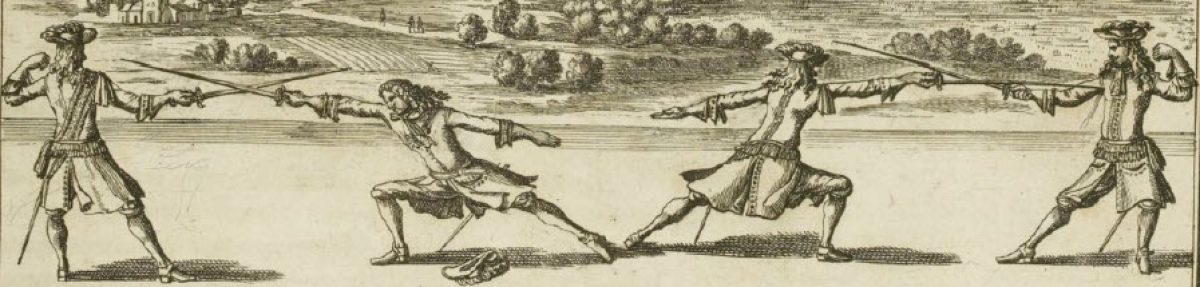

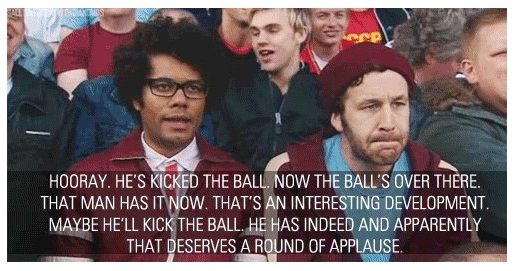


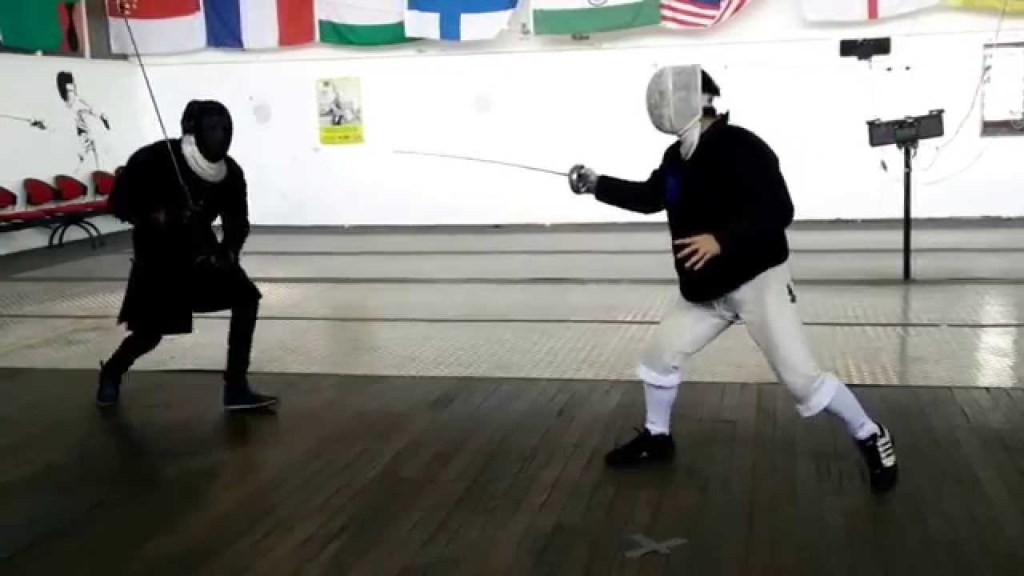


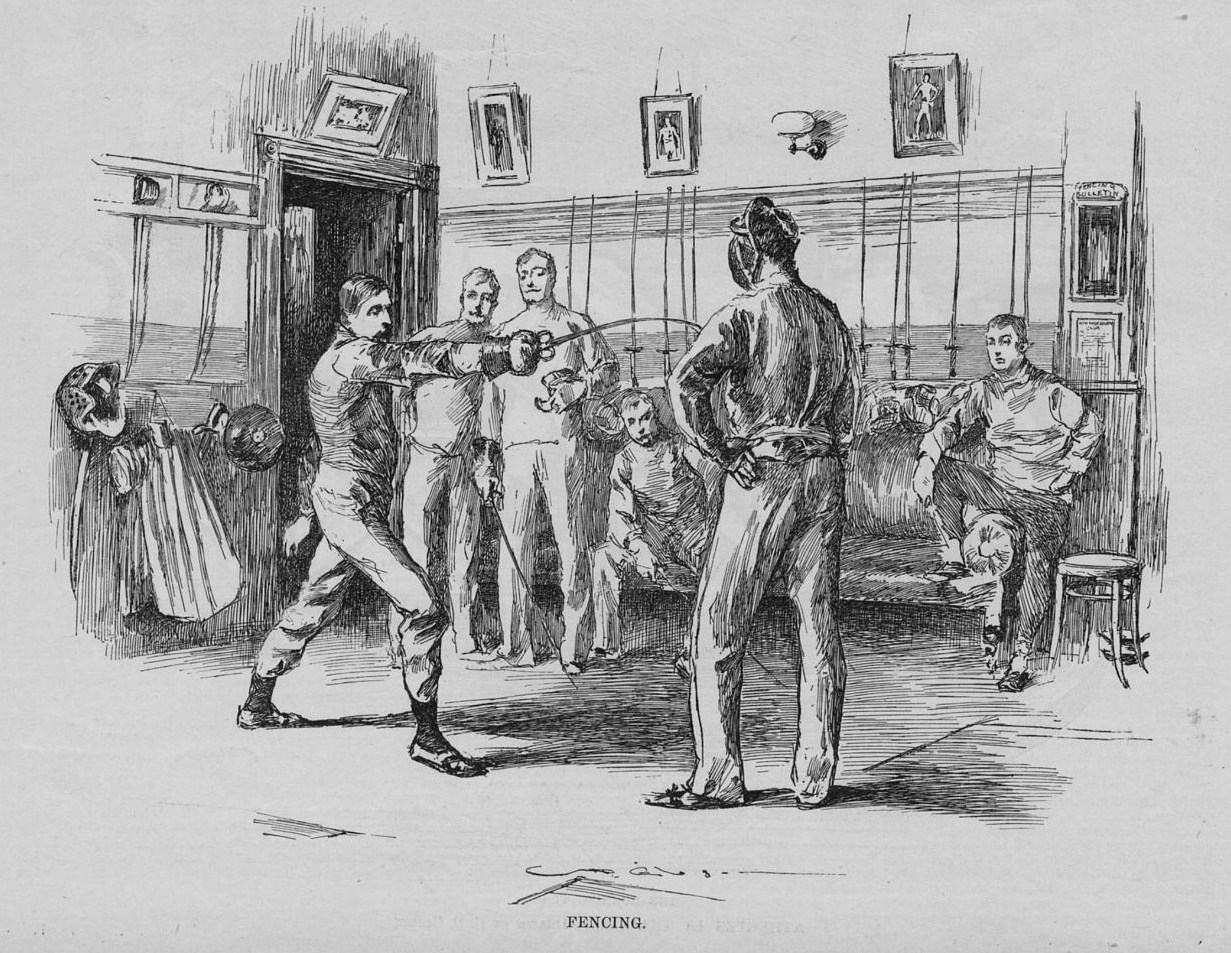




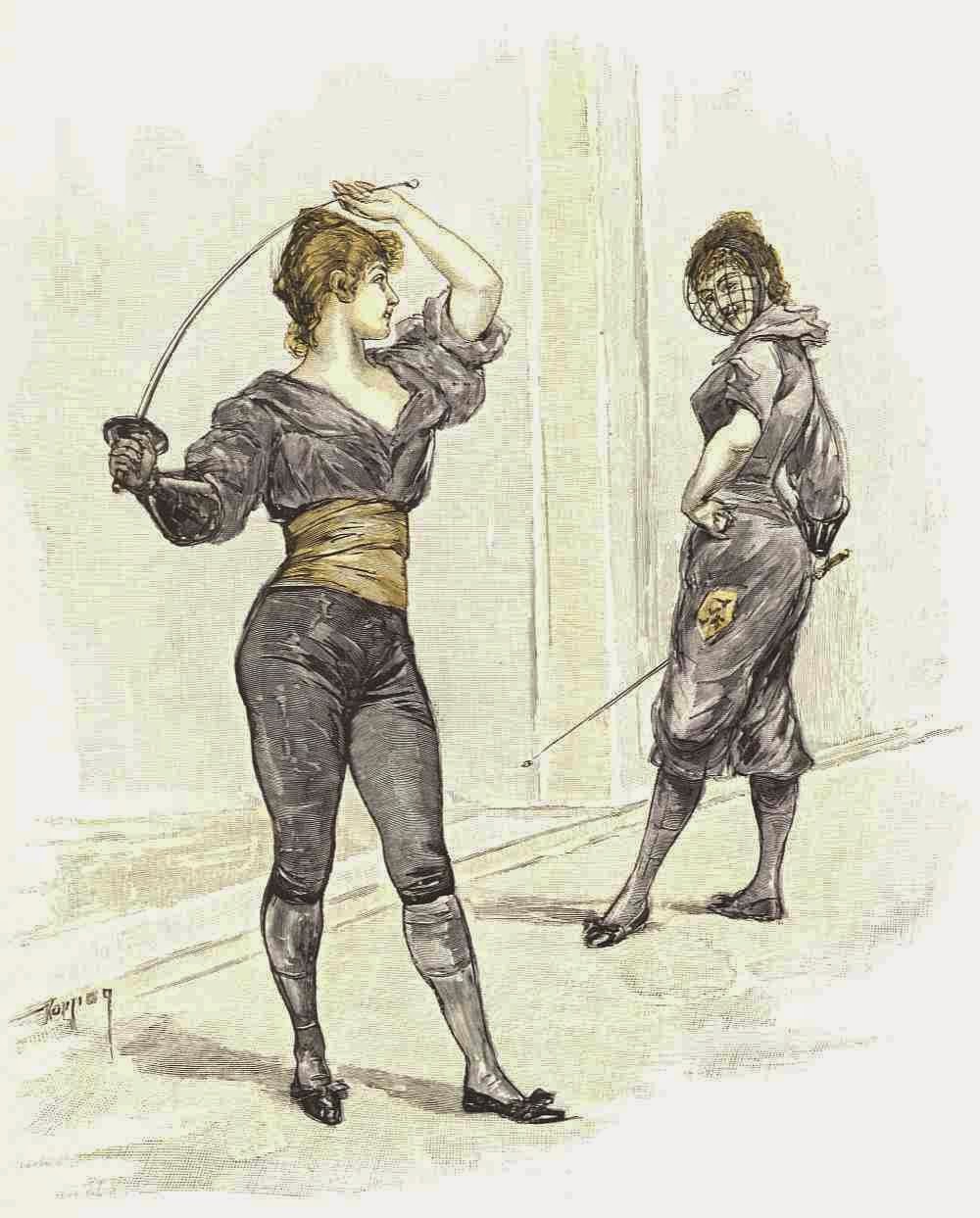



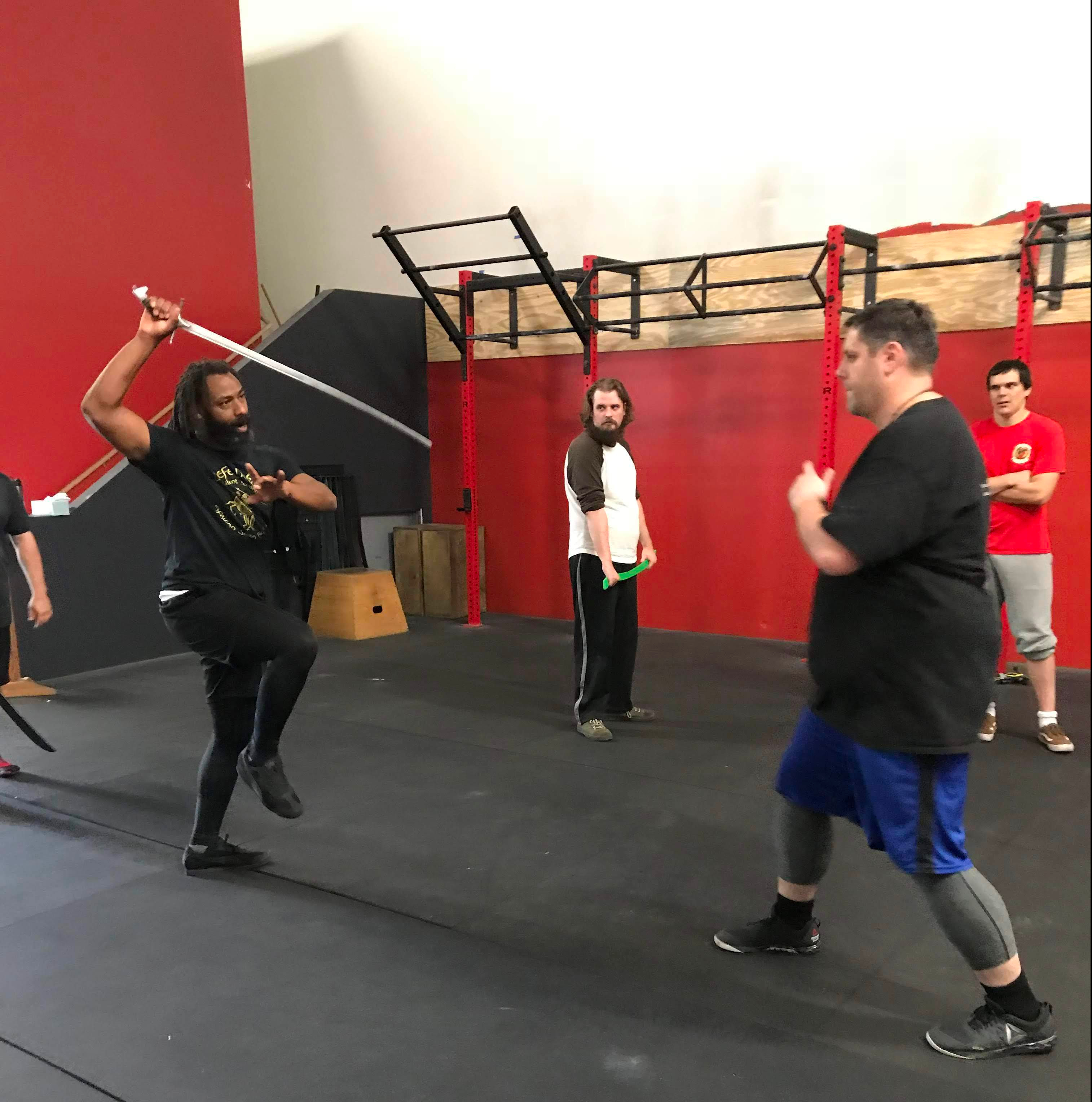
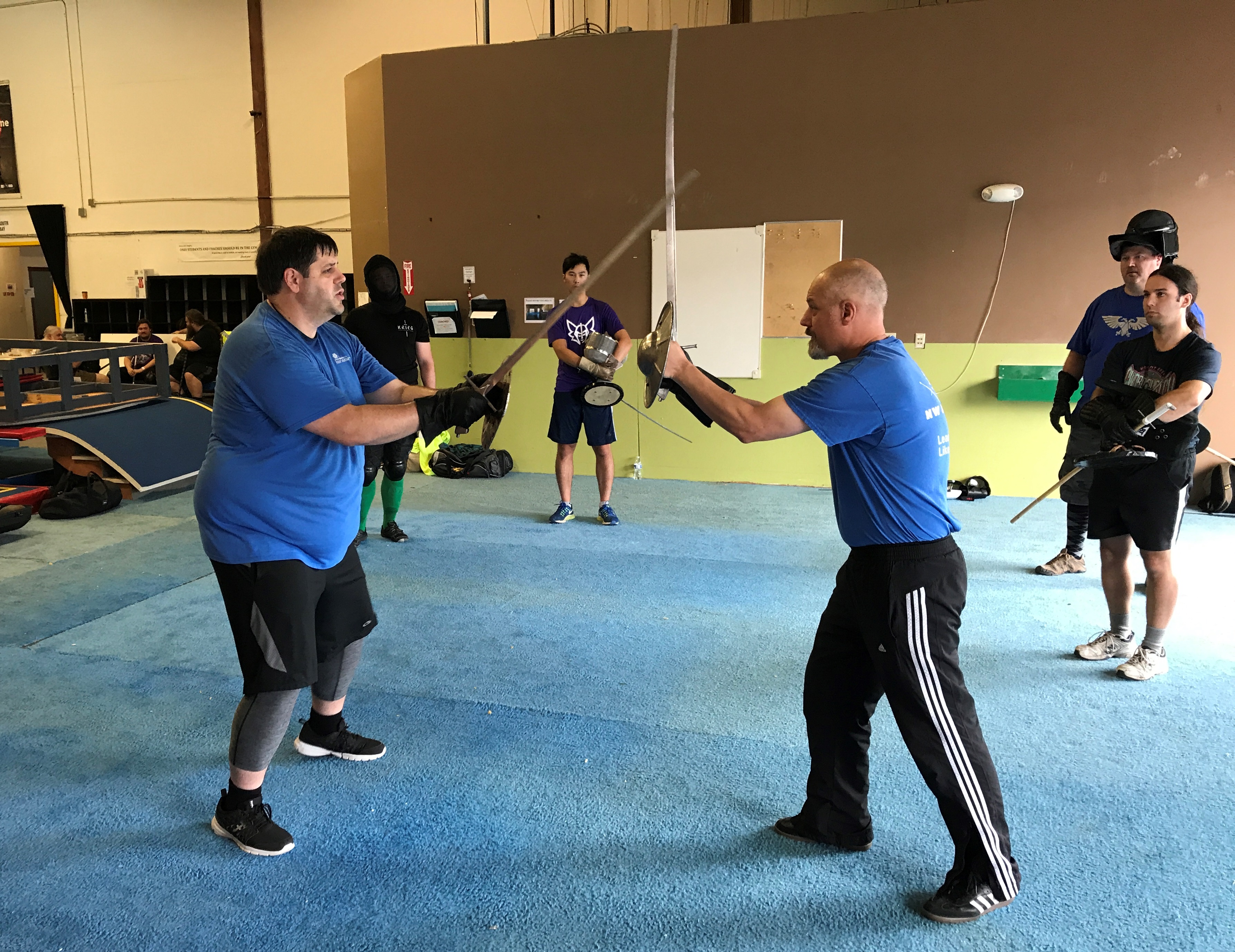


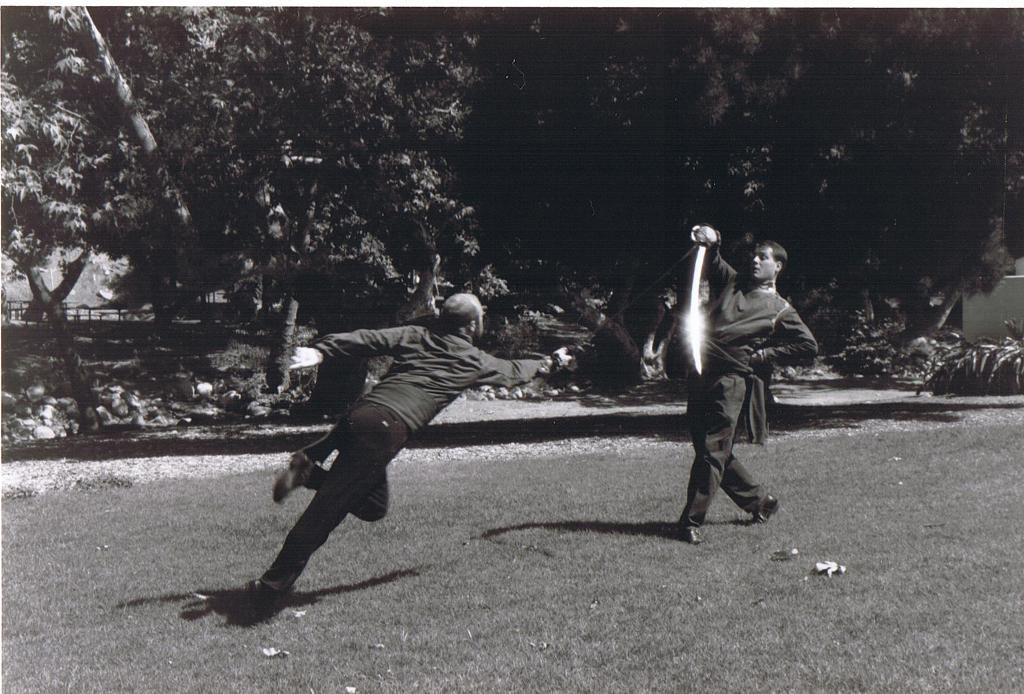
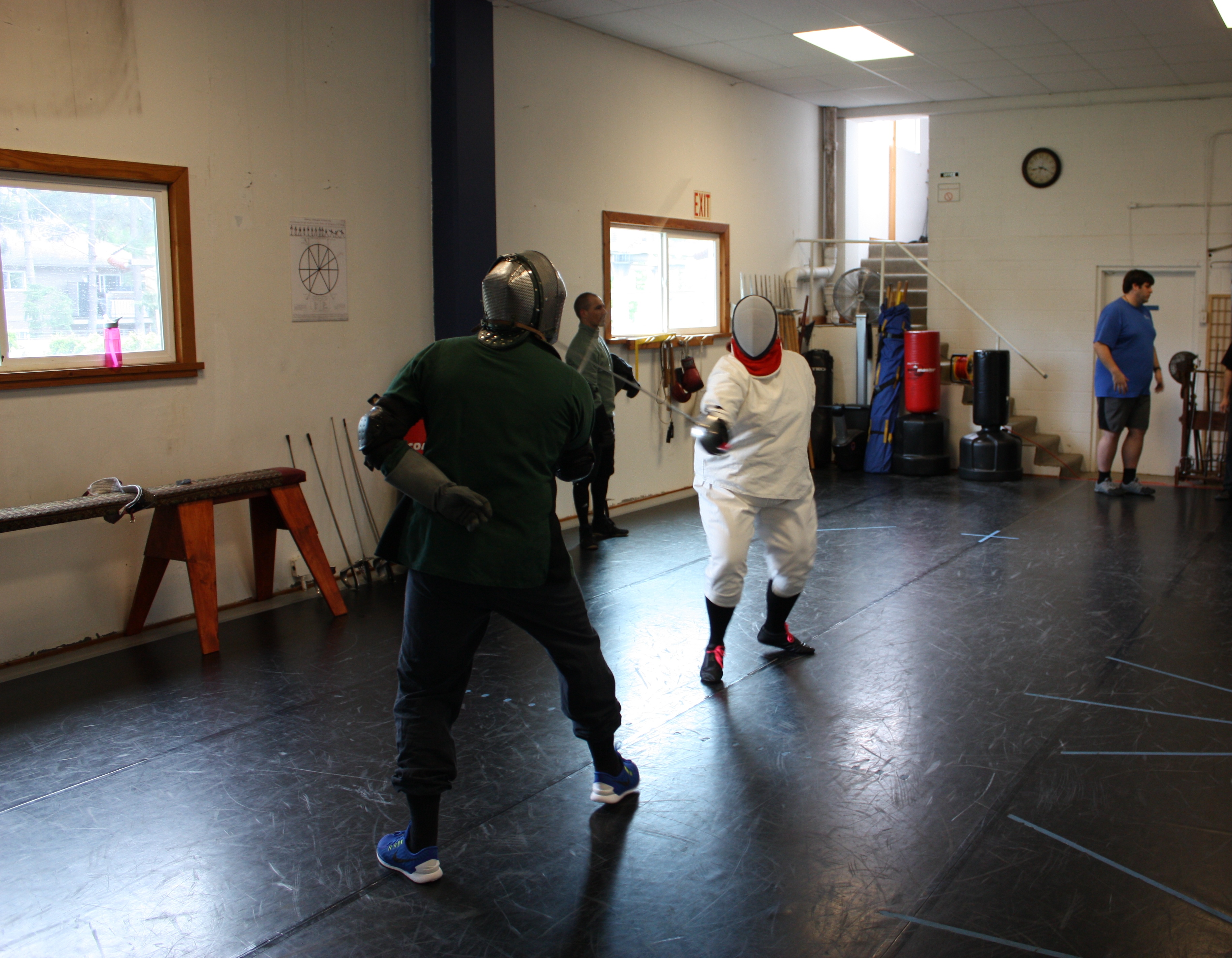

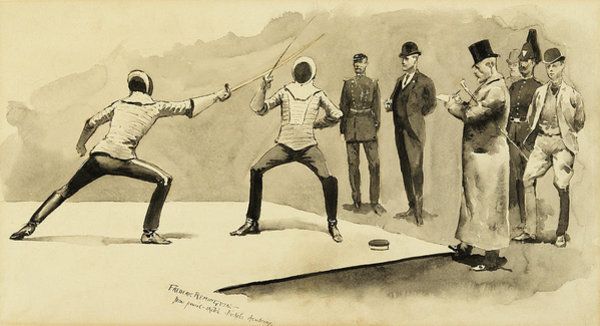

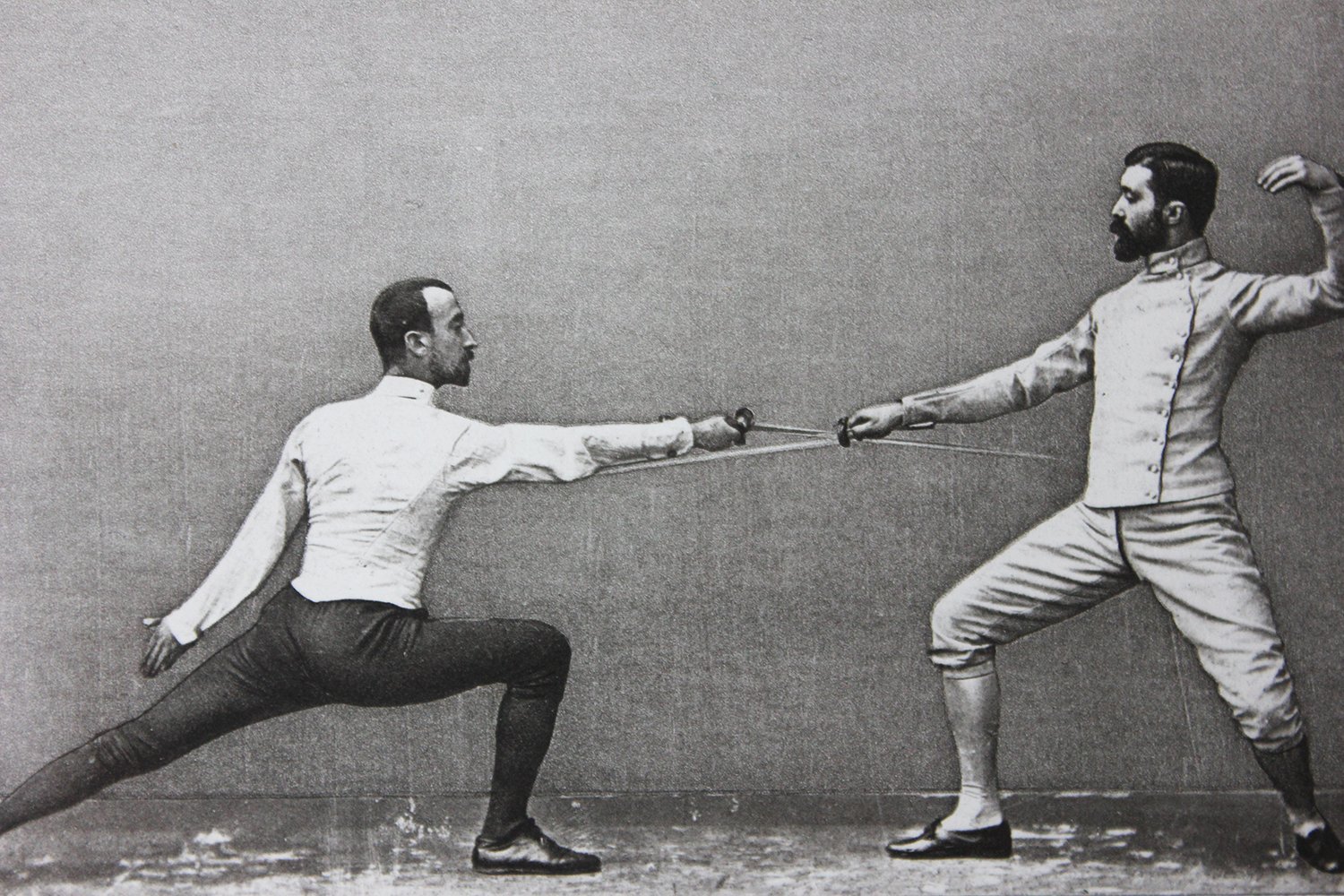 Drill is a mainstay of fencing. We do footwork. We practice point control. We make molinelli in the air and at a target. We (should) be doing a lot of drill. In historical fencing we sometimes devise or find ourselves doing drills that are new, concocted out of our source material, and it’s a fair question to ask what might be signs that a drill isn’t up to par or might even be dangerous? What does it take for a drill to be “safe” when we’re talking about hitting people with weapons? Different types of partner drills require different levels of complexity, intensity, and safety-gear. The instructor has primary responsibility for introducing safe drills and monitoring how fighters are managing safety, but there’s an equally heavy burden on fencers performing the drill. They need to exhibit proper control and courtesy or they’ll injure their comrades and injured comrades mean fewer people to fence with.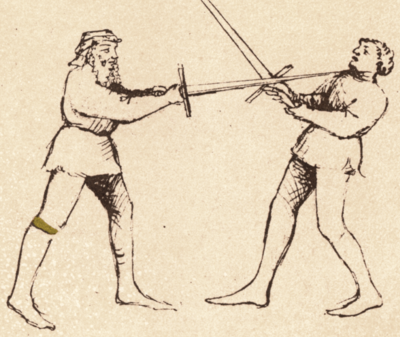
 Capitale Escrime Historical Fencing