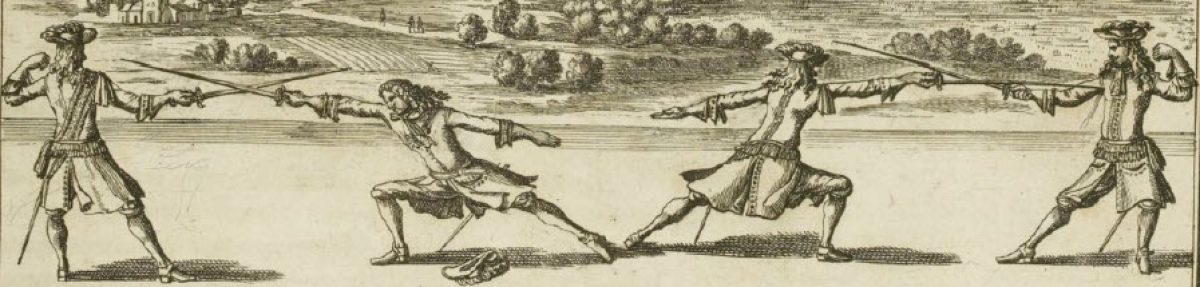

In two separate conversations in the last twenty-four hours the topic of martial arts, combat sports, and injury has come up. My spouse’s uncle, yesterday, remarked that when he was a teen studying TKD they viewed the semi-ambulatory middle-aged coaches as old men—now much, much older, he realizes that they were not old really, but battered and damaged from hard-training and fighting. This morning, I had a chat with a friend and college, Matt L., in California, about avoiding the very thing my uncle in law noted—early decrepitude thanks to martial arts. As someone navigating that very issue I have some perspective, and some advice for those not yet there about how to avoid, or at least forestall, the physical consequences of our training.
This is a post I’ve started a number of times, then put aside. It’s not that I don’t know what to write, but that there is so much to say, and, so little that most people will find motivating. I was no different, so if this sounds judgmental, know that I’m including myself in the censure. When I was in my teens and twenties, I could do things, and so, I did. I fought in a collegiate tournament on a sprained ankle that I taped up; I didn’t wait long enough to start training again after a slight tear in the meniscus of my right knee or years later after a chance stab wound to the same knee, one that nearly severed the LCL; I didn’t take a break, but taped and armored up my torso after a missed parry meant two cracked ribs. These were not smart choices, and, they’re choices that in one way or another I have to manage now.
Injury & Recovery
If you are injured, be it while fencing or in some other activity, take-a-break. Let yourself heal. This can be especially challenging when one is an active competitor, because the fear of losing ground, of any break affecting one’s standings, rank, or success is strong. Add to that the desire not to miss favorite events and it’s a double whammy.
You have time, use it. One “can” fence on injured joints or strained muscles, but one shouldn’t. I’ve likely stateed this on this site before, but we pay for all the fun of our teens and twenties in our forties and fifties, so, the better you manage yourself when younger, the less you’ll suffer when you’re older.
A good coach, by the way, will not only support a break to heal, but actively encourage or even order it. I’ve worked with ones who said tough it out, and, a few who told me to stop and take a break. Maitre Delmar Calvert, for example, when tennis elbow started plaguing my right arm again, told me to take a break and go to PT. Maitre Handleman just a few years ago told me and one other grey-bearded chap to take more breaks and to use walking steps during a weekend coaching seminar. This is good, proper coaching, and, good advice.
As a younger person, I fought competitively for several years in ITF conference TKD, and, at a time where the pads we had were good, but only so much. A smaller glove could easily reach through headgear; the footpads we wore had no sole, so a side-kick landed as it would in earnest; and we had no chest protection. By the age of 13 or 14 I’d had two ribs and my nose broken, never mind the damage I inflicted on people the same way. When a fellow student, a bit over-zealous, broke my nose in the practice right before a tournament, my coach—who was excellent—was more worried about my mother freaking out than the fact I’d been injured. It’s fighting, and well, we get hurt sometimes—it’s “normal.” He and another coach set my nose (NOT fun), told me to go and change out of my dobak (which was covered in blood), and to keep the paper-towel under the nostril inside my lip there until it stopped bleeding (a great way to stop a bloody nose by the way).

We accept injury as normal, but should we? Would it not be better to prevent it? I’m not sure I have a great answer or solution. On the one hand, I’m grateful for having learned early how much punching and getting punched can hurt—it no doubt helped me avoid trouble I was likely to be in otherwise. On the other hand, as a parent, well, I don’t like seeing any children hurt, especially when it isn’t necessary. My solution has been to focus on the mental side of all this, to help students cultivate mental toughness, confidence, calm, and wisdom to avoid trouble if at all possible.
Time & Repetitive Movement
Even if you are lucky to escape injury, years and years of repetitive actions take a toll on us. At 45, I started having an odd pain in my right leg and so saw my doctor. She ordered x-rays and other tests, and turns out my right hip was in the early stages of arthritis. I thought that was crazy; “I’m only 45!” was my reaction, but she then reminded me that I had been lunging on that same leg since I was 16. How many thousands and thousands of times had I likely lunged? Never mind other traumas to that leg.
It was the same with my elbows—Radaellian sabre mechanics use the elbow as axis, and even my Olympic training retained vestiges of this approach to cutting. I have tennis elbow in both arms, ironically because in 2001 I was in a serious car accident that all but destroyed my right shoulder, and so I started training as a leftie.
Neither of these issues arose from anything improper or stupid—they are the result of activity and repetition. While some degree inevitable, depending on one’s genetics and training, there is a lot we can prevent by taking simple steps. For example, had I rested my elbows longer; had I continued my PT exercises; had I taken better care of myself I wouldn’t be in as bad a condition as I am. I’ve been slightly wiser with my hip, though it has cost me some fun—I use more walking steps than fencing stance and footwork when teaching, and, hardest of all, force myself not to do things I actively want to do. At Rose & Thorns earlier this year, I desperately wanted to bout with people, but with my hip acting up after a misstep while teaching, I know I’d be on a cane, again, if I did. Missing out on the fun makes this a lot harder, but, if I can attend in 2026, hopefully that choice means I will be able to fence people.
Be Kind to your Future Self
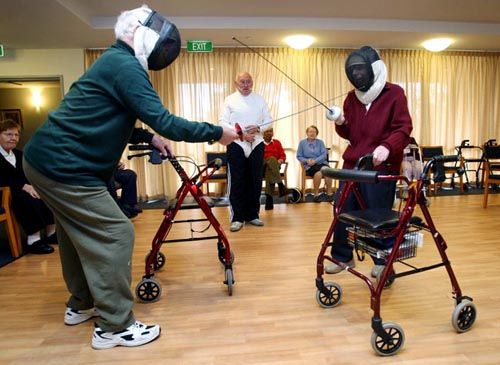
Many of us want to fence into old age, right up until we drop, and generally we can IF we take care of ourselves. Nothing I say or write is likely to change anyone’s mind—I didn’t listen well when I was 18 or 28 either—but I’ve reached the age where it’s now my turn to take up the mantle and sound like Chicken Little.
If you’re injured, take a break and heal. If you are fencing a lot, warm-up, stretch properly, and after your workout cool down and maybe stretch again. If you are doing stupid things, and let’s be honest, at some point many of us have, at least consider first what that choice will look like in twenty to thirty years. I can’t say for sure that twice jumping out of a second-story window also contributed to my hip issues, but… [1] Fencing with seriously garbage repro sabres in the mid-90s while understandable given interest in historical fencing, meant that injuries from them were a magnitude higher than with an Olympic or Schlager blades. Neither of the latter ever cracked my ribs, sunk into my knee, or broke my fingers protected poorly by a brass knuckle-bow. The truth is the training I received, particularly from Maestro Al Couturier and his assistants, was perfect for studying Radaellian sabre, and the cutting dynamic doesn’t need a 100% accurate tool to work—one can use an Olympic sabre, something slightly heavier, or a stick. It’s the mechanics, not the tool. [2]
Ideally, in addition to fencing one is also exercising for health. This not only contributes to your general condition and well-being, but will aid you in preventing injury. A solid program for cardiovascular health and an appropriate weight-lifting/condition regimen only help. [3]
To the examples of Masters Albert and Delmar already mentioned, I’d like to point out some of the masters I’m working under in Barbasetti Military Sabre since 1895, Josef Šolc, who is 89 years old, has fenced for 75 years and is still going.

Exhibit A: Me
In much the same way as Sy Sperling was both president and a client for his “Hair Club for Men,” I’m not just advocating that you take care of yourself, but I’m a living example of what happens when you don’t. [4] I’ve been better about it in the last decade or so, but consider how late that is—I was in my 40s when I finally started paying attention to the good advice I got from coaches, maestri, and health professionals. There is no round-trip ticket to yesterday, so I can’t undo that or go back and smack sense into my younger self, but for many of you it’s not too late.
You can avoid being the middle-aged person often on a cane, or sitting out from the fun, or taking extended breaks to fix something you made worse by not taking that break earlier. We often say that the most difficult opponent we face is ourselves, and this can be as true on the piste or in the ring as it is outside of them. It will take willpower, discipline, and strength to avoid some of the pitfalls I’ve outlined here, but it can be done. You’re future self will thank you if you start taking care of yourself now.
NOTES:
[1] Details are unimportant, but needless to say jumping out of windows, for whatever reason, if it can be avoided, should be. When I talk about being young and dumb, I speak from experience 😉
[2] This is an important point and one often misunderstood, despite the fact that most of the historical fencing community is aware that people in the past often trained with sticks. The value of using a period-weight trainer isn’t that one is required to do things correctly, but that it helps us understand why certain aspects were necessary. For example, many cavalry sabres, especially mass-produced trooper blades, are front-weighted. It’s not only harder to use the wrist to move them, but it’s a less effective way to use the weapon. Radaelli’s innovation provided a better approach. One can, however, use the same elbow-as-axis mechanics with a sport sabre or stick.
[3] Beach muscles (or would we say Instagram/Tiktok now?) are not generally helpful in fencing. One needs strength in some degree, but the real value is in muscular support of joints, the cultivation of stamina, and the side benefits for one’s general health.
[4] Cf. 1984’s commercial, https://youtu.be/xeFoLdeqG1I?si=wW-4jlN131y13SgP
 Capitale Escrime Historical Fencing