(I’ll be Your) Steppin’ Stone

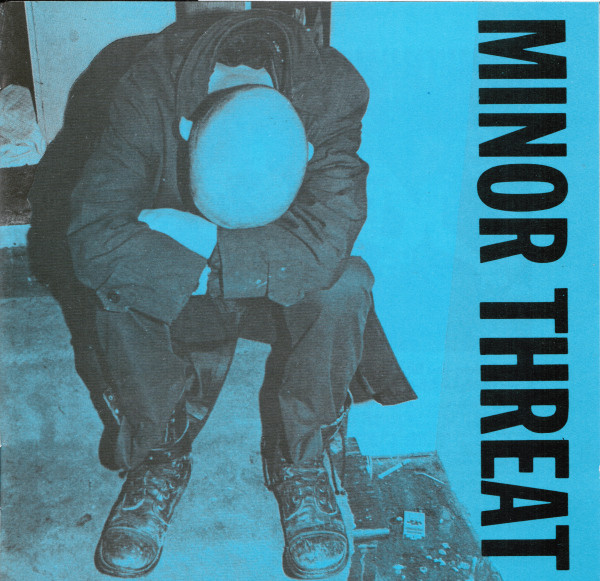
Minor Threat, “Minor Threat,” 1984 (Discord Records, DC)

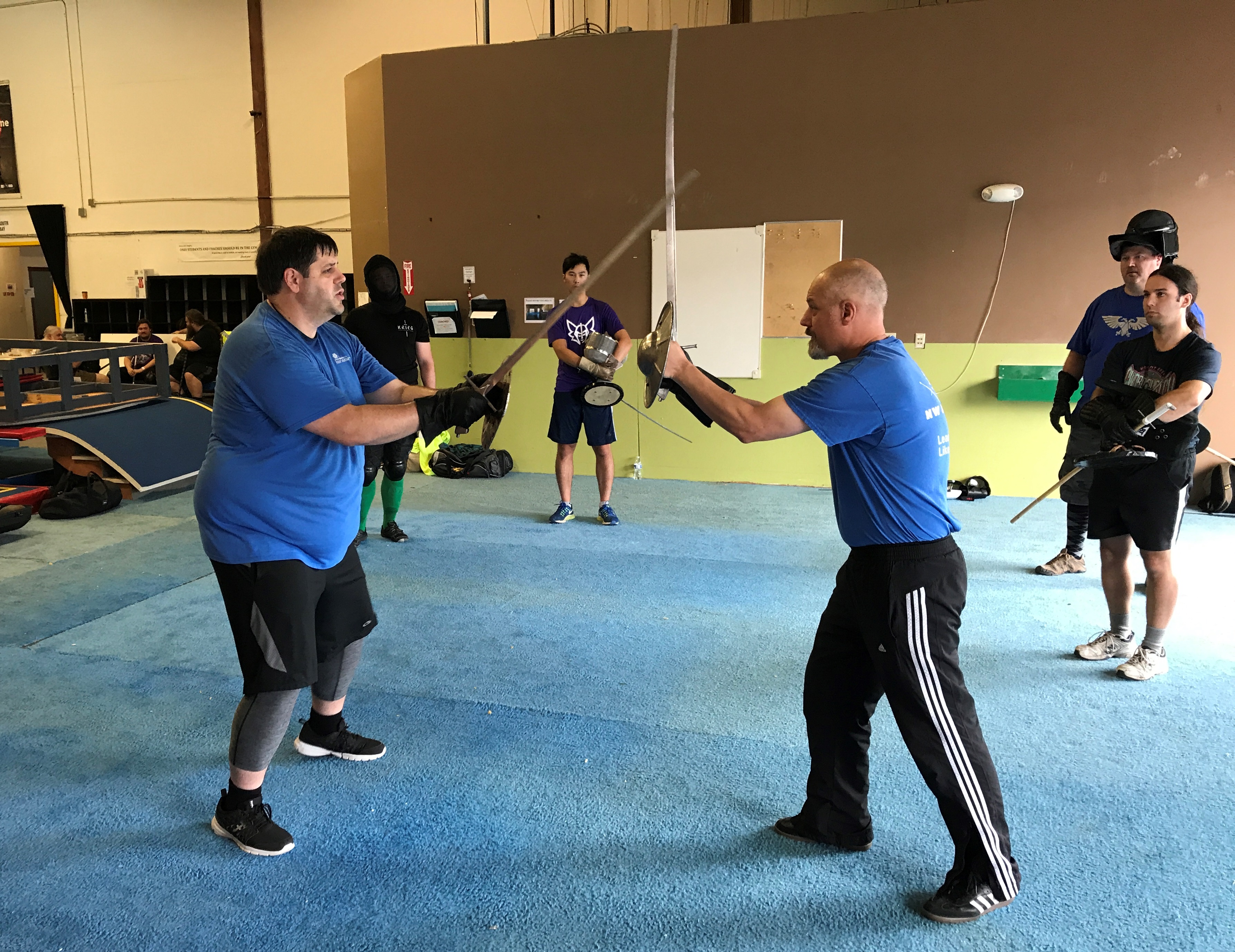
With apologies to Minor Threat (and ultimately to Paul Revere and the Raiders) there are times when it’s appropriate to act as a stepping-stone. [1] Granted, in a political and social context it’s a condition to avoid, but as a teacher it’s a model I rather like. I don’t mean that in the sense of someone walking over me or anyone else, but in the sense of approaching our particular instruction as just one stop along a longer path. There are a few reasons I prefer this model to the top-down one too often assumed.

Top-Down Teaching

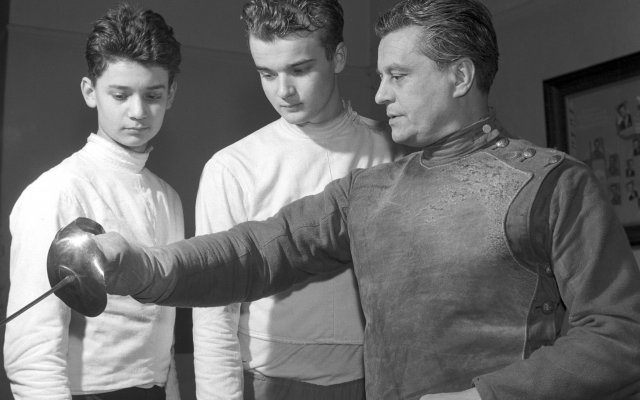
Despite centuries of change our conception of teaching is more or less medieval. The university, for example, was born in the Middle Ages and was, like most of society at the time, hierarchical. It’s not a bad system, and it works for many things, but it has been slow to adapt as societies have changed, as the purposes of education have changed. Other guild systems, particularly in skilled trades, have adapted better. [2] In fencing, as I’ve shared here before, the traditional model of master and student has worked well, and working one on one it’s still the best way to learn (assuming good rapport). I maintain it is still a discussion rather than a lecture, or ought to be, but I’ve worked with masters who definitely saw it as a one-way transfer and still I learned a lot. Group instruction tends to follow the same notion of information transfer.

No one in traditional or historical fencing is unaware of the challenges in teaching groups—it’s just plain harder to do. [3] Attention is divided, skill levels and experience can vary widely, and some systems are harder to teach than others. Seminars, for example, can be great, but we have to be realistic about our goals with them. That holds for students as much as instructors. Typically an instructor runs a class in a short window, from say two hours to a day, and in most cases expects attendees to keep up. Seminars are great for exposing people to something new, but not so great for retention or skill-growth unless the students are relatively advanced and know how to learn. [4] Meeting different needs in different ways is extremely difficult to do, and few top-down models accommodate the flexibility to do any of that well. So, one downside to the top-down model is that it tends to be unadaptive; this is more true in group settings than in individual lessons since an experienced instructor can read a student’s skill level and identify problem areas more easily. With a small group one can move among students and manage more individually, but in cases where one student needs far more help than the others figuring out how much to dial back or press on is a tough call. Finding a happy medium in cases like that is challenging—too often we either leave someone behind or hold everyone else back.

But… but my medals Bruh!

An additional issue with the top-down model centers around expectations. People who seek out a fencing master at a traditional or Olympic school accept that someone will be teaching them, and, that the person in question has information or skills that they themselves do not yet possess. Thus, a maestro, by virtue of training and experience, has built-in authority than no historical fencing instructor without such certification can assume. For the most part, “HEMA” has been more grass-roots, and authority far less obvious or certain. It’s a perennial problem. HEMA is ever at the whim of demagoguery. Popularity spreads via social media and has more weight than most anything else save tournament success. The problems with both should be obvious, but they aren’t. There is no automatic equivalency between fame and skill; they can correlate, sure, but that’s a maybe, not a given. Likewise, tournament performance can mean something, but it doesn’t mean what those who hold it up as the tantamount benchmark think it does. This is one reason that movements like HEMA eventually fracture—no amount of evidence puts the slightest dent in anything driven more by ego than sense, and both popularity and naivete about tournament success are, by and large, inseparable from ego needs and external validation.

In a related way, instructors who favor the top-down model sometimes suffer a strange mix of imposter-syndrome and arrogance. This drive for success is fueled by a wish for recognition from students and fellow instructors and/or a fear that they’re letting their students down. In this version they feel they aren’t doing enough or that their efforts are inadequate, or, that their work is unappreciated. That’s a lot of pressure to put on oneself. We must be concerned about doing the best work we can do, absolutely, but the responsibility to learn is not the instructor’s alone. Students must carry their burden too. People learn in different ways, at different rates, and try as we might there is only so much a diligent instructor can do. Sometimes no matter what we do, we are just the first to acquaint students with a new idea; this means that often they will not realize it let alone recognize each step or person who helped them. If our goal is sharing the Art more than appreciation then we should be happy with the fact they have that new understanding. If they remember us, great, but they don’t have to.

Allied/Collaborative Teaching

My preferred method of instruction is collective, mutual, because in teaching others we learn and grow too, least we should. However skilled, a teacher is nothing without students—it’s somewhat symbiotic. One of the benefits to this model is that it assumes and incorporates student skill and experience, and thus the burden to “teach” while still on the instructor is a burden in some respects shared. For example, for the last few months I’ve been advising a local branch of a larger club in Insular broadsword. Thanks to Covid, this school, one of the largest in our area, can’t meet en masse, and so they’ve divided in two for the time-being. The head instructor, Mike, is a close friend of mine; I check in with him about my curriculum, our progress, and keep him informed because I’m working with part of his crew. It’s collaborative in the sense that my friend trusts me to give them what they need, and that I’m coaching some of his people, but it goes a step deeper than that.

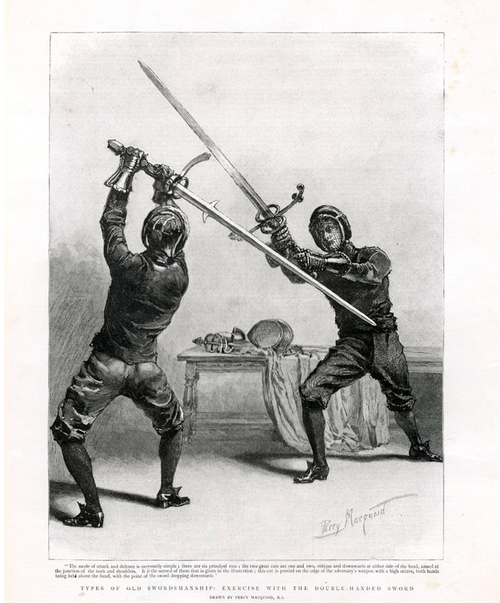
I rely on the experience and perspective of these students. Most have studied Fiore’s Armizare, some fight in harness, and most have also studied other branches of the Art, from MMA to other schools of fencing. Because they were taught well, they understand the basic, universal principles behind sword-arts, and thus are quick studies. I speak just enough Fiore to help them bridge the differences, say in comparing Roworth or Angelo’s cutting charts, Radaellian molinelli, and Fiore’ segno—all cover the same lines (not an accident), and, all enshrine critical aspects of their respective systems. Working from the familiar they more easily gain the unfamiliar. They ask questions, we break to discuss what they discover during the drills I put them through, and as a result they’re building not just technique, but as importantly, understanding by applying it in problem-solving. [5] Time will tell how many stick with it, but their time will not have been wasted. The knowledge, understanding, and appreciation for the Art will have grown.

Like a well-placed, solid stepping-stone my function is to support them best as I can while they’re with me. Some will continue down this path, a few may follow the same path but with a different instructor, and many more will take another route all together, but if I’ve done my job I’ve given them what they need while their feet stood on the stone I manage. Kahil Gibran (d. 1931) famously wrote that “Your children are not your children/They are the sons and daughters of Life’s longing for itself./They come through you but not from you,/And though they are with you yet they belong not to you.” [6] A less poetic by equally powerful analogy is the unsung hero of any nation, the elementary school teacher. They teach students for a year, teaching them the skills they will need in life and that will enable them to continue learning. They get little respect, next to no pay, yet no one has a more important task than they do. No one. Nothing I teach is as important—people can live with knowing how to feint-cut head or disengage—but like them most fencing instructors are a temporary fixture in a fencer’s life. That’s not always the case, but I think it’s a healthy approach—it keeps us responsible and on task, and helps us avoid concerns over turf, ownership, and other distractions. So, “my” students are mine while they work with me, and in the sense that they may carry on to others what was passed on to me, but their journey with the Art is their own. This doesn’t mean I have no responsibility, quite the opposite, but it does mean that my focus remains on the material, on sharing it effectively, and in helping others learn and enjoy skills difficult to acquire rather than on numbers, reputation, or a legacy. I must make the absolute best use of the time I have with them, and since it’s usually short, I must stay sharp too, reading, drilling, and improving.

Mixed Approach

The collaborative model is more result than method. In truth, when I’m teaching or advising generally it’s because I have the background, education, and training to teach that topic. I won’t teach things I know I’m not qualified or ready to teach (yet another plug for continuing education). One reason people go to me, when they do, is because I know the sources well, and I’ve been fencing and researching it for a very long time. None of it “belongs” to me; it was all devised and written by others, some of which was passed on to me, some of which I have studied, but regardless I’m more a conduit than anything else. A blocked pipe is inefficient, it doesn’t do its job well, so potential clogs, especially those of ego, have no place in teaching. One needs to be confident, but any real confidence is born of ability, not desire, and smart students quickly spot the difference.

In sum, what I want is for them to learn and enjoy the material, not shower me with attention, kudos, or external validation. The top-down model can work, but it more easily facilitates those interested in self-worth generation than the Art. For instructors like that, because they are the font of information, it can be harder to be questioned, less comfortable working with other equally skilled (never mind superior fighters), and easier to worry too much about rep and not enough about the material and the best strategies for sharing it.

An important caveat: all of us have an ego. Most if not all of us struggle with self-worth in some fashion. I’m no exception. The difference is I’ve been lucky, or unlucky depending upon how one views it, to have spent far, far too much time around people driven by ego, and I’ve seen the results both to those same people and those they teach, in fencing and in academia. The fewer the rewards, the more savage the fight over scraps.

Young Kendoka in mokuso, via Pinterest

Having started in Asian martial arts, where Buddhist ideas of the annihilation of the ego inform so much, I view the Art, whatever the branch, fencing included, as paths by which to grow. [7] Decades of training, wherever I’ve had it, have only proven to me how important it is to get out of our own way. Li Mu Bai, one of the protagonists in “Crouching Tiger, Hidden Dragon” (2000), said “No growth without assistance. No action without reaction. No desire without restraint. Now give yourself up to find yourself again.” This applies to many things, teaching included, and I believe that we do our best work, teach the most effectively, when we recognize the gifts others bring to a class, when we try to meet them in the middle, and when our focus is genuinely on the Art rather than ourselves.

NOTES:

[1] Cf. Paul Revere and the Raiders, “(I’m Not Your) Steppin’ Stone,” Midnight Ride, 1966, Vinyl; the song was written by Tommy Boyce and Bobby Hart. I’d heard the original and the cover by the Monkees, but by age and location I always think of this as track by Minor Threat, “Steppin’ Stone,” Minor Threat/First Two Seven Inches, 1984.

[2] There is a lot of literature about medieval education. See for example John W. Baldwin, The Scholastic Culture of the Middle Ages, 1000-1300 (Prospect Heights, Ill: Waveland Press, 1997); Charles Homer Haskins, The Renaissance of the 12th Century (New York, NY: Meridian, 1972) & The Rise of Universities (Ithaca, NY: Cornell University Press, 1965) are now dated, but classics and worth a read; Edward Grant, The Foundations of Modern Science in the Middle Ages (Cambridge, UK: Cambridge University Press, 1996); L.D. Reynolds and N.G. Wilson, Scribes and Scholars: A Guide to the Transmission of Greek & Latin Literature, 3rd Ed. (Oxford, UK: Clarendon Press, 1991);

[3] See especially László Szabó, Fencing and the Master (Staten Island, NY: SKA Swordplay Books, 1997, 11-14; see also Zbigniew Czajkowski, Understanding Fencing: The Unity of Theory and Practice (Staten Island, NY: SKA Swordplay Books, 2005), 132139; 182-187; 280.

[4] Advanced students, because they have a solid knowledge of universal principles, can more easily “mine” a class than can new or intermediate students. Newer students still benefit, and as I’ve set things up they intermix with more advanced students for whom broadsword is new too. This brings them all up faster. In the past, this has worked well, and seems to be doing so now. The only hiccups hitorically have been unteachables, i.e. students who believe they already know everything and dismiss what we’re doing because it doesn’t conform to their notion of things. They tend to be disruptive, critical, and keen to put the stupid instructor in their place—happily, they don’t last and leave when they can’t “spar.” Until recently I was keen to try to help them out, convert them as it were, but there is an old saying about arguing with a fool only makes two fools, so…

[5] More and more I’ve been working to adapt some of the approaches we use in individual lessons for groups. My plan for the next post is to explore some of this in more detail.

[6] Kahil Gibran, The Prophet (West Molesey, UK: Senate, 2004), 20.

[7] Lest anyone think that self-improvement via fencing is unique to Asia I’d like to share this short passage from J. Olivier’s smallsword treatise from 1771:

It is the cultivation of this art that unfetters the Body, strengthens it, and makes it upright; it is it, that gives a becoming gait, and easy carriage, activity and agility, grace and dignity; it is it that opportunely awes petulance, softens and polishes savageness and rudeness; and animates a proper confidence; it is it which, in teaching us to conquer ourselves that we may be able to conquer others, imprints respect and gives true valour, good nature and politeness; in fine, which makes a man fit for society.

[J. Olivier, Fencing Familiarized: or, A New Treatise of the Art of Sword Play, 1771 (London, UK: John Bell, Google Books), xliv-xlvi.]

Piste & Page (Part I)

[I’ve been asked several times how I got into historical fencing, why I’m no longer competing, etc., and figured it would be helpful to me if no one else to spend some time on that. Thirty years of fencing, and forty of martial arts, puts a body through a lot so the easy answer to the competition question is “mileage.” For the literary minded this is a choice between playing Achilles or Nestor—the former’s path may gain one glory, but a shorter career; the latter a longer career, but less glory. I intend to do all I can to fence until I am utterly unable to do so, and so that means focusing more on teaching and research than it does tournaments. Few talk of Nestor, but he made it to Troy and acquitted himself well so while hardly the most exciting character among the Danaans, there are worse role-models 😉 In any event, here is part I of how I landed where I currently am]

A friend of mine, an author working on a new book, asked me why sabre is my favorite weapon. This sparked a longer conversation about how I got involved with historical fencing. I learned a long time ago to develop answers akin to those one uses in academia, that is, to have a soundbite, a two-minute answer, and then a full answer which might take a few minutes, each appropriate for specific instances. Most people, for example, when they find out you’re a professor ask “what do you teach?” and expect a short answer, such as “history.” Going into detail about Libanius’ support of the Emperor Julian or imported narrative tropes in Irish hagiography is usually only of any real interest to me and three other people. Neck-deep in graduate research, working alone for the most part, it’s easy to answer these questions with far more information than people want or need. It can take time to read that in people, least it did for me. They might ask, but they don’t really want to know.

It’s the same with fencing. I replied with a short answer, but my friend wanted more, so I told him that like many people I started in foil, but that the sabre squad at my university needed a fourth member so I volunteered. I had watched the sabreurs fence, and was attracted to the speed, noise, and violence of it. It looked fun!

Our coach at the time, Maestro Edwin “Buzz” Hurst, was strict, appropriately demanding, and quick to dress us down if we got lazy or our attention wavered.[1] This was difficult for many students. An Annapolis grad and retired naval officer, Buzz can summon that stern military demeanor when necessary. I learned a lot from Maestro Hurst, not only in terms of technique but in terms of tactics and strategy. One of the things I admire about him is that he never once refused to answer a question or explain something. I’ve met coaches who have 15-20 min. per student and little patience for questions. Busy as he was, Buzz was happy to answer questions after a lesson or if we happened to join him for lunch.

UCSB Fencing Team 1992–Maestro Hurst is in the middle, rear row; I am on his right as you look at the photo; Phil Ives, our sabre squad captain, is on Buzz’s left; Jason Levin, another sabreur, is just right of me and down slightly.

UCSB’s fencing club was just that, a club, which meant limited resources unlike NCAA supported teams. It was all on us for the most part to bring in additional money, something we did with everything from bake-sales to fencing demonstrations. Our numbers dipped, and about a year or so after Maestro Hurst helped us achieve the division championship (1992)—something a club team had not done in some 25 years—we found we could no longer afford him. [2] This affected the sabre squad perhaps most, but in time we were lucky to contract with another Los Angeles area maestro, Albert Joseph Couturier (d. 2014, aged 91), “Al” to us. Members of our foil squad had been visiting his salle in Culver City, and some of his students and assistants had helped direct our tournaments.

It was a long drive for Al, then in his early 70s, so two students, Larry Dunn and Brian Peña, usually drove up with him and assisted. Brian helped coach foil and epee (though he is a good sabreur too), and Larry assisted Al with sabre. The years I spent studying with Al and Larry, as I look back on it, were the years that shaped most of my game. Buzz had given me a solid foundation, and they helped me build a house on it.

SoCal NCAA Fencing, 1990s

Reputation for laxity and a “duuuuuude, the waves are like sooo killer brah” attitude aside, southern California was and remains a major hub for fencing in the United States.[3] In the early to mid-90s the level of skill in the collegiate division, fed as it was by parallel interest in USFA competition, was high among the top tier of competitors. With so many maestri in town, and post 1984 Olympics (Los Angeles), coaching was not only available, but often of extremely high caliber. It had long been this way. Some names are well-known in American fencing, such as Aldo Nadi and Henri Uyttenhove, but Delmar Calvert, Len Carnighan, Michael d’Asaro Sr., John MacDougall, Torao Mori, Heziburo Okawa, George Piller, Charles Sandberg, Doc O’Brien, Hans Halberstadt, and many others all taught at some point or other in California, and between them and their senior students the talent pool was as broad as it was/is deep. In addition to the masters resident in the area, many world competitors and instructors visited too. Daniel Costin, originally from Romania, directed some of our collegiate bouts, and I had a few lessons with Ferenc Lukacs when he was at Salle Couturier.[4]

When there is such a high level of coaching, so long as one is dedicated and puts in the time one will improve. Like many things, the more we know of something, the more we’re able to do, the more enjoyment we get out of it. Provided with frequent tournaments, in college or via the USFA, we didn’t lack for chances to hone our skills. One reflection of this mix of enjoyment and skill was the fact that after the sabre portion of a tournament was over—we were usually first to finish—a number of the schools in the conference would keep fencing. This was common pre-electric sabre.

Depressions Beach, Isla Vista–yes, yes it is somewhat a miracle that any of us at UCSB ever graduate.*

We came to know many of the fencers at UCLA, USC, CS Fullerton, and others. Our major rivals, however, tended to do their own thing.[5] The chance to fence with some of the best fencers in our area, after the stress of competition, not only made for fun but allowed us to fight better fencers without the pressure. We learn a lot in friendly bouts with those more skilled—the fact that it’s fun helps too. As a much younger person fighting in competitive TKD tournaments I had been encouraged to seek out better fighters—one will face some tough bouts, but what we can learn there is invaluable. It is just as accurate in fencing. D’Artagnan Sr., one may recall, tells his son “Vous êtes jeune, vous devez être brave par deux raisons: la première, c’est que vous êtes Gascon, et la seconde, c’est que vous êtes mon fils. Ne craignez pas les occasions et cherchez les aventures. Je vous ai fait apprendre à manier l’épée; vous avez un jarret de fer, un poignet d’acier; battez-vous à tout propos; battez-vous d’autant plus que les duels sont défendus, et que, par conséquent, il y a deux fois du courage à se battre.” [6] This happy camaraderie changed dramatically with the advent of electric-sabre in collegiate fencing.

Electric Scoring: Sabre’s Charge at Krojanty [7]

Electrical scoring wasn’t new and had been a normal part of foil and epee for decades, but sabre proved far more difficult to convert.[8] Where depressing a button at the tip of the weapon is a fairly simple mechanical process, figuring out how not to make the non-dangerous portions of a sabre blade register as a hit is complicated. To this day no one has done it. It’s one piece of metal, but only the true edge, tip, and last third of the false edge—supposedly—should register a score. That is in keeping with real blades—the flat might smart, the forte might bruise, but neither is sharp. In the days when sabre was fenced dry, where we had a director presiding over the bout and four judges to assist, this was far easier to track. The director had to listen as well as look—if they heard fabric before steel, it was a hit; if steel before fabric, it was parried and the following “thwack!” was whip-over; if the sounds were simultaneous then chances were good it was a malparry or failed parry. The judges, ideally, helped determine this by acknowledging either a hit or miss, or in the event they were unsure or could not see, they could abstain.

Since the judges were pulled from the teams, and since some teams were open to cheating, the judges could and did try to game their role. A good director called them on it, however, and made it clear that such garbage wasn’t going to work. Given this potential problem with judges the appeal of electrical scoring was obvious; but it was introduced too soon. The technology only worked in ideal circumstances, but those with the power to do anything about it didn’t see that.

Whether used with an accelerometer/capteur (as we did initially) or without, electric scoring in sabre only works if everyone is playing according to ROW (right of way), is skilled enough to fence cleanly, and honest enough to acknowledge a fair hit against themselves or deny a poor hit awarded to them. Assuming well-trained fencers who are defense-minded, who aren’t adapting their technique to exploit the scoring system, it “can” work. However, because it was so easy to exploit weaknesses in the system, the lowest common denominator became the path to success. Crappy fencing could and consistently did beat out better fencing. To make matters worse, the rules, then as now, do not allow one to overrule the box. Worse still, the rules soon changed to reflect the new reality.

Almost overnight the problems became obvious. First, from the director’s call of “allez!” both fencers would fleche at one another and double out. In the next exchange, the better tactician might feign a fleche, but instead take distance, make say a beat-attack against the fencer making the fleche, and make the touch, but… lose the point. The reasoning behind this, such as it was, argued that since the attacker’s light went off the other fencer must have failed to make the beat-attack in time. Half the time the director called it a failed parry-riposte—understandable, perhaps, but less so when the fencer making the beat is taking distance and striking either the middle or last third of the blade… Part of a director’s job is to make the call as to who has ROW, the initial attacker or the person who made the counter-attack in tempo, and this was still required, but increasingly the director came to rely on the box versus their eyes and ears.

With both lights signaling, and thus both fencers “hit,” the fencer making a simple attack with a fleche, say a cut to the head, was awarded ROW mostly because their attack was straight-forward. Anything more complicated than hop-and-chop was too easily taken for a failed parry or searching for the blade. The problem with this is that the very same principle of ROW means that an attack into tempo, such as a beat cut–properly made–takes ROW away from that attacker. Relying on the lights rather than one’s senses was a natural mistake, one only encouraged by the director having to bow to the box. Between less focus on what the action actually was and expectations for bad fencing at the collegiate level, directing followed the fencing as it descended into the chimpanzee donnybrook it increasingly became. As for the parry-riposte game, it was gone.

The “Flunge” **

The answer was a band-aid instead of a solution. They outlawed the fleche and any other attack where one crossed one’s legs. Fencers, however, who relied on it began to make a similar, if far more clumsy attack, the “flunge” (more or less a fleche except that the legs don’t cross). The en garde position went from mid-century third, a compromise between offense and defense, to a forward leaning position, one where the hand was held at about hip height, point near the floor, to facilitate a speedy slap at the bottom or side of the bell-guard. [9] These fencers were literally attacking the strongest part of one’s defense and scoring—it didn’t matter that this was whip-over. The light went off. One could take the Platonic ideal of a parry and it meant nothing. The entire ethos of the game changed, and the frustration of some combined with the glee of those getting away with it fostered a bully approach of mask-throwing, simian grunting, and screaming clownishness that has persisted. Had they addressed the one thing that would have fixed it all, the nature of the blade, they could have saved themselves a lot of trouble (and no, the s2000 blade did not solve the problem).

Disillusionment

Anyone who spends years dedicated to honing a complex set of sophisticated techniques is going to be a little disappointed that almost overnight they don’t matter. As in so many things, it also didn’t matter that one was right—that the logic of ROW argued against the ridiculousness, that both common sense and history were on one’s side. Nothing. What mattered was winning. The chimp who slaps at your bell-guard and makes a light go off has not proven that they’re the better fencer, only that they’ve learned a game using sabres well. There is a difference.

The lack of concern, even amongst our teammates, was disheartening. The coaches were sympathetic, but on the one hand hamstrung by the rules and on the other were accustomed to a different experience on the piste themselves. There was a short time where high-level competitors, who had been trained properly, could work around the nonsense. Directors too, since they were dealing with A-level competitors expected and looked for more than the hulk-smash blitz of the flunge at the bell-guard. Only later when these fencers started to suffer too did coaching change. In their view, I suspect, bad fencing is just bad fencing, and since they had less trouble, the problem wasn’t the electrical scoring system, just newer or less-experienced fencers than themselves.

Defection

I can’t recall the exact date, but it was during the last two years of my competitive life that I made the break. It wasn’t apparent to me then, in fact it wasn’t for a very long time, but looking back on it the decision to dive into the sources was a turning point. For a long time the sea-change in my imagination was the memory of a comrade and I cracking open two bottles of McEwan’s Export Ale after our last collegiate bout, but in hindsight that was just a sad denouement.

Carl Thimm’s bibliography and other works in the university library were my first stop. I combed bookstores, and the burgeoning internet where among other things I discovered that there were other weirdos like me as well as people like Patri J. Pugliese who had started scanning and sharing long out of print manuals and treatises. I discovered both further conviction for the cause and comfort in works like Barbasetti’s that were so close to what I had learned.

Tolle, lege!

To most historical fencers this will sound pretty normal, i.e., looking at sources, but in Olympic circles it is, or was, less common. There was almost never any reason other than an individual’s curiosity to consult a work on fencing, especially in our region. We all took lessons from masters who had carried on centuries’ old methods, who could answer questions, and while the historical nugget here or there was fun trivia, the focus was improvement to advance and medal. One didn’t need books to do that.

If reading up on fencing, and reading old fencing manuals was odd, even worse were the attempts to create more realistic (yet still safe sabres). With apologies to my friends in the SCA, my teammates back then, viewed the various experiments that my good friend and fellow sabreur Jon Tarantino and I conducted as one step away from puffy shirts and bad Elizabethan accents. It cost us most of our credibility with the club. We were tolerated, but barely. Pity to say that now, some twenty-five years later, the ill-will people bore us remains strong with some former teammates. No amount of explanation, even apologies for souring newer fencers, has made a difference.

Dennis Nedry to Dodgson: “See? Nobody cares.”

One thing I believe to this day was that Jon and I found a simple solution, one we proved worked, and that would have helped alleviate a lot of problems if it didn’t outright fix electric sabre or make it unnecessary: a return to more historically accurate blades. The core issue was whip-over, so logically a slightly stiffer blade would help. This was the path the FIE took and the resulting s2000 blade is stiffer.

However, that was only part of the problem. Fencing with a weapon so light is fast, so fast that it allows one to do things that one cannot do, not safely anyway, with a weapon of period weight. This was less an issue when the lighter blade was invented for the sport because training still reflected the reality of the duel. After all, the duel had not disappeared in Italy yet, nor in France for that matter, and there were still people either issued swords or using them in war as late as World War II.

Stiffness was an easy solve, but adding weight is not something I think anyone official considered. Concerns over legal and safety issues were raised when Jon and I brought it up, but these were weak arguments. Produced correctly, blunted, with proper flex, a blade along late 19th century lines is as safe as anything else. The additional weight becomes negligible quickly after a little practice, and there is no marked increase in force—most of that comes down to training. Good fencers are not hard-hitters.

We sunk a lot of time and money into researching options for such a blade. The problem was no one made them. We went through a lot of crappy Indian-made “cavalry” repro-sabres, any theatrical blade even slightly robust, and at least two really lovely—but totally unsuitable for bouting—“Masiello” sabres made by Oscar Kolombatovich. In most cases we had to alter these weapons significantly to use them safely. With the repro cavalry sabres, for example, we tapped out the peen to remove the blade, ground it down to a more suitable length for use on foot, reground the tang, tapped the tang for a pommel nut, and reassembled the sabre. Even a clipped point that is rounded out by grinding, however, can be dangerous, and while these were fun they were never ideal.

We settled on schlagers, the oval ones still available then, as they had enough flex to thrust safely, were rigid enough not to whip, and were closer in weight to earlier blades. To test our hypothesis, we rigged two schlager blades for electric, accelerometers and all, as these were the closest thing we could then get to say late 19th century practice blades. Most of this was easy—we painted the inside of the bell-guard to insulate it, taped the pommel nut, and added an accelerometer jack into the last two steel guards we owned. These were robust, had a rolled edge, and lasted an impressive amount of time. All that remained was to suit up and try them out.

To say that we demonstrated that they worked well for electric would be too prosaic—it literally solved every issue. Even a panic parry close to the body didn’t incur whip-over. After we beta-tested it, we had one of the coaches try it. They agreed it was better, but sort of shrugged. Suited up as we were, and with tips wide and broad enough for safety, it was less a concern for any danger, I suspect, as it was that they were just too different. Jon and I explained that the increased weight was necessary, that current blades were too light and meant that speed dominated the game over proper technique (still the problem today). We added that it took a few weeks to adjust to the weight, but that it was worth it. For proof, here we were, sharing the fruits of our labor so others can see how easy it was. No amount of enthusiasm, no demonstration of proof of concept, nothing made the slightest dint in anyone’s opinion. Not even having them try it out helped. It didn’t matter to anyone but us. It’s not hard to set out on one’s own after that.

Glad as I am, thrilled as I am, that we have the blades that Castille Armory, Danelli/Balefire, and Darkwood make, it’s hard not to wish they’d been around in the 1990s. Castille’s 16mm sabre blade would have solved most of the issues. It still could. The daffy junk one sees in modern sabre won’t work with a proper blade.

In Desertum

The last half of the 1990s and the first decade of the new millennium I spent researching, drilling, fencing, and taking lessons whenever possible. Like Bracciolini, everywhere I went I hunted for books, buying whatever I could find that was useful. [10] I also worked on a few papers, one with Jon entitled “Is a Heavier Blade the Answer?” which never saw the light of day. I published another article in Fencer’s Quarterly, edited by Maitre Nick Evangelista, and was hopeful of publishing a second when the magazine folded. [11] I’ve continued to write, mostly for myself or students, ever since.

Eager for allies, I continued to look for them, but the few I found were as beleaguered as Jon and I were. Most had given up and left the competitive world. It was hard to blame them for it, but I didn’t want to do that. I wanted fencing to be what it had been, to fix something it ought to be able to do, and, that it could do safely. I wanted to compete again. My interest in classical and/or historical fencing, at the time, was largely geared toward improving Olympic fencing, but it had been clear for a long time, especially with the rise of both “classical” fencing and early historical experiments that this was a waste of time. Whatever I would do with fencing it seemed more and more likely I would be doing it alone until I could find other, like-minded people to fence with again.

NOTES:

[1] Maestro Hurst is an active coach, not only teaching out of his Cabrillo Academy of the Sword, but as a long-time officer, in many capacities, of the USFCA. https://www.cabrillosword.com/instructors

[2] I wasn’t part of club leadership and can’t say much about the decision process that led to us losing Maestro Hurst. Rumors must have been circulating as a chance meeting at my school library with a rival coach proved. The late Carlos Fuertes, a former Pacific Coast Sabre Champion and then a coach for Cal Tech, recognized me when I said hello, and asked if I had a moment. He was in the same tracksuit that I normally saw him in and was even wearing his “dancing bear” t-shirt. That “moment” turned into some 45 minutes of him cross-examining me (he was a lawyer as well) as to the “real” reason Buzz was no longer coaching at UCSB. It’s true that a few of my teammates were unhappy with Buzz and took his sometimes strong criticism personally, but as far as I knew while that might have made it easier for them to make the call, the fact was we were a club team and continually poor. Buzz was my second coach, but the first master I had the privilege to study under and there was no way I was going to feed rumors one of his rivals had heard. Buzz had no special affection for me—I was just one of many students–but he was my maestro, he gave me my start in sabre, and loyalty is important. I would not dishonor that or him. It’s not easy finding articles etc. for this period in California’s fencing history, rich as it is, but the source is the West Coast Fencing Archive, cf. https://www.westcoastfencingarchive.com/2015/05/18/san-jose-state-university-unknown-tournament/ . The LA Times archive also has some articles.

[3] Southern California has long boasted a thriving fencing culture. The large number of colleges and the proximity of Hollywood meant that there were always a lot of fencing masters resident in the area. There were also often close relationships between some college teams and public salles, because many collegiate fencers also fenced, outside the academic setting, for those salles. Maestro Couturier was with us long enough that UCSB at the time was a satellite as it were of his school, and the rivalries we had with schools like Cal Tech and its connection then to Salle Grenadier, meant that opponents often had twice the reason to defeat the competition. This was not as Jets and Sharks as it sounds, but as sabre culture soured in the late 90s these additional loyalties definitely played a role. For those interested in Hollywood and fencing, the standout work on the connection between fencing and Hollywood is Jeffrey Richard’s Swordsmen of the Screen (New York, NY: Routledge, 1977).

[4] Ferenc’s lesson was straight-up old-world Hungarian, and the only “t-shirt lesson” I ever had. These tend to stick in one’s mind as outfitted only with a mask and glove any failed parry means that an attack stings more than usual. There was a language barrier, so much of the lesson was carried out by repetition until I made the right correction. The one example burned in memory was that my guard of third was off just enough in one lesson that Ferenc cut at my arm, the whipover of which did a number on the top of my forearm, until I made the correction that prevented it. Though not my way of doing things, I will say it did make my guard and parry of third pretty decent.

[5] CSLB and CalTech were my school’s major, consistent rivals, but much of this varied by squad and over time. UCSB’s sabre squad, pre-electric, tended to meet up with that of UCLA, CS Fullerton, and some of USC’s sabreurs to get in some extra fencing. Reuben, whose surname I forget, from UCLA, and Jason Late of USC were two of the most enjoyable, skilled fencers we had the pleasure of facing, and, were always gracious win or lose. I learned a lot fencing with them.

[6] Alexandre Dumas, Les Trois Mousquetaires, Ch. 1. [“You are young; you must be brave for two reasons: the first is that you are a Gascon, and the second, you are my son. Do not be afraid of opportunities and seek adventure. I have taught you the sword—you have a leg of iron, a wrist of steel; fight about everything, fight all the more since duels are forbidden and therefore there is twice the courage in fighting.”] http://www.gutenberg.org/cache/epub/13951/pg13951.html

[7] The Polish cavalry charge against German mechanized infantry is proverbial for famous disastrous last stands. See for example https://worldhistoryproject.org/1939/9/1/charge-at-krojanty

[8] Epee was the earliest of the three to go electric (1931). Foil followed in 1956. The first more or less successful version for sabre saw service in 1986 for one event’s finals pool; the first complete event to feature an entirely electric sabre section was the 1989 World Championship. See Nick Evangelista, The Encyclopedia of the Sword (Westport, CT: Greenwood, 1995), 197-200; E. D. Morton, Fencing A-Z (London, UK: Antler Books LTD, 1988), 57-58; Julius Palffy-Alpar, Sword and Masque (Philadelphia, PA: F. A. Davis Company, 1967), 117-118.

[9] Stupid as this sounds, slapping at the bell guard was an easy way to take advantage of the modern blade and score. The s2000 blade, ostensibly less flexible and thus less prone to whipover, was an improvement on that particular blade design, but not a solution. It’s just too light, which encourages speed over proper technique. This doesn’t mean that there isn’t a technique to making a touch now, but to say that modern technique is at variance with an impressive amount of literary, even video evidence from a time when practice was closer to the real thing. The guard of third, which has become the standard en garde position, is due to Hungarian influence. Italian sabre, which transformed the Hungarian program, has a similar parry, terza bassa or low third, but historically this was a low-line option used in specific circumstances. The guard of choice, and in my view still the best guard, is second. It presents a threat, it puts the point on target and makes a thrust or actions with the point easier, and yet allows for quick parries in the first triangle (first, second, and fifth) as well as setting up various molinelli well.

[10] Like the generation of Italian humanists before him, like Petrarch and Boccaccio, Poggio Bracciolini stands alone as the finest discoverer of ancient books. As a Papal secretary, Poggio was ideally situated to explore libraries. The Council of Constance (1414-1417), which attempted to rectify the breach in the Church caused by the “Great Schism,” was a key event which allowed for a number of humanists to visit northern libraries. Poggio, for example, visited Cluny in 1415 and brought to light several works by Cicero unknown at the time, including speeches such as the Pro Roscio and Pro Murena. He later visited St. Gall where he uncovered a complete version of Quintilian. While many of the texts they found have since been lost, copies exist which led us back to them and their editions. Tireless, Poggio traveled through France, Germany, and England hunting for ancient manuscripts. Like other humanists, he was not simply a collector, but a scholar who edited copies of those new works that he found and who shared his ideas with other humanists. He even helped popularize a new style of handwriting, one based on the old Carolingian minuscule [this is an adaption of a piece I wrote for ABC CLIO).

[11] See “Fundamentally, we have gone off the track…,” in Fencers Quarterly Magazine 9:3 (Spring 2006), 26-28; a second article, one on the weird book that is Cut and Thrust: The Subtlety of the Sabre by Leon Bertrand (1927), was set to be printed but FQM folded. That piece lives on my academia.edu site, but is dated. The world is no poorer for the fact it wasn’t printed.

*Source: https://www.californiabeaches.com/beach/depressions-beach/

**Flunge photo via (source: https://www.reddit.com/r/Fencing/comments/f2i0p4/my_friend_pulling_off_a_flunge/)

Dealing with Criticism

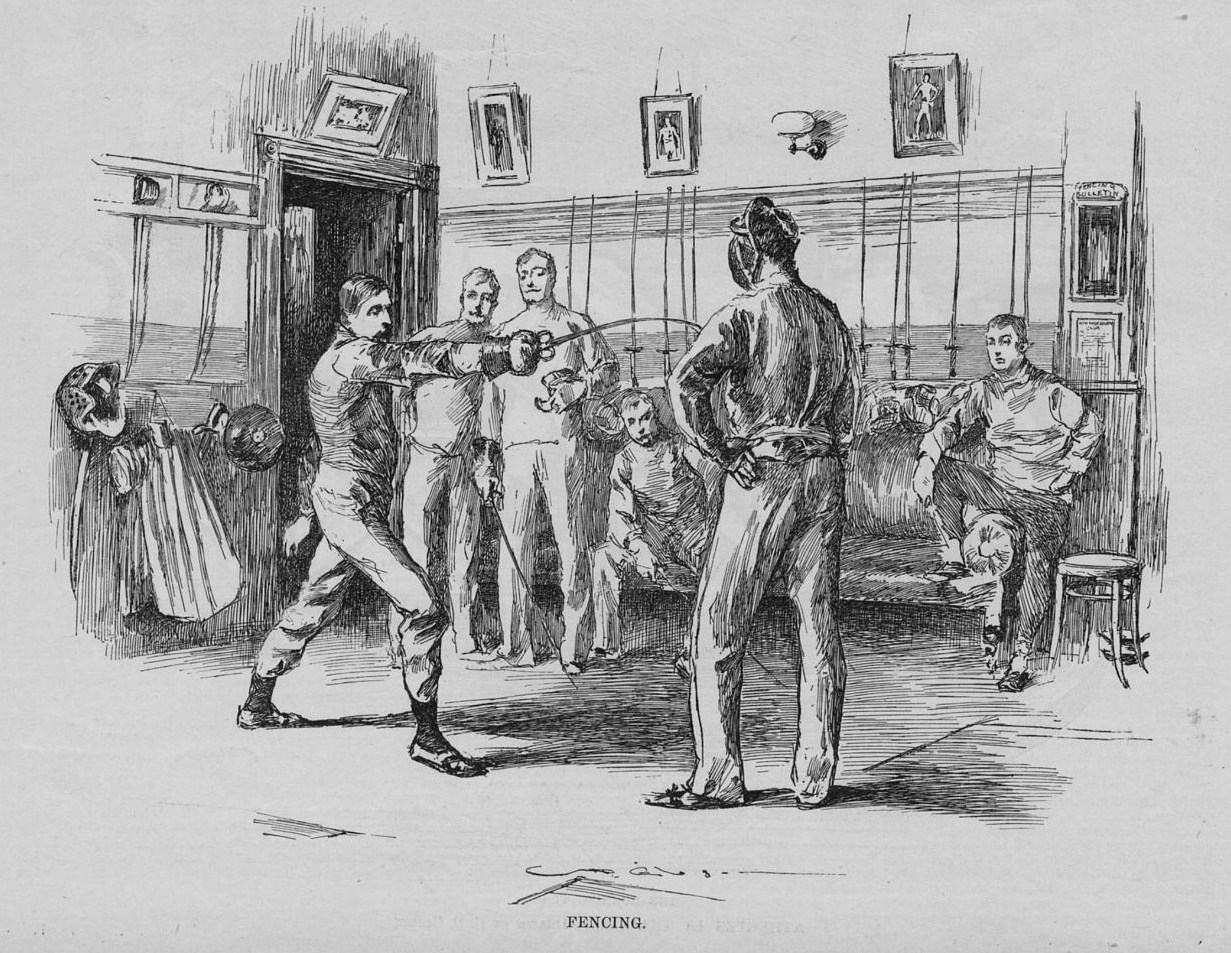
FENCING published in Harper's Weekly June 1890

It’s a commonplace that criticism is one of the hardest things we face. No one enjoys it, but shared correctly and viewed appropriately criticism is a powerful tool. For the fencer it can help to “unpack” criticism as it applies to us as student. This is as true for the researcher. Just as important as these two situations is an instructor’s ability to offer criticism well.  In each role we approach this differently, experience it a little differently, but in each case—as student, teacher, researcher—we’re in an endeavor that by definition includes correction. So, it’s worth reflecting on some of the ways we give and receive such evaluation.

Despite its etymology “criticism” generally connotes something negative. [1] There are probably multiple reasons for this, but one reason must be that so often people don’t offer these observations well, either in terms of kindness or effectiveness. It’s easy to take criticism personally, as an attack on our character, and when criticism is offered poorly it’s small wonder. One of my instructors many years ago—and since he’s still active I’ll not share his name—was notorious for his meanness in lessons. More than one student left a lesson in tears. He was less liked than he was feared, and while many of us did well, many more of us might have had he been more amiable. For me, having grown up within military culture, it was a little easier to deal with some of what he said (while my father was not draconian, I certainly heard a lot of orders given elsewhere that were brusque). I didn’t take it personally, not that it was easy sometimes. Two of the more memorable comments he made to me were “you move like a bovine,” during a lesson, and in coaching piste-side at one tournament “Grow a pair and hit that guy—my grandmother could do this.” Hardly inspiring.

In comparison to my other instructors, all of whom were task masters in their way, this one sharp-tongued coach stood out. He’s not unique. A friend of mine here in Portland was so scarred by a foil coach as a teenager than he left fencing all together until discovering HEMA. Hopefully your instructor isn’t like this—if so, I encourage finding a better one if that’s possible. If you’re stuck with a lemon, or, if you struggle with criticism generally, there are a few things to keep in mind that might help.

As Student
Looking first at proper criticism, i.e. the constructive, meant-to-help sort, the most important thing to remember is that learning includes getting things wrong. Correction is thus part of the learning process. We make mistakes, we mishear, we struggle, we forget, etc. and a good teacher points these out and helps us get them right. Usually our problem is less being corrected than how we are corrected. This is as true in fencing as it is at school or at work.

This said, even the kindest criticism can be hard to swallow. This is all the more true when we feel like we’re doing our best. We expect results from hard work, and that’s not wrong, but as a working hypothesis it needs refinement. Hard work on its own does little—it needs to be consistent, it needs to focus on the correct things, and hardest of all it takes time. Fencing is difficult. It is a highly technical art. If you’re going to assume anything—and assumptions are generally a bad idea—then assume years of constant, persistent practice. Be kind to yourself and give yourself room to mess up.

No one masters this stuff right away. Being armed with more realistic expectations helps a lot. Knowing that what you’re studying is difficult and time-consuming should temper the impact of criticism. When you expect it, it feels less about you and more about the process. Just keep at it. However dressed the critical assessment of your skill is at that moment looks less awful seen against the backdrop of long-term development. It’s a moment of time—you will learn to do X, and then find some new challenge. All of this requires that your ego is in check, that you’re less concerned with how you look in front of your peers, and that too takes work. Focus on the Art, not the perception others may have of you.

If your instructor is like that one I describe above, then you’ll need to separate out the emotional chaff from the constructive grain. This means ignoring any comment that touches on feelings and focusing instead on those that treat substantive issues. In the case where my instructor referred to my movement as “bovine,” he went on to have me do footwork for the rest of the lesson. I was plodding, not advancing, and so I spent a lot of time trying to make my front and back foot land at the same time (back foot to floor as front toes land). [2] I ignored his nasty comment and just focused on the skill. Easier said than done, true, but with practice and a good attitude it’s possible.


As Instructor

Photos-1858-Victorian-fencer

It’s in our own best interest to be kind when offering advice or criticism. Kind doesn’t mean talking around an issue or walking on egg-shells; it means sharing your evaluation in a way more likely to reach that student. Often the best policy, a la the Golden Rule, is to mix whatever analysis you have for them with encouragement. We know this stuff is difficult, we know it takes time, because we were at the same stage of development once—this should make us sympathetic.

Like anyone we can get frustrated. Maybe you’ve had a bad day, maybe the student doesn’t seem to be trying. Your job is to recognize that emotion, put it in place, and proceed without expressing whatever vexation you’re experiencing (if you are). It doesn’t help your student, and more than likely will only stymie them. As important as criticism is, so too are compliments were appropriate. Initially you may only compliment their effort or an aspect of one action, but with encouragement students are far more likely to press on, because they know you believe they can do it. This support is especially critical as they start—many new fencers quit not because they don’t like what they’re doing, but because it feels impossible. No coach should reinforce that idea. Your own training is proof it isn’t impossible, and with that insight your support is not empty, but informed.

Expect to repeat yourself, a lot, especially with younger students. Expect to repeat the same lesson often. Expect to work at new ways to explain the same thing. Patience is worth cultivating, and, it will help you and your students. Our enthusiasm, patience, our can-do attitude is everything, and it’s not a race: if it takes student X longer to master a specific technique, then it does.

Returning to my gruff former instructor, how else might he have addressed my poor footwork? Here is one approach, least it is close to the sort of thing I have found useful:

Halt! Okay, now when you advance listen to the sound. Good—you’re making a single advance, right? How many steps did you hear? Not sure? Okay, do it again. How about now? Two! Did you feel like you were smooth or sort of    bopping up and down? Correct, kinda bobbing, right? This time try to coordinate  the landing of the back foot with the front toes as they touch the floor. Watch me—I lift the toes, I glide just over the floor, and as my front toes lands so does my back foot. How many steps did you hear? One. And I wasn’t bobbing, right? Now your turn.”

In this example there were no ad homines; no questions as to the student’s simian ancestry, relation to barnyard animals, or quips about the student’s masculinity or femininity. This example focuses on the skill-set, on the specific actions, and explains them. The instructor demonstrates it, and then encourages the student to try again.

There are a lot of ways to do this, but whatever words you choose it’s best to build up, not tear down.

As Researcher

If you’re a researcher or translator you’re going to run into critics. There are different sorts, and happily many you can ignore. The ubiquitous internet “troll,” for example, the dolt who just has to pick something apart or disagree, isn’t worth your time. There are a lot of people in the historical fencing community with over-inflated notions of their own brilliance and/or importance, so chances are good if one of them attempts to heckle you that you’ve somehow put them in touch with their own insecurities. Not your problem. Be above that and avoid the intellectual squalor to be found in the fetid fen of the comments section. [3]

The only criticism worth troubling yourself about is proper, subject-driven, constructive criticism by credible people. You may disagree, or, have information that your reader doesn’t, and the situation may or may not warrant a rebuttal, but if you put your work out there you should expect that some aren’t going to like it or agree with your conclusions. For a quick example, an article I wrote for my graduate advisor’s Festschrift received some decent criticism. Now, the reviewer, since they didn’t deal with the editor of this book, couldn’t know what I did, namely, that the stuff the reviewer wanted to see in my article had been there, but had been excised for length. I wasn’t happy about that, but as the first academic article I had in print I didn’t know to push back, or, time-allowing, edit it so that all that could be there. The reviewer’s point is a good one, and my article would’ve been better with that information still there. We learn.

600px-Libraries_in_the_Medieval_and_Renaissance_Periods_Figure_5

The public nature of this criticism makes it all the harder to take. Where even a decade or two ago a review might only be read by those with subscriptions or access to the periodical that published it, today a quick search of your name and a title on Google allows the entire world to find it. Add social media sharing and that many more eyes are likely to see it.

How we react to criticism says a lot about us, so it’s worth reflecting, even preparing for various scenarios. Good criticism is always nice, and being gracious about it is important. However, dignity, grace, and measured reactions to a bad review or criticism are as important, maybe more so since people are far more likely to notice and remember fireworks than a thank-you. If the evaluation is accurate and fair, if the criticism leveled at your work stands up, then it behooves you to make changes and re-share the work. Own it—there is no shame in admitting we’re wrong when we actually are. If it’s not possible to fix or reshare the work, then you can write something else and discuss it there. I’ve had to do this, even preemptively, when I’ve noticed an issue in my own work. [4] Allowing poor work or a mistake to stand or worse digging-in and trying to justify it are unwise. Maybe you have supporters, maybe you don’t, but if an error you’ve made has been demonstrated sufficiently, the better part of valor (and scholarship) is to own it, then fix it. [5]

Knowing what is fair criticism or not, what is accurate or not, can be difficult. To state the truth not all professional reviewers are as balanced, fair, or objective as they should be. Some have their own agenda and their criticism, as such, is more “you didn’t do what I would have done” than anything substantive about what you actually produced. It’s not fair, but nothing is fair. In cases like these it can sometimes be important to write a rebuttal. One must be careful to separate personal embarrassment in making errors from chagrin with one of these critics. Each situation is handled differently.

Understood, accepted, and used as a tool for growth effective criticism can be valuable. It helps when that criticism focuses on the task, not our character, and when it is shared in a supportive fashion. If you fence, and it doesn’t matter what style, you will have to find ways to handle being evaluated. The good news is that it does get easier over time. With practice it’s far easier to focus on what they’re attempting to help us do than anything else. Pick your instructor well, realize that they’re doing what your hired them to do (teach), and remember that there is “no growth without assistance.” [6]

———-

NOTES:

[1] Our word “critic” derives from Latin criticus, itself a loan from Greek kritikos, “capable of judging.” Context is everything, but as a general rule, for most American speakers of English anyway, “criticism” is a word that most interpret negatively without further clarification.

[2] This is a very useful pedagogical tool. Students tend to make smaller steps, tend to coordinate their feet better, and in time improve their advance as well as retreat. In practice, during a bout, one doesn’t necessarily move as nicely as this, but one will move better for having worked so hard at it.

[3] I’d rather not name the people, one in particular, that seem to make an effort to disagree or undermine anything I say or post on social media or elsewhere, but they’re good examples of insecure people with ego needs that outweigh their ability to reason or play nicely. Unless there is a reason to correct them, I ignore them. Arguing with the village idiot, as the old saying goes, only creates two idiots.

[4] A fun example, and one hard for me not to enjoy given the irony of my interest in historical fencing, is a line that was misprinted in Artifacts from Medieval Europe (2015). On page 32 the line “Like the sword discussed here, they were still broad enough to cut, but also had a strong, rigid diamond shape that enabled the sword to punch through plate like an awl.” The word “plate” should have been mail, for while it is possible to pierce armor with poor heat-treat—a friend of mine has done this with a dull spear-head—swords in the age of plate weren’t used against armor, and when they were, they were used like a pole-arm to stab into those sections not as well-armored, generally of cloth and/or mail.

[5] A good example of this problem is the debate, such as it is, between two translators of the same rapier text. One of these translations, made by a well-respected scholar, is certainly freer in expression in some places, but is far and away a better version than the other. The author of the less successful translation has attacked his rival on a number of occasions, but to little effect outside of his little collection of supporters. I’ve read through the criticism of his work and the complaints hold up. Even when called on it he refused to accept it. Don’t be that guy.

[6] So says the character Li Mu Bai in “Crouching Tiger, Hidden Dragon” (2000); https://www.youtube.com/watch?v=UiuQNFiEmMs

IMAGES:
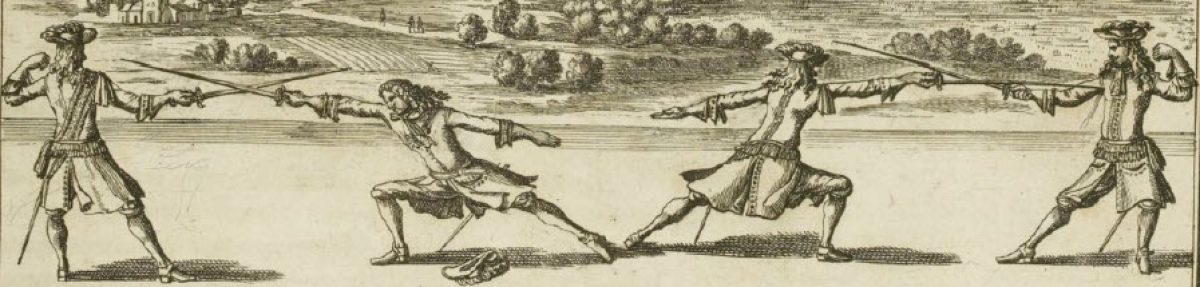
First — scene entitled “Fencing,” in Harper’s Weekly, June 1890.

Second — “Victorian Fencer, 1858,” https://www.leonpaul.com/wordpress/fencing-history-fencing-in-the-19th-century/

Third– modified image of a print, by J.C. Woudanus, 1610, of shelves in library of the University of Leiden: https://en.wikisource.org/wiki/Libraries_in_the_Medieval_and_Renaissance_Periods

Gauging Improvement in Fencing

Most of us tend to carry simplistic notions of progress and improvement. This is as true when we talk of societal “progress” as it is a particular skill-set such as fencing. [1] In broad outline the idea of progressive improvement is not “wrong,” assuming that the topic is subject to the idea of progress (here defined as an increase in skill, knowledge, and ability over time), but on a day-to-day, functional level it wants for a lot. How we view progress, especially our own improvement in something, depends greatly on our attitude toward it. Happily we have considerable control in shaping that. I don’t mean this in some sort of pie-in-the-sky Professor Pangloss way, but in the sense that there are considerations, methods, and approaches to the idea of improvement that we have control over and that can do much to make the process much less painful. [2] This doesn’t mean free from aggravation. Frustration is a part of learning, not just at the beginning of acquiring new skill, but later too, and how we manage that is as much about how we think about it as anything else. How and what we think affects how we learn as well as our enjoyment of the subject.

A Conventional View of Progress

This is just a chart I made, inexpertly, using Word and Paint, but it illustrates an attitude toward improvement that many of us have. We often don’t even realize we’re applying it:

Usual View of Mastery
One Typical Way of Viewing Progress

Looks so simple, right? In this view, beginners start at the bottom, and through hard work, discipline, and time, increase their knowledge, skill, and ability, until they reach mastery. It’s a straight line up a steep slope. Length of climb depends on the gifts of the student, the talent of the coach, and access to practice. It’s deceiving. The slope is steep and long, but the way looks smooth. It isn’t.

Were this an impressionist painting this view is the one that we’d get from perhaps mid-gallery. We see the whole work. Beginners start with no experience, spend time and effort, usually with help, and in time and assuming good coaching, discipline, etc. they master the new skills. As we get closer to the painting, however, we see more detail, we see the brush strokes, the ways in which different colors mix, and up close it’s harder to see how all this chaos leads to the attractive image we see. It’s not as pretty, but, it’s important, for without all those details there is no painting. It’s these less attractive details and how they relate that produce the pleasant whole. We need to step closer to the painting, or in this case the chart, and examine in closely to appreciate it fully.

Plateaus of Progress

What follows is a closer look at the painting. Rather than view this as above, as a nice isosceles triangle with a smooth slope to success, we’ll look at it as if it were a stepped-pyramid or ziggurat consisting of uneven blocks. The way forward, in truth, isn’t easy, straight, or made in regular stages, but in moments of insight and break-through, in long plateaus of stasis, followed by another jump in ability. [3]

Plateau Final hopefully
Plateaus of Progress, a.k.a. the Ziggurat of Improvement

Like the first chart, the beginner [B] starts at the bottom, but improvement is illustrated in a slightly different way. Initially, the climb is vertical, long, and improvement is marked by sharp contrast as we hit the first plateaus in learning (the sharp, 90 degree corners). Over time, as we grow, those edges round off a bit (steps farther up have rounded edges): adding new skills is a little less difficult because we have a better sense of the geography. In time, some plateaus are shorter, we spend less time on them; we grow a little faster. It may take us a while to incorporate the new skills as they grow in complexity, but we spend less time between them (steps are taller, but distance between one step and the next is shorter). “Mastery” here is a guide, not a goal; the concept of it helps us strive to improve and add to our ability, but the more we learn the more we realize that there’s always more to learn, and, ways to deepen what we already know. There’s no top to the ziggurat—in Babel fashion it just reaches into infinite heights.

Looked at this way, with full recognition that the path of improvement is not straight, should make harder aspects of the process less painful. Some sections of the path are easier than others, some take longer to travel than others. It’s all part of it. We will struggle sometimes, we’ll make mistakes, we won’t understand, we’ll feel like we’ve added one skill only to lose another, and we will sometimes feel as if we’ll never get it. Knowing that this is to be expected, that there’s nothing wrong with you, that it’s not a question of talent, but of dedication, can help us get through the rough patches.

We Control Attitude

Attitude is thought. Whatever native self-confidence or self-worth issues we might have, however much we might struggle with imposter syndrome, whatever sense of grace or clumsiness we possess, whatever setbacks we have or identify as setbacks, how we think about it all makes a difference. It can take an “I’m no good at this” or “I can’t do this” and change it to “I’m still learning this” and “I can’t do this yet” (or better, “I’ll be able to do this soon”). Fencing, no matter what sort you’re pursuing, is difficult; it’s a complex way of thinking with movement. It takes time.

Bob Ross, the famous television painter, said “Talent is a pursued interest. Anything that you’re willing to practice, you can do,” and he was right. [4] That fencer that you see whom you find gifted, who makes it all look easy, whose movement and tactics inspire, got where they are through hard work. Maybe they were precocious physically, but they too had to learn; they too made mistakes; they too struggled. They got to where they are because they didn’t give up. The best fencers recognize that the learning never stops.

An attitude that takes into account the mileposts, not just the destination, and realizes and accepts that parts of the path are bumpy, parts steep, parts easy, that some stretches are longer than others, will suffer less and get more out of the trip. Approached this way, it can be easier to focus on where you are now, on the new skill you’re working on, and not how much farther you have to go and all that you haven’t mastered. With practice, it’s possible not only to be present in the moment, focused on the task in front of you at this specific time, but enjoy it too. 

Theory and Practice

Theoretical approaches to pedagogy are informative, but how does one apply all this to the actual practice of fencing? There are two chief ways.

Macro Level

What I’ve shared above about a more useful way to consider improvement is the macro level. It’s the big picture. The whole painting seen from a distance. Put another way, it’s your life as a fencer from open to final curtain. When we hit a plateau in learning, when we feel like we’re not getting where we want to go as fast as we think we should, this is when a more realistic look at the big picture can help. It puts the present moment in context. We see that our current struggle is necessary, a key part of the journey, and importantly, that we’ll get past it and then work on another one.

Micro Level

This same ziggurat of improvement can help us with individual techniques, tactics, and maneuvers too. Just as our entire fencing life can be examined against this notion of improvement, so too can the acquisition of new skills. As an example, consider the simple cavazione/disengage in foil. When we first learn how to perform this, our actions are large and clumsy; our arms might not be extended. We pick the wrong time and distance to use it. Over time, with practice, we make smaller evasions; the action is tighter; our arms are more extended; we use thumb and forefinger more than arm. We start to select the right moment (where time and distance converge with judgment) to use it. The technique, the cavazione here, is now part of our repertoire.

Setting Expectations

This idea of plateaus of improvement assists us in setting realistic expectations and goals. Our expectations affect our performance, so developing a pattern that preempts the downside of frustration only helps us. Used on the macro and micro levels it helps us manage long- and short-term learning goals. It is also a kinder way to appreciate our improvement, because it’s easier to see each stage in context, as part of a much larger whole. Both student and instructor can benefit from this perspective [5].

“Wanderer above the Sea of Fog,” (ca. 1818), by Caspar David Friedrich [6]

Recognition of the reality of the road of improvement won’t erase frustration, but it can mitigate it. If nothing else one can look back over the climb they’ve made to date, realize how far they’ve come, how hard they’ve worked, and that today’s tough plateau is just one step in a series of plateaus we’ve already conquered and those yet to come. There’s an odd mix of satisfaction and determination in such moments. It builds confidence. It can be the one thing on a tough day that helps us with make the next leg of the journey. 


Macro & Micro Expectations

  • Expect learning new things to take time
  • Expect to improve with practice
  • Expect certain maneuvers to make more sense later
  • Expect to make mistakes & that it’s part of the process
  • Know that you have all you need to succeed
  • Know that you will improve
  • Know that your benchmark is not others, but yourself yesterday

Addendum, 10-24-19:

A fellow local fencer, and a chap who also teaches, shared some feedback with me about this piece. I want to share it in full here as it will speak more to those with experience than my attempt to reach a wider audience does. Most of the comment only restates, in more technical language, the point I was making, but he shares an idea there that I think is worth adding. Thank you Will P. for your feedback =)

“A very approachable explanation of a non-intuitive and important topic, thanks for writing it, Jim BT Emmons, and to Mike Cherba for sharing. Some feedback, though. As a preface, It’s a given that any concept involving humans is going to be complex enough that one has to strike a compromise between detail and actually getting something written, but there are two concepts that I think are fundamental enough to be worth knowing even in an overview. First, improvement comes in the complementary forms of expanding understanding and skill building. Skill-building follows an exponential decay pattern while understanding follows a step pattern (like in your diagram). And they inter-relate in that skill-building is capped by understanding while gains in understanding often require a certain threshold of skill in order to be meaningful. Putting the two together, and you get something like a ziggurat with heavily rounded corners, where the upwards movement is skill-building that gradually slows down until a new insight occurs that allows it to speed up again. Second, and more important for beginners to understand, is that progress (as can be seen externally) can be very different from the experience of progress, where the latter looks a more like the Dunning-Kruger curve: one feels like one is improving rapidly as a mysterious thing becomes comprehensible, followed by a period where one feels like one is getting worse (as the full scope of the skill becomes apparent), followed by a slow build (as one’s perception finally starts to align with reality). ” [source, NW Armizare, fb page, 10-23-19]

Will’s second point here, that experience of progress in oneself very often looks much different than that of a coach or other fencers, is important. Perspective changes with experience, and for newer fencers it can be easy to believe that one is doing technique X well when in fact one is only doing it marginally better than yesterday. This isn’t bad, but knowing that our own estimation of where we are, especially at the beginning, is important. I can attest to this well myself, though the example (one of many alas) is a little embarrassing. In my first year of competition, as the third string sabreur on my college squad, I left one bout of however many I fought that day convinced I’d won. Everything seemed to go well, better than well, and yet… I kept losing the touch. In this particular bout I think I managed 1-5. In discussion later, my coach at the time remarked that I had made some of the actions well, better than before, but at the wrong time or in the wrong context. Looking back on that now, some 30 years later, I know far better what he meant. Anyway, be kind to yourself, give yourself room to screw up, and keep fencing!

—————

NOTES:

[1] There’s not room enough to discuss the idea of “progress” or its failings, but if you’re curious the Stanford Encyclopedia of Philosophy has a decent summary: https://plato.stanford.edu/entries/progress/

[2] Pangloss, a caricature of the philosopher Gottfried W. Leibniz, is the ever-optimistic tutor of Candide in Voltaire’s Candide, or Optimism, translated from the German of Dr. Ralph (1759).

[3] In the process of editing this, and looking for typical charts for fencing improvement, I found a very similar idea if, in my opinion, less well spelled out 😉 [the link here has issues, so look up academyoffencingmasters, blog, and small-steps-big-progress and you should find it.

[4] Bob Ross, The Joy of Painting, “Meadow Lake” (Season 2, Episode 1).

[5] My plan for the next essay is on dealing with criticism/assessment of skill as fencer, instructor, and researcher.

[6] Photo obtained from https://en.wikipedia.org/wiki/Wanderer_above_the_Sea_of_Fog#/media/File:Caspar_David_Friedrich_-_Wanderer_above_the_sea_of_fog.jpg

Conan the Barbarian, Sir Percival Blakeney, and the Cult of Machismo in Historical Fencing

C91Vzz0WsAA_8_w

There are times when our lives in and outside the sala intersect. Recently I experienced this with regard to advocacy for women’s rights, equality, and representation. Whatever one’s politics—mine are apparently less clear than I thought—this is an issue not only as an instructor and fencer, but as a human being, especially one living in the topsy-turvy world of the United States in 2019. There’s no middle-ground—either you believe in equality and fight for it, or, you don’t. There’s no fence-sitting, because by definition—in this case—inaction is tantamount to action: it is to be complicit in those customs, laws, and attitudes that are prejudicial. As a middle-aged white male, though, it’s often difficult to appear to be an advocate; I look like “the enemy,” after all, and though I do my best to support anyone really who’s not an a-hole, only continuous action might convince those who think otherwise.

In fairness, our attempts to advocate for others can fail, we can be taken for what we’re not, but that doesn’t mean one shouldn’t try. It’s all the more important to me as an instructor, because in my own, small way I have a chance to make a difference. The adults who train with me are, not surprisingly, on much the same page.[1] Preaching to the chorus is affirming, but it’s work already accomplished. With my younger students, however, I can do a lot of good, or, a lot of harm. I have an opportunity to make a difference, but I also feel I have a duty to make that difference, to create a safe, encouraging, and supportive spot for everyone. This I try my best to do. In part this is a carry-over from parenting—my wife and I are keen to raise our boys to be part of the solution, not the problem—but it also comes of seeing the damage bad coaches can do over a life-time of watching it happen.

From the adults, feedback is constant, and I’m thankful for that. At present we have one adult woman who regularly attends and happily she’s a good gauge for how well we’re doing, how well I’m doing, to create a safe spot. She has suffered a lot of abuse at the hands of men in fencing, from disregard to the actual threat of violence, and it’s a testimony to her strength and passion that she didn’t just quit. A long-time friend, she has been a good guide for me, not only from what I’ve picked up in trying to help her through so much b.s., but also in the fact the she has shared her ideas, experiences, and feedback. She speaks her mind; she will call me on poor choices and then it is up to me to be a large enough human to consider what she says. My younger students, most of whom are between the ages of 9 and 16, are less forthcoming with feedback, less capable of that insight as yet, and so I have to do the heavy-lifting for them.

Conan and Sir Percy

Sir Percy
Anthony Andrews as Sir Percy in the 1982 “Scarlet Pimpernel”

Anyone who spends much time in historical fencing is going to run into the Janus-faced Macho “HEMA Bruh.” He isn’t confined to our community; wherever there are combat-related past-times you’ll find this guy.[2] On the one hand he exemplifies the most facile, shallow notions of western masculinity—one sees this in the focus on victory above all, physical strength and size, his romanticism of violence, and a misplaced sense of his own ability. On the other hand, the second face is often more subtle. It’s homophobia expressed in humorous attempts to belittle other fencers. The math here, such as it is, reads like this: smaller sword = weak, “gay,” lesser, etc. If HEMA Bruh is Conan the Barbarian, then as far as Bruh is concerned smaller men, especially if they fail the big-sword test, are all the public persona of Sir Percy Blankeney-as-dandy, i.e. cowardly snobs who hide their weakness behind fancy dress and witticisms, or in this case, avoid “real” sword-fighting by using less scary weapons.[3] Wimps like that, so Conan thinks, have as much business pursuing “MAN” activities as women do. The 1950s middle-school nature of this thinking is sad, but they’re telling too coming from grown men. For those of us teaching later aspects of the Art, for example, the fact we don’t wrestle or use big swords makes us easy marks. Teach foil or smallsword in HEMA-land and you’ll see what I mean. Among adults it’s easy to see this and avoid such people, but what about for kids?

Instructor as Role Model

Like it or not, if you coach younger people you’re a role model; not the most important one in most cases, but one example of an authority figure that can have significant influence on a young person’s development. Acting the part of Conan the Barbarian, even making room for the HEMA Bruh or similar clowns, are all detrimental to any training program—the best such programs create are future HEMA Bros and considerably more people turned off to the Art. That is a net loss for everyone. I’ve watched this happen. [4]

Instructors must be ever mindful of how they act, what they say and how they say it, of the example they set. One of the ways this is made easier in fencing (of any kind) are the niceties and cult of manners inherent in the tradition. We salute in and out of class, we address people politely, we comport ourselves in the sala with self-respect and respect for others. All these things help but on their own are not enough. Just as old as the salute are double-standards, and though these are less evident today than they once were, they’re still around. For example, there are still instructors out there that either believe or unwittingly apply double-standards to female fencers, who think they can’t or shouldn’t do X. Claptrap. They can do whatever they want, and like anyone who applies themselves, do well.

Is Conan Really so Bad?

Arnie as Conan (1982)

How is the Cult of He-Man detrimental? Starting with the less pernicious effects, focus on facile notions of masculinity—strength, aggression, dominance, power, fame, victory, etc.—undermines the value of these concepts and removes them from what they should be.

  • Strength one develops for health and to practice the Art
  • Aggression, in a sportive context, is better developed as appropriate offensive strategy
  • Dominance of self outweighs any other version
  • Power should be a measure of control over the weapon and ourselves, so modulating not only one’s strikes, but oneself
  • Fame, like anything that serves ego alone, takes one’s attention away from the Art—if you bump into it, fine, enjoy it, but keep it in check
  • Victory is a diagnostic tool for measuring growth, tactics, and identifying areas for work.

I’m not trying to take the joy out of a win or suggest we all meditate in the ring or on the piste rather than fight. I’m suggesting that we get far more out of the Art, out of all our hours and training and hard work, if we look deeper.

Another issue is that these same He-Man values favor only one type of fencer—the larger, stronger, brutal fighter. Is there room for him? [5] Yes, but only if that same fencer is keen to grow beyond what nature provided him. He will be a liability otherwise. The instructor’s job with this fencer is to impart more of the Art to him, to round the corners off him, and teach him to harness and make the best use of those natural gifts (if he’s up for it). This is, in essence, what the instructor should be doing with each student, but that’s easier to do if one’s values extend beyond the physical. Focus on the big guy as a way to gain tourney gold and reputation at the expense of also putting in as much time with smaller, less powerful fencers might bring short-term gains, but at great cost.

To name one current example from one of my kids’ classes, there are two elementary school girls who are picking up technique quickly, but also who understand what they’re doing and why. Will they continue to fence? I don’t know, but my job is to give them all I can to help them find out, to encourage them, improve what they do well, and help them build those parts of the game they are struggling with. I also have a male middle-schooler in that class as tall as I am, and while strong that asset is little use to him in foil. With him my job is to help him channel his size and strength into more effective uses, in this case reach and stamina. Whatever size they are, whatever sex or gender, they’re my students and my task is to share the Art with them, to help them grow.

Put short, whatever a student’s gifts, whatever their challenges, we work with them—we do not favor one type over another. To do so limits us, limits the students, and sets a poor example. The motto of my school is Vis enim vincitur Arte, “For strength is conquered by Art,” because the Art can aid the powerful, but it can make the weak fencer overcome the powerful one.

How I treat them individually, but also as a class, is important too. I’m an adult teaching them something very complicated and difficult to do–that is challenge enough without inane ideas about boys being better at this, girls better at that. To me they’re potential fencers, fellow students only younger, and I must strive to set the best example I can for them.

The Truth about Attribute Fencers

The truth is that one can go far embracing the Conan the Barbarian approach—not everyone responds to them well and they can easily overwhelm many opponents. That doesn’t mean one is successfully expressing the Art, however, and while that can correlate with skill, they’re not one in the same. This is to say just because one is fast and powerful doesn’t mean one has good technique or understanding—you can win through intimidation and power too.

The half-life with this approach is short. If injury doesn’t take one out of things, burn-out will. Some experience that burn-out as frustration when they reach an opponent who’s a better Conan than themselves. Others quit at whatever it is they consider the top of their game convinced there is no one left to beat. The first can be fixed, the second is a sign of deeper problems. This same type of fencer is demoralized or becomes convinced things are rigged if a smaller, but more skilled opponent beats them. This is much the instructor’s failure as the fencer’s, more so for it shows the instructor failed to teach them one of the more important lessons we learn in the study of arms—how to lose with grace and use that loss to improve.

Attribute fencers often do well, for a time, but the longer they stay in the game the more they’ll discover that reliance on their speed or strength is limiting. Skill will win out in the end. One doesn’t stay strong and fast forever. This will sound funny to anyone who hasn’t experienced it, but if you face an opponent over 70 you’re in trouble—no matter how fast you are, how strong, etc., if that person is still fencing at that age then they know something, a lot of somethings, and you’re going to have your work cut out for you. The best losses I’ve experienced were to opponents over 70—they were great lessons. He would be 106 now if he is still alive, but being bagled 5-0 by the then 80 year old Fred Razor in 1993’s Hack und Slasch tournament in Victorville, California, was an indelible lesson for me.

The Deeper Danger of Conan

Robert Mark Kamen as “Johnny” from Cobra Kai in the 1984 “Karate Kid”

The real evil in this Cult of MAN is that it fosters unhealthy attitudes and beliefs. It provides an arena for those to grow. When this happens, people get hurt, but more than that, the same fragile notions of masculinity carry over into other areas of life. If the example we set for younger fencers is that might makes right, that our genitals determine our success or suitability for X, and that the gifts of nature in terms of size or strength outweigh the hard road of study, then we do more than create Cobra Kai fencers—we help shape, even if in small ways, the same monsters who plague our society at large. This is as true if we ignore it–it’s tacit approval.

This is not just “liberal propaganda” either—there is science here (nb: science, contrary to public opinion, is not a liberal conspiracy). Reinforcing pernicious social mores across activities, locations, and populations helps solidify those ideas. With fewer areas of life demonstrating competing views it is easier, especially for the very young, to accept those ideas as normal. Each of us in our own way, to the degree that we can, is responsible for the world we live in; we have a choice in how we engage others, what we accept and reject, and if we truly believe that equality matters, that respect for others and ourselves is worth cultivating, and that these values make for a better society, then everything we do, from how we vote to how we approach a sabre lesson echoes. This isn’t to say a fencing instructor makes or breaks things, but it is to say that it matters—if the Art is more than a body of technique and tactics, if it does relate to our growth as individuals, then it matters. [6]

I’m not an enemy of big dudes–some of my closest friends are big dudes. I also value the role that wrestling and grappling have played in the Art; more than that, I like to dabble in longsword too, and if the chance came up to take a class on spadone/montante, I would. Interest and pursuit of these is fine, perfectly awesome really, but like anything it is how we go about it, how we treat others, and all of these aspects of the Art can be approached sans Conan’s fur speedo.

———–

Notes:

*Photo of Dodgers player Kiké Hernandez and reporter Kelli Tennant. This photo was widely shared and the subject of a popular meme. It’s been cited as classic example of “fragile masculinity,” but there is evidence–in this case–to suggest that Kiké, a notorious prankster, might have been up to something else. At the very least he shared the same photo himself in 2017 as a short-person joke.   For the initial photo–see https://www.washingtonpost.com/news/the-intersect/wp/2018/07/13/a-baseball-player-stood-on-a-bucket-and-sparked-an-online-debate-about-masculinity/

See also, https://www.chicagotribune.com/columns/heidi-stevens/ct-life-stevens-tuesday-kike-hernandez-bucket-masulinity-0710-story.html

[1] I’m lucky to work with good people. Among the many civic and socially minded examples of their excellence, one even serves as an escort/guard for any woman fearful of protestors wishing to go to Planned Parenthood.

[2] “Bro” culture is rife in sports as it is in most places. Historical fencing, because it has larger weapons, because so many of the traditions dealt with war as well as the duel, and because physical size can make more of a difference in grappling is perhaps more prone to this sort of machismo where other branches of fencing—saving perhaps Bohurt—are less likely to see it.

[3] For those unfamiliar with the character, Sir Percy is the hero of Baroness Orczy’s The Scarlet Pimpernel (1905), a wonderful tale of an English aristocrat who hides his heroic rescue of the French noblesse from the guillotine behind the mask of a dandy among other personas. There are a number of film versions of the book as well (my favorite remains the portrayal by Leslie Howard’s from 1934). There was, it seems, a popular trope in swashbuckling literature of the inept, questionably hetero hero who adopts this persona to hide his more “manly” heroics. The other classic example being Zorro. It is telling that in 1981 “Zorro the Gay Blade” made this suggestion overt. Conan the Barbarian was the creation of Robert E. Howard whose series of stories first appeared in 1932. The most famous film version, recently remade, is the 1982 “Conan the Barbarian” starring Arnold Schwartzenegger. Both big-bad-ass-barbarian and sly-dandy films reflected, and helped cement, ideas about masculinity, sexual orientation, and what was and wasn’t acceptable: modern audiences (hopefully) will experience these older movies differently.

[4] It can be easy to forget how long childhood extends. Teens can look older, present older, but are nonetheless kids; even those in their early twenties have brains still in development. In the few instances where I’ve seen adults forget this, I’ve tried to help both the child and the coach, but sometimes the issues those adults face can blind them to the reality of the situation—kids, even 17 or 18 year olds, do not think or act like adults, so expecting from them what one does from a 30 year old is misguided at best.

There are also schools, some infamous in the States, for encouraging “Bruh” culture, but not so surprisingly they’ve run into more and more trouble. If you don’t play nice, people won’t want to play with you. Guess they never learned that.

[5] Yes, “him.” I try to use gender/sex neutral language as much as possible, but in my experience to date the worst offenders of macho-man syndrome have been male. Naturally there are fencers who identify in other ways that may be just as annoying to deal with.

[6] One standout example of a fencer’s moral choice during trying times is Nedo Nadi who repeatedly refused to join, represent, or work with Mussolini’s fascist regime. See Richard Cohen, By the Sword, New York, NY: Random House, 2002, 326 ff.

NB: My friend, and a gracious Big-Dude, Mike Cherba of Northwest Armizare, is using this post in class, so I have edited some of it, mostly removing excess words, repetition, and trying to tighten up the sentences a bit. What, I’m long-winded, I like long sentences…. I blame Latin. [4-8-2020]

Fencing, Martial Arts, and Self-Improvement

Αισχύλον Εύφορίωνος Άθηναιον τόδε κεύθει μνήμα καταφθίμενον πυροφόροιο Γέλας· άλκήν δ’ εύδόκιμον Μαραθώνιον άλσος αν εϊποι και βαθυχαιτήεις Μήδος έπιστάμενος.

This tomb in grain-bearing Gela covers an Athenian, Aeschylus son of Euphorion, who died here. The famous grove of Marathon could tell of his courage and the longhaired Mede knew it well. [1]

Herma_of_Aeschylus

The Greek playwright Aeschylus (d. 456 or 455 BCE), one of the luminaries of Athenian drama, is remembered today for his poetry, sophisticated plots, and stage-craft. His “Oresteia,” to name one example, has been standard reading in many college literature and classics classes for decades. However, his epitaph says nothing of these accomplishments, achievements for which he was celebrated even in his own lifetime, but for his participation in the Battle of Marathon (490 BCE). Either the poet himself or his family wished for him to be remembered for his military service, not his contributions to world literature. There is a lesson in this for us fencers, for any martial artist.

For many fencers the Art is a game, a sport, and in certain iterations that’s absolutely true. I think it is, potentially, much more than that. As a caveat I should say that my first exposure to martial arts was Asian—my father, who had been stationed in Korea, took up Tang Soo Do while there and began teaching me as a child. In late elementary school I started formal training in Tae Kwon Do. Later, as an adult, I studied Kendo, Gumdo, and Tai Chi (including some sword forms), all after long exposure to western fencing. In short, much if not most of my thinking about the value and purpose of martial arts, any martial art, is “Eastern,” which is to say heavily influenced by Buddhist notions of ego-annihilation, humility, and self-improvement. These values will not appeal to everyone, and that’s okay, but they’ve shaped much of my path as a student and I’ve found them useful even outside of philosophical considerations.

For example, focus on improvement versus more easily-met ego needs, like trophies and rankings, is one such way that this more “Eastern” approach is beneficial. This isn’t to knock those successes, but to see them in their proper light. Sure, be proud of what you’ve accomplished, but appreciate the realities of competition too. What worked? What didn’t? What areas should you work on? What did you learn from your opponents? Too much concern about medaling, fame, all that distracts from study; it’s easy to take these nice things too far and rest on your laurels. When people believe that trophies and notoriety are the best proofs of skill and worth they often start thinking they’re superior fighters and have nothing left to learn. There’s always more to learn, always ways to improve.

Another benefit of cultivating humility is that it makes it easier to work with others, to share information without one-ups-man-ship, and collaborate. For those who think they have it all figured out, others are either dead wrong or mostly wrong; they’re far more quick to criticize what another is doing than consider that there may be lessons there. This is particularly odd in historical fencing, because by its nature reconstruction is tentative. In so many cases there is no proof one way or another, just the best case to be made from the evidence, any product of which might be overturned should new evidence be found. That should engender more excitement than dread, and generally does unless one has a lot riding on a particular interpretation.

Lastly, what is fencing if not a form of self-improvement, a constant process of refinement in action and thinking? The plateaus and peaks we spend so much time on are a lot less rocky knowing that the path goes on, sometimes through rough terrain, sometimes on grass. That one action we believe we do well is always something we can make even better. The sensei with whom I studied kendo briefly told this story—each year he joins his master at a Zen retreat in New York. They train, meditate, train, meditate. Each year his master fixes something “basic” such as his grip on the shinai or boken. In sharing that story Yan Sensei wasn’t complaining, but making a point. We can always do what we do well, better.

If this seems completely foreign, e.g. “non-Western,” it might be worth considering some of the western sources we have on the role that the study of arms plays in developing a person. There are a number of medieval and later works that treat this. The works on chivalry that we have, chivalry as a code of ethics, an approach to life, while they don’t lay out tenets the way some Asian manuals do, nonetheless make a connection between the study and practice of arms and virtue. Why? Was it merely ecclesiastical and royal concern about public violence? Was it just a way to fancy up what was, in essence, the truly bloody business of what today we’d call organized, state-sponsored murder? I don’t think so, not to read Lull, Gower, de Charny, Loyola, and others. It was more than that to them. Some, like de Charny, not only lived by this code, but famously died by it. [2]

Cortegiano.tif

Medieval notions of chivalry in time combined with more urbane concerns about court life, political involvement, and a shift in the way in which some authors, especially renaissance humanists, viewed humanity. Few works exemplify this like Baldassare Castiglione’s Il Libro del Cortegiano (The Book of the Courtier). Published in 1528, Castiglione contributed to the idea of the “renaissance man,” that is, a polished, educated, multi-talented individual who was at once self-reliant and a dutiful, skilled courtier. In discussing martial arts, he famously wrote:

 But to come to some details, I am of opinion that the principal and true profession of the Courtier ought to be that of arms; which I would have him follow actively above all else, and be known among others as bold and strong, and loyal to whomsoever he serves. And he will win a reputation for these good   qualities by exercising them at all times and in all places, since one may never fail in this without severest censure. And just as among women, their fair fame once sullied never recovers its first lustre, so the reputation of a gentleman who bears arms, if once it be in the least tarnished with cowardice or other disgrace,  remains forever infamous before the world and full of ignominy. Therefore the more our Courtier excels in this art, the more he will be worthy of praise; and yet I do not deem essential in him that perfect knowledge of things and those other  qualities that befit a commander; since this would be too wide a sea, let us be content, as we have said, with perfect loyalty and unconquered courage, and that he be always seen to possess them.[3]

There is much of interest in this short passage, but for our purposes the emphasis on the study of arms being the “principal” and “true profession” of the courtier is instructive. Here, Castiglione has one foot in the Middle Ages and one in the “Renaissance,” the combined stance of which shaped the idea of the gentleman in western thought for centuries afterward. In some circles today it still does. But what to make of it? If arms are the occupation, how does it relate to a person’s experience of other arts, of knowledge of literature, skill in music, their devotion to a prince and excellence as a servant? What is it that the Art provides that is so important? The more obvious answers, outside the physical benefits, are discipline, tenacity, and focus. Done right, pursuing the Art can do much to improve how we interact with others, from how we assess them and ourselves to fostering respect and a sense of fair play. Cultivating these qualities can extend beyond the ring or piste.


Castiglione discusses this too. He goes on to describe some of the virtues of the study of arms, but of note with balance. Significantly, he doesn’t favor braggarts or thugs:


Therefore let the man we are seeking, be very bold, stern, and always among the first, where the enemy are to be seen; and in every other place, gentle, modest, reserved, above all things avoiding ostentation and that impudent self-praise by which men ever excite hatred and disgust in all who hear them. [4]

Though he doesn’t spell it out in 12 convenient steps, Castiglione suggests that even in the study of arms, as elsewhere, the goal is self-control, balance, and a keen sense of what is appropriate when. In other words: self-improvement.

Yamamoto_Tsunetomo

I’ll confess that The Book of the Courtier is a favorite book, one with great meaning to me, but beyond that there are lessons there that are on par with the best out of Asia. Castiglione would no doubt have found much to like, and dislike, in Yamamoto Tsunetomo’s Hagakure, but I think he would have understood it well, not only the courtly aspects, but also the emphasis on self-control, humility, and service. [5]

Fencing should be fun, it should provide a work-out for your body and your mind, but it can also be a path to self-improvement. Can be, doesn’t have to be. In historical fencing we’re often worried about “contamination” from other traditions, even other western traditions, and that’s fair. One reason I’m laying this out as I am is to own up to at least one way I commit that sin. However, to my mind there is precedent generally within martial arts, and even specifically within the western tradition, that allows for if it doesn’t outright encourage the study of arms as a way to improve ourselves. Put to it, one can find examples from Greece, not only for the idea of moderation in all things, but also for the place of physical activity, especially martial training, in cultivating the self.

As fencers, we are not warriors, but enthusiasts; serious as we may be we play at fighting. There is value in doing so, value that goes beyond practical skills, beyond historical insight and appreciation, beyond enjoyment. We can find ourselves, test ourselves, and hone the way we approach challenges, other people, and our world. As the example of Aeschylus demonstrates, while to focus solely on martial arts, especially those with less practical utility today, would leave out the other arts, other avenues for growth, we should nonetheless remember, as he did, that there is virtue in the study of arms, something worthy enough for an epitaph.

———-

[1] There is debate about whether Aeschylus or his surviving relatives chose his epitaph, but linguistic studies indicate that the language hails from his time, not the later Hellenistic era as some have suggested. Among other sources, see Todd M. Compton, “Aeschylus: Little Ugly One,” in Victim of the Muses: Poet as Scapegoat, Warrior and Hero in Greco-Roman and Indo-European Myth and History, Hellenic Studies Series 11., Washington, DC: Center for Hellenic Studies, 2006, avail. online at https://chs.harvard.edu/CHS/article/display/4923.part-i-greece-12-aeschylus-little-ugly-one#n.4 Regardless, it’s telling that for all his fame that this is what he or his family emphasized as his legacy.

[2] See on this site “Mindfulness and the Illusion of Inclusion,” August 30, 2019, n. 5.

[3] Baldesar Castiglione, The Book of the Courtier, I. 17, trans. Leonard Eckstein Opdyke, New York, NY: Charles Scribner’s Sons, 1903, p. 24-25, avail. online at https://archive.org/stream/bookofcourtier00castuoft/bookofcourtier00castuoft_djvu.txt

[4] Ibid, p. 25.

[5] See Yamamoto Tsunetomo, Hagakure: The Book of the Samurai, trans. buy William Scott Wilson, Tokyo: Kodansha International, 1983.

Mindfulness and the Illusion of Inclusion

72c2504e8d67b5bd79789f71b6b6e1ea

While not universal, there’s a general tendency toward inclusion in historical fencing, and where I live—the Pacific Northwest—it’s become a key part of our fencing culture. It will surprise no one that I value inclusion—hard to favor collaborative teaching and learning if one doesn’t. Now more than ever perhaps it’s important to know where one stands—in the US, beset as it is with the reemergence of public racism among other evils, the lines are increasingly drawn in sharper contrast. This may help delineate the various positions well, but as someone trying to support, encourage, and create a safe place for people to train, I worry about this, because there is inclusion, and, then there’s the semblance of inclusion.

One reason I think about this is that as a middle-aged white hetero male I can rest in my privilege or use it for good. I’d like to do the latter. Lip-service to a position or cause is not enough. We have to live it, be the example, take the sometimes unpopular step and suffer whatever eye-rolling, insults, or worse come our way. To do this well, to “show up” as it were, means we need to be self-aware and mindful about what we’re doing. It’s easy enough to post a nicely-worded “we like everyone” mission statement, but in terms of the day-to-day operation of a sala, what does that look like? How do we actually do that? I don’t have all the answers, and will happily direct people to those I know, even obliquely, who have more answers than I do, but the instances in which this has come up for me have been instructive and might resonate with others.[1] Even asking the question honestly “am I doing this right? Could I be doing it better?” can be useful.

This came up for me in a powerful way this week. If you follow historical fencing in any of its guises via social media you may have seen a letter several mid-west schools put together announcing their disassociation with a former member. I am close friends with people who know some of the principals and have details that many people do not, but, between the integrity of these friends and the fact that so many schools took the time to produce this document it’s difficult to see this as some species of personal blacklisting. Their concerns appear legitimate. To this I would add that several women have come forward—they have nothing to gain in doing so.

I help manage a facebook page where the head admin posted the letter in question.[2] It generated some good discussion. One politely expressed response asked if this was fair, if it wasn’t breaking the notion of innocent until proven guilty. Both the head admin and myself responded, each of us in our own way explaining why we shared the letter. We’ve worked hard to make that page, the largest on fb for historical and classical sabre, a safe place and to date it has been a relatively fireworks free zone. That’s something to brag about in historical fencing circles: with over 3,000 people and as many opinions and ideas, only creating a safe place prevents the blow-ups, so often ill-handled, we see on a lot of other pages. Okay, self-congratulations aside, this is important—the point is that we do much to create our culture. A fb page is not a court of law—we don’t decide whether the guy accused of numerous inappropriate actions is guilty or not—but we have a responsibility to our members to keep them safe. We have a lot of women on that page, and if ONE woman is spared having to suffer the creepy stuff this guy has reportedly done, then it was worth posting. You may not agree, and that’s fine, but if you don’t my guess is that you’re most likely male.

This incident also got me thinking about the ways we “show up” as allies day to day. A lot of people are quick to say we should be supportive, even more people are quicker to tell us how they think we’re failing at it, but few people are giving out practical advice. I’m stumbling my way toward advocacy and being a good ally, so I don’t have a ton of advice, but I have some, and the one important piece is to consider the ways we silently, unintentionally undermine underrepresented groups in our clubs. Here I will focus on women, but this same question pertains to ethnicity, gender, sexual orientation, and other underrepresented people.

Women in Historical Fencing

Hoosier State Chronicles women fencers

Though much has changed in the Olympic world, traditionally it’s been less inclusive to women, and I’ve been fencing long enough I’ve watched some of these changes myself. There was no women’s sabre when I started fencing; there is now. My college team, even our division, didn’t have options other than foil for women until the mid- to late-1990s. Historical fencing, on the other hand, is a movement that has, from the start, had skilled female martial artists in its ranks. I’ve had the good fortune to work with, take classes from, meet, and bout some of these fencers. Looking around most of my fellow students accept this as natural. There are exceptions, and even in the PNW, despite its rep, I’ve witnessed some hullabaloo particularly where LGBT fencers are concerned.

Aww, ain’t she Cute with her Little Sword?

I cannot speak for women, but I can relate what I’ve seen and heard, and share how we’ve handled it. One major way I think we fail at inclusion with women is that we too often fail to recognize that letting them in the door, having them in the class, doesn’t automatically mean we’re being inclusive. Many male instructors don’t take women as seriously, or, without realizing it marginalize them in a way they don’t their male students. Some of this is latent “little lady syndrome,” and often the men don’t even know they’re doing it. More often than not the men I’ve seen do this are fierce proponents of equality and women’s rights. They’re good people. We are, however, all products of the society we live in, and it will out at times, good and bad.

Little-lady Syndrome takes different forms.[3] One of the most common expressions of it is treating younger women serious about the Art as somehow “cute,” not in the physical attractiveness sense, but in the sense of “Aww, isn’t it cute that this little thing is playing swords,” as if it is unnatural that a woman should find fighting or weapons appealing. What example are we setting in treating a young woman in such a way? If we belittle her time, effort, and passion for the Art, how are we helping her achieve, build confidence, how are we helping her grow? I’d argue that we’re not only failing to help her grow treating her this way, but we’re normalizing, reinforcing an old, nasty patriarchal form of condescension.

Another expression, more often aimed at older women, is to treat them like Nanny McFee. Sure, maybe they’re mothers, maybe they’re good at managing a bunch of people, but she is there to fence, not babysit. If either of these examples makes you smirk, then ask yourself how often you hear or see similar things directed at either younger men or older men. No one asks the Stay-at-home-Dad to play den mother; no one looks at the awkward teen boy and thinks “aww, he and his sword are so cute!”


Hey Baby, Nice Sabre

1912

Another, often easier to spot failure is the ways in which some male instructors cross personal boundaries. The most egregious is what we called the “foil lesson” in college where a jackass would “help” a new fencer adjust her hips, be effusive in support, all of that, and yet it was obvious his intentions had less to do with fencing. That isn’t okay. But there are more subtle ways this can happen too. As a general rule, if you are the instructor, maintain a level, unisex professionalism with everyone. Always ask permission to touch someone, even if it is “only” adjusting someone’s arm. If hip or leg alignment is off, explain it, demonstrate it, and have them imitate you until they get it right. Some instructors use a stick or rebated weapon like a foil to point out similar issues, but for my part I’d rather take the time talking about corrections and fine-tuning than poking or pointing at people.

Just as one never touches another without permission, and then only as relevant to training, there are also things we just don’t say. It’s okay to notice someone’s attractiveness, of course, but there are guidelines for what and how we express it. The best way is don’t—you’re there to teach, not hook up. This doesn’t mean you have to be cold and unfriendly, just appropriate. If a fencer has a new pair of knickers, “hey cool, new stuff!” is arguably better than “damn… those look good on you.” If in doubt, let them bring it up first, “hey, I got new knickers, what do you think?” Asking about fit, comfort, or where they bought them are usually safe. Not bringing it up at all is perfectly acceptable too, and in my opinion, preferable. If one of your fencers brings up new knickers, fine, respond appropriately, but best not to initiate that. Focus on the Art.

Sometimes a student may be flirtatious with an instructor, and here especially it is vital to maintain your professionalism. Don’t take the bait, don’t bite; and if there’s mutual attraction then that is something to handle outside the sala. It’s a slippery slope, though, and the best advice is to avoid, always, student/teacher romance. If the cheesy B-movie examples on the Lifetime channel or mugshots of high-school teachers gone wrong shared in newspapers aren’t enough deterrent, then consider the health and longevity of your school. It might not seem like a big deal, but sometimes when these relationships end it’s messy, like lose your community, friends, reputation, and sanity messy. [4]

It goes without saying, but in no circumstances is it ever, ever okay to flirt with or in any other way act inappropriately with a minor. The lowest circle of hell is reserved for such people.

The Golden Rule as Applied to Inclusion

The best thing we can do before acting or saying anything is think about it. Be mindful. Before you ask that mother of three to “mind the kids” reflect—would you ask a man to do that? Before you offer an “attagirl” to the teenager who just made a sweet move, reflect—what’s the best way to compliment her choice of action? How would I phrase the same question to a boy her age? If you find that your response is different, pause, and then rethink your words.

I try to use neutral language as much as possible, both here (when I use they/them rather that third person singular pronouns), and, in class. There are many ways to correct, compliment, encourage, and explain things without resorting to language that can alienate. It isn’t hard either; it’s an easy thing to do and honors the diversity around us while reducing the chance of hurting someone’s feelings. No, I don’t step on egg-shells, but I’ve been approached, in confidence, a few times by people, young and old, too uncomfortable to talk to an instructor on their own. Even the most well-meaning humor or attention can sometimes misfire. I’ve always encouraged those same people to talk with their instructor, I’ve even offered to go with them, and in most cases I’ve tried, quietly, subtly, behind the scenes to help (and yes, that was a failure most of the time). If you are having problems with an instructor, be direct and polite, but let them know. Any instructor worth the name will be horrified they’ve upset you and will seek to make it right.

Integrity as Instructors

800px-Baldassare_Castiglione,_by_Raffaello_Sanzio ca 1514-1515
Baldassare Castiglione, portrait by Raphael ca. 1514-1515

We all mess up. We’re human, it will happen, but what you do, how you handle that mistake is everything. Own it. Make it right. Sometimes, and I speak from experience, trying to do the right things will not fix much; sometimes it can make things even worse, but it’s still the right thing to do. We talk a lot about honor, integrity, fair play, largesse, chivalry, and a host of other lofty virtues in historical martial arts. There is value in these ideals; they can guide us to our better selves, and, make us better teachers. So far as I know none of our authorities, not Lull, Gower, de Charny, nor Castiglione ever suggested these were easy values to observe or practice; most things worth pursing aren’t easy.[5]

Our job as instructors goes beyond imparting technique and tactics; we are there to build people up, to help them improve in a skill-set they enjoy. In a way, we are doing our own tiny part to help them be who they want to be. We don’t want to do anything, wittingly or unwittingly, that undermines that. To minimize the chances that we do, we must be mindful, we must consider our behavior, our words, our actions. We lead by example, set the tone, and determine the safety of our salas, so, do it right.


NOTES:

[1] The good folk at Valkyrie WMAA are one such resource (see “Accessibility” under the About Us menu option: http://boxwrestlefence.com/valkyriewmaa/

[2] Military and Classical Sabre–there are currently almost 3500 people following the page, https://www.facebook.com/groups/1454534811515787/

[3] There are few places, alas, I’ve not seen this, but some of it comes down to age breakdowns. In fairness to my own age cadre some of the worst offenders are elderly instructors who have a different sense of propriety. I’m not excusing it, merely stating it. There are, however, plenty of men much younger that make this mistake too.

[4] Our culture can be dangerously wishy-washy about this. Some of the best advice I received was when I was student teaching in university–during office hours, always leave the door open; don’t date students in your class; etc. This might seem obvious, but… there were problem children in my department. As the instructor you have a duty to teach; mixing that with romance is a very bad idea. Don’t do it. 

[5] For more on the authors mentioned:

Ramón Lull/Raymond Lull (d. 1316), was a polymath and the author of The Book of the Order of Chivalry (ca. 1276), a widely disseminated work on the history and ethics of knighthood.

Geoffroi de Charny (d. 1356) was a French knight and the author of several works on Chivalry, probably the most well-known being The Book of Chivalry. He died in defense of the French standard at the Battle of Poitiers.

John Gower (d. ca. 1408), English poet, covered aspects of chivalry in his Confessio Amantis and Vox Clamantis.

Baldassare Castiglione (d. 1529), held many offices in his lifetime, first with the Dukes of Urbino, and later with the Vatican. His brilliant Il Libro del Cortegiano (The Book of the Courtier), published in 1528, has long been cited as one of the key works for the idea of the “renaissance man.”

Historical Fencing Pedagogy, a Few Guiding Principles

IMG_6222 (2)In watching several recent historical fencing events friends and I got to chatting about effective (and ineffective) teaching methods, and, of the difficulties that tentative endeavors such as interpreting extinct fight-systems presents any instructor. In so many ways we lack a blueprint for how to teach some of these past arts. Many of us draw from the venerable advice and time-tested techniques of established fencing programs, such as the Scuola Magistrale Militare di Roma [Military Fencing Masters School of Rome] and its North American Counterpart or the USFCA.[i] We consult other instructors, our own or colleagues, and between the collective wisdom of the schools, other instructors, and our own experience we can do a lot. We also mine the pages of works like László Szabó’s Fencing and the Master and adapt ideas and drills to our own context. Happily, this is a problem all of us share, and increasing the issue of pedagogy is coming more into the larger dialogue.[ii] There’s a small, but growing corpus of literature about pedagogy making the rounds in historical fencing circles too.[iii] These are important conversations for us to have, and as the community grows we can expect discussions of pedagogy to garner more attention. That’s a good thing.

There are a few principles that I want to share here, ideas we discussed post-event, but also some which I’ve learned as a professional teacher. I don’t claim to be novel, I don’t want to reinvent the wheel (the ones we have work fine), but these principles might be handy to others pondering the place of pedagogy in historical fencing. What follows might be a solid collection of discussion topics if not a nice primer on some simple ideas every teacher should embrace.[iv] Some I’ve covered before, many others have treated far better, but for any set of drills, exercises, and the other elements of a successful curriculum attitude about them, about teaching, is everything.

Humility

Victory of Humility over Pride from Jungfrauenspiegel ca 1200
Victory of Humility over Pride, from _Jungfrauenspiegel_, ca. 1200

No one can learn anything who lacks humility. Those who believe they have it all figured out are fooling themselves; don’t let them fool you. The texts we work with are often difficult to interpret, no one has all the answers, and that’s okay. It’s the fact that we do not know, but wish to that drives us to study.

Historical fencing is unique in that there’s no official certification program, not yet anyway, for creating a master and this means a number of things. Given the nature of the evidence, the fact that most extinct arts have no surviving tradition, it’s highly probable that the nature of any such program will be different than say a fencing master’s schooling when we finally develop such a certification. Until then, and arguably after then, even the best interpretation will only stand until a better one comes along, so, take heart, be honest, and do your best. Don’t worry about mastery—that isn’t really a concern here in the conventional sense. We’re going to get things wrong, and a humble person will more easily handle that and change.

Collaboration & Sharing

This seems like a no-brainer, but it isn’t; not everyone wants to play nicely with the other kids. Sometimes this unwillingness stems from fear—perhaps one is working on a beloved project and doesn’t want anyone else beating them to the punch in publishing. Sometimes this fear stems from insecurity about one’s approach, interpretation, ability, or effectiveness in teaching (imposter syndrome is a common issue for many instructors). Whatever might stop you from reaching out, make the effort—there’s no shame in learning from others, in asking for help, from working together.

At the event that first sparked this conversation about pedagogy there was an impressive assembly of talent, from those working in the medieval Italian and German traditions, to classical Italian, to eastern martial arts, to everything in between. Such opportunities are ideal for exploration, for presenting what one’s been working on and getting valuable feedback from people as jazzed as you are about the topic. Working together benefits everyone. Also, it’s fun—how often at work or in other social settings can you discuss the finer points of a parry? How often do you get to take swords in hand and work out some play? Talk, share, make friends—it will only help. Don’t make the mistake of working in isolation.

55a4eae5a90f78e4a119c3531a75aa77--fencing-lessons-fencing-gearCultivate a Willingness to admit “I don’t know”
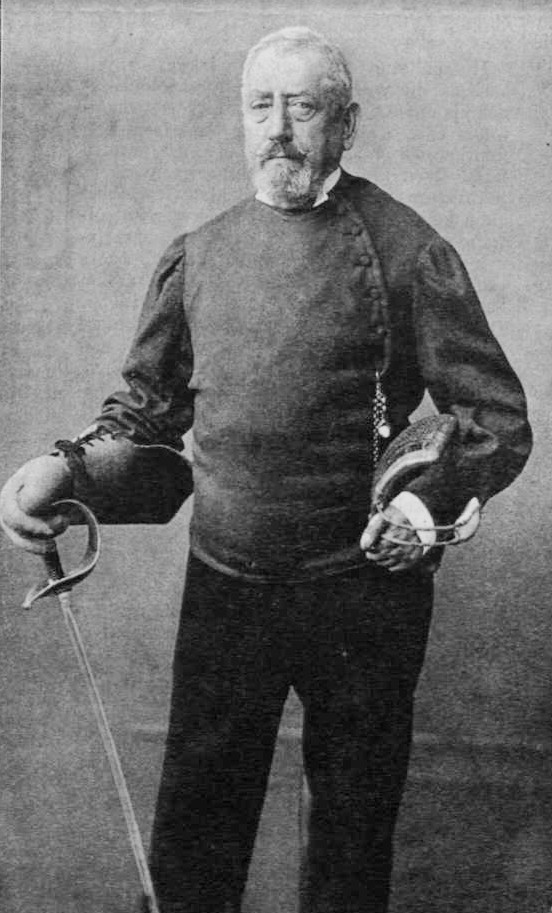
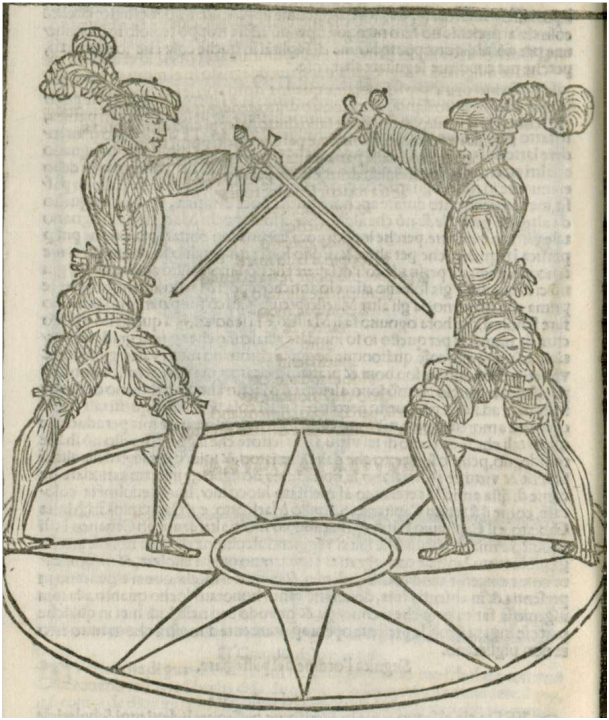
Not having all the answers is okay. No one in their right mind will ever assume you do. Not knowing is what spurs us to learn. Saying “I don’t know” is never the wrong answer, however terrifying it is to say, and once said puts you on the path to changing an “I don’t know” to an “I’m going to find out to be best of my ability.”

I offer the following somewhat humorous and embarrassing example. In the oral portion of my doctoral exams, one professor, a stand-in for the Greek expert my school never seemed to be able to keep (allusions to Spinal Tap’s drummer have often been made…), turned out to be one of the two types of examiners one will face in such exams, in this case, the person who wants to see what you don’t know. His first question, of a sort, was to shoot a clay tablet to me across the table and ask “what is that?” I looked at it, replied that the clay was modern, that the script looked to be Linear B but that I wasn’t completely sure (I spent far more time on Latin and Celtic). I thought crap, this is going to be some everyone-knows-this-inscription and I’m screwed. He said it was the first line from Homer’s “Iliad.” I raised an eyebrow in disbelief, said that was impossible as Homer post-dates the Mycenaeans by a good stretch, and waited for the hammer to fall. Satisfied, he then proceeded over the next half hour to ask me random questions about Greek history from Troy to the fall of Greece to the Romans. I cannot tell you how many times I said “I don’t know.” If I seemed to know anything, he quickly changed the topic. I left feeling that I’d failed, that I was washed up, that I’d embarrassed myself, shamed my advisor, and should find a nice heavy rock to crawl under. Despite this emeritus jackanapes’ glee in stymying me, I passed, and only passed his section because what I could answer I answered well, AND, and this is the important part, because I was smart enough not to bullshit, but to admit “I don’t know.” That’s hard to do under pressure—I know, believe me—but it’s sometimes the only answer you can and should give.

Cultivate a Willingness to Remain a Student

I used to teach college courses, mostly working adults in community colleges, and it’s seriously one of the most dynamic arenas in which to learn or teach. Where a room of 18 year olds will have some decent conversation and insight, a room of 16 to 75 years olds, many of whom have acquired expertise and experience in fields from mining to combat, from factory floors to homemaking, is so full of knowledge and experience that discussions are usually richer, more full of insight, debate, and fun.

I firmly believe that the best teachers never stop being students. Good teachers learn from their students, from other teachers, and from anyone whose line of work involves instructing others, be they foremen, former drill sergeants, mothers of six kids, or farmers. My students make me a better teacher, yours will too if you listen.

Own your Expertise

József Keresztessy, around 1892

This can be a tough one, least it is for me, and it’s because it must jive with humility. No one wants to be that insufferable know-it-all or be taken for one. If you’re teaching then chances are good that you have enough experience to do so, are the only option, or are spear-heading a study group and by default have to lead. Maybe you have more formal training, and/or certification via accredited fencing programs. If you’ve earned it, own it.

We can err the other way and undermine ourselves too. If you’re too quick to point out shortcomings, things you don’t know, then that is what people will hear—people are more likely to question you if you question yourself. It can be a fine line. I learned this lesson as a first-time college teacher. I was teaching on an army post and decided not to list my name as “dr” or “name, PhD” on the board, and at the end of the first term an older man, a sergeant, approached and asked me about it. I told him something to the effect of wanting to create an open room where they felt free to talk, to disagree with me, etc. His reply was awesome and a powerful: “Sir, this is an army post—everyone has a rank. You earned those credentials, you earned your rank—don’t be afraid to share that. Whether people feel free to chat or not doesn’t depend on your rank, but how you use it and how you show respect to them. There is room for both command and respect.”

Own your expertise, but do not wave it in people’s faces; share it with them through appropriate means, through scholarship, through teaching, and by living the example. If you are out there reading this Sgt. Bond, again, thank you.

Be Open to Revision as Necessary

With an endeavor as tentative as research into historical martial arts one must be willing to revise any interpretation, no matter how good, should new evidence come to light or a more logical interpretation enter the picture. There’s no shame in ceding place to a better interpretation, only in pig-headingly holding on to one that’s been superseded.

This should drive all of us to work even harder at drawing conclusions that follow from the texts and which make sense logically, in terms of body-mechanics, and fit the historical context. None of this work is wasted. So your conclusions about Fiore have been bested by a new theory, don’t fret—scholarship doesn’t happen in a vacuum and it may be that Jane Schmoe relied on your work to devise her own interpretation (if Jane is a good scholar she will admit that too).

Give Credit where it is Due

Following closely on the last point, always cite your source, and, always give proper credit to the scholars, researchers, and fencers whose hard work, dedication, and passion have helped your own path of study. This goes beyond leaving a paper trail or protecting oneself from plagiarism—it’s just the right thing, dare I say it the chivalric thing, to do. Everyone gets a kick out of seeing their name in a footnote, dedication, acknowledgements, or Facebook post. It honors them, and, in honoring them you honor yourself for you demonstrate that you’re a team-player, an ally, someone who is working to provide the best research, teaching, and interpretation of these martial arts as you can. Stay chivalrous my friends.

Have FunMarozzo (2)

Why do we pursue historical fencing? Why do we spend so much time pouring over the often cryptic passages in old fight manuals? We do this because it’s fun, it makes us happy, and fun is good for us. Don’t lose sight of the value of play—historical fencing exercises your mind and body, and done right, can give your spirit a workout too.

NOTES:

[i] See http://www.fencingmastersprogram.com/about.html

[ii] László Szabó’s Fencing and the Master, Staten Island, NY: SKA Swordplay Books, 1997; see also, among many others, Zbigniew Czajkowski, Understanding Fencing: The Unity of Theory and Practice, Staten Island, NY: SKA Swordplay Books, 2005; Ziemowit Wojciechowski, Theory, Methods and Exercises in Fencing, Datchet, Berkshire, UK: Amateur Fencing Association, 1993.

[iii] For a good place to start (in fact, just read this, it’s fantastic ) see Roger Norling, “HEMA Pedagogics Part 1: The Pedagogics Pioneers & The Role of a HEMA teacher,” at HROARR, November 21st, 2014, http://hroarr.com/hema-pedagogics-part-1-the-pedagogics-pioneers-the-role-of-a-hema-teacher/ (part 2 is here http://hroarr.com/hema-pedagogics-part-2-the-implications/ , part 3 here http://hroarr.com/hema-pedagogics-part-3-how-to-create-a-good-learning-environment/ ); see also a breakdown of a typical practice at The Phoenix Society for Historical Swordsmanship in “How we Train” by Richard Marsden, http://phoenixsocietyofhistoricalswordsmanship.webs.com/apps/blog/show/31776335-how-we-train-by-richard-marsden .

[iv] Pedagogy is a giant subject—here I will discuss some general ideas, but in the next installment on this I will discuss some real-time strategies for teaching.

The Art above All Else—Collaboration and Fencing Instruction

Fencing books

It’s taken me years to learn this, but with fencing I’m at my best, at my most pure when my focus is the Art–the sources, the body of technique, history, movement, theory, and, in sharing all that with other people. I started out as most people do. The masters with whom I studied took a traditional approach—I worked one on one with them, sometimes with their assistants, then drilled with more advanced students and my peers. I was encouraged always to seek out better fencers and bout with them. To most, this approach seems very top-down, that is, information comes from master to student, from senior fencer to junior, and that’s not wrong, but… it is also, by its nature, collaborative. The instructor works with a student, not just at them. In working with senior students, with better fencers, one is also collaborating. So, for me, fencing is not a one way exchange, but a dialogue. This seems obvious to me, and maybe it is to you too, but that said it isn’t to everyone.

When something’s near and dear to us, when it’s a part of us, we often fail to see how it’s not obvious to others. We go about our way, acting on the assumption others are in line with us when they’re not. Sometimes this can be taken for a lack of concern, or worse, as something threatening. To others we may simply seem naïve. For my part, I try to act in a way that makes my position clear, but intentions and results don’t always match up, and when it comes to collaborative approaches to an historically individual endeavor like fencing instruction what I’ve learned is that actions on their own aren’t enough. One must be explicit, verbal, and reassuring. One must expect the raised eyebrow from some, the head shake of disbelief from another, and even the sly smile of the ambitious who think they sense a sucker. This said, I still think it’s worthwhile to try to find ways to work together.

Regardless of what sort of fencing one teaches—Olympic, Classical, or Historical—more often than not one does so solo. A master may have a provost or two or some other assistant, but a master working with another master, any instructor working with another, is less common. There are some good reasons for this. As I mentioned in my last entry, the individual, one-on-one lesson is the norm. An instructor teaches a student. Historically, even in the days when one had more reason to learn to fence, instructors vied for students; they were in competition with one another. Today, when fencing is normally a pastime, students fewer in number compared to football/soccer or similar sports, competition can be fierce. Fewer resources and a low profit margin can make anything pretty cut-throat, and fencing is no exception.

1F8A8CB8-E8D9-4EF8-AB72-5E9B022B806A beta

It may run counter to established practice, tradition, even reason, but off the piste I do not care for competition. I understand it, but I don’t like it. In part I think some of this is a carry-over from teaching college classes. In the trenches adjuncts like me occupied working together could mean job security. At my last teaching job, for example, I was—by default—the “pre-modern” professor, so I was teaching not only things I spent years studying in order to teach, but courses in different if congruent areas of history. There are a lot of ways to do this, but my way, being scared to do it poorly, was to contact the people in those fields I know and get help. They’d send me their syllabi, textbook recommendations, articles, thematic breakdowns, everything I needed to produce a decent (not perfect) survey course in classes outside my area. All I had to do was read, interpret, and admit when I didn’t know something. Then, I would either work with students to figure it out, or, tell them that I’d look into it and get back to them. In short, I looked to my peers, and in turn, they looked to me for help teaching courses where I could help them. I’ve taken this same approach to fencing history and instruction—there are people out there, many of them, smarter, more experienced, and knowledgeable than I am, so why not politely ask for their help? I’ve made some good friends out of this too, an added bonus.

In step with the “habit” of working with others, I also realize that with something as vast as the Art, the art of defense, especially within an historical fencing context, there is simply too much to know. This is part of its appeal, and, something we have to keep in mind because we are, each of us, limited by its totality. This is humbling in the best sense—faced with such a mountain of information we have the privilege of being eternal students, forced to engage the material again and again, and with hard work hopefully grow. By extension, knowing that others have more information, or different information or perspectives, it makes sense to work with them. I learn, true, but so too do my students, and as an instructor that is my purpose—teaching. No one ever said we had to do that 100% on our own. Maybe we often do, but even then… someone, normally several someones taught us, and so really we are all the products of shared learning, of a collaborative system, whether we like to think so or not.

From a business perspective it’s easy to see flaws with this. If I send people to a colleague; if I promote another instructor’s seminar; if I do anything to advance them am I not hurting myself? Am I not potentially sending students that might be mine to them? Yes. I am potentially doing that, but it’s a question of values, of goals, and, a recognition that I’m not the only student of the Art, not the only instructor. If I truly believe—and I do—that most students benefit from learning with multiple teachers, in having problems to work out presented in different ways, then I put it to you how can I not involve my colleagues? Do I not do my students a disservice by trying to hoard their time and energy? That’s self-serving in the worst sense, and can undermine the very goals I purport to have. If my goal is sharing the Art, in igniting a fire to study it in all its variety, depth, and beauty, then other concerns are secondary–not unimportant (I have to pay rent)–but secondary.

IMG_4426

It’s not naiveté, a lack of business sense, or even a secret plot to undermine colleagues that I promote their classes, seminars, ideas, or anything else. I do so intentionally, and yes, in full awareness that it could (and often does) affect the number of people attending my classes, and even more so individual lessons. I also recognize, in truth with some sadness, that not all will return the favor. I persist though, I continue to do so because the Art comes before all else; it comes before me, before profit. To the degree that I have any business teaching, then I must do so in accordance with what I value, in what I think the Art has to teach us, and for all the mayhem and murder one learns in the study of arms, one learns far, far more than that—one can learn civility, generosity, largesse, respect, and humility. The best friends I’ve made I’ve made fencing; much of what I learned in competition or in lessons or the assault has had parallels in my life outside the sala; some of the most severe crises in my life have occurred either within this context or were partially mitigated via fencing; I even met my wife fencing. The Art has given me so much, introduced me to so much, and continues to do so whether my own classes are a success or not. Moreover, the Art doesn’t belong to me, but to us all, and it is best shared.

I believe that working together is better. I believe fair play, honest exchange, and mutual promotion ultimately helps us all and furthers the Art. You don’t have to agree, of course, but I’ll say this—if I promote your class, your seminar, anything you’re doing, then it means I recognize in you a fellow student, a fellow disciple of the Art; you’re someone I like, respect, and want the best for; you are someone I know I can learn with and from; you’re the sort of people I like to know and talk to; I recognize you as one of my tribe. I don’t care what ethnicity you are, what sex or gender you are, if you’re young or old, if you’ve got two legs or one, if you’re gay or straight, what religion you follow or don’t follow—only that we share a love of the Art (this said, note well: I do discriminate against bigots, fascists, and others who seek to harm others in thought, word, or deed. If such lowlifes read this and say “but I’m a student of the Art too,” my reply is no you’re not—if you were you wouldn’t be as ignorant as you are).

14103048_10208555503259416_5675796283840380623_o

In some respects it comes down to how we define success, in what our goals are. Sure, like anyone I want my school to thrive, to stay open to introduce people to this wonderful Art, but it’s not the only way to teach. Even if all I do is act as one stepping-stone on a much longer path, that stepping-stone is important too, and the path is long and winding. So, whatever happens business-wise, or with the other irons I have in the fire; however crippled I may become; however busy; I will, so long as I can, continue to study, train, and learn about the Art we love, in all its colorful expressions, and, I will continue to support you as you do so too.


Photos:
–Fencing Books

–Seminar on Maghreb Sabre with Da’Mon Stith, July 2018 at Northwest Armizare [Da’Mon Stith is one of the finest martial artists and teachers I’ve ever had the honor meet]

–Mike Cherba’s Introduction to Lashkroba class, Swordsquatch 2016 [I was Mike’s pell/cut dummy 😉 ]

–Introduction to Italian Sabre, class presented at Grit City HEMA, Tacoma, WA, August 2016 [Will Richmond and I taught this class together]

The Central Place and Importance of the Individual Lesson

deB3

In discussion with a friend and fellow fencer this morning I was reminded of something most of us on the Olympic or Classical side take for granted: the individual lesson. In historical circles one can find this option too, but less often, partly because of the backyard, study-group heritage of historical fencing, and partly because often there’s no one available who can, properly, teach the old, interpreted material super well. This isn’t a dig at my peers, just an observation. The historical community isn’t as venerable, relies less on precedent (and is often outright hostile to it), and is so varied in expression, purpose, and equipment that a standard teaching method, while desirable, is less easy to formulate.[i]

Joinville 2

Why is the individual lesson so important? There’s a lot of literature on this, and much of it written by far wiser heads than mine (so you should check it out), but in summary the one-on-one lesson with an instructor is better because of focus, attention, and feedback. We learn a lot in group classes, but by their nature such classes can only do so much. The instructor, even with an assistant, must survey everyone, all the time, and notice what is going well, what not so well, and step in. Rather than helping one person in a focused way, they notice a problem one student might be having and make a group announcement. Maybe the student not turning that front foot straight during footwork drills realizes that the instructor is talking about them, maybe not. One on one, that student has no question. As students, we should seek out individual lessons if possible, at least if we truly wish to improve. The focused attention, the critical eye, the distinct correction for our specific idiosyncratic movement, all of that is invaluable.

One thing we don’t talk about enough, though, is what it takes for individual lessons to work well. The easy things to list are well, easy: a knowledgeable instructor, an attentive student, clear expression of ideas and techniques with demonstration, etc. But the single most important thing is personality fit. Not everyone learns the same way, not every style works for all. Students seeking individual lessons may need to shop around, and they should. Few things sink a student’s success like a bad rapport with a teacher—this could mean an outright gruff instructor to one that for whatever reason just isn’t a good fit. It’s like that sometimes.

Joinville 3

Instructors need to realize this too. If they’re in this to make money then it especially behooves them to find a style that will work for most people. Traditional approaches to the individual lesson, as still taught at the Coaches’ College or at the Sonoma program, remain the most effective, tried and true way to teach this material. There’s a reason that lessons are still taught as they are after several centuries of development.[ii] For those of us not in the profit game it’s just as important if we truly want to share this wonderful Art with people. For me, when I realize that a student struggles more with my presentation that the skill-set, if I realize that they need something I can’t give them, I recommend friends of mine or other schools who might. If we truly care about the student, then this is what we do. As an instructor, our goal is for students to grow, hopefully with us, but if not then with someone. We’re a small community, and to my mind we collectively gain by recommending one another, helping one another out, and promoting the Art over ourselves.
———-


[i] For complicated reasons many historical fencers outright reject anything smacking of “sport” or “classical” fencing, presumably for being less “martial”—a word over-used and too often poorly—than their more macho historical style of choice. This does their cousins in those other camps a disservice, but it also limits their own growth.

[ii] In brief, traditional lessons one on one start with a short warm up, say lunging a direct thrust or cut to the instructor via cues. Next, the instructor may either introduce a new concept or technique, or, may drill one already shared. Depending on the student there may be a little of both. Lessons often end with a cool-down drill, e.g. parry-riposte or stop-cut drills for sabre. Group lessons often mirror this, but writ large.