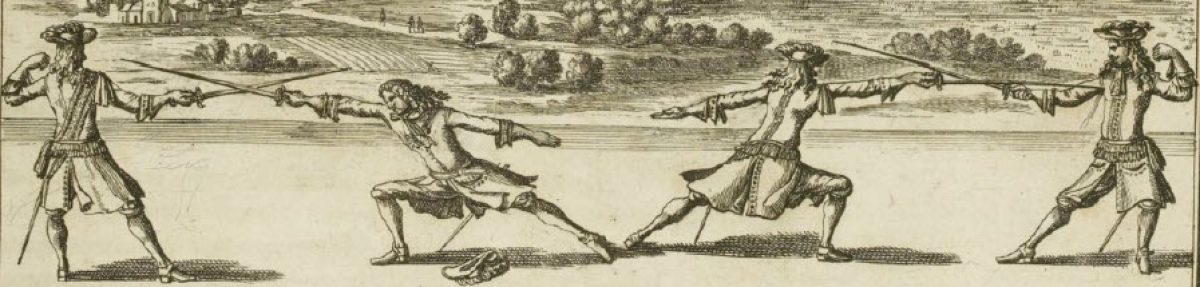
Pants before Shoes: Skill Progression in Fencing

from the genius of Gary Larson and his “Far Side”

In fencing some skills are difficult by nature, some because we make them so. For the former, one must put in the time, sweat, and sometime frustration—there is no other way. For the latter, however, there is much we can do to limit the ways in which we make skill acquisition harder. As much as this applies to any student, it applies all the more to the instructor, for they plan the lessons and set the pace. It’s their responsibility to present material in a logical, progressive way so that shoes are not donned before pants, so that equines are not placed before carts. We do this in most things, and fencing is no different.

Culture & Approaches to Learning

So much of what we study is exciting and people can’t wait to dive in—deep—but the fact is that fencing, any fencing, requires considerable coordination, skill, and experience to do well. For the clubs (especially here in the U.S.), which are various takes on Chuck Palahniuk’s Fight Club, often newcomers are handed a weapon day-one and ten minutes later are bouting. It should be obvious why that’s a bad idea, but given how widespread the practice is, it’s not.

Often those running such clubs probably don’t realize how short-sighted this is; it might be the way they themselves got involved, so it seems normal. In addition, most clubs struggle to stay afloat, and the tired adage of “give the customer what they want so that they come back” may underpin this get-them-playing-right-away practice. It’s a tough spot for any club—we want people to stay, but the fact of the matter is that most people are there to play. It’s recreation. By and large “HEMA” consists of people in their late teens to those in their thirties, so college students, adults with jobs, people with time and just enough money to pursue this expensive hobby. It makes sense that many if not most folks don’t want to spend the little free time they have doing thirty minutes of footwork drills, working on point control, or exploring this play or that from technical aspects.

A caveat: I am not dogging play-time; however, I think it’s important to ask the question, to be mindful of what it is we offer, and why. If a club wishes to be the “HEMA” equivalent of fight-club meets theme-park, fine, but admit it; have the integrity to own that what you’re doing is less “martial” than it is playtime with a few historical “tricks” thrown in. There is room for this, and in my experience, that in fact is what most people actually want. This is to say that the numbers are telling. Those groups who focus more on technique, on building depth within the Art, not only tend to be far smaller than others, but also get people bouting at full tilt slowly. Between the length of time to learn enough skill to bout effectively and the fact that there is a lot of work up-front, few people stick. To reiterate: this is perfectly understandable. That doesn’t make it any less unfortunate.

The Difference between “Do this” and “Here is how to do this”

For those interested in comprehensive technical skill acquisition the old way is still the best way. Ideally students do this one-on-one with an instructor, but it also works in a group setting if slightly less well. In short, this approach takes “do this” and expands it to “this is how you do this.” For example, one could demonstrate how one stands in posta di donna in Armizare, ask the student to copy it, and when it looks right enough, say well done and continue. Alternatively, one could start there and then make the micro-adjustments that will save the student problems later. The instructor could speak to how far apart the feet out to be, what direction they’re pointing, and where one’s weight should be—between the feet? Front-weighted? Back-weighted? There is also more than one way to adopt posta di donna—one can adopt this stance with the sword over the right shoulder, over the left; one can stand in posta di donna pulsativa, which is more back-weighted, and, in the same way but with the sword on the left (posta di donna la senestra pulsativa). [1] The student might be wielding a longsword, a longsword as pole-arm, a spear, or a pole-axe, and while the stance is more or less the same the length and heft of the weapon change critical aspects, such as measure and tempo. Each one of these positions is useful for some instances, less so for others, and so it’s not enough to say “stand like this;” we also have to explain when and why to stand this specific way. If the student is shown one version of this posta they’re getting short shrift, and, it’s not going to work well for them.

An Argument for Slow & Steady

What’s the risk in not learning how to fence via a method which introduces complexity one step at a time? There are a few things. First, if their level of understanding is shallow, the student’s ability to add to their repertoire is affected. Lacking basic comprehension makes learning permutations for that skill or related ones harder. This is all the more true with fundamental actions. For example, if the student learns to lunge without ensuring that the front foot is pointed at their opponent/along the line of direction, there are cascading consequences. They increase the risk of injury to knee or ankle. They inhibit their ability to advance quickly or perform maneuvers which employ the same foot orientation, such as the advance lunge, jump lunge, or redoublement. In the worst cases the misdirected foot misdirects the body and thus the weapon.

Second, hard is it may be, the acquisition of skill in a logical, progressive sense builds confidence. Having mastered how to lunge, for example, the student is more inclined to use it, and often, more amendable to learning other methods of moving that employ it. Confidence—sensible confidence—is everything in fighting. Without it one is immobile, potentially at the mercy of a more confident opponent. Proper education instills proper confidence, because it is built on more than luck or the myopic reality of having something work in specific situations like tournaments where most people are at the same skill level. If one has learned to lunge well, and with it, when to lunge and from what distance, there is science in play—it’s adaptable, not tied to the conditions of any one situation. This is important, and, not only for the more source-driven, history-minded folks, but tournament folks too—fight long enough, in tournaments of different types, and one learns quickly whether their toolbox is as replete with tools as one thinks.

This brings us to a third reason the slow and steady approach to learning is important: resilience. When the tournament fighter reaches the day where their bag o’ tricks lets them down, the countdown to their quitting starts. They have nothing to fall back on; the more passionate among them seek out new tricks, but since these “tricks” are misapplied or misunderstood fundamental actions or composites of such actions, they are ultimately a dead end. This fighter doesn’t know how to recombine them. This is one reason, judging by local numbers, people jump into “HEMA” for two to three years, then leave. For the fighter, however, who possesses skill and understanding in the fundamentals, there is a built-in approach to analyze and problem-solve what went wrong in that bout or this tournament. So armed the student is less likely to hang up their mask and feder, but examine what went wrong and why, because they have the tools and technical vocabulary to do so.

Related to resilience, but perhaps more germane to the let us say the “mature” fencer…, a solid grounding in technique, not just in its use but in understanding, will allow them to keep fencing when they can no longer, or should no longer…, engage in some branches or fight with certain weapons. Call it adaptability. I work or have worked with fencers older even than I am, and the ones who are still fencing have been able to continue because their understanding isn’t shallow. Even moving say from KdF to smallsword wasn’t the speedbump some might think because they were well-trained in KdF. Their instructor at that club—one I knew and have a lot of respect for—taught them correctly. I didn’t have to teach them how to move, just adapt what they had been doing; I didn’t have to teach them to attack with the weapon first, because they already understood that; I didn’t have to introduce them to tempo because they’d learned this as well. All I have done is help them adapt the lessons they learned studying Liechtenauer, Dobringer, and the rest to new tools. With other fencers, in contrast, who have not received decent instruction, who, poor souls, were just thrown in the pool and told to swim, two things generally happen: they struggle in the first lesson where we go over basics, then in frustration they leave and I don’t see them again.

Further Examples

Specific examples help, so here I’d like to explore two. The first is from rapier, the second smallsword. I’ve not chosen these at random either—I see these very problems all the time. Seeing what sorts of issues these examples cause fencers has served to bolster my position on taking the time to learn to do things properly. The first example, from rapier, concerns adding too much too soon. The second, from smallsword, focuses on a complicated action as if it were simple.

Rapier and Dagger

One of the most popular combinations in historical fencing is rapier and dagger. Not going to lie, I love it too, and in fact it’s now difficult for me using any thrust-oriented weapon held in one hand not to want a dagger in the other. That defense-in-depth is a game-changer. Happily, we have a large number of rapier treatises that cover using an off-hand dagger, among other options, which means that we have comparatively less guess work than we do in so many areas.

If one examines a random selection of rapier works, it is worth noting when the source covers dagger, that is, where it is within the book. For example, I pulled these four from my shelves:

  • Camillo Agrippa, Trattato di Scientia d’Arme, 1553
  • Vincentio Saviolo, His Practice, 1595
  • Francesco Alfieri, La Scherma, 1640
  • Francesco Marcelli, Regole di Scherma, 1686

Agrippa is one of the oldest rapier texts, Marcelli arguably one of the latest, and so though brief this gives us some notion of changes over time. I also considered different translators as a sort of double-blind or check that I wasn’t favoring one (I have my favorites like anyone else).

from Agrippa’s _Trattato di Scientia d’Arme_

Agrippa’s Treatise on the Science of Arms features the pairing of sword and dagger from the off, and, in most sections. It is safe to assume, then, that working these in combination as one starts study of Agrippa makes some sense. In contrast, Saviolo covers sword alone first, then sword and dagger, then returns to sword alone. Likewise, Alfieri turns to sword and dagger later, in the twentieth chapter, in On Fencing. Marcelli’s Rules of Fencing covers the span of a bible before getting to sword and dagger—he begins coverage of it in part two, book one, chapter 1. [2]

Going by these four, and granted this is a tiny sample, starting with sword alone makes sense. There is another reason to study sword alone first—it’s hard enough studying one weapon without adding an additional set of positions and actions, never mind coordinating them both. Proper control of a single weapon is difficult, especially at first, so unless there is good reason to do so, why double that difficulty? [3] Put blunty, if the student can’t make a decent direct thrust or perform the most basic parries yet, then the addition of a second weapon isn’t going to help them: they’ll just have two tools with which they must struggle. Moreover, pairing sword and dagger changes one’s position—from a slightly profiled guard positon one adopts one that is more square, because the offhand weapon now provides some measure of security. To remain profiled limits if it doesn’t prevent one from using that offhand weapon. Thus, if a student’s footwork for sword alone isn’t decent, the addition of variations will only complicate things.

Smallsword

Turning to smallsword, a number of works discuss the demi-thrust, sometimes in English called a “half-thrust.” The term is deceptive—taken literally it might be mistaken for a thrust made half-way or perhaps some manner of in-fighting action, but it’s actually a species of false attack made by the defender. Girard’s Traité des armes (1740) illustrates this action well.

Demi-Botte de Quarte

Au dedans des armes pour tirer tierce, ou quarte dessus les armes

Ayant paré un coup de quarte au dedans des Armes, au lieu de riposte droit de quarte sans dégager, je fais level la main & la pointe plus basse, en frapant du pied droit, comme pour achiever le coup au dedans; & lorsque l’ennemi vient à la parade pour fraper l’Epée, dans le même-temps je fais dégager subtilement & tirer ferme au dehors, soit de tierce ou de quarte dessus les Armes, la main la premiere dans le principe, puis redouble de second sous la ligne du bras, ensuite faire retraite l’Epee devant soy. [4]

The defender, having parried in quarte, feigns a riposte in the same line (fourth), but as the opponent moves to parry in quarte, the defender makes an appel and disengages and thrusts in tierce with opposition. Seems simple, right? It is, if one has already a good command of the key actions that make up the demi-botte.

Girard covers this later in the text, well after discussion of the thrusts in tierce and quarte, the parries of the same number, how to move, and importantly, after explanations of feints, beats, and compound attacks in various tempi. Organized as it is, The Treatise on Arms proceeds from less to greater difficulty, so, if the demi-thrust is covered after these other complex actions, there is likely a good reason. There is complexity there.

An indication beyond placement within the treatise, Girard does not explain how to perform the specific actions that make up the demi-thrust; he just describes the action. He assumes that the reader, hopefully possessing at least a modicum of instruction, will supply the required skills and ideas. As it’s laid out, the demi-thrust reads like yet another technique employing a disengage, but it’s more than that. It recalls the section on feints, though it isn’t one, but it also assumes excellent timing and a keen sense of measure. [5] All of these must work in concert to make this defensive option viable.

Girard 1740, _Traité des armes_, plate 39

An instructor must know what each action within the text entails, and, plan what to cover (and in what depth) according to a student’s level. Following this example, if one wishes to cover the demi-botte, then the student needs at least to have a solid grasp on movement, the key lines of tierce and quarte, and the ability to use these techniques in more than one tempo.

Thanks Capt. Obvious

Often, most often really, I feel like my posts state the obvious, things people already know. I have my biases too, my blind spots, and that cuts both ways—I may assume people know something, or, I may assume they don’t. Apart from the handful of people who read this that I know, and who chat with me about things, I have no idea to what extent any of this is helpful, but the goal with these posts is to provide anyone who might need it some help. It’s offered in my role as a fellow-traveler, someone who’s been studying all of this for decades, and without any expectation or need for thanks, recognition, or anything else. Importantly, I’ll be the first to say I don’t know everything, and the longer I spend on the Art the more I realize how much greater what I will never know truly is (too large to measure).

Teaching is difficult, despite the sad maxim popular among my own people, and I’ve been fortunate to receive a LOT of training as a teacher, not only in fencing, but in higher education. [6] Lately, as I’ve been nursing injuries, teaching more than I’m bouting, I’ve been thinking it might be useful to share some of these things. Hopefully, it’s helpful, but if not, and you’ve read this far, thanks for reading it anyway.

NOTES:

[1] Online, cf. http://www.nwarmizare.com/Pocket-Fiore/assets/www/index.html

[2] See Camillo Agrippa, Trattato di Scientia d’Arme, see Ken Mondschein, ed., Fencing: A Renaissance Treatise (New York, NY: Italica Press, 2009); Vincentio Saviolo, His Practice, see James L. Jackson, Three Elizabethan Fencing Manuals (Delmar, NY: Scholars’ Facsimiles & Reprints, 1972), 197-247, 247-298, 298-310; Francesco Alfieri, La Scherma, translated by Tom Leoni (Lulu Press, 2018); for Marcelli, see Francesco Marcelli, Rules of Fencing, translated by Christopher A. Holzman (Witchita, KS: Lulu Press, 2019), cf. p. 267.

[3] There are exceptions. Agrippa assumes a dagger in much the same way that Georgian Laskhroba assumes a buckler (pari) when using a sword (khmali). In the latter tradition, sword and buckler work together, and at least as I have learned it while one can separate the hands, and in some cases absolutely should, but that is a lot easier to do if one has learned how to keep the together first.

[4] P.J.F. Girard, Traité des armes, La Haye, Chez Pierre de Hondt, 1740; the BnF pdf features this action on page 109. Finishing the action in tierce is one option; one can also complete this with quarte over the arm, that is in the line of tierce but hand supinated/in fourth position. Moreover, one can redouble and strike in seconde as well, before retreating behind the point.

[5] Arguably one could call this a compound parry-riposte, a return that employs a feint to draw a counter-parry and then which changes lines. Regardless, like the demi-botte in Girard, the compound parry-riposte is normally taught after a student has good command of the basics of single tempo parry-riposte.

[6] The quip in question is “those who can’t, teach,” easily one of the stupidest phrases yet uttered, and a deep window into the anti-intellectual culture gaining prominence in the United States. If this seems like the bitter thing a former academic might say, well, consider how our movies and television programs, many popular world-wide, portray professors, scientists, and scholars—almost universally they’re villains or clowns. Mine is the only nation I’ve visited, so far, where more than one person has referred to a PhD as “post-hole digger,” a remark that shows at once the disdain for higher education, the glorification of manual labor (which is perfectly fine and necessary), and the fact that with a glut of PhDs and MAs running around many are in service jobs.

Russ Mitchel on Timmlich

As someone who regularly points out how daft it is to use a trooper-weight sabre for foot combat (tough to make any complicated action well), I feel it only right to share this lovely video from Russ. Timmlich’s excellent treatise provides the historical fencer into BIG sabres a way to use them, on foot, effectively. Check it out!

SabreSlash 2022, October 1-2

Sala delle Tre Spade & Barbasetti Military Sabre since 1895, Partners in Fencing

This weekend our sister-school, Barbasetti Military Sabre since 1895, based in beautiful Prague, Czechia, will host its annual event: SabreSlash! Day one consists of classes; day two presents a cutting event, the Zabłocki Sabre Tournament, and the highlight of the day, the Moustache Challenge, easily one of the more difficult historical fencing contests.

This year Michael Kňažko of Barbasetti Military Sabre is joined by another close friend, the excellent Patrick Bratton (Sala della Spada, Carlisle, PA). Patrick will be exploring Radaellian actions on the blade. They are joined by several other instructors, including Maestro Leonid Křížek (CZ), and Leonardo Britto Germoglio (D). Here is the full program:

SabreSlash 2022 program:

Saturday, October 1st
– ”Actions on the blade in Radaellian sabre”, workshop led by Patrick Bratton, Sala Della Spada, Carlisle, PA, USA.

– “Akademische Fechten”, workshop led by Leonardo Britto Germoglio, Germany.

– “Molinelli in Barbasetti sabre”, workshop led by Leonid Křížek, Barbasetti Military Sabre (since 1895), Prague, Czech Republic.

– “Sciabola in Mano, controlled and conserved strength for cuts and thrusts”, workshop led by Michael Kňažko, Barbasetti Military Sabre (since 1895), Prague, Czech Republic.

Sunday, October 2nd
– “SabreSlashing with light sabres”, test-cutting workshop 😊

– “SabreSlash Moustache Challenge”. All gentlemen are encouraged to attend the event wearing a fully grown Ferdinando Masiello style moustache. The wearer of the most classical moustache will be awarded a very special prize.

– „ Zabłocki Sabre 2022“. The biggest Barbasetti sabre fencing tournament since the legendary 1895 Prague military fencing tournament organized by k.u.k lieutenant Dominik Riegel. The winner of the tournament will receive a brand new Swordsmithy practice sabre.

[cf. https://www.facebook.com/events/415973570345249/?ref=newsfeed]

Sala delle Tre Spade & Barbasetti Military Sabre since 1895

Russ Mitchel on Textual Criticism vs. Ad Hominems

Long experience has taught me that external validation is chimerical, distracting, and no replacement for appropriate confidence, but that doesn’t mean it isn’t nice to encounter. Finding this response to another fencer’s rebuttal of Russ’ take on Alfred Hutton’s unfortunate Cold Steel (1889) was like finding a good pastry to go with coffee this morning.

Of particular note, Russ explains probably better than I’ve heard it anywhere else (and certainly better than I ever have) that textual criticism, including analysis of a researcher’s position, is not the same thing as a personal attack. Yes, the two can mix, and sometimes do, but Russ doesn’t do that–more than once, and this is in any number of his videos, Russ has not only given Hutton credit where due, but also recommended a superior text by the same author, The Swordsman (1891).

Despite the number of people who have finished secondary school and/or college this is, surprisingly, an extremely common mistake. For the handful of people who read my posts here a prime example would be the response several fencers had to my critique of the 2020 paper that attempted to reinterpret George Silver’s system. Cults of personality being what they are, no matter how well-made a critique is the chances of it winning out against devotion to those personalities are slim, especially if that critique is coming from someone outside that clique. Name recognition tends to win out against analysis in “HEMA.”

In this case, however, Russ is not only a trained academic, but also someone well-known in historical fencing’s research circles if not in the wider, “HEMA” tournament scene. This video is important to watch for several reasons, but among them is the fact that Russ’ measured, information-driven rebuttal provides a great template for the community.

Russ Mitchell, response to Pope in re Hutton

Using Historical Fencing Treatises, Text & Subtext

Teaching from early fencing sources can be daunting. On the one hand, their organization, language, and lack of details can impede interpretation. There are also the challenges we face in using images, not to mention dealing with sources that lack them. On the other hand, we cannot always guess what assumptions the author had about the reader’s knowledge or even what they intended with the work. For the period in which the smallsword was popular (roughly ca. 1615 to 1800), some treatises were likely meant for public consumption, others were written in an attempt to solicit patronage, still others to challenge existing custom and/or defend a new approach. All on some level were meant to immortalize a particular author’s views and put their name on the rolls of influential masters. Some are mere tracts, others replete with a host of actions and maneuvers. Even when a source is less difficult to understand there remains how one should use it. Both deciphering challenging texts and deciding what to use from them (and how) are things we must consider when teaching from them.

As someone averse to anything remotely smacking of Bourdieu, Derrida, or Foucault, my use of the term “subtext” here is meant to convey the implications within our sources, not some hidden meaning or the imposition of some anachronistic, fashionable theme into the past. There is, plainly, what a book says, and, what it doesn’t, and we can learn a lot from both.

“Barcelona,” 1994, by Whit Stillman

Explicit vs. Implicit

When we’re lucky an author is explicit. They provide details as to the individual movements and positions that make up a stance, technique, or action. Sir William Hope, for example, is one of our chief sources for knowing that one should not insert the fingers through the annulets, those rings, descendents of a rapier’s pas d’âne, found on many smallsword hilts. In his Scots Fencing Master (1687) he wrote

You must hold your Sword after this manner; hold your Thumb upon the broad side of the Handle with your Fingers quite round it, as in the second Figure of the first Plate marked F. and not as some do, who their foremost and middle Fingers thorow to two arms of the Hilt, thinking that by doing that, they hold their Sword firmer, some use onely to put their foremost Finger through, which the Spaniards did of old, and many even to this day do it; but both ways are most ridiculous, and dangerous.
[2]

Presented in the much-used trope of master and student in discussion, the corresponding student comments that one is at risk of having one’s fingers broken should one come to grips. Details like this are critical in our interpretations as the presence of the annulets naturally suggests they are there to secure one’s grip.

The granularity of instruction, generally, is less precise than it is in more recent works. One reason for this is that the sword, being a feature of culture at the time, something carried, seen on stage, and of course discussed within treatises, meant that readers possessed better familiarity with the topic than most people today. This is, perhaps, why so many of the smallsword works appear deficient in specifics. There is still, however, much we can learn from them. For example, many suggest or list a series of lessons. De Liancour (1686/1692) and Wylde (1711), for example, both suggest lessons within their treatises, the former in a series of “games” a master might take a student through, the latter via a suggested lesson. [3]

from Sir William Hope’s _New Method_ (2nd Ed., 1714)

When we find ourselves left with less detail than we’d like, we must find a way to bridge text and subtext, that is, connect what is explicit with what is implied or assumed. There is an inherent danger in this, however, so we must apply precedent when available, analogy where applicable, established fact when known, and always the faculty of reason. An example I’ve often cited before is how to step. Whatever the word used, “step,” “pass,” “advance,” there are certain things we know (or should) about how humans walk. Given how long our species has been walking upright we can safely assume that people in the 17th and 18th century did too.

As another example, Wylde suggests that

The most absolute and truest way of thrusting Cart and Ters, is to perform your Pass as close to the Fort of your Opponents Weapon as you can; for in so doing, it will in a great Measure preserve you, if he happen to Counter Tang: but if your Push fails hitting, besure to make your recovery strongly engaged upon his Weapon, or spring your self backward withal the Celerity imaginable out of his distance, in a true Line.
[4]

If one is familiar with the parts of the blade, this may sound odd. Close to the “Fort” (forte/strong) of the blade seemingly goes against what most fencers know about the respective mechanical advantages and disadvantages of strong and weak. Placing the weak of our blade near the strong of theirs provides the opponent more leverage. To attack in such a way is to hand the opponent a parry. So, what does Wylde mean?

It will help to revisit Wylde’s division of the blade. He separates it into three sections, but one is more a point than a section:

The Blade, I likewise divide into Three Parts thus, From the Shell to the middle, I call the Fort or Strength of the Weapon: The middle is the equal Part betwixt the Shell and the Point: From the middle to the end, I call the Feeble or Weak. [5]

So, the “weak” here is really middle to tip, the “strong” middle to guard, and the middle merely where they meet. Armed with this notion of blade division Wylde’s admonition that one keep as close to the opponent’s forte makes more sense. The thrust isn’t tip to forte, but made so that the middle of one’s weapon is more or less along the middle of the opposing steel. He also provides reasons for this close thrust—it can help protect one from a counter-attack, and, should one’s attack fail, then it is easier and safer to retreat having already closed off the line. Wylde doesn’t remind the reader here what he means by forte and feeble; he assumes the reader knows.

Further clarification derives from Wylde’s guard position:

Stand upon a true half Body, or edge wise, which I call, lie narrow your leading or right Foot, two Foot or more distance from the left, being in a direct Line from the same, then your right and left Foot will resemble a Roman ‘I’; your Hand fast gript about the hand of your Foil or Rapier, then put your Thumb long ways or forward upon it, your Arm quite extended from the Center of your Body, the Point of the Weapon being directed in a true Line against your Opponent’s right Pap, sinking somewhat low with your Body, your right Knee bowing or bent over the Toes of your right Foot, (tho’ some Masters teaches a strait Knee,) your left Knee more bent, inclining towards the Toes of your left Foot; lying in this Order is the Posture, which I call, Stand your Line, the Medium Guard then is fixt.
[6]

This guard, sometimes called a middle guard, has the arm midline, not to the right or left depending on handedness. To thrust in Cart (quarte) or Ters (tierce) one is moving off that midline, so without attention to the opponent’s blade as one thrusts, without some opposition there is an increased chance of being hit as one strikes. We’re not dealing with right of way here, or foils, but sharp swords, and thus Wylde’s recommendation makes good sense.

Subtext & Using a Treatise

Moving from micro to macrocosm, there are times we must look to assumed or implicit knowledge to use a treatise effectively. The progression of techniques, for example, in P.J.F. Girard’s Traité des armes (1740) might seem a logical approach for introducing more complicated actions. In part this is true, however some distinction should probably be made between what we call today bread-and-butter techniques, those we use most of the time, and those that are “medicine for the hand,” those more complicated actions, especially compound actions, which are less viable in actual combat. It’s not that a double or triple-feint can’t work, but that the effective use of it assumes an opponent of considerable skill, more so than most people possess. One is likely to face a counter-attack using so many actions—the more parts to a maneuver, the more time, and thus the more opportunity for it to go wrong, for the opponent to take advantage or disrupt one’s plans.

This does not mean that one shouldn’t incorporate Girard’s excellent section on feints, but that the instructor should know, and be clear in teaching, that some of these drills we do to push skill forward, to hone it. [7] If one can make complex actions well, then one can make simple actions well. The importance of this, in a bout, is that we not only tend to find the most success with relatively simple actions, but also that in any arena in which nerves, fear, or excitement is likely our ability suffers. [8] So, the more effective and solid our technique is, the less far it is likely to fall off and hurt our chances. This is why effective teaching and constant drill are so vital.

Outside research, particularly into accounts of duels, as well as practical advice from those masters active when duels were prominent, can do much to fill in the missing context. Girard does not say that his more sophisticated actions are medicine for the hand. At a time when more people learned the sword and might use it in earnest it’s likely that a double-feint proved effective; not against every opponent, but against those well-trained it likely did. It remains an open question just how expert the average fencer in the age of the smallsword, or any age for that matter, was; our sources suggest much, but confirm little. There are enough references to fencers of “natural” skill and little training to suggest that many who carried a sword either hadn’t received instruction or at least not very much. A good analogy my friend Ken Jay has made in this regard is to the number of people in the U.S. who opt for concealed carry of firearms—many if not most have shot a pistol before, but the vast majority have little to no formal training in how to shoot in self-defense or combat scenarios. Maybe they’ve taken a class or series of classes, but here too the analogy holds up well with the Early Modern Period: for all the solid, experienced instructors teaching “tactial” handgun techniques, there are a multitude of charlatans and well-intentioned, but unskilled people offering training, just as there were when dubious sword masters set up shop and took in the credulous.

Oblique references, for example, indicate a wider knowledge of fencing, at least among those sections of society eligible to wear a sword, but also suggest that not all were particularly good students. We see extremes in the literature. Máire Anna MacNeill begins her doctoral dissertation with the example of cavaliers in England attending a performance of William Davenant’s “The Unfortunate Lovers” in 1660. The play included two dramatic sword fights in acts four and five which these same attendees, post show, mocked at a local tavern. They also drew their swords to show how the choreography failed. [9]

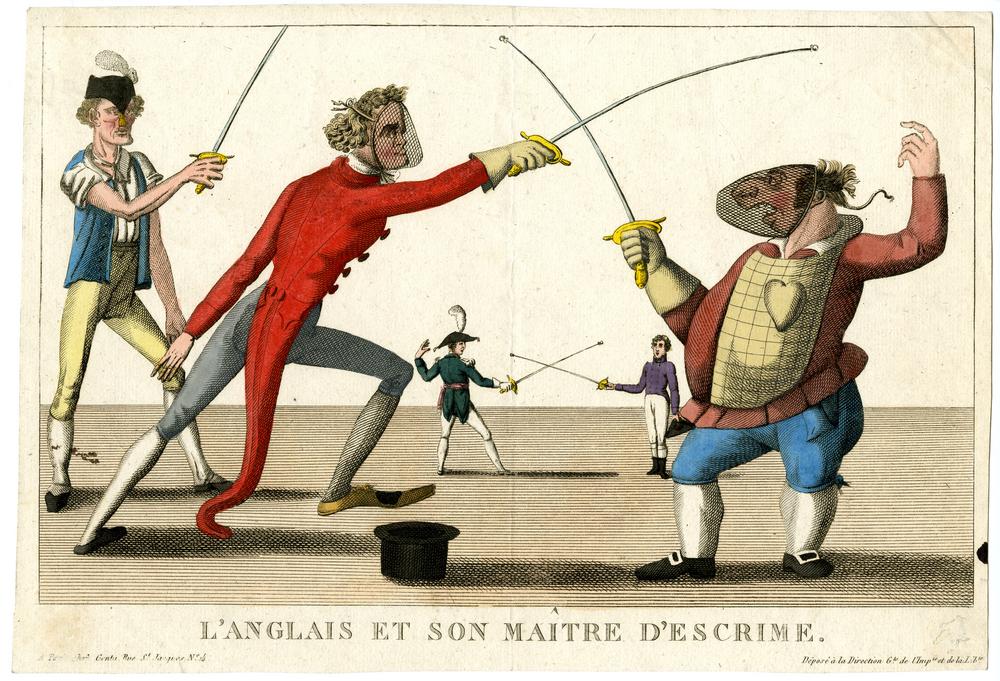
Satirical Print, 1814, The English Fencing Master and his Student, courtesy of the British Musuem, https://www.britishmuseum.org/collection/object/P_1856-0712-639

Against this example we have, again for England, references to the curious fashion of wearing a sword but it being rude to use one save in extreme situations. Aylward cites the example of a character in Fanny Burney’s Evelina (1778) grabbing his sword hilt—he remarks that this was “an unseemly gesture pardonable only in an excitable foreigner.” These two examples are separated by a century, but it’s important to note that works closer in time to that of Davenant echo similar sentiments. Aylward also cites Andrew Mahon’ 1734 translation of L’Abbat’s L’art en fait d’arms (1696), where Mahon remarks one should only draw a sword in service to the crown, for one’s honor, or in self-defense. [10] Between the poles of sword-as-fashion-accessory and sword as sidearm there is a vast middle ground. Likely, most people had some modicum of training, but like today’s concealed-carry types, extremely little chance of having to use that weapon.

For the instructor, examining a treatise in light of not only what it says, but when it was written and what prevailing views of the time suggest will improve their interpretation and teaching. Some works seem clearly more self-defense oriented—Hope, L’Abbat, de Liancour, McBane, and Wylde read very differently from de la Touche, Domenico Anglo, Olivier, and de St. Martin. The former are more clearly concerned with optimizing a guard for most situations (Hope and Wylde especially perhaps), one to two tempo attacks, and the importance of opposition. The latter cover much of the same material, but add some techniques more salle than on the ground friendly. We can learn a lot from both types of sources, and we should read and use both, but always with a keen appreciation for what they reflect. By the mid­-18th century, the foil play originally intended to create a slightly safer style of practice (key in a time before masks were standard) became a game in its own right. Domenico Angelo, writing in 1763, in some ways spans both worlds—he wanted all touches targeted to the chest, a fact that speaks on the one hand to his eschewing masks and on the other to an interest in fencing as an elegant exercise and ideal way to cultivate grace becoming the status of his many elite students. [11] His inclusion of smallsword versus various other weapons, “ethnic” guards, and weapon-seizures recall earlier works, like Girard’s, but the mix of smallsword and foil in his School of Fencing, not to mention the success of his London salle as the premiere academy, we must note too.

In terms of lesson-planning, one approach is to compare how several masters treat a specific action, say the thrust from tierce or quarte. What is different? What the same? Given the instructor’s own perspective, what does it make sense to emphasize? For those more concerned about smallsword as weapon, a more conservative approach makes sense; for those whose interest is tournaments, a mix of solid self-defense and salle fencing is appropriate. Of course, one can teach both as well. The point (no pun intended) is to be mindful about what we are teaching, how we teach it, and to keep the textual basis, explicit and implicit, before us as we plan, devise lessons, and teach them.

NOTES:

[1] Clip from “Barcelona” (1994), by Whit Stillman

[2] Sir William Hope, Scots Fencing Master, 1687, pp. 11-12. See also J. D. Aylward, The Small-Sword in England, its History, its Forms, its Makers, and its Masters, London, UK: Hutchinson & Son, LTD, 1960, 134-135. As an argument for reading the sources, one work from 1982, concerned only with the tool, makes the mistake of listing fingers through annulets as correct. Doubtless some fencers did. See Anthony North, European Swords, London, UK: Her Majesty’s Stationary Office, 1982, 19.

[3] See de Liancour, Le Maistre d’armes (1686/1692), p. 69/78; 119/128 in the BnF 1686 pdf); see Wylde, English Fencing Master, 15 in the pdf, https://smallswordproject.files.wordpress.com/2016/11/zach-wylde.pdf)

[4] Wylde, p. 13 of the pdf.

[5] Wylde, p. 5 of the pdf.

[6] Wylde, p. 6 of the pdf.

[7] See for example P.J.F. Girard, Traité des armes, 1740, pp. 47-51 (p. 80-86 in the BnF pdf).

[8] For a more recent historical example of this within the context of a duel, Aldo Nadi’s account of his duel in 1924 against Contronei in Milan is instructive. The few photographs of the engagement reveal the typically plate-perfect technique of Maestro Nadi drastically changed when confronted by a sharp spada. The goal—don’t get hit—changes everything. See Aldo Nadi, On Fencing, Sunrise, FL: Laureate Press, 1994 (originally published 1943), 24-35.

[9] See Máire Anna MacNeill, “The Sword as Didactic Tool on the London Comic Stage, 1660-1740,” PhD Dissertation, Royal Holloway, University of London, 2016, pp. 9ff.

[10] Aylward, The Small-Sword in England, 20; cf. Fanny Burney, Evelina, 1778, Letter 23, https://www.gutenberg.org/files/6053/6053-h/6053-h.htm . Aylward on Mahon and L’Abbat, 20; cf. L’Abbat, The Art of Fencing, Dublin, 1734, p. 72 in the edition by Lector House (2020).

[11] Aylward, The Small-Sword in England, 108-112.

Curriculum Building & Teaching via the Universals

In an earlier post [9 Aug. 2022] I covered recursive cycles of instruction as one approach to curriculum building. Implicit in this schema, and hopefully in any methodology, is the central place of the universal principles, that is, those elements that underpin all hand-to-hand fighting. [1] While many works touch on these vital concepts, it can be difficult to find discussion of them in one place.

This post will attempt to sketch the salient points of one list of universals. [2] Lists vary, but most include the following:

  • measure or distance
  • tempo
  • judgment

To these I’d like to add several that Maitre Robert Handelman includes:

  • speed
  • initiative
  • tradecraft [3]

Measure or distance is the area of play, the space between two fencers. Typically this is divided into pedagogically useful segments. In Fiore’s armizare, and even in many later Italian works (Marcelli for example), the divisions may be largo and stretto, wide and close. Early modern sources down to today tend to divide the space between two fencers into three: out of measure (where neither opponent can hit one another); in measure (where one can lunge to target); and close measure (where either opponent need only extend the arm to reach target). There are variations by master, further refinements, but these three serve well.

Tempo is perhaps best defined as the time of a single simple fencing action. So, an advance, the extension of the arm, a beat, all of these equal one tempo. Simple and compound attacks, for example, are separated by the number of actions and thus the tempi in which they happen. A direct thrust on a lunge is one tempo; a feint-disengage is two tempi (feint + disengage/thrust = 2).*

Judgement, or decision, is the faculty by which we decide when to attack, from where, and how. We develop this through trial and error, over time, and improve as we grow in skill.

Speed is different than tempo, though they’re related. It’s helpful to think of speed as how fast or slow an action is or is made. We often refer to manipulating tempo, such as a compound attack that is slow-slow-fast, or, slow-fast-slow, etc. Strictly speaking, this is manipulating how fast or slow we make an action. It’s subtle, a bit hair-splitting perhaps, but to illustrate this imagine someone making a thrust on an advance, but then as soon as the opponent parries doubling the speed of the disengage and lunge to target. Speed also refers to reaction time, how fast we respond to stimulus. Like measure, we can break speed down into maximum, necessary (what speed is required to make an action), and slow.

Initiative refers to who starts an action, who moves first, and it can be defensive or offensive. In certain types of lessons we also talk about “student initiated” versus “instructor initiated” actions; this much like “Agent” and “Patient” in some historical fencing circles.

Tradecraft refers to the various ways in which we use rules, psychology, and bluster or bluff to outwit opponents, and importantly, officials. The most successful tournament fighters, whatever branch of the Art they pursue, typically “play” to the director and judges as much as anything else. This requires a good grasp of the rule-set and especially how those rules are viewed and enforced.

Historically speaking, tradecraft describes the gathering and exploitation of intelligence gleaned from interacting and/or observing an opponent. Sizing up an opponent, making probing actions to see what they do, how they react, all are part of tradecraft. It can be as simple as the early modern categories some masters used to describe types of fencers, from the reckless to the timid combatant, from the phlegmatic to the composed fencer, from the large, tall fighter to the smaller, shorter one. [4]

The many springs which flow from the font of these universals are too vast to cover, but for one, easy example the extension of the arm and weapon before the body illustrates well how general principles relate specifically to technique and tactics, even position.

  • The common guard that has the lead foot forward, body slightly forward, weapon arm leading attempts a compromise between safety (distance from the opponent) and target (reach to target).
  • The weapon and hand/arm lead the attack because this continues the compromise to the degree possible: the sharp thing races toward the opponent, something they should be thinking very hard about, while exposing as little of the attacker as one can
  • The positioning, method of extending the weapon, all make the best use of distance and tempo (tempo here, again, equally one fencing action)

Why the Universals are Important

Without meaning to court the exciting world of being “canceled,” if one is teaching or fencing without some intentional inclusion of the universals, then one is not really fencing. One might be fighting, sure, and maybe one has some success, but what makes the Art an art is not bravado, enthusiasm, physical attributes, speed, or luck. There is science involved, study, a set of principles and techniques that made this training worth one’s time back when it actually mattered, and, makes us more effective now.

Colpi di Vilano

Lest one think I’m making this up take a look at those sources from Fiore on that discuss fighting the untutored—the better masters knew this was possible if not likely and explained how to use the Art to counter the clod with a weapon. [5] I’ll be the first to admit that the attribute fighter full of confidence will collect a lot of medals, but success in a game is not the same thing as effective self-defense. We should be far more concerned with not being hit at all, and that means when we attack too.

The universals are important for a number of reasons. First, because these principles underpin any hand-to-hand combat system, they provide a vocabulary for understanding the sources and lessons which impart these systems. If your instructor stops you after an action and asks you about the measure just employed, or what action or actions one of you made; if they ask you why you chose a specific tactic over another; if they ask you to break down the action; they are discussing the universals as applied to what you’re learning. The universals, then, are behind every action and technique we tend to make, so it pays to know what they are.

Second, a solid grasp of these principles will “open up” or unpack a lot of sources. One can look at Meyer, Marcelli, Rossi; one can look at Jack Dempsey’s book on boxing; one can watch a lesson at BJJ dojo; one can watch some MMA match on television and analyze any one of them according to the universals. For the historical fencer the value of this knowledge can make all the difference in how effectively they’re using a source.

Lastly, a thorough grounding in the key concepts behind every action and tactic not only make it possible to take a student deeper into the Art, but also and as importantly help the instructor identify problem areas. How can we correct what we don’t understand? Moreover, the universals provide a nearly inexhaustible supply of lesson options.

How to Use the Universals in Lessons

There are different types of lessons, but no matter what type they are they should work from the universals. Warm up, teaching, option, and bouting lessons all work from the core principles. [6] Here I’d like to focus on option lessons, that is, having a student use material they know in different situations and set-ups. Generally, one is not introducing new concepts or techniques in an options lesson, but exploring that which the student already knows and/or does well.

The simplest way to create options for the student is to start with the universals. By varying what we do with these we help the student develop wider and more sophisticated applications of particular actions. As an example, the simple feint mentioned earlier, can be changed in myriad ways:

Ex. 1: Smallsword/Spada/Foil

Simple Feint (feint-thrust, disengage and thrust to target):

Measure:
–in measure (the student can reach target with a lunge
–out of measure (the student must advance or redouble to reach target with a lunge)
–close measure (the student can extend the arm to target)

Speed:
–attack executed at necessary speed
–attack executed with a fast feint, slow disengage/thrust
–attack execute with a slow feint, fast disengage/thrust

Initiative:
–instructor provides cue for student to begin action
–student provides cue for beginning action

Roles:
–instructor is defender, student attacker
–student is defender, instructor attacker
–both I and S can attack, a question of who sees the opportunity first

Putting all this together, the lesson might look like this:

3-5 min.           warm-up

direct thrusts from standing; lunging; with an advance; on the march; parry-riposte inside high and low/outside high and low

15-20 min.       OptionL:           working simple feints

Feint direct (inside/outside line)—student lands touch
–from standing
–with lunge
–with advance/cross-step lunge

Feint direct (outside/inside line)—Inst. parries; S p&r
–from standing
–with lunge
–with advance/cross-step lunge

Feints on the March
–Instr. provides cue, e.g. raising weapon from 8 to 6
–S. picks moment to attack (should look for neg. bal.)

Feints with Change of Tempo
–S. uses feet
–S. uses varies weapon’s movement

5-10 min.         Cool Down

Instr. attacks with open line, S makes arrest
–top of arm
–inside of arm
–outside of arm
–under the arm/wrist

This is just a quick sketch of one way to do this. The student and instructor could switch roles; they could each be confined to responses in a particular tempo; the Instr. or S., depending on skill level of the S, might introduce random actions in the midst of the topic. So long as these choices are made with the universal principles in mind, it is hard to go too far wrong.

Ex. 2: Fiore, Sword in Two Hands, from Punta Spada [7]

First Master of Longsword

Measure:
largo [wide]
stretto [close]
–passing steps into measure
–using accrescimenti to advance into measure

Tempo: 
–one tempo [thrust to face]
–two tempi [cut over to head or arms]

Speed:
–necessary speed
–slow-fast [slow step into measure; quick strike]
–fast-slow [quick step into measure; cut-over]

Initiative:        
–Instructor provides cue by stepping into measure and crossing swords
–Student provides cue by stepping into measure and crossing swords

Putting all this together, the lesson might look like this:

3-5 min.           Warm Up

7 Strikes of Segno; Meyer Square
–solo, in air or against pell
–with partner who adopts opposing posta
–from standing; with passing step

15-20 min.       OptionsL:          Working from the Bind in Longsword

I initiates action, crossing punta spada (1st master L gioco largo)
[I applies little pressure to bind]
–S thrusts to face
–from standing with step

I initiates action, crossing punta spada (1st scholar 1st Mstr)
[I applies pressure to bind]
–S steps to right with cut over to head or arms
–with pass right or left

I initiates action, crossing mezza spada (2nd master of L g.l.)
[I applies little pressure to bind]
–S drops sword to cuts hands (1st sch 2nd mstr)
–from standing with step

I initiates action, crossing mezza spada
[I applies pressure to bind]
–S steps to right with thrust to the chest
–with pass right or left

I initiates action, crossing mezza spada
[I applies little pressure to bind]
–S steps in, grabs point and cuts to the face (2nd sch 2nd mstr) [8]        

To make this more dynamic, one can have the student initiate the action; the student could add a defensive response; at close of lesson, the student must select the appropriate action based on sword placement, measure, and pressure on the blade, all of which the instructor changes at random.

Nuts & Bolts

The examples above hopefully illustrate the basic method. Armed with a grasp of the universals, and assuming decent familiarity with the subject, the instructor can select an action, class of actions, or actions and responses to create lessons that explore whatever the topic is beyond its simplest expression. One can scale up or down using the universals to create different permutations, all of which incorporate the basic action, be it a feint, working from a bind, or using the head and tail of a pole-axe. [9] Changing measure, tempo, speed, or initiative allow what is too often a limited action to became far more useful. Because such lessons build up from solid fundamentals, they not only help a student drill those elementary, foundational actions, but also teach them how to expand what is possible with them.

None of this, however, is easy, especially if one wasn’t taught this way. Like anything, though, it’s a question of putting in the time, taking lessons from someone who can impart these concepts, and then going through the sometimes clumsy process of making it all work in class. Each student is different, so flexibility is important too.

Curriculum Considerations & the Universals

Devising a curriculum requires sufficient subject knowledge, teaching skill, and experience enough to know where the progression of lessons should lead. Historical fencing, because it is (ostensibly) source-based and not just learned on-the-job, adds an additional layer of challenge. Often what clubs do is start on page one and proceed through a source start to finish. That can work, and some of our texts are set up to do that, but some are not organized the way we normally organize things now. Mnemonic verse, interleaving actions and options through masters, scholars, and remedy masters as Fiore does; incomplete works, notes, or outlines; difficult language, poor preservation, and obscure analogies or references all work against us. I’ve stated before that modern fencing vocabulary, while dangerous to apply one-to-one to many ancient works, nonetheless gives us a way to talk about these things. For example, I’ve described the action that  Fiore’s first scholar of the first longsword master makes as a cut-over; it is not made the same way one is in smallsword, sabre, or rapier, but if one knows what a cut-over is—moving from one side of the blade or engagement on that blade to the other by bringing the sword over the opposing steel—then it helps one figure out what to do. The differences are crucial—from punta spada I should not make that cut-over if the opponent is not pressing against my blade: I should thrust through and thus maintain opposition reducing the chance I get hit as I attack. In smallsword there are similar considerations, but I’m not worried about a cut, so the mechanics, the angles of a cut-over are different.

From Amazon (not making this shit up)

If new to the universals in a formal way, start small, start slow. Take a simple action or basic play and analyze the ways measure, tempo, or speed play into it. Even changing one thing will add to your student’s toolbox. From experience I know that it gets easier to devise lessons along these lines with practice, and to be candid, with failure. We have to give ourselves room to screw up or we will never advance. I’m not a fan (at. all.) of trite maxims, the sort best left to decorate the walls of some Trimalchian pilates trophy spouse’s home studio—life is hard, often cruel, a constant attempt not to drown in disappointment: the only way through it is to do what we do in a bout, to fight on regardless of the outcome. So, if using the universals doesn’t go well at first, break down what happened, adapt, and try again. It will deepen not only appreciation for the intricacies and beautiful variety within the Art, but also make us better instructors.

NOTES:

[1] With a grand statement like this one might easily take issue, but there is some consensus in the martial arts community’s research side that there are universal principles to hand to hand combat. Humans can only move so many ways, weapons can only be used in so many ways, and given these limitations and the typical contexts in which people fight hand to hand they tend to arrive at similar conclusions. See for example, Wojciech J. Cynarski, Martial Arts & Combat Sports: Towards the General Theory of Fighting Arts, The Lykeion Library Series, Vol. 25, Gdansk, PL: Wydawnictwo Naukowe Katedra, 2019.

[2] Many early modern and modern works on fencing discuss theory, variously defined, as well as technique. Where the universal principles are not mentioned, however, they are normally implied. One difficulty is that the community’s understanding and expression of theory has changed over time. The best interpretation of Fiore’s cutting mechanics for longsword I’ve yet seen seeks to project the weapon out quickly, efficiently, and with force—at its simplest, to make a mandritto fendente (downward blow from the right) from posta di donna, one drops the hands to chest height and out to target. Fiore doesn’t explain why—he assumes the reader knows. For a more explicit example, George Silver’s “true times” clearly list the chief considerations around measure, tempo, speed, and initiative and judgment.

[3] See Robert Handelman and Connie Louie, Fencing Foil: A Practical Training Guide for Coaches, Parents and Young Athletes, San Francisco, CA: Patinando Press, 2014

[4] For a prime example, see Francesco Marcelli, Rules of Fencing, translated by Christopher A. Holzman, Wichita, KS: Lulu Press, 2019, 63-79.

[5] Fiore, in the 4th scholar of the Second Master of Longsword, Wide Plays (Getty MS), discusses the Colpi di Villano, “Peasant’s Strike.” Cf. http://www.nwarmizare.com/Pocket-Fiore/assets/www/getty_th_longsword2.html

[6] This division of lessons types is modern, and not all concern each branch of fencing the same way, but the divisions remain useful for teaching.

[7-8] Unfortunately the most recent editions of Fiore’s surviving copies, published by Freelance Press, are expensive. Eric Miller, whom I met at Mike Cherba’s club (Northwest Armizare), put together a very handy app for Fiore. See http://www.nwarmizare.com/Pocket-Fiore/assets/www/index.html

[9] I’ve only dabbled in pole-axe, chiefly via Fiore’s corpus and the late 15th century Burgundian work, Le Jeu de la Hache. For the latter, see Olivier Dupuis and Vincent Deluz, “Le Jeu de la Hache,” A Critical edition and dating discussion,” Acta Periodica Duellatorum 5: 1 (2017): 3-62. In fact, the very first portion the author of the this work lays out an option lesson for the tour de bras, folio 3r, Rubric 2, Section 4, 2.1 ff.

Confronting Difficult Textual Passages

Read enough and inevitably one will encounter one of those passages that for one reason or another seem tailor made to confuse us. Sometimes we’re just tired and need to take a break, sometimes translation or transcription issues are behind such problems. However, there are also instances when a passage, in any language, remains cryptic. The sentences are grammatical, the topic is in a logical place within the source, but somehow despite our best efforts we can’t unravel what it is the author meant.

Recently, a colleague in Passau, Germany, Christian Olbrich (Fechten Passau)* and I discussed one of the latter examples in a source we both value greatly, Maestro Luigi Barbasetti’s The Art of the Sabre and Epee (1936), itself a translation of the 1899 German edition Das Säbelfechten. [1] My friend asked me for my two cents on several passages in Barbasetti that even on second glance tend to make us scratch our heads. The first question, and my example here, concerns the molinello from an engagement in third. Here is the passage in question, both in English and in German:


English:

After Your Own Engagement

In Tierce—(a) With the aid of a horizontal molinello from the left to the right side, you can perform inward to the face, chest, or abdomen’

(b) If your adversary does not respond to your engagement by pressing your blade, you can, with the aide of the coupe, pass your blade to the inner opening and touch his head. [32-33]

Deutsch:

Aus der gegnerischen Bindung

In Terz, a) Mittelst einer wagrecht geführten Schwingung gelangt man von rechts auf die innere

Seite des gegnerischen Gesichtes, auf die Brust oder auf den Bauch.

b) Auf den Gegendruck der feindlichen Klinge rechnend, kann man mittelst Coupé – Bewegung auf die Innenseite übergehen, um mit einem Kopfhiebe zu enden. [57-58]

This particular action, a horizontal molinello from one’s own engagement in third (Terz, tierce), has popped up as a source of consternation several times. Some years ago, the sabre group at Indes WMA (now Indes Ferox Gladio, see links) brought this action up, and more recently Christian and I explored it via email. If one isn’t sure why this action seems odd, it may help to illustrate it.

Engagement in 3rd–a little exaggerated and at too extreme an angle, but both “fencers” here have their opponent’s blade to the right/outside, and are in third

By “my engagement” we mean that I have sought my opponent’s blade and made contact with it, in this case, “in tierce” or on the outside line, “outside” here meaning to the right of a right-hander. To perform a molinello, that is a circular cut using the elbow as axis, I must detach the weapon from my opponent’s to cut. Easy, right? Yes, but, there is an important question this raises: if one has control over the line by taking the engagement, and then leaves it to make a cut, what happens to the other blade? It is still out there, pointing at us, and threatening. From the sound of it, Maestro Barbasetti seems to be suggesting that we leave a place of security to attack without first removing the threat, a threat that we ostensibly had control over at the start. That doesn’t make a lot of sense, especially given how well-trained the maestro was and how well put-together his books are.

There are a few ways to make sense of this passage. A first and crucial step is to reread the passage, and, those which inform it. For example, I have defined “molinello” as a circular-cut employing the elbow as its axis of rotation, but earlier on page 29, where the master discusses cuts generally, he says

If you execute a circular movement ending with a final touch, the blow is called “cut by molinello.” The object of this preparatory circular movement is to disengage your blade from that of the opponent.

You must perform all cuts at the moment you detect an opening, retaking the position of guard immediately after. [29]

The German text says much the same, but is more specific:

Geschwungene Hiebe werden angewendet, wenn sich die Notwendigkeit ergibt, der Klinge des Gegners auszuweichen oder die eigene mittelst einer Schwingung von der gegnerischen Bindung zu befreien.

Hiebe sind zu führen, sobald der Gegner eine Blosse und die Zeit bietet, sie zu benützen; sodann muss die Waffe wieder in die Auslage zurückgeführt werden. [52-53]

My German is not great, but as I read this the 1899 edition explains that one uses these circular blows (Geschwungene Hiebe) either to elude (auszuweichen) or to separate (befreien) one’s blade from that of the opponent. [2] In either tongue, however, we are told that the “molinello” for Barbasetti involves disengaging one’s blade from that of the opponent. This is a subtle point, but an important one, because this is only one use of the molinelli. They are used as the maestro suggests, but also alone as exercises, as offensive actions, and—significant in this instance—as defensive actions.

We read “from our engagement” in a section on cuts and often assume we are on the offensive, but this can just as easily mean we are on defense. A parry, after all, involves engagements too; cuts include riposte options. Making a horizontal molinello from third makes the most sense to me as a riposte, which is to say that having parried in third one can reply with a horizontal molinello toward the right.[3] There are, however, not many instances in which I would choose this cut as a riposte from that parry—as a drill, however, as a way to practice this molinello, there is some merit, but as a riposte I would couple it with offline movement to the right and forward. The sketches I add here suggest rather than demonstrate, but hopefully provide some visual sense of what I mean:

Shifting right and diagonally forward with the riposte
Same idea, different view–here the idea of shifting the line of direction a few degrees is a little more clear

Read, reread, make sure of each term, and ask for help. There is no shame, ever, in asking other qualified people for their thoughts. When the people at Indes WMA asked me, we worked on it, but once home I sent a message to Chris Holzman to get his take as well. As Christian and I explored it this past week I once again checked in with Chris and Patrick Bratton. I wanted to be sure my own thinking wasn’t too far out before replying to Christian. Due diligence is important, and with something as odd as this one little passage, it pays to be cautious.

In the end, how we use the action and what the maestro intended may differ. In part this is down to context. Barbasetti, like many others of the Radaellian school, put his approach to paper, but as a working instructor he knew, as we do, that a book can inform but cannot teach. Fencing was and is, primarily, something one does. We learn it in person, individual to individual and/or group, and IF reading is involved it’s supplementary. Generally, a fencing book collects information, explains it, and serves as reminder and reference. [4] While Barbasetti offers his book as a pedagogical tool, he also assumes one has some knowledge of fencing. In the sala, when a question like this pops up, it’s far easier to manage because one can physically explore it with guidance. It’s far harder on one’s own. [5]

In classical and historical fencing not everyone has the same amount of experience, so seeking help is a logical step. This said, it is worth our time pondering these more challenging passages; the effort is not wasted, we learn something in the process, and our understanding deepens. It especially behooves an instructor to wrestle with the text—it forces close-reading, helps us avoid being cavalier with information that is actually rather complex, and better prepares us and students to tackle the material.

NOTES:

*For Christian’s club, see https://www.fechten-passau.de/ They do a lot–sport, classical, and theatrical–be sure to check out the photos and videos for the latter!

[1] The German language text is Cav. Luigi Barbasetti, Das Säbefechten, übersetzt von K.u.K. Linienschiffs-Lieutenant Rudolf Brosch und Oberlieutenant Heinrich Tenner (Wien: Verlag der “Allegemeinen Sport-Zeitung,” 1899. The English text is Luigi Barbasetti, The Art of the Sabre and Epée (New York, NY: E.P. Dutton & Co., Inc., 1936).

[2] NB: what follows stems from the German I learned in graduate school for reading—the class was tailored per field, and one of several I had to learn but which I am in no way expert.

For auszuweichen (infintive), I looked to ausweichen, v., the primary meaning of which in my basic Langenscheidt Standard German Dictionary, rev. 1993, is “to make way for (with the dative),” “get out of the way of,” “dodge,” but which may have a meaning specific to fencing my little dictionary does not contain. Jeffrey Forgeng, in his glossary of German terms in historical fencing, cites the use of this verb in Meyer (1570, 2.18v, 86v), and supplies “evading” [cf. https://wiktenauer.com/wiki/Fechtkunst_Glossary_(Jeffrey_Forgeng)#Glossary]. Befreien, however, is a little more straight-forward. This verb typically means to “free, liberate; release.”

As for Geschwungene Hiebe, the term here for “molinelli,” initial denotations are not much help. Geschwungen is an adjective meaning “curved,” but also the past participle of schwingen, ‘to swing, wave, brandish.” Hieb (m), means a “stroke, blow, punch.” To render this as “curved blow” seems clumsy, and I’m not much happier with “swinging blow,” though that perhaps gets closer. 

German readers are encouraged to assist this thick-tongued Yank if they would be so kind (Danke an alle!)

[3] I am not alone in seeing this as really only viable as a riposte; Chris Holzman does as well. The logic here is that if one has stopped an attack, parried it, one has robbed it of its force, and while it’s true the point remains there (and must be considered), the opponent’s first thought should be their own defense, NOT a remise or counter-attack. This is the difference between the more sportive idea of ROW and approaching the weapons sans rules.

[4] Fencing books have served many purposes. Some were attempts to impress a patron and gain preferment or a job, others were vehicles to lambast opponents and explain the “true” way, and still others were meant to share a particular school’s view on the Art. Most modern works, and by modern I mean 19th and 20th century texts, assume some degree of familiarity on the part of the reader. True, some do not, but most maestri writing these books write them to help students and share their take on things, not as substitutes for lessons with themselves.

[5] Historical and classical fencers, unlike their cousins in the sport, rely far more on sources. How much differs widely, but reliance upon the source tradition and fencing’s early purpose is what tends to define these two branches. On the one hand, books are the primary way by which we know anything at all about pole-arms, sword in two hands, and rapier. On the other, later books help us peel back the layers accrued over the 20th century. It is still interpretive more often than not, but without books, without the sources, it would just be make-believe.

Weapon, Heft, and Interpretation

In the last post I shared news about the Shrike Forge highland broadsword I recently received and had a chance to use. My friend Mike Cherba, who heads Northwest Armizare just up the road, filmed this bout and others and shared it a few days ago to Youtube (link is here: https://youtu.be/QJM4GvJAy2Y).

To confess the truth I am always a little uncomfortable being on camera, any camera, and by a “little uncomfortable” I mean I actively avoid it. It’s not just my natural introversion, but my instructor’s eye: I see what I did incorrectly, what I need to work on, and while that is a good thing it’s not necessarily fun.

Video can reveal our awesome bouts to be somewhat clumsy fencing sometimes (source Pixabay)

I tend to blame my college fencing coaches; there’s nothing quite like walking away from a tournament where one did well and then seeing just what one’s fencing actually looked like on video… Add the rest of the team in the mix and that sense of spotlight turned interrogator’s hot lamp is easy to understand. We all suffered like this, not just me, and for the most part it was useful. One of my chief goals is improvement, so if and when I see video of myself what stands out to me are the actions or decisions that need correction or improvement.

Mike is a good chap, so naturally he asked if I minded sharing it. My first reaction, internally, was “no! I make too many mistakes! What will people think?” but that isn’t very useful. It’s just ego. So, I checked that feeling, and then said “Absolutely!” There are three reasons I was quick to agree. First, Mike is my friend and asked. Second, that bout was an absolute blast–Josh is one of my favorite people to fight and we always have fun, but I don’t think we’ve had as much fun as we did fighting with weapons of similar style. Lastly, I’m a teacher, and just as it’s important to impart correct technique and tactics, so too is it to learn from our mistakes. So, here is a fun video where I am making some mistakes–it’s a great learning opportunity, and not just for me.

Lessons within this Video

One truism within historical fencing is that the weapon, its size, weight, balance, all of it, matters. It’s worth examining why that is, and this bout serves as an excellent example. One thing I’ve often said to students, both my own and those I’ve met in other groups, is that sabre qua sabre and broadsword qua broadsword share much in common. For example, both highland broadsword and unmounted Italian sabre include advances, retreats, lunges, and off-line footwork. All of that is true, but importantly, while both employ similar guards, lines of attack, even footwork, there are differences in the actual weapon that inform just how one uses these common features.

Swords within the same family, in this case single-handed cutting swords, are, to quote many freshman college history papers, “both similar and different.” A broadsword designed along the lines and heft of one from 1700-1750 is going to perform differently than a sabre designed for use in the saddle circa 1850-1900. They balance at different points; they’re generally different weights; one tends to be straight, the other curved; the specific combat context for each was different even beyond the basic differences of unmounted and mounted. [1]

So, it follows that the way a weapon moves will affect how one might use ostensibly similar footwork. If you watch the video linked above, you will notice quickly how differently Josh and I move. I move like a sabreur (which makes sense)–it’s all very linear. Josh, on the other hand, has spent a lot of time on works by people like Thomas Page, and it shows–he pivots more, traverses more. Why is that? Why the difference, that is, beyond training and habit? Why this difference in the sources?

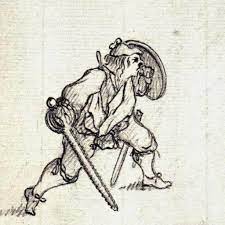
One of the 18th cen. Penicuik sketches

The weapon. A three-pound sword with the balance of these two broadswords makes certain actions, certain uses of measure, not impossible but unwise. In the Radaellian tradition we use a lot of just-out-of-measure preparatory actions to make it safe to employ our skull-crushing molinelli. This is not as easy to do with a broadsword. I “can” thrust to the inside line and then disengage around and cut to the head, but the weapon isn’t optimized for this. How I do that must change in order not to suffer from too slow an execution. Josh, for example, though you see me trying it too, often makes a Cut 1 (a la the Insular enumeration or what we might call a mandritto fendente, a descending cut from the right, in Italian circles), and then a cut two (reverso fendente)–the first isn’t a feint really, though it can be. With the weight behind a broadsword one ignores a cut like that at one’s peril, and so naturally one must respond. If one doesn’t, then yay, free head cut; but if one does, a quick flip of the wrist and that beast is screaming to the outside line of the head.

The footwork accompanying this is normally a step to one side, then the other. [2] This is a safer way to make this one-two attack combination. Attempted with the more linear footwork of sabre, it’s far more difficult to pull off, because one is farther away when making that Cut 1. If one delivers this specific combination with a lunge, one must hold the extended blade potentially longer to await the opponent’s response–lunging distance is a bit more farther out than stepping distance, so not only must one move the blade once they’ve responded (if they have), but recover forwards or redouble in order to disengage and cut to the other side. Stepping as Josh does is more efficient, faster, and helps conserve energy. In short, “critical distance” varies not only by height and reach, but also by weapon type. There are important ramifications for this I will share shortly.

In brief, Newton’s second and third laws of motion, to whit…

  • The acceleration of an object depends on the mass of the object and the amount of force applied.
  • Whenever one object exerts a force on another object, the second object exerts an equal and opposite on the first. [3]

… explain that there is a relationship between a sword’s acceleration, its mass, and how much force propels it. [4] If that sword is then yanked back, if it must decelerate rapidly and change directly, it will require energy enough to accomplish this; if it meets resistance, say a parry, it will transfer energy to that other sword. Distance affects this too. It is easier to change the direction of that weapon if one is closer, and thus, stepping vs. lunging that initial cut makes good sense. One can lunge it sure, but it will be slower, easier to parry or to launch a counter attack.

This is not to say one can’t lunge or that one doesn’t, because one can and does–if I wish to force the blade (a species of press, coulé, filo, glissade, glisé, etc.) I can absolutely lunge this attack, and arguably should as it helps close the line. The extant sources for broadsword, though perhaps more “regimental” than “highland” or “early” to use popular categories, make it clear that the lunge was a standard method for delivering attack. As ever, context, especially situational context, should dictate whether we step or lunge.

A Few Ramifications that Follow

Confiteor Sancto Gregorio… quia peccavi nimis cogitatione, verbo et opere: mea culpa, mea culpa, mea maxima culpa

Jokes aside (and apologies to Father Tavares) I have often chided or raised the judgmental eyebrow at footage of broadsword and sabre. It comes with the territory. In my defense, there is usually justification for the mental red pen we apply to the mistakes we see in video, but at the same time it’s easy to slip into an unwarranted sense of superiority or elitism.

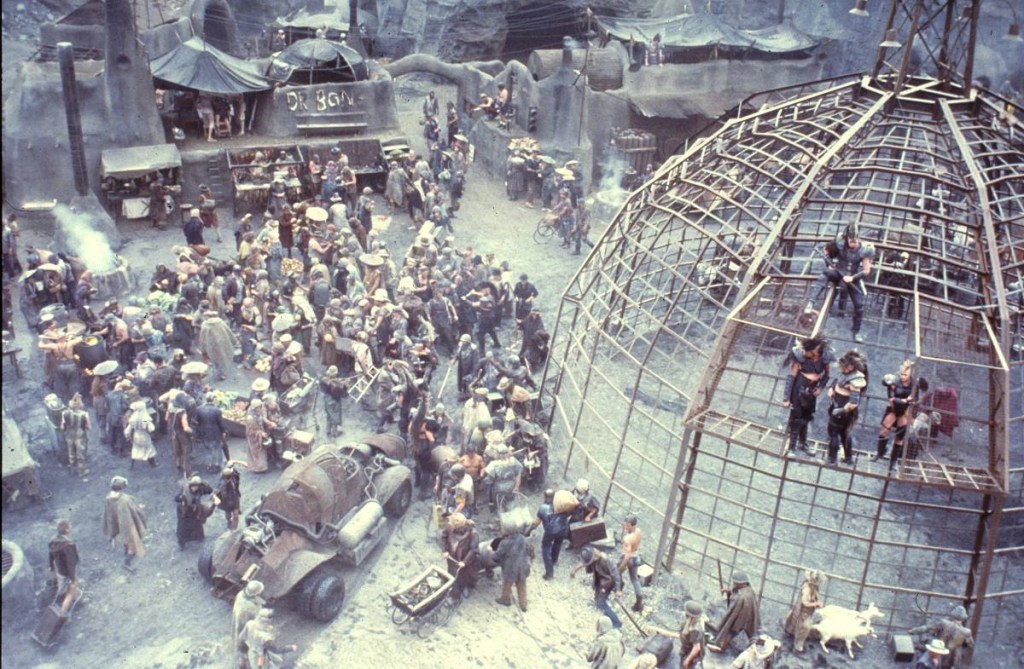
“Mad Max Beyond Thunderdome,” 1985

The best check against this tendency is time spent with the tools and sources underpinning the fencing one is viewing. It will change how we view it. As a final example, one of the complaints many of us in the more classical Italian and/or French side of historical fencing make is about the HEMA tendency to fight in measure. It’s like “Thunderdome” only without using the whole dome–two people enter the ring, clash, repeat. There is little use of measure, little suckering people in and exploiting when they fall short, little use of any footwork save the advance. That isn’t good.

If a 3lb Scottish broadsword and if our interpretations of its use are at all close, then we have reason to recall that use of measure is different for different weapons, for different contexts. Like most observations I make here this is obvious, I know, but it’s also easy to forget when we view most things through our own experience and bias. We all do that sometimes. In order to foster the openness to see how other, even related systems use measure, tempo, and footwork, we must first acquaint ourselves with their sources and tools.

Doing so is not just a window into something new, but a way of gaining a different perspective on our main focus within historical fencing. Exploration can also be a lot of fun, which is reason enough to try out that baskethilt, longsword, or rapier that perhaps we’ve sometimes found easy targets to criticize.

NOTES:

[1] It’s too large a topic to explore properly here, but warfare among the Irish and Scots favored ambush, quick strikes, not long engagements of massed troops in meadows. Armor and weapons, well into the early modern period, appeared archaic to many, but had long served well in the bogs and heavily forested areas either side of the Irish Sea. Roman and Greek sources made much of Gallic horsemanship, but in many parts of the Isles foot combat made more sense. Cavalry played a role, but it was not as great in medieval or Early Modern Ireland or Scotland as it was in say France or Spain.

[2] Thomas Page’s work (cf. https://linacreschoolofdefence.org/Library/Page/Page.html) remains controversial, but is worth reading in conjunction with other works on Insular broadsword. Questions of accuracy in re Highland fighting aside, much of what he describes is useful. His section on traversing can be a little dizzying to read at first, but taken slowly and then drilled it does work.

[3] Cf. https://www1.grc.nasa.gov/beginners-guide-to-aeronautics/newtons-laws-of-motion/

[4] With so hefty a weapon one needs little force to propel it forward. Good mechanics, that is technique that allows the weapon to do the work, used with proper measure and timing not only is more efficient and less exhausting, but also less likely to expose one to counter-attacks. Newton’s laws hold here too–if one swings too hard and wide, it’s that much harder to recover and one is that much more prone to being hit.

Who are you? With what authority do you speak thus?

She ordered Charles to have the horses put to. Holst understood this, which was said in French, and begged her for the love of God not to set out; he had orders not to let her depart. “You,” said she, in a somewhat haughty tone, “who are you? With what authority do you speak thus?” He said he had no written order, but by word of mouth, and that his governor would soon arrive…

From Memoirs of Leonora Christina, Daughter of Christian IV of Denmark, Written during her Imprisonment in the Blue Tower at Copenhagen, 1663-1685, translated by F. E. Bunnett, London, UK: Henry S. King & Co., 1872) [https://www.gutenberg.org/files/38128/38128.txt]

Last week I had a chance to discuss the Radaellian school of sabre with a distant colleague in Germany, Dr. Manouchehr Khorasani, on his channel Razmafzar TV. There is one topic we didn’t discuss in detail, and which in part I dreaded despite its importance, but which I shall try to address more fully here. This is the place of Italian sabre in “HEMA” and one of the major challenges within it. [1] Late period Italian “HEMA” is an archipelago of tiny islands scattered so widely that they are a related island chain in theory only.

There are several reasons for this. On the surface, and understandable, is the fact of geography. When pockets of interest are separated by miles, countries, and oceans naturally it’s hard for the inhabitants of these islands to visit one another. Beyond that, however, there is a less obvious reasons for division. There is an unfortunate cliquishness born of both a lack of familiarity with other, related groups, and some variance in concepts of authority.

When possible I prefer to build rather than burn bridges, and because I’ve met few of the people in the field in person, I can’t know how they will react. How one appears online is not a sure guide. The internet is notorious for skewing intent and meaning. It is not my wish to call anyone out or set fire to yet another bridge, but only to call out the elephant in the room. My sense, knowing what I do know about the inhabitants of some of these islands, is that they may take umbrage with someone they consider an unknown, an upstart daring to discuss topics which they believe belong only to them. If any do, then they do, and I can only hope they reach out to me to discuss it.

Cliques writ Large

“Mean Girls,” 2004

People, being social (least most of them—we introverts unite, separately, in our homes…), tend to congregate around those they identify with, who share their interests, and in some degree who provide some measure of external validation. These benefits of association are intensified when the group in question, for whatever reason, is actively under siege or feels as if they are. How one responds to attack, or the perception of one, varies. Some seek to adapt in hopes of crossing whatever barrier exists between themselves and the clique. Others seek to undermine that clique, to besiege the besiegers as it were. Still others solidify their own position and contend with their rivals as best they can. Some leave the contest all together.

Cliques writ Small

For my part, I lament the reality of the cliques I see within the conglomeration of Italian schools. We’re few enough as it is. No one in HEMA balks at mention of Fiore, Marozzo, or Giganti—to name only three popular Italian masters studied in historical fencing—but bring up Radaelli, Masiello, or Pecoraro and Pessina and suddenly one is categorized as “other.” The kinder sort relegate one to “classical” fencing (never well-defined); the nastier sort lump one in with the modern sport, HEMA’s favorite bugbear. I recognize, thanks to age and experience, the ways in which some of this is natural, but as a life-long student what I notice most acutely is that all of us lose more than we gain in maintaining these boundaries. Sad as it is to be the red-headed step-child in the larger community, it’s sadder that those who should be natural allies, our fellow late-Italian enthusiasts, should follow suit and treat their family members as poorly.

Outside geography and isolation, the hard lines seem to fall along the fault-lines of notions of authority and recognition. For example, those who have worked hard to obtain certifications sometimes believe that anyone who has not is, by definition, unqualified or certainly less qualified than they are to expound upon that subject. Sometimes this is true, but sometimes it needs adjustment: in “HEMA” certifications within modern traditions, while valuable, do not grant automatic authority for past systems, not even to those extinct branches which created one’s own.

While definitions of authority are often shared between cliques, there are often operating differences that work to demarcate one group from another. Credibility is important, but it doesn’t belong exclusively to the provosts and masters. This is an especially important fact for anyone believing that they themselves are an authority, because one of the unwritten rules of expertise is responsibility to manage it appropriately, and, to recognize just what “authority” entails. What is it, specifically, that grants authority? Is it the organization that grants it? The piece of paper declaring it? Is it the internal ability and knowledge? Some combination?

Just as important, however, and far, far more difficult for many established or certified individuals, is recognizing expertise or skill outside such certification. It takes more than memorizing rules, definitions, and regurgitating them to recognize and honor other capable folks. There are people within the Italian orbit who have done significant, important work, and yet don’t warrant an invite to major conferences, teaching seminars, or invitational tournaments (no, I do not mean me). Why is this? It’s not lack of skill, because in print, video, and in person they have demonstrated not only their grasp of the pedagogical tradition, but also proven their ability to teach it and fight it. Professional jealousy and fear, both outgrowths of ego, likely explain this “ghosting.” If one has worked hard to obtain a certification, but has done so without the proper sense of humility such a course should entail, it’s easy to fear the person outside that system that might show one up.

To be fair, comparatively speaking there are many masters and provosts in the Italian branch of “HEMA,” both from and in Italy as well as outside it, who are keen to work with lots of people, not just other masters. There are, however, some notable exceptions in North America who appear not to want to work with others save on their own terms. However much they believe they are guarding their sacred, occult tradition, the inability or unwillingness to provide more than that when it is readily available is a sure-fire way to sink a program. It leads to stagnation, cultic adherence to received learning as one learned it, and unless students of that program can hold their own against others, as fencers, teachers, or scholars, that program is going to atrophy. Certification programs should include the necessarily flexibility to adapt and adopt new ideas and approaches when those novel ideas might improve the course.

“The Adventures of Robin Hood,” 1938–in this scene Little John beats Robin and worries that the famous outlaw will be upset. Robin replies “On the contrary, I love a man who can best me.”

True confidence, true ability, recognizes that students can benefit from such experts, even if they are not card-carrying maestri. Not to enlist the aid of such people when the goal is learning and improvement is horribly short-sighted and limits one’s own program. It’s narrow-minded, the worst sort of conceit. It takes a degree of mental toughness to acknowledge an expert, let alone invite one in, but if one’s goal is learning, then this is the way it should be done. My model for this is the old-school model I learned as a graduate student in history: one doesn’t go to a school because it’s a “name school,” but instead applies to a person, to the people most qualified to guide one in one’s study. If they’re worth their repute, they will encourage one to see other experts too. That person might be at Turnpike Tech, not necessarily Oxford or the Sorbonne.

In an arena as varied and complex as historical martial arts it’s perhaps best to conceive of authority in the plural, as authorities, and recognize that while a master’s cert indicates significant training, that it’s not the only path. Patrick Bratton, in one of our chats, provided a few rubrics by which we might measure authority or credibility:

–can they teach effectively?

–are they a competent fencer in the system they are teaching?

–do they know the history/context and theory, AND can they effectively convey it to others?

Within these three broad categories are subsets of questions important to ask. In terms of teaching effectiveness, are they able to explain each technique, idea, or tactic in its most elemental specificity, from the position of the hand to the pressure exerted by control fingers, from the placement of the arm to the timing with which the technique is made in relation to the feet? Can they then incorporate that level of detail and build up? If they can, do they? There is a LOT of video out there, and so much of it is shared without any hint as to why. Teaching vids are some of the worst offenders in this regard. If one is sharing a teaching video, at least include what it is one is doing and why. With regard to fencing competency in the system in which they were certified, how adept are they? How often do they exercise and test this skill? Do they do so only with friends, or, do they venture out? When it comes to history and theory, how well do they know it, and, do they avail themselves of available resources?

Certification—What is it?

What the modern schools are supposed to teach is the current body of knowledge as handed down, and depending on rank, how to teach it. [2] This is as true of the USFCA as it is the Sonoma program. Masters emerging from either program should be able to teach anyone, at any level, and most importantly help train new teachers. What history they study, if they do, is generally minimal and/or tailored to the specific needs of their program. The USFCA, for example, is focused on the sport, not its development; the Sonoma program, which does cover some history, does so only within the confines of the work of their founder, Maestro William Gaugler. [3] What either program should provide is first an understanding of the universal principles in fencing, what Matire Robert Handelman refers to as “the elements of fencing.” [4] Second, they should impart technique and tactics, the first in fine-grained specificity, the second following logically from what it is possible to do with those techniques oneself, and, what one does when they’re used against one. Needless to say that all of the above must reflect the elements or universal principles. For the maestri, provosts, etc. who do study past systems, what gives them an edge is the fact that they are armed with a solid foundation in the application of the universals, technique, and tactics. It’s a lot easier to look at historical versions of this if one has a firm grasp on today’s systems.

Nothing in the purpose of modern fencing certification equates to expertise in historical fight systems. In fact, possession of the lanista’s rudis is not the only way, and in fact, might not be the best way. It depends on the person. There are other paths by which one may accrue both knowledge and skill. I will argue whenever I have the chance that everyone should take at least a year of foil or sabre, preferably in as traditional/classical as one can, before diving into HEMA, but beyond that I think it’s important to separate what one learns in becoming a provost or master today from what some certified teachers purport or suggest their sheepskin means.

A Challenge

For my colleagues within the late Italian sphere of fencing, especially those with the certifications of master or provost, I challenge you to reach beyond your clique; I challenge you to embrace discomfort and seek out those individuals who can best aid your students. Why pass up a good chance to improve your program? I challenge you to look beyond your certs and at what these individuals have to offer, humbly, without recourse to ego, fear, or envy. Put those aside, put what is best for your students first. It will be good for you too.

As a student myself, I seek out the best teachers I can, because I want to improve. My skill is never good enough for me; sure, it may be fair enough to impart basics to someone new, but for me myself the climb is eternal, the journey the point; it’s what I learn along the way more than it is any trophy, award, gift, or certification. The benchmarks we reach, such as certifications, signify key moments in study and growth, but are not destinations in and of themselves, least they ought not to be. [5] These honor my effort, and I appreciate them deeply, but I want to work with those who can best help me grow, certification or not.

NOTES:

[1] This is a topic I covered briefly in an earlier post, 22 March, 2021 “Italian Sabre & HEMA” https://saladellatrespade.com/2021/03/22/italian-sabre-hema/

[2] Ideally, any certification program, moniteur to master, is teaching one how to teach. This goes beyond watching and emulating, but down to actual discussion, instruction, and on-the-job training.

[3] Maestro Gaugler established a military masters’ program in San Jose, California, under the auspices of Italian programs like the Accademia Nazionale di Scherma in Naples and The Fencing Masters’ Preparatory Course at the National Institute of Physical Education, Rome. His works, A Dictionary of Universally Used Fencing Terminology (1997), The History of Fencing (1998), and The Science of Fencing (1997), perhaps with the addition of his articles, comprise the course reading at the program’s new home at Sonoma State University. Gaugler’s books are important additions, late ones, to a venerable corpus, but no replacement for the original sources or classics like Szabo’s Fencing and the Master.

[4] See for example Maitre Rob Handleman and Maitre Connie Louie, Fencing Foil: A Practical Training Guide for Coaches, Parents, and Young Athletes, San Francisco, CA: Pattinando Publishing, 2014, 308-312; see also Fencing Sabre: A Practical Guide for Coaches, Parents, and Young Athletes, 2010. The epee course I took in 2021, which is available in full via Fencing Metrics, takes the place of his book on epee. I’ve had the honor to take two courses with Maitre Handelman and he emphasizes over and over that everything we do, anything we teach, must emerge from the elements. The old masters would agree.

[5] My eldest son, when he completed his black belt, did so at a do jang with the right attitude. There is a poster hanging in the school that sums up what the students are meant to learn in acquiring that well-known symbol: a black belt means that they are now ready to start learning. I would suggest that our fencing certifications might be best viewed in a similar light.

A Short Discussion on Radaellian Sabre

Yesterday I once again had the pleasure to chat with Dr. Manouchehr Khorasani on Razmafzar TV. This time we discussed the sabre system of Giuseppe Radaelli (d. 1882) and its legacy. I was lucky to have Mike Cherba from Northwest Armizare present to help demonstrate some of the key features of the system. In part 1 of the interview we discuss Radaelli, the works on his system, and his period. Part 2, coming soon, will share the demonstration portion.

https://youtu.be/7V1BZBNBs6s