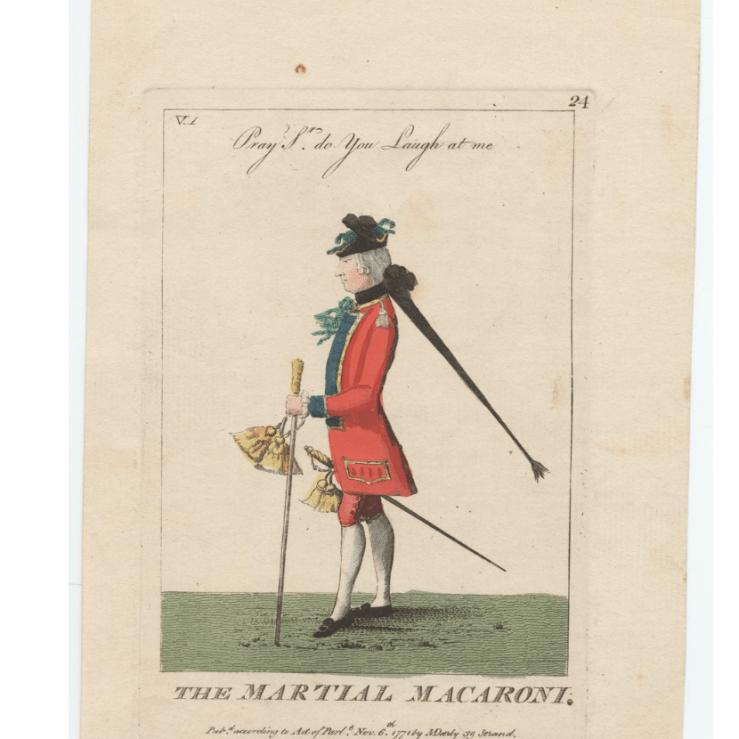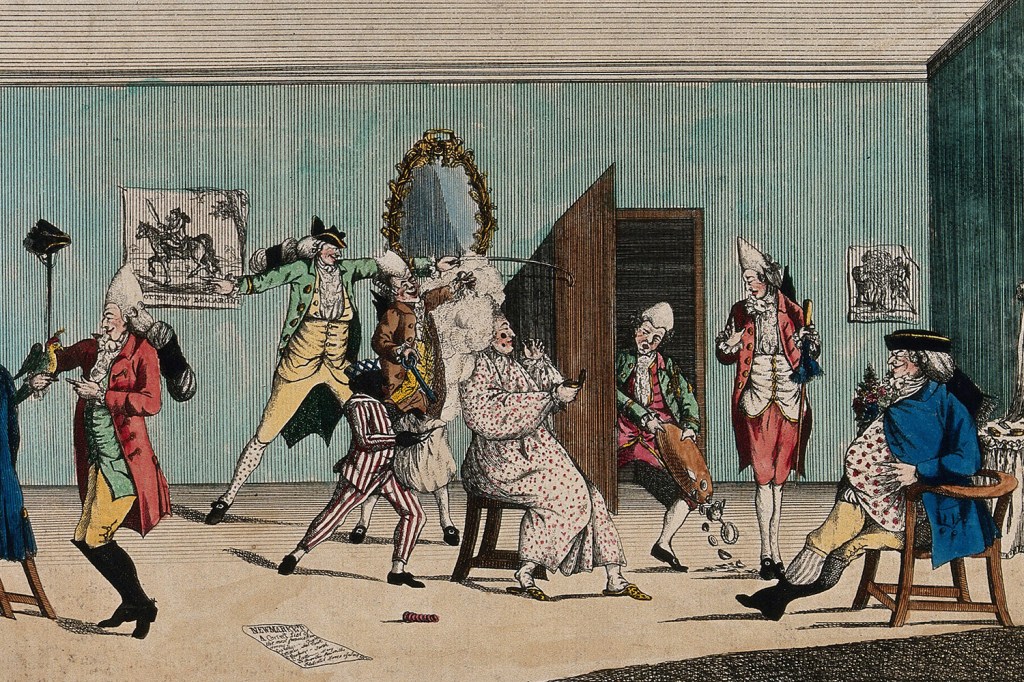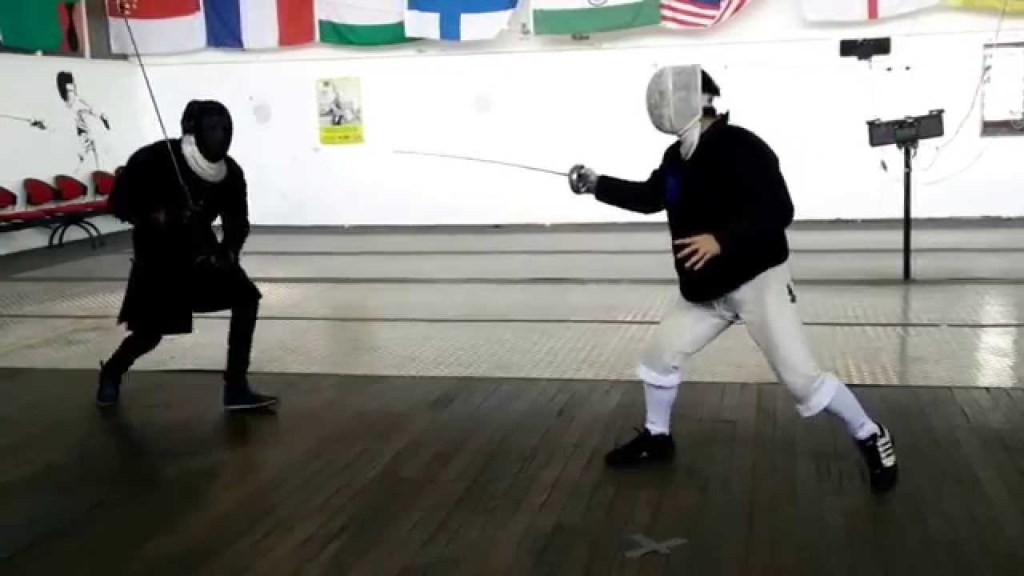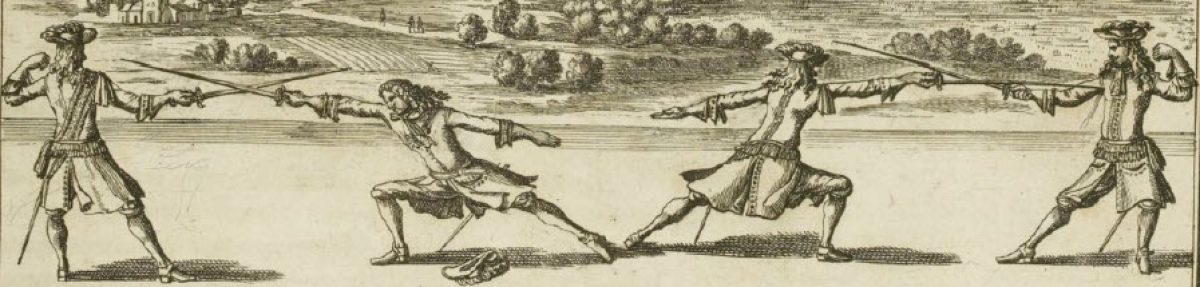
The question asked of sound and trees falling in the woods works for many situations. It’s especially apt as so many of us work alone thanks to the pandemic, but even in the best of times fencing is—be it conducted within a club, school, or team—a solitary pursuit. Our training partners and opponents are instrumental in our growth, and we cannot progress far without them, but the hours of footwork, conditioning, and drill honing technique is a responsibility on the individual fencer. All the flash and fire, all the joy experienced in flow during a bout, little to none of that does one enjoy advancing, retreating, and lunging, doing point-control drills, or performing molinelli against a pell. At its best it can be meditative, but normally, about as good as it gets is merely the awareness that the dull work matters, that one has successfully executed the necessary discipline, and that it’s all important. Unlike bouting, it is not “fun,” though absolutely crucial in our development.
Solo Drill & Isolation
On a another level, however, there is or can be a loneliness in fencing. In most ways it’s a journey we take alone, so that makes sense, but in the deeper waters of the Art and in trying to find other explorers at that depth the isolation, if we’re not aware of it and careful, can be detrimental to our study. With the pandemic, when most of what we can do safely is solo drill, it’s hard enough to find motivation to do the grunt work let alone fight that added sense of isolation if it assails us. Thanks to the internet this is a problem we can alleviate in some degree—few days pass where I don’t chat with the few people I know who are as keen to plumb the Art’s depths, explore texts, and learn as I am. After all, few people in our community, never mind people outside of it, enjoy the deep dive and can discuss the Art for hours on end. I know I’m not the only one who has watched a hapless friend’s eyes glaze over with the unmistakable look of a person that realizes they should never have asked us about fencing. The ability to chat with people far distant is a lifeline we’ve not always had and we should be grateful for it.
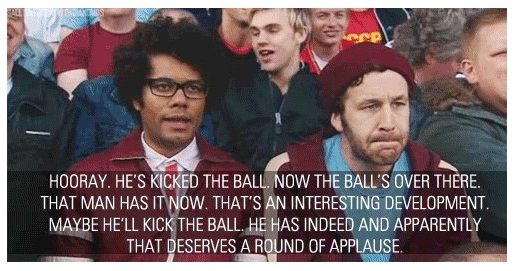
“The IT Crowd,” BBC, on sports
On a public level too fencing can be lonely. Like any more or less obscure pursuits fencing is not one of the typical dinner-party topics or likely to come up at a rave, farmer’s market, or appropriately distanced line at a grocery checkout (the six feet rule protects us not only from the virus, but small talk 😉 ). [1] American football, however, or the other sports-ball games, the latest shows on television, etc. are far more likely as topics of conversation. In short, most fencers have no one else to discuss the Art with apart from other fencers, not all of whom devote the same amount of time to it.
Moreover, with all that is going on in the world, with the dire challenges of climate change, Covid-19, social and political turmoil, and every person’s own trials, devoting time to a complicated, obsolete martial art probably seems silly or irresponsible to many people. Even assuming the fears of the conspiracy-minded sorts out there panned out, it would be a long, long time before anyone needed to use a sword again in earnest–in the US alone it will take centuries to run out of bullets–so in terms of the “practical” side to fencing it’s a hard sell. Not impossible–a cane, umbrella, or stick in the hands of a decent fencer is not something anyone should want to experience. So, maybe studying a dead martial art ranks low among the wines and spirits, but the Art can also be a healthy diversion, decent exercise, and intellectual entertainment, which are reasons enough to pursue it. It can be more than that too. The combination of physical and mental stimulation and exertion can be great stress relief.
Of the various perspectives perhaps one of the hardest is the lack of interest or even censure from other fencers. It’s hard enough to feel isolated generally, but when it comes from seemingly like-minded people it is that much harder. Typically this is something, when I’ve experienced it myself, that comes from either Olympic fencers or from similarly narrow-minded sections within “HEMA.” Truth is that everyone filters things through their own experience; reason, evidence, all that has little to do with it.
For example, in the 1990s when some of us defected from Olympic fencing to explore ways to make fencing about swordplay again, there was little support from our comrades. Impassioned appeals were usually met with laughter or hostility. I know my own disappointment and frustration with the poor decisions the FIE was making were made worse by the near complete lack of sympathy from teammates. Our vocal complaints about the system, especially with newer fencers in the mix, were not conducive to group cohesion, but we wanted those newer fencers to know there was a difference between defense-minded approaches and the slap-happy b.s. then in vogue. This is something that typically hits harder as one has more perspective. As it turns out, those of us upset about some of these changes were correct, and this is maybe one reason that to this day some former teammates haven’t forgiven us. [2]
Scene from “Gaslight,” 1944
It is extremely easy to feel gas-lighted in situations like this. I tend to hate terms like “gas-light,” but having had too much experience with it, even in fencing, it’s appropriate. Like many things, there is a spectrum for gas-lighting, but one of the most difficult to manage and overcome is the particular species wherein people believe that you believe something, but do not believe you’re correct and actively do things, wittingly or unwittingly, that make one feel like they’re losing their mind. [3] They offer what seems like positive reinforcement but which really only confuses everything–one comes away under the false assumption that they agree, when they don’t. We discover that the face they present to us is not the one they share with everyone else, the result of which breeds further confusion when in company with shared associates and it becomes clear there is a difference in what they’ve heard.
For fencing, an illuminating example is where people stand with regard to a silly rule that to this day affects Olympic sabre, t. 70 1 & 2, which states:
METHOD OF MAKING A TOUCH t.70
The sabre is a weapon for thrusting and cutting with the cutting edge, the flat and the back of the blade.
All touches made with the cutting edge, the flat or the back of the blade are counted as good (cuts and back-cuts). [4]
It should be obvious why this is a problem. The decision to allow the flat of the blade to score was the FIE/USFA’s “solution” to the problem of whip-over in sabre. The logic was apparently that an attack made with right-of-way, even if it hit the guard, was valid if the light went off. Since the director cannot overrule the light (see for example t. 73.1), the only arbiter of the validity of a touch is the box, so despite the idiocy of attacking literally the strongest area of defense, one can–and people do–score by slapping the bell-guard. Because competition reflects responses to a rule-set, the nature of fencing and in time instruction (in some areas) changed.
Those of us unhappy about this were ignored, ridiculed, or told to shut up. Of these the response easiest to manage was ridicule–at least that was honest. We mined older works on fencing and photographs and illustrations of sabres with wider blade profiles. At one point, I collaborated with a close friend and fellow sabreur, an engineer, and we rigged up electric sabre kit with the closest thing we could find to period blades, schlager blades, and demonstrated that fixing the problem was as simple as returning to an earlier blade style. Whip-over disappeared. We even had one of our master’s assistant coaches try it, and while he agreed that it was better, he shrugged it off. It didn’t affect him at his level of competition–where training reflected a pre-electric mindset–so he didn’t see the issue. In his mind, the problem with whip-over wasn’t anything other than the fact that most people experiencing it were just “bad fencers.” To those of us trained as he was, but having to fence people increasingly taught to exploit this rule, it was maddening. One either adapted and did the same or quit.
The facts, evidence, the goal of helping the community fix an error meant nothing. A lot of us, myself included, felt abandoned, and it was easy to feel like it was all in one’s head. Rationally we knew the evidence supported us, but it didn’t matter to anyone else. What does one do when that happens? Our solution was to press on, and apparently a lot of other people did too, because now there are multiple companies making blades along earlier lines. There is also the classical/historical community that mushroomed in the wake of the exodus from Olympic competition.
So What?
The take away lesson is this: pursue the Art for you, for the reasons that make sense to you, and close your ears to those who mock, attack, or play Janus with you. If Olympic is your thing, do that; if classical/historical is, do that; if it’s bohurt, LARP, SCA, or anything else, go for it. So long as you’re honest in your study, with yourself, and with everyone else it’s hard to go wrong. Not everyone will see it that way, but the right people will and they are the ones who matter. They are your community even if they live half way around the world. As the pandemic continues, as we are forced to train more or less in isolation, we may as well do that the best way possible, and use this time to examine our study more closely, more honestly, and separate wheat from chaff, not only in terms of the Art, but of those who help or hinder us in our pursuit of it.
NOTES:
[1] Yes, I know, no one is going to raves or anything, but still.
[2] One of the hardest parts about owning one’s own share of the responsibility in a bad situation is that other parties will take advantage of it even so far as to use your admission against you. In this instance, both my close friend and I apologized for “souring” younger sabre fencers, but it did no good. It doesn’t matter that we were correct, it doesn’t matter that we did the right thing in owning our share of things, it changed nothing. It neither fixed that relationship or any other, and arguably it made some worse. This said, it was still the right thing to do.
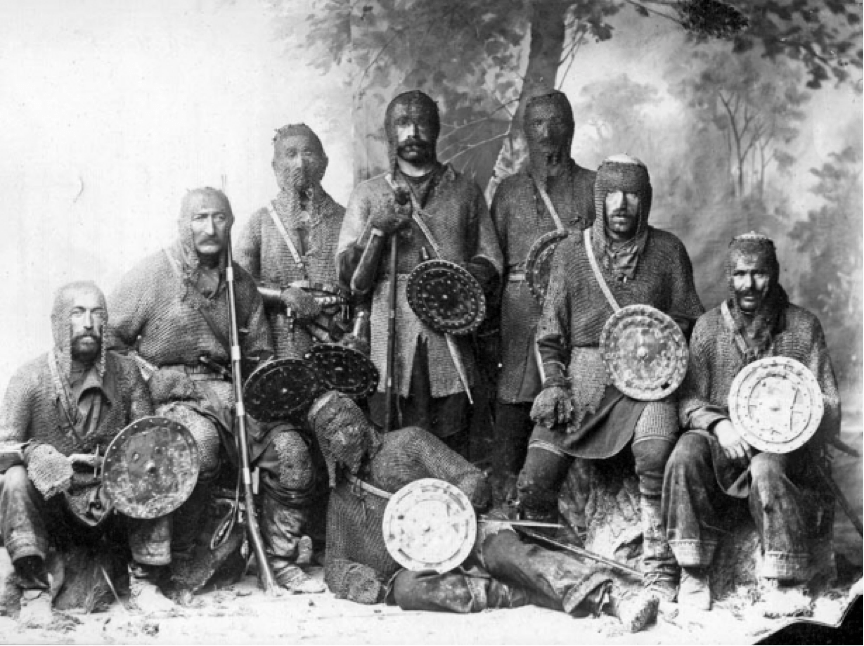
Photo of warriors from Khevsureti, 1935, taken by Halliburton.
This past Friday I had the honor to assist my friend Mike Cherba of Northwest Armizare with his online class for “Cybersquatch” (hosted by the fine folk at Lonin League in Seattle). In preparation for the class we worked in Mike’s backyard–it’s a large space and allows us to follow better the protocols necessary during this pandemic. None of us had counted on wildfires and smoke, so, at the last minute we were forced indoors. While not ideal, we made it work, but you can see from our actions how cramped it was–this was less an issue for the Georgian material than the examples Mike pulled from the Dardi School or I 33. It was, as always, great fun!
Our friends at Lonin have shared the footage of this year’s Zoom classes online, both on fb and via Youtube; a link to Mike’s class I’ve placed below. NB: there is valuable information here for interested fencers at any stage of training, but newer students may be unfamiliar with the examples. MS I. 33 or the Walpurgis Fechtbook, ca. 14th century, is the earliest known work on swordplay from western Europe and features selections of a sword and buckler system that may reflect less aristocratic combat traditions. The Dardi School, often referred to as the “Bolognese School,” looks to a Bolognese master, Filippo Dardi (d. 1464), whose successors–Antonion Manciolino, Achille Marozzo, Angelo Viggiani, and Giovanni dall’Agocchie–produced works that share many features in common. All cover the sword, but some also include buckler, rotella, montante/spadone, and pole-arms. Many students of I 33 and the Bolognese tradition pursue sword and buckler, though naturally there are differing interpretations of both systems.
Georgian _pari_ or buckler with “Shashka” trainer next to my usual Italian tools.
Mike Cherba, who has worked on the highland Georgian fighting arts for over a decade, has introduced this fascinating folk system to an audience outside the Republic of Georgia and Georgian enclaves outside it. In this he has been aided by two Georgian friends, Vakhtang and Niko, both of whom had a chance to study with the last three surviving masters of this art in the 1990s. This was a combat system that employed sword and buckler into the 20th century! Mike’s research, and the experience of Georgian martial artists, smiths, and dance teams continue to reveal aspects of what was clearly an intense, viable, and sometimes brutally efficient martial art. The Soviets, to name a modern example, not only had their special forces adopt some Georgian principles, but even tried to transform the more playful version of the system, Parikaoaba, into a “people’s” pastime.
In a recent conversation with an old friend and fellow fencer, one on the Olympic side of things, I realized just how poorly understood “historical” fencing is. To be fair, what most people consider to be historical is horribly inaccurate—it takes a part for the whole. This is not completely their fault; it’s mostly a result of what they’ve seen. The most publicized and well-known aspect of it is the black-clad longsword tournament sect, and balk at it though the SPES-donned might, they’re not representative. Much of what falls under the umbrella term of “HEMA” is much older than that; as much rests on better premises as well. [1]
Trying to explain to this friend what historical fencing is (or ought to be) was difficult. It was not only that historical fencing encompasses so much, over so long a time, but also that his preconceived notions were hard to refute given the one example he knows. Reflecting on that conversation I’ve been devising a short list of features to help round out the limited picture my friend and others have of historical fencing.
If you are easily offended it may be best if you stop reading here, for what I am about to say, however true, might upset some people. Happily, my readership is small, more inclined to agree than whine, and realistically what one obscure fencer thinks about HEMA makes no never-mind to those most likely to take umbrage.
HEMA to Your Standard Olympic Fencer
Silly meme made for some others in no-man’s land
Much of competitive longsword is bad. To a trained fencer it looks like apes with sticks whacking away at one another with little regard for art or safety. There are several reasons for this. Too many people begin competing too soon. Coaching is inconsistent and sometimes outright horrible. Rulesets, though they continue to evolve, tend to reveal the state of current opinion in re some pet concern (e.g. the “after-blow”) more than they do the logic of not being hit. Directing and judging, so often staffed by the same new folk, is dicey. Put together, to anyone who has fought within the Olympic world competitive longsword is one codpiece away from LARP and more closely resembles bohurt save that for some reason longsworders detest metal armor.
This is not to say that there are not skilled fencers among competitive longsworders. There definitely are. I know a few and know others by repute from credible witnesses and mutual friends. Likewise, this is not to say that competitive “sport” fencing is devoid of problems—nothing could be farther from the truth. HEMA, as such, would not have grown as it has from the late 1990s on had the Olympic world had its act together. Among the many similarities between competitive “sport” and “historical” fencers is that too many of them either fail or refuse to see the problems within their own camp. It’s a lot easier to point at the flaws in the other and count oneself and one’s view as the correct one.
So, what is “Historical Fencing” then?
Setting aside, for now, the mutual dislike and focusing instead on the easily demonstrable, here is what my Olympic friends tend to miss about historical fencing:
it is not just competitive longsword (skilled or apish)
it is source-based
it attempts to approach the Art as a martial art more than a sport
it encompasses sources from the High Middle Ages to the early 20th cen. [2]
it increasingly incorporates more than European systems [3]
modern fencing would not exist without some of these sources/systems
like anything some of it is really good; some of it really bad
This is a short list, but it’s important and contains most of the key details my Olympic friends miss.
HEMA ≠ longsword
This view again mistakes a tree for the forest. While arguably the most popular weapon among those interested in competition, longsword is merely one weapon and maybe the most visible of those systems people tend to see. Many if not most of the surviving sources which cover longsword also cover other weapons, such as spear, pole-axe, sword in one-hand (or single-sword), dagger, wrestling, dussack, Messer (a large, usually single-edged knife), agricultural tools turned weapons (e.g. sickles and scythes), and sword and buckler; some include material for fighting in armor as well as out of it. Many if not most of these have their competitive side too, though with allowances necessary for safety—fighting in armor, for example, and with weapons like poleaxes which greatly multiply force, requires excising those maneuvers intended to end fights. [4]
There is no “HEMA” without Sources
Unlike traditional and competitive fencing, historical fencing—by and large—focuses on extant sources. These can, however, take many forms. Not all are crusty old manuscripts or obscure books. The techniques one sees within any weapon class are—or should be—interpretations of techniques, ideas, and plays found in these sources. Due to the difficulties and vagaries inherent in interpretation there are often differences of opinion about even seemingly simple things. A researcher’s background and training have a significant effect on what they see, and thus in how they interpret what they find. The disdain many Olympic fencers have toward sources is, oddly enough, not uncommon among people in HEMA either, at least as expressed in the wide-spread dislike and distrust of formal academics. [5]
Not everyone in historical fencing reads the source material. Ideally, they would, but to be fair some of it is challenging to read, some poorly written, and much of it dull to modern eyes and ears. To name one example, long expositions on geometry couched as a discussion between a learned master and an eager student tend to be tedious to modern readers. Moreover, not all translations are equal, and there is little formal training or attention paid to teaching students how to separate wheat and chaff. [6] As in most things, politics and cliques often attend one’s choice of translation—it’s ridiculous, but remember while based on sources historical fencing is not populated by scores of trained historians or paleographers. Most people, probably 99%, “do HEMA” as a hobby, for fun; doing homework for a hobby after a long day at school or work doesn’t appeal to most of them. These students look instead to an instructor for guidance, drills, and a chance to try out what they’ve learned with others. This is a major difference from Olympic fencing where an instructor, most often certified, hands down a tradition passed on to them the same way. [7]
Combat Art vs. Combat Sport
Historical fencing is, depending with whom you speak, one or the other, or, both. There is a competitive wing, but being competitive is by definition less combat oriented. This is true however much one desires for it to be “martial.” It’s the nature of the beast. One cannot use, for example, all of Fiore’s Armizare or people would be maimed or killed (Master Fiore really liked breaking joints and thrusting the pommel and cross into people’s faces). This said, for the most part historical fencers try to approach these old fight systems as a martial art. Some attempts are more successful than others. Not everyone competes either, and this is an important point—”HEMA” is far more recreational than it is competitive.
MS Ludwig XV 13 28v-a
In Olympic fencing, just to illustrate the difference a little more clearly, the rules and training reflect a sport based on a former martial art. Off-target touches, some uses and interpretations of ROW (“right of way”), and the weapons themselves all demonstrate this well. There is no off-target in historical fencing—if one is hit, one is hit. [8] Hitting first or with priority—depending on rule-set—tends to take second place to being hit at all. Lastly, the weapons, while blunt, are meant to approximate more closely their historical predecessor. So, rather than foils we use smallswords or spada, which are still light and quick; in sabre we use 16mm wide blades or larger that weigh anywhere from 650g to 1000g. [9] Then there are the weapons that didn’t survive into the modern world, such as rapier, longsword, the knightly sword, the so-called “side-sword” and buckler, and pole-arms.
Historical Fencing & Non-European Systems
Strictly speaking HEMA, as named, refers to “historical European martial arts,” thus the acronym. This is one reason I do not favor this term, but instead use “historical fencing” or “historical martial arts.” As someone who values and incorporates the research that colleagues are producing in the study of various African, Persian, or Asian systems, I prefer a more inclusive term. In addition, as in so many fields, “European” can be and is defined a variety of ways. Most of our extant medieval works are in Latin, early German, French, Italian, or Spanish, so what about those in other languages that are less well-known? What about those from regions that are partly European, but heavily influenced by non-European peoples, such as the Republic of Georgia? [10] Happily, aside from the fools within the community who embrace ultra-nationalist notions, most people are pretty open, even excited to see what students of other regions are discovering.
Even within “HEMA,” however, there is a wide variety of difference in source type and purpose. Some works were hand-made and illustrated where later period ones were printed; some were meant for the aristocratic warrior caste, others for civilians; some were personal gifts to a patron, some mass-produced manuals from a government print house; some cover one weapon and context, some a multitude of weapons for a variety of contexts. We have some complete works, and some that are fragmentary. We have groups that identify a master or school, such as the Mss. that cover aspects of Fiore’s Armizare or the various masters associated with the later Dardi School. There are works written in simple language such as most 18th and 19th century sabre manuals, and then there are those written in purposefully obscure language to protect a master’s ideas from non-students, like “The Zettel.” To these we can add some rather poorly written works as well.
Modern and Ancient
Guard positions, Del Frate 1876; photo by Sarahorsomeone, Deviant Art, from the 2012 Olympics
Like it or not Olympic fencers learn and use a system that was the product of those that came before, especially those from 18th and 19th century Italy and France. Today’s foil and epee look back, each in its own way, to smallsword; sabre to 19th century works. It’s obvious to anyone watching modern fencing that a lot has changed, and not always for the best.
An explanation for how these changes occurred is lengthy and not one we need to dwell on here. In short, the requirements of sport are different than those for the dueling ground or battle field, and that meant changes in the rules, in the very weapons, that allowed for and in some ways created fencing today, good and bad. Competition, especially between nations, meant not only cheating but mutations in technique to exploit vulnerabilities and loopholes in the ruleset. Ridiculous attacks like the “flick” in foil a while back and the still undeniably stupid ability to score with the flat of the sabre blade are two such examples.
I urge anyone I know interested in fencing, really interested, to start with foil. It’s one reason I normally start my own students with foil. A good sport coach will provide any fencer with the fundamentals they need to pursue any other branch of fencing. Foil imparts the universals of swordplay and develops the core principles upon which all hand-to-hand fighting rests, distance/measure, timing, and judgment.
The Good, the Bad, the Ugly, and People
Olympic fencers may look down their noses at some interpretations within historical fencing (historical fencers certainly do), but they should understand that more often than not that smallsword or sabre fencer is working from texts either directly or indirectly related to what they themselves have learned and fence. Not all interpretations are equally good. Some are flat-out bad. This is to say that if some meathead is doing something that seems odd, it may be that meathead and not the system which is at fault. Don’t make the mistake of assuming all historical fencing is bad based on one practitioner or one clip of longsword tourney footage. There are many people who’ve made names for themselves and inspired a following who have some things demonstrably incorrect.
My caution to any fencer, especially my Olympic friends, is to ask questions before passing judgment. This list should help a little—if nothing else one can ask what sources that historical fencer is using and look into their instructor’s background. Unlike “sport” historical fencing is largely an amateur pursuit, in the best sense, which is to say that most instructors are not certified maestri. HEMA has no such program, and the attempts to create them have come to little in part due to the variety of sources and interpretation that make up HEMA and in part because of a lack of leadership. [11] The historical fencing community, as such, is decentralized, fragmented, and outside of a few major events most clubs work in isolation from others.
Just as in the Olympic world the historical community can claim some gifted fencers and some clowns. As someone who has lived in both populations, and currently occupies some strange no-man’s land in between them, I work hard to explain both sides to both branches. To be honest I don’t believe this has been particularly successful either way—the historical fencers who agree with me either have similar backgrounds to my own or some analogous path; those who disagree most likely don’t really care what the other camp does or thinks; they’re content with their own view. It’s the same for Olympic fencers.
Multae Viae, Una Ars The Art is one, but there are many roads that lead to it. None of this may matter to you. That’s okay. I believe, however, that any true student of the Art will look for wisdom and help wherever it may be found. We have, potentially, a lot we might learn from one another, but it requires humility, curiosity, and a willingness to retain a beginner’s mind.
It means setting aside the concerns of affiliation or what one’s peers think. I hate to say it, but fencers, wherever they are, could give most middle schools a run for the money when it comes to cliques, cattiness, and drama. All that rot just gets in our way. The Art is hard enough to chase without those added pressures. They add little, detract a lot.
I’m due to have another Zoom call with my old comrade from our college fencing team. He may likely fire another shot at me for my “LARPing,” but that’s okay—this time I’m a little better prepared to set him right 😉
NOTES:
[1] Ignoring earlier efforts at recreating historical arts, such as those that took place in the Victorian Age with people like Hutton, much of todays’ “HEMA” derives from two things, the exodus of Olympic fencers in the 90s unhappy with changes in competition and the creation of the internet. HACA, ARMA, etc. all came about in the late 90s and started sharing texts. Those of us already doing that research were thrilled—in what felt like a change overnight many of the works we had read about in Thimm’s bibliography were suddenly available in pdf.
[2] The sources for HEMA are legion. Some are medieval, many renaissance and early modern, and still more produced in the last two or three centuries. Though it must be used with caution, one can gain some sense of this from a visit to Wiktenauer, a wiki attempting to collate and share many past works on martial arts. Some translations shared there are good, others less so. It is popular because it is free, which is great, but the lack of academic rigor means that it’s best used like most wikis, as a place to start.
[3] Two standout, non-European projects include the excellent work of Dr. Manouchehr Moshtagh Khorasani, researcher, author, instructor, and the force behind Razmafzar, a world-wide group of practitioners who rely on his work (see for example https://www.moshtaghkhorasani.com/books/persian-archery-and-swordsmanship/). There are also the various projects under HAMAA, the “Historical African Martial Arts Association.” One of the best places to go for current research within HAMAA is its fb page, but Da’Mon Stith’s school site, http://www.silentsword.org/, is also a great resource.
[4] Polearms, because of the physics involved, are dangerous, and any researcher working on them should be quick to say this. Even in harness, never mind within a class where people are in workout clothing, there are risks. Be wary of anyone or any school that doesn’t take these dangers seriously.
[5] Yes, I know, there are many people in “HEMA” who do value the work and contributions from academics. However, this said, if social media is any guide, there is a sizable voice within the community that not only thinks little of academic training, but also dismisses any criticism they don’t agree with, however correct. I’ve encountered this hostility myself from people popular within HEMA’s ranks. To borrow an analogy from “Firefly,” it’s like Patience running her little moon: they’re rather impressed with themselves and do not want anyone from “off-world” meddling in the fantasy. The difference is that unlike a tv show, assuming that they have the same skill as someone who spent a decade learning how to handle and interpret historical sources is as prone to error as it is presumptuous. I’ve watched shows about doctors, read books by them, and have had to use first aid, but I don’t think that qualifies me as a cardiologist. Training matters.
[6] Most students of historical fencing rely on translations or someone else reading translations. Any translator will tell you that the work is as much art as science, and the uncritical too often assume that a translation is good merely because it exists. This isn’t so. To name one example, there are two major translations of Giganti’s rapier text. One is really bad, and the other is Tom Leoni’s. Those who favor the former do so out of misplaced loyalty, not based on rigor or skill. Locally, I’ve worked with Mike Cherba of Northwest Armizare, who shares this concern about translations, to help people in selecting and using translations. I have transcripts of these lectures, with slides, on my academia.edu site, but will happily share them with anyone if they want them and don’t have access to that one.
[7] HEMA is mostly amateur led, that is to say that most people instructing are people who have spent more time with the material than others rather than certified fencing masters or experts in that time period or source tradition. One reason that HEMA has retained its appeal is because this diversity of expertise is more inclusive than exclusive. Had only a bunch of academics been in charge, fewer people would be working on this stuff and we’d make less progress. We need both, experts and amateurs, and we need them to work together better. In contrast, within the Olympic world there are very few people teaching fencing, at least teaching it well, who have not been to coaching school or who haven’t spent decades learning and teaching.
[8] I’m giving this complex issue short shrift for the sake of brevity, but for those interested there is a sizable collection of articles, books, and diatribes bemoaning or celebrating ROW and the use and abuse of the FIE/USFA rule book. Ping me if you’re interested.
[9] Despite a plethora of historical examples, there is a dedicated section within historical sabre that idolizes ridiculously heavy sabres. Most—not all, just most—meant for use on foot fall into the 650-900g range. Those at the top-end, however, more often than not are weighted for horsemen or systems of combat that were as simple. While one “can” make more sophisticated actions with a 1000g sabre, one cannot do so for long, and so the use of such a weapon for much beyond a sharp club is limited. There is an ever-growing list of extant sabres with specs that Chris Holzman, Kevin Murakoshi, and others maintain that I can share with you if you’re interested. There is also an excellent, but difficult to find article by Christoph Amberger on sabre weights.
[10] This is a shameless plug for my friend Mike’s hard work on a Georgian system that survived, no kidding, into the 1990s. Mike shares his research freely—you can find some of it here:
[11] There are a number of organizations that attempt to organize the community, such as the HEMA Alliance (https://www.hemaalliance.com/), but not everyone follows their lead or accepts their decisions. Fb is one of the best places to look for these groups, but many have webpages too. Some are specific to one area, like IAS, the “International Armizare Society” (www.armizare.org, though as of today the site seems to be down), and for most anyone not interested primarily in competitive longsword it is to these smaller groups that they should probably look to.
With the disadvantages we face during the pandemic it helps to think outside the piste. Drill is rote even in the best of the times, but lessons often afford us that sense of time moving, of progression. As students we work on something, then next lesson may work on something new as well. Improvement may be slow sometimes, but it still feels more like progress than the same set of exercises month after month with no variation.
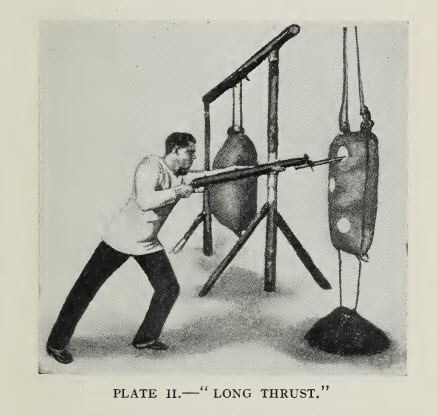
When it’s less safe to do much of the usual work, especially that which puts us well within six feet of one another, lessons can become repetitive and dull. In truth, doing the same thing over and over again in attempt to do it better is just part of fencing, but even with that acknowledgement there are only so many ways, for example, to attack and defend the extended target.
I have a few students right now who are at a stage where some attention to tangential material is possible. By tangential I mean aspects of sabre that have disappeared in the modern game. These were, however, once a necessary part of one’s training. It was only last century that competitive bayonet fencing died out; smallsword died out nearly a century before that in most places, but a number of works treat dealing with different types of swords. [1] Sabre vs. bayonet was a key aspect of most military training programs, whether for infantry or cavalry, and still has application today.
Sabre vs. Bayonet
Last weekend I introduced one student to the rudiments of defense against bayonet. Some of the maneuvers one can employ, for reasons of safety, I left out, such as parry, seize rifle, pommel strike with follow-up attack. Everything we did started with the student in seconda/2nd while I adopted one of the basic guard positions with bayonet, in this case what the English called “High Port:”
“High Port” from Bayonet Training Manual, 1917
As you see here, the left hand grips the rifle and is level more or less with the left shoulder; the right hand is centered above the fork and just in front of the solar plexus; left foot forward. The student might assume the guard of terza/3rd just as easily, but seconda is the preferred guard for several reasons. First, it places one squarely and safely behind the steel, the point threatening the opponent. Second, from 2nd, the shift to quinta/5th or prima/1st is quick. Both of these parries are quick, sweep the line, and set up powerfull molinelli.
My initial attack was to the student’s inside line with the “long thrust,” that is, a thrust made from about 4-5ft away–as with the sword, bayonet and rifle move first. The student takes a half-step back, parries in prima, then steps slightly to their right and delivers a cut to the arm or down the barrel to the attacker’s hands (this second riposte must be made carefully, one reason that this is not a drill I run with beginners). There are other options, such as a cut to the head via molinello, but we were doing our best to maintain the requisite distance in light of Covid.
The next drill started the same way, but as soon as I saw the student shift to prima, I made a cut-over the parry to the outside line. The student then had to take a second half-step and sweep back to seconda or terza. From there they stepped slightly to the left and delivered a cut to the forward hand on the rifle., before detaching and delivering a thrust with cover.
It was a valuable exercise for a number of reasons. First, because we were on grass, it mean having to be careful with footwork. Given the length of the bayonet trainer the student had to move–to plant and attempt to defend would mean a best we both got hit. Best of all, seeing the versatility of the first triangle parries–1st, 2nd, and 5th–cemented why we focus on them so much. Lastly, it was fun, and that is important.
Sabre vs. Smallsword
Yesterday, in a another lesson, I had a different student defend against smallsword.
D. Angelo, School of Fencing, 1765
This particular student has considerable experience, and at this stage of his training it’s possible to incorporate more and more of the more advanced, less standard material. Among the traditions he has studied is long experience with KdF (Kunst des Fechtens), which means that dealing with a variety of weapons is not new to him, and, that use of the weapon for defense as well as strategies for coming to the grapple are second-nature. He is far more comfortable with grappling/stretto play than I am, but I am learning a lot from him in the process (what little I’ve studied comes down to a few years studying Fiore’s armizare and weapon-seizures in sabre and smallsword or spada).
Here too we were keen to maintain “social distance,” so as per current custom attacks were mostly to the forward target. My initial guard was Girard’s high tierce/3rd, his was his choice of 2nd or 3rd. As with the bayonet drill, I focused first on attacks to the inside line, mostly toward the wrist; he countered with 1st or 4th depending on where he was as my lunge completed. Ripostes were generally to the arm, or, with a diagonal forward step right, to the head. Next, I performed a simple disengage/cavazione moving from the inside to the outside line. He countered with 2nd or 3rd, again, depending on where our relative distance was and how time affected the choice.
Finally, I adopted Girard’s guard of high quarte/4th, and attempted a variety of thrusts
Girard, Traité des armes, 1740
with opposition or via a feint. My student countered these as before, either attempting a stop-cut or arrest with a parry-riposte, or, when unsure of the tempo just parry/riposte.
I was surprised, but thrilled he enjoyed this exercise as much as he did.
The quickness of the smallsword and the fact that the point was always on him meant that he had to be conservative. Any attack, as he put it, had to deal with that preeminent fact. A little over a century after Girard another Frenchman, Baron César de Bazancourt, remarked in his Secrets of the Sword that
La pointe d’une épée est une réalité qui fait disparaître bien des fantômes.
“The sharp point of a sword is a reality which quickly makes illusions disappear.” My translation is a bit free, and less eloquent than de Bazancourt’s translator, C. F. Clay, but I think illustrates the lesson well. [2]
In the attack, this same point had to be dealt with safely before anything else. A decent sforzo or expulsion was effective, but had to be measured well since the lightness of the smallsword makes recovery to line a little easier. Since his weapon is heavier–he was using Castille Armory’s 16mm blade in a Radaellian guard–feint via cut was less safe than a feint followed by a thrust. This is yet another reason that the guard of 2nd is so excellent.
He did well in both offense and defense; his key concern was not to be hit, and so, if there was the slightest chance of mishap, he regrouped or attempted to provoke me to attack. I am really happy with how well he has taken to sabre, how skillfully he adapts to different and often difficult scenarios, and how much he enjoys it.
What’s Next?
I plan to continue the inclusion of both bayonet and smallsword on occasion. It’s fun, diverting, and forces the student to apply what they know to a new situation. As my student and I discussed yesterday, exercises like this force one to look at their toolbox and figure out how to make a hammer perform like a screwdriver, or, vice versa. Against the advantage in reach offered by a bayonet, one must adapt to handle that; against the lighter, faster, and more nimble smallsword larger actions and those to deeper target are dangerous, and so to achieve either option one must plan well or be hit.
I do not yet have a smarra, but I have an Italian epee that will perform the job until I do, and I may pair that with an off-hand dagger. I have not explored off-hand options with these students yet, and we have a lot to choose from, from cape (one of my favorites since a jacket, towel, or blanket remain similarly useful today) to buckler to dagger. In each case, it’s important to note, much of what we are doing is examining how we use the fundamental science within sabre to tackle non-standard scenarios. It’s a good mental exercise, forces the student to consider those fundamentals from a different perspective, and it’s a ton of fun.
NOTES:
[1] The one I had in mind as I typed this up was Domenico Angelo’s The School of Fencing, first published in 1765. In the edition I have he treats the use of the smallsword against various nationalities of fencer, Spanish, German, and Italian, and against a variety of weapons and off-hand accessories, dagger, dark lantern, cloak. A few other works of note that deal with multiple weapons include Pierre Girard’s Traité des armes (1740), which likewise pits his student against various European foes and their “favorite” guards; Charles Roworth’s The Art of Defence on Foot, 2nd ed. 1798, includes directions for sabre or broadsword against smallsword, spadroon, and musket and bayonet; and Nicola Terracusa e Ventura, True Neapolitan Fencing (1725), which includes defense against sword and dagger, buckler, rotella, and cape (an excellent English translation of this was made by Christopher A. Holzman in 2017 (available via LuLu Press).
[2] The English translation of C. F. Clay, originally published in 1900, was reprinted by Laureate Press in 1998. It was first published, in French, in 1862, and then again in 1875.
Attempting to reenter the world—safely—during a pandemic is nerve-wracking. Unlike many former plagues, Covid-19 is stealthy: symptoms may appear anywhere in 5 to 14 days; it can appear like allergies or a more run-of-the-mill cold; and it can even hide, like the Danaans in their wooden horse, in people who never develop symptoms but spread it far and wide. Against an enemy so difficult to track it pays to be cautious. For those of us teaching fencing or anything else that requires close proximity, be it dance or BJJ, we must make every effort to keep our students and ourselves safe.
Few things are harder to give up than something we desperately want and which brings us joy. Sometimes, however, we must if only for a time. The jury is still out as to whether we should begin classes as we did pre-pandemic. I’m inclined to think this is a bad idea, at least here in the States, but individual lessons, of a type, are perhaps something we can do under certain provisions. To date, there are several steps we can take generally that will reduce the chance of catching and/or spreading the virus:
we work outside
we wear masks
we keep an appropriate distance
we reduce the length of lesson time
I have given two lessons this way so far, and it’s interesting what works, what doesn’t work so well, and what effects these changes in approach can have on the body.
What Went Well
Parallel drilling works well and easily abides the social-distancing protocols. Yesterday after stretching we started with molinelli. I had this student add a few additional molinelli to the three I started with him (I normally have students begin with a) a fendente from the left to the head from point in line, hand in second, moving through prima; b) with hand in fourth, point in line, an ascending cut to the flank moving through sesta; and c) from point in line, hand back in second, a cut to the left cheek moving through quinta). I also introduced him to the scarto, that is, to shifting the trunk back and forth as one parries/chambers a cut and attacks. It allows one to fine-tune and play with distance, can provide a few more inches of defensive space, and it can feed the cutting dynamic with a little extra oomph.
Next, we ran through a few footwork drills. We started in parallel, just advancing, retreating, and lunging. Then, together, I pushed him back and forth from just out of distance; his job was to maintain that distance. While out of measure, this still works distance and one’s sensitivity to it. Ideal? No, but useful, yes.
The rest of the lesson focused on progressively more complex actions to the forward target. This prevented us from getting too close while still allowing us to work on something of worth. The first was a simple stop-cut drill, e.g. I advance, expose the inside, outside, top, or bottom of the wrist, student strikes to that line and returns to guard. Next, on occasion I would cut after he made the touch to encourage him to cover himself after the cut. Third, I would parry some of the stop-cuts or arrests, riposte, he would parry, then riposte in turn.
What Didn’t go so Well
For more experienced students the footwork we normally warm up with is not enough to push them or have them hone that footwork for tactical situations. Advance, retreat, lunge, passing steps, etc. are important to drill, but on their own only do so much. I may be able to bring a pell out, but this will require working at my home, a choice perhaps less ideal during the pandemic (my pell, such as it is, is an old Wavemaster with additional padding on top and an old, heavy canvas jacket around it). One useful alternative is a softball trainer, the sort of long wand with a ball on the end, but this is a much more restricted target. It is, however, far more portable.
Molinelli too, while a great exercise and one we should all do, suffers without application. I include them in warm-up to prime us for more activity, but without the ability to get into distance we lose the opportunity to drill these offensively and defensively. My student today is at a stage where he would benefit from this, but it will have to wait.
Without closer proximity much of what we normally cover is just off the menu for now.
Effects of the Changes
Apart from being hobbled in what we can drill and cover in lessons, the single greatest change has been arm fatigue. Both instructor and student have the arm a bit more extended for longer periods of time working the forward target. Even in terza/third this can be tiring (the Italian third is taken with the arm farther forward). With Olympic weight sabres this is less onerous, but with period weight blades it begins to tell much more quickly.
The answer in both lessons was more frequent breaks. These afford a chance to discuss what we’re covering in more depth, so more breaks aren’t necessarily bad, but it’s not ideal either. As we acclimate to the weight we’ll be able to manage longer exchanges, but day one was proof that we’re rusty and our muscles used to quarantine idleness. So far, we have not taken most exchanges beyond three or four actions. While perhaps closer to how we actually bout, longer phrases are medicine for the hand. We drill in more complexity, strive to improve so that in the simpler actions in a bout we are cleaner, our eye sharper, responses crisper. One positive aspect to this extended target, however, is that focus on the advanced target is more in keeping with the conservatism that should be present in any bout. As I often point out, in surviving footage of duels most opponents seem particularly keen to stay just out of measure. [1]
Looking Ahead
The most common complaint about drill is that it’s boring. If that is all we have, then I agree. We drill as a means to an end, so when it feels like the goal, like it’s all we do, it’s a lot easier for boredom to creep in. It’s boring for me too. Varying lessons while maintaining appropriate distance for health is difficult, but there are ways to jazz it up.
I have some less standard material I plan to employ to help. I’m still brainstorming these, but as one example bayonet drill may afford some diversion. As a pole-arm, rifle and bayonet keep us a little further away. Even if I am the only one with the bayonet and the student is defending with a sabre, the distance will remain a little farther out. This means that some of the more fun, crowd-pleasing options are out, for now, but that is not wasted training. While the bayonet may be less often employed in today’s military, it’s extremely useful technique to have in one’s toolbox. [2]
Safety First
Safety is, and always should be, our top priority. It’s inherent in the very term “fencing,” which derives of course from “defence,” so an added layer of protocol, while annoying, is not so great a step. Face masks under the mask are annoying, but no more so than a pair of glasses (my poor student today has to wear glasses and a face mask, and he does fine). Whinging to the contrary, one can breathe in a face-mask well enough too.
My town, obscure as it is, has had a rise in cases this week, so it is difficult if not impossible to determine how things will look in a week let alone in a month. We cannot fence on a respirator or if dead, so… hard as it may be, financial blow though it be, put your health and that of your students’ first. If you’re potentially ill, if a student is, cancel and postpone. At some point we will be able to fence again, but only if we ensure that we make it through Covid-19, so, be smart, stay healthy.
[2] The nature of modern warfare has no doubt reduced the need and use for a bayonet, but a number of militaries still teach the rudiments of this important skill. One does, after all, run out of ammunition or find oneself in situations where striking with the rifle butt or stabbing with a bayonet may be necessary. I can’t speak to this myself, but my father and his father related to me how important they found it in combat. Even in Vietnam, my father’s war, he had recourse to it. For civilians, bayonet drill is perhaps the simplest staff/pole-arm to learn and though we don’t walk about with rifles, one never knows when that mop handle, cane, umbrella, or broom may be the only thing between one and an assailant.
PHOTOS: to the best of my knowledge these are free to use.
Second Image: this image of the primary hand positions (as opposed to invitations/parries with the blade) is widely used, including within published works, but I’m uncertain as yet of its first appearance.
Third Image: this is plate XIX from Cav. Ferdinando Masiello, Sabre Fencing on Horseback, Firenze, G. Civelli Establishment, Editor, 1891, trans. by Christopher A. Holzman, Lulu Press, 2015, p. 52.
Fourth Image: this is Fig. 9, page 34, “Position de la garde et engagement,” from Jean Jules Gaston, Manuel d’escrime à la Baïonnette, Berger-Levrault & Cie, 1910. A pdf may be found here: https://www.ffamhe.fr/collectionpalas/Jean_Jules_Gaston.pdf
Several trips, one international, were in the works to teach, share ideas, build bridges, and learn. I had just added an introductory fencing class for adults at my local parks & rec. I was starting to make some progress on two exciting writing projects. And I was trying to find a way to start work toward obtaining certification as a moniteur d’escrime [2]. That all changed in March.
All the trips have been canceled. My P&R classes, which were two weeks in, abruptly stopped, and how the planned August summer camp will materialize remains uncertain. With no classes at the dance studio each Sunday (which closed for quarantine) money for a space lapsed and with it, insurance to cover that specific space. With quarantine I couldn’t teach individuals either, so the small income from lessons which helped fund us dried up too. When school moved online this spring (it likely will be in fall too) my first duty was to assist my children with the switch, and so time to work on certs, never mind affording it, were nixed too. It feels a bit like having a vehicle stall out, only slightly slower. At so slow a stall one also has time to take in the scenery, and it’s been… revealing.
In light of all these rapid changes, it’s probably understandable to wonder how all this will work out, and where one will be if and when it does. Our situation State-side wouldn’t be so dire had my nation been grown up enough to handle it properly. Being leaderless didn’t help, but if my town is any indication few people could hack three weeks let alone three months of quarantine. So, now in July, we have a rise in cases. Florida had a record 10,000 cases confirmed in a single day this past week and the pressure on hospitals in Texas, to name a second example, is so great that administrators won’t share numbers. People are having “Covid Parties” for fuck’s sake. In a place where some see wearing a mask as an attack on their personal liberty (I know, I know, I don’t understand it either) it’s likely that we will, as a nation, wrestle with the pandemic for a long time. No New Zealand experience for us.
Fencing in the Time of Covid, Revisited
Where does that leave fencers? While obviously not an essential part of the workforce, we’re affected too. Some groups with enough momentum have survived the hiatus pretty well. My friend Mike’s group has been sharing videos of solo training and meeting at normal practice times via google-meet since quarantine started. NWFC, a key Olympic school, has had video classes as well. Even smaller groups, like my friend Matthew’s, have met with success meeting online to discuss their topic (Simon de Frias). Patrick Bratton, who runs Sala della Spada in Carlisle, PA, has had a few outdoor practices, but wisely with montante/spadone instead of the more typical sabre, rapier, and spada. No one bouts with montante, so it’s perfect for enforcing social distance. He has made a lot of videos for his students as well.
With sufficient numbers or at least a highly engaged set of students these are good ways to keep people engaged, and what’s more, dive into material they might not look at normally. I’ve had the honor to sit in on some of these meetings and they’ve been great. In my case it made less sense to follow the same path. The students I teach individually are at different levels of development. I’ve assigned some “homework” for them, mostly footwork and drills against a mask or pell, but meeting in real-time is harder to manage with students of vastly different ages and responsibilities.
Some schools and clubs are talking about starting again, but it’s too early to return to “normal,” especially given what we’ve learned about confined spaces, proximity, and the importance of particulate in spreading the virus. There is some evidence to suggest that severity of illness may be linked to length of exposure, so to return to gyms even with face masks and proceed as we used to seems unwise.
Covid-19 answered much of the question for me—with no building, no funding, and sporadic interest there is no “return.” Instead, it’s back to the hedge, to teaching outside. The old hedge schools may be less illustrious, but they are at least venerable.
The Obstacle is the Way
There are a number of ways to look at this change. On the surface, if I’m being honest, it feels like failure. Another one. To have worked so hard to build a small, but viable program only to see it disappear so quickly hurts. All the doubts one has ever had about credibility, likeability, and interest come calling and more loudly than ever. For someone who has been through this before the disappointment can easily feed the narrative declaring that one’s lot in life is failure. Samuel Beckett’s admonition in re failure from “Worstward Ho!” notwithstanding, it sucks. This time, it actually cuts twice as deep, as part of building SdTS was, for lack of a better term, part of a healing process.
What follows is perhaps the most personal I’ve been in a public forum, and yes, it will circle back to fencing. I share it because it will, I hope, illustrate some important points about fencing, growth, and resilience.
Without going into detail, three years ago I was in the darkest period I’ve yet experienced—genetics and trauma are a good recipe for clinical depression, a condition I only officially addressed 14 years ago. Medication, therapy, a patient spouse all help, but I wasn’t sure what would happen or even if I would survive 2017. Some days I still don’t know. Suffice it to say that surviving personal calamities and wrestling with the cascade of consequences in the aftermath either makes or breaks us. I’m unsure what it will do to me down the road, but I made the choice three years ago to recast myself, lose some of the dross, and in the process I’m all the more certain that doing the right thing—despite the costs (and they’ve been considerable)—is the only way.
Part of my goal with SdTS was to do a job I had done before, only better. There were a number of challenges and obstacles, but as in my personal life the way forward seemed to be via those obstacles, and so, I pressed on. Obstacles are opportunities; they’re lessons we need to learn; we can try going around them, but they will appear again if we do.
Fencing and Self-Improvement
I typically refer to fencing, to martial arts as “The Art,” a borrowing from Fiore (fl. 1410), but I believe it is true too. All arts might offer what the Art does, but where many artistic pursuits may lead to insights over time, the crucible of combat can mean sudden breakthroughs hard to get to any other way. Having to test decisions and plans or change them in nanoseconds can be instructive. Not everyone sees it that way, but those who do will likely agree with this notion. It’s not just a modern sentiment either. Castiglione (d. 1529) not much later than Fiore also said the art of arms was the chief profession a gentleman should possess. I believe he meant this in a deeper sense than service to one’s prince.
There is much one can learn from the Art: dedication, persistence, resilience, generosity, patience, attentiveness, and decisiveness are just a few such examples. Acquiring and perfecting the skills necessary to fence is an inherently frustrating endeavor. If one is up for the challenge and navigating occasional frustration then fencing is a great way to exercise these traits and strengthen them. [3]
I’m also aware of the Zen filter I apply to western fencing—if nothing else stuck from a lifetime spent studying martial arts this did. I see martial arts, ANY martial art, as a potential vehicle to self-improvement. For its faults it’s a healthier approach than the over emphasis on winning, making a name for oneself, or (in those arenas where it happens) on profits from commercial endorsements. Fencing, since it brings so few rewards in the form of fame or cash, makes for a cut-throat endeavor. Back-stabbing is normal however gauche—this is true no matter what camp one belongs to (pardon the puns).
Fencing, A Solitary Pursuit
Returning to fencing was, as it has often been for me, an attempt to work on myself, on those areas I knew needed work. In 2017 I had greater worries than what would happen with fencing beyond my own need. I couldn’t proceed as I had before—mitigating circumstances made that unwise, so rather then return to the club I had been with or join another, I tried to create my own. To use a fitting analogy, a friend of mine in Baltimore, a former heroin addict, related that he was only able to get clean because he left his neighborhood, his job, most of his friends, and make a fresh start. I found myself in a similar situation (minus the substance abuse).
There were many outcomes from 2017 in re fencing and community, but chief of which is that I realized there is no community, least not as I had thought of it. My notion of it was, to put it bluntly, a naïve pie-eyed School House Rock fantasy. I focused on similarities, tried to ignore some differences, and realized in the aftermath of a personal crisis just how shallow a pool I had been in. No minnow in the drowning pool helps another. Each minnow is only concerned with itself—few even realize the water is seeping away. It was also clear that goldfish are not welcome, not that I knew I was a goldfish until things went south.
One thing that no one tells you when you’re trying to put your life back together, is that the more honestly you do it, the more sincere you are, and the healthier you become, you will lose people. Your isolation will increase. People don’t know what to do with honesty—this is especially true if that honesty puts any demand on them to consider their own role, choices, or point of view. In the issue that sparked the crisis in 2017 I decided to own my role and took responsibility for my part; I decided not to focus on others or their choices, only mine, and so threw no one under the proverbial bus. Few times have I seen an outwardly correct thing blow up in my face like that did. It ended up serving me well, in some ways, as one, it freed me up to pursue my own path, two, it forced me to face and deal with some of my shortcomings (which gets easier with practice), and three cushioned me when I once again honest with some friends last October and one of the four decided to make it about her somehow. People don’t like honesty; they don’t like having to consider that maybe they got it wrong. I have dwelled on these examples, and honesty, for a reason.
Honesty is the enemy of ego, and ego is the single-greatest stumbling block we face. Ego is the enemy within, the pernicious source for so many of our poor choices, and as a man in India expressed some 2,500 years ago, a major cause of our suffering. Life is suffering, so learning to manage it well is vital, and it’s not something we Americans do well. Too often we foist responsibility onto others, create convenient scapegoats, or ignore what is uncomfortable. A more honest approach is to embrace the discomfort, lean into it, use it as a stepping-stone to whatever is next. It doesn’t mean we ignore reality, but that we don’t let the reality beat us into submission. We suffer, it is our lot, but that doesn’t mean we should wallow in it. See it, note it, learn from it, and move on.
Am Dún Díthogail
It would be easy to quit. Between bad luck, less interest for what I teach, and less support received than given, quitting might even be wise. But this is where viewing the loss of a space and students another way is beneficial. If we’re honest about ourselves, about our goals, if we see our strengths as well as our limitations, then the people who see that and are supposed to be in our lives will remain. Even one such person is enough for a teacher.
After a lifetime of martial arts, of some thirty-three in fencing, what role I have in the Art is as a teacher. Injury and age mean my fighting days are over. Research, writing, and teaching I can do with the limitations on me at this stage. A teacher is first a student, and a good teacher remains a student. To teach is to learn, if we’re doing it right, because we can never know it all. Teaching forces us to learn more. We never conquer the Art; there is always more to learn, more to correct, to relearn. In the process, if we pay attention, if we’re honest, we learn about ourselves.
Fencing has been a source of joy for me, but it has also been one of the primary paths of self-examination and introspection. When I first started this painfully long piece, I devised a long one-to-one analogy between self-awareness and fencing, but decided it was too much. In short, though, there are lessons we can learn from the tactics we often employ. We learn to lie as fencers, to deceive; if we pay attention to that writ a little larger perhaps we appreciate those subtleties in ourselves a little better. Fooling an opponent to make the touch is part of fencing, but it’s generally a poor approach to other aspects of life, particularly in dealing with others. It’s no better deceiving ourselves.
Scoil Scairte
There is a simplicity, something natural about teaching out of doors. It’s not for everyone. Living in the Pacific Northwest means that one needs to be comfortable with months of rain and grey skies—two of my favorite things—but this means that by definition I’ll see fewer students. Rather than view that as another proof of failure, which it may very well be, I instead choose to see it as weeding out those who shouldn’t be working with me. [4]
This is, next to fencing as a path to growth, what I’ve learned: what I teach is not for everyone and that’s okay. Those who wish to take lessons with me will, and I will happily share all I know. That is my role as an instructor. This may mean that very few will see the value in my approach. That’s okay too.
I know it’s value, I live it every day, and while it has not made me a happier person, I think it is making me a kinder, more compassionate one, and that’s still a win.
NOTES
[1] Scoil Scairte, Irish, pron. skole skart, lit. thicket or covert school, usually translated “hedge school;” these began appearing in the 18th century when sanctions against Catholic schools were strictly enforced. Schoolmasters, some more legit than others, began teaching out of doors, often secretly, and even when they left the bothy for a building the name “hedge school” stuck.
[2] For more information, the USFCA site is one resource (https://www.usfca.org/); see also the works of Walter Green such as The Moniteur Handbook and his The Moniteur d’Escrime Historique Handbook, both available on his Lulu page (http://www.lulu.com/shop/search.ep?contributorId=1099801). My goal in looking at the initial, official ranking was two-fold; first, it would give me more tools as a teacher, and second might open up teaching opportunities that are closed to those outside the official organizations.
[3] There are dangers in studying the Art too. For everyone of us looking to the Art for growth, there are ten thickwits who pursue the Art for the wrong reasons, even evil reasons. The ridiculous Deus Vult types, the minority within Germanic heathendom who embrace right-wing ideas, and those out to victimize opponents to feel good about themselves stand out as some of the worst cases.
[4] Having worked hard since 2015 to build up the sabre community in the PNW, there are more options than there were. I’ve tried my best to support these colleagues, tout their programs, hang their shingles next to my own, and in every way possible be an ally instead of a rival. I can’t say I’ve convinced any of them that this is the case, but that doesn’t really matter. Students have more options, and since personality and approach matter so much, more instructors who know what they’re doing is good.
For a while now, I’ve been working hard on an issue we talk about all the time, but which we struggle to manifest: coverage. How to hit and not be hit. For historical fencers this is supposedly the guiding principle in how we approach the Art, and, what ostensibly separates us from our cousins in the Olympic world among others. This isn’t to say that the sport ignores proper coverage completely—ROW assumes it—but as often interpreted, taught, and scored “hit and don’t be hit” is less important than who made the touch with right-of-way, regardless of off-target or near simultaneous strikes. Historical fencers, particularly within their own sporting wing, struggle with the exact same issue only under different terminology. Considerable gymnastics form some answers to the problem, from over concern about “after-blows” to peculiar understandings of the angles for “effective” cuts, and to be fair similar gymnastics in rule-sets with point values by target…, so looked at honestly sport-HEMA faces the same challenges the Olympic world does. [1]
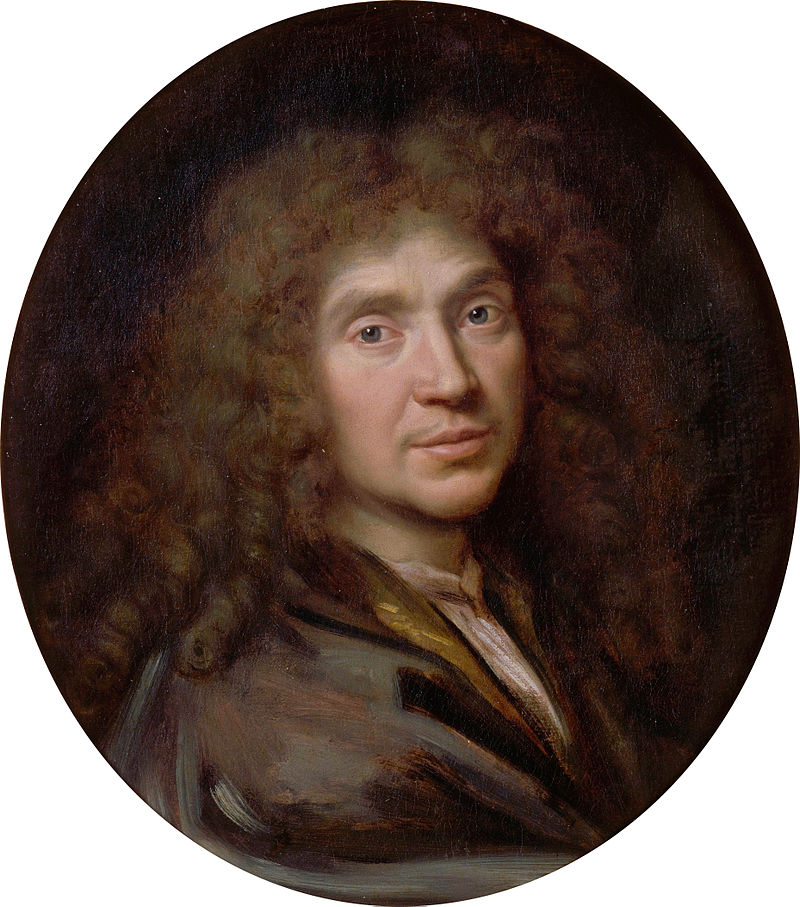
What exactly do we mean by “coverage?” In short, to quote Molière, it is “to give and not to receive” when fencing. This maxim derives from a line in a ballet by Jean-Baptiste Poquelin Molière (d. 1673), usually referred to only by his surname. He was a French dramatist whose work captured key social issues of the Ancien Régime. In his 1670 “Le Bourgeois Gentilhomme,” often translated as “The Would-be Gentleman,” Molière explored the ridiculousness of a social climber keen to take on the activities of his social superiors, something obvious to everyone but poor Monsieur Jourdain himself. Among those he employs to better his situation is a fencing master who, in an oft-quoted line in traditional fencing circles, remarks “As I have told you, the entire secret of fencing lies in two things: to give and not to receive.” [1] In the 1990s when “classical” fencing was quickly establishing itself in reaction to the excesses in the sport, this line was often the battle cry.
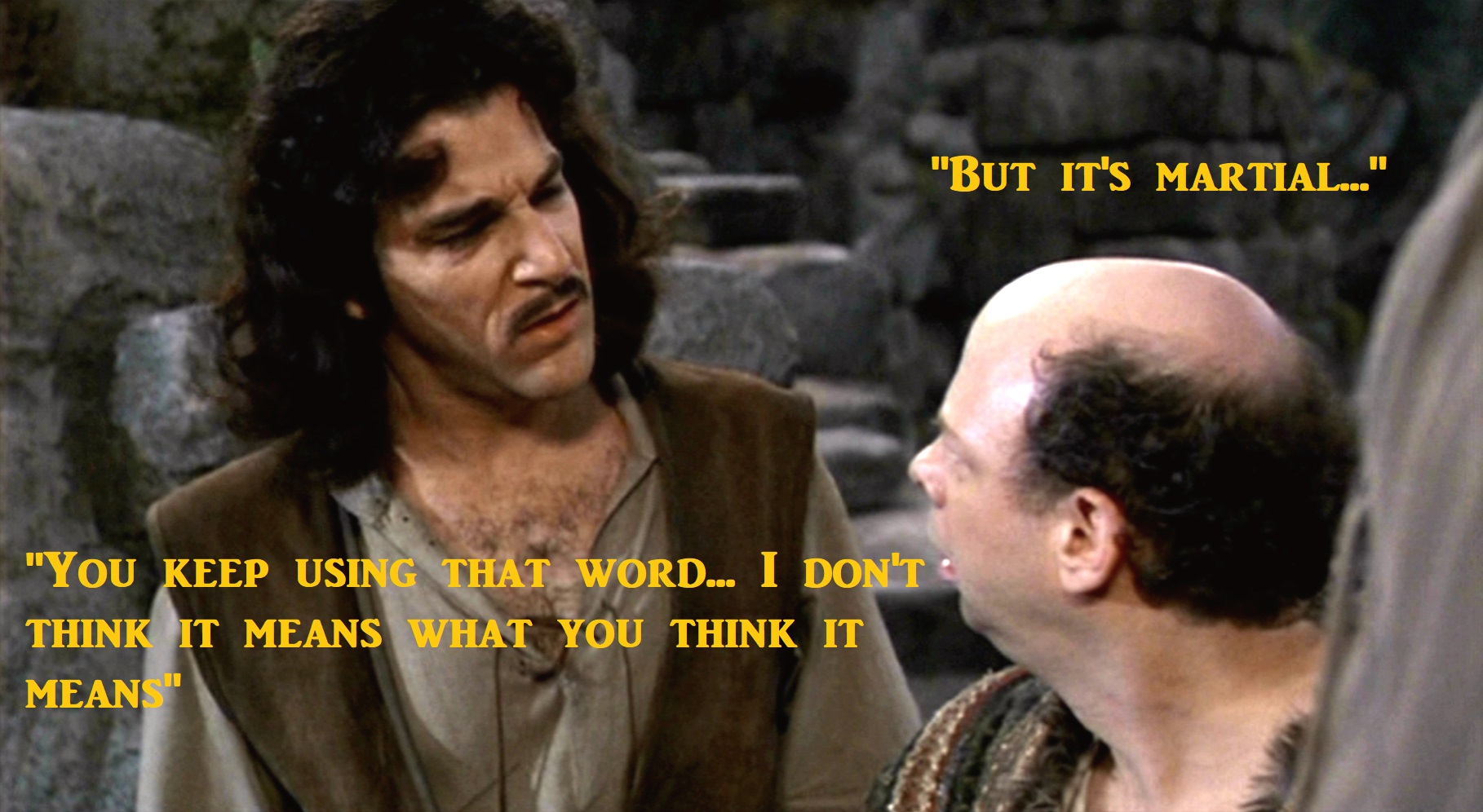
On its own, it’s a clear, simple, and direct notion—hit your opponent, but in doing so don’t be hit. This is far easier to say than to do. Why is that, and for those of us looking at period manuals, why is it that we still struggle to achieve this? What gets in our way? Does it even matter? [2]
Working backward, it doesn’t have to matter; that depends on one’s goals. Anyone purporting to pursue historical fencing should care, but there’s a spectrum within “HEMA” and naturally not everyone agrees. Assuming that not being spiked or slashed does matter, however, there are probably multiple explanations for why it is so difficult today. This first discussion of coverage will discuss a few of the big picture issues.
Through a Glass Sporty
Much of our way of thinking about “real” swordplay has been framed within a sportive context, so we often unwittingly apply this sportive filter to our look at works from the past. This particular blindness is born of working in a context so divorced from the original environment of the Art. One result of this is that we have nothing against which to compare our interpretations, progress, or effectiveness other than parallels within our context, and all of these are sportive. We can get close to more accurate interpretations, maybe be dead-on in some cases, but much if not most of what we build, especially for older systems, will remain tentative. It’s inescapable since we no longer use swords in war or fight duels. The emphasis many place on tournament bouts doesn’t take into account this filter, but it must—by definition a tourney bout is sportive. This has serious ramifications not only for how we train, but also for the value so much of the community places on medaling.[3]
It is easy to underestimate the importance of this. In the past, when the sword was still an active weapon, final proof of readiness and skill was pass or fail, something one only discovered in combat, in whether or not one survived. Setting aside the issues of infection resulting from wounds or a stray musket ball on a battlefield, one’s skill either effectively dispatched the enemy and saved one’s life or it didn’t. Confidence accrued over time as one continued to survive until one either retired, met one’s match, or was killed by some non-primary assailant. This is a perspective and style of confidence that we cannot really know. Modern military people with combat experience may better appreciate this psychologically, especially if they have experience in hand-to-hand combat, but even for them the nature of warfare is different in significant ways.
The Role of Fear
The confidence gained in “on the job training” didn’t mean a lack of fear, only the ability to put that fear in check. More than anything else, it is the lack of fear, the lack of dire consequences which most affect our approach. Some historical fencers assume that because the system they study is “martial,” by which I believe they mean either for the battlefield or as a synonym for “effective,” that they are more or less automatically approaching it the same way as people did in the past. One may move much the same way a treatise suggests, but movement is mechanical however much informed by intent and to move the way a master recommends does not mean the mindset is the same. We can’t even be sure we’re moving the right way much of the time.
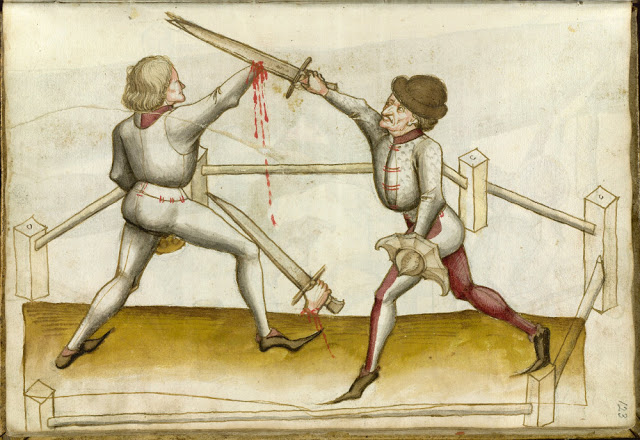
This is an old problem, one at least as old as fencing for sport, and there have been many proposed solutions. ROW in Olympic fencing, for example, is meant to reflect the reality of a duel—in short, if one is being attacked, one must defend, or, counter-attack in enough time to have hit the opponent before one is hit. The inclusion of “off-target” and poorly timed touches affect everything. The most important complaint about ROW is the fact that there is not enough emphasis on not being hit at all. If, for example, my opponent attacks me and I decide to attempt a counter-attack, ideally I do that in the correct tempo and cover myself on the retreat. However, by the rules, I just have to strike one tempo before my opponent to nullify their attack—this doesn’t mean that I’m not hit, just that I hit first, in sufficient time, and thus rob them of the touch and score one myself. As Olympic fencing is a sport this is perfectly sensible, but if we’re talking fencing as a martial art then it is a problem.
Rule sets in historical fencing have to make choices too, but for the most part they’re just as artificial. Anytime we game a combat system we introduce artificiality. Some suggest that only certain angles of cut, for example, are sufficient to do any damage and thus only cuts made at those angles count. This flies in the face of actual cutting practice, however, as even a tip cut with a longsword is going to do some serious damage, never mind weapons designed to cut that way. Other rule sets, and I’ve made one myself, try to introduce either benefits or punishments for bad tactical decisions. Some award points to “after-blows” in the belief that one should have covered, others attempt to promote better attention to defense by weighting the initial point more.
None of these are perfect and each have advantages and disadvantages. None, however, solve the problem of mindset. If cuts must be made at certain angles, then cuts that might have damaged someone but aren’t at those angles are ignored—”tippy” cuts to the hands, to name one example, aren’t considered “martial,” but the hands and forearms are common targets in the sources and as I learned from one sabre coach, if you remove the arm’s ability to wield the weapon, the rest of them is a lot easier to hit. The thorny issue of the “after-blow” likewise presents difficult choices—what is more important, responding properly, defensively to that initial attack or cutting into it to lessen its point value despite the fact both opponents are hit? Weighted point-systems set up similar challenges. For example, in my rule set I reasoned that weighting the first touch in a bout would make fencers more cautious and defensive, but the point advantage led more people to attack in hopes of being a point up from the start. These artificial attempts to infuse some species of “fear” and/or better fencing vary in quality, but none does the job super well.
So, if we cannot replicate the context and fear of actual sword combat, what can we do?
Interestingly enough, some dubious individuals have decided that the only way is to fight with sharps; I don’t mean in a drilling sense, but in a bouting sense. However, fighting with sharps “to the bloom” among fringe elements within the community is not the answer. In addition to the legal issues inherent in such idiocy, this activity resembles more some rite within a cult of machismo than anything else. Moreover, some of these groups are known alt-right, white supremacists with mixed up ideas of valor in addition to their ahistorical and unscientific notions of “race,” nationalism, and everything else. Their lack of credibility belies their approach to most things and one must remain suspicious that they even understand what they’re reading (assuming that they can read and do). [4] From the context perspective these dangerous fights are more ritual than a species of duel or battlefield combat. Groups like that in Hamburg do this by choice, with their friends, and while no doubt afraid in some degree, like the older institution of German student dueling at certain universities, this is more social than “martial.” Did I mention it’s stupid?
Cultivating “Fear”
At the risk of sounding too Pacific Northwest and as crunchy as organic granola, one thing we can do is cultivate a sense of danger, that is, be mindful from the moment we pick up a weapon that it’s a weapon. Blunt, not blunt, treat that sword like it’s dangerous. By analogy anyone who owns firearms knows to treat that rifle, pistol, or shotgun as if it is loaded. Always. Though clearly more critical for gunpowder, the same mind-set can help us approach our drill and bouting with more awareness of what it is, in theory, we’re doing. Employed appropriately our fencing will change. We can become more cautious. We may reconsider how that tip cut to the hand might have ended the fight. We can second guess an attack that puts us at too much risk even though we’re sure we’ll land the touch.
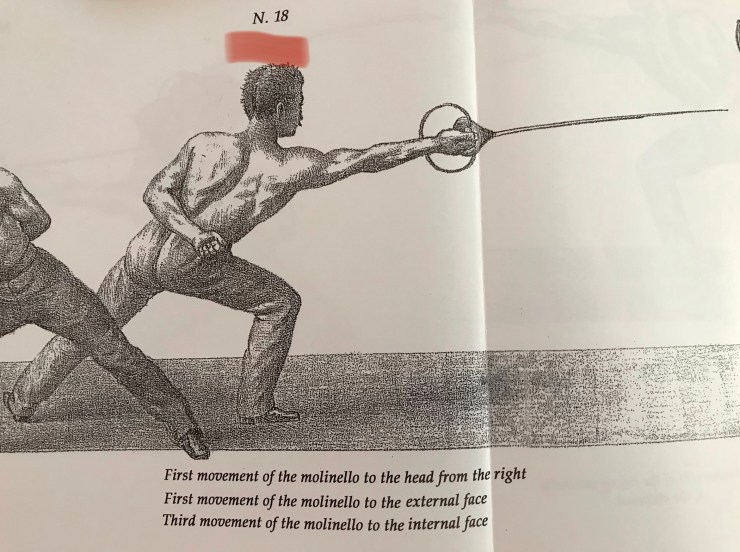
In itself this is not the answer. It’s a useful approach I’ve been trying experimentally, but I’m optimistic about it as a training aid for two reasons. First, the mindset of “all swords are sharp,” if we apply it well, puts us one step further from fencing for points. Second, the more sources I read—irrespective of system or time period—the more I notice the emphasis on avoiding being struck, on attacking wisely and whenever possible with cover, opposition, or room to maneuver away.
In the Part II of this discussion I will examine a few sources, from the 14th cen. to the 20th, and how they treat these issues.
NOTES:
[1] In the two years we used versions of the rule set I put together it has changed. Most of this change came from the insight and experience of those who competed and officials. Their input improves the rule set far greater than trying to do so on my own can, and it’s long past time for me to reexamine and improve it again. One major change will be taking away the weighted first touch.
[2] Hitting and not being hit includes a lot, from effective parries to attacking from the right measure and in the right tempo. It includes trying whenever possible to thrust with opposition to returning behind the point or under guard on our recover after attack. In Part II I will explore these in more detail.
[3] As another nail in the coffin of tournaments being “martial,” all of them are set up as duels, a fight between two individuals.
If you’re worried that a steamy tale of love and betrayal follows, fear not; the title of this piece is a nod to Gabriel García Márquez’ famous book, but has nothing to do with any of its subject matter save that both treat tragedy. We are seemingly inundated with a new disaster each month, but objectively many of our current woes are as old as (or older than) the nation. What’s worse, much of our current plight might have been avoided or better mitigated had there been any leadership nationally and had our populace a better grasp of science. We’re a young nation and act like it.
In light of these truly terrible problems—a pandemic and the 400-year-old evil of institutional racism are pretty terrible—it feels selfish, irresponsible, and bit gauche to discuss the challenges one obscure person running a fencing program faces. Were it just my own struggle, I wouldn’t bother, but most everyone with whom I am in contact, from my own students to other fencers and instructors world-wide, relates that the loss of fencing in their lives has exacerbated the more serious ills. I won’t pretend that what we do falls in the category of “essential labor,” because it doesn’t, but for many of us it is essential (small -e-) for one reason or another.
Fencing for most of us is more than physical exercise; it’s mental as well. This is true both in the sense of an intellectual problem and in terms of mental health. The combination of movement and decision making, of explosive large muscle activity with the fine motor skills required in particular techniques, all serve to remove us from reality for a while. When we are in “flow,” as it’s often termed, the world melts away—we are present only in each second, no thought for the second before and barely one for what follows. In flow our mind or soul or whatever you want to call it relies on the hours of drill and just does what it needs to do. There is harmony of the body, of the mind, of the spirit, and all at the same time. In few places in our daily lives do we achieve that synthesis. It matters.
My students range in age from those not yet ten to those in their sixties, each with the weight of life appropriate to their stage of life and experience, and while fencing is fun for them, it’s more than that. It’s a break from the trials of school, the grind of work, or the challenges in their personal lives. It’s a form of rest, a chance to partake in an ancient rite, one shared by people all over the world, and, one practiced for centuries much as we practice it now. It’s time-travel. It’s time apart. It’s a safe, controlled, and dynamic way to let off steam and establish control over oneself in a world where so much feels out of control. It matters.
Like many instructors, I’m in limbo—I cannot meet students safely as yet, but I’m working on “out of the box” approaches to make that happen again. I’m scheduled to teach a summer camp for my local parks and rec, but have no idea how to introduce fencing to beginners from 6 to 10ft away. I don’t have many students, so the online sessions that colleagues of mine hold—which are excellent—make less sense for me. Most of my students are young, struggling with online school thanks to the pandemic, and at a stage where the deep dives into the material are less effective and definitely less fun. The adult students and attendees that remain are too few, and in the latter case are running groups of their own. Having taught college for over a decade I know the horror of an empty online meeting room, and where there is a lack of interest there is little cause for the work that goes into such a class. My students, colleagues, and I chat via IM, phone, and email, but it’s not the same. The interaction, the movement in real time, the decision process, all of that is absent. It is fencing abstracted, academic, which is part of the Art, but only a part. The Art is meant to be practiced. It matters.
The pandemic brought the momentum of my school and many other clubs to a halt. Just as our community was starting to find possible ways to reenter the sala, years (centuries really) of righteous anger, ignored by so many for so long, have exploded into city streets in response to so many racially motivated murders. The gravity of these two challenges, pandemic and the ongoing battle for civil rights and equality, overshadow—rightly—the plight of individual pursuits and businesses. This doesn’t mean I won’t be teaching as soon as I can, because I will, but it does mean that we face far more weighty issues at the moment. These issues matter. They matter more.
We must take care of ourselves at all times, but especially in times of crisis, and, we must be supportive of one another as well. If we’re able, we should continue to train, drill, read, and reflect, because we need to stay sharp, healthy, and in control of ourselves. Physical and mental fitness are vital. It’s crucial that we be able to muster all of our strength, that we be able to think clearly, that we be able to persevere, and thus best prepare ourselves for the trials ahead. They look to be many and serious, and just as in a duel where victory or defeat are in the hazard it will take all of our abilities, focus, and heart to emerge if not unscathed, then at least alive.
One of the hallmarks of historical fencing vs. other branches is the central place of the sources. Olympic fencers may never crack open a book about fencing, let alone an old one, because they don’t need to. This isn’t to say they shouldn’t, but that it’s not required. The high level of teaching in Olympic fencing, the focus on individual lessons, and the crucible of the tournament experience all work well together to produce capable fencers. Historical fencers, however, can’t really pursue the Art without recourse to the texts, images, and tools that comprised parts of it. There is a spectrum within historical fencing—at one pole are the handful of academics focused on the texts, at the other are those who receive all they know through an instructor who (ostensibly) does the reading for them, and then there is a wide variety of approaches in between those poles. Wherever one may be along this spectrum they should, at least on occasion, read the sources that inform their study.
To use an appropriate cliché, reading the sources is a doubled-edged sword, because while diving into the source might illuminate a lot, it also requires reading skills most people don’t apply day to day. That can be daunting. Unlike a novel or magazine piece we can’t be passive; we must be active. We must apply close-reading skills, and many people haven’t exercised those since secondary school or college; some never have. Don’t worry: the good news is that one doesn’t normally have to do this in the detail sometimes required of many historical documents.[1]
It’s important to read, if only on occasion, to check that the interpretation we’re using or learning is still valid. In much of what people normally think of when someone says “HEMA,” for example, people rely on ideas and techniques which, if one looks further into, are flawed. One of the places this is most evident is in cutting dynamics. There are false equivalencies guiding much of current practice as well as a fundamental misunderstanding of fencing universals. The trouble is that those crowing loudest have gained what notoriety they have on these faulty foundations, so there’s little incentive to own it. There’s a direct analogy here with the FIE officials, coaches, and fencers who either made their way via dubious, non-traditional actions like the “flick” or allowed such actions to count in the 1990s. Vested interest and concern for reputation above all tend to work to undermine not only better work, but also actively seek to discredit it. That’s a problem. [2]
I’ve discussed this before, but there are many ways to cut a mat—cutting the mat, on its own, doesn’t mean that one has cut that mat as one’s chosen source or style has dictated. This is a false equivalency. It won’t register as a problem unless one knows the sources, however, so that means it’s on each of us to read. It’s especially incumbent upon those responsible for teaching cutting to get this right—not all of them do. Some of the loudest voices are using techniques more in common with certain Japanese schools than with KdF or other European systems. Anyone who dares suggest this, though, is assaulted with ad hominem attacks, even home-made memes featuring the offender’s photograph. Childish responses like this should be raising serious questions about the attacker’s credibility; it’s not just the lack of maturity and fair play displayed, but the unwillingness to counter with better research. In some part the name-calling is meant to mask the fact that some of these supposed experts don’t know how to do proper research. [3]
For those concerned with approximating as best they can their chosen branch of the Art it’s vital to gain a basic understanding of the source material. It’s as important as finding a qualified, informed, and open-minded instructor. Any instructor worth the name should be open to reevaluation in light of more information or a better interpretation. Just as one shouldn’t follow Deepak Chopra for medical advice based on t.v. spots, book sales, or wishful thinking, so too shouldn’t one take the advice of any HEMA luminary at face value.
Cutting can be a good litmus test for our practice, but only if one has at least a nodding acquaintance with the source and what it says, and importantly doesn’t say, about how to cut. It’s not enough to use the right tool, or to have read a source the way one does a magazine article—one must understand as much as is possible what the text advocates. [4]
As an example, here is one of the molinelli as described by Settimo Del Frate:
47. Molinello to the Face from the Left in Three Movements
The execution of the molinello to the face follows the rules given for the molinelli to the head. The instructor gives the preparatory command and then the command of execution. For the molinello to the face from the left [hereafter, “external face”] from point in line, at the commands:
One! –turn the hand from right to left by rotating the forearm. The edge of the blade should point to the left (N. 18).
Two! –lift the sabre with the forearm, and straighten the body, carry the hand to the right of the head, approximately ten inches distant from the same. The sabre should be vertical, with the edge turned back diagonally, and the weight of the body equally squared between the legs (N. 20).
Three! –with arm power coming forward from behind, tighten the fist and give power to the movement of the sword with the body. The sabre should describe a horizontal semicircle at the height of the shoulders, so as to return the body and the sabre to the position of point in line. [5]
A fencer new to Del Frate’s seminal work on the Radaellian sabre method should have questions as they read this. Assuming they’re familiar with the term “molinelli” or “moulinets,” the French rendering being more common in the States, the next question might be “What did DF say about molinelli to the head?” The author assumes that the reader is familiar with these and indicates that they are either necessary or helpful in understanding what he’s about to share. If the reader hasn’t read that portion, they should now.
The reader should also notice that Del Frate breaks this particular action into three chief parts. Starting from a position, in guardia, of point in line (DF assumes the reader knows what this means), the fencer then:
1) turns their right hand from the right to the left (this means going from the hand in “first in second position” where the thumb is between 7 and 8 o’clock to the hand in fourth position where the thumb is at 3 o’clock); for reference one can reference Del Frate’s plate No. 18
2) from here the fencer bends the arm at the elbow and brings the weapon up by their ear; for reference examine Del Frate’s plate No. 20
3) from here, the fencer moves the sabre forward turning the hand to strike the opponent’s right cheek; this is powered by tightening the grip, using the elbow as axis of rotation, and putting the force of the body behind the blow; when the cut lands one should be more or less in the same position as 1), and then recover into guard
In broad outline this molinello is comprised of preparation, chambering, and the strike. The specifics of movement, however, require some attention. For those terms or ideas the reader doesn’t know, a glossary or reference work on fencing is useful, but so too is time spent actively thinking about each term, how they apply, and then putting them all together.
There are also things Del Frate doesn’t specify in this passage that one must know from the earlier section of his work. One assumes the point in line from guard, and upon completion of the cut, where one ends up in the same line, then reassumes guard. Of note, Del Frate simplifies the section on turning the hand; many Italian works not only break down the guards by number, but use specific positions of the hand too. Del Frate, for whatever reason, did not, neither in the section on sabre or spada. Likewise, the reader only realizes the thumb should be on top the backstrap if they’ve read Del Frate’s explanation of the grip.
Even for an experienced fencer the first attempts at this molinello might be a bit daunting. This is an older form, all but vanished in modern fencing, and much larger and more powerful than the direct cuts made today. It can make one feel vulnerable, and this is important because this is where personal experience and learning to date bumps into a seemingly less viable method. One of the complaints made against Radaellian sabre is that the fencer is more vulnerable in making these cuts. From a sport perspective that is true, but this assumes a sporting context which is very modern. When Del Frate wrote down his master’s ideas he wasn’t thinking about points, but about making cavalrymen more effective. This context is everything (cf. the last website post, “Sabre, Saddle, and the Vital Importance of Context,” 4-6-2020).
Most of us, however, are not fencing from the saddle, so the next question is “how do I make this work on the ground?” In this one passage on the molinello to the external cheek there is no explicit mention of how to cover. What do we do? We need to read more, and, perhaps dwell on those points, research them, and discuss them with more knowledgeable people. This is hard work, and it’s a lot less fun than bouting is most of the time, but it’s the work that separates a skilled fencer with deeper knowledge from a decent fencer who relies more on attributes and limited understanding. Without this work it is easy to assume that one knows better than the text. Even if that is true, a truly debatable point, IF one wants to cut the way Master X suggests, then one needs to give that master’s advice a fair try. Not one of the Radaellian masters suggests one rush into danger making wheeling cuts and exposing themselves, so, clearly they had thoughts about defense. Discussions of footwork, measure, timing, and parries all inform this, as do the molinelli themselves. A key aspect of the molinelli that’s easy to miss is how each of them moves through a particular parry. That’s not an accident.
Before a cutting target many people focus on cutting the target; that’s the goal, right? Yes, and, no. Yes we want to sever the bamboo, bottle, or tatami, but ideally we want to do so according to our chosen system. If possible, select a weapon suitable for that system. For these Radaellian cuts, for example, a sabre between 650 and 850g is perfect. Next, forget the goal and focus on the technique: think back to those three commands. From guard, establish a point in line, bring the arm back to chamber, and then cut. Use no more force than suggested.
One may not cut successfully through the target the first time. That’s okay. In time one will. This is why we do test-cutting, to help us figure out the system, to test our interpretations. Ideally, one cuts at target precisely as they make the same cuts in a bout—there is no reason one should cut differently just to sever the target. We are likely to undermine our hard work if we treat them differently. Approaching test cutting as an adjunct to our other modes of practice can be extremely valuable when conducted with the right frame of mind. There’s also nothing in shooting for accuracy within a tradition to make the exercise less fun.
Notes:
[1] In graduate school I once had the chance to take a class with Naphtali Lewis, a renowned papyrologist. He took us line by line, word by word, through the “Res Gestae” of the Emperor Augustus, a tour de force of propaganda. I have found that with most fencing works while it can help to focus on a single word, it isn’t always necessary. He impressed upon me, however, that starting out asking the question “Do I need to read in depth X” can often save us time and pain later.
[2] By “HEMA” here I mean, generally, those most associated with the sport side of HEMA (especially State-side). It is a spectrum, however, and many groups are “doing HEMA” without falling prey to the facile interpretations championed by this crowd or hobbled by their knee-jerk reaction to anything vaguely Olympic. The over-riding concern to distance themselves from Olympic fencing suggests they too see the similarities between themselves and our Olympic cousins just as the rest of us do.
[3] If fb is any guide the jealousy with which these individuals guard their view is matched only by their inability to play nicely with others. One learns a lot about anyone who’s first reply is an insult. So long as these people have a cult following, however, they’re unlikely to evaluate their own positions fairly. The recent mess of an attempt to reevaluate George Silver only last week is a case in point. On the one hand, there was a respected researcher, Stephen Hand, and a disparate, varied group of people voicing support or supplying corrections about aspects of this new theory, and on the other were the authors of the piece and their fans. The new theory doesn’t hold up well for several reasons, not least of which is that they failed to understand Hand’s position correctly. More than one researcher, myself included, concluded that this piece was less about Silver than it was about attempts to justify a) what the authors are already doing in tournaments and want to see the rules validate, and b) to fit the sources to their own interpretations. Watching this debacle of a debate was another reminder of why most serious researchers have so little to do with mainstream, sport HEMA.
[4] In fairness to those working with much earlier sources it’s often much harder to interpret how to cut. Many people view medieval and renaissance images as if they were photographs; this is generally unwise. The artist or author may have intended a realistic rendering, but that wasn’t always the case. See post “Using Period Manuals in Historical Fencing,” Sept. 18, 2019 here, and, “Transcription of Lecture delivered at the Thundermark Deed, March 20, 2019,” on my profile at academia.edu.
[5] Settimo Del Frate, Istruzione per La Scherma di Sciabola e di Spada del Prof. Giuseppe Radaelli, Scritta d’Ordine del Ministero della Guerra, Milano: Litografia Gaetano Baroffio, 1876, 43-44; for the English, see Christopher A. Hozlman, The Art of the Dueling Sabre, Staten Island, NY: SKA Swordplay Books, 2011, 34. The images from the 1876 are from the plates in Chris’ translation.
Unable to train with others during quarantine we make do. Solo drill is one avenue, but so too are discussions that allow us to dive deep into the Art. I had the pleasure this morning to chat a few moments with my friend Patrick Bratton, instructor at Sala della Spada in Carlisle, Pennsylvania, USA, [1] about a crucial fact we forget to our peril in studying Italian sabre: our tradition was born in the saddle. Radaelli and many of his students were cavalrymen, and if we forget this, then there are aspects of our practice that may have us scratching our heads.
This is a well-established and well-known fact, and one we pay lip-service to frequently, much as one mentions smallsword in the context of foil or that ROW (right-of-way) is meant to mimic the conditions of a duel, but the fact that we began as a cavalry method is something we need to dwell on from time to time. Why? In brief, ruminating on the cavalry elements within our technique and tactics not only informs our understanding of the history and development of Italian sabre, but also helps explain how the shift from saddle to foot occurred, and, what differentiates each method. Moreover, awareness of the differences can aid us in making the best use of both mounted and unmounted aspects of the weapon.
For example, the molinelli as presented in Del Frate and other key Radaellian texts are meant to do two things. First, the molinelli are exercise meant to build the muscles and responses needed to use the weapon effectively. In addition to edge-alignment, we work power-generation, timing, measure, and hand-eye coordination. Second, the molinelli teach us about parries. We talk about them as powerful cuts, and they are, but as Patrick mentioned today they are defensive in nature. Our mentor for all things Radaellian, Chris Holzman, sees it this way—here I quote Patrick from our earlier discussion: Ours is both a conditioning exercise and made to teach parry ripostes, the other systems are conditioning, but teach attacks not parry-ripostes. So as Chris stresses we don’t attack first intention with them, we use the point or an action on the blade. Naturally there are offensive applications for the molinelli too—our texts make this clear from Del Frate to Barbasetti—but if we ignore the fact that these fundamental exercises were meant for defense too, then we miss something important.
[addendum: counter-offensively, the molinelli can be used much like the cavazioni, that is to change lines; using them this way is a species of action on the blade. For example, from second one might make a molinello moving through prima as the opponent’s blade thrusts to the inside line, and cut a fendente/descending cut to the head. Thank you Chris =) ]
There are two points I’d like to follow up with in Chris’ summation. The first, is the defensive aspect, the second the importance of preparatory actions. In the saddle a fencer’s range of motion is different; timing is different too since the speed and size of the mount affect movement. The molinelli, because they sweep through each parry, also assume that parry in their arc; this means that they can be used as “active parries,” something valuable when range of motion and even sight are limited. They can be used this way on foot as well.
The second point, the importance of preparatory actions, is critical for anyone using these chambered cuts. They are larger cuts, so potentially open to counters, especially as those made from certain guards, such as third, mean a momentary exposure of the wrist. As such, we don’t normally use molinelli in direct attacks; instead, we set them up using a feint with the point, a beat, or some similar action to increase our safety. The goal here is to get the opponent to move (by feinting) or to move their steel for them (actions on the blade), both of which then clear the way for the chambered cut. [2]
For those of us who came up through a much later iteration of the tradition, like I did, this subtle difference can hit like a shock when it finally does.[3] However, it’s liberating too. One of the best questions I’ve had from students is how to make molinelli “work,” that is, how can we use these effectively and without opening ourselves up. This question has been at the heart of my own journey with earlier Italian sabre, and it’s revealing to me just how much my own understanding has changed, and, how that has informed my approach in class.
Early on, I used the molinelli primary as warm up, partly because they’re great for that, and partly because I didn’t feel completely comfortable incorporating them yet save as ripostes from certain parries (e.g. from prima or fifth). These days I will have students work the molinelli to warm-up, but we cover them tactically too. We’ll even cover them as direct attacks, but this latter exercise is more technical than tactical. It’s sort of a baby-steps approach toward making them a normal part of their game. Accustoming oneself to using the elbow as the axis of rotation takes time and practice; there is technique involved, from the way our fingers shift on the grip to the way we lean in and out slightly when cutting and defending. Likewise, I will have them play with measure to see from what distance they can safely chamber and still make the touch. It’s not easy. It’s also not immediately obvious to all what the value of this is.
Because these drills are not always obvious to students, I do my best to explain why we are drilling say a chambered cut from 3rd when we don’t normally attack with it. Normally I use a progressive approach, explaining at each step how it will lead into the next, e.g.
from in guardia, chamber and cut from 3rd to head or chamber from 2nd and cut right cheek
same drill, only with a lunge against a partner, working on what each person’s safe distance is to make this attack (NB switching partners is vital here as that measure changes)
finally, we add a preparatory action and mix the molinello into it, e.g. feint with thrust from 2nd to draw their fourth, then cut over with a molinello to the head
Before quarantine, I was including more and more work with molinelli both in class and in individual lessons. They’re an important part of our heritage as fencers of Italian sabre, but more than that they allow for a more powerful cut, something ostensibly important in historical sabre where our focus is nuanced–after all, presumably we’re not after points alone, but may be cutting bamboo or, more typically, explaining to new students why we see these larger cuts in the texts. For students from other traditions, and especially from the Olympic world, the shift from direct to chambered cuts can be off-putting. Direct cuts are faster, travel more efficiently, and made well tend to close off the line (the fist/guard often remains in the plane of third when cutting to any line, at least for many cuts, and can effectively block or set one up well to parry).
The molinelli, however, were a fundamental part of Italian sabre on foot after Radaelli’s reforms, and it is telling that his students retained them for so long, and more than that, that other nations saw the merit in this approach, most famously England (the 1895 Infantry Sword Exercise is largely based on Masiello’s work, though there are some errors of transmission that confuse a few things, the molinelli in particular). These cuts were more effective, because they’re more powerful and–importantly–made in a way to maximize defense so long as one has decent footwork and timing (thus the importance of drill). This does not mean hitting hard or with maximum force, but developing a controlled, powerful blow for when it is important to use one.
Herein is a major quandary for many within historical fencing. There is a cult around the word “martial” that seems to hold that only a hard, game-ending blow is legitimate. Hard-hitting was and remains a sign of poor training and/or attitude. Anyone can hit hard if they want, but hitting effectively with the force actually required in that instance, having that demonstrable control is the hallmark of a skilled fighter. The fact is that these more powerful cuts can be made safely—it just takes training and practice. Each drill, solo or paired, that we do with molinelli is ostensibly building this skill.
One of the exercises Patrick takes students through is the unmounted drill from works such as Masiello’s Sabre Fencing on Horseback and the 1873 Cavalry Regulations. This is such a fantastic idea, and one I am working on implementing on occasion myself. On the one hand students see, as they’re doing the very drill, how this might work in the saddle, but on the other they are afforded an opportunity to ponder how they might make use of this drill for fighting on foot. Thinking about and trying to make all this work in real time helps us develop skill, and with it, control. For fencers like me, who learned some molinelli, but spent more time on direct cuts initially, this sort of training makes all the difference. The ability to make both cuts is, I firmly believe, important, for even if one chooses one style over the other one must be able to counter whatever is thrown at them.
For me, this is in keeping with the spirit if not letter of the law. After all, many of these works were intended to assist a soldier not only in the field or saddle, but to prepare officers unfortunate enough to find themselves facing a duel. In this way, many of these works were not just cavalry drill, but sword drill meant to cover all the bases. It is, arguably, one of the facts that make Italian sabre so dynamic and flexible, and why it came to define sabre at its apogee as military practice was transformed into sport.
[1] For a little more about Patrick and Sala della Spada, see https://www.saladellaspada.com/. He also maintains a facebook page.
[2] One can use molinelli as direct attacks, but it’s more difficult and dangerous. One way is to cut in such a way as to close the line. For example, from the guard in 2nd, one can chamber a cut in third, then cut to the chest, but more across the chest closing the line. Rather than cutting through and rolling back to guard in the same plane, one would cut in such a way that one ends up more or less in fourth.
[3] Understanding something doesn’t equal confidence in it. Having learned a few molinelli from Al Couturier and his assistant coaches, and having used them for a long time, made it easier to pick up the others, but using them as Del Frate and others recommend took me longer to feel confident about. In some ways, my experience with historical sabre has been a long, slow process of stripping away layer upon layer of habit and outlook acquired from decades in mid-century sabre. Tactical reasoning in particular is so tied to ROW that it can be difficult to get around the short-comings in it, and for a while I was trying to use Radaellian maneuvers as substitutes for the mid-century ones I originally learned, but that is not always a one-to-one correspondence. More of it is than not, but even so, some actions, like the sforzi di cambiamenti went out of favor after Rossi (1885), and so these were not actions we drilled. To me, to be a teacher means one is always a student, and happily research into Radaelli’s system means I have a lot to look forward to, a lot yet to learn.
IMAGES: these images are from Cav. Ferdinando Masiello, Sabre Fencing on Horseback, trans. Christopher A. Holzman, Wichita, KS: Lulu Press, 2015 (orig. published 1891).