Hussar Sabre & Fokos Seminar with Russ Mitchell

[A short review/overview of the Hussar Sabre & Fokos seminar featuring Russ and hosted by Mike Cherba and the folks at Northwest Armizare, Sherwood, OR, USA, 4-5 Nov., 2023]

Hussar Sabre & Fokos Seminar, 4-5 Nov., 2023, with Russ Mitchell, hosted by Northwest Armizare

A core aspect of teaching, of the Art, is remaining a student. Whenever I can, I take lessons, classes, any seminars to learn, unlearn, or improve, because we’re never finished learning. As my old kendo master once shared, even at his level his own master would fix things as elemental as his grip whenever they met up. In tandem with cultivating a student mind, I encourage my own students (when they’re ready) to seek out other teachers, and, better fencers.

This past weekend I had another chance to work with a better fencer, the excellent Russ Mitchell (Winged Sabre Historical Fencing, Irving, TX, USA), and explore new material. [1] One of the traditions Russ learned while in Budapest was a broken lineage for sabre, one adapted to the unique needs of early 20th century soldiers in greatcoats, carrying packs, and either in ranks or in trenches. Professor Hidán Csaba, with whom Russ studied in the late 1990s, learned this system from his grandfather, a drill master in the later years of the Great War, and from his grandfather’s friends. [2] Russ will be the first to add that we lack much of the pedagogical apparatus for the system, but through study and his time in Hungary, he is confident that much of the physical game is correct. If I may offer a proof for it, I have found fencing his students extremely difficult—they are not duelists where most of us, whether we admit it or not, are.

Movement & Bones

Among the many hats Russ wears he’s also an expert in movement. A student of the Feldenkaris Method, his approach to martial arts includes many of the tenets of the Method, and, for the better. [3] To be quite honest, I had not heard of FM until this weekend, but have now seen, firsthand, its effectiveness. In grade school I fractured my right wrist badly—the bones were all but poking out of the skin. It did not set super well, and so for decades I’ve not been able to supinate fully. Years of fencing, racquet sports, etc. added layer upon layer of compensation for this issue. Then, in 2001, I was in a serious auto accident, one that injured my shoulder and released all the horrors that might not have appeared until later, tennis elbow chief among them.

Sunday, before the second day of class, Russ kindly took a look at my arm. We chatted first and I gave him the history and general problems I experience with it. He examined my arm, had me perform a few exercises, and then had me supinate again. I believe I said, well, shouted, “WTF…” in disbelief. Where I had been able to turn my hand maybe 120 degrees on a good day, here I was supinating to about 170 degrees. I couldn’t believe it. I have homework to do, and I’ve never been more motivated to do it, but I have far more mobility in my wrist, and best of all, did not experience the usual, weekly night of hell with a neck and backache I cannot treat save through heat, ice, and leaning into the pain. [4]

Lest one think that the seminar included certain smokable plants and esoterica, it didn’t. Russ explained much of what we were doing in terms of what bones, muscles, and tendons were working at any one time. The first half of Saturday, for example, explored balance, weight-shifting, and the biomechanics of the lunge. I said last April that Russ had changed my understanding and approach to teaching the lunge—this portion of the class added to that understanding, and, as before, though we spent a LOT of time lunging, no one was tired. For anyone who has spent time in an Olympic school and knows how challenging footwork drills can be, that should reveal just how effective Russ’ system is.

Hussar Sabre

Following the lunge portion, we then learned the rudiments of the Hussar sabre system Csaba imparted to Russ. The footwork, cutting mechanics, and options this system uses are simple, but not simplistic. The videos that Russ has shared on YouTube will give one a far better idea than any description I provide can, so please see the link below to his channel. [5] Of note, this is an unforgiving, effective, and brutally efficient system of sabre.

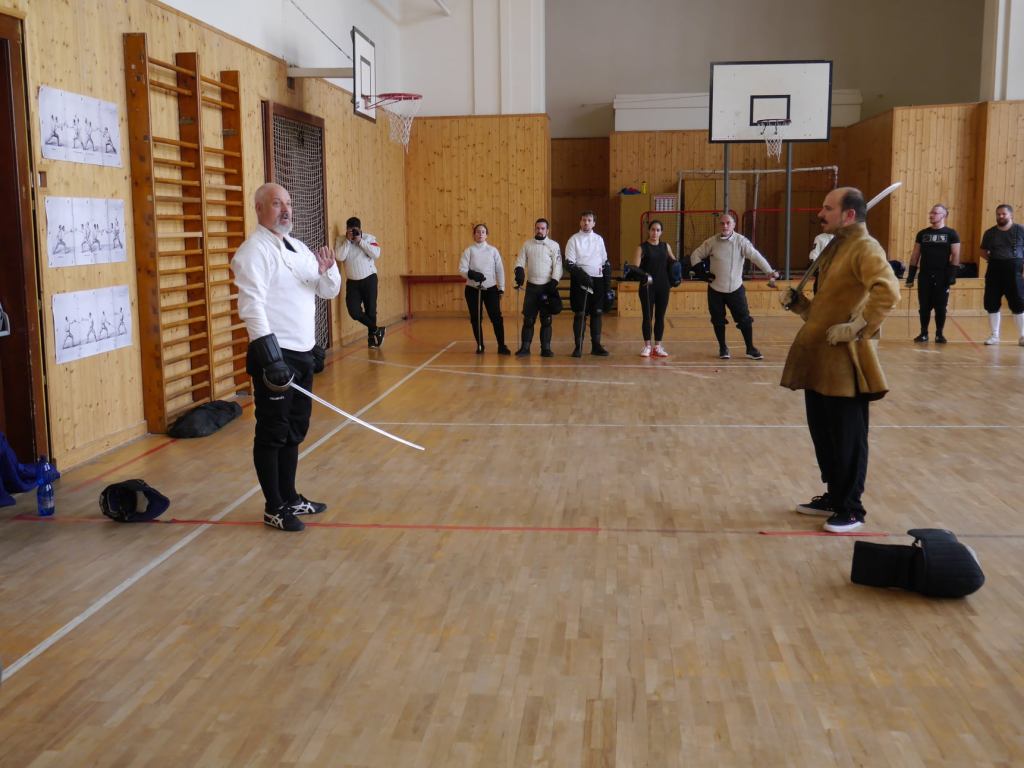
Russ and Noah demonstrated how to parry low-line

Significantly, this system assumes a curved sabre, and, takes complete advantage of false-edge cuts. Measure is generally closer than someone from my background is comfortable with, but this said it fits the system well. The first four cuts, one through four, bisect the target in an “X” formation: cut 1 descends from the right, cut 2 from the left; cut 3 ascends from the right, 4 from the left. There are other cuts, including horizontal blows, but we spent the most time with 1 and 2, and, options from there as both attacker and defender. This was especially valuable to me as having fought a school of people using this system, and knowing how challenging it is, I know have a better idea of how it works.

Fokos

Sunday we started out with more bio-mechanic work to prep us for working with the fokos or shepherd’s axe. Sometimes described Stateside as a long-hafted tomahawk (an apt analogy), this axe was long-used by shepherds, but was also used in the Great War. Russ showed us the military application he was taught, but also some of the “folk” uses. The latter, for example, might help one collar old uncle Boris after he overindulged at the pub. Like the sabre, one is using more of the hips and torso to propel the weapon and block. This means that one turns to stay behind the weapon.

One thing I did not anticipate, it not being my thing, was the amount of grappling one can do with the fokos, either against someone without the weapon or with one. The hooking ability of the axe can bind up not only an opposing fokos, but limbs. We explored this aspect in the “folk” portion, and like most folk arts a fair amount of learning how to use the axe to assist grappling is experimental. Russ armed us with a few principles, demonstrated a few set-ups, and then had us play with these actions and ideas.

The military portion was more intuitive for me as the starting position is one shared with bayonet. That is not an accident. Given the weight of the average rifle ca. 1915 the fokos makes for a much faster, nimble tool. Our brief exposure to this weapon only increased my sense of horror that attended trench warfare. [6] It’s a delightfully nasty weapon.

Take Aways

Russ told us our brains would be full and he wasn’t wrong. I’m still processing a lot of what we covered, never mind reeling from the fact I can supinate on my right side now. That still seems unreal.

At the risk of sounding sycophantic, Russ is one of a handful of instructors whom I would advise anyone to work with regardless of what he’s teaching. His knowledge is as deep as it is varied, his skill impressive, and he has a fantastic sense of humor. Moreover, and one sees this is his books, Russ is aware that not everyone is 19 and a paragon of fitness. As easily the oldest person at the seminar this weekend, I might have special appreciation for this fact, but what this means is that regardless of one’s shape, ability, or fitness level, Russ can and will work with you, and, you’ll get something out of it. A lot of something.

In addition to his videos (see link below), Russ is a prolific author, and produces works that combine the rigor of his academic training with an ease of reading that is often rare in our field. Buy his books and read them; watch his videos; and if you have a chance to take a class with him, whatever it is, take it. You need not thank me, but you might wish to. [7]

NOTES:

[1] See https://saladellatrespade.com/2023/04/24/a-bar-raiser/

[2] Russ Mitchell, Hungarian Hussar Sabre and Fokos Fencing, Irving, TX: Happycrow Publishing, 2019, xiii-xvi.

[3] For more on the Feldenkrais Method, see https://www.sciencedirect.com/topics/medicine-and-dentistry/feldenkrais-method ; see also https://www.ncbi.nlm.nih.gov/pmc/?term=feldenkrais+method ; the Wikipedia entry, one should know, was written and monitored by an opponent of the school.

For Russ’ practice, see https://irvingfeldenkrais.com/

[4] I have spent a lot of time, off and on, studying both yoga and MBSR (mindfulness-based stress reduction), the latter thanks to the cancer program at OHSU (see for example https://www.apa.org/topics/mindfulness/meditation). Much of what we covered echoed what I have learned in these disciplines as well as in various PT sessions for injuries.

[5] Russ’ YouTube channel: https://www.youtube.com/@russmitchellmovement/playlists

[6] My paternal grandfather fought in the Great War, and though he didn’t like to talk about it, I learned from my own father that between the sound of gas canisters and trench warfare, it was utterly terrifying. I can’t imagine having to face one of these axes–they may look small and delicate, but they’re effective and quick.

[7] Cf. https://www.amazon.com/stores/Russ-Mitchell/author/B006PFZ3IS?ref=ap_rdr&store_ref=ap_rdr&isDramIntegrated=true&shoppingPortalEnabled=true

Specific Drills & “Realism”

“Show, don’t tell,” was some of the best teaching/writing advice I ever received. To that end, I’m adding some specific drills to illustrate what I shared in the last post on this topic better (https://saladellatrespade.com/2023/10/31/yes-yes-very-nice-but-how-cultivating-defense/ ). Many, if not most of these drills, are venerable—if anything I may have adapted things here or there, but all of what follows are standard drills or types of drills. [1]

These progressive option drills start with a basic action and build in complexity. If a student is new or struggling, one may stop with the first version and work on that, or, aspects of it. For more advanced students, one can add an additional layer of difficulty as required. In the first example, for smallsword, one could simplify the drill even more by having the student initially deny the engagement and break measure. This would observe the “don’t get hit” rule, but not set them up well for a strike of their own.

Two things I didn’t add below, but which apply are first, that it’s important to switch roles, that is, have both the student and instructor initiate the action. This gives the student a chance to act as attacker and defender. Second, movement and varying distance is critical for success. If one starts “firm-footed,” that is, in place, fine, but then add movement. Chase the student, have the student chase the instructor; start out of measure, start in measure. For more advanced students, another option we can layer in is varying tempo and speed.

Drills & “Realism”

On their own, there is little inherent in most drills to make them impart a defensive mindset automatically. All the drills I provide below, for example, can be gamed to current tourney standards easily if one wishes. How “realistic” or not they are depends on explanation and reiterating correct principles over and over and over again within each element of the drill.

One of the most frequent questions I get in drills and lessons, and a good one, is “but why wouldn’t I just do this?” This simple question has become one of the single most important ways in which I push correct mindset. To cite one example from this past week, one student in a smallsword class asked me why they couldn’t just disengage and thrust against the glide in third. I told them that they could, but then asked what would happen if they did—what is the opponent doing? If the opponent is gliding to target, and one ignores that to strike… one is still hit. Not good enough. IF one wishes to disengage in response, fine, but don’t do so into absence, do so with opposition in the new line, a shift of the body to one side, or both. [2]

Option Drill with the Glizade/Glide in Third

To Start:
S [student]: in guard of third
I [instructor]: in guard of third
*engaged on the outside line

  • S: finds measure and gains weak of I’s blade with middle of own [3]
  • S: performs glide in 3rd, maintaining opposition, and strikes target (forward target or chest)

2A:     

  • S: finds measure and gains weak of I’s blade with middle of own
  • S: performs glide in 3rd, maintaining opposition, and thrusts
  • I: parries 3rd, ripostes; S. parries in 3rd and ripostes [4]

3A

  • S: finds measure and gains weak of I’s blade with middle of own
  • S: performs glide in 3rd, maintaining opposition, and thrusts
  • I: parries 3rd, begins riposte; S. disengages, engages in 4th, thrusts to target with opposition

4A:

  • S: finds measure and gains weak of I’s blade with middle of own
  • S: performs glide in 3rd, maintaining opposition, and thrusts
  • I: makes dérobement to avoid glide and engages in 4th
  • S: via circular 3rd, retakes line and glides in 3rd to target
  • I: finds measure and gains weak of I’s blade with middle of own
  • I: performs glide in 3rd, maintaining opposition, and thrusts
  • S: parries 3rd, ripostes

2A:     

  • I: finds measure and gains weak of I’s blade with middle of own
  • I: performs glide in 3rd, maintaining opposition, and thrusts
  • S: parries 3rd, begins riposte; S. disengages, engages in 4th, thrusts to target with opposition

3A:

  • I: finds measure and gains weak of I’s blade with middle of own
  • I: performs glide in 3rd, maintaining opposition, and thrusts
  • S: makes via dérobement avoids glide and engages in 4th
  • I: via circular 3rd, retakes line and glides in 3rd to target
  • S: parries in 3rd, ripostes

Finta Scorsa or Advancing Feint of Marcelli

To Start:

  • S: in guard of prima
  • I: in guard of third
  • S: in prima, makes false attack to the high inside line
  • I: parries in 4th
  • S: via cavazione /disengages to outside line, and strikes target (forward or chest)

2A:     

  • S: in prima, makes false attack to the inside line
  • I: parries in 4th
  • S: via cavazione /disengages to outside line; I parries 3rd, begins riposte
  • S: parries in 3rd (or 4th depending) and ripostes, striking target

3A

  • S: in prima, makes false attack to the inside line
  • I: parries in 4th
  • S: via cavazione /disengages to outside line; I parries 3rd, begins riposte low-line
  • S: takes 2nd, ripostes with opposition

4A:

  • S: in prima, makes false attack to the inside line
  • I: parries in 4th
  • S: via cavazione /disengages to outside line; I parries 3rd, begins riposte low-line
  • S: takes 2nd and thrusts; I. parries 2nd, begins riposte
  • S: parries 2nd, ripostes with opposition
  • I: in prima, makes false attack to the high inside line
  • S: parries in 4th
  • I: via cavazione /disengages to outside line, and thrusts
  • S: parries in 3rd, ripostes to target

2A:     

  • I: in prima, makes false attack to the inside line
  • S: parries in 4th
  • I: via cavazione /disengages to outside line; S. parries 3rd, begins riposte
  • I: disengages to 4th, starts riposte with opposition
  • S: disengages to 4th, ripostes with opposition to target

3A:

  • I: in prima, makes false attack to the inside line
  • S: parries in 4th
  • I: via cavazione /disengages to outside line; I parries 3rd, begins riposte low-line
  • S: takes 2nd and thrusts; I. parries 2nd, begins riposte
  • S: parries 2nd, ripostes with opposition
  • I: with parry in 2nd, passes left foot forward in order to seize guard
  • S: steps back, attacks to body

Working from Mezzaluna (Marcelli)

To Start:

  • S: in guard of mezzaluna
  • I: in fourth guard [5]
  • I: in fourth guard, makes attack to the inside line
  • S: parries with dagger; with sword ripostes to target (forward or deep)

2A:     

  • I: in fourth guard, makes false attack to the inside line
  • S: attempts to parry with dagger (downwards and out)
  • I: disengages to strike hand
  • S: parries with dagger (upwards and out), ripostes with sword to target

3A:

  • I: in fourth guard, makes beat attack against sword to open the inside line
  • S: parries in 4th to close line, ripostes with opposition
  • I: parries with dagger (upwards and out), ripostes with sword inside line
  • S: parries with dagger (downwards and out), ripostes to arm
  • S: makes false attack to face
  • I: parries with dagger (upwards and out)
  • S: disengages and strikes arm or hand

2A:     

  • S: makes false attack to face
  • I: parries with dagger (upwards and out); ripostes to arm
  • S: disengages and strikes to arm or hand
  • I: parries with dagger, ripostes
  • S: parries with dagger (downwards and out); ripostes to arm

3A

  • S: makes false attack to face
  • I: parries with dagger (upwards and out); ripostes to arm
  • S: makes circular parry in 3rd; ripostes via glide to outside line
  • I: parries in 3rd, checks with dagger, ripostes in high line over engagement [6]
  • S: parries with dagger (upwards); shifts right, ripostes to body

Options from an Engagement in Second

S &I: in 2nd, at punta spada/last third/weak of the sword; then, start out of distance

  • S: cuts over to threaten face with feint via half thrust
  • I: moves to parry in 1st
  • S:
    a. performs molinello ristretto or coupé to the arm [7]
    b. performs molinello ristretto via rising cut to the bottom of the arm

2A:

  • S: cuts over to threaten face with feint via half thrust
  • I: moves to parry in 1st
  • S: performs molinello ristretto via rising cut to the bottom of the arm
  • S: secondary attack: pushes through to thrust or cut flank

3A:

  • S: cuts over to threaten face with feint via half thrust
  • I: moves to parry in 1st
  • S: a. performs molinello ristretto or coupé to the arm
  • I: parries 3rd, cuts to head
  • S: parries 5th, cuts via molinello to head

4A:

  • S: cuts over to threaten face with feint via half thrust
  • I: moves to parry in 1st
  • S: performs molinello ristretto via rising cut to the bottom of the arm
  • S: secondary attack: pushes through to thrust or cut flank
  • I: parries in 2nd; ripostes via thrust
  • S: makes ceding parry in 2nd, ripostes via thrust to target
  • I: cuts over to threaten face with feint via half thrust
  • S: moves to parry in 1st, parries via molinello to head

2A:

  • I: cuts over to threaten face with feint via half thrust
  • S: moves to parry in 1st
  • I. disengages and cuts to arm
  • S: parries 3rd, cuts head

3A:

  • I: cuts over to threaten face with feint via half thrust
  • S: moves to parry in 1st
  • I. disengages and cuts to arm
  • S: parries 3rd, cuts head
  • I: parries 5th, cuts to flank
  • S: parries in 2nd, thrusts to target

NOTES:

[1] To name one example, and analogous to the first one I share here, there is the discussion of options facing an opponent in 4th in Charles Besnard, Le maître d’arme liberal, 1653, 43 (63 [orig. French] and 161 [English] in the translation by Anne Chauvat and Rob Runacres, The Free Master of Arms, Glasgow, UK: Fallen Rook Publishing, 2022).

[2] The use of the inquartata or demi-volte, for example, would work in this instance.

[3] Two ways to vary this are to have the student find measure by a short extension of the arm from critical distance, in order to gain the weak with the middle of their weapon, or, have them step into measure to engage. The first is more conservative, but the second option is important—ideally, students learn to find measure and exploit it both ways.

[4] As set up here, the final actions are a battle of ceding/yielding parries and glides. Both help students cultivate better awareness of presence, varying pressure, measure, and opposition.

[5] Marcelli’s fourth guard for rapier and dagger is depicted thus:

Marcelli, Rules of Fencing, “fourth guard” (L) and “mezzaluna (R)

Mezzaluna, on the right, needs explanation. Chris Holzman points out that Terracusa e Ventura (1725) remarks that the tips of the two weapons are close enough to form a “half moon” shape. Here, there is a much wider gap between them. The accompanying text, however, tells us that the fencer “carries the dagger forward covering all the upper parts in such a way that the opponent only sees the chest below the dagger as target to strike.” [Holzman, Marcelli, Rules of Fencing, 1686, Wichita, KS: Lulu Press, 2019, 273; see also n. 115 that page.

[6] Here, the instructor, having parried the incoming sword in 3rd, uses the dagger to hold the opposing weapon in place in order to swing their weapon around obliquely to the right and up (assuming a right-hander) in order to threaten the face.

[7] The coupé , in Radaellian sabre as taken down by Del Frate, is also known as the colpo di cavazione or cavazione angolata. It is made by bending the forearm back a bit to increase power. Chris Holzman, in his gloss, remarks that it’s similar to the last step of the molinello. See Christopher A. Holzman, The Art of the Dueling Sabre, Staten Island, NY: SKA Swordsplay Books, 2011, 234.

Review: Swordsmithy Sabres

Late 19th/Early 20th Century Austro-Hungarian Training Sabre 

Swordsmithy, Prague, Czechia 

http://www.swordsmithy.com/ 


SPECS: 
Total Length: 104.14cm/41” 

Blade Length: 86.36cm/34” 
Blade Width: 15mm/.59” 

Grip Length: 12.7cm/5” [mid-grip width 2.5cm/.98”] 

Guard Width at Widest: 9cm/3.54”; at mid-Knucklebow, 3cm/1.18” 

POB: 9.5cm/3.74” 

Weight: 663g/1.46lbs 

Materials: steel, wood, leather 


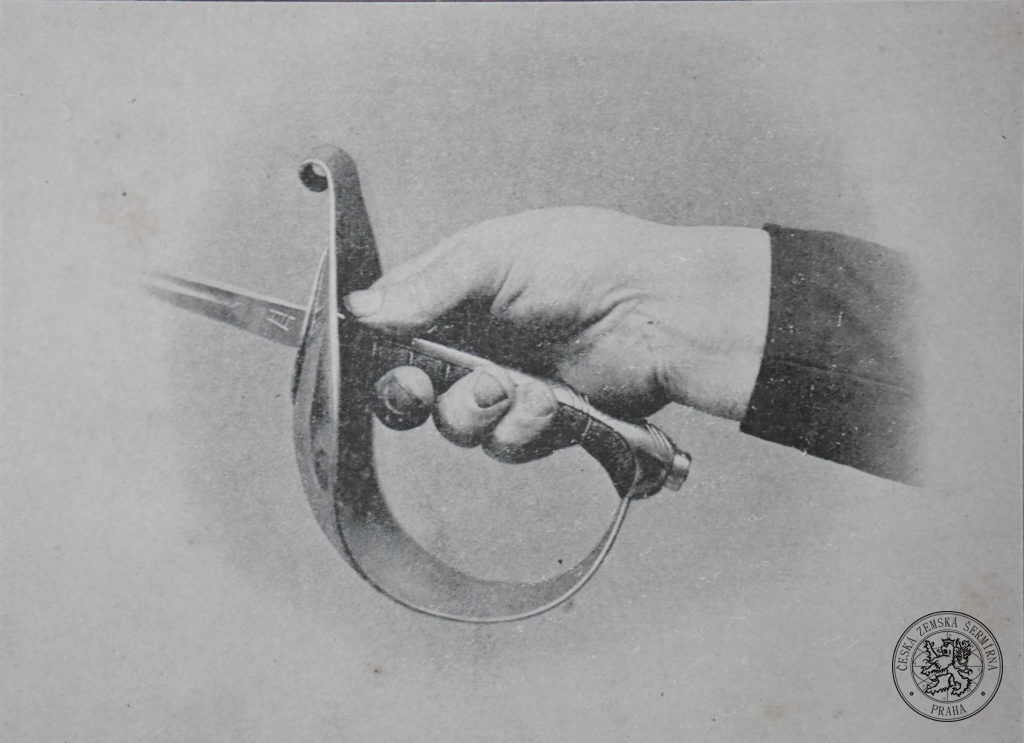
I had the privilege to borrow one of these excellent sabres in October 2021 at SabreSlash in Prague, Czech Republic, for several days. For handling, my portion of teaching day provided me a great opportunity to assess balance, heft, and nimbleness. Thanks to a bad leg which acted up, I was unable to bout as much as I should have liked, but did bout with one the redoubtable reenactors from Warsaw, Poland, Jaroslaw Kubacki from Kompania Czarnej Szabli (Black Sabre Company). As the photo demonstrates, he was using a larger sabre than I was, but the Swordsmithy sabre held its own well. In brief, these are fantastic sabres, well worth the cost (they’re handmade) and wait.

Handling

Despite ”HEMA’s” obsession with beefy, heavy sabres, most sabres intended for more than chopping from the saddle were lighter and more nimble than our trainers. J. Christoph Amberger provided a nice, small survey in an article in Fencer’s Quarterly Magazine that concluded that the difference between say Italian “featherweight” sabres and “other, heavier German-made broadswords” was about as much as a block of chocolate. Humor aside, his sample ranged from 1350 to 300g for the period between 1780 and 2000. Anecdotally, the historical examples I own or have held confirm that most sabres were not the clubs modern reproductions would have us think. Swordsmithy sabres, because they are handmade, vary slightly in weight, but the six in my order weighed on average 660g, which is within the typical range for sabres of this period. [1]

The balance is perfect for Radaellian/late period Italian sabre, but will work equally well for many other traditions. The model for these sabres is a Viennese sabre similar to what we see in Luigi Barbasetti’s The Art of the Sabre and Epee; it was a common trainer used in the Austro-Hungarian Empire. [2] My class at SabreSlash focused on various uses for the molinelli, the elbow-driven cuts that are a hallmark of this system. The Swordsmithy sabres performed perfectly, whether for molinelli as exercise or as offensive or defensive maneuvers.

Sabre in Barbasetti, courtesy Ars Dimicatoria, CZ

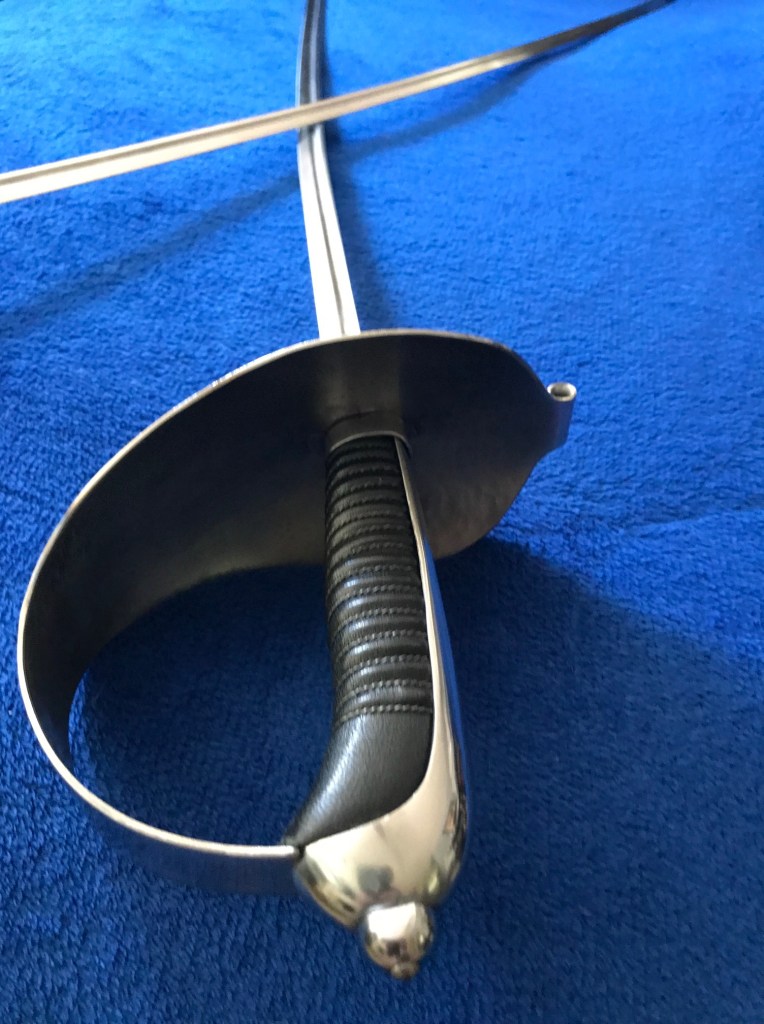
One of the best features of these sabres are the grips. They are large enough for normal hands, a clear advantage on most options out there today, and comfortable. The slight swell mid-grip makes for good purchase on the grip, and the ribbed leather seats nicely against the glove. The steel backstrap is solid and close to if not identical to original examples. The only change I might suggest is to score the portion where the thumb rests with some manner of cross-hatching to make one’s grasp that much more secure. However, so long as one wears a glove there’s no need for cross-hatching. The Swordsmithy’s grip is my favorite of all the options available now.

Durability & Performance

There’s no criticism I can make about the way these sabres handle and hold up in use. They’re stout, well-made, and perform equally well against different sabres as well as when a matched pair. It is saying something that Michael Knazko, one of the people behind Swordsmithy Sabres, has used the same six weapons in the tournament portion of SabreSlash three years running. I challenge most other events to make such a boast. [3] 
 

The one major difference with these sabres is the hardness of the blades. Some fencers will balk at this, because most other options are made in such a way that when a sabre bends badly that’s that; we replace the blade. Swordsmithy sabres, however, are so constructed that one can beat the blade back into shape. I have seen this myself: one of the background sounds at SabreSlash is the ringing of Michael’s hammer as he beats a sabre back into shape on a lead plate (wood works too). There is an art to this, but it is easily learned and with practice easy to do. It is, however, more labor than many fencers expect or may wish to take on, though to be honest much of this depends on how they are used. Tournaments, for example, tend to be higher stress than practices, and some fencers struggle to fight with control; they hit harder and the weapons take more abuse. This matters. The fact that Michael has used the same six sabres, in such a high stress environment, speaks volumes for the design Swordsmithy has selected. 

 
The guard is stout, strong, and well-shaped. They’re ambidextrous, a real plus for those of us who fence right and left-handed, and wide enough—assuming good structure–more than ample to cover the hand when parrying. On a personal note, I really like the hammer marks barely visible on the inside of the guard. The thickness is perfect and more than sufficient to parry a hard blow. 

The blade length is just right for most systems, and the width well within historical parameters. The tip is constructed for safety, being wide enough that it’s extremely unlikely to pierce safety equipment. [4] I prefer spatulate tips, but even without this these blades—assuming normal practice–more than meet safety requirements. 

Conclusion

Swordsmithy sabres are worth the cost. In the US, they go for about $390 which is expensive compared to the offerings from popular options such as Hanwei. They are, however, better made, and handmade, and this explains the price. Castille Armory’s “Italian Dueling Sabre” is, at the time of writing, $490; Darkwood’s sabres are $360. [5] Until I handled the Swordsmithy sabres the Castille was my favorite–they’re good blades and the guards, while undished, stout.  

My go-to now, however, is this Czech-made trainer. They are not inexpensive, and the temper on the blade requires more work on part of the fencer, but in terms of longevity alone these blades will last longer than most others I’ve used, and, with fewer problems. Swordsmithy sabres are worth the cost.

On a side note, shipping in and out of Czechia can be pricey, but ordering more than one at a time (two friends and I went in on an order) helps. Michael packs these weapons well and they arrived far faster than I expected.

Notes:

[1] See J. Christoph Amberger, “Inference and Imposition: Anachronism in Fencing Historiography,” in Fencer’s Quarterly Magazine/FQM (Summer 2004): 25-28. Amberger sampled 17 weapons (p. 26), the heaviest at 1350, the lightest at 300, with an average of 682g.

“The weight difference between the Radaelli and the lightest German Fechtsäbel–exported in large quantities to and used in Britain throughout the late 19th century as practice ‘broadsword,’ is only 40g. The much-vaunted 1796-model British Light Cavalry sabre weighs in at only 80g more. And the weight difference between the Italian ‘featherweight’ and other, heavier German-made broadswords and the model 1899 British Gymnasia Pattern practice sword corresponds to that of a bar of Milka chocolate.” [26]

A more recent tally, the spreadsheet maintained by Maestro Kevin Murakoshi, examines both historical examples and modern reproduction trainers, and here too we see more sabres in the 600-800g range. The examples over 1000g are all trooper sabres and thus not so much meant for “fencing” as braining retreating infantrymen.

[2] Luigi Barbasetti, The Art of the Sabre and Epee (1936), was published earlier in German (1899) and Italian. NB: my thanks to Chris Holzman for the correction as to type.

[3] In contrast, at an open sabre tournament in 2017 multiple Hanwei and Coldsteel sabres were broken; this was also the first time I’d seen anyone obtain a concussion in sabre.  
 

[4] I say ”unlikely,” becauase it depends on how one fences. In Radaellian sabre we use the point a lot, but learn in such a way to minimize risk. Any sabre might potentially damage someone or equipment. Hanwei’s ”Hutton” sabre and Darkwood’s ”dueling” sabre blade both present a danger, the first because it’s tip is pointed, the second because the tip is too thin and is not wide enough. Twice I have had a DW blace pierce a glove while giving lessons.

[5] Prices accurate as of 3 July 2022.