[what follows is a very bare-bones, big-picture look at running a tournament, but hopefully helpful]

Tough as it can be competing in a tournament, running one is almost as hard if not as hard as being in the pools, and in some ways it’s a lot more challenging. People may not remember Fencer X’s performance, but they tend to remember whether they thought a tournament was well-run or a waste of time. Importantly, they also remember if an event was particularly biased or inconsistent in judging. Having run tournaments, I know firsthand the obstacles to a successful one, and, a few things that help. So, continuing the tournament theme, this post looks at this from the organizer’s point of view.
Planning
Organization is everything. There are typically a few essentials for a tournament and few without cost. Among the major considerations are:
- Funding
- event location
- officials
- awards
- food & beverages
- accommodations
- advertising
Not all tournaments will include all of these. At most, one brings their own food, lunch money, and water, though water-bottles or access to fountains or sinks is normal. Likewise, few tournaments can afford to fly in and board competitors. [1]
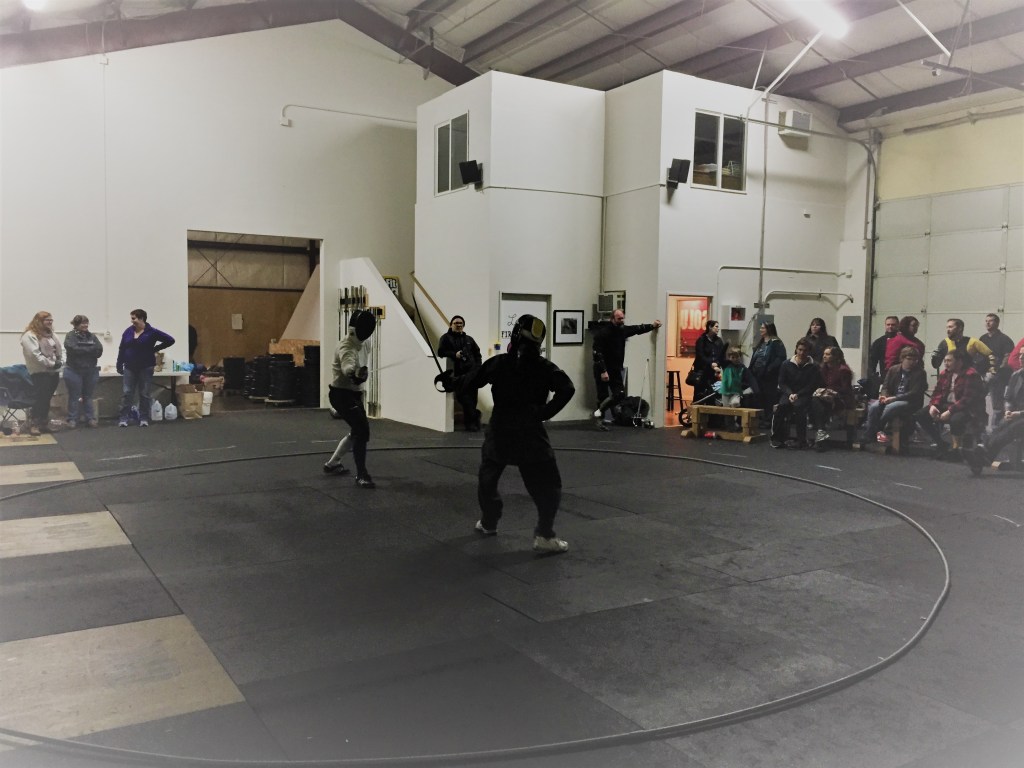
I start with event type, then consider whom to invite. For example, in the pre-pandemic sabre invitational, my buddy Brent Lambell and I decided to team up. He had a space and I had a good idea of whom we should invite. [2] Not everyone will show, and even those who r.s.v.p. may change their minds for one reason or another, but knowing what you plan to do and how many people will likely be there determines most everything else.
Funding
Most clubs fund their own events, but if one can acquire sponsors it helps. Some may be local businesses, some well-known suppliers like Purpleheart Armory. It can be decent advertising for those who chose to assist, and even if all a sponsor covers are the awards or morning coffee, those are things that don’t come out of the club’s budget and help reduce the overall cost.
Approach sponsors respectfully and with an eye for partnership. They may have questions, especially for historical fencing events, so be ready to answer questions, direct them to your website or instatwitterface, or hand them a brochure your club has them. If their answer is no, thank them for their time and leave a good impression. Maybe next time they will agree.
Location
Depending on where one lives, there are often fees or legal aspects to renting a space and running a sporting event. In the United States, for example, proof of insurance coverage is standard. The venue will tell one what the requirements are, and since these can sometimes take time securing the location early is wise.
For larger events, one needs more space, and in the U.S. anyway that means additional costs. Locally, the larger tournaments we have had here have been hosted by several schools versus one; this helps spread out the cost and with luck increases the number of volunteers. The events I’ve put on have been small, so a gym has sufficed, but I’ve worked with tournaments that have rented entire buildings as well.
Bathrooms and/or changing rooms are usually available, but for some events one may have to rent portable toilets etc., an additional cost. Whenever possible, access to restaurants, hotels, and other amenities help. These should be listed and shared with attendees and staff—I typically include it on the flyer and in the individual messages to participants.
Officiating
With the caveat that some clubs are isolated and have little choice, it is always best to employ officials from outside one’s own club. For example, in the invitational, the director was an old friend and colleague of mine unassociated with the school. An experienced Olympic fencer, he was an ideal choice, and impartial as he knew none of those competing.
As the organizer, I likewise had nothing to do with officiating lest the event appear biased for my fencers or friends. My job was managing the event, from problem-solving (the guy with the movable rings was a no-show so we had to have someone run to the store for tape and create some manner of piste), helping people find spots for gear, and assisting with the clock and scoring table. Another friend and fencer, also unassociated with anyone fencing that day, worked with me to ensure further that nothing might appear untoward.

Even with the best intentions, one can be favorably biased towards those one knows; it’s easy to read intent behind an action because Fencer X “always does that” versus what that fencer actually may have done. For this reason, if not just for appearances, it’s best not to officiate one’s own fencers or friends. If the event is isolated or in other ways unable to get sufficient outside help, then local officials may have to suffice. In that case, every effort should be made to ensure that anyone directing or judging isn’t presiding over bouts their best friends are in, and, that they are calling what they see, not what they think they saw. When in doubt, abstain.
No one wants to pay, travel, and devote time and energy to a tournament that appears rigged let alone is rigged. I have witnessed systemic cheating myself, and just this weekend chatted with a friend in Canada who attended an event that was horribly inconsistent with calls at best, and wholly ignored some actions at worst. [3] If one hopes to run an event more than once, consider not alienating and aggravating visiting competitors. It makes the host school look bad, well, to fencers who don’t favor cheating anyway.
Experience means different things. A local fencer who has judged a few longsword opens has, relatively speaking, experience, but that is not the same as the former Olympic fencer who was trained in an environment geared toward competition and who may have taken courses on officiating. I’ve found that any Olympic fencer willing to help out is open to the rule changes that come with historical fencing. If nothing else, ensure that judging is consistent. Bad, but consistent trumps bad and inconsistent. Seek out seasoned fencers, people with considerable experience, to officiate if possible.
Awards, Prizes, etc.

What one chooses for awards varies considerably. Trophies and medals can be ordered locally in many places or online. [4] These are not inexpensive considerations, so if sponsors can help, great, if not then club money will need to be set aside to cover the cost. If and when possible, something different and unique can spice things up—for example, in the invitational my club hosted we had a technical award decided by all participants. The winner of the technical award year two was presented with a page from Major Alexandre Muller’s Théorie sur l’escrime a cheval (1816) [5]. The winner of SabreSlash 2021 was awarded a beautiful sabre. If and when possible, extras like this add excitement and a little color.
Food & Beverages
With few exceptions most places I’ve used or which I have visited do not have kitchens, though when a site does it can solve a lot of problems food-wise. In the Pacific Northwest, for example, we are lucky to have a chap named Sven who loves cooking, knows how to cook for a small army, and makes seriously delicious food. Some venues will not allow food or anything save water, so best to find out ahead of time versus day of.
I try to have ample supplies of water on hand at a minimum. Fencing kit makes for a hot, sweaty day, and people need water. I’ve also done my best to bring some coffee and breakfastish pastries for guests and officials. Listing local food options is helpful as well, especially those within walking distance.
Accommodations
Housing attendees can be one of the most expensive aspects of a tournament, and, it isn’t a requirement. In the past I’ve listed inexpensive hotels as well as forming part of a pool of people happy to host out of town guests. Travel can be expensive and most people are grateful for a couch or spare room. Hosting is also a great way to get to know people, and the better ties one has with one’s community, typically the more we enjoy time in that community.
Advertising
The inexpensive ways to do this are via social media, email, and word of mouth. Posters and fliers can help, and I imagine radio or t.v. spots would too, though I don’t know any schools that can afford to advertise on radio or tele. Some, like my friend Mike’s club, Northwest Armizare, have been on television a few times, but most of us are not so lucky.
Joining events like the local Renaissance Faire or offering demonstrations at schools, festivals, and other events are other ways to advertise. Personally, I’ve found most such festivals to get more work out of us than we get new students in turn, but advertising and boosting school numbers aren’t the only reason to attend these events. A good demonstration can make an impression and one never knows where it might lead.
Officiating, again, and a Word on Rule-sets
Choice of rule-set determines a lot. Whichever rule-set one decides upon, learn it well, and enforce it as consistently as possible. Make sure competitors are aware of the rules before the tournament, and, rehash them briefly before the event starts.
No one will remember what brand of coffee an event had on hand, and no one will remember if the bathrooms were worse than any other public one, but they will remember a poorly run event and terrible officiating. For all the amenities, fencers will remember good or bad calls; they will remember fairness. If you want a tournament to become a regular occurrence, then ensure the best officiating you can obtain.
Post Script: I neglected to mention having a first-aid person on site. Some insurance carriers and/or facilities will demand it, but it’s a good idea anyway. The goal in any tournament, from my view, is to keep the first-aid person as bored as possible and then reward them nicely with public thanks, some token of appreciation if your budget allows it, on top of any fee they may collect (some volunteer, some one must hire).
Many events are staffed and succeed thanks to volunteer efforts, so be sure to thank them, publicly, for their help.
Notes:
[1] Few events can do this, and those I’ve attended that do usually offer one or the other, save for a headliner.
[2] Brent’s club has changed hands and he moved, but my hope it to get the invitational rolling again and likely as a charity event. The plan is to expand it as well. Day one will be sabre, and day two a mixed steel accolade for later period thrusting weapons. Experience taught us that a sabre open tended to invite people not ready to complete, so I pushed for an invitational where we would attempt to attract well-established, skilled fencers.
[3] Enough time has passed, I feel I can speak about the Rose City Classic in 2017 and the egregious cheating that took place. It was a larger tournament for Portland, but was co-hosted by the infamous Blood & Iron club out of Vancouver, BC, Canada. The directors were all B&I, and two of the three judges were as well. I wasn’t competing, but visiting Gus Trim—one of the vendors there—and so had an ideal seat to watch several of the competitions. There were shots the B&I judges ignored, doubles they awarded to their own, and other more subtle ways they manipulated the rules. Moreover, there was zero accountability for hard-hitting, and worse, for clearly ill-intentioned shots after the halt, the standout example being a bout between B&I’s cult leader, Lee, and another fencer, cf. https://youtu.be/3r86pARypTo
[4] Purpleheart Armory is one such resource, cf. https://www.woodenswords.com/category_s/2072.htm
[5] In the estate that selected my club for a non-profit donation, there were among the books several loose pages out of Muller’s 1816 manual. They’re in poor shape—not acid-free paper—and weren’t housed properly, but I’ve stabilized them and will continue to use them for the technical award until I run out of them.


 Capitale Escrime Historical Fencing