Tag: fencing treatises
Early & Later Smallsword Treatises: A Note
[originally posted 30 July 2023 on the old CEHF site]
It’s customary to discuss particular weapons in somewhat monolithic terms. We speak of “foil,” “smallsword,” “sabre,” or “longsword,” to name a few, as if these constitute a tidy, discrete facet of sword-types. In some ways, this is true: sabre is different from spear, longsword from smallsword. However, as convenient as compartmentalization is, despite how necessary it is to organize a topic as gigantic as swordplay, we can easily forget that within each division there exists both variety and change over time.

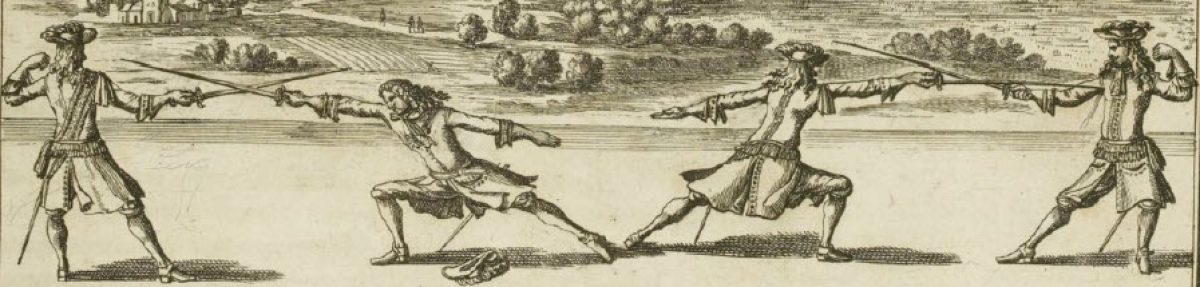
For smallsword, a cursory glance at earlier and later texts will reveal some critical differences. There is overlap to be sure, but the differences are important. Even among texts of the same general time one should compare them. De La Touche’s seminal work from 1670, Les vrays principes de l’espée/The True Principles of the Sword, for example, reads differently from de Liancour’s Le Maistre d’armes/The Fencing Master (1686), but both read very differently from Sir William Hope’s The Scots Fencing Master (1687) and A New Short and Easy Method of Fencing (1707).

The works of Sir William Hope, Zachary Wylde, and Donald McBane tend to read as primitive, unsophisticated works to many fencers with more traditional training. It’s easy to see why. These works contain fewer actions, seemingly odd things like weapon-seizures and guards other than tierce/sixth, and are often less well-written. Compared to the succinct descriptions in Le Sieur P.J.F. Girard’s Traité des armes (1740) or Domenico Angelo’s L’École des armes/The School of Fencing (1763/1787) one might conclude–erroneously–that these later works are “better” than those which preceded them.
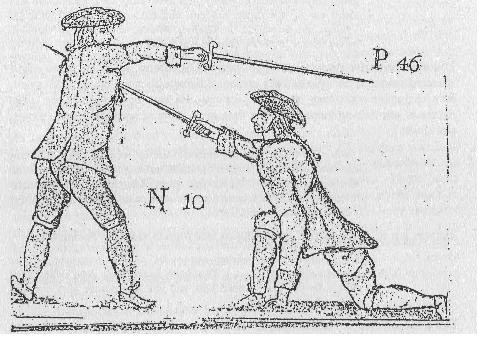
The answer is context. The earlier works reflect a different set of concerns. These are largely works of self-defense first and foremost. While Girard and Angelo also offer solid advice for the duelist, they also reflect a different culture, one in which smallsword was already transforming into the game of foil (originally a training tool for smallsword), that is, a polite game where beautiful execution and grace were often as or more important than actual combat effectiveness.

It behooves any student to study earlier and later works, because together they provide a far more complete examination of how smallswords were used. This is easier to do without bias: to apply the filter of late 19th/early 20th foil to 17th and 18th century foil jaundices our view and can lead us to the wrong conclusions.
 Capitale Escrime Historical Fencing