
Four years ago, when I first had the pleasure to attend SabreSlash 2021 in Prague, Czechia, I was stunned at how well-run, how fun, and how high the level of skill was, both amongst the attendees and the instructors. This event jumped to the top of my list of “if you can go, GO!” historical fencing conferences. My visit this year, last week in fact, only cemented the value of this mix of workshops, fencing, and camaraderie. So, if you have a chance to attend, DO.
It was a busy week for me, partly because I wanted to support my dear friend, Maestro Michael Kňažko, as he set things up and managed the two-day mix of workshops and fencing, and partly because there was a double reason for my attendance this year: I would be testing for certification as a maître d’armes.
Michael, his amazing partner in life, Caroline, and the excellent folks at Barbasetti Military Sabre (since 1895) have preparations down to a science, and if anything set-up and take-down were faster than ever. The rest of the weekend was as well run—workshops were a good length and sandwiched between ample rest periods; “RandomSlash,” was super successful (more on that below); and everything was geared to allow people to mix and get to know one another.
Goals of SabreSlash
The three goals of SabreSlash are to celebrate and explore history, hone skills, and cultivate friendship. The first and second were most on display in the workshops and in the RandomSlash bouting day two. I have much to say about all the workshops, especially as I did my level best to be a grown-up and sit out so that I didn’t exacerbate any of the injuries I’ve been tending and which are all but managed. Few things are as difficult as seeing that degree of fun and forcing oneself to take notes.
What I would like to discuss first, because it is the most important to me, is the friendship portion. I honestly don’t know quite how to express this, but to say that there are few places in life where I have met that many people and felt an instant kinship, like I had always known them, and who are, to a person, absolutely remarkable, interesting, and kind. At my age, one doesn’t make a lot of new friends; distance and loss tend to start to take over, not necessarily from any ill-will, but stage of life.
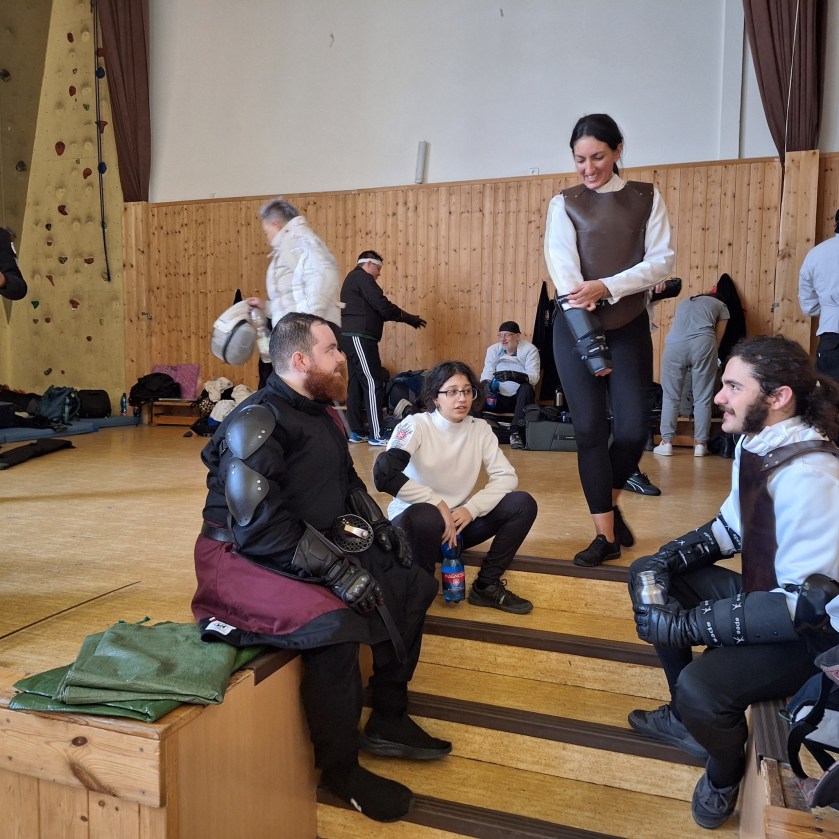
I was absolutely struck numb by the warmth, openness, and genuine interest to get to know everyone that pervaded the event. This was the first time I had met people from FISAS in Italy, as well as the team from the Malta Historical Fencing Association, or, from the Wrocław Polish Martial Arts Club SIGNUM POLONICUM. I cannot say enough really about how much all of them impressed me, not just for their fencing ability and related skills, but as people. We talked about a lot of things, not all of them easy topics, and the compassion, understanding, even hope were inspiring. I am so grateful to have met them—people like that enrich our lives in ways we don’t always see right away. I also had a chance to reconnect with people I met last time, especially Paul Chéreau from Paris, and meet his coach there, Maître Jean-François Gilles. Despite language barriers, we all managed to communicate pretty well—to be fair, my monolingual status was the greatest barrier, but I like to think that a little time trying to speak, even a little, in Czech, French, Italian, and German only helps. [n]
Workshops
The workshops made me feel like a kid in a toy shop. The first class, given by Maître Gilles and Paul, was on French contre-pointe, a topic of great interest to me. After lunch, Maestro Andrei Xuereb explored firm-footed fighting. Finally, a man I had been looking forward to meeting as we’d only chatted on facebook, Leonard Marynowski, took us through a detailed look at the way Polish winged-hussars fought from the saddle. The next day, Sunday, Maestro Franco Burberi, presented a close look at Radaellian sforzi di cambiamenti, and for me personally this was eye-opening. My class was the last one, and I think it went okay. I’m not always sure, but I tried not to speak too quickly or use too many odd idioms—this last tends to be a problem thanks to family and having moved around a lot.

RandomSlash
The RandomSlash fencing pools started next. These were inspired by the “Iron Quadrangle” popular in the FISAS clubs. Everyone got to fence everyone, and, more than once. The bouts were one-touch, and presided over by a single director, in this case a friend of Michael’s, Čestmír Cimler, and me. I know that pre-event not everyone was happy that the fencing portion would be less competitive, but I stand by Michael’s decision. There are plenty of tournaments, and when affixed to workshops eventually, in time, the tournament half tends to dominate. RandomSlash’s approach allowed people to fence A LOT, but more in the spirit of a shared joy of fencing than in the stress of advancing out of pools.

My praise of this event, by the way, is not to disparage competition or other styles of historical fencing get-togethers. My best competitive days are behind me, my day schedule makes training properly for a tournament difficult, and I have other priorities, such as the sports my children play. What I value about this style of competition, which is to say bouting, is that it takes some of the pressure away and lets people focus a bit better on technique and tactics. Only one bout got a little heated, but this was not out of anger but an excess of spirit and a preexisting rivalry between friends. There were, of course, no injuries, and, people used a variety of sabres. This last part is important because generally SabreSlash supplies their own 600-650g Austro-Hungarian army-inspired trainers, and, because these mixed without issue with those used by the Poles and others with wider, heavier sabres.
Still my Favorite Event
I confess that I have some natural bias towards this two-day fest of skill, bouting, classes, and bridge-building. I like these kinds of events. The organizer is a close friend. I am a member of the host school. These, yes, all predispose me to be supportive, but it goes beyond that.

Barbasetti Military Sabre (1895)’s “SabreSlash” has been running for years without any major hullabaloo or injuries. The level of skill is high. The teaching some of the best I have witnessed at any fencing event. The work I do with Storica Defensa, based in Canada, has very similar goals in terms of improving skills, teaching, and providing safer tournaments. It’s one reason we asked Maestro Kňažko to act as the director of the program. Beyond all the excellent instruction and fun, what SabreSlash provides is a model for running a high quality, safe, and thoroughly enjoyable event, one without injuries, one where everyone walks away with better understanding, and importantly, new allies and friends.
I can’t wait to go again.
Notes:
[n] I am not fluent in any of those languages. French, German, and Italian I have learned to read academically—this means I can read articles and the like so long as they pertain to my research field or fencing. It is next to useless for using a menu or making small talk. Czech, I continue to study, because as a member of a Czech salle it is only right I work to speak the language everyone there uses. It is not an easy language, but I like the challenge, and with luck one day I’ll be able to use it well enough not to embarrass myself too badly.
 Capitale Escrime Historical Fencing