I started the day off in a rapier lesson with one of the students with whom I’ve worked longest. I have often said that teaching is a two-way street, that both instructor and student—ideally—learn, grow, and improve as they work together. During one drill, my friend stopped, said “question,” and we stopped to chat. “Is there a reason you’re taking such a big second?” It was an easy observation, but one I had not made—was I? Was I taking too large a parry? He then asked “what else are you working on right now?” and then it hit me. What followed was a lovely chat about the ways in which different weapon tracks can “leak” into one another, something that can be a benefit, but in good cosmic equilibrium, can also work against us.
In this case, it was the latter, and I was grateful for his observation and said so. Focused as I was on the lesson plan, and on making purposeful mistakes, I didn’t notice an unintentional one, another insight Ken shared with me. There are many instances in which the instructor makes mistakes on purpose—it’s critical for teaching a fencer what to look for, how to take advantage of such issues, and it’s all valuable, but it’s sometimes a difficult thing to switch off, which is to say that a lot of us find ourselves struggling not to be in teacher mode when we’re bouting to bout.
The Drill
Here, the danger was not only my own overblown parry of second, but also undermining an otherwise valuable drill. At Ken’s level, we work on a lot of tactical set-ups, on second intention, traps, and ways to conserve energy. For me to drop the ball in any one section breaks the drill, and, potentially—were Ken not so aware—upsets the student’s learning. The drill in question started with a classic, workaday action:
Student: feint thrust to hand from 2nd or 3rd Instructor: parries 4th Student: disengages to strike outside of the hand or arm
Next, we added a second exchange:
Student: feint thrust to hand from 2nd or 3rd Instructor: parries 4th Student: disengages to strike outside of the hand or arm Instructor: takes a half-step back, parries 2nd, thrusts with opposition Student: transitions from 2nd to 3rd to block, ripostes over the instructor’s weapon
In taking my parry of 2nd so vertically, I made it a lot easier to hit me, something someone on their game would be less likely to do. After Ken’s correction, my parry reverted back to what it should be in this case, shallower, point closer to him, and danger way more real should he not cover.
Whither yon Leak?
It didn’t take me long to figure out what was happening. What I was doing in the instant was not so much taking 2nd as it was dropping into what broadsword sources refer to as an “outside half-hanging” parry, that is, a block defending the same area as 2nd, but which has the blade hanging more vertically. The “outside hanging” parry defends the upper half well in the same way.
For some time now I’ve been spending more time on “Old Style” broadsword. Thomas Page is the major source I am using, and the nature of that style of fight, never mind the change in heft and balance with a baskethilt, enables one to drop the blade more to parry in an outside half-hanger because the axis of rotation is the wrist, and, it’s thus quick for a riposte.
In rapier, such a deep parry is to invite a counter-attack or fail to cover a line, and so while there are similarities between them, they work differently. With Ken’s help, I now can start to work on better compartmentalizing these weapons.
Stopping the Leak
Awareness is the first step. Thanks to Ken, I am aware of that issue, and best of all, will double-check everything else I am doing.
Next, I drill both weapons with specific attention to the techniques unique to them. It always comes down to drill, more and more drill. I will also be far more mindful now, which is never bad, and with work not only will I fix some of these issues, but better serve my students.
As a coach of other fencers, and thus responsible for raising them up, challenging them, helping them reach the next goal, correct technique, just like proper timing, distance, everything, is a must. As a coach to other coaches, there is also benefit—each pitfall I encounter is another lesson for my colleagues, especially those starting out and yet unaware of problem X or issue Y. We are never finished learning, and, so long as we retain a “beginner’s mind,” we will continue to grow and be better able to make corrections as we discover places that require them.
Capo Ferro’s lunge, p. 49 in _Great Representation of the Art and Use of Fencing_ (1610)
In a recent discussion with a good friend and fellow fencer about differences in perception of success when bouting, we got to talking about how this plays out specifically for rapier. He’s been frustrated when bouting with the folks at his other school, namely by the lack of concern they have for their own theoretical safety, and, their over-reliance on cuts. Having spilt so much binary ink on the issue of failure to focus on how safely one makes a touch (over just making it no matter what), I’ll leave that aside, for now, and focus on the matter of cuts in rapier. [1]
It’s not that cuts didn’t exist within the canon of attacks for rapier, because they absolutely did, but that they tend to enjoy a disproportionate amount of attention in “HEMA.” Moreover, there are some clubs, perhaps the one my friend attends included, that opt for a cut over a thrust more often than they probably should. By and large, the rapier was a thrusting weapon; this use only intensified as rapier play developed, a fact demonstrated well within the surviving corpus of texts. The rapier of Agrippa and that of Marcelli, while similar in many ways, likely boasted an important difference: blade width and overall weight. [2]
Generally, cutting swords have a wider blade profile—there are more knowledgeable people than I am who can verify this. Gus Trim, Tinker, and Peter Johnsson, among others, can provide far more specific, detailed answers. Though not always critical depending on sword-type, many cutting swords weigh a bit more than those for thrusting do. [3] Earlier rapiers tended to boast wider blades than many later ones. None of this, however, was monolithic—there was no committee for rapier width and use. Older swords stayed in service or were re-hilted. Newer swords might reproduce a cherished heirloom. There was the issue of individual preference. And, surviving examples demand caution as not only are there many fakes produced for rich collectors in the late 19th/early 20th centuries, but some extant swords are likely an amalgam of different weapons.
With extant examples all over the map, and few in number relatively speaking, a far better guide to use, at least for suggested use, resides in the treatises on rapier. To cover more than a couple here would be the length of a bible, and since I’m told my posts are “too long” (really? Does no one read anything longer than a headline?), I’ll cover a small sample. What follows is a picture painted with broad strokes—individual texts may be more cut-happy, but compared to the majority of texts and the overall representation of the rapier as thrusting weapon the take-away is that the point is primary, not the edge.
Camillo Agrippa (1553)
Significantly, Agrippa assumed cuts as part of the fencer’s repertoire of actions. This said, he makes it clear that he vastly prefers the point, and, that it is superior to cuts. For example, Camillo in discussing his first guard wrote
Moreover, some people say they can raise a man out of a guard in which he holds his hand extended in this way by cutting with mandritti and riversi, with defensive weapons such as the dagger or the cape, or by seizing the blade with a guanto di presa. I reply that this is nonsense, for, as I have often repeated, someone who tries to beat the point of your sword aside with mandritti is only fooling themselves. That is because you can, in a single action, without moving your arm any, lower the point a little bit to evade the enemy’s sword, aim at his right side, extend your arm while rotating your hand, and step forwards with your right foot to hit him.
Et rispondendo à quelli che affermano poter levar’ uno facilmete da questa Guardia, tenendo tanto innanzi la mano, con mandritti, riversi, & co arme diffensive, come son oil pugnale, et la cappa, overo pigliandola co’l guanto da presa, fargliela distuile, dico replicando quan to ho detto molte volte, che s’ingannano d’ assai, difignando con loro mandritti, batterli la punta de la spada, perche senza movere punt il braccio dal suo loco, abbassando alquanto la detta punta, col schifar la spada contraria, & volgendo la mano in giro, verso la parte destra del nemico, et brevemente, co’l springere d’ esssa mano, & col passer innazi, di pie dritto, tutto in un tratta potrebbe invester l’ aversario… [4]
It is not that Agrippa eschewed these cuts, for he also says just a little farther into the same chapter that one can easily make these cuts from his guard of prima. He also mentions that these kinds of cuts can be useful if the opponent attempts to beat or seize one’s weapon—this implies an attack into tempo from a secure position and distance. It does not suggest using cuts as a direct attack. Elsewhere Agrippa mentions using cuts, such as a riversi to the flank or leg, from grappling distance, which makes sense: it’s harder to bring the point to bear from close measure:
However, if the enemy is so quick that he can make a stramazzone to your head, abandon the first technique, parry him close to your hilt, and follow with the same grappling technique, raising your right hand and aiming the point at his right side in second so that he has to parry—whereupon you can attack him with a riverso to the flank or leg.
Ma se il nemico fosse cosi presto, che volgesse co un stramzazzone per testa, Questo abbandonarebbe il principal colpo, ch’ io dissi di sopra, & volgendo di croce, pararebbe al contrario, presso al fornimento de la sua spada, & sequirebbe à far’ la presa sopradetta, alzando la mano dritta in alto, con la punta verso il fianco suo destro, con la volta di mano, & benche il nemico parata che havesse la Seconda di questo, potesse offenderlo d’un riverso nel fianoc, overo ne la gamba. [5]
Throughout his text, Agrippa does not discount the cut, but uses it in specific instances. For the most part, he advocates using the point whenever possible, and, it makes sense—thrusts are faster, and, more devastating.
Nicoletto Giganti (1606)
Giganti begins his work with the sword alone as “carrying a dagger, targa or rotella is not common in every part of the world,” and even so armed one might lose them in a combat and be left only with the sword. [6] His work starts with focus on the thrust. After introducing guards and counter-guards, and explaining measure and tempo, the very next thing Giganti shares is his take on the direct thrust via lunge.
It is not until his twelfth plate that he mentions cuts, and concerning that plate the topic is delivering a thrust in tempo against someone making a cut. [7] Two plates later he discusses defense against someone making a cut to the leg. [8] It is little surprise given his treatment of cuts in the portion dealing with the sword alone that when it comes to sword and dagger Giganti is also concerned more with defense against cuts than using them. Both cover methods for parrying a head-cut with the dagger, the second being specific to countering a riverso. [9]
This treatise is popular in “HEMA,” and Leoni’s edition is fantastic as he does much to help the reader understand not only terminology, but also the pedagogical approach and principles. Emphasis throughout this text is mostly on the thrust; where he covers cuts, it’s mostly in reference to defending against them.
Capo Ferro (1610)
NO idea what’s up with the formatting
This master’s work, another popular in “HEMA,” like those covered so far, is no exception for preferring the thrust to the cut. In chapter 12, “Of Strikes” (Del ferire), section 116, Capo Ferro states
The cut is of little importance, since it is impossible to use it in the narrow measure. The arc described by my arm and sword leaves me completely open and makes me lose measure; instead, it gives the opponent a good tempo in which to hit me. Although the cut is of some utility, the thrust can always be employed more fruitfully from the same measure and in the same tempo.
Il taglio è di poco momento; perche non posso ferire di taglio nelle dette distanza della misura stretta, che per il giro del braccio, e della spada, ch’io fo, non mi scuopra tutto è non dia misura, & tempo all’annversario di ferirmi, & se pure si trova qualche utilità di taglio non è però, che nella medesima misura, & nell’ istesso tempo non si possa mostrare una maggior della punta. [10]
Throughout his treatise, Capo Ferro’s focus in on the thrust, and in fact, he has a separate section near the end entitled “Some Principles regarding the Cut” (Dalcuni Termini del Taglio), where he makes this clear:
I had thought of adding some illustrations on how to deliver and parry cuts (plus a good number of actions on this topic), but I realized I can accomplish the same with a brief description of the following principles.
Ha vevo fra me stesso risoluto di appresetarvi aclune figure, che vi mostrassero il mod di coltelliggiare, sì del parare, come del ferire, & in quest’attione mostrarvi molti effetti, ma considerando, che quello, che potevo fare con le figure, possolo ancor fare co questi pochid’avertimenti, che vi propongo… [11]
Of note, Capo Ferro mentions cuts within the body of the work, often as options in certain situations, but his plates and the focus is, again, on thrusts.
Francesco Alfieri (1640)
On first glance this master might be said to have advocated for the cut more in his treatise, La Scherma/On Fencing, so it seemed fitting to include him. After all, if he provides an argument for the inclusion of the cut in our own rapier practice, then it would be remiss not to discuss him. However, a close reading will indicate that to say Alfieri was different than most other masters would be to misread him.
In chapter 18, on attacks and types of strikes, Alfieri mentions two types of attacks, the thrust and the cut. He then enumerates the various cuts and explains their meaning, e.g. riverso is a backhand cut, a mandritto a forehand cut. Importantly, just after the explication of cuts, he writes
It is common for all fencers to consider the thrust far preferable to the cut. The reason they point to is that the thrust is more lethal, which is something I don’t necessarily agree with. A shorter, wider sword wielded by a strong man can deliver cuts every bit as fearsome as thrusts—which means that the this reason must be complemented by other considerations to explain the most basic difference between these two modes of attack.
Tutti li Schermitori comunemente vogliano, che’l ferir di punta sia di gran longa, megliore che’l ferir di taglio, e la ragione che ne adducano è, perche la punta sia più mortale del taglio, io non resto in questo sodisfatto, I tagli d’una Spada corta, larga, è d’un braccio forte, si deveno cosi temere quanto le punte, e però alla ragion de gl’altri, par à me che si debbano aggiungere alter considerazioni le quali mostrano con maggior son damento la lor differeza. [12]
The master provides four additional reasons for the value of the thrust over a cut. First, one uses more of the weapon to cut, and casting so much of the weapon makes it easier for the opponent to defend since there is more of the weapon to intercept. Second, the thrust is faster—it traverses a shorter path to target; cuts, he adds, may be stopped by bone and not reach the vital organs. Third, because the arc of a cut is slow, it allows an opponent potentially more time to anticipate one’s attack and prepare for it. Lastly, cuts tire the arm as they require more energy and motion to make, not to mention often uncovering the body.
Plate 5, Alfieri, _La Scherma_, 1640
In his first dedicated section on the attack, Chapter V, Alfieri covers the stocata longa and the two principal cuts (due Tagli principali). Leoni translates the chapter title as “How to Perform the Lunge: The Two Main Cuts,” which obscures the importance of the word stocata. As he himself explains in the glossary of his translation of Giganti, stoccata is a general term for the thrust. [13] In the Italian the title of the chapter reads Come si Tiri la stocata longa, e i due Tagli principali, or, somewhat loosely, “How to Lunge the Thrust, and the Two Main Cuts.” A reader unacquainted with the original text (and Italian), will likely read this as “how to lunge the two main cuts.”
The Italian corpus includes a number of terms for the lunge—arguably stocata longa might be taken as merely a lunge, but next to the passage the title corresponds point for point. To translate this as a lunge versus a lunge via thrust gives undue precedence to the cut. In this very section, Alfieri indicates that the lunge with thrust comes first:
To learn how to deliver it [the lunge], place yourself in the mixed guard and move your hand, sword, arm, foot and shoulder all in a single tempo. By doing so, your thrust will reach farther, travel faster and your attack will be virtually impossible to parry.
Per imparare à tirar la bisogna ritrovarisi nella Guardia Mista, e in un tempo unire à far questo moto, la mano, la Spada, il braccio, il piede, e la spalla, con queste circostanze s’allonga il colpo, va con velocita, ed è poco meno che irreparabile… [14]
Placed together, the direct thrust and the two chief cuts, the mandritto and riverso, illustrate this author’s stance in re cuts: they belong in one’s arsenal. The next chapter likewise mixes these attacks, but notably starts with thrusting options. In sum, while Alfieri clearly valued the cut and provided options for it, he covers the thrust first and argues for its primacy.
Francesco Marcelli (1686)
As a last and late example, I’ve selected the text from which I work most, Marcelli’s Rules of Fencing. That changes in practice had occurred since Agrippa is clear—Marcelli remarks that
In order to fulfill my duty, because the cuts are not so frequently practiced, I must not omit their explanation, and also teach them to avail themselves of them in tempo, so that the studious disciple can, in a regulated manner, avoid the danger of it and turn it to their advantage. Nonetheless, with the warning made a little earlier, that the cuts are less effective than the thrusts, I have intended to delay the cuts for these; since one, as much as the other, can bring grave danger to the actor when they are performed out of their tempo; and those, as much as these, are well-made when they are made in tempo.
Non perche non siano tanto frequetemente pratticati I Tagli, devo tralascirare la di loro spiegatione, sì per coplire al mio debito, come anche per insegnarli à servirsense à Tempo, acciò lo studioso discepolo possa, con la regolata maniera, sfuggirne il pericolo, & insieme convertirlo in proprio vantaggio. E nè meno, con avertire poco fà, che i Tagli sono meno efficacy delle pute, hò inteso di posponerli à questse; poscia che, cosi gl’uni, come l’altre, possono apportar grave pregiuditio all’Attore, quado sono operate furoi del suo Tempo; e tanto quelli, quanto queste sono bone da farsi, quanod sono fatte à Tempo. [15]
Like Alfieri, Marcelli is quick to note that the cut is slower, larger, and therefore dangerous to make out of tempo. He goes on to say
The cut is called the son of the thrust because it must proceed in second intention in order not to be at risk (making it in first intention) of the evident danger of the opponent’s offense. The reason is that the cut is an action very poor for defense, in itself, as it goes to wound and exposes the whole body in the tempo that it makes its circle. It is not like the thrust that, in going forward and returning back, always moves along a line and keeps the body continually covered under the weapon, and is found in presence of the opponent.
Il Taglio si chiama figlio della punta, perche si deve sequire di Seconda intentione, per no arrischiarsi (facendolo di Prima) ad evidente pericolo dell’offesa dell’avversario. Periòche il Taglio è un’Attione per se stessa molto povera di difesa, nel mentre, che và per offendere, e scopre tutto il corpo nel tempo, che fa il suo circolo; e non è come la punta, la quale hell’andare avanti, e nel tornare in dietro, camina sempre per una linea, e mantiene continuamente il corpo coperto sotto l’armi, e si trova in persenza del nemico. [16]
The rest of the chapter introducing cuts describes the various specific uses and then ends with Marcelli’s suggestion that cuts be reserved largely for ripostes:
In summary all of the past discussion it is gathered that the cut must not be made to occur in the first intention, that is to say, other than as a riposte. This is for two reasons; first, because it is a universal rule of fencing that in all its actions, in order to make them perfect, it is necessary to make them sudden so that the velocity of the movement makes them invisible to the opponent’s eye so that he cannot parry them. If the cut, therefore, is also enumerated among those, and is it inferior in perfection and goodness to none when it is performed with regulation, it must also be based on that universal and invariable maxim of this profession… The second reason for which I advise against the aforesaid decision is because the cut has less measure than the thrust. Therefore, having to strike purposefully with it, it would be necessary to bring the torso very forward to accompany it with the body.
In somma da tutto il passato discorso si raccoglie, che il Taglio non si deve seguire di Prima intentione, che è l’istesso dire, che di risposta. E ciò per due ragioni: la prima, perche è Regola universale della Scherma, che tutte le attioni di essa; per far, che siano perfette, bisogna farle improvise, acciò la velocità del moto re renda invisibile all’occhio del nemico, che non possa pararle; se dunque il Taglio, è ancora numerato trà quelle, & a niuna è inferiore di perfettione, e bontà, quando è operato con regola, deve essere ancora appoggiato sù quella Massima universale, & infallibile di cotcsta Professione… La Seconda ragione, per la quale io consiglio il predetto partito, è, perche il Taglio hà minor misura della Stoccata, e perciò, per dover colpire con esso di proposta, sarebbe necessario di portare avanti assai la vita, e di accompagnarlo co’l corpo. [17]
Mondschein’s chart of weapon & blade specs in his translation of Agrippa parallels other studies on the changing nature of rapier blades over time. [18] There are always exceptions, which as I stated before we must be cautious with, but which are still important. Later period rapiers, generally, sport blades less ideal for cutting than they do thrusting. A week ago today (12 Oct. 2023) Matt Easton shared a beautiful 17th century rapier on his Youtube channel. This is a prime example of late period thrusting blades—its profile will not hold a decent edge. It was not meant to. [19] While many later period blades clearly were meant only for thrusting, it is significant that even when wider blades were in use focus was still more thrust than cut-centric.
An Argument for Looking Across Texts
One of the advantages we enjoy is access to so many period treatises. Hundreds reside on sites like Google Books or archive.org, and more and more are translated and published all the time (though not all are equal in execution). Reading the sources can be difficult, even frustrating, but it is important if we are serious about the “historical” aspect of what we study. Anyone teaching historical fencing should be doing this work. They risk leading students astray if they don’t.
Another plus to reading the texts, and to reading more than one, is that our understanding deepens. As the set of examples demonstrates here, despite the inclusion of the cut and the uses to which it might be put, the rapier was what we say it was, primarily a thrusting weapon. If we are not using this weapon as intended, and worse, if we’re teaching trusting folks to use the rapier improperly, then we’re not teaching historical fencing. Least we are not teaching it well. Instructors owe it to their students to do the hard work and represent what the treatises impart to the best of their ability.
As for the cut in rapier, yes, it existed, but as these examples reveal the cut was, normally, secondary to the thrust. If in one’s bouts there are more cuts than thrusts, it might be worth pausing to examine that. Textual support for it is thin, and as historical fencing—supposedly—looks to the extant works on the subject, that might be cause for concern.
NOTES:
[1] Among the many karmic burdens it seems my lot to carry (and inflict on others on this page) is the perennial issue of failure to appreciate that there’s a difference between making a touch and making a touch without being hit. I have no idea why this is such a tough point, but there it is.
[2] See especially the useful comparison chart in Ken Mondschein’s Fencing: A Renaissance Treatise by Camillo Agrippa, New York, NY; Italica Press, 2009, 120-127.
[3] I had the pleasure to handle a period 1796 light cavalry sabre a few years back. What struck me immediately, so used to modern trainers and clubs like the Ames 1865 sabre, was how flimsy the blade felt. It was wide—an important fact—but thin by modern standards. It was also far more flexible than I had anticipated. It was easy to appreciate just how nasty one of these would be to face or be struck by. NB: our trainers today are made to last, and, with the expectation of far more edge-to-edge contact than most used in period. A “thin” 1796 would not hold up well to modern bouting, but used against the woolen jackets and leather shakos of retreating infantry, they no doubt did just fine.
[4] Mondschein, Fencing: A Renaissance Treatise by Camillo Agrippa, 17; p. 26 of 158 in the pdf from archive.org, Agrippa, Trattato di scientia d’arme: con vn dialogo di filosofia, 1553, Prima Parte, Ch. 4.
[5] Mondschein, Fencing: A Renaissance Treatise by Camillo Agrippa, 44; p. 62 of 158 in the pdf from archive.org, Agrippa, Trattato di scientia d’arme: con vn dialogo di filosofia, 1553, Prima Parte, Ch. 20.
[6-8] Tom Leoni, Venetian Rapier, The School, or Salle, Nicoletto Giganti’s 1606 Rapier Fencing Curriculum, Wheaton, IL: Freelance Academy Press, 2010, p. 5; pl. 12 on p. 19; and pl. 14 on p. 21.
[9] Leoni, Venetian Rapier, plates 25 and 26 on pages 36 and 37 respectively.
[10] Tom Leoni, Ridolfo Capoferro’s The Art and Practice of Fencing, Wheaton, IL: Freelance Academy Press, 2011, 18; in the pdf. available via Google Books, Ridolfo Capo Ferro, Gran Simulacro dell’Arte e dell’Uso della Scherma, 1610, 23. Capo Ferro remarks, in the next section, 117, that the cut is useful from the saddle.
[11] Tom Leoni, Ridolfo Capoferro’s The Art and Practice of Fencing, 86; Capo Ferro, Gran Simulacro dell’Arte, 126.
[13] See Leoni’s Alfieri, Part 1, Ch. 5; or p. 92-93 in the pdf. For his definition of stoccata, see Leoni, Venetian Rapier, 57.
[14] Ibid.
[15] Francesco Marcelli, Rules of Fencing, 1686, trans. by Christopher A. Holzman, Wichita, KS: Lulu Press, 2019, 181; this passage may be found in Part I, Book II, Ch. XXII, p. 121ff in the pdf.
[16] Marcelli, Rules of Fencing, 1686, trans. by Christopher A. Holzman, 185; this passage may be found in Part I, Book II, Ch. XXII, p. 126ff in the pdf.
[17] Marcelli, Rules of Fencing, 1686, trans. by Christopher A. Holzman, 186-187; 127 in the pdf.
[18] See A.V.B. Norman, The Rapier and the Smalls-Sword 1460-1820, Reprint, Ken Trotman Publishing, 2019,19ff; Ewart Oakeshott, European Weapons and Armour: From the Renaissance to the Industrial Revolution, Woodbridge, UK: The Boydell Press, 2000, 136ff; see also Eric Valentine, Rapiers, Harrisburg, PA: Stackpole Books, 1968.
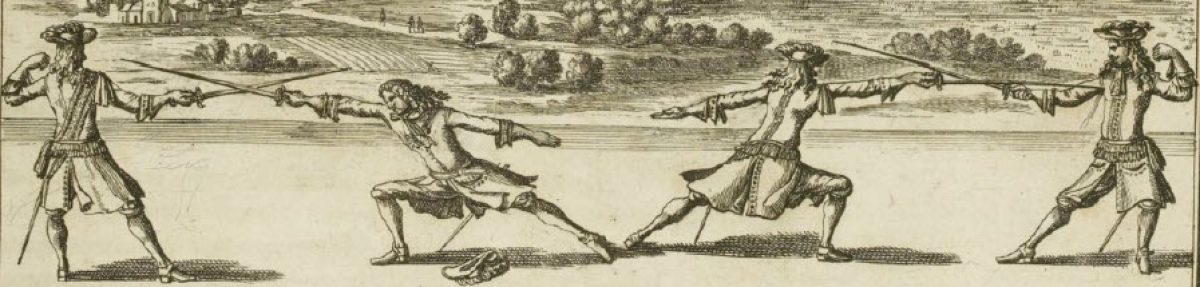
One of the hallmarks of the Roman-Neapolitan school of fencing is the stoccata annervata or annervated thrust. A fencer today examining the illustrations in Marcelli or Pallavicini’s works may find this particular action odd as it looks so stiff and awkward in comparison to the bent-leg lunge of today (a.k.a. a stoccata if to the inside line, imbroccata if to the outside line/outside the arm).Wiser and more-knowledgeable heads than mine have explored this variety of the lungish attack far better than I can. [1] Thus, while I cannot add much to their conclusions I must, like anyone else wrestling with a source, figure out how to perform this maneuver and teach it. What follows is my working interpretation at present, and I share it less because I’m convinced I’m correct than because it illustrates another example of a fencer working closely from a source.
The translation I rely on is Christopher A. Holzman’s–his is the first translation into English and perhaps one of his greatest contributions to the historical fencing community. This is not to denigrate in any way his Del Frate or other offerings, but to say that Marcelli’s Rules of Fencing (1686) is easily one of the finest works on fencing ever written. It’s value extends beyond the weapons he covers (chiefly rapier and associated side-arms)–for his coverage and explanation of universal principles alone Marcelli is a must-have source. Much as I hate the parlor-game question–“if you were on a desert island and had only one X, what would it be?”–I can answer it for works on fencing: it would be Rules of Fencing. [2]
My academic training urges me to find the best translations I can, but never to forget the original source. Thus, while I rely on Chris’s excellent Marcelli, when it comes down to anything I must investigate closely I make sure to read the Italian next to it. I provide the original Italian after quotations in English below. Note: I am not fluent in Italian. I have only a functional get-the-gist-of-it ability and only for things like fencing or ancient and medieval history. Wine-lists, menus, Dante, yeah, can’t read those (yet). Like many historians working in early European topics I must have a working command of some languages in order to identify if not read key secondary works in languages other than my own. [3]
Here, I will share some key passages for the annervated thrust, then share how I’m reading them and why.
Pallavicini (1670/1673):
Giuseppe Moriscato Pallavicini, in his Fencing Illustrated (2 vols., 1670 and 1673), provides useful depictions of this annervated attack:
Pallavicini, _Fencing Illustr._, Vol. 2, p. 2
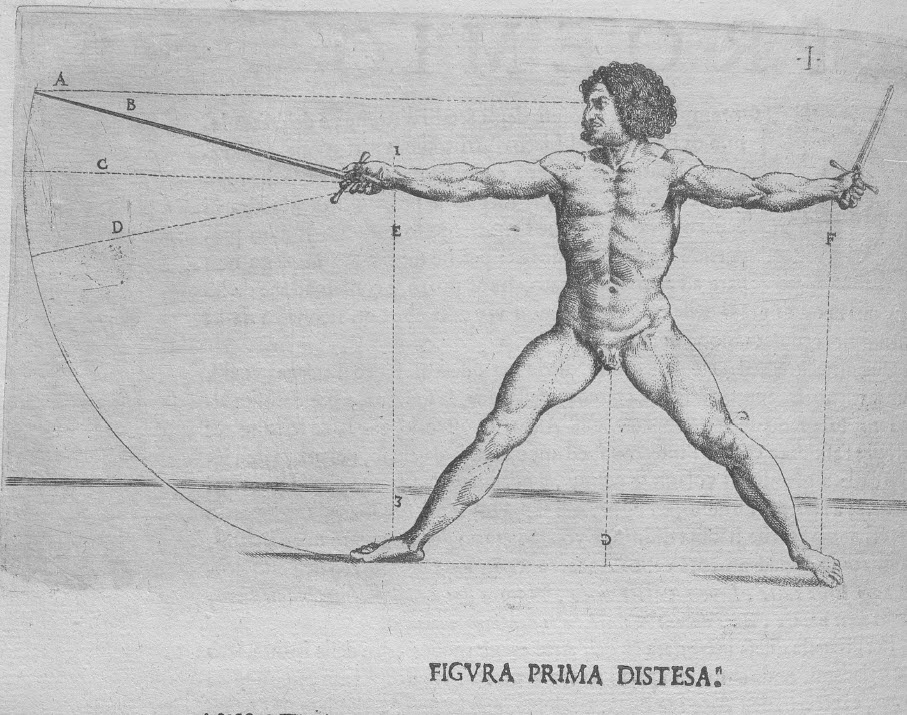
The explanation Pallavicini offers for the first illustration (p. 2) explains how one launches the attack:
The present figure shows the visual line with the assigned letter A, so, at the point of standing in stance, the the first thing is of the right arm going out, then tensing the left knee (which is bent) and in tensing it, extending it, the right foot is made to advance on the ground performing the thrust in 3rd.
[Figura mostra la linea visuale per la lettera assegnata, A, al punto cosí standon in piāta, la prima cosa e d’uscire primo il braccio destro, è doppo annervare il ginoccho sinistro, in cui stando curvo, & in annervandolo disteso, fà avanzare il piede destro in terra, e tirando la stoccata di terza…] [4]
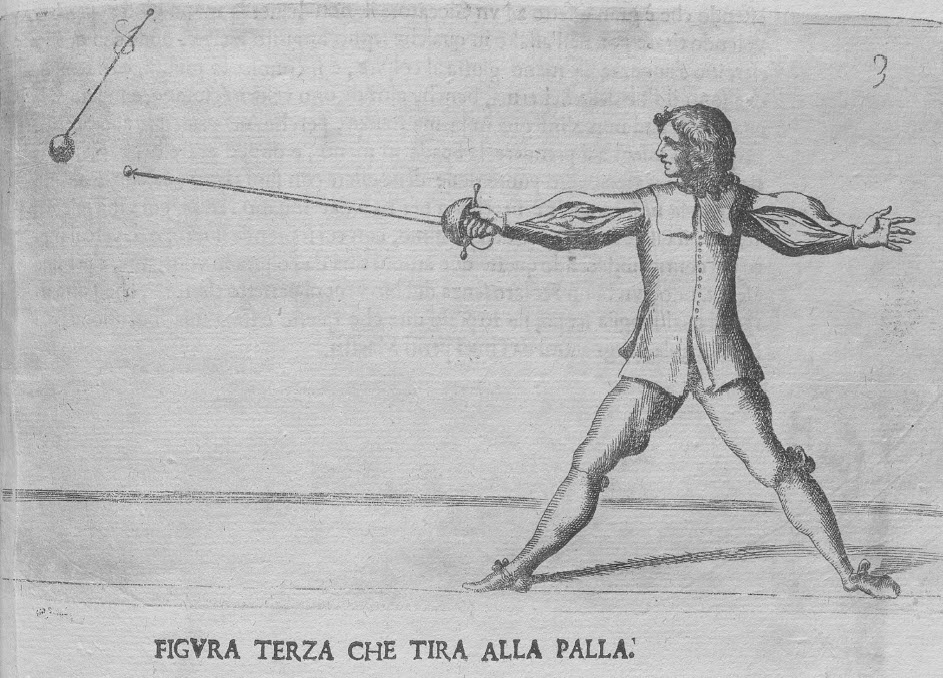
We see a similar completed attack on page 7 where the author describes the drill of thrusting against a hanging ball:
Pallavicini, _Fencing Illustr._. Vol. 2, page 7
For the sake of comparison, here is the same maneuver from another contemporary master, Giuseppe Villardita, author of A Compendium of Sicilian Fencing/La Scherma Siciliana ridotta in Compendio (1670):
Villardita, _A Compendium of Sicilian Fencing_, 1670, 28-29
Franceso Marcelli (1686):
While other works within the Roman-Neapolitan orbit I find useful for context I focus mostly on Rules of Fencing/Regole della Scherma (1686). Like others within this tradition Marcelli employs an annverated attack, but importantly spends as much time or more on a version of the lunge ancestral to the modern iteration.
Marcelli, _Rules of Fencing_, Bk I, Part II, Ch. V,, p. 15, fig. 4
Accompanying this image Marcelli writes:
All the movements that I have proposed to be made in performing the thrust are seen marked with the numbers in the present illustration. The number 1 signifies that the aforesaid Cavaliere has started the sword hand first. The number 2, marked near the left knee, denotes that after having brought the hand forward he has violently extended that knee, which was bent. The number 3 that stands at the right foot indicates that it was the third movement of the body, and that after having advanced the hand and extended the knee he has advanced the foot, which is the last movement, because it has to do the least travel of all.
[Tutti i moti, che hò proposto da farsi nel tirar la Stoccata, si veggono segnati co’i numeri nella presente figura; dove il nu. 1 significa, che il sopradetto Caval. hà partito prima la mano della spada. Il num. 2., segnato vicino il ginocchio sinistro, dinota, che doppo haver anticipate la mano, hà disteso con violenza quel ginocchio, che stave piegato. Il num. 3., che stà nel pie destro, signitica, che quello e stato il terzo moto del corpo; e doppo haver caminato la mano, & annervato il ginocchio, ha caminato il piede, il quale e l’ultimo moto, perche hà da far camino meno di tutti.] [5]
Interpretation:
Standing “heroically,” Hugh Laurie as the Prince Regent in “Blackadder the Third,” Episode 4, “Sense & Senility,”1987
Looked at alone these images, as useful as they are, can be misleading. Taken literally one is likely to jam the knee, slip, or split one’s pants. No matter how well rendered we must be cautious with images. We must read them with any accompanying text, and, consider how the fencer gets to this position. Put another way, what does the guard position one is in prior to launching the attack look like? Placed side by side what can we deduce about moving from guard to annervated thrust?
Here is one example from Pallavicini, Vol. 1, for the guard position:
The guard position is back-weighted, body upright, rear arm up and out of the way (if unarmed), front foot toward the opponent, and weapon directed to target. The rear shoulder, so Marcelli remarks, should be over the bent rear knee. The weapon hand should be about belt high (cf. Marcelli, CH, 83ff).
Critical to understanding this style of attack is how one most easily shifts from this rear-weighted guard position to the annervated thrust. As Marcelli states the right or lead foot doesn’t move very far, and both Pallavicini and Marcelli are explicit about the speed and force used in snapping the left or rear leg into an extended position forcing the right foot forward.
This is less a lunge per se than a quick step made by shifting weight from the rear leg to the front. It is shorter than than lunge as we know it, and must be because landing straight-legged on the front foot is not something comfortable or safe to do if the step is too long. The Roman-Neapolitan masters took time to explain just how far one should stand in guard.
Pallavicini, for example, explains
In order to know how large the man’s stance must be, the proper distance is a third part of the man’s height, counting from the left heel to the narrowest part of the right foot, as my Figure shows, marked with a straight line from the point of the left heel where the right foot is placed over the same line, since it shows a distance of three and a half palmi [approx./ 8.5-10 inches/20-25cm], in which the man comes to stand more comfortably in the proper proportion of the stance. Since this Figure stands with the point of the sword in the ground, I have made it easier for the student to know how to find the proper length of the stance, which is made by bending the left knee, and advancing the right foot on the straight line. In order to know how much the right foot must be advanced, the sword point is placed on the ground, and keeping the left knee bent, and the right knee extended, the body stays in the center, as my Figure shows, and the right foot must advance as much as needed to touch the sword point.
[e così per sapere la quantità quanto l’huomo deve star largo di passo, la guista distanza è la terza parte dell’altezza dell’huomo, numerando dalla punta del Tallone sinistro per insino alla legatura del piede destro, come mostra la mia Figura segnata con la linea retta, della punta del tallone sinistro dove posa il piede destro sopra la medesima linea retta benche mostra la distanza delli tre palmi e mezzo, nella quale l’huomo viene à stare più commodamente nella giusta proportione della pianta, e benche stia questa Figura con la punta della Spade in terra, l’hò satta per più faciltà dello Scolaro, per sapere trovare la giusta distanza della pianta, la quale si fà curvando il ginocchio sinistro, e doppo avanzare il piede deitro per la linea retta, e per sapere quanto deve avanzare il piede destro s’abassa la punta della Spada in terra, e tenēdo il ginocchio sinistro piegato, & il ginocchio destro difesto, & il corpo che stia in cētro, come mostra la mia Figura, & il piede destro deve avázare táto quanto hà di toccare la punta della Spada.] [6]
Pallavicini illuminates this notion thus:
Pallavicini, _Fencing Illustr._, Vol. 2, illustration 2, p. 5
Marcelli’s treatment of the type of steps and guard position are separate, but the latter assumes the former. For example, in explaining how ones comes into guard he writes
having first planted the left foot on the ground, he should bring the right foot forward as much as is necessary to form a correct and proportionate stance, in relation to the distance of the step with which the blow must be extended, in order to be able afterward to easily recover with it (a thing so necessary, and of such consequence, that upon this depends the good or bad outcome of the operation).
[Impugnata in tal maniera la Spada, e piantato prima in terra il pie sinistro, porri avanti il pie destro, tanto, quanto basta a formare un passo giusto, e proporionato, respetto all distanza del passo, co’l quale si deve distendere il colpo, per potersi doppo con esso rihavere con facilita (cosa tanto necessaria, e di tanta conseguenza, che da questa dipende il buono, o cattivo successo dell’operatione).] [7]
This makes far more sense when one recalls the earlier passage on the types of steps. For brevity these are:
the straight step: made when one moves along the line of direction
the traversal or oblique step: made when we leave the line of direction and go left or right
the mixed step: a good example is the inquartata
the curved step: made when gaining, passing, or seizing the opponent’s weapon vs. returning to guard
[Quattro forti de’Passi si possono formare nel caminare à fronte del suo nemico. Il primo è’l Passo Retto. Il secondo, è’l Passo Trasversale, or vero obliquo. Il terzo, è’l Passo Misto. È’l quarto e’l Passo Curvo.
Il passo si fà, quando si camina per linea retta incontro del suo nemico, e si move à dirittura per quella medesima linea nella quale stà situaro il suo contrario. Questo si dice, caminar retto.
Il Passo Trasversale, ò vero Obliquo, è quel passo, il quale si forma, quando uscendo dalla linea retta si camina a man destra, ò à man sinistra del suo contrario…
Il Passo Misto, è quel passo, che si fà con l’Inquartata, quando che si hanno da sfuggire le stoccate che son tirate di dentro…
Il Pass Curvo si fà solamente, ò nel guadagno, ò nelle passate; benche in queste non si finischi di terminarlo, con tutto ciò da questo passo si guidano… [8]
This is, as Marcelli himself remarks, a “natural and composed posture of the body” and easily adjusted to navigate measure and set the stage for one’s choice of footwork. We unconsciously manage this all the time whenever we’re on guard; we adjust measure, we shift our feet, we shorten or lengthen steps based on what it is we need or wish to do.
Conclusion
The necessity for (relatively) easy movement, combined with a guard position designed to keep the weapon out and oneself as far back as possible, makes little sense if one of the primary methods to deliver a thrust is awkward. Just as one doesn’t serve up popsicles on fine china, so too does one avoid a stilted, jarring attack from an efficient, sophisticated guard. It needs to work.
These masters, Marcelli especially, were not simple-minded. Their students might be wounded or die if their teaching included some walk-like-an-Egyptian-lunge. It doesn’t follow. If in our interpretations we find ourselves landing with pain on the front leg, if we are off balance, then likely we are missing something.
So, what is this annverated attack then? It’s a from of half-lunge. Like the bent front-leg lunge this version uses the rear leg to propel the body forward. Nothing, however, happens until that weapon moves first. The lead foot is lifted a short way and set down with a straight leg. It’s this last portion that is different and a little tricky at first.
A natural question is why use such an attack? Part of the answer is about the context in which the Roman-Neapolitan school developed, one in which Spanish destreza played a significant role. Many of these masters quote from Carranza, Narváez, and Pacheco just as they do the luminaries of the Dardi School and others (see for example Pallavicini, Vol. 1, p. 78, in Holzman’s translation). [9] Another reason is the reality of a sharp point. In an age when most people learned to fence to protect themselves defense was foremost. Our study, however dedicated, is removed in time and purpose from the very real danger of being spiked, and so we are accustomed to taking chances we likely wouldn’t were our weapons sharp. This is a point I make a lot and I won’t belabor it here, but in sum the annervated attack is less extended, easier to recover from, and a compromise between reach to target and the dangers of over-extension.
I’m still working on this attack, but as I read and reread the sources, as I try out this annervated thrust with students, the one thing that comes to mind each time we work on it is that this had to work at least somewhat well to have appeared in works from at least 1670 to 1725 (give or take some years). Chris Holzman suggests in his translation of Nicola Terracusa e Ventura’s True Neapolitan Fencing (1725) that this interesting form of attack seems to have gone out of fashion by the time Rosaroll & Grisetti penned their magnificent The Science of Fencing (1803). The bent front-leg lunge we see in Marcelli, and which we see little of in Terracusa e Ventura, is the precursor of the lunge that most of us have learned since. [10]
Why did the annervated attack disappear? One reason may be that by 1800 fencing, while still important–especially in Italy and France where the duel survived longest–had also long been transforming into a past-time and sporting pursuit. The conservatism of the annervated thrust is less well-suited to the speed necessary in agonistic fencing, ditto the less aggressive reach to target. So much of rapier has analogues in modern epee and foil, but this attack, this odd somewhat stilted looking thrust, is an exception that allows us a unique look into the Art’s more serious past.
Marcelli, _Rule of Fencing_, Part 1, Bk I, Ch. VI
NOTES:
[1] See especially Francesco Marcelli, Rules of Fencing, Trans. by Christopher A. Holzman (Wichita, KS: Lulu Press, 2019), and Francesco Loda, Historical Fencing Manual: Rapier-Fencing in the 17th and 18th Centuries (Wheaton, IL: Freelance Academy Press, 2019).
[2] Feel free to disagree. The two works that I have found comprehensive, not only for technique but theory, are Marcelli and the later Science of Fencing by Rosaroll & Grisetti.
[3] European colleagues are often at an advantage in language acquisition. Living so close to other language populations and a longer tradition of language study make a difference. Outside of Latin, Middle Welsh, and Classical Irish, the three languages I spent the most time on, as a late Romanist/early medievalist I needed to be able to read some Greek, German, French, and Italian. With the exception of Latin and perhaps Middle Welsh, where I’m arguably semi-literate, I consider myself functionally illiterate in the other languages outside the extremely restricted works on history and fencing that have been my focus.
It should be obvious, but for any long passage and certainly anything I publish I always have someone expert in the language check my translation and/or interpretation of what I read. I do this even with the Latin translation work I do because it’s due diligence; it’s equally important to mention this expert help as well.
[4] Pallavicini, Fencing Illustrated, Vol. 2, p. 2; Holzman, The Second Part of Fencing Illustrated by Giuseppe Moriscato Pallavicini (Witchita, KS: LuLu Press, 2020), 1. The image of the fencer thrusting at the ball is on page 7 in Pallavicini, and page 11 in Holzman’s edition of Vol. 2. See also Giuseppe Villardita, A Compendium of Sicilian Fencing/La Scherma Siciliana ridotta in Compendio (Palermo: Imp. Cuzol. G.V.G. Imp. de la Torre R.P., 1670), image between pages 28 and 29 in Google Books.
[5] Marcelli, Rules of Fencing, Bk I, Part II, Ch. V, p. 15, fig. 4; Holzman, 288.
[7] Marcelli, Rules of Fencing, 62-63; Holzman, 84.
[8] Marcelli, Rules of Fencing, 31-32; Holzman, 37.
[9] See for example Pallavicini, Fencing Illustrated, Vol. 1, Trans. Holzman, xi-xiv; Loda, Historical Fencing Manual: Rapier-Fencing in the 17th and 18th Centuries, 1-12; 38, n. 49. Dr. Loda notes that the upright stance of the annervated thrust recalls the upright stances common to much of destreza.
[10] See Nicola Terracusa e Ventura, True Neapolitan Fencing, Trans. by Christopher A. Holzman (Wichita, KS: Lulu Press, 2017); Rosaroll & Grisetti, The Science of Fencing, Translated by Christopher A. Holzman (Witchita, KS: Lulu Press, 2018).
POST SCRIPT: I need to get better photos with the measuring tape, but I did an experiment this morning [9 Nov. 2021] to test out the proportions of the guard and annervated thrust. Using the method mentioned above where one uses the sword to step toward when I’m in the Neapolitan guard there is approximately 18″/45.72cm distance between my left/rear foot and the heel of my lead/right foot. Depending on the degree of bend in the rear leg this can extend to 2’/61cm distance between my feet. This accords pretty well with the proportions Pallavicini lists, that is, that the space between my feet is about a third of my height when on guard. An annervated thrust from this stance is super short in terms of how far forward the front foot extends.






 Capitale Escrime Historical Fencing