Tag: HEMA Community
More on the Idea of Master/Mastery
This short video from my dear friend and colleague, Maestro Jay Maes, has a lot of excellent points in re mastery and the idea of masters in historical fencing today.
https://youtu.be/5CvcvR4gXHM?si=VdZehxDdTvVYe-aD
K. u. k. Military Fencing Tournament
K. u. k. Military Fencing Tournament, Prague 2026, is an annual event dedicated to fencing with weapons taught at the K. u. k. Theresian Military Academy in Wiener Neustadt – foil, sabre, bayonet rifle.
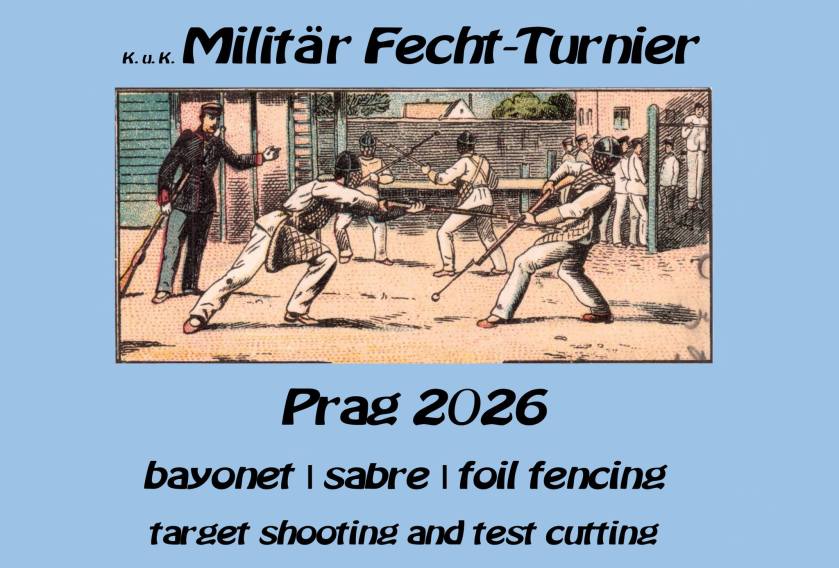
This event continues the tradition of the K. u. k. Armee Fechtturnier, a series of eleven successive Austro-Hungarian Army fencing tournaments held alternately in Vienna and Budapest between 1898 and 1914. The inaugural 1898 tournament was held as part of the jubilee celebrations marking the 50th anniversary of Emperor and King Franz Josef I’s accession to the throne.
The K. u. k. Military Fencing Tournament, Prague 2026, is open to practitioners of all styles and skill levels interested in military fencing from the 1895–1914 period.
DETAILS:
Official program:
Saturday April 18
9:30-10:00 registration
10:00 Opening ceremony
10:15-11:00 Foil fencing workshop with Maestro Michael Kňažko
11:00-12:30 Foil fencing tournament preliminary rounds and eliminations (max. 12 fencers in the pools).
13:00-14:00 lunch in the restaurant Na Urale
14:15-15:00 Bayonet fencing workshop – Maestro Leonid Křížek
15:00-16:30 Bayonet rifle fencing tournament preliminary rounds and eliminations (max. 12 fencers in the pools).
16:30 Bayonet rifle x sabre
17:00 Bayonet rifle x field shovel
Bayonet rifle charge
Target shooting
Test cutting
Pistol duelling
20:00 – 23:00 official dinner – restaurant U Topolu, Prague 6, Jugoslávských partyzánů 943/32, 160 00 Praha 6-Bubeneč
Sunday April 19
10:00-10:45 Sabre fencing workshop – Maestro Michael Kňažko
11:00-12:30 Sabre fencing tournament preliminary rounds and eliminations (max. 24 fencers in the pools)
13:00-14:00 lunch Na Urale
14:15 Pistol duelling workshop
15:00 target shooting & test cutting workshop
Closing ceremony
Tournament weapons:
Czechoslovak spring bayonet rifle – provided by the organizers
Classical French or Italian foil – own weapon required
Barbasetti Sabre 1895, model 2 – provided by the organizers
Tournament requirements:
– own complete protective foil/sabre/bayonet fencing gear (mask, jacket, gloves, protectors)
– own French or Italian foil
– bayonets rifles and sabres will be provided by the organizers
Host:
Barbasetti Military Sabre (since 1895), Prague, Czech Republic
Ars Dimicatoria School of Historical Fencing, Prague, Czech Republic
Place:
Main gym of the Primary School Emy Destinnové, náměstí Svobody 930/3, 160 00 Prague 6 Bubeneč 160 00, Czech Republic
Price: EUR 120
Official T-shirt: EUR 20
To reserve your place contact Michael Knazko
via fb messenger or e-mail: a.dimicatoria@gmail.com
Please note: The organizers reserve the right to make changes to the event program. The organizers also reserve the right to cancel the event wholly should unforeseen circumstances or/and risks to public health arise.
SabreSlash 2025, Prague, Czechia

Four years ago, when I first had the pleasure to attend SabreSlash 2021 in Prague, Czechia, I was stunned at how well-run, how fun, and how high the level of skill was, both amongst the attendees and the instructors. This event jumped to the top of my list of “if you can go, GO!” historical fencing conferences. My visit this year, last week in fact, only cemented the value of this mix of workshops, fencing, and camaraderie. So, if you have a chance to attend, DO.
It was a busy week for me, partly because I wanted to support my dear friend, Maestro Michael Kňažko, as he set things up and managed the two-day mix of workshops and fencing, and partly because there was a double reason for my attendance this year: I would be testing for certification as a maître d’armes.
Michael, his amazing partner in life, Caroline, and the excellent folks at Barbasetti Military Sabre (since 1895) have preparations down to a science, and if anything set-up and take-down were faster than ever. The rest of the weekend was as well run—workshops were a good length and sandwiched between ample rest periods; “RandomSlash,” was super successful (more on that below); and everything was geared to allow people to mix and get to know one another.
Goals of SabreSlash
The three goals of SabreSlash are to celebrate and explore history, hone skills, and cultivate friendship. The first and second were most on display in the workshops and in the RandomSlash bouting day two. I have much to say about all the workshops, especially as I did my level best to be a grown-up and sit out so that I didn’t exacerbate any of the injuries I’ve been tending and which are all but managed. Few things are as difficult as seeing that degree of fun and forcing oneself to take notes.
What I would like to discuss first, because it is the most important to me, is the friendship portion. I honestly don’t know quite how to express this, but to say that there are few places in life where I have met that many people and felt an instant kinship, like I had always known them, and who are, to a person, absolutely remarkable, interesting, and kind. At my age, one doesn’t make a lot of new friends; distance and loss tend to start to take over, not necessarily from any ill-will, but stage of life.
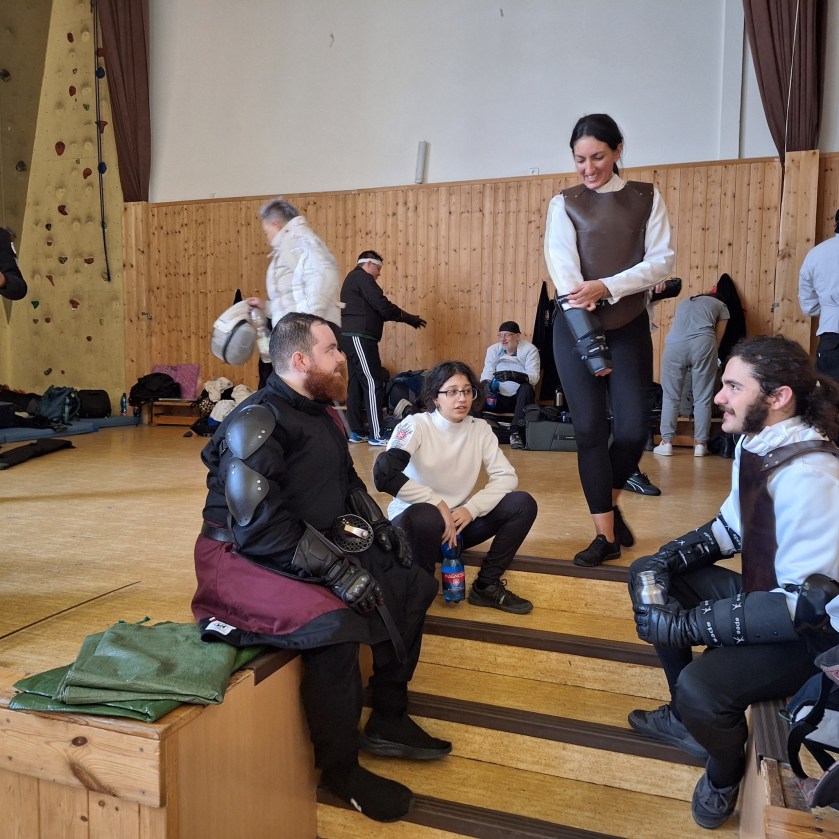
I was absolutely struck numb by the warmth, openness, and genuine interest to get to know everyone that pervaded the event. This was the first time I had met people from FISAS in Italy, as well as the team from the Malta Historical Fencing Association, or, from the Wrocław Polish Martial Arts Club SIGNUM POLONICUM. I cannot say enough really about how much all of them impressed me, not just for their fencing ability and related skills, but as people. We talked about a lot of things, not all of them easy topics, and the compassion, understanding, even hope were inspiring. I am so grateful to have met them—people like that enrich our lives in ways we don’t always see right away. I also had a chance to reconnect with people I met last time, especially Paul Chéreau from Paris, and meet his coach there, Maître Jean-François Gilles. Despite language barriers, we all managed to communicate pretty well—to be fair, my monolingual status was the greatest barrier, but I like to think that a little time trying to speak, even a little, in Czech, French, Italian, and German only helps. [n]
Workshops
The workshops made me feel like a kid in a toy shop. The first class, given by Maître Gilles and Paul, was on French contre-pointe, a topic of great interest to me. After lunch, Maestro Andrei Xuereb explored firm-footed fighting. Finally, a man I had been looking forward to meeting as we’d only chatted on facebook, Leonard Marynowski, took us through a detailed look at the way Polish winged-hussars fought from the saddle. The next day, Sunday, Maestro Franco Burberi, presented a close look at Radaellian sforzi di cambiamenti, and for me personally this was eye-opening. My class was the last one, and I think it went okay. I’m not always sure, but I tried not to speak too quickly or use too many odd idioms—this last tends to be a problem thanks to family and having moved around a lot.

RandomSlash
The RandomSlash fencing pools started next. These were inspired by the “Iron Quadrangle” popular in the FISAS clubs. Everyone got to fence everyone, and, more than once. The bouts were one-touch, and presided over by a single director, in this case a friend of Michael’s, Čestmír Cimler, and me. I know that pre-event not everyone was happy that the fencing portion would be less competitive, but I stand by Michael’s decision. There are plenty of tournaments, and when affixed to workshops eventually, in time, the tournament half tends to dominate. RandomSlash’s approach allowed people to fence A LOT, but more in the spirit of a shared joy of fencing than in the stress of advancing out of pools.

My praise of this event, by the way, is not to disparage competition or other styles of historical fencing get-togethers. My best competitive days are behind me, my day schedule makes training properly for a tournament difficult, and I have other priorities, such as the sports my children play. What I value about this style of competition, which is to say bouting, is that it takes some of the pressure away and lets people focus a bit better on technique and tactics. Only one bout got a little heated, but this was not out of anger but an excess of spirit and a preexisting rivalry between friends. There were, of course, no injuries, and, people used a variety of sabres. This last part is important because generally SabreSlash supplies their own 600-650g Austro-Hungarian army-inspired trainers, and, because these mixed without issue with those used by the Poles and others with wider, heavier sabres.
Still my Favorite Event
I confess that I have some natural bias towards this two-day fest of skill, bouting, classes, and bridge-building. I like these kinds of events. The organizer is a close friend. I am a member of the host school. These, yes, all predispose me to be supportive, but it goes beyond that.

Barbasetti Military Sabre (1895)’s “SabreSlash” has been running for years without any major hullabaloo or injuries. The level of skill is high. The teaching some of the best I have witnessed at any fencing event. The work I do with Storica Defensa, based in Canada, has very similar goals in terms of improving skills, teaching, and providing safer tournaments. It’s one reason we asked Maestro Kňažko to act as the director of the program. Beyond all the excellent instruction and fun, what SabreSlash provides is a model for running a high quality, safe, and thoroughly enjoyable event, one without injuries, one where everyone walks away with better understanding, and importantly, new allies and friends.
I can’t wait to go again.
Notes:
[n] I am not fluent in any of those languages. French, German, and Italian I have learned to read academically—this means I can read articles and the like so long as they pertain to my research field or fencing. It is next to useless for using a menu or making small talk. Czech, I continue to study, because as a member of a Czech salle it is only right I work to speak the language everyone there uses. It is not an easy language, but I like the challenge, and with luck one day I’ll be able to use it well enough not to embarrass myself too badly.
Article on “Military” Sabre–Additional Thoughts
My friends in Canada shared an excellent article with me today, one by Paul Becker with the Historical Fencing Academy, Nordhausen, Germany [https://www.hema-academy.com/home]. Entitled “Military Fencing & Military Sabre?” Mr. Becker explores, through detailed examples from the Austro-Hungarian Empire, what constitutes “military” fencing in his view. Do please read his article–it is well-done and covers a lot of ground that too often is left untilled. Readers will find not only his coverage of texts, but his examination of period weapons useful.
The link is here: https://www.hema-academy.com/blog/militaerfechten-militrsaebel?fbclid=IwY2xjawNLfuhleHRuA2FlbQIxMABicmlkETFNWFhBeEROeVJiOVJtR2gwAR4f6JSN3yJQ-8Lx-JSo9nfDbVAMm34vfEm6-ObW6zQ2xp0spOmIVtM2ea1J4Q_aem_KNNZWoEg5WhCCc_VVMw0dw
If you’ve read much I’ve written, then you will know how much I tend to detest the separation of sabre into “dueling” and “military” in popular “HEMA.” These labels, while in some degree useful, obscure an important fact, namely that the very people using sabres for duels were normally military officers. To quote my good friend Alex Spreier, somewhat out of context, “sabre is sabre.” The problem is that we often feel we need or at least wish to differentiate what we study from related topics–sabre encompasses a vast, truly global tool, and so is perhaps especially prone to fall into categorizing nightmares.
As I’ve too often stated, in “HEMA” the use of “military sabre” is normally meant to separate out what the user is doing from the sport. There is some sense in this, though it is over-emphasized given the vast amount of common ground shared by those examining historical systems and the modern sport. It is, historically speaking, redundant in that sabre was by and large a military weapon. It’s like calling a howitzer a “military howitzer.” The use of national terms, e.g. “Italian sabre” or “Hungarian” or “Spanish sabre” makes a bit more sense, as it refers–one assumes–to texts from those cultures and often in their respective languages. How different these systems are from one another, and how much they overlap, is a separate issue.
There were, as Mr. Becker rightly points out, differences even in the period many of us study: there was sabre intended for war; sabre intended for duels; there was sabre for fun and which employed competitive rule-sets. The weapons were often different too. For reasons I’ll leave aside for now, not that I know all of them, “HEMA” has taken a fancy to the heaviest sabres it can find, sabres that are rubbish to fence with–this doesn’t mean they wouldn’t be useful when mounted or as sharp clubs, but even there for a weapon to be effective and not exhaust the user too quickly some compromise was generally found. No one should be fencing with a 1.81 kg or 4lb sabre. One can, but why?
If one takes the time to examine the sources, and we have a ton of them, for sabre between say 1850 and 1950, they will readily see just how varied the tools were. There is the example of Lt. Col. Eduard Wagner, a Czech army officer, who not only worked with the common 600-700g training sabre, but also the heavier cavalry tool (this was about 1 kg). For a second example, one might recall the scene that Leon Bertrand shares in his odd book Cut and Thrust: The Subtlety of the Sabre (1927) where an Italian master, Giuseppe Magrini, crosses blades with an unnamed English soldier, the former armed with lighter sabre, the latter with a blunted cavalry weapon. The Englishman was also armored cap-a-pie “in heavy canvas, shin guards and cage-like mask.” [1]
In terms of the abuse of adjectives, Mr. Becker specifically calls out Barbasetti Military Sabre, and as a member of that school, and moreover as one who spent the last few months doing all I could to learn its history, I feel compelled to offer an alternative view. Allow me first to say that in most respects I agree with my esteemed colleague–but, there may be context he doesn’t have for Barbasetti Military Sabre, Prague, and if that is so then perhaps I can fill in that missing piece for him.
Barbasetti, the Military, and Fencing in Czechia
Barbasetti visited Prague in 1895. While there was sabre in the Czech Lands, it didn’t appear on the map until after the master’s visit. The influence of Barbasetti on the Austro-Hungarian army was profound. Prior to the establishment of the independent Czech state in 1918, Czech officers serving the Empire were trained, like their colleagues, in Barbasetti’s method alongside their comrades in Austria. Some, like František Dvořák and Robert Tvarúžek, attended the school at the Theresianische Militärakademie Wiener Neustadt and became masters themselves. Important to note, it was K.u.k. Fencing Master Robert Tvarúžek who wrote Šerm Šavlí, the first sabre text in Czech. Tvarúžek presented Barbasetti’s method only in the Czech language. [2]
Moreover, when the Czech army set up its own program for sword instruction, they also chose Barbasetti. From 1918, through the 1920s and 1930s, Barbasetti‘s formed the fencing curriculum in the Czech Republic. One well-known master at Vyšší vojenská reálka v Hranicích (the Military Academy, Hranice) was staff captain Karel Sekanina. He was posted to Hranice in January of 1920, and is important to the current program in Prague because he was the master who taught Master Leonid Křížek’s teacher, Lt. Col. Eduard Wagner (d. 1984). Sekanina worked with Wagner three times a week from 1923 to 1925. [3]
For Barbasetti Military Sabre itself, as a club, the use of “military” distinguishes the school’s approach from that of its colleagues in Prague. There is a close association, for example, between Barbasetti Military Sabre and Český šermířský klub Riegel–their histories are intertwined. Even today, many of the masters who teach at BMS also teach or have taught and/or fence at ČSK Riegel, including Maestro Josef Šolc and his son Maestro Michael Šolc. [4]
In addition, the terms “Barbasetti Military Sabre” also speak directly to the school’s lineage. Maestro Leonid Křížek, a key instructor and scholar with the school, was taught by Lt. Col. Eduard Wagner, in the 1960s–the method that Wagner learned, and importantly taught thereafter, was Barbasetti’s system. Maestro Křížek taught Master Michael Kňažko, and both have been important mentors to me.
The use of the term “military” is not one anybody at BMS takes at face value or wishes to project under false notions. None of us are active duty military, so some titles that we might apply would be borrowed glory and in bad form to assume. For example, the K.u.k. Armee Fechtturnier, was for military personnel. To call the event that our club puts on the “Imperial Army Fencing Tournament” is too specific–we are, again, not in the army, nor are we members of a now defunct empire. However, “military” is appropriate because the modern event celebrates these important tournaments, and, uses the same weapons and format. “Military,” here, is an appropriate and descriptive adjective. To call it K.u.k. Militär Fecht-Turnier is descriptive and avoids any confusion were we to use Armee.
SO, What do We Call Sabre?
That’s up to you. For me, I prefer “Historical Fencing” and “Historical Sabre” as it’s general enough to cover most things and yet specific enough so that students don’t show up expecting me to make them Olympic champions. I’m not the guy for that. Interested parties will ask “what kind of historical sabre?” and then I can explain the specifics of what I research and teach. My club name here, one chosen by students, is “Capitale Escrime” because most live in the state capital, Salem, OR, and we fence. We put it in French because, well, it sounds better, but also because the vast majority of students study French smallsword. My sabre students, when they meet again, will do so as a North American satellite of Barbasetti Military Sabre headquartered in Prague.
NOTES:
[1] Leon Bertrand, Cut and Thrust: The Subtlety of the Sabre, London, UK: Athletic House Publications, 1927, 74-76.
[2] K.u.k. is an abbreviation of German Kaiserlich und königlich, or, “Imperial and Royal.” See for example https://www.visitingvienna.com/culture/k-k/
[3] For a full history of Barbasetti’s impact in Czechia, see https://www.ars-dimicatoria.cz/en/barbasetti-military-sabre-since-1895-2/
Ft. Ligonier/Carlisle, PA, Pt. II
While there were a number of Carlisle, PA, adventures with my friend and host, Patrick Bratton, among them were a few with other coaches and some of his students. As another example and proof for the value of cross-fertilization in fencing, I’d like to talk about the morning I spent watching a fantastic lesson by an Olympic coach, the excellent Tony Alvarez.
Excellence in Coaching: Tony Alvarez
I’ve known about Tony since the Pandemic–he worked with Patrick online in the epee class with Maitre Robert Handelman we all took–but this was the first time I had met him in person. Knowing my background, or at least my current focus, he was quick to remind me that the lesson sample I was about to watch was modern. While I cannot say I enjoy modern sabre, I do recognize that there is much to learn there despite the problems, if for no other reason than smart fencing coaches like Tony adapt well.
I’ll not lie–I have been quick to criticize modern sabre, and I likely still will, but this said I gained a new vantage point on it thanks to Tony and Patrick this past Monday morning, and I’m grateful for that. First, and to honor Tony’s skill, he showed very few actions, but actions used in different measures and tempi, in different set-ups.
He started with actions in the box, between the two en garde lines, then outside the box. Watching Patrick and Tony, both of whom know what they’re doing, made it seem as if very little had changed since the days of my early training save in one respect: speed. The modern game relies on speed in a way that one could mitigate more easily before the end of proper edge-alignment in sabre. There simply is not time to make some actions, most especially ripostes, in every instance.
Everything is a distance game played at the right time and correct speed. Here’s the pinch–that has always been true. What differs is method and tool. A lighter, fast weapon that can score with any part of the blade demands tighter timing. This is one reason the age of competitors has dropped so significantly in the past three decades.
I learned A LOT watching Tony teach, and his advice for working with children–the majority of his clientele–is invaluable.
Quick Studies-A Radaellian Lesson with one of Patrick’s Students, “J.”
One of the things I most looked forward to was working with Patrick’s folks. One student, a young high-schooler, wanted a sabre lesson and the last day at the fort we were able to have a short one. Important things to note: this young man started fencing last August; he is a big man, but super quick and flexible (day one in Justin’s Besnard class he dropped effortlessly into a de la Touche lunge…).
I gave him a very traditional outline, but with Radaellian elements, meaning we started with some point in line/disengage work, then some parry/riposte to warm up. Then, I took him through two set-ups with feints. Finally, as a cool down, we did a stop-cut/parry-riposte drill. He made all of it look easy.
I have adult students who struggle with some of these set-ups, but J. looked like he had been doing these drills for years. Even in the cool-down he opted to use an arrest half the time, an action that takes considerable point-control and timing. I was so impressed and told him so.
J. is as good as he is because he has a great coach, and, because J. is motivated, keen to fence, and found the right place to learn. I have written a lot about the importance of the universals in teaching, of starting with and honing fundamental actions, and J. is proof of how sound an approach that is. Moreover, J., and Patrick’s other students, are working within a mixed community, diverse in many senses but also in the sense of fencing styles and influences. It shows.
Why is this important? It’s important because it reveals another layer of diversity within Patrick’s club–put simply, his students are getting tools for their toolbox not only from different stores, but different lines of work. In the U.S. now there are people keen to erase diversity and downplay its importance. They do this out of fear and ignorance, for there is no science, reason, or morality behind any of their claims.
A diverse club is a healthy club, one guaranteed to push people and help them grow, and not just in terms of their ability to lunge or parry well. Exposure to people different from us, in large ways and small, reveals that they are people like us, just fellow humans trying to make their way through life.
Diversity fosters strength–it is harder to accept the idiocy of race-politics, for example, when one spends a lot of time with different “races” etc. and therefore knows what politician A or pundit B says is complete horseshit.
Working in Pennsylvania, and in an area rather “red” as it were, what Patrick has achieved at Sala della Spada is remarkable. Under his roof you will find not only the usual notions of diversity, but also political diversity. Now, like many of us, politics is not a topic there is time for in a salle, so they focus on fencing, but everyone in the club knows that they are working with people who see the world differently in key ways and work together nonetheless. In this there is hope. It is hard to remain divided when we spend with people ostensibly on the “other side” from us. We find our common humanity, we find common ground. If nothing else, we all love to fence.
Ft. Ligonier French Fencing Weekend
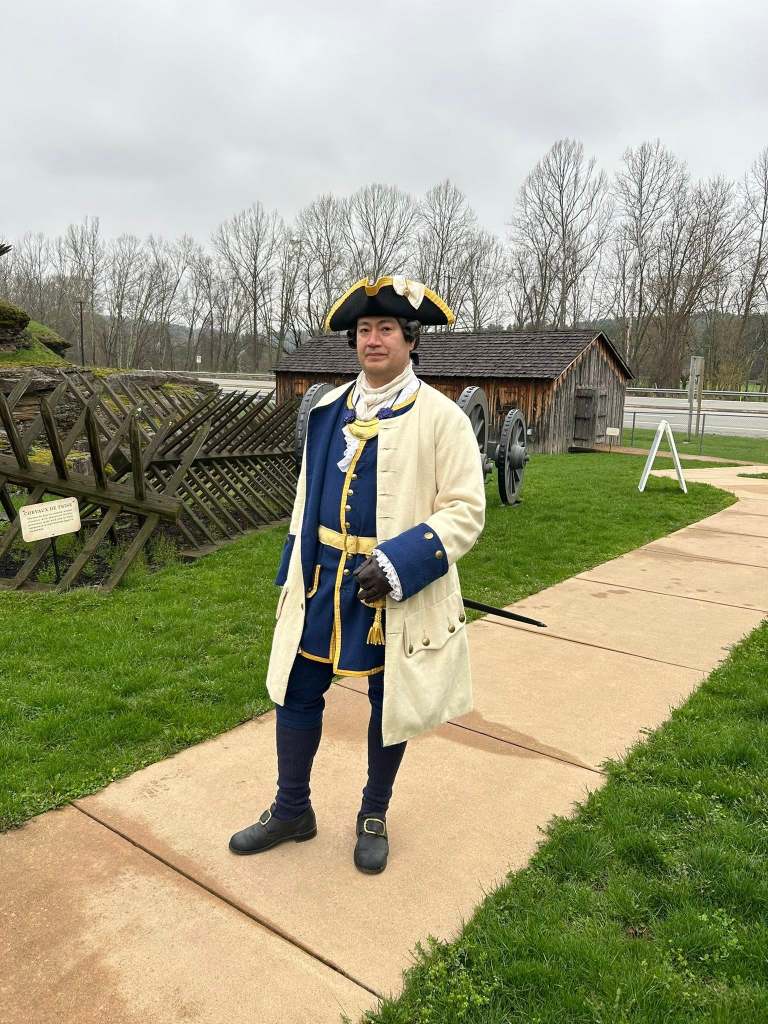
I’ve been meaning to write something up since I returned late Tuesday, but between work and an unexpected veterinarian adventure, I’ve not had time to do this event justice. It was, in a word, amazing, and so much so that I truly hope it becomes a regular event. Patrick Bratton and team put on one hell of a seminar–it was not just the classes, though those were great, but that the setting was apropos and unique, we had behind-the-scenes access to some of the museum, and ample chances to eat, laugh, and get to know one another. Yes, we also fenced, or many did–it was all I could do not to break my doctor’s orders and jump in, but for once I was a grown-up about it (and appropriately as bitter as a toddler told “no”).
By most definitions, I don’t think people would consider me particularly “lucky,” but when it comes to finding myself at truly impressive, informative, and fun events, I’m as rich as Croesus. To the list of favorites–SabreSlash, The St. George’s Day Exhibition of Arms, Rose and Thorns Historical Fencing Symposium–I can now add a fourth, Patrick’s French Fencing weekend. One reason, beyond the obvious draw of all things hoplological or fencing-related, is that it combined three branches of the community: historical, Olympic, and reenactment. The benefits of such cross-over should be obvious, but may not be, so to illustrate this I cite the example of a fascinating chap, Matthew Schlicksup, an artisan of historical footwear currently working at Ft. Ticonderoga in New York.
Historical Artisans
Matthew makes historical footwear, among other period items, and is a master craftsman. Trained in Williamsburg, Virginia, he has made shoes, attended events, and conducted research that most of us might not think about, and, despite the fact we all wear shoes. We take them for granted. Ft. Ligonier, however, has the world’s largest collection of period shoes thanks to the accident of 18th century castoffs and the powers of anaerobic preservation. An archaeologist in initial training, Matthew brings science to his craft, and with impressive results.

This weekend he shared, and wore, his version of the fencing shoes or sandals depicted in de la Touche’s seminal treatise, Le vrays principes de l’espée seule (1670). So, here we are at an historical fencing seminar with a man who makes shoes from the period for that very purpose. This may not seem important, but it is. A few years ago I spent considerable time researching the development of the lunge and this included a look at footwear–would that I had known Matthew then! In discussion with him about de la Touche’s sandal, I learned so much more than I might have, not only about construction, but also about how such shoes function. Put simply, this was a window into period fencing via a single often unconsidered artifact.
Museum
Our host at Ft. Ligonier, Matthew Tristan, was accommodating, supportive, and generous with his time. It was he who gave us the behind-the-scenes tour. It says a lot that he and the foundation were open to having us there: a busy historical site and nuts with swords sounds like an insurance adjustor’s nightmare. With Patrick and others in period dress, and quick to chat with visitors, it went well and we hope added something to the experience. When trusted with the safety of the site and its guests, one wants to do all one can to make it go well, and under Patrick’s excellent leadership this was not even in question. With all the discussion of clubs losing insurance because of unsafe and/or stupid activities, with some unfortunate high-profile legal cases, a win like this is easy to dismiss. We shouldn’t–this was a success and a sign that things can be done correctly.
Classes
In terms of classes, I participated as much as I was able–stupid injury maintenance–but was super keen to see what Justin Aucoin did with the work of Charles Besnard, one of my favorite masters. Justin has long experience with fencing and the SCA, and runs a seriously fantastic class. People loved his classes. I loved his classes. He taught one on Besnard and a second on the bâton à deux bouts or French double-spear in Pascha. I had been looking forward to meeting Justin for some time–Patrick spoke highly of him, I liked what I saw in his videos, and he is a die-hard fan of Dumas and The Three Musketeers, that last fact which immediately endeared him to me.

Justin combines deep knowledge with obvious skill and a passion for his topic. It’s infectuous. Moreover, he works with a diverse student population–always a good sign–and so was quick to suggest work-arounds and ideas to make each thing he covered work for different folks. If he is teaching anything near you or you have the chance to travel to work with him, do.
Bridge-Building
I tend to gravitate towards and work with other folks interested in bridge-building. It’s not just the strengths that collaborative work brings, but the sort of people that go in for it. Among these, I have worked most often outside my immediate surroundings with Patrick. He is, quite honestly, a model coach and advocate for what we do. As a trained teacher (he’s a professor at a college in Pennsylvania), researcher, fencer, and man of eclectic and fascinating interests, from vintage fashion to hunting lore, Patrick perhaps more easily combines disparate strings together to make a viable tapestry.
The historical reenactment group he is involved in, a detachment of mid-18th century French marines, has worked at Ft. Lignonier, among others, before, and it was an ideal location for a look at several late 17th century fencing masters. Some students were in costume, some not, but the addition of period appearance added a lot. Having good relations with the museum staff meant not only a chance to hold the seminar on site, but also see parts of the museum most people do not see. The historian and former archaeologist in me was seriously thrilled about that, but I wasn’t alone.
The only other event that I have attended that combined all these elements so successfully was my mentor Master Michael Knazko and company’s SabreSlash–we had fencers from all walks, reenactors from Krakow (17th Polish hussars), and tours of various sites within Prague relating to fencing (among other historical subjects). In both cases the camaraderie was the finest.
A Model for Future Events
Until recently, until this latest trip actually, I had planned some invitational tournaments. Now, while there may be a tournament element, I am planning to put together something closer to what Patrick and Maestro Knazko have done. It’s a good mix–class for those who like it, some history and other activities (we ate well for example), and some fencing or lessons. It is my hope that Patrick makes this event a regular one–we’ll be lucky if he does.

Historical Fencing Coaches Clinic–Post-Event Thoughts
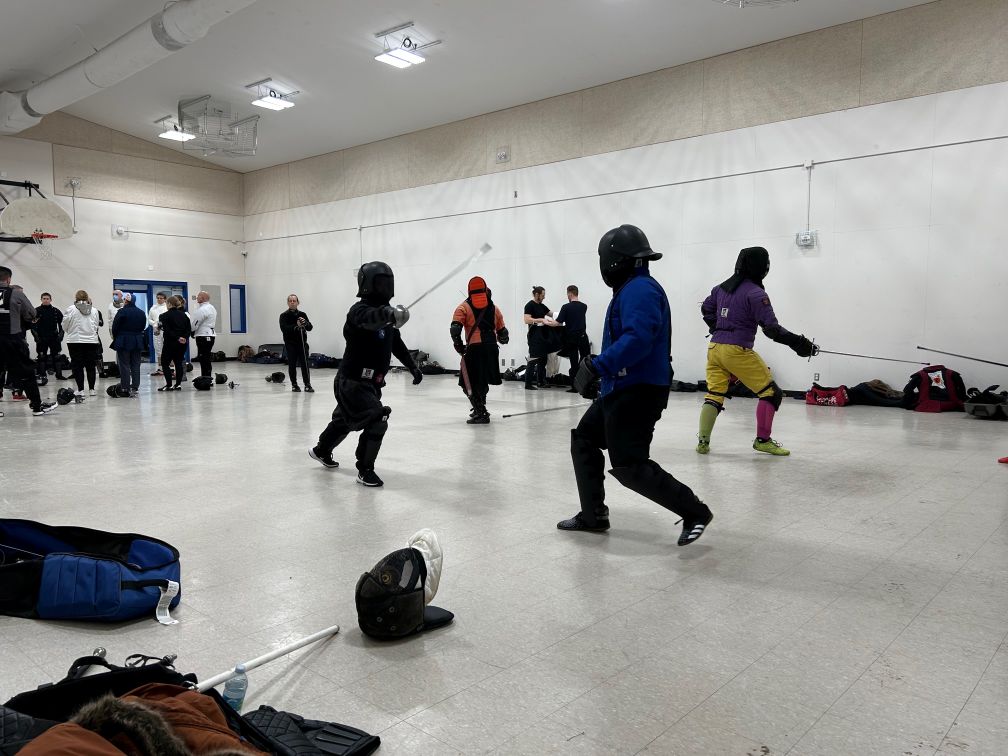
I had the great pleasure to visit old friends and make new ones a few weekends ago in Winnipeg, Canada, at the Historical Fencing Coaches Clinic sponsored by Storica Defensa. I’ve been to a fair number of coaching clinics, many Olympic, far fewer historical, but this one stood out, and no, not just because I am a Storica Defensa coach. This two-day event showed what is possible, and, perhaps a better path than typical in historical fencing.
In part, it was the mix of coaches, both in terms of experience and position, and in terms of background and focus. We had two masters from the excellent Sonoma Military Masters’ Program, David Coblentz and Eric Myers; we had Prevot Tim Guerinot from Texas; and we had two of our SD coaches, Xian Niles and myself, representing our organization. If I had any complaint it was that time demanded we have two classes run at once–I really wanted to take each one, start to finish. Even recovering from RSV and nursing a damaged Achilles’ tendon, which meant I wasn’t fencing, didn’t allow me enough time to devote to each class as they were running.
It’s all in the Details
Granularity. This was the leitmotif of the event. With many attempts in historical circles to improve fencing, from judging to technique, what’s missing is granularity, the specifics, all the step-by-step movement and thought behind all that we do. Much as it pains me to say it, this is often due to the fact that those teaching possess only a surface understanding of what it is they’re trying to teach. To the untrained eye, for example, a cut-1 in broadsword or a disengage in smallsword look simple enough, but to make either well and with consistent effectiveness demands deeper understanding, at least if one is facing an opponent better than oneself who will take one apart for the slightest mistake.
Despite the triumph of ignorance now prevailing in my nation (what sensible nation keen for equality dismantles the very agency designed to oversee that?), education and learning are difficult. The moronic maxim “those who can’t, teach,” underscores just how poorly people understand how difficult teaching is.
A lot of people can: but few can teach.
There is also great merit in incorporating different teaching and learning styles. Not everyone learns the same way, not everyone teaches a topic the same way. To have classically trained masters as well as people more on the coaching side only strengthens the approach, especially if well-organized.
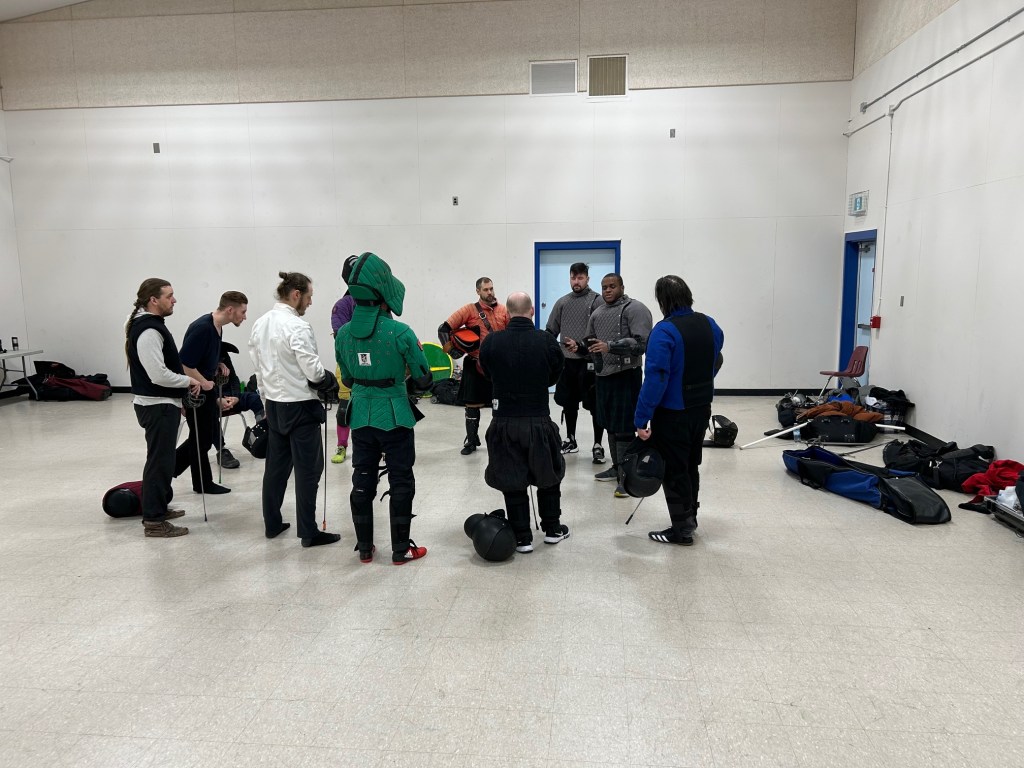
The Classes
Space and reader patience doesn’t allow for a full description of the classes, but here are the topics:
SAT
9am
Maestro Eric Myers: “Better Fencing through using and Exploiting Fundamental Concepts of Fencing, Part 1.”
Coach Xian Niles: Strategos
11am
Maestro David Coblentz, “Setting up Students for Success”
Prevot Tim Guerinot, “Intention, Provocation, and Second Intention”
2pm
Coach Jim Emmons, “Text & Technique–From Description to Practice”
SUN
9am
Maestro Eric Myers: “Better Fencing through using and Exploiting Fundamental Concepts of Fencing, Part 2”
Prevot Tim Guerinot, “Intention, Provocation, and Second Intention, Part 2”
11am
Maestro David Coblentz, “Helping Students make Good Decisions”
Coach Xian Niles, “Am I still Doing the Thing?”
2pm
Coach Jim Emmons, “Concluding Remarks” [1]
The success of this year’s event has encouraged us to make this happen again, and if possible, often. We haven’t settled on a yearly or biannual schedule, but one way or another, the value of this type of meet-up was obvious in the marked-improvement in the attendees even over two days.

Why this Matters
Historical fencing is not so much a community as it is a collection of micro-communities, and so when it comes to any future forecasting there must be some qualification. I cannot speak to 99% of the community–I work with a small fraction of it. This said, for that sliver of the pie, I have some ideas for where it looks like we are headed.
SD, because it doesn’t seek ownership or control, will continue to reach out to recognized authorities for help in improving coaching and fencing. Many of these people may hold a master of arms, many will not. Expertise comes in different forms, and the ability to recognize that, and harness it, is what makes an organization like Storica Defensa both flexible and strong. Moreover, some fencers respond better to certain teaching styles, and since our goal is student and coach success, this means including any skilled fencer with sufficient depth and knowledge to assist us.
Not everyone cares about qualifications. Worse, many ascribe the wrong set of rubrics to what they call qualifications. Again, this is not just my sorrow and frustration over the anti-expert and anti-intellectualism so pervasive in the United States–it is painful and terrifying watching how this anti-expertise idiocy is helping destroy the nation we were and might yet have been to create a plutocrat’s playground.
It is also a known fact within “HEMA” that many favor things like “HEMA Ratings” or the over-confidence of play-acting scholars. They can do whatever they like, but few such people will get an invite to help us, because failure to understand the relative nature of tourney success and aping actual scholars only takes one so far, and, not as far as we wish to go.
This said, there is a LOT of talent in the wider community, but few truly effective means of harnessing it. Different foci, geographical distance, jealousy, arrogance, and even the innocent failure to understand that there is more to all this than one sees do much to prevent not only better unity, but also the sort of improvement we see in better developed branches of fencing, Olympic most of all. THIS is why my comrades to the north created Storica Defensa–we need it.
As a final word, but an important one, it is vital to note that SD is not a vanity project, certificate factory, or attempt to overthrow any other viable and worthy program. Over time, as people see the events we put on, as they see how we run tournaments, how we approach teaching; as they see how their coaching improves, how their students improve; as they see the caliber of fencer we ask for help, as they see the maestri and other experts we have asked to oversee and guide SD; all of these things will be the proof of that. [2]
There has been, sadly, considerable suspicion around what we are trying to do, and I’m happy to say none of it has any foundation. We’re literally doing what we say we are doing. It says a lot, and little of it positive, that such suspicion so naturally arose around an honest effort to make things better. In some cases, personal beef with one or more organizers, fear, and concern for turf explains these concerns, but I suspect a lot of it too is just curiosity poorly expressed.
I know I speak for all of SD’s organizers and coaches when I say this, but let me assure you that
- we are not trying to overturn your program or replace it
- we are not granting ourselves titles, authority, or certification
- we will not tell you how to run your club, curriculum, or what events to attend
We are, though, doing the following:
- working to improve coaching in historical fencing
- working to improve fencing in historical fencing
- working to create a viable, varied, and robust program to train coaches irrespective of any other program with which they may be involved
- working to build bridges internationally and within North America
NOTES:
[1] I had a class prepared for the afternoon slot on Sunday, but one part of teaching is reading a room. People were fried. At least one person, no kidding, was on a knee, head on their hand, looking like they needed a nap. There was also nothing in what I had planned to do that had not already been covered in depth by the other coaches.
So, I opted to scrap my class and sum up–this included a very brief reminder of how we can approach a given technique, in this case a beat attack, and build not only possibilities from it technique-wise, but also tactically. I could tell from peoples’ faces that they were a little confused that I had scrapped my class, but I lack sufficient vanity to put tired, mentally exhausted people through another in-depth class when what they really want to do is relax, free bout, or hit up our guest coaches for lessons. And, it turned out, that Javier, one of our attendees from Calgary, was celebrating his birthday that Sunday and wanted birthday bouts.
I never really know how well or poorly a class goes–few people offer a lot of feedback–but I stand by the decision.
[2] SD has approached and enlisted the help of several well-respected, certified experts to assist us as we grow. We have the honor to have the experience, knowledge, and guidance of:
Maestro Michael Knazko, Ars Dimicatoria/Barbasetti Military Sabre since 1895, Prague, Czechia, EU [Chief Advisor to SD]
Maestro Francesco Loda, PhD (x2), Cinecittà-RFA-UniTeramo, Rome, Italy, EU [Advisor]
Maitre Steve Symons, former President and CEO of the Canadian Fencing Federation (2004-2012), Winnipeg, Canada [Advisor]
Masks & What Matters
[I’m not a fan of “trigger-warnings,” but as most folks who read this page read it for fencing, this post has a fair amount of politics as they relate to sport, etc. Unless you’re up for reading a beat-down of right-wing idiocy, don’t read this]
This summer’s Olympics have witnessed considerable controversy, from artistic choices in the opening ceremonies to some truly strange debates over sex and gender. I won’t waste anyone’s time with my views on artistic expression, but I’d like to address the vitriol a few man-boys have made about female athletes, gender, and athletics. As a coach, as a human being, and especially as one who works with a diverse clientele, I have a responsibility to do right by them.

Predictably, the men whinging most are the least fit intellectually or physically to attack a world champion like Simone Biles or Imane Khelif. I have no idea what made them so intimidated by women, but regardless of cause there’s zero justification for it. These idiots make the rest of us look bad, and I resent that. Having been raised by a single-mother; having only a sister as sibling; having had mostly female teachers and bosses; and having been fortunate to marry a woman who deserves better than me, it’s possible that I’ve just been super lucky to see how empty any notion of female inability is. Whatever the reason, it’s important to show my colors, not just to reassure my students, but because one cannot sit on fence when it comes to bigotry.
I am not female and will not dare speak for women. [1] Women are perfectly capable and happy to put morons in their place, and I don’t wish to be lumped in with the morons (not any more than I might be already). With that caveat, I have some perspective on sex, gender, and sports, and think it is important to offer some real-life examples for the simple men who likely have not worked closely with women. Moreover, at the moment, most of my students are, or identify as, female. Most are young, between the ages of 11 and 15, so there is an added impetus to be a good role model and influence.
As a middle-aged, cis, white chap there is an important responsibility on me not to be part of the problem. It seems like common decency to me to support, advocate, and build-up my students, especially as there are so many men who look like me spouting horseshit. Often, these same clowns are vocal, loud, and quick to say things that can hurt regardless of the fact there is no truth to them.
Persistent Perils
I don’t follow the news much, because with treatment resistant depression the news does little to lift my mood, but I follow enough to know that athletics, across the board, continues to be plagued by horrors that should never happen anywhere. From coaches molesting their young charges, to sexual harassment of colleagues, to downright dismissal as serious competitors, women face a disproportionate amount of abuse. It’s utterly shameful.
We are making some progress, but we clearly have a long, long way yet to go. Organizations like Safe Sport have done much to increase awareness of the issues, and importantly, educate coaches about better, more professional and appropriate interactions. This, of course, won’t fix creeps, but it can reduce both unintended line-crossing and foster both better awareness and behavior.
Real change begins with us, each of us, in our homes, at work, with friends and family. Not to wax hippie, but we have to be the change we want to see. It won’t convince everyone, but it will convince someone.
Sex, Gender, and Fencing
Historical fencing falls under the general heading of “combat sports,” and traditionally such pursuits are a “male” arena. Despite historical precedent, science, and good sense, there are still men quick to say that while women might play sportsball, they have no business boxing, or wrestling, or using hand-to-hand weapons. Claptrap.
Absolutely women should be able to pursue these arts. There’s no reason why they shouldn’t. This is especially true where weapons are concerned.
The truth was summed up beautifully by Francesco Marcelli in 1686:
Vis enim vinictur Arte
“For strength is conquered by Art.” [2] The use of weapons changes whatever physical advantages one was born with—it does not level the field automatically, but it can, and, regardless of whatever one has in the way of genitalia. In many martial arts, size and strength play a greater role, and so weight-classes, age brackets, division by skill level, all characterize competition. This is sensible. A 5’ 9,” 140lb woman might be plenty strong and skilled, but in grappling arts she will be at a disadvantage against a man 6’ 5” and 350lbs. Put a weapon in her hand, though, the math changes.
Sad as it is to say, I remember when women were finally allowed to fence epee and sabre. It’s not that women didn’t dabble in these weapons, but that they could not compete. It was not until 1996 that we saw women’s epee in the Olympics. Women’s sabre did not appear in the Olympics until 2004! Up until then, the only weapon women were allowed to compete in was foil. It seems ludicrous now, and it should, but these changes only happened twenty to thirty years ago.
You are a Mask
Outside of severe physical or mental limitations, anyone can and should be allowed to fence, box, or wrestle. One advantage to fencing is that the addition of a weapon can—again can—mitigate size and strength differences.
In my classes, in my lessons, everyone is a MASK: their sex, gender, sexual orientation, all of that is largely irrelevant. Not unimportant, but in the context of what we do—fencing—irrelevant. Identity makes no difference. In the HBO series “Game of Thrones,” Aria’s sword-master, Syrio Forel, shares a similar view. When his new student remarks that she is a girl, he replies “Boy, girl… You are a sword. That is all.” [3] Though fiction, the author, George R. R. Martin, shares a truth most serious martial artists know–skill is skill.
For me, the acquisition of skill is challenging enough without adding additional hurdles—as a mask, one has only one task, one focus. In the salle/sala, the only concern is growth.

In truth, there are still some considerations; anatomy, for example, sometimes dictates decisions about safety-gear. Women with larger chests, for example, often struggle to find suitable protection. Most of the off-the-shelf stuff is one-size-fits-all, and I’m told uncomfortable to wear. There is a major opportunity for an enterprising person to devise better solutions for chest coverage.
Every body is different, regardless of sex or gender, and so my job as a coach is to help each person find a way to stand and move that takes into account their unique shape. If one’s hips are a little wider, fine, then try standing a bit more square versus in profile. Likewise, if one’s chest is broader, one may have to turn at the hips to make an inside parry. If one is recovering from injury, has balance issues, whatever, there are ways to make it work most of the time.
Mask & Culture
Happily, the culture I’ve worked hard to create has tended both to minimize problems in class and scare away people who don’t share the same values. Advertising one’s stance on key issues, as I do on this site (go to “About Us” and scroll all the way down), does much to send bigots packing. It’s rare, but on occasion I have had to reeducate young men who “didn’t want to fight a girl” or had something outdated to say about either the ability or suitability of women in combat sports.
As I’ve remarked here before, I’ve fought alongside female martial artists all my life. When my formal training began, so did my sister’s. In college I fought alongside female fencers. I know women in a variety of martial arts, from fencing to BJJ, and a lot of female coaches and club-heads. They are my colleagues, peers, and friends. Their identity as female, again, doesn’t weigh into things for me because what matters is their ability and outlook. If we share the same values and they’re good at their job, then great.
There is only one place where I feel I need to pay more attention to their identity—as an ally. This is true as colleague, coach, or student, in any role I assume. This is to say that men should advocate for their colleagues regardless of sex or gender, and, regardless of where that man is in a hierarchy.
At my age, I have seen a diverse range of behaviors towards women in sports, some great, some bad. Current politics in the United States has reached a point where it’s no longer enough merely to support—one must act. What one does may not be national or international in scale; it may be local. As an obscure coach in a small city next to miles of vineyards and hop-fields, I see firsthand, every day, the very same problems we see on a national scale. My focus, thus, is here, helping where I can, as I can. I do my best to model a better way for my students, and, I do my best to create an inclusive, safe atmosphere in which to learn.
I don’t talk about any of this much, because being an ally is something one does, and in a day where “virtue-signaling” is as ugly as a running mate plugging a book arguing that “progressives” are “subhuman,” I’d just rather not contribute to useless, ego-driven posturing. [4] Ideally, advocacy comes out in all that we say and do. I’m talking about it here because the comments about Ms. Khelif, the addition of a new student in my sabre class, and the observations one of my 12-year-old female fencers shared last Sunday highlight the importance of the issues. Each example highlights either the problem with attitudes toward women, as was the case with Khelif, or, gives the lie to ideas that women might be less skilled or knowledgable.
From the Mouth of Babes (NB: “babes” in the age sense)
To give the lie to the idea that women have no place in sports, I submit the following, recent examples. First, there is a 15-year-old female fencer who just started attending my Sunday sabre class. She has worked with me for several years via the parks and rec class, but she caught the bug—she loves this stuff, wants to do more, and is keen to improve. In consultation with her parents, I invited her, and them, to the class. [5] When I told the existing students we would have a new fencer, they were excited as it’s been a while since a new person started.
To my delight, they greeted her with open arms, and couldn’t wait to work with her. She soundly defeated the three boys who were there. I am not one to crow, but if I may, I was so proud of all of them. She acquitted herself super well, and was gracious in victory. For the boys—they were thrilled to meet so good an opponent. They complimented her fencing and told her that she would love fencing G., my longest attending student.
This past week, when he returned, everyone had trouble focusing on drills because of the anticipation of what all expected to be a high-level bout. My most experienced student found a serious challenge in the newcomer, and at the end extended his hand and complimented her. She is one of them now, as if she had always been, and for me if I have done nothing else right, I have at least created a safe, healthy culture for these kids however they might identify. They’re mutually supportive, humble, eager to learn, and enjoy a good challenge. If they don’t fence later in life, hopefully the environment in which they did fence, and the implicit lessons they’re learning, will stay with them.
As a second example, in an earlier class that day, the youth foil/smallsword class, one of my 13-year-olds wanted to talk about the Olympic fencing she had seen on tele. Her first question was why everyone was hopping about like rabbits and failing to extend the arm on the attack. I nearly cried with joy. We then discussed why what we do seems so different from what they’re seeing in Paris. Since the mid-1990s I have tried, largely in vain, to argue with other adults for the time-honored wisdom of extending the weapon first, and here was a room of young middle-schoolers who not only understand it, but also can call out the very same issues when they see footage of modern fencing bouts.
Sports, Identity, and a Healthy Society
Within that discussion, we discussed the issue of people gravitating to what is easy versus what is hard. In explaining why modern fencing allows silly things like not extending the arm we discussed how hard it can be to change large organizations, to change what people find comfortable, and what benefits those in control. Change, all change, begins with an individual. Working together we can do more. This rounded back to why we look at things the way we do in our club. I have always reminded them that what we do is super difficult and takes a long time to learn and do well. They know that one is never finished learning. Our way is harder, but richer.
There is a real-world parallel. Bigotry is generally born of ignorance and fear. It’s lazy, comfortable, easy. It takes zero strength or courage. It is harder to rid oneself of bigotry if one benefits from it. These are the reasons it is so entrenched in American culture, and, one reason many people are so afraid. It takes courage to face something or someone new. It takes courage, strength, an open mind, and a willingness to change one’s stance given new data. Much as I don’t want a bunch of bigots at my sala door, I would honor the chance to introduce them to people that terrify them and let them learn for themselves that regardless of gender, sex, race, or sexual orientation, they’re all just people.

Traditionally, fencing is male dominated, and a “white” sport, but it hasn’t been that for a long time if ever. History recounts a number of female fencers, fencers of color, not to mention some pretty fluid gender identities. Whether we’re talking about one of my favorites, Julie d’Aubigny—better known as “La Maupin”(d. 1707), or the Chevalier Saint-Georges (d. 1799), who was of color, or the Chevalier d’Eon (d. 1810), who wore women’s clothing, fencing has never been exclusively male or white. More recent history indicates just how much it has all changed– Peter Westbrook, Ibtihaj Muhammad, and Sada Jacobson are just a few examples.

after William Ward, after Mather Brown
reproduction of mezzotint, original published 1788, National Portrait Gallery, London
The Person in the Mask is a Person
Despite my being an old white dude, over the past few years more young women have enrolled in my classes as have many LGBTQIA+ fencers. Not all stay, but some do, and that is significant. There is no magic involved—retaining anyone comes down to one simple factor: how we treat them. Honor another human being as a human being, as a person. It has proved important for several reasons.
First, I have been told by several LGBTQIA+ fencers of the relief they have felt in knowing they are free to be themselves, and safe, at my school. Locally, the past few years have seen increased hostility towards any student that is not white and straight. The effort by alt-right school board members in my city, for example, to ban any symbol but the American flag was a clumsy attempt to ban both Pride and BLM flags. [6] I got involved with this as parent, educator, and coach, and like others ended up the blacklist of one alt-right supporter. No one shares a list like this on the internet to send one cake…
TWO of my students at the time were directly affected by this. One, who bravely spoke up during one of the virtual board meetings, told me his heart about sank when he saw me on screen, a wall of books and a giant American flag behind me—it’s our flag too, and, propaganda works both ways. He was relieved when he realized that I was sharing the same message of inclusion he did. Another student ended up moving when one of his parents, at the time involved in education, received death threats. I could not let these students down, I didn’t want to let any child down.
Second, I have no illusions or fantasies about my role. I’m a recreational coach in a small, rural city, and while I have had the great fortune to work outside it, even in other countries, what will matter most in the end is the impact I have here. Each generation, if it’s on its game, does what it can to help and prepare the one to follow. I want these kids to grow up and inhabit a world where we see less of the idiocy around sex, gender, and sexual orientation. It causes so many people so much pain, and for the lamest of reasons. We can do better, but only if we ourselves actually do better, and, give these kids a map for social interaction that emphasizes their common humanity. My hope is that what little I can do will help, at least enough so that when they leave the salle each week, they will carry some of the lessons with them they learned while in their masks.
NOTES:
[1] Someone like me can support, can advocate for, and stand with women, but as a male I have no business speaking for them. That has always been part of the problem–witness the idiocy of men determining national and state policy with regard to women’s reproductive issues and rights.
NB: in using the term “women” I mean those born so or who discover that they are. Each person has the task of determining what their identity is, and yes, in some cases it may change or defy easy definition. So what? Regardless of how they identify they’re a fellow human, and that is what matters.
[2] Francesco Antonio Marcelli, The Rule of Fencing, Book 2, Ch. 1, 55-56 in Holzman’s translation.
[3] Game of Thrones, HBO, “Lord Snow” S1: E3.
[4] The alt-right rejects data, evidence, and reason. Denying facts is not disagreement, but willful denial of fact. Everything comes down to their “values.” As an historian who spent a lot of time studying the early church, I especially challenge them on their persistent use of OT lawbooks rather than the NT commands of Christ. Lists of dos and don’ts are easy, convenient, and do not require one to think or choose. The second great commandment Jesus laid down was to love one’s neighbor as oneself. He didn’t include exceptions. Moreover, he expressly told people not to judge others. Somehow, though, judging others and choosing exclusion over love and understanding defines their “Christianity.” On a similar note, the cover of the book Vance touted features a hammer and sickle, a nod to rightwing fears of Commies. There are no commies. Both of them are keeping pretty quiet right now. What we do have, and what the DHS and FBI have released reports about, is the great danger we face from right-wing terrorists. But again, facts don’t matter to them.
[5] Complete transparency is an absolute must when working with minors. I encourage parents to stay for practices—it reassures them, often makes the kids more comfortable, and no one is better to help a child with an ill-fitting jacket or the like than one of their parents. If a lone child is waiting for a parent, we wait outside at the grange or in the public lobby if at The Aquatic Center. There should never, ever be any question as to one’s ethics. Working with children is a sacred trust and must be honored as such.
[6] The damage that the alt-right members of the school board did has been considerable. This was, of course, part of the plan—fascism thrives best where people are not educated in anything other than party dogma. Two articles should suffice to explain the issues:
Budget Crisis: https://www.kgw.com/article/news/education/newberg-school-district-faces-more-than-3-million-dollars-in-debt/283-4639e728-df91-4082-80be-487fc871df9b
Alt-Right on the School Board: https://www.oregonlive.com/education/2023/11/trial-begins-challenging-alleged-secret-meetings-to-discuss-firing-newberg-schools-superintendent.html
Just this weekend, so 17 Aug., a LGBTQAI+ student informed me that my attitude is one reason she has stuck with my program. I honor her for who she is, and while I will fight to the death to protect her right to love whomever she might love, the fact of her orientation is, again, irrelevant in learning fencing.
Tending our Gardens
“Cela est bien dit, répondit Candide, mais il faut cultiver notre Jardin.”
Candide, Voltaire (1759)
Unlike most posts here this one, while it deals with some aspects of historical fencing, likely will say far more about me than anything sword-related [readers keen for the former can stop reading here]. We each of us have our karmic burdens, our boulders to push uphill over and over again, and so long as we don’t go completely mad or become crushed by those boulders, so long as we take a look around us, chances are good we may learn something. If nothing else perhaps we build resilience and in a chaotic, irrational, and unerringly unfair world, that counts for something. Not to admit defeat, at times, is the best middle-finger one can extend to that chaos.
In my case, and returning to karmic burdens, I seem to require relearning certain lessons repeatedly. Perhaps I’m uncommonly thick-headed (jury is mostly still out on that) or perhaps I was born under an unlucky star, but regardless the one lesson I’ll be highlighting here concerns assumptions about how people think. Fair to say, I’m a walking poster-child for all manner of mistakes, but this one, because it might conceivably help a reader, seemed appropriate to share. It’s also an issue I run into all the time in the historical fencing community: I assume reason; I assume evidence matters; I assume people look to these even when first experiencing something emotionally, but by and large they do not. I always fail to realize most people work off emotion with little to no rational reflection. [n]
When we lack or fail to use more rational introspection, we can come to the wrong conclusions. That can be especially dire if the conclusions are about another person’s intentions, because we may blame them or attribute motives to them that are not there. There are many explanations as to why this happens, and while interesting to analyze, the why is less important than developing ways not to make the mistake. Our operating assumptions, viewpoint, and experience can be at complete variance, and we need to be aware of this fact. Sometimes we may look at the exact same thing, but we come away with different conclusions, and the more we realize that this might be in play, the more likely we are to find happier solutions.
It may be my age or life-experience (it’s no doubt both), but it’s clear to me that often I’m not, to quote Inigo Montoya, “using the same wind they are using.” I run into this time and time again, and because I value reason, analysis, etc., and because life has not allowed me much opportunity if any to assume I’m always correct, I look at this and think that the one common denominator is me. Somehow, I must be doing something wrong, or expressing things in a less ideal way, something. Often that is true, but, just as often the problem isn’t me.
When we find ourselves in any disagreement or confrontation, it’s healthy to ask what our responsibility is and what we may have contributed to the problem. Emotion is not our friend in this instance—depending on one’s emotional make-up and experience, guilt, fear, anger, all manner of unhelpful emotions, often unrelated to the event at had but the awful gifts of past trauma, infect the current problem. So, we have to think, analyze evidence, and as much as possible work from facts. It’s not that emotion is wrong or bad, it just is, but if we act on emotion alone we get into trouble. Sometimes a lot of trouble.
One thing I try to remember is that very few things in life are about us. The me-o-centric universe that so often seems to shape behavior today, while common in the age of the selfie and instatwitterbook, is a deviation from normal. Put another way, not everything is about you. In the example that spawned this post I realized pretty quickly that while directed at me, the issue was not about me at all, but another’s own doubts and sense of self. That is liberating for me, and that’s nice, but out of concern for the other party I felt compelled to respond to their message.
Even when insulted, angry, or hurt, some pause, some time to allow ourselves to feel something, and then time spent thinking about it, applying the tools of reason, is vital. Analysis makes emotion take a back seat. Analysis clears the way for us to be more compassionate, odd as that may sound, and in most human interactions if not all compassion is a far better response than any other. What I know, just from my own collection of personal hells, is that very very few people know I have them, and so, I suspect that everyone else does too.
When I received that recent complaint, one I felt was unjust, I was angry—it’s an extremely short trip as I am baseline angry all the time and have been since I was eleven. I also knew that responding in anger would do nothing, in fact, it might make things worse. I let that wash over me, just as one might a wave too large to surf, and thought about it—why did they send this? What is it that they’re upset about, and what if anything does it have to do with me? Do I own any part of it? What steps make the most sense to improve if not solve this?
When I responded, it was after sober reflection, well after the immediate emotional response, and I did my best to be polite and fair. This person felt hurt whether I believed they should or not, and so it made sense to tread lightly, to be compassionate. This doesn’t mean I didn’t explain things from my perspective—I’m not good at taking things on the chin—but my hope was that what I shared might help them reevaluate their own perspective and maybe reexamine their own assumptions. I have no idea how they responded, as they didn’t reply, but I hope that they realize that some of their fears were without foundation, and, that I in no way had it in for them. I have monsters enough to fight without trying to creating enemies.
The Point: the reason I am sharing this extremely personal, embarrassing, and uncomfortable stuff is because the approach so closely matches the decision making in fighting, in fencing, and especially in a competitive space. Emotion is not our friend in fighting—it will steer us wrong. Good fencers spend years learning to think versus feel, as do most martial artists, and there is a good reason, one beyond the benefits in fighting. It is practice for life. If one spends hours and hours a week actively choosing to think rather than react emotionally; if one works at keeping a cool head; if one does one’s level best to see each opponent as a teacher, a learning opportunity, as an equal, a partner; if one approaches a fight of any kind with understanding and compassion; then one is more likely to use the same approaches and point of view in other aspects of life. Make no mistake—it takes considerable strength to wield understanding and compassion in a disagreement; it’s far harder than anger. Anger is easy.
As a caveat, I am not saying don’t feel things or that one should stifle emotion, not at all. FEEL what you feel, give yourself space to feel whatever it is as powerfully as you must, for as long as you need, but then set it aside. We feel all kinds of things, and no matter how real, legitimate, or illegitimate, one should always think before one acts. It’s a cycle, because we will (hopefully) always feel things, but rarely is it wise to act on feeling alone, this is as true in fighting as it is in romance, as true at family dinners as in one’s workplace.
Fencing, I know, rarely applies the same life lessons that one more commonly finds in East Asian martial arts, but it’s there. The Art is one. It belongs to all people, all nations, and no matter what it is, Muy Thai, fencing, boxing, BJJ, Tai Chi, you name it, one can find meaning in the study of the Art beyond the piste or ring. There is something to be said for a path that helps reduce the pain of existence, ours, but maybe that of those around us too. We are better able to, as Candide recommended, tend our garden. One thing Voltaire left out, that I’d like to add is that our gardens invariably lie adjacent to those of many others, and so part of tending our garden is being mindful of those next to us, that even those in gardens far away, face the same struggles, the same challenges, and thus deserve some empathy.
 Capitale Escrime Historical Fencing