Manitoba Highland Gathering Tournament, East Selkirk, Manitoba, Canada, 22-23 June 2024
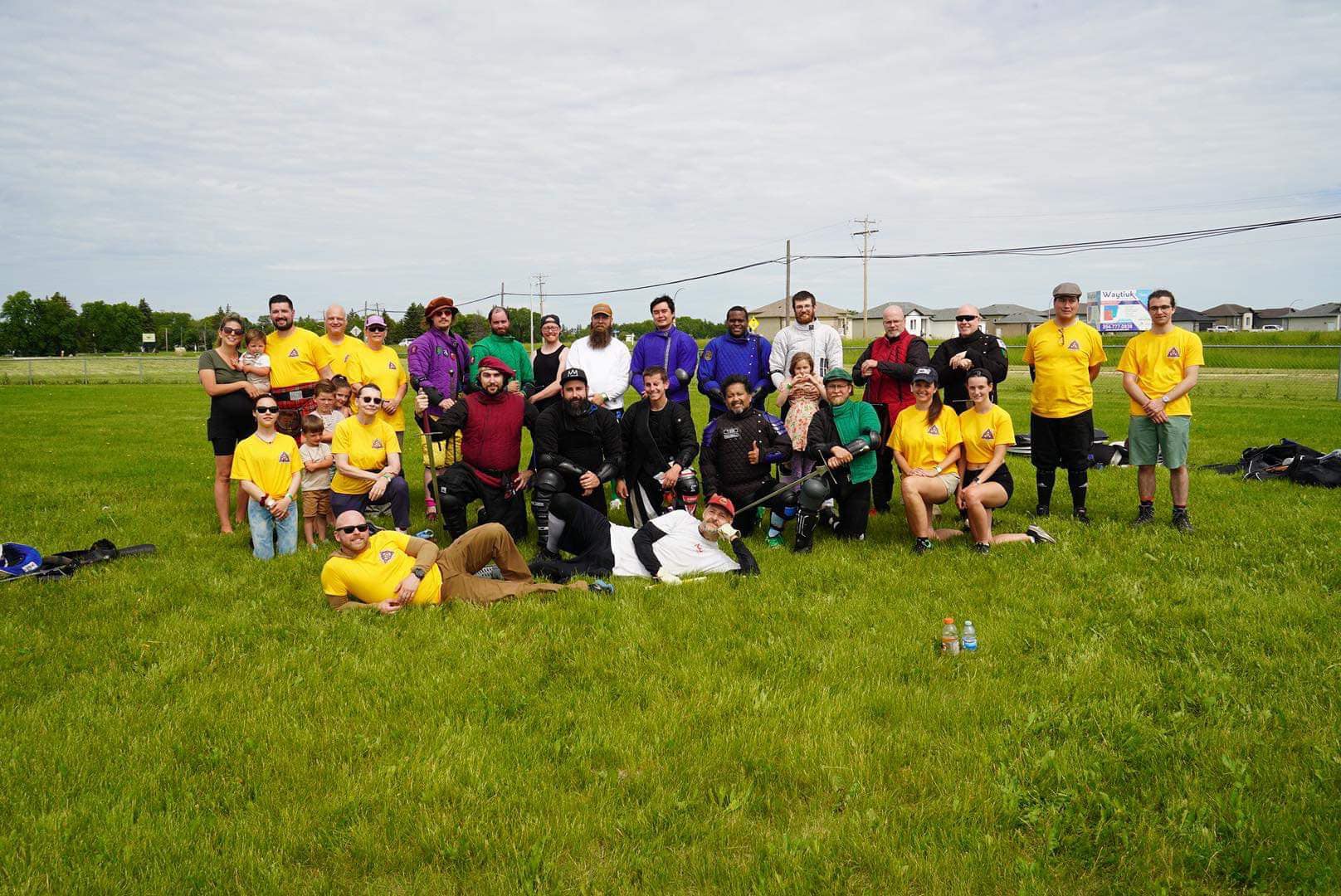
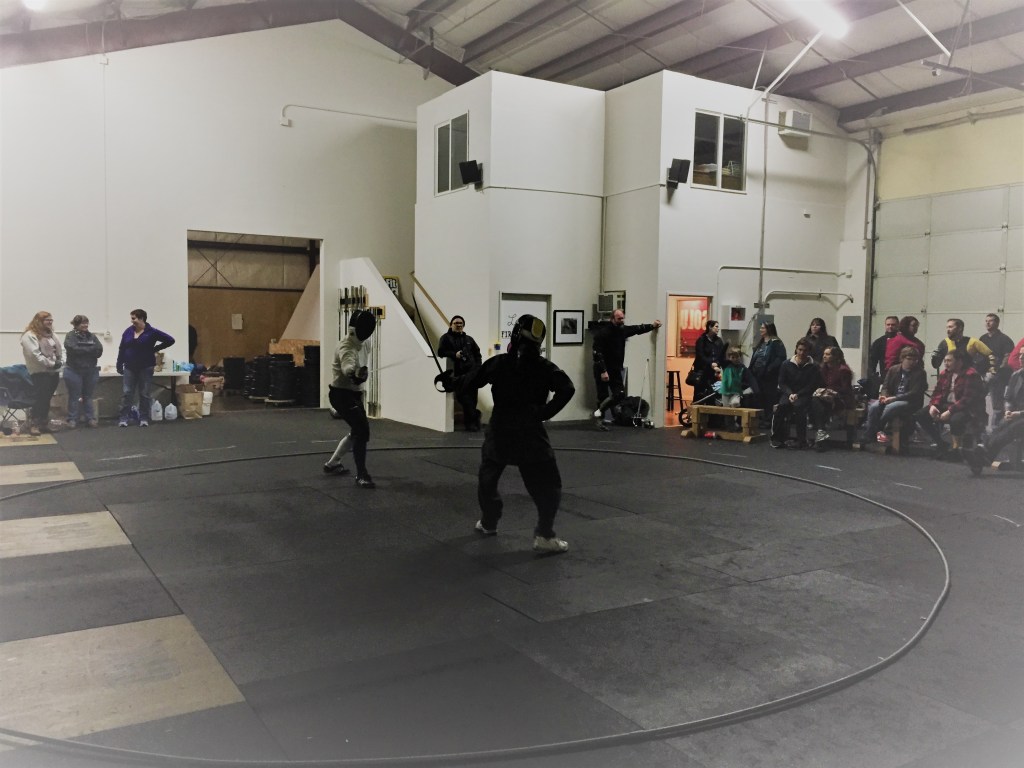
This past weekend, I had the great privilege to attend and assist my Storica Defensa colleagues in the various tourney pools at the Manitoba Highland Gathering in East Selkirk, Canada (held June 22nd and 23rd). This two-day event included longsword, veteran’s sabre, broadsword, and women’s smallsword. Despite some truly warm weather, some swampy fields, and a few moves between gyms, everything went amazingly well. The MHG Tournament marks the seventh SD event and serves to add another data point in support for the approach we are taking to competition.
In terms of safety, no one was hurt. Not one. To date, there have only been two minor injuries in SD events, both involving a failure in gloves to protect forefingers. This is more a kit issue than one of safety culture, and no such injuries occurred last weekend. We place heavy emphasis on safety and no hard-hitting is permitted. So far as I know, not one judge had to remind anyone about force levels. Club members, especially Eric Elloway, army veteran and first-aid certified, brought a giant cooler of water and officials pushed hydration hard. In fact, my friend Xian Niles noticed I was starting to stare off and had me get water, then go sit in the shade (thank you my friend, that was a wise decision). Best of all, the fencers looked out for one another—on two occasions I witnessed, fencers halted action so their opponents could fix gear.
Very Serious Fencing…
The camaraderie was visible and honestly endearing. Most bouts ended in hugs as well as handshakes, and people were keen to keep fencing post event. This is not to say that the competition wasn’t high, because it was as any clip of footage will demonstrate. The hush that fell upon us all watching some of those final matches… I don’t think anyone made a peep during the final broadsword match between Xian Niles (Niles’ Fencing Academy, Halifax, Nova Scotia, Canada: https://www.nilesfencingacademy.com/) and Zach Brown (Superior HEMA, Thunder Bay, Ontario, Canada: https://www.superiorhema.com/?fbclid=IwZXh0bgNhZW0CMTAAAR0noPMDPX7PaM8kxh8SpQdf-e15Ie53xzsJucV58BZno1pycKsN_r25q9I_aem_yB6MUK3J6OWM7jK68jGjaQ). People were quick to concede points and generally did so appropriately, and were gracious when calls didn’t go their way. If anyone needed gear, another fencer was happy to help. Rarely have I seen so many competitors as generous in assistance to one another as I have here.
The level of skill was high. The pools were designed around Storica Defensa competitive levels as much as possible. Most action was easy to follow, and thus, easy to judge (comparatively speaking—judging is never easy). The timbre of an event, the expectations that are set, do much to determine how an event goes. SD’s rules and expectations are clear in the ruleset, and so from the off everyone was more or less on the same page. In specific terms this means that people knew any hard-hitting would be called out, that fencers were honor bound to admit a hit, and that there would be zero tolerance for poor behavior. We also hit the safety aspect hard. I mean, HARD. To put this another way, these expectations attract a particular type of fencer, and in doing so, discourage those fighters keen for garbage like heavy-hitting, use of the afterblow to gain points, and other b.s. Free-fencing post pools was common, and speaks again to the level of positive interaction—people wanted to keep fencing one another.
Eric Elloway with a beautiful running attack in the vets’ sabre event
Organization is critical to running a good tournament, and it is a testament to the planning Jay and crew had that even with a few hick-ups everything went smoothly. Day one was super hot, not a cloud in the sky, and in the morning the ground was a bit damp; day two we had to switch gyms. In each case everyone just got to work and made things happen. We carried tables, gear, scoring placards, everything, and neither day went late. In fact, on both days we ended in time for people to free fence for hours before the Gathering shut down for the night.
SUMMARY:
The MHG Tournament is growing, and in time I suspect will double in size. It’s not just the fact that winners in each event received lovely prizes—sharps, training weapons, and discounts for gear—but that people were safe, enjoyed the fights, and were eager to socialize afterwards. This event is one I am adding to my list of go-to, must-attend events (the others being SabreSlash in Prague, Rose & Thorns Historical Fencing Symposium, and the St. George’s Day Exhibition of Arms).
Following fast on the heels of another two-day tournament I attended, this time as a live-stream announcer, the contrasts stood out starkly. That first event was large, and in most respects typical of “HEMA” events. [n] For example, I witnessed a fencer injure another—twice. The offender was barely censured, but should have been black-carded, and the victim, though evaluated by a medic, was not taken to the hospital. He should have been as he received a pommel-strike, full on, from a running opponent, and was visibly shaken, never mind nursing a mask-waffle print on his nose. The judging was also poor. The silver medalist in rapier, for example, should have taken gold, but the judges failed to call the action correctly. Many, I found out later, were pretty new fencers.
One of Storica Defensa’s goals is to provide better tournaments, not only safer ones, but better run, better judged ones. In this it is exceeding expectation, and I’m keen to see this develop. True, I have a stake in it as a coach for SD, but I stand by what we’re doing. It’s working.
This post is a follow-up to the last [“They Doth Cut too Much,” Methinks, 19 Oct. 2023] and takes up, again…, the issue of how we make a touch. This issue has been on my mind a lot in part because of teaching, but also because my current book project requires me to explain the challenge of hitting without being hit as simply and clearly as possible. While I’ve discussed this often, which is to say like the drone of a bagpipe in a particularly long air, it’s one of these critical issues that we can never really emphasize enough. The proper mindset determines everything we do.
In brief, rather than focusing on making the touch, we should focus on trying not to be hit. It’s easy to say, but far harder to put into practice. The old adage “nothing ventured, nothing gained” might work in dating, but it’s rubbish as a maxim for self-defense. We focus too much on offense. While the same conservatism would help Olympic fencers, it’s less necessary for those in foil or sabre thanks to the conventions of right-of-way (ROW); epee fencers, on the other hand, would certainly benefit. If the entire point of historical fencing is to approach as best we can how swords might have been used in the past, then fencing in ways that run counter to that ethos is nonsensical.
“HEMA,” the popular expression of historical fencing, has been around long enough that it’s likely that many newer fencers, because they have not had to face the issues that helped create the movement, may be wholly unaware of the place that attempting realism had/has in shaping “HEMA.” To enter this world now is, for the most part, to enter a sword-based sport similar to Olympic fencing, only without the pedagogy, organization, and recognition. This means that many fencers in “HEMA” are, in good faith, learning to approach things more concerned with competitive rule-sets than the logic of the sharp point. So ingrained is the competitive outlook that even those not actively competing often adopt the same methods and mentality. Social media, YouTube, and a few of the organizations, such as the HEMA Alliance, present a seemingly unified mode of play and purpose.
As a caveat, there’s nothing wrong with competition—despite all the bitching I’ve done here about problems with it, the fact is I like competition and have enjoyed it myself. The longer I look at these problems, the more convinced I am that many of them, such as doubles, obsession with the afterblow, etc., all might be remedied by better attention to defense rather than making the touch.
The Logic of the Sharp Point
At the risk of sounding reductionist or like yet another would-be western Zen guru, in the end there is nothing but the sharp point. It is all that matters. The entire purpose of fencing is defense—it’s in the name. “Fencing” derives from Middle Engligh fens, a shorter version of defens, a word used to denote defense, resistance, even fortification (the ME term ultimately comes down via medieval Latin defensum). Italian scherma and French escrime both derive, originally, from a Frankish word, skirmjan, “to protect or defend.” [1] While the denotation of words over time often change, it is worth noting the consistency in the meaning of the terms for fencing, and, how the source tradition reflects the same concern behind what these words mean. Sure, we read a lot about offense, but no master I can recall suggests rushing into the fray minus concern for personal safety or suggesting that winning a contest via afterblow is legitimate.
Maestro Nick Evangelista, so far as I know, is the origin for this phrase, the logic of the sharp point, but what he describes is, and should be, self-evident. [2] Every action we make, every decision, should reflect this logic. Having watched Olympic sabre tank in the 1990s, and having the misfortune to watch HEMA make many of the same mistakes ever since, I believe that this same logic should be present in competition. When it is absent, we see a lot of, to put it bluntly, stupid actions.
It is human nature to game systems, to find ways to work around them. We love loopholes. I’ve not stayed current on the latest trends in bio-social-anthropology or evolutionary psychology, but the studies that emerged when I did were sobering. Put briefly, if people believe they can get away with something, they’ll go for it. [3] As great a tragedy as that can be, when our rule-sets then follow suit and make the loophole canon, it’s a far greater calamity. Now a source of authority enshrines the mistake. Given the value most in HEMA place on competitive success (despite all the flaws in that assumption), to argue anything counter to established practice is treated like heresy. This is true no matter how well-supported the supposition might be. Emotion and identity typically beat out reason and evidence. Concurrently, the opinion of some “name” or “HEMA celebrity” trumps most arguments, however sound.
There is little one can do about human nature, and thus, little one can do to fix the cognitive bias that affects HEMA. Moreover, the increasing distrust of experts, in most any field, compounds the problem. The best we can probably do, following Voltaire, is tend our own garden. [4]
Fencing with the Logic of the Sharp Point
What follows is a quick summary of my approach. I’ll use smallsword and rapier as an example as these are the weapons I teach most (I follow the same methodology for sabre). Nothing here is new or uniquely mine—as I see it this is just doing what we should be doing IF the swords were sharp. Fencing this way requires far more concentration on the imagined danger than it does anything else. After all, we do this for fun and wear safety gear, and thus outside the lunatic fringe should have nothing to worry about. [5]
The first rule is “don’t get hit.” If there is a choice between making the touch and being hit, and avoiding the hit, I encourage students to choose the latter. Even if this means losing the opportunity to riposte, better that than be hit. Defense should govern all, and so I teach them to defend unless they are certain that an attack has some chance of reaching target without danger to themselves. For rapier and smallsword especially this means selecting those actions which provide opposition and which allow them to recover either behind the point, with a parry, or with a beat. This conservatism also means choosing the extended or advanced target over the body. The hand, wrist, and forearm allow one to strike a vital target—were the weapons sharp such a blow might end the fight—and at the same time allow one to stay farther away and better able to defend (there is textual support for attention to the forward target). [6] In order to defend well students must develop a keen sense of measure, tempo, and judgment, three of the most important universals in fencing. Attendant to observing these principles they must be able to move well, quickly, effectively, efficiently, and with balance. They must possess excellent point control. They must be able to read the opponent quickly.
It takes time to develop these skills, a lot of time. There is no royal road to skill acquisition. This said, regular practice, proper drill, and the right attitude can do more than one might think. It goes without saying that proper instruction is everything.
Institutionalized Suicidal Tendencies
My horrific GenX puns aside, HEMA is quickly institutionalizing (if it hasn’t already) an approach to fencing that would get most people killed were the weapons real. [7] The number of students I talk to who experience a peculiar gaslighting in bouts grows all the time. For example, one of the students I see, and who fences at another club as well, has been frustrated by the lack of concern colleagues at the latter seem to possess in bouts. Even when he has the initiative and launches a good thrust, one they should parry, they’re as likely to make some counterattack with a feeble cut than anything else. They have zero awareness of the problem, but my friend does because he fences as best he can to the logic of the sharp point. It is far harder to see this clearly when everyone around us sees it another way. We’ve chatted at length about it, and I’ve assured him that from what I’ve seen of him fencing, what I’ve experienced bouting with him, and from what I know of other clubs, he’s doing everything right, but, can’t and shouldn’t expect others to know that.
This is an uncomfortable place to be. This same friend wants his mates to improve too, but they won’t so long as they continue to fence like they’re playing a game of tag. Our bouts shouldn’t be about who hit first, but who hit and was not hit. I’d be at a loss for why this is even an issue, because it seems so obvious, but the truth is before us: the people playing tag think they are doing it right.
Earlier I mentioned the problem of cognitive bias: this is the best explanation for what my friend, what so many of us experience fighting in genpop HEMA. [8] The people making that ridiculous cut in rapier against a thrust they should be parrying believe they are acting correctly. It matches what they see in tournament footage, what their clubmates do, and so, ergo, it must be right. So, how do we overcome this problem? Can we overcome it?
I’d suggest as a first step entertaining the possibility that we might have something wrong. With historical fencing, we have copious sources against which to compare what we’re doing, and, in some cases, some pretty decent scholarship about it. All of us have to do this, as painful as it can be sometimes, because no one is infallible. We must consider the context of what we’re learning and place that next to our context which, for the most part, is very different. We should also compare notes, which here means visiting other clubs, taking lessons with people at other schools, and fencing with as many different people as we can (the more skilled, the better). If we do these things and are able to step back from it all, and analyze it, we are more likely to see the patterns, and within those patterns, any deviation. Maybe that deviation is correct, maybe not, but it can no more be taken on faith as anything else.
Let’s use my posts as an example—if you read them, thank you, but please go look up these topics and see what others say. Check my facts. I do my best to fact-check and support everything, but I goof up too. It’s one reason I leave comments on and a contact feature on this website—so I can make corrections when people share them with me. Watch footage on YouTube and look for suicidal fencing; look for more defensive fencing. Read. Chat with people. Collect all this stuff and then compare it. I’m not the betting sort, but I’d wager that if you do, and accept the universal principles outlined in so many works on fencing, you may notice the same set of problems. The more of us who do, the more likely we might effect any change for the better in HEMA.
NOTES:
[1] Cf. “escrime” at Trésor de la Langue Française informatisé,
[3] In the 1990s, early 2000s, two scholars at my alma mater (Leda Cosmides and Joh Tooby) produced some excellent work on this topic. See Leda Cosmides, et al., “Detecting Cheaters,” in Trends in Cognitive Sciences 9: 11 (2005): 508-510; a wonderful, but likely dated book on the topic is The Adapted Mind: Evolutionary Psychology and the Generation of Culture, Jerome H. Barkow, Leda Cosmides, and John Tooby, eds., New York, NY: Oxford University Press, 1992; Jens Van Lier, et al., “Detecting Cheaters without Thinking: Testing the Automaticity of the Cheater Detection Module,” in PloS One 8: 1 (20-13): https://www.ncbi.nlm.nih.gov/pmc/articles/PMC3547066/
I’m no prophet, but the divisions we see within HEMA will likely formalize in time—this is a pity, but understandable. Many of us, myself included, already believe our approach to be different enough that it no longer qualifies as “HEMA” (as typically defined and expressed). It’s one reason I prefer “historical fencing” or “historical martial arts” over the usual acronym. I’ve covered this too often to regurgitate it here, so will leave it at that (see for one examples, “Disparate Places, Liminal Spaces,” https://saladellatrespade.com/2021/06/15/disparate-places-liminal-spaces/ ).
[5] I hit these notes as often as the others, but again, it bears repeating. There is a weird fetishizing of injury in HEMA that I don’t understand. Whenever someone shares some fb post of some smiling fencer sporting their latest battle-wound I hear the words of Bismarck to a young German cadet. I forget where I read it (still trying to find the citation), but supposedly the young man thought to impress the chancellor with his scars. The latter supposedly remarked “In my day we parried with the blade, not our faces.” Von Bismarck was a redoubtable schlager and fought over seventy duels as a student.
[6] I’m not a fan of self-aggrandizement, but since I put a lot of time into this topic, may I suggest an article I wrote, “The Curious Case of the Forward Target in Rapier and Small Sword,” April 2023, available here: https://saladellatrespade.com/instructors/research-media/
[7] The title of this piece is a nod to the 1983 hit “Institutionalized” by Suicidal Tendencies, a band out of Venice, California, and one of the first punk/thrash hits to get much radio attention. See https://youtu.be/LoF_a0-7xVQ?si=c37NGGbWWPi1k6hn
Hiro banging his head against a desk, “Big Hero 6” (2014)
Our sister school, Barbasetti Military Sabre since 1895, recently held its annual SabreSlash event in Prague, Czechia (Oct. 1 & 2). Maestro Michael Kňažko, a dear friend and one of the chief organizers of the event, related that it was the largest crowd they’ve yet had. As one of the best events I’ve ever had the privilege to attend, this naturally makes me happy, and having left most social media I’ve been slowly gathering what news I can from him, attendees, and those following the various stories on sites like facebook.
Of these, one of the more interesting if tragic tales related to me was about the confusion so many in “HEMA” have around right-of-way (ROW) and how it works or used to work in sabre. Much of this is explained by a lack of familiarity or experience with sabre pre-electric as well as electric. As someone who competed before the widespread adoption of electric scoring for sabre, and suffered for several years trying to make it work, I have some perspective that might help should they chance to read this.
One of the comments shared with me was this:
AFAIK, what they wanted to do with electric sabre didn’t work due to the technology. They experimented with sabres that had motion measuring devices, to try and only score proper cuts, and also looked at how to only have the edge and point score. In the end none of it worked properly and they gave up and ended up with the current ‘touch with any part of the magic wand’ result, and I guess in that context they thought they needed to have ROW for some reason. I don’t actually know why they chose ROW for Olympic sabre, but certainly in the late 1800s sabre rules ROW was not universal, and in at least one of the early Olympics they still allowed legs as a target. There was a lot going on at that time and it’s difficult to know why they landed on certain decisions, such as no-legs and ROW. But it was clear by the 90s that everyone was gaming the ROW horribly in sabre.
I don’t know who wrote this, but they raise key points that are worth examining.
First, sabre, like foil, employed ROW before the adoption of electric scoring. The only weapon that does not use ROW is epee. Officially, electric scoring for sabre was adopted in 1988, was first used at a major event in 1989, and was adopted for NCAA fencing in the mid-90s. It was a complete disaster and led, so the author above remarked, to “the current ‘touch with any part of the magic wand'” calamity that has dogged the sport ever since.
Second, the use of the capteur or accelerometer was short-lived. This device, a small gauge inserted into a port in the knuckle-bow of the bell-guard, more often created foil and epee-like mechanical issues on the strip than it did assist in determining the impact of a cut.
As I understand it, there is now a move afoot to reintroduce the capteur as well as the fleche. Good luck FIE, you’ll need it: at least two generations of sabre fencers have learned how not to fence and have about as much notion of proper edge alignment as they do why not getting hit might have value (a failing they share with their cousins in “HEMA”).
Right of Way
This concept is misunderstood and much abused in historical fencing. I get it, I do. As I’ve written here ad nauseam the logic behind ROW is solid–it’s the abuse of the rules around it that is the problem. Briefly, this is what ROW is:
IF threatened/attacked, one’s response should be defensive
In terms of specifics, the Refereeing Handbook provides a nice, short list:
A properly executed attack has priority over a counterattack
A properly executed stop-hit (attack in preparation) has priority over an attack
A riposte has priority over a remise
A properly established point-in-line has priority over everything
None of this applies in epee [1]
Fencers love arguing over what constitutes a “proper” attack, etc., but the first point “should” make sense: if something sharp is speeding toward one, the absolute stupidest thing one can do is counterattack–sure, maybe one hits, but one also failed to defend. Not smart.
The exception, point two, is a counterattack made in the right situation, and thus, at the right time and measure–normally this means one has at least one tempo of fencing time to attempt the counter. Such a tempo is often created by an attacker starting out of distance or attacking poorly, say with their arm too exposed. Ideally one has enough time to make the counterattack AND parry-riposte should that counter fail.
The riposte trumps a remise for the same reason as point one–the initial attack was parried and the initial attacker “should” expect that having lost their initiative, that their opponent is going to make a return. Thus, ignoring that riposte in order to push through a remise, that is a second attack in the same line, is utterly daft.
Ha! I got the touch! You lose bruh!
As an example, a close friend and old comrade from college, recently bouted in longsword with a KdF club in his area. His opponent made an Oberhau, or a descending cut from above and my friend parried this with Ochs; the attacker ignored the parry and thus the riposte and continued to push through, sans any force (it having been spent when parried) and received a Mittlehau or horizontal cut to the abdomen. The attacker was upset with my friend, but the weight of the riposte’s impact was entirely his fault. My friend, realizing that his opponent didn’t have the foggiest notion of the logic of the sharp point/edge attempted to explain it to him, but came away feeling that he had both failed and poisoned the well. It didn’t matter that he himself had been hit, only that he had eventually made contact, however weakly, with my friend’s mask.
Herein lies the major stumbling block with HEMA–getting the touch is not everything, it’s how we get the touch. If the only virtue is making contact, then one doesn’t need classes, drill, or practice. Find a friend, armor up, and just whack away–it requires no art, no science to do that.
The point-in-line, again a subject of pointless (haha) debate among fencers, is a simple concept: if someone is pointing a sharp thing at one, then it behooves one to deal with the sharp thing first before trying to reach target. [2] Put another way, don’t run onto a sword. The line has priority, and thus ROW, because it is, again, rather silly to rush upon something sharp.
No, generally they don’t
ROW as Pell
When historical fencers raise their hackles about ROW it is, nine times out of ten, not ROW they’re upset about but the ways in which their Olympic colleagues game it and/or misapply it. The examples of this are legion and cataloguing them of little value, so I’ll share two classics.
Exhibit A: Slappy Sabre
It would seem illogical that one could score by striking the strongest part of an opponent’s defense, but… one can. Thanks to the nature of the Olympic blade, a well-placed blow–yes, even with the s2000–can whip over the guard and hit. Because the rules allow any part of the blade to score, it’s irrelevant in the sport if one hits flat. This was a major problem in the 90s and one of the things that drove some of us out of competition–the choice was leave or adapt to the idiocy of some game divorced from fencing. Careers and more than one generous commercial deal were made this way.
It didn’t used to be like that. Before electric, before the director had to obey the box, they listened for the sound of steel or fabric, or the order they were in, and moreover, looked to see if a thrust was passe, that is, whether it had brushed against the target rather than sticking or slicing into it. The entire approach to sabre, even to how much of it is taught, exploited the disappearance of these critical nuances and does so still.
Exhibit B: Floppy Foil
Changes in timing within the box have helped, but a standout example from foil is the infamous “flick.” If one has ever held an actual smallsword or epee d’combat, one will realize instantly how insane this attack is. The argument for it was that it constituted an attack because the fencer had “forward momentum.” It was irrelevant that their blade might be pointed towards the sky or behind them.
Many of these flicks landed on the back and no one was turning tail, so… how an ostensibly rigid thrusting weapon should reach the back when no back was in view might have raised some doubts, but nope. Coaches and fencers eagerly adopted it and referees and rulebooks bent over willingly. For a time the language in the ruleset changed from “extended” arm to “extending” arm, a subtle but important distinction. [3]
It’s not just Making the Touch
George Bluth, “Arrested Development,” a Fox TV show on 2003-2019 at various intervals
Both “HEMA” and Olympic fencing struggle with poor understanding of what a touch means, and thus it’s little wonder they resemble one another more and more. There is a difference between making a touch at the right time and way and just merely making contact, however powerfully or “martially.” IF the goal is to fence as realistically as one can and/or in accordance with the principles that aimed to keep fencers of the past alive, then focus ought to be first on defense and second on reaching target without being hit oneself.
This changes how we fence. We attack less often or haphazardly; we’re more careful. It takes considerable effort and practice to do this at all, let alone well, for as I’ve blathered on and on about we feel safe and do this for fun. There is nothing wrong with fun–it’s maybe the best reason to fence. Likewise, it would be moronic not to fence safely, least in my country where legal and insurance reasons make not following safety protocols truly unwise choices.
This said, as a community we ought to focus a bit more on being honest about what it is we’re doing. If one is not concerned about being hit, only hitting, there are better and less expensive venues for living out sword and sorcery fantasies. You’ll get no judgement from me, I don’t kink shame. You be you and find like-minded consensual folks with whom to play. However, for so many in HEMA to insist upon a “martial” approach and then jump into the fray without any concern for protecting themselves and solely focus on getting the touch, whatever happens, is about as close to gaming the system in Olympic fencing as it gets.
ROW–Theory vs. Practice
Returning to ROW, the principles behind it are sound. They make sense, but importantly these ideas only work if one abides them, and, attempts to fence correctly. Playing to the director and/or judges, exploiting weaknesses in the rules, etc. are all part of fencing and have been for a long time, but one doesn’t have to fence that way. One can fence properly and in accordance with ROW–the problem is most people don’t, whether Olympic or HEMA. They want to win, not necessarily win and fence well, and too many people don’t realize that there is a difference. As I’ve commented more than once, one doesn’t need to fence expertly to win–if one knows the rules and how to massage them, if one is focused on making the touch at any cost, one can go super far.
Events like SabreSlash, in employing an interpretation of ROW, are raising the bar–appropriately–for competition in historical fencing. To anyone who understands ROW, and how it attempts to introduce the reality of the sharp point, most HEMA competitions look exceedingly poor. For all the time and effort HEMA players put in, the average skill level, if competitive bouts are any guide, is low. One reason for this is that too few fighters approach the bout with the logic ROW attempts to instill.
For colleagues in “HEMA,” learning to distinguish between theory and practice (exploiting rules, poor judging, etc.) will do a lot to lower one’s blood pressure. Learning to fence according to the logic of the sharp point will, if one works at it, improve one’s understanding and skill. [4] There is nothing to lose, and much to gain.
The Unexamined Training Regimen is not Worth Pursuing
ROW is not perfect. It’s just a concept meant to capture some of the reality behind fighting with actual swords. Like any theoretical framework it is subject to human foible, but this doesn’t mean that the core of ROW is silly–it isn’t. The whole point is first, not to be hit, and second, to strike the opponent in ways that minimize risk to oneself.
It’s difficult to understand why this would be such a point of contention in a pursuit like “historical martial arts.” It begs the question: why is it such a problem for some HEMA players? In this instance I think it perhaps comes down to being unable to reach the bar that events like SabreSlash present.
Looked at another way, many if not most of the directors that Barbasetti Military Sabre use are masters. They know more about fencing, and more about competitive fencing given their decades of experience, than most anyone competing. Some attendees have next to no experience outside of HEMA’s flawed rule-sets, and so stepping back, which is more likely, that a collection of masters with decades of experience are worthless, or, that the HEMA players whining are unhappy that their usual approach failed them? It is easier to cry foul than face the possibility that their training, years of hard work, and ability are flawed, that they may have in fact wasted considerable time and effort on poor interpretations and training.
My heart goes out to them, honestly, because that is a wretched place to land. They have a choice, though, and if anything it’s a harder one than facing the reality that their skill level is inferior, their years of training wasted. Anytime our sense of self is tied so intimately to training and where we believe ourselves to be with that training, we face two options. One, the easier and more popular choice, is to blame others, the ruleset, and seek communal support.
The other choice, is to step back from one’s sense of self, and examine the facts more objectively, to entertain the possibility that the real issue might be ourselves and not something else. It takes considerable strength to make this second choice, because if we intend to continue study it means starting over, at least in part, and acknowledging that some of the ideas and practices we’ve railed against for so long might, in fact, have merit that would have saved us from being in the very sport we’re in. It can be done. A good friend of mine, who started out in HEMA, faced this very situation and made the hard choice–he’s not only a better fencer now, but a happier one.
If I’ve learned one thing with these posts it’s that they are mostly a vox clamantis in deserto–my audience is extremely small and oddly enough, with less than five exceptions, comprised of European, East Asian, and South American readers. If anything I post here helps anyone, anywhere, even one person, then great. Site stats for this post have proved no exception to the handful o’ readers rule, which is too bad as I think this piece could help some HEMA players better understand ROW, and, what it might do for them, but as a teacher and fencing instructor I feel duty-bound to do what I can to help regardless of the actual impact it might have (its a lot like teaching freshman survey courses actually).
NOTES:
[1]USA Fencing Refereeing Handbook, Version 1. 2 (April 2012), 38.
[2] In Olympic fencing a proper point-in-line must be held at the right height, established before an opponent is in range, and is thus often a point of contention despite being a simple concept. In historical fencing, issues of when it is established aside, it doesn’t matter if that line is shoulder-height or not: if made in time, and projecting forward, then one must deal with that point. A surgeon likely wouldn’t ask the person spiked by such a line whether it was at the right height or not.
[4] IF HEMA players understood the logic of the sharp point better, the issues they have with double-touches and the afterblow would be greatly reduced. Doubles are often a result of not paying attention or reacting to an attack incorrectly. The afterblow, as used in competitive HEMA anyway, is a way to exploit the rules–it’s the same as doubling out in epee. Get one point ahead, then double or afterblow and win the match. It’s smart gaming, but not good fencing.
[This is a continuation of the post “How to Tournament” posted yesterday (19 June 2023)–much of what I say here has been said before, including by me, but since it is on theme, here it is anyway]
In part one of “How to Tournament,” I focused mostly on intelligence gathering and assessing the competition. Here, I’d like to discuss mental preparation, a topic covered earlier in part by the “The All-Important Place of Calm” [15 May 2023, https://saladellatrespade.com/2023/06/19/how-to-tournament/]. The approach to managing emotion is key here too, because nerves, excited or fearful or nervous, can derail us no matter how well-trained we are or ready we are to compete and succeed. One way to think of it is akin to drill. We tend to fight as we drill, because we condition ourselves to respond to certain actions and situations and reinforce this via repetition. We can do the same thing mentally—without meaning to sound like Moonbeam the Hippy or some faux guru on tele, cultivating calm and simultaneously picturing ourselves in an event, start to finish, and in specific instances of action, can do much to help us the day of the event. What is familiar is less likely to unsteady us, so from physical training to mental training, we can make even competition just another day sword in hand.
Calm, Revisited
Not to repeat the earlier post, but calm is something we can choose and practice like anything else. In this instance, this means consciously focusing on one’s place in the event and when necessary supplanting negative emotions (nerves, anxiety, fear, whatever) with concrete thought. For the first, visualizing our performance, from the moment we enter the event to specific actions, beforehand can do a lot to prime us. It’s not magic (sorry Moonbeam). Whatever other benefits visualization may have, the process of making something familiar helps remove uncertainty. The more we know something, the more comfortable we are with it, and thus, the less likely nerves take over. [1] [yes, I did just repeat this… see? repetition!]
Duel between an unfortunate braggart and Kyuzo, “Seven Samurai,” 1954
When nerves pop up, and they sometimes will, we’re better prepped to manage them having already envisioned the situation, but we can apply active replacement too. This requires noticing, consciously, that we feel nervous, and then pausing to distance ourselves long enough to set that emotion aside and replace it with something more useful. For example, Fencer X has just completed the first pools, and is nervous about the second. The competitors here are strong and Fencer X begins to doubt. Noticing this, Fencer X stops, takes a deep breath, and says to themselves “No. Focus on what you know. You’ve seen these people fight; you know how to counter them. Relax and have fun.” Conscious thought, that focus, can—with practice—remove some degree if not all of the negative emotion that undermines us in a fight.
Constructive Visualization
In no way is this a nod to crystal-thumping charlatans; I draw upon a few sources for this, but maybe the most important being well-attested memorization protocols. [2] Self-help books from the 1980s aside, all this is really is a form of meditation, just very focused meditation. Simply put, one focuses on imagining oneself at the event. If one can visit the venue first, that helps—gives a face to things. It might help to visualize oneself entering the facility, full of calm, and warming up. Next, one might visualize a specific action one’s been working on lately and successfully executing it in a bout. Perhaps an entire bout, maybe even against a specific opponent, is worth contemplating.
None of this determines the outcome, but what it does do is prime the mind for action and reduce potential nerves. Ideally, one gets on the strip or steps up to the ring and is utterly calm or maybe just in state of happy excitement. One can tell, by the way, when this happens. It shows. I have found in competition, as well as in at least two actual fights (fists, not swords), that steady calm can utterly unnerve some opponents. Calm suggests confidence, and with that, skill. This can affect what judges see too (remember: competition is a game, as psychological as physical if not more the former). [3]
Pre-Tourney Practice
In conjunction with mental preparation, one normally trains physically before an event too. This exercise may take place during regular practices or within individual lessons if one is taking those, but people often add additional drill in the mix too. Much of this may be one’s normal cardio and/or weight etc. training—all ideal times by the way to visualize things the day of.
?
For those practices focused on fencing, emulating the warm-up or pre-competition lesson tends to work best. This style of lesson is similar to a technical lesson, but the goal is to build confidence in the fencer, not to impart new skills. Keep things simple and focus on those actions a fencer does best—drill so as to make these actions as crisp, tight, and well-timed as they can be. Warm-up lessons are also typically short, maybe 10 minutes, tops 15. My approach in the past has been to include some of these types of lesson a few times in the weeks leading up to an event. The week of, we focus hard on these things, and, anything that the fencer may have had trouble with in the past. [4] The day of the event, I would have them warm up, then put them through the same short, 10 minute warm-up. Like contemplating success, this style of lesson has them work things they do well, all of which build confidence and ready them for the pools.
Intent, Expectations, and Take Aways
As in so many things, we get out of them what we put into them, but added to this much comes down to how we do this, what it is exactly that we invest. I tell my students and any colleague I prep for an event, to set goals. What do they want out of this event? How does it fit into their growth and experienced as a fencer? Laying all that out helps set expectations for an event, and thus, helps prevent the common distractions that come up when things don’t go as planned.
Versatility is a vital skill for any fighter—if weapons break, does one have a backup? If one’s tactics are failing, can one notice, adapt, and continue the fight? How does one handle victory in a bout? How does one handle defeat? The culture we create in a club or school goes a long way in shaping and cultivating this skill.
Be gracious, be courteous, and show largesse win or lose. I’m a strong advocate for managing both victory and defeat with a becoming grace and humility. Today it went one’s way—great; tomorrow it might not. No one with any aspiration to sanity dislikes a generous, gracious fighter. In fact, people will want to fight with that person because their heads are screwed on right and they make it fun. Fencers like that make the bout about the bout; they think in terms of a shared, dare I say it intimate experience and not just what these tiny victories might do for their self-worth. Officials like them too, because they don’t whine when they lose a point, even if unfairly, and use proper channels to protest something they find illegitimate or untoward.
After the Event
Conducting a post mortem after the tournament is important. With any fencer I have prepped, I like to follow up with them and see what they thought went well, what not so well, and how the experience might guide future training. This helps me, as their instructor, but it helps them too. It’s a chance to see that what they’ve learning is working as well as those areas that might benefit from additional practice.
Lastly, I always asked them if they had fun. Fencing tournaments, of any kind, are not famous for making any participant rich. We don’t have pay-per-view prize fights with purses to match. In the U.S. one never sees fencing on tele unless it’s the Summer Games and we have high level fencers in the run for medals.
We fight in tournaments, for the most part, because they’re fun. I have written a lot about tournaments and bouting as learning tools, and they are, but they should be enjoyable as well. Looked at in this way, a good tournament (emphasis on good events…), can push our skills forward and be a blast at the same time, and there are not many areas in our lives to day to day where we can often say that.
NOTES:
[1] We are resilient creatures. One of the best, if more extreme examples of this, emerges powerfully from combat and the process by which many military folks become accustomed to the extremes of life-threatening horror. I leave it to those military personnel and veterans willing to talk about it to explain this as they can do so better than I can.
[2] I mean no offense to modern spiritualists etc., just those trying to make a buck off of people. There was a spate of new-agey self-help books in the 1980s that mixed decent advice with a lot of b.s. Check the shelves of most any bookstore and these scams are still on the shelves. There has been a lot of work on how we can use, even improve memory, and condition ourselves. One of the more influential books for me, odd though it may sound, is M. T. Clanchy’s From Memory to Written Record, England 1066-1307, Hoboken, NJ: John Wiley & Sons, 2009. I also recommend, for a broader look, Fances A. Yates, The Art of Memory, Chicago, IL: University of Chicago Press, 1974.
[3] I remain convinced that I will never acquit myself better in a fight than I did in the last one I had, or didn’t have rather, in college. A sub-letter got nasty with my girlfriend at the time about rent, and I told him to knock it off. He decided to take it outside, and once outside, kicked off his shoes and danced about posturing. I stood across from him, ready, and waited. At one point he started to approach, so I started to raise my hands and smiled. He stopped, and a few second later walked over with his hand outstretched. Having had excellent masters, I didn’t trust this gesture and made it clear that if it was a ploy it wasn’t going to work. He was, happily, sincere. So, we walked away from the small crowd that had gathered and talked it all out. I was just looking after my girlfriend, and he was trying to save face, both understandable places to land, and since I had no ill will toward him, nor he toward me so far as I know, it was easy to fix.
[4] I didn’t invent this style of lesson. They’re well-known in Olympic circles. For a solid explanation of warm-up lessons, among other types, see Maitre Robert Handelman and Maitre Connie Louie, Fencing Foil: A Practical Training Guide for Coaches, Parents, and Young Athletes, San Francisco, CA: Pattinando Publishing, 2014, 324-325.
17 May-12 Aug 1928: Oreste Puliti (left) of Italy and Gyula Glykais (right) of Hungary fencing during a bout in the Team Sabre event at the 1928 Olympic Games in Amsterdam, Netherlands. The Hungarian Team won the gold and the ItalianTeam the silver medals in this event. Mandatory Credit: IOC Olympic Museum /Allsport
It seems only fair, given how often I have complained about the issues plaguing tournaments, that I should say something about the positive side of these events, and, offer some advice for those who compete in them. I’m not anti-tournament or competition, but I have high standards for them and for several reasons. First, they should be well-run and officiated. Second, they should be safe and the chance of injury reduced as much as possible. Lastly, however important medaling is, however much fun fighting is, tournaments are also learning tools, a chance to see what is working, what needs additional drill, and to test our strategies, tactics, and skill against other fencers.
With few exceptions, my competitive days are behind me, and no, I’m not happy about it. It’s less age than mileage—we pay for the fun of our teens, twenties, and thirties beginning in our forties (if we’re lucky it doesn’t start before then). It’s downhill from there. It’s not just stupid things we did when younger, though that is definitely in the mix, but decades of repetitive motion and too often not healing before starting up again. In one college event, for example, I rolled my ankle the night before, but wanted to compete so just wrapped the affected spot and fought anyway. Sometimes we’re just unlucky—I was in a serious car-accident in 2001 and not only injured my right arm, but in doing so unlocked all the existing trauma that was lying dormant. In an effort to prevent the crash I kept my hands on the wheel, which stretched out my supraspinatus tendon when we rolled, tore the rotator cuff, and released some lovely tennis elbow, the last a result of over-compensating when fencing and playing racquet sports thanks to a poor bone set. We can do a lot for a long time until something happens and we can’t.
PDX Winter Open, 2015, Steel Accolade. Here Will Petillo (in foreground) and I (in white jacket) fence a little sabre.
If time, injuries, and finances allowed, I would still be competing. I enjoyed it until sabre went electric and the flick took over foil. One of my attractions to what would become “HEMA” was the prospect of being able to compete again, but as things have turned out HEMA added new problems to the age-old issues so common in many tournaments. This is not to say that there are not well-run events, because there are—Sabre Slash, held in October each year in Prague, Czechia, and run by my friend Michael Kňažko, is an excellent example. [1] Likewise, I have heard that the Smallsword Symposium is worth attending, though I have yet to make that event. [2] By and large, however, most tournaments are poorly run collections of single-tempo doubles and abysmal officiating.
Until things change, if they do, one can still get something out of tournaments. It’s important to know what one is getting into, but with that caveat, there are several steps one can take not only to have fun at them, but also learn something.
Intelligence Gathering
Obtaining intel about other fighters is far easier to do now thanks to the internet and the tons of footage people share of their bouts on sites like Youtube. Pre-internet the typical way to check out other fighters was to show up at events and watch bouts when one wasn’t fighting. If one was super lucky, maybe there was a VHS tape around with footage, but that could be fishy—was this something the coach saved from a previous event? Hopefully. Or, was it some footage someone shot during another person or team’s training? Far less savory. Today, though, people share their bouts willingly and literally on platforms open to most of the world. Why not use it?
PDX Longsword Summer Tournament, June 2016
The value in studying other fencers is not just to see what they do, but how they do it. While super helpful when we fight them, watching better fencers and/or successful tournament fighters (not always the same thing), can helps us improve our own game. One doesn’t have to engage in intel gathering, but it’s a tried and true part of the game. Yes, game. There is a persistent, but false, notion that tournaments are somehow a “real” test of skill. They are, but not in the way most people think. There are rules, and where there are rules, there are ways to bend or break them, or, manipulate those who are there to enforce them. Thus, familiarizing yourself not only with the rules, but the officials, and players only helps.
The closest affinities between a tournament bout and an actual duel are in psychology and the role of chance. It is a lot easier to be calm, to think clearly, and use what we know when the situation we’re in is known, predictable, and subject to analysis that isn’t spur of the moment. In a sudden fistfight, in contrast, we gather intel as the fight progresses or once it’s over. If we’re smart, we size up a bar, theater, shopping center, etc. and assess potential threats, but that could be my natural bias as an American [3]. Put another way, tournaments provide us an opportunity to gather the same information without pressure and with ample time.
What to Look For: Intangible and Tangible
What should we examine? Start with general aspects. The easy things to assess are physical, such as height and thus reach. We can assess speed, the length of weapon, and the general composure of a fighter under pressure. Are they calm? Are they nervous? Do they rush right in at “allez!” or are they more calculating? If losing, do they lose composure and become wilder? Do they seem able to change tactics? Even knowing what club they’re from will tell you a lot—the fight-club style home to bruisers tend to fight a certain way, as do those from technique-driven schools, those with an Olympic background, etc.
Next, one can examine a fencer’s game and tactics. This is more successful if one knows what one’s seeing. Even sans a deep background and experience, one should be able to tell if a fencer tends to favor feints or actions on the blade or if they just wade in swinging. Does the fencer favor certain attacks? Guards? How well do they use the space in the ring or on the piste? Do they know when to attack or do they just attack whenever they feel like it? [4] Are they open in any line? Is their guard position correct and sufficient to protect them? Do they make a mistake consistently that one might exploit?
Tournaments as Pedagogical Tool
Tournaments should be fun. Ideally, they’re a chance to square off with opponents new and old, and test one’s game. Even in poorly run, shoddy events it’s possible to get something out of it, even if that means only adding another event to the list of those to avoid. Let’s assume the tournament is well-run and large enough to include a range of skillsets. Perhaps one makes it to the finals, perhaps not, but regardless each bout in the event is a learning opportunity. We often talk about competition as the crucible or pressure-cooker for what we’ve been learning, and in large part that is thanks to both the fact we tend to face new opponents and have the added pressure of rules, a clock, and ranking. Much fun as bouting with our weekly foes is, we get comfortable, complacent, and in the worse cases, cocky. Just because our favorite attack always works at home doesn’t mean it will work against unfamiliar opponents.
Competitive fencing, of any kind, can make or break people, and much of it comes down to how they view competitions. If the only goal is to win, and one isn’t winning, then it’s a lot easier to become discouraged. The top fencer at Podunk Sword Club is often shocked by a poor showing at Prominent Sword Club’s major event. Some quit after that, convinced they will never get better or that they are just not “naturals.” Others, however, seek out low-level competitions and sweep them; they like winning and it feds their self-worth needs—this may be the equivalent of an adult beating up a toddler, but somehow they see past that. A better path is to seek out better competitors, because they will push you and force you to grow; this requires, though, an awareness that initially at least one is going to lose a lot. A LOT. Be okay with that and learn from each bout, each fencer. In turn, as one advances, it helps everyone if we do our part to raise others up. Maybe you offer to be a ring-coach for a new fencer; maybe you experience the horrid martyrdom of officiating to help newer fencers see how things should be done; maybe you just offer advice to someone between pools. How we do this is everything—people can get on the ear fast when anyone suggests that they might need help, so be kind, open, and most of all only offer help if you can actually give it.
Over time, with patience, practice, and persistence, we improve, and our tournament experiences change. We’re grateful for the harder, more challenging opponents, and we realize we can never, ever underestimate anyone. Least we shouldn’t. [5] Each opponent is a teacher, each bout a chance to improve or see what needs shoring up, and if we’re really lucky, we have fun at the same time.
[2] My friend and colleague, Dr. Patrick Bratton, has attended this event for several years and has had good things to say about it. Smallsword, far as I can tell, tends to attract people for whom technical ability holds merit, and so while one can—and people have—won by buffaloing their way through the pools, the fencers who stand out are those who are skilled win or lose. Remember, competition = rules = ways to game the system.
[3] I jest, but also, well, depending on where one is this is an important skill. We shoot people at schools and theaters here, so…
[4] For example, there are ideal and less ideal time to attack. Some modern masters refer to looking for moments when the opponent is in “negative balance,” that is, as they just begin an action (especially if just out of distance), if they’re taking a step, or if they’ve just attacked and fallen short, since upon recovery from the lunge they’re less capable of covering themselves. [5] One of the axioms I teach is that we should never underestimate anyone. The best fencer can have a bad day, the worst a great day. History has plenty of examples where underestimating an opponent had dire consequences. Remember Signore Cavalotti, https://trove.nla.gov.au/newspaper/article/66694588









 Capitale Escrime Historical Fencing