Why Storica Defensa?

[warning: this is a long post, but I wanted to address a few things fully]

On several occasions lately I have been asked about my role in Storica Defensa, and in some cases the same way police might ask a teenager why they’re loitering outside a convenience store. There is some inherent suspicion there, and in this case, for several reasons. First, and perhaps most obvious to the denizens of social media’s historical fencing pages, because one of the founders, Jay Maas, a friend of mine, upset a lot of people with satire initially a little too subtle that aimed at fault lines in reasoning, practice, and interpretation in “HEMA.”[1]  It is not that Jay was wrong in his criticisms—pound for pound he has been correct—but that he ruffled a lot of feathers. Not everyone saw the satire, and so took his memes, comments, etc. as personal affronts. For the record, Jay knows that his previous (key word: previous) approach was not the best, and has made repeated, concerted efforts to mend things with people. [2] In many ways Storica Defensa (SD) is part of that—it’s a way to give back and rather than point out the flaws, address them and work to fix them. Second, and at the risk of upsetting some colleagues, especially those with certifications through either the USFCA or equivalent bodies, there is a sense that unknown or troublesome upstarts are infringing on their turf. Third, SD is new, not well-known yet, and those upset by it or fearful that it may affect their own programs, have misunderstood, and in some cases misconstrued, the purpose of SD.

As a person brought on early in SD’s formation, I would like to address these in turn, and explain from the inside what SD actually is. I do not join anything without consideration. Experience, perhaps especially negative experience, is a powerful teacher. More than once, either through naivete or enthusiasm, I’ve allied myself with people or groups I later regretted having joined. For a local example, some years ago an instructor at one school I attended on occasion, during a particularly difficult time in my life, attempted to humiliate me publicly more than once. It didn’t end well, but as the truth will out, his poor behavior with still others ended up destroying that school and relegated him to the sidelines. We repeat lessons we haven’t learned, and this was, for me, just such a repeat—do not put faith in people or groups who do not have your best interest at heart.

This is to say that I would not back SD if I didn’t believe in its mission or if I took issue with the organizers. I’ve known all but one of the four initial members a long time, and the fourth, Xian Niles, I quickly developed a deep respect for, even before learning of his fencing education. If I had had the least doubt that any one of my colleagues was up to no good or eager to undermine anyone else, I would not have agreed to help.

My Own Involvement with Fencing Organizations

My first exposure to the larger issues plaguing most sizeable fencing associations was with the USFA (United States Fencing Association) in the early and mid-1990s. For several reasons I have never been over-fond of the USFA. First, it’s expensive—especially for younger students. Second, it dropped the ball (along with the FIE) when the “flick” in foil and the idiocies attending electric sabre ruined traditional technique and tactics.[3] Third, it’s myopic in focus: all that matters to the USFA is the competitive world. For the vast majority of fencers in the U.S., being competitive fencers, there is little to no problem with the governing organization. Most of the time it is more or less invisible, there in the background. It works well enough for them, especially if all they know is the post-flick and flat-of-the-sabre-as-able-to-score world. That is fencing to them. [4]

In more recent years, while working toward a certification through the USFCA, I was annoyed to learn—post exam—that I had to join the USFA and jump through other hoops as well. This was not clear up front either on the website or in the test preparation documents. Having to go through SafeSport, while an extra cost, at least is something I can get behind because it’s important—as a coach, and moreover one who works with a lot of children, mostly female children these days, it’s crucial to be a part of the solution and to model good behavior. Everything SafeSport teaches “should” be obvious, but it isn’t and so while ticked to find out about a hidden cost, again, this one I understand.

In fairness, I had good experiences with the USFCA (United States Fencing Coaches Association) up to then, and was disappointed to learn that it was merging with the USFA. On the surface it’s a natural alliance and makes sense, but of the two there was a chance, a slim one, that the coaching wing might, might continue to entertain the idea of a broader view and remain inclusive. The USFA is almost solely concerned with Olympic aspirations and the competitive scene, but fencing is, and has always been, much more than that. Most fencing coaches are not training Olympians, but working in obscurity at the YMCA, your local P&R, or some college campus. The USFA gives next to no thought to them—the USFCA did, at least a little. If nothing else they allowed the late Walter Green to push “classical” fencing classes and viewpoints and allowed obscure coaches like me to participate in classes for my own improvement as fencer and coach.

On the historical side, which is far more decentralized, the “HEMA Alliance,” for example, was a good idea, but like its cousin in the sport world is more concerned with sport (largely longsword) than anything else. They offer an instructor certification course, but it is unclear just who is evaluating candidates, and of course, like the USFA more recently, one must pay to retain a certification after a few years. [5] Given that leadership in the HEMA Alliance has often been people very new to fencing, it raises serious questions about who they think is qualified to evaluate other instructors. Most competitive HEMA is dismally poor in quality so one must question just how high the bar for skill is. Put another way, if fans of a medical tv drama are teaching and evaluating surgeons, that’s bad.

In sum, I am wary of most fencing organizations, Olympic or otherwise. It’s not that they don’t include a lot of good, because they often do, but that for one reason or another they fail. It may be that I have just been unlucky with these organizations. They work just fine for many people, after all, and while they don’t work for me, I don’t condemn anyone who finds value in them. This said, I think we can do better; I think most every fencing organization with whom I’ve had contact can do better. One of the things that attracted me to SD was that built in is the notion that it’s a new group that will grow, evolve, and improve over time. One may well wonder why that is, and so, here is the single most important reason.

It’s about the Material—not Us

While SD contains personalities, SD is not those personalities. Cults of personality are popular in “HEMA,” but a terrible basis for a teaching program. Skill trumps popularity. Openness tends to be healthier than stodgy isolation. Transparency fosters trustworthiness better than hiding in the shadows. NONE of what we teach is ours—our interpretations of past fight-systems are, like museum artifacts, property of the human race. We may help explain them, teach people about them, but we do not own any of this. Be wary of anyone claiming to have a monopoly on truth, ability, or understanding. The nature of historical fencing is mutable, and must be as new or better information may change previous conclusions.

Our focus is on the material, in this case, the corpus of fencing theory and practice as put to paper over the last 700 years. The best preparation for tackling period sources, contrary to the prevailing opinion in “HEMA” is a solid grounding in traditional pedagogy and technique. Modern fencing, the sport, while it features some aberrations, still imparts a thorough grounding in universal principles and much of technique. Armed with this, a student of historical fencing will more easily unpack what the sources contain. Certainly, historical understanding of the period is a boon, but this can be obtained secondarily by leaning on the historians who work in the specific period of one’s interest. There are even a few such historians active in historical fencing.

Added to the source traditions and time-proven teaching methods, SD’s founding members, among others, have extensive experience in other martial arts systems. Though wary of “frog DNA,” of misapplying one system’s material to an older, extinct one, a broader, deeper understanding of a variety of approaches does much to inform one’s own. [6] Where individual responsibility for clear delineation might fail, collective attention to the dangers of comparison, another built-in feature of SD, does much to correct.

Storica Defensa’s Goals

The goal of SD is three-fold. First, we wish to improve the quality of teaching. Second, we wish to improve the quality of ability in historical fencing. And lastly, we want to sponsor and cultivate not only safer competitions, but also better run and judged competitions. These are three of the areas that currently suffer the most in the community. To tackle any one of these areas is a daunting task. However, they’re related—if coaching is better, the fencing will be better; if both coaches and fencers have a more sophisticated understanding of the Art, then judging will improve too.

So, here is what we are actually attempting to do at Storica Defensa.

Teaching:

Many, maybe most “HEMA” groups got their start as a tiny group of people, or an individual, who saw something about historical fencing and wanted to get involved. Some people have a background in the sport, others in the SCA, still others in martial arts, and many with no athletic background whatsoever. [7] The grass-roots nature of historical fencing’s development, therefore, has rarely included much if any training in traditional fencing pedagogy. In fact, given the misguided disdain for all things Olympic fencing, most people in “HEMA” outright reject modern teaching methods.

There are a handful of schools with credible masters who teach historical fencing topics, often among more modern lessons, but these are comparatively few and too often exclusive. Some are exclusive out of fear, others out of arrogance, some suffer both, but the result is the same—unless one pays their way in, kowtows to the right people, one is forever excluded. This is true regardless of skill, knowledge, or anything else save perhaps notoriety. Get enough Youtube hits, who knows, you too may be invited to WMAW. It tends to be a closed club, however, and unless there are political or social reasons to consider, or one has made a big enough splash to appear knowledgeable, outsiders are not welcome. They may attend, if they can afford it, but they will not do so as intimates of the inner circle.

I do not wish to knock WMAW—it is a solid event and would that we had more conferences that combine classes, lectures, free-play, and the all-important after-hours conversations where the real learning happens, but with all appropriate respect to those benefits, and to my friends and colleagues who teach there, it doesn’t do much good for the vast majority of historical fencers. This is, granted, a bias of mine: I want everyone to have access to what we do, with as few economic or social barriers as possible, but not everyone sees it that way.

The few teaching programs available State-side, staffed by many of the same who teach at conferences like WMAW, tend to be exclusive too. One must travel to their events, pay for participation (which makes sense of course), and take whatever it is they’re teaching. Most of these programs have a set curriculum, and few offer help online to reach those unable to travel. This is not to say that the instruction is bad, but you get whatever it is they are offering and that may or may not be what one wants. I back—for the record—any informed, skilled, and valuable teaching program, and in do not wish to denigrate them; here, I am simply pointing out that there are various barriers that prevent these schools from reaching a lot of people who really, really need their help.

SD seeks to be inclusive, to teach teachers how to share all this disparate, often difficult material better, wherever they are and whatever the topic. Much of this can be done online. There is not, at present, any fee to join. Should SD work out and grow, in time that may change as costs to operate increase, but the goal is not profit or fame, but improving instructors and fencers. Moreover, SD does not take over a club or impose its will and ruleset on anyone—it is completely voluntary, and, is set up to work with any program. Your club, this is to say, will not be subsumed but continue to be your club. In fact, we want people to study with other coaches, as many good ones as they can, because we all benefit in the end.

Quality of Fencing:

If you’ve read much on this site you will know I do not have a high opinion of most historically-oriented competitive events. Much of it is unsophisticated, sloppy, and devoid of anything more complicated than single-tempo actions. I have, on the other hand, done my best to promote those events where both skill and officiating is excellent—SabreSlash in Prague, Czechia, and The Rose and Thorns Historical Fencing Symposium, Auburn, California, USA, stand out in this regard. The solution to seeing better fencing is creating better fencing instructors, thus point one just above. However, not everyone wants to coach, so SD has a system to help competitors or recreational fencers improve their game.

One learns better having to teach a topic, so for those clubs interested each rank in SD can teach certain other ranks a degree of material if that club wishes to do that. This can be as simple as leading footwork drills. Each rank, each set of rubrics, all the training videos, are built on traditional fencing instruction, close attention to the source material, and decades of experience between the organizers, all of whom continue to take lessons as well. As new information or better interpretations pop up, the various curricula will change if and when necessary: we do not want to rest in any interpretation should it be superseded by a better understanding of that weapon or tradition. All of our training videos and personal instruction reveal a path forward, but we also believe it is important to investigate other (rational, well-supported) interpretations. In the aggregate, we all learn more and improve.

Proof is on the piste. Watching some members work towards the next rank, and then looking back at earlier footage, the improvement stands out. The system works. For those of you more competitively-minded, SD fencers are cleaning up in a variety of events in Canada (where we started), and, in some cases at events actively hostile to some of our members. To overcome bias, dislike, and less than fair judging requires a degree of skill deep enough that it is absolutely clear who got the touch.

Safer, Better-Officiated Competitions:

Having witnessed injuries in historical fencing tournaments I never imagined I’d see, and hearing of even more, there is a deep need to provide safer, better run matches. We do this for fun, after all, and trips to the ER, permanent injuries, and all the cascading consequences of maimed limbs, concussions, and pulled muscles shouldn’t be normal.

The SD events held in Canada in 2023 and 2024 have been not only injury free, but have highlighted the difference solid officiating makes. It’s common, for a number of reasons, for attendees to act as judges. Many do not have adequate time-in let alone sufficient training to judge the high-speed action of a bout. It takes years to learn to do this even moderately well. SD dedicates time teaching instructors, fencers, everyone, how to judge. Fencers in SD, from the off, are taught to analyze and evaluate bouts. It makes sense too as for historical fencing, we do not have a body of officials specifically trained to do this job. This is normal, or was, in the Olympic world, and works better than winging it.

SD’s ruleset is also system agnostic. General terms, such as “outside parry,” for example, might apply to sabre, smallsword, longsword, or spear. Specific categories, say smallsword or longsword, will have rules appropriate for these tools, but the basis is the same: hit but do not be hit. For some weapons the scoring is weighted (e.g. longsword, sword and buckler), for others—especially those that are high-speed (smallsword, sabre), it’s non-weighted. Considerable thought and experience went into these rules.

WhoTF Do we Think We Are?

It is important to explain why we think we are able to offer what we do, and, what if any process we underwent to validate the claim. This is a fair question, and it deserves an honest, clear answer. Transparency is a necessary ingredient in trust, and in the spirit of that, here in no particular order are some of the reasons we feel capable to offer what we do.

First, none of us is claiming any rank or expertise that we have not earned. We are not maestri d’armi.

Second, each of us brings considerable experience, not only in terms of teaching, but competitively.

Third, we have taken and continue to take lessons whenever possible. Fencing is a lifetime pursuit and we are never, ever finished learning, correcting, or perfecting.

What else?

Combined the two founders (Xian and Jay) and their advisors (Patrick and myself) have over a century of experience and instruction. Moreover, each of us has long experience not only with traditional fencing pedagogy, but also deep grounding in the source traditions. Any one of us, by the way, is willing to provide evidence for this should one wish.

Both Patrick Bratton and I have doctorate degrees. In and of itself that doesn’t mean much—neither of us has a PhD in fencing ;-)—but it does mean that we spent years and years learning to conduct formal, public research, to analyze sources, to deliver conclusions clearly in print or at a rostrum, and that we know a thing or two about teaching. My initial research was in ancient and early medieval history, especially early medieval Ireland and things Celtic, but when academia didn’t pan out I turned my research skills to fencing and now, almost exclusively, research the history and development of various aspects of the Art.

ALL of us have years of formal instruction in fencing, and as I said, continue to study with a master whenever we can. Some of us more or less acted as prevots/provosts at various times in our careers. For example, my last master had me work with his younger students and ready them for competition.

Xian, Jay, and Patrick not only teach, but continue to compete in historical fencing tournaments. This means, among other things, that they’re putting their money where their mouths are—if you require proof of their skill and suitability, of their knowledge of tourney life, there it is. I used to compete, but age, injury, and a demanding schedule don’t make it easy for me to train for tournaments. Serious competitors train for these things, and let’s just say that past a certain age, and with comprised limbs, it’s absolutely necessary to train well unless one wishes to go to hospital or miss months of fencing thanks to recovery. [8]

As for the ranking system we employ in SD, from Ibis to Oak, it owes much to both the French and Canadian armband systems in Olympic fencing. [9] In fact, a former president of the Canadian Fencing Federation, Stephen Symmons (Phoenix Fencing), was instrumental in helping us devise a system for historical fencing. Note well: SD ranks are stand-alone—at present, and so far as I know for the future, there is no plan even to try to establish some equivalency with older, well-known programs and ranking systems. [10]

Finally, and to correct misinformation out there:

NOTES:

[1] The internet is notorious as an imperfect medium for communication. It is easy to misinterpret a comment or joke. This can be a hard lesson to learn, but the responsibility goes both ways—just as we need to be mindful in what we say and how we say it, so too as readers we need to take the time to evaluate and make sure we understand what we’re reading. When in doubt, ASK.

[2] It pains me to see Jay’s concerted efforts to mend things with people and to encounter people who either ignore that fact or for some reason don’t think it’s enough. This has happened twice in the last month.

[3] I have waxed long and boringly on these faults often, so will leave it at this.

[4] One reason Olympic fencing will never fix the problems undermining it is that on the one hand those who have succeeded via dubious techniques have a vested interest in preserving the status quo. Second, it’s been long enough now that an entire generation or two of fencers doesn’t know any better. All the garbage, as I stated above, is fencing to them.

[5] Just as we have people play-acting as scholars, so too do we have people without ability playing instructor. Got to crawl before you can walk, and in “HEMA” too many people only run.

[6] In the “Jurassic Park” sense of frog DNA as a misguided shortcut.  A classic example is cutting competitions—much of the technique by so-called experts comes not from the manuals and treatises they claim to use, but from their experience in Japanese sword arts. There are many ways to cut through a target, but that doesn’t mean they’re all the same.

[7] One of the best things about historical fencing is the diversity. However, the same ethos is too often applied to pursuits like research and teaching where there are conditions. We should have a variety of viewpoints in scholarship, but all of them should be informed; we should have different approaches to coaching and learning, but the people teaching should have sufficient training to teach.

[8] The older the engine, the more maintenance it requires. Time, wear, and repair take a toll. The vintage auto one takes out once in a while will likely survive a day trip in the country, but one should not take it to Le Mans.

[9] For France, see for example https://www.escrime-parisnord.com/les-blasons; for Canada, see https://fencing.ca/armband-instructional-program/

[10] This is an important point to make. I have often expressed concern over people with dubious claims of authority and/or expertise, and thus am perhaps a little too ready to show my cards. I do though, because one must. So, if anyone reading this wishes to discuss my own credentials, etc., let me know and I will do so.

There are analogies with traditional fencing ranks, I know, but this has more to do with common roles and requirements. Put another way, the ranks we’ve devised are more job description than status marker. Need help getting ready for a tournament? Find a Lion or Fist. Have questions about devising a lesson plan or approaching a new weapon under study at your club? Ask an Oak.

In brief, the ranks divide into the following:

Competitive Ranks:* Ibis (green), Ram (blue), and Lion (red)

Coaching Ranks: Fist (bronze), Oak (black)

*these are coaching ranks as well, but more limited in scope.

For the most part, the ranks help determine where fencers will be placed in tournaments. So far, having people of similar skill levels compete against one another has worked out well. There are plenty of opportunities to push themselves in working with more advanced fencers too.

For the coaching ranks, Fists are high-level coaches who can teach fencers of all levels, and Oaks primarily coach other coaches. Each of us who have been granted the Oak rank underwent the same evaluation process that new candidates do. To earn the Oak rank a panel of at least 3 other Oak-rank coaches must meet and assess the fencer in at least 3 different weapons at all levels of coaching (Fist to Lion).

[10] SD Informational Brochure, 2, 3.

Demi-Pointe Lunge Articles, Revised

[14 Nov. 2023] It’s been busy lately, but I finally had a chance to make improvements to my three part series on the demi-pointe lunge. It is important to recognize a colleague’s contributions, and to that end I would like to thank Ian Brackley whose knowledge of both smallsword and 18th century history have done much to bolster several points I make. Even better, he provided another perspective on the protruding piece of leather on some fencing sandals–I have made sure to include his ideas in part three where footwear is covered. He raises an excellent alternative or additional reason for these bits of leather, and it is important to share it. Ian also shared a few more resources with me, down to page numbers, passages, and select images, some of which I missed in my own readings, some of which are new to me. Few people ever take me up on my offer in these papers to add additional information, proper criticism, or corrections, but when they do, and have the delicacy and sincerity Ian does, it only makes a paper better. IF you see this Ian, again, thank you.

NB: for those to whom this topic is new, and who are wondering why I spent so much time on it, I’m happy to explain. Reading the articles one might think that there is a major movement of people who think one should land on the toes or balls of the feet in historical fencing–I don’t believe this is true. Happily, most people don’t seem to have fallen prey to this interpretation. However, there are enough people out there (usually Scadians) who do buy into it that one may run into the notion, or, see yet another one of the queries about it that pop on some social media platform with some regularity.

It came up, again, for me earlier this month during Russ Mitchell’s recent seminar at Northwest Armizare. One of my fellow seminar-goers, when asked if we had questions about movement, was quick to ask whether one lands on the heel or balls of the feet when lunging. The person in question is also in the SCA, the likely origin of this garbage, and from the timbre of his inquiry thinks little of my study (or didn’t read it or did and doesn’t agree with it). Lest one think this is some manner of paranoia or arrogant assumption on my part, I was not the only one who found the question jarring and out of place in the discussion. Most advocates of the toe-tapping lunge tend to dig in when asked about it, so this isn’t unusual.

The purpose of the study is mostly to offer people an examination of the arguments people have presented for the demi-pointe lunge, and, how those arguments fail to hold up. There is no support for it in the sources. A number of those works they cite they have, quite clearly, misunderstood or misinterpreted.

If the snarky question at the recent seminar is any guide, no evidence, reason, or number and variety of proofs will sway those who, for whatever reason, find this daft way of landing appealing. People believe what they like. However, for those of us for whom evidence and reasoned analysis matter, my hope is that these articles will afford them some ammunition should they have the misfortune to run into this remora on the belly of historical fencing.

Head to Desk, Repeat: Explaining ROW to HEMA

Hiro banging his head against a desk, “Big Hero 6” (2014)

Our sister school, Barbasetti Military Sabre since 1895, recently held its annual SabreSlash event in Prague, Czechia (Oct. 1 & 2). Maestro Michael Kňažko, a dear friend and one of the chief organizers of the event, related that it was the largest crowd they’ve yet had. As one of the best events I’ve ever had the privilege to attend, this naturally makes me happy, and having left most social media I’ve been slowly gathering what news I can from him, attendees, and those following the various stories on sites like facebook.

Of these, one of the more interesting if tragic tales related to me was about the confusion so many in “HEMA” have around right-of-way (ROW) and how it works or used to work in sabre. Much of this is explained by a lack of familiarity or experience with sabre pre-electric as well as electric. As someone who competed before the widespread adoption of electric scoring for sabre, and suffered for several years trying to make it work, I have some perspective that might help should they chance to read this.

One of the comments shared with me was this:

I don’t know who wrote this, but they raise key points that are worth examining.

First, sabre, like foil, employed ROW before the adoption of electric scoring. The only weapon that does not use ROW is epee. Officially, electric scoring for sabre was adopted in 1988, was first used at a major event in 1989, and was adopted for NCAA fencing in the mid-90s. It was a complete disaster and led, so the author above remarked, to “the current ‘touch with any part of the magic wand'” calamity that has dogged the sport ever since.

Second, the use of the capteur or accelerometer was short-lived. This device, a small gauge inserted into a port in the knuckle-bow of the bell-guard, more often created foil and epee-like mechanical issues on the strip than it did assist in determining the impact of a cut.

As I understand it, there is now a move afoot to reintroduce the capteur as well as the fleche. Good luck FIE, you’ll need it: at least two generations of sabre fencers have learned how not to fence and have about as much notion of proper edge alignment as they do why not getting hit might have value (a failing they share with their cousins in “HEMA”).

Right of Way

This concept is misunderstood and much abused in historical fencing. I get it, I do. As I’ve written here ad nauseam the logic behind ROW is solid–it’s the abuse of the rules around it that is the problem. Briefly, this is what ROW is:

IF threatened/attacked, one’s response should be defensive

In terms of specifics, the Refereeing Handbook provides a nice, short list:

  • A properly executed attack has priority over a counterattack
  • A properly executed stop-hit (attack in preparation) has priority over an attack
  • A riposte has priority over a remise
  • A properly established point-in-line has priority over everything
  • None of this applies in epee [1]

Fencers love arguing over what constitutes a “proper” attack, etc., but the first point “should” make sense: if something sharp is speeding toward one, the absolute stupidest thing one can do is counterattack–sure, maybe one hits, but one also failed to defend. Not smart.

The exception, point two, is a counterattack made in the right situation, and thus, at the right time and measure–normally this means one has at least one tempo of fencing time to attempt the counter. Such a tempo is often created by an attacker starting out of distance or attacking poorly, say with their arm too exposed. Ideally one has enough time to make the counterattack AND parry-riposte should that counter fail.

The riposte trumps a remise for the same reason as point one–the initial attack was parried and the initial attacker “should” expect that having lost their initiative, that their opponent is going to make a return. Thus, ignoring that riposte in order to push through a remise, that is a second attack in the same line, is utterly daft.

Ha! I got the touch! You lose bruh!

As an example, a close friend and old comrade from college, recently bouted in longsword with a KdF club in his area. His opponent made an Oberhau, or a descending cut from above and my friend parried this with Ochs; the attacker ignored the parry and thus the riposte and continued to push through, sans any force (it having been spent when parried) and received a Mittlehau or horizontal cut to the abdomen. The attacker was upset with my friend, but the weight of the riposte’s impact was entirely his fault. My friend, realizing that his opponent didn’t have the foggiest notion of the logic of the sharp point/edge attempted to explain it to him, but came away feeling that he had both failed and poisoned the well. It didn’t matter that he himself had been hit, only that he had eventually made contact, however weakly, with my friend’s mask.

Herein lies the major stumbling block with HEMA–getting the touch is not everything, it’s how we get the touch. If the only virtue is making contact, then one doesn’t need classes, drill, or practice. Find a friend, armor up, and just whack away–it requires no art, no science to do that.

The point-in-line, again a subject of pointless (haha) debate among fencers, is a simple concept: if someone is pointing a sharp thing at one, then it behooves one to deal with the sharp thing first before trying to reach target. [2] Put another way, don’t run onto a sword. The line has priority, and thus ROW, because it is, again, rather silly to rush upon something sharp.

No, generally they don’t

ROW as Pell

When historical fencers raise their hackles about ROW it is, nine times out of ten, not ROW they’re upset about but the ways in which their Olympic colleagues game it and/or misapply it. The examples of this are legion and cataloguing them of little value, so I’ll share two classics.

Exhibit A: Slappy Sabre

It would seem illogical that one could score by striking the strongest part of an opponent’s defense, but… one can. Thanks to the nature of the Olympic blade, a well-placed blow–yes, even with the s2000–can whip over the guard and hit. Because the rules allow any part of the blade to score, it’s irrelevant in the sport if one hits flat. This was a major problem in the 90s and one of the things that drove some of us out of competition–the choice was leave or adapt to the idiocy of some game divorced from fencing. Careers and more than one generous commercial deal were made this way.

It didn’t used to be like that. Before electric, before the director had to obey the box, they listened for the sound of steel or fabric, or the order they were in, and moreover, looked to see if a thrust was passe, that is, whether it had brushed against the target rather than sticking or slicing into it. The entire approach to sabre, even to how much of it is taught, exploited the disappearance of these critical nuances and does so still.

Exhibit B: Floppy Foil

Changes in timing within the box have helped, but a standout example from foil is the infamous “flick.” If one has ever held an actual smallsword or epee d’combat, one will realize instantly how insane this attack is. The argument for it was that it constituted an attack because the fencer had “forward momentum.” It was irrelevant that their blade might be pointed towards the sky or behind them.

Many of these flicks landed on the back and no one was turning tail, so… how an ostensibly rigid thrusting weapon should reach the back when no back was in view might have raised some doubts, but nope. Coaches and fencers eagerly adopted it and referees and rulebooks bent over willingly. For a time the language in the ruleset changed from “extended” arm to “extending” arm, a subtle but important distinction. [3]

It’s not just Making the Touch

George Bluth, “Arrested Development,” a Fox TV show on 2003-2019 at various intervals

Both “HEMA” and Olympic fencing struggle with poor understanding of what a touch means, and thus it’s little wonder they resemble one another more and more. There is a difference between making a touch at the right time and way and just merely making contact, however powerfully or “martially.” IF the goal is to fence as realistically as one can and/or in accordance with the principles that aimed to keep fencers of the past alive, then focus ought to be first on defense and second on reaching target without being hit oneself.

This changes how we fence. We attack less often or haphazardly; we’re more careful. It takes considerable effort and practice to do this at all, let alone well, for as I’ve blathered on and on about we feel safe and do this for fun. There is nothing wrong with fun–it’s maybe the best reason to fence. Likewise, it would be moronic not to fence safely, least in my country where legal and insurance reasons make not following safety protocols truly unwise choices.

This said, as a community we ought to focus a bit more on being honest about what it is we’re doing. If one is not concerned about being hit, only hitting, there are better and less expensive venues for living out sword and sorcery fantasies. You’ll get no judgement from me, I don’t kink shame. You be you and find like-minded consensual folks with whom to play. However, for so many in HEMA to insist upon a “martial” approach and then jump into the fray without any concern for protecting themselves and solely focus on getting the touch, whatever happens, is about as close to gaming the system in Olympic fencing as it gets.

ROW–Theory vs. Practice

Returning to ROW, the principles behind it are sound. They make sense, but importantly these ideas only work if one abides them, and, attempts to fence correctly. Playing to the director and/or judges, exploiting weaknesses in the rules, etc. are all part of fencing and have been for a long time, but one doesn’t have to fence that way. One can fence properly and in accordance with ROW–the problem is most people don’t, whether Olympic or HEMA. They want to win, not necessarily win and fence well, and too many people don’t realize that there is a difference. As I’ve commented more than once, one doesn’t need to fence expertly to win–if one knows the rules and how to massage them, if one is focused on making the touch at any cost, one can go super far.

Events like SabreSlash, in employing an interpretation of ROW, are raising the bar–appropriately–for competition in historical fencing. To anyone who understands ROW, and how it attempts to introduce the reality of the sharp point, most HEMA competitions look exceedingly poor. For all the time and effort HEMA players put in, the average skill level, if competitive bouts are any guide, is low. One reason for this is that too few fighters approach the bout with the logic ROW attempts to instill.

For colleagues in “HEMA,” learning to distinguish between theory and practice (exploiting rules, poor judging, etc.) will do a lot to lower one’s blood pressure. Learning to fence according to the logic of the sharp point will, if one works at it, improve one’s understanding and skill. [4] There is nothing to lose, and much to gain.

The Unexamined Training Regimen is not Worth Pursuing

ROW is not perfect. It’s just a concept meant to capture some of the reality behind fighting with actual swords. Like any theoretical framework it is subject to human foible, but this doesn’t mean that the core of ROW is silly–it isn’t. The whole point is first, not to be hit, and second, to strike the opponent in ways that minimize risk to oneself.

It’s difficult to understand why this would be such a point of contention in a pursuit like “historical martial arts.” It begs the question: why is it such a problem for some HEMA players? In this instance I think it perhaps comes down to being unable to reach the bar that events like SabreSlash present.

Looked at another way, many if not most of the directors that Barbasetti Military Sabre use are masters. They know more about fencing, and more about competitive fencing given their decades of experience, than most anyone competing. Some attendees have next to no experience outside of HEMA’s flawed rule-sets, and so stepping back, which is more likely, that a collection of masters with decades of experience are worthless, or, that the HEMA players whining are unhappy that their usual approach failed them? It is easier to cry foul than face the possibility that their training, years of hard work, and ability are flawed, that they may have in fact wasted considerable time and effort on poor interpretations and training.

My heart goes out to them, honestly, because that is a wretched place to land. They have a choice, though, and if anything it’s a harder one than facing the reality that their skill level is inferior, their years of training wasted. Anytime our sense of self is tied so intimately to training and where we believe ourselves to be with that training, we face two options. One, the easier and more popular choice, is to blame others, the ruleset, and seek communal support.

The other choice, is to step back from one’s sense of self, and examine the facts more objectively, to entertain the possibility that the real issue might be ourselves and not something else. It takes considerable strength to make this second choice, because if we intend to continue study it means starting over, at least in part, and acknowledging that some of the ideas and practices we’ve railed against for so long might, in fact, have merit that would have saved us from being in the very sport we’re in. It can be done. A good friend of mine, who started out in HEMA, faced this very situation and made the hard choice–he’s not only a better fencer now, but a happier one.

If I’ve learned one thing with these posts it’s that they are mostly a vox clamantis in deserto–my audience is extremely small and oddly enough, with less than five exceptions, comprised of European, East Asian, and South American readers. If anything I post here helps anyone, anywhere, even one person, then great. Site stats for this post have proved no exception to the handful o’ readers rule, which is too bad as I think this piece could help some HEMA players better understand ROW, and, what it might do for them, but as a teacher and fencing instructor I feel duty-bound to do what I can to help regardless of the actual impact it might have (its a lot like teaching freshman survey courses actually).

NOTES:

[1] USA Fencing Refereeing Handbook, Version 1. 2 (April 2012), 38.

[2] In Olympic fencing a proper point-in-line must be held at the right height, established before an opponent is in range, and is thus often a point of contention despite being a simple concept. In historical fencing, issues of when it is established aside, it doesn’t matter if that line is shoulder-height or not: if made in time, and projecting forward, then one must deal with that point. A surgeon likely wouldn’t ask the person spiked by such a line whether it was at the right height or not.

[3] For an old examination of the “extended” vs. “extending” arm, see JBT Emmons and Dennis Le, “The Difficulty of Judging an Attack in Modern Foil,” 2002, https://saladellatrespade.com/instructors/research-media/

[4] IF HEMA players understood the logic of the sharp point better, the issues they have with double-touches and the afterblow would be greatly reduced. Doubles are often a result of not paying attention or reacting to an attack incorrectly. The afterblow, as used in competitive HEMA anyway, is a way to exploit the rules–it’s the same as doubling out in epee. Get one point ahead, then double or afterblow and win the match. It’s smart gaming, but not good fencing.

An Ugly Truth about “HEMA”

Many in the “HEMA” community dislike academics. Actively, vehemently, dislike them. Unfortunate as that is, it gets worse: they tend to look to people who have somehow convinced the community that they have the training and background to expound upon historical sources when in fact they don’t possess that expertise. It would seem logical, given the nature of investigating past fight systems, that one might lean on subject experts, of whatever type, who might best help one do that, but for some complicated reasons that’s not the case. Many of these fencers are quicker to dismiss trained scholars than question those claiming the same expertise. While they wouldn’t take their cars to bakers for a tune-up, or visit a plumber when they need open heart surgery, somehow it’s perfectly okay to dismiss historians when it comes to history.

Nothing one says, does, writes, makes video of, etc. is going to sway most of those who dislike academics. Formed as it is by both prevailing culture and personal experience, the hatred runs too deep.

The purpose of this post is not to persuade—a recent, local disagreement with people I both respect and love has made the reality of the uselessness in trying to convince anyone that we should be on the lookout for charlatans (and pay better attention to real scholars) all too clear. Beyond any personal hurt this caused me, which is fleeting and with time and reflection easy to put in perspective, I thought that on the off chance that anyone reads this that maybe, just maybe I might be able to disabuse one or two people of some of the misconceptions they have about academic training, academics, and why some of us, me for example, so often play Chicken Little when it comes to those who spread poor information.

Academia is a Meat-Grinder

Francisco de Goya, “Saturno devorando a su hijo,” (1819-1823)

The picture of academia as a mix of Hogwarts and ca. 1920s Cambridge is persistent, but inaccurate. Academia is more Oliver Twist meets Mad Max—it’s a hard living with low pay, violent competition, and few rewards. It’s become a business first and foremost, and in good American fashion that means championing the bottom line, not the product or those who make it. Much as wider society is wary of academics, no one perhaps cares less about academics than other academics. To put it bluntly, most any grad program has more narcissists and similarly self-worth-compromised folk, that ego is everywhere a problem. Dogs fight hardest when there are so few scraps that fall from a table.

The academic world eats its own young. Before the 1990s, when there were fewer people obtaining advanced degrees (MAs, MPHILs, PhDs), and jobs were more plentiful, there was less competition for work. With the glut of PhDs in the late 1990s, early 2000s, there were suddenly more people vying for the same jobs, and with so few rewards attending these jobs (academics are not paid much, do not get stock options, and have piss-poor benefits) competition was fierce between perspective hires. To name one example, I applied for a part-time position at a college in rural New York in 2002 that, so the thin letter told me, had 500 PhDs apply for it. [1] For every PhD hired that feels lucky, there are more who see the choice of themselves over their colleagues as some manner of divine right. Clearly, so they believe, they were just better, others less than worthy. If one has had the misfortune to spend a few minutes with any graduate of a “name school,” a new vegan, or a crossfit cultist then this will seem familiar.

Most schools took and continue to take advantage of the situation. A friend of mine from graduate school, now teaching at a major university, told me that her department set out to hire a lower division workhorse—the job was intended to put all the courses they didn’t want to teach on the new hire, and, this same new hire, while full-time, would not receive benefits, have any chance for promotion, or any hope of tenure. My friend’s question to them about the ethics of this, her concern over the complete lack of sympathy, was all shrugged off; they had theirs, right? They filled the position. People who want to teach are that desperate, and despite the abuse, are told sotto voce that maybe, juuuust maybe things will work out for them. It never does.

The cycle is one where the carrot of full-time employ is held out, but never awarded. Best of all for the schools, if one quits in frustration they are immediately replaced. There are that many people willing to knife a nun or toddler to get a job. Why? Because they were trained to teach, and in a society where teachers are held in low esteem, the options outside of teaching are bleak. Add school debt to this, something they will never be able to pay back without full-time work, and their plight is all the more desperate.

ablum art, The Pop Group

My point in sharing this is that these days most academics are more likely serving you coffee or pumping your gas than they are teaching, never mind engaging in research. It takes funding and department support to conduct research. Worse still, with the advent of online serials, most journals—where the most cutting-edge scholarship resides—are behind paywalls that small schools can’t afford. This creates, for those poor bastards teaching at community colleges, another level of inequality with their better-positioned peers. If one is an adjunct or part-time hire on contract, it’s even worse: one is so expendable that zero funding is available for improving one’s position. [2]

The reality may not change one’s views of academia or academics, but I thought it worth the time to explain that it’s not a rosy world where people feel smart and important all the time, and consider all others as beneath them. No. Most academics these days question the decision to take on such a poor career and the debt that so often comes with it; most are anxious because they may not have a job next term or be able to pay rent; and, whatever achievement earning an advanced degree might be, with very few exceptions there’s not much in place to make one feel like celebrating it. That is especially true when that PhD is the albatross around one’s neck trying to find work outside academia. As I’ve often said, in popular culture, academics are either clowns or villains, not heroes.

Why do People Hate Academics?

Some are, to put it Bluntly, Dicks

First and foremost, thanks to so few rewards and so little respect, there are, alas, many academics who lord their training over those who don’t have it. There are several notorious examples active in HEMA and they have not only hurt themselves, but the rest of us with similar training. Bitterness, frustration, and the sense of injustice at having worked so hard for something makes some academics into annoying snobs. Others, so cowed by experience, so accustomed to scraping by, barely if ever acknowledge their training, especially if they have experienced prejudice because of it. [3]

Gilderoy Lockhart as portrayed by Kenneth Branagh

Arrogance is ugly and it’s small wonder that the HEMA community dislikes these people, and by extension, anyone like them. While I understand the arrogance behind the sort who insist that people use their academic titles (a defense mechanism), I don’t like it and resent what it does to the rest of us. Nothing quite like suffering for another person’s sins. There is a time and place to use those titles, and generally, it’s not in amateur pursuits like historical fencing.

In the past week I’ve been made aware that I come off like the very academics none of us find pleasant. Worse, not only have my own meager efforts to make things better gone unnoticed—the advice I’ve provided for reading mss on this website for example—but also that I’m an asshole for refusing to let academic posers off the hook. Sharing concern about this, pointing it out, doesn’t read to people like a warning or an attempt to caution them and steer them to better resources, but as rants. It comes off as bitter attacks on respected “contributors.” They see only the volume of the message, not the message itself, or maybe, they do see the message and either don’t get it or don’t care. The result is the same. People aping experts have more clout than actual experts, and any of the latter calling them out are the real problem.

People don’t really Understand what it is Academics Do

In fairness to most people, HEMA being no exception, most people lack the perspective to evaluate any difference between real scholars and a person playing at being one. Unless one has been in that mix or close to it, it all appears to be the same. Real scholars look at sources, but people playing scholar do too. So, they’re the same.

TV, movies, and popular fiction’s take on history has not helped this–at least one generation of people has grown up seeing the ancient aliens nutters treated with the same dignity as actual scientists, and if anything, because it gets ratings these shows shit on actual researchers and champion the loons who attract an audience. If one’s exposure to history, as such, has largely been pseudo history, then it’s little surprising that the difference between proper history and entertainment is indistinct. On a certain level, many people who enjoy shows about ancient aliens etc. know the hosts are nuts, but given that these are the “experts” they see, it’s hard not to conclude that this poisons opinion against actual experts too.

One of the worst results from these shows is that they impart poor reasoning and half-baked methodology. It boggles my mind that there are people who think that archaeologists are hiding evidence of giants, ufos, or Atlantis. The truth is, if there were evidence of giants or ufos scholars would be racing to share the news and murder any other scholar who so much as suggested a threat that they might steal their thunder. Such a sensational find would equal funding, a tenured chair, and more fame than most could ever imagine.

There’s Room for Both Amateurs and Academics

Despite the number of times I’ve stated this, that we need many different points of view, types of expertise, and a healthy mix of amateurs and academics, the recent attack I’ve made on charlatans obscures it.

To be clear: I do not have a problem with amateurs. When it comes to most things we’re all amateurs. What I have a problem with is first, people claiming expertise who don’t have it and who thus mislead people, and second, the general bias against academic expertise of any kind.

One of the things we were taught in graduate school is responsibility for our work. It is vital we do our best, to be as honest, transparent, and as evidence-based as possible. To own the truth, not every historian follows this, and in fact, some have actively falsified, mislead, or misrepresented ideas or people in their work. Consider only the monster that alleged, falsely, that vaccinations are linked to autism or the halfwits who maintain fluorinated water will poison the world. Again, I speak from experience about this—on a minor level, a visiting prof stole my dissertation title for their book, and on a more serious level, a PhD student I never met not only misrepresented the purpose of my own dissertation, but also attacked me personally in her own thesis. [4] Like I said, there are no doubt some serious stinkers in academia. I’ve met way more than I’d like.

As a final clarification: my purpose on this site has been the same as with the books I’ve published to date and the hundreds of pieces I wrote for an academic database—to share information more widely and to do my best to do so fairly and accurately. Monographs, while key for landing an academic job, are not of interest to me–that’s why I never wrote one. The four people who study the same thing I did already know all that and don’t need another tired dust-collector on the library shelves. If the so-called Ivory Tower is to have any meaning, any use at all, then the work it does must be shared outside the tower and as widely as possible. All the research in the humanities, at least, is pointless otherwise.

To those I offended with the vehement complaint I made about posers in HEMA: my motivation was duty, not some personal beef. If the language was more pointed, it’s because of frustration and disbelief that no one else seems to care about the ramifications of propping up people who mislead others. My concern with doing it right is professional responsibility, not sour grapes. I have no grapes, and don’t want them. I not only do not want the notoriety, but I’m more than happy to share the job. I just want it done right. In fact, I’m happier if other people deliver these papers as I’m naturally introverted and have to work exceptionally hard to address groups (never mind the recovery afterward). [5]

Just. Do. It. Right. And, if one isn’t trained to conduct research, then maybe consider collaborating with one of the myriad un- or under-employed academics out there. Most would be happy for the work even though it doesn’t pay—it might suggest that their hard-earned skills are worth something after all.


NOTES:

[1] There is ample literature about this for those interested, and, not all of it behind paywalls. See for example Kevin Carey, “The Bleak Job Landscape of Adjunctopia for PhDs,” The New York Times, 5 March 2020, https://www.nytimes.com/2020/03/05/upshot/academic-job-crisis-phd.html, accessed 6 Sept. 2020; Stephen Werner, “Reflections of a College Adjunct after 31 Years,” Inside Higher Ed, 1 March 2023, https://www.insidehighered.com/opinion/career-advice/2023/03/01/plight-adjuncts-reflects-academes-dysfunction-opinion, accessed 6 Sept. 2023.

[2] A friend from graduate school, one who got a job, was in my town for a conference and invited me to go. More than once I was asked, as one is, for a business card, and enjoyed the awkwardness of having to explain why I didn’t have any. Embarrassing as that was, it beat out the experience of a friend of mine who was an adjunct professor at one of the CalPoly schools who was told he, as an adjunct, had to pay for the free coffee.

[3] As a rule, I don’t talk about my training, not unless someone else brings it up or it’s actually germane in a conversation. Having that degree has been more often a liability than a plus. It’s not that I don’t value the training, I do, but I am suspicious of anyone who manages to complete graduate school and has a big head.

Working toward an advanced degree is an extremely humbling experience, least it should be, but naturally a lot of people come out of those programs thinking they are Einstein. Mixing with people smarter than we are, and spending a decade on the smallest fraction of the smallest fraction of all we know (never mind all we don’t) should serve to remind each of us that we’re tiny, insignificant animals and can never know enough. Ego, however, begets ego, and in a world as cut-throat as academia, the Peter Principle is alive and well.

[4] The person in question was a student at Queens University Belfast who dissertated in 2013. Though my dissertation has next to nothing to do with her own study, which concerned the dating of a collection of saints’ lives, my work was one of the only ones at that time on the subject of a particular Irish saint within that collection, and thus was worth a footnote (though nothing more). The points I made about the dating of this group of saints’ lives were minor and present in my own work because there was controversy over the dating at the time (2002) and not to address it would have been poor work. The author of the 2013 dissertation cherry-picked from my dissertation and misrepresented not only the point of my work, but also individual arguments I made. Worse still, she included ad hominems about my intelligence, ability, and suitability as a scholar.

I am not sure how her dissertation committee allowed such a breach of propriety and such egregious unprofessional behavior, but they did. Celtic Studies is a small field; most of us, at least when I was active, knew of one another if we hadn’t actually met, and this behavior was atypical. Mention of my Celtic prof in her diss, and her comments about his work, leads me to wonder if maybe she or her committee had issues with him, and if perhaps her attack on me, a virtually unknown, minor scholar not even active in the field, was actually an attack on him. He’s well-known, respected, and an absolute delight to be around, so it seems doubtful, but one never knows. Academics are pretty rabid sometimes.

[5] I acknowledge the irony of being extremely introverted and training as a teacher. In part, I was drawn to teaching as a way to combat my reserve. For me, it has always been the material, the subject, that interested me, not my role in it. A lucky thing, as it turns out, as my career path… as such… has been, well, “non-traditional.” In class, and even now teaching fencing, my focus is on the subject and sharing it, not my experience of it or how I come across. Apparently I need to worry more about that.

Old Wine in New Bottles: Fencing Theory and Interpretation

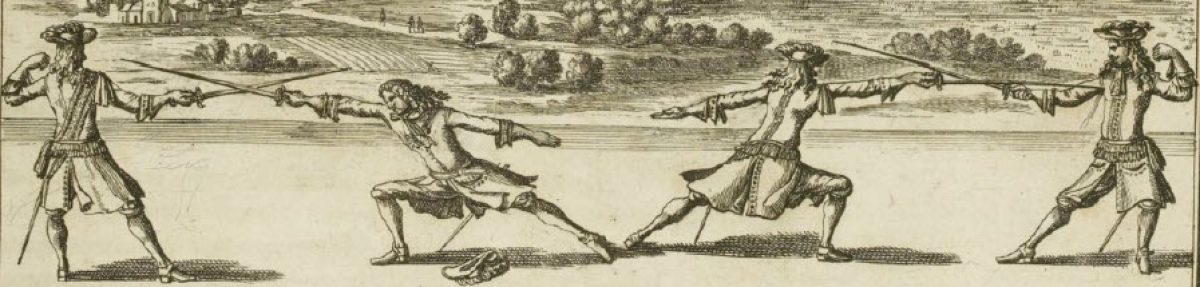
passing attack from _The Art of Fencing_ 1730

The much-maligned maestro, Nick Evangelista, turned a phrase that I have long used, “the logic of the sharp point.” [1] For anyone interested in fencing as more than an elaborate game of tag in unfortunate polyester uniforms, the logic of the sharp point should guide all they do. In short, this logic boils down to one idea:

If attacked, defend

When we don’t envision that point as sharp, we make poor choices—most doubles and the obsession with the after-blow stem from misunderstanding or misapplication of this logic. Why is it that in historical fencing, supposedly keen for fostering “realism,” we see such a gap between theory and practice? In short, the divergence stems from failure to learn and apply the most basic tenets of fencing theory. The reason for that is simple: too many historical fencers refuse to examine what modern fencing has to teach them.

This is a topic I’ve spent a lot of time on, but when a problem persists, we keep at it or quit. One fact I must accept, however, is that no matter how much time I or anyone spend on this, no matter how much evidence or analysis we throw at things, it won’t matter to most people in “HEMA.” There is daily proof of this, but there is also precedent: similar issues plagued the Olympic fencing world in the 1990s and early 2000s and then as now most people didn’t care. That doesn’t make them right. Their discomfort with a truth in no way changes the fact of that truth. I will argue until I’m worm-food that one should extend on a thrust, that the flat of the sabre shouldn’t score, and that off-target is, ultimately, illogical.

In like manner, not to avail oneself of modern fencing theory is to hobble our efforts at understanding fencing of the past. Modern theory was not created in a vacuum—it is the product of quite literally centuries of work. As always, one must distinguish between theory and how that theory is applied or misapplied. They are separate things.

For a quick example, applying right of way (ROW) to sabre, in theory, is sensible. ROW, in its way, attempts to enforce the logic of the sharp point, but being a game, a sport, this rule is less doctrinaire than it is for historical fencers. Historical fencers balk that ROW allows consideration of off target, and that one may win the point but still be hit. However, despite those aspects, despite the tyranny of electric scoring, the rule states that an attack should be dealt with, not just reacted to via counterattack out of time. One should defend if attacked—that is basic logic, the point, really, of fencing, defense. Thus, the ruling idea is sound, but how that rule is abused and interpreted is a mess.

Case Study: Passing Attacks

In one of the most recent and unfortunate fracases on social media, over a specific type of attack [see the post 13 August 2023, “Shadows in Caves,” https://saladellatrespade.com/2023/08/13/shadows-in-caves/], we have another example of the perils of interpretation. As I stated in an earlier post, part of it vested interest in maintaining a perceived status within the community, part of the problem was vocabulary, and partly it was a failure to understand how the sources and modern theory intersect. I’m fed to the teeth criticizing the all-consuming horror that ego plays in all this, so this post will instead focus on terms and misapplication of theory.

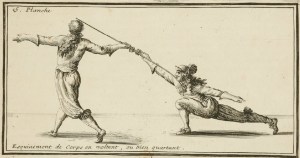
One mistake that people are making is equating a modern version of a species of attack for one of the same class from the past. It might help to illustrate how the terms relate. “Passing attacks” comprise a category of attacks where the rear foot passes the lead foot. Just how one does this changes. The terms and description vary as well. For two examples, we have the lunge made on the pass in de la Touche (1670), his “thrust of the pass” (l’estocade de passe), his “the finished pass” (la passe finie), and the modern flèche. [2]

de la Touche, 1670; the fencer on the right is making a thrust of the pass

No one in de la Touche’s time called any passing attack I’m aware of a “flèche.” Those quick to decry the use of a “flèche” in a recent Canadian tournament cite the use of a passing attack as modern and anachronistic, and thus out of keeping with period practice. It’s important to break down the attack, and criticism, to see if this criticism holds.

I’ve selected de la Touche in part because detractors have cited him for proof, but also because de la Touche did a fantastic job of explaining many aspects of technique. He was not the only one to include thrusts of the pass, but he is a good example. [3] The section on his thrust of the pass is long, thorough, and informative. In speaking of thrusts generally, de la Touche reminds us that one should be careful to aim for the most uncovered section of target, and, that one must thrust with conviction, that one should let oneself “go and extend as much as you can, so that the action has more force and swiftness of reach.” [4] I note this because swiftness, speed, is a critical consideration, one detractors downplay.

The master observes that one’s reach is longer with the thrust of the pass, and thus that the measure is larger so it requires more time to make. This is a crucial point. If one can hit with a thrust of the firm foot, then one shouldn’t use the thrust of the pass, unless one was initially aiming for the arm and decides to go for the body. It is particularly useful if the opponent is breaking measure (retreating) and if one wishes to surprise the adversary. Most importantly, one must accustom oneself to “execute the thrust of the pass with great swiftness, in order to compensate for the length of the action by the promptness of the execution.” [5]

Important to note, and a point in favor of the critics, de la Touche’s thrust of the pass assumes that the lead foot does not move. One advances the weapon, arm, body, and rear foot, but the front foot remains in place. [98] However, in the next section, De la Passe finie, “Of the Finished Pass,” de la Touche remarks that

De la Touche discusses this action, of moving the rear foot past the front, within the context of weapon-seizures. Such seizures are, as he observes, incredibly dangerous and chancy, especially if attempted when attacking (he is less uncomfortable with such seizures when defending). [7] One question arising from this is whether or not the master recommended this passing step only for weapon seizures. In answering this question one must interpret since de la Touche is not specific. How best to do that?

First, we must examine the action in the context in which the master shares it. It makes sense to include this passing step in a section relating to seizing the weapon as the distance one must travel is, arguably, longer than it is when lunging or lunging on the pass. Of note, this step is more connected to attempting a seizure when attacking than defending, as ostensibly the opponent is either standing firm-footed or breaking measure to defend.

Second, we must compare the advice in this passage with the rest of his work, with the general timbre of his approach. This is, granted, where we enter the world of conjecture. Thus, it is all the more important to work from the text, not just one passage or section. We must apply logic to any such comparison; it is, really, the only way to avoid the more obvious pitfalls, such as selecting only what supports our point of view or cherry-picking.

Whenever evidence works against us, we must deal with it honestly. In this case, the thrust of the pass itself does not appear to include moving the front foot from its place. De la Touche makes this clear. Those unhappy with the attack my friend and colleague made at An Cruinneachadh this past month are not incorrect about that. [8] However, I believe they are on far less firm ground if they suggest that the finished pass, that is a pass where both feet move, is only advisable when attempting a weapon seizure. Yes, that is the section in which it appears, but on its own that doesn’t make for a strong case. De la Touche covers the lunge in one section too, but one assumes that he wants one to use it whenever applicable.

Herein lies the crux of the problem—applicability. What follows is my take, my interpretation of de la Touche, and I will be the first to admit it is more spirit than letter of the law. I have reasons for that—we do our best to conform to what a text says, but we must remember the purpose of a source. De la Touche was concerned first and foremost with effective fencing. The goal, quite literally, was to strike and hopefully not be struck as one did so, because failure meant injury or death. If that was the goal, then slavish attention to any action makes little sense. Put another way, if one attempts a thrust of the pass, but the opponent retreats slightly more, one can either break off the attack, or, continue it (assuming the same elements of surprise and safety) by moving that immobile front foot. Fencers make different choices depending on the situation; technique, ultimately, backs up tactics, not the other way around. The attacker is at risk regardless—should they continue an already long attack, they increase the chance of failure, but should they recover needlessly just to follow the letter of the law they may create an opportunity for the adversary to attack in their turn.

In my reading, what Jay used in that match follows the logic of the finished pass and the thrust of the pass. Both fencers were working measure, but Jay launched his attack (about :07/:08 seconds in the video on fb) as his opponent (the chap in green) was in negative balance, as he was just about to initiate an action. Jay threw his arm and body forward, a la the thrust of the pass, but then crossed his feet a la finished pass in order to reach his now retreating opponent. Nothing in this action is out of keeping with what we read in de la Touche.

In fact, Jay used the proper speed to execute this attack successfully, an aspect de la Touche was quick to point out. Judging by both video of their fencing and from what I have observed on my own in person, many of Jay’s detractors do not employ speed in their own fencing, and one fears that they may not realize its importance. No attack made from just out of distance will succeed without it.

But his Fleche!

Now, what is the modern, well, 20th century flèche? It depends upon how one defines it. Generally, in French fencing, the fleche is a “running attack,” but in this can be further explained as Gaugler put it, as “a running attack executed following a loss of balance by an exaggerated forward displacement of the center of gravity.” [9] Maitre Robert Handleman provides a fuller description:

Handleman’s work was published in 2014, the flèche outlawed for sabre in 1994, but older works discuss the use of the attack in all three weapons. The flèche is still legal in modern foil and epee competitions.

So, did Jay flèche? Yes and no. Yes, he made a running attack, and going by just one definition, Gaugler’s above, we can call it a flèche. However, nothing in that action was out of keeping with what de la Touche, among others, described in their coverage of passing attacks. So where does that leave us?

Old Bottles, New Wine

Often in historical examinations we employ the simple tools of comparison and contrast. Examining patterns of what is similar, what different, we can unpack a source and see relationships, connections, and with further analysis, reach conclusions about what we are studying. In some cases, one type of comparison may reveal more to us. As a related example, from the study of myth, Joseph Campbell’s The Hero with a Thousand Faces does a great job of finding cross-cultural similarities in what he called the “monomyth,” but his study is only so useful because he did not, and did not intend, to examine the differences in how this motif was or is used. A hero’s motivations, for example, may be vastly different even if the narrative construct is similar; those differences will be far more revealing about cultural values than similarities.

In contrast, the situation here is one where similarities should help make sense of the sources, but which do not thanks to bias. Prejudice against the “new wine” of modern fencing, an outgrowth of the reactionary period in which modern historical fencing was born, has persisted and continues to affect how those suffering this bias view the “old bottles” that are period sources. The flèche as they see it is an artifact of modern, 20th century fencing, not that particular century’s version of an old and time-worn attack. Why? Because in their view nothing modern is legitimate.

In fairness to his critics, if one places a photo from mid-century where a fencer is nearly horizontal in the air as they flèche, and then a plate from de la Touche side by side, then the differences are obvious. It’s clear these are not exactly the same, but they’re not the same in execution, and it should be easy to see why: the contexts are different.

pass in seconde, de Liancour, 1696

This has been obvious to other scholars of fencing. Morton’s A-Z of Fencing contains a lengthy entry on the flèche as well as one for the pass which, so Morton states, was an older method of movement, and, one in which the lead foot might, if necessary, move as well. [11] As a last example, Nick Evangelista, in defining the flèche, echoes the same cautions as de la Touche, reminds the reader it is best used sparingly and as a surprise, and most importantly, that “the pass on avant of the eighteenth century is considered the forerunner of the flèche as it is practiced in modern times.” [12] These writers see continuity as well as change, versus change alone, and with good reason. No aspect of modern theory was created ex nihil—all of it is built on precedent.

De la Touche on more than one occasion is at pains to warn the reader against actions that will get them hurt, because in 1670 people were using swords and intended harm with them. No one of sound mind is fencing in that context today—realistic as we may wish to be, we do this for fun, not because our lives may depend on it; we fence with friends, not people keen to kill us; we use safer trainers and wear safety equipment, not a simple shirt or the lack of one. In contrast, fencers using the flèche in Olympic fencing, and especially in sabre in the late 1990s, not only had no fear since they were going for points, but especially in the case of the latter could stretch the action to ridiculous lengths to game the system. Indeed, so abused was the flèche that they outlawed crossing the legs in sabre.

Wine is Wine, Old Bottle or New

In the sitcom “Schitt’s Creek,” one of the main characters, David Rose, explains his sexual outlook to Stevie, a woman who works at the hotel where he is staying, and with whom he had hooked up:

Stevie Budd : So, just to be clear, um… I’m a red wine drinker.

David Rose : That’s fine.

Stevie Budd : Okay, cool. But, uh, I only drink red wine.

David Rose : Okay.

Stevie Budd : And up until last night, I was under the impression that you too only drank red wine. But I guess I was wrong?

David Rose : [nods knowingly]  I see where you’re going with this. Um… I do drink red wine. But I also drink white wine.

Stevie Budd : Oh.

David Rose : And I’ve been known to sample the occasional rosé. And a couple summers back, I tried a merlot that used to be a chardonnay…

Stevie Budd : Uh… okay.

David Rose : …which got a bit complicated.

Stevie Budd : Yeah, so… you’re just really open to all wines.

David Rose : I like the wine and not the label. Does that make sense?

Stevie Budd : [smiles]  Yes. That does. [13]

In addition to being a wonderful way to explain pansexuality, I see an analogy in re fencing theory. Fencing is, ultimately, fencing, and it is either effective or not. Contexts, purposes, equipment, and ethos all change, but should one lay out the better modern works on fencing side by side with those from the past the kinship becomes absolutely clear. Yes, there are differences, and in historical fencing in particular to ignore those differences makes what we do ridiculous. However, it’s double-edged—to ignore what modern theory provides any fencer, especially those attempting to interpret past sources for the Art, is to handicap one so terribly that the interpretation too easily becomes something other than what it should be, fencing. A prime example, which I’ve covered in other contexts, is the abject devotion to the images in the Bolognese corpus which produce versions of fencing more graceful than effective. [14] The desire to make “sidesword” different obscures the fact it was a cut and thrust weapon, and, that cut and thrust weapons existed before and after the 15th century. If pose becomes more important than purpose, one has lost one’s way.

The logic of the criticism used against the passing attack Jay used at An Cruinneachadh is faulty. The operating assumption is that anything that looks like a flèche, or indeed may be one, is automatically illegitimate and anachronistic. That doesn’t follow. One can make a fair case that the passing attack Jay employed abided all the cautions and guidelines that masters like de la Touche put forth, and as such, should not be classified as some aberration. [15]

NOTES:

[1] Nick Evangelista, “When Classical Fencing Goes Bad,” The Evangelista School of Fencing, 20 April 2014, https://www.evangelistafencing.com/blog/2014/4/20/9swnz7n7n709uvg9cko2hkh5a1h3n5

[2] Philibert, Sieur de la Touche, Les vrais principes de l’Espée seule, 1670, 66 (plate just before page 65); see also Reinier van Noort and Antoine Coudre, The True Principles of the Single Sword, Glasgow, UK: Fallen Rook Publishing, 2016, 88ff.

[3] For other examples, among others, see de Liancour’s passes to the inside and outside p. 24ff in Le maître des armes (1696), Girard’s pass of quarte p. 71ff Traité des armes (1740), and Angelo’s pass in carte over the arm p. 62 The School of Fencing (1787). Of note, many works cover passing steps in connection with weapon-seizures.

[4] Van Noort and Coudre, The True Principles of the Single Sword, 90.

[5] Ibid., 100.

[6] de la Touche, Les vrais principes de l’Espée seule, 75; cf. Van Noort and Coudre, The True Principles of the Single Sword, 108. I translated this passage myself, so it differs from that of van Noort and Coudre.

[7] de la Touche, Les vrais principes de l’Espée seule, 75-78; cf. Van Noort and Coudre, The True Principles of the Single Sword, 108-109.

[8] For the bout in question, see https://www.facebook.com/groups/261251458841817/permalink/835017504798540/?ref=share&mibextid=NSMWBT

[9] Willam M. Gaugler, A Dictionary of Universally used Fencing Terminology, Bangore, ME: Laureate Press, 1997, 34.

[10] Rob Handelman and Connie Louie, Fencing Foil: A Practical Training Guide for Coaches, Parents and Young Athletes, San Francisco, CA: Pattinando Publishing, 2014, 444.

[11] E.D. Morton, Martini A-Z of Fencing, London, UK: Antler Books, 1990, 67; for the pass, see 132-133.

[12] Nick Evangelista, The Encyclopedia of the Sword, Westport, CT: Greenwood Press, 1995. 250. Queen City Classical Fencing’s glossary, supplies

[Sir William Hope, A New, Short, and Easy Method of Fencing, Edinburgh, 1707, 136-138]

[13] This quotation was obtained from IMDB, https://www.imdb.com/title/tt3653932/characters/nm2391794

[14] 10 June: Lecture Transcript: “Prance or Pounce? Interpreting Images in Bolognese Treatises,” Northwest Armizare Weekly Online Meetup, https://saladellatrespade.com/instructors/research-media/

[15] Jay’s fencing is effective and he is doing well in competition, so it is possible that maybe that is the real issue: envy.

Jay, like me, like others, approaches past sources with the tools and theory that they bequeathed to modern fencing, and he is an effective fencer. Those aping the plates devoid of actual understanding are not doing as well, because their study is incomplete. When one is absolutely convinced that one’s point of view is correct, and especially when that stance is backed by those believed to wield authority (however true or untrue), then one is not only losing matches but forced to confront an even harder possibility: their training, however long, however passionate and dedicated, has been flawed. This is extremely painful and unpleasant, and my heart goes out to them. At the same time, it is something one can fix. Jay, in fact, can speak to this better than I can, as it happened to him. He didn’t quit, but put his disappointment and regret aside and started over with a better training regimen.

Addendum, Shadows in Caves

It’s never my intention to be mean or divisive. To the best of my ability, I try to focus on the material and evaluate both arguments and support. The more directly and clearly one does that, the better, but directness, especially online, can read differently to people. It’s easy to take any criticism personally even when it’s not intended. [1]

I didn’t pull any punches in my last post, but no blow was aimed at people as people—my intent was to target interpretations, argumentation, and issues of authority either widely acknowledged as problematic, such as “HEMA” lacking any real oversight, or, concerned with questions about credentials that have long been under discussion. [2] It’s important.

As an instructor and historian I have a responsibility to my students and everyone else to be honest about my training, how I arrive at the interpretations I do or why I use those by someone else, and to be as transparent as I can. When I get things wrong (and I do), I owe it to all involved to own it, correct it, and give credit where credit is due.

Few things are harder than declaring, publicly, that one made a mistake, but it’s one of the most important things we can do. First, it’s honest—everyone screws up. Second, owning mistakes and trying to correct them argues for one’s credibility. Third, because our interpretations are shared, we owe it to those who use them to keep them in the know. My own experience with this has demonstrated to me that not everyone will appreciate it, but it’s the right thing to do regardless of reception. Thus, whenever someone offers us valid criticism, it’s on us to consider it and if necessary adjust our conclusions.

Working remotely in a tiny corner of the world, and rarely able to travel to events, conferences, or seminars (though I try), I know of, but do not know, most of the people engaged in the current debate within smallsword circles. I know them only via their work or participation in the community. Even if I did know them, I should not judge them as people (provided they’re not bigots or overly arrogant) but evaluate their work. I expect people to do the same with anything I might share of my work. That is how research works, well, how it’s supposed to work. [3]

All of this is to say that if you are hurt reading my critique, please remember I see you as a colleague in a difficult endeavor; that we, all of us, owe it to all using our work to do right by them and produce the best work we can. Good research is a collective pursuit—we rely on others for support, for correction, and for making our work better. In like vein, we also owe it to our students and one another to be honest, frank, and ready to back up any credentials we claim. The study of martial arts, any branch, relies on trust, and we establish that trust more in action than words.

Notes:

[1] Even in person it can be hard to face criticism, but it’s part of the job. Online communication is notorious for confusion; lacking facial cues, body language, etc., we have to work harder to be clear in what we write and be sensitive to how things might read.

[2] The burden of proof for one’s credentials is on the individual. Normally, it’s easy enough to prove should one question things—maestri, for example, are handed a diploma produced by the organization that granted it and that displays the signatures of those masters that evaluated the candidate. There shouldn’t be any mystery around it.

[3] Work in research long enough and you will see the best and worst in people when it comes to using or evaluating one’s work. For every instance of helpful, well-intended help, there are a legion of people who fail to read it completely, or worse, misconstrue and misrepresent our work. For example, one reviewer of a book I wrote failed to read the preface; had he done so he would have realized that his major criticism, that the book was less monograph than he expected, was targeted towards undergraduates. For a more serious example, a dissertation from 2014, and which mentioned my dissertation from 2002, not only resorted to insulting language, but also misrepresented my work (how her dissertation committee let that go is anyone’s guess—mine would have read me the riot act for such a breach of professionalism).

Shadows in Caves

One of the benefits of not having to suffer the tempests in teapots that boil over on social media is that I only hear of them second-hand. I’ve heard a lot in the past few days about an unfortunate debate on one of facebook’s smallsword pages concerned with a particular action. Controversies like this have a way of forcing people to show their colors, and this latest hullabaloo is no exception.

The lines, as I understand it, are drawn between those upset by the inclusion of a passing attack, a collection of enthusiasts including a number of English fencers, at least one sword-maker, and a few vocal students, largely American. Their opposition consists of an assortment of historical fencers who have argued for this attack based on the sources. If one is familiar with my posts here it will not be difficult to determine where I land in this debate (not that what I think will matter to many participants). However, as an instructor and historian I feel a duty to those I work with to say something.

False Equivalencies & the Fleche

The action in question is a rapid attack meant to surprise an opponent and one made by passing the back foot in front of the lead foot. To work, one chooses the right measure and tempo, and then applies the right speed and weapon angle to close the line. Whatever the name, these are the component features. It is, in truth, a dangerous action, especially if made poorly or at the wrong time or distance, but the fact that it shows up in so many works means it is worth study.

The criticism aimed at the passing-step proponents centers upon this action being too “sporty,” too “modern,” and since that first generation of classical and historical fencers arose in large part because of the excesses in the sport, anything remotely whiffing of the modern piste is immediately suspect. I  know because I was there, and like these poor folks, once over-compensated and over-corrected. This was easy to do in the 1990s and early 2000s for several reasons. The  complete lack of concern and disdain from fellow fencers about over-use of the fleche, of the flick in foil, of duck and cover, or any of the other aberrations was hard to understand and unpleasant to face. Second, and in ways that echo in the current debate, none of the evidence–and there was plenty–proving that these were departures from the point of fencing and ahistorical made the slightest dent in their resolve. On the one hand, older fencers unaffected by much of this failed to see the danger. On the other, many newer fencers, having made their reputations on these dubious actions were loath to condemn them; to do so would be to condemn themselves, to call into question their own position. 

Ego drove much of this, and, ego drives the anti-passing step side now. Combined with misunderstanding of the problem the anti-passing step faction has taken the suggestion that a move like the fleche is viable as a personal affront. Ironically, they decry the action despite the evidence from the very sources they claim to use. Ego is the first barrier: an inflated sense of self and one’s importance tends to blind one to reason. The second barrier is mistaking issues with a particular action for the action itself. Memories of fleche after fleche in the late 1990s and all the daft measures the FIE took have made any attack like it, never mind the fleche itself, anathema.

Of note, the pro-fleche camp, for lack of a better term, has not argued that the passing attack in Vadi or L’Abat is exactly the same as the flying leap sabreurs so took advantage of in the 1990s. Contexts are different, the weapons different. This said, the idea of a rapid, surprise attack made by throwing the weapon forward and passing the rear leg past the lead one is present in our sources. Whether one chooses to use it or not is another question. Whether one makes the attack well is another matter. Whether a master advocated it or merely included it is an additional consideration. Some masters specified that they didn’t care for an action, or, that it was dangerous outside the salle, but often we don’t know where they stood on its effectiveness or safety for actual fighting. [1] There is ample precedent for fleche-like actions on the record, so to poo poo the use of an effective passing attack in modern historical competitions, which we do for fun, is about turf and ego, not the sources.

Why the one faction should stubbornly argue against the evidence of the sources should make one pause. For smallsword works alone, the inclusion of the passing-step attack is common. It should be little wonder as to why. Given the place of cross-steps forward and back in earlier works (de Liancour, 1686, is a good example), adding speed to the same method of advancing follows logically. The same attack, however, appears earlier in the sources, from Vadi to many rapier treatises. What separates historical fencing from other branches is, supposedly, reliance on the sources, so to ignore the basis for interpretation, particularly when we can trace this action over time and across masters, is odd. If the source tradition isn’t their basis for support, then what is?

The Problem of Authority

One of the bugbears within “HEMA” is a blind appeal to assumed authority. In this case, a number of early researchers and their fan-base appeal to the early success and acclaim these luminaries enjoyed in the belief that it’s as valid now as it was in the early 2000s. That is, sadly, not often the case. Research has not stopped since their time, yet many of these same people stick to outdated theories and flawed interpretations.[2] Their argument, thus, is not made from evidence and analysis, but from ego, from fear of losing the status they depend upon from their acolytes. They fear being eclipsed. The last has already happened as this latest fracas, one skirmish of many in the past twenty to thirty years, demonstrates.

Time-in is another supposed source of authority. It can lend one credibility, but depends on other factors. On its own time-in means absolutely nothing. If one has been in “HEMA” for thirty years and has not only been working from poor theories, but also continues to argue that they were correct despite the evidence, then time-in means very little. This happens a lot–I’ve met many people who have wasted years with charlatans or in glorified fight-clubs or working from once key interpretations that have been superseded.

Complicating the stagnation is an often surprising lack of understanding of fundamental actions and concepts. For example, a well-known fencer recently quoted de Bazancourt with respect to rushing in, which not only demonstrates a failure to understand the intended use of the action, but also serves to corroborate the fact they are basing their view on misuse of the action. Preparation is everything in fencing, and attacks like the passing step and even its much abused 1990s version (ideally…) relied on setting an opponent up for it. The sabreurs who flung themselves stupidly at “allez!” and who never varied the game are a different animal. In the footage I’ve seen from a recent Canadian event, the fencer employing the “fleche” used it wisely, and, as intended: as a surprise against an unprepared opponent. I am a fan of much of de Bazancourt’s wisdom, but the quotation supplied is misapplied. Used at the appropriate time and in the right setting, the passing step or fleche is no more dangerous than a lunge. Both put one at risk. Every form of attack potentially does.

Another issue plaguing “HEMA” is the echo-chamber effect. Adherents to this idea or that group focus increasingly only on what those within their section of the community teach, believe, and use. Their views become myopic, limited, and prone to precisely the ego-driven arguing we see in this current example, because for them the debate is less about sources than it is their reputations as “authorities.” They view the shadows cast on the wall by the tiny flame in their hands or in those of their heroes and take those shadows for reality. It seems real and legitimate to them because they refuse to consider any other well-made argument. In like vein, if any light is cast from someone they don’t know or who fails to pass the anemic view of authority they employ, they ignore it, or, call them heretics.

Proof is in the Teaching

Perhaps it is the Hollywood notion of 18th century manners, of high style, and the romance around the waning influence and power of European aristocracy, but many of the interpretations from the anti-passing-step camp are wooden, slow, and lacking in vigor. They present more like demonstrations or dance than a fight. It’s form over function. For all the formality and etiquette that people of the past attempted to apply to personal conflict, in the end it was a sword fight. The intent was bodily harm or semi-acceptable ritual murder, and no evidence we possess suggests that two people, potentially angry and emotional, fighting fear, and terrified of public opinion, were more likely to square off and fight as if dancing. All evidence is to the contrary. Surviving footage of late period duels is no exception, and many of those were first-blood affairs, not to the death. For all the blather about “realism” few in “HEMA” spend much time if any pondering what that means, or, what it should mean in our context. [3]

The flaccid yet florid approach these fighters take to fencing reveals too much concern for aping the elegant plates within the treatises rather than what those treatises were meant to help teach: fighting. I am not the only one cautioning fencers about over-reliance on images, but time and again many in the community gravitate to the images because they don’t understand the text. [4] While language and diction are often challenging, the deeper issue is that these same fencers lack sufficient understanding to read the text. The one place they might go for help, a solid Olympic or traditional fencing program, is anathema among them, and so, they do their best to adopt what they see in the illustrations and produce pretty bouts largely devoid of any intent.

In the footage of their bouts, in their instructional videos, and especially in their attempts to shout down opponents, the shallowness of their understanding and skill emerge vividly. The inability to fence beyond a snail’s pace, the poor use of measure, and the more choreographed timing are red flags. No one fought in slow motion. It’s hard not to conclude that this is one reason that the clubs and cliques against passing step attacks avoid bouting anyone outside their little world. Against fencers with legitimate training and armed with sufficient knowledge they come up short. Such defeats should suggest to these fencers that maybe there is more to learn or better ways to learn it. In fairness to the newer students among them, hearing from their clubs that these defeats don’t count because others are wrong or too dangerous etc. is easier to accept within their echo chamber, when the only voices they hear are all part of the same program. [5]

Make the Bold Move

It takes courage to accept new ideas, even when well-presented and argued, but it remains the right choice if one wishes to retain any respectability. Lacking any official organization to manage these things, we are left only with each faction’s arguments and how to evaluate them. The best approach is to evaluate the respective arguments in light of the evidence, and, against what the purpose of fencing used to be. The masters who wrote these works, many of them anyway, meant for their books to help teach students how to fight. Sure, some, especially later, were more concerned with salle play than with duels, but for those clearly self-defense oriented, like many mentioned in the debate over the passing attack, the goal was effectiveness first and foremost. There was ample attention to deportment and conducting oneself with grace in many works, but this was, outside a fencing hall, a secondary goal. No master stayed employed long if their students died or were maimed for life. [6]

Those quick to condemn historical fencers using the passing step attack should take their example from other members of the older guard, people like Paul Wagner, Stephen Hand, and Dave Rawlings, all of whom have continued to learn, adapt, and alter their thinking based on new and better information. Though well-known, they have remained humble and thus open to learning, and between these factors and being gracious opponents, they have stayed relevant. They have not been eclipsed. 

When it comes to past fight systems, no one has a monopoly on the truth. Every interpretation must be tested and compared against the sources, and when new and better ideas make sense, when they follow from the sources, then they’re worth consideration however much that may disappoint one. At such times, hard as it is, once those shadows on the cave wall have been revealed for what they are, it’s time to do the hard thing and turn around. When one does, one sees better and grows, and often, one finds that those they have perceived as enemies turn out to be staunch allies.

Notes:

[1] De Liancour, for example, believed counter-attacks better suited for salle play than affairs on the ground (Le maitre d’armes/The Master of Arms, 1692, 13 in the pdf, 29; in Lynch’s translation, 36); Capt. John Godfrey, in his A Treatise upon the Useful Science of Defense, 1747, 12-13, expresses his dislike of the flanconade.

[2] A prime example is the demi-pointe lunge. See my papers related to this topic in the “Research” section found at the bottom of the Instructor page.

[3] I’ve spent a lot time on this in previous points, so here I’ll only add that while we strive to be historically accurate and as “realistic” as possible, the fact remains that we do this for fun, wear protective gear, and have no real need for this skillset in our own time and cultures.

[4] See my pieces on using and misusing images in historical fencing under “Research” in the Instructors section.

[5] Most fencing schools, most of the better martial arts programs, include working with and/or competing against those outside one’s own school. It’s critical for growth. It is never a good sign when instructors fear this or actively preach against it.

[6] Even in self-proclaimed self-defense works we see concern for deportment. In James Underwood, The Art of Fencing, Dublin, 1798, p. 7, he explains that he doesn’t like the off-hand arm forward because “I think the beauty of the figure is strangely disfigured by it, and that all fencers will allow that they cannot help being pleased with a symmetrical posture.”

Censorship or Criticism? Why You’re Wrong about “Gate-Keeping”

“Discord is the great ill of mankind; and tolerance is the only remedy for it.”
― Voltaire, Philosophical Dictionary

[Warning: rant ensues]

The choice of quotation is not an accident. Thanks to a toxic mix of politics and poor life choices I left most social media a few years ago, and, with one exception (barring messenger/email apps), have next to nothing to do with it. Research articles on the effects of social media continue to support my belief that this was a good decision. It’s not just that people can’t watch or read anything longer than a tiktok video or tweet, but that the supposed anonymity fails to prevent, and maybe even encourages them to be nastier than they would be, in most cases, to one’s face. How does this related to fencing? I promise to connect A and B if you keep reading.

It gets worse. Swimming in such a shallow pool feels safe, because everything is on the surface, but this ignores that fact that one can still be sunburned, even drown in an inch of water. It changes people.

The faux familiarity, the apparent openness, and the need for connection that social media seeks to create but which it actually undermines, all produce an illusory culture of contented seemingly intimate pals. Test it. Say something vaguely controversial and see how people react—the ability to differentiate between confirmed belief and a joke is all but nonexistent; lacking facial cues, changes in intonation, etc., this is hardly surprising. It is not an accident, however, that this diminished capacity for communication and an equally strong inability to separate criticism and censorship have grown in parallel.

Gate-keeping online is the new Inquisition, not only for the social auto de fe that so often follows in its wake, but also for the fact that the basis for it is confused.

There are a lot of ways people define “gate-keeping,” but I find that the Urban Dictionary, while typically an amalgam of denotations, taken in toto provides a fair sense of what contemporary terms and movements mean. Here are a few from the first two pages of definitions:

  • Gatekeeping is to make your interests exclusive in order to protect them from becoming “mainstream”
  • When someone takes it upon themselves to decide who does or does not have access or rights to a community or identity.
  • A word used to describe when someone sets a standard/limit on what someone must do to call themselves a ‘true fan’ of something/someone.
  • When someone uses a hobby or interest as a means of elevating themselves above others to give oneself a sense of being superior transforming their passion or knowledge about a particular subject into an ugly tool of self-inflation
  • When someone takes it upon themselves to decide who has access to something
  • When people discriminate against others who want to enjoy the same things as them, and usually gatekeepers use the dumbest reasons as excuses [1]

For a slightly more august definition, the Cambridge Dictionary defines it as “the activity of trying to control who gets particular resources, power, or opportunities, and who does not. [2]

More than once I’ve been accused of gatekeeping, but according to these definitions I have not, in fact, been gate-keeping. No, I have criticized poorly constructed theories, ineffective training regimens, inexpert translations and interpretations, and bigots. This is important, because what I have NOT done is:

  • make my interests exclusive in order to protect them from becoming “mainstream”
  • set a standard/limit on what someone must do to call themselves a ‘true fan’ of something/someone
  • used a hobby or interest as a means of elevating myself above others to give myself a sense of being superior or transformed my passion or knowledge about a particular subject into an ugly tool of self-inflation
  • decided who has access to something
  • discriminated against others who want to enjoy the same things as me, and for the dumbest reasons

I would love for well-researched, well-coached, and inclusive historical fencing to take off and become mainstream. I have no business telling people what they can or should like—people like what they like. This hobby, well, um, it does not elevate one socially at all and those who, sadly, think it does I feel pity and compassion for—fencing is not going to help you find a date, fame, or money. Historical fencing should be for all—the only people I will not teach or interact with are people who are known bigots. [3] Finally, I have trouble understanding why anyone would discriminate against people who share the same interests—hell, I’d all but kill for more people interested in the things I am!

Here is what I do and will continue to do:

  • I will continue to support good research, and, attempt to improve bad research
  • I will continue to do my part, as an educator, researcher, and fencer to support, make, and improve interpretations of historical fencing
  • I will continue to do my part to create an inclusive culture (bigots either get wise or fuck off)
  • I will endeavor, as I have to date, to do all of this with compassion and understanding, because historical research and interpretation is, by its nature, extremely difficult to do and even harder to do well

Lastly, I issue a challenge. The next time you think someone is gate-keeping, take the time to consider a) what gate-keeping is and b) if what you find unpleasant conforms to those rubrics or not. IF, as so often happens, you’re simply reading something that you don’t like, or which you somehow think is about you, or which makes you feel attacked, pause and consider the likelihood of that. As I’ve said, most things are not about us. It’s probably not about you, and you know, if someone my age can figure out how to mute a channel or thread, then you can too. Like it or not you’re responsible for your feelings and how you react, not me. I take care of my garden, you take care of yours. That’s what wearing grown-up pants is all about kids.

In our context, if you’re upset that a cherished theory has been challenged or that some old, obscure upstart has dared accuse some HEMALand darling you admire of poor work, reflect upon what that says about you.

I am not interested in making enemies; I’m interested in good research and fulfilling my duty as a trained researcher to steer people right about research. It comes with the sheepskin. This said, if calling out charlatans and would-be experts creates enemies of them, or you, fine. IF I’ve taken the time to call them out, there is a reason, and it has nothing to do with self-aggrandizement, attacking others, or just being an asshole. It’s not like anyone thanks me for it—getting attaboys is not the purpose: improving research is. I don’t need or want thanks or anything of the sort, just better research.

If I’ve called someone out about their work [key word, their work, not they themselves], it’s because I know they lack the skill, experience, and/or knowledge to make the claims they are or have made a grave error and are fooling people about it. Most people, wisely, don’t pursue research as a career-path, and so there is a responsibility on those of us who do to do right by all. Theories and interpretations are things we can evaluate, that are demonstrable, and either someone has those skills or doesn’t; either they’ve proceeded responsibly with their research, or they haven’t. The only time this gets “mean” is in HOW we call these things into question. It is never my intention to be mean—life is cruel enough and hardships a plenty without my adding to it.

Please note: my goal in throwing myself up for a beat-down when I offer criticism (that is, critiques to help someone improve or fix a position they are sharing) is intended to help them, not blast them. I spent over a decade learning to conduct research and another decade honing and teaching others to reason and analyze information. I want people to do better work. Too many academics could care less, and most wouldn’t bother trying to help non-academics improve. There’s a direct correlation between depth of snootiness and lack of resources that explains that; put another way, many academics are small people and sad. For me, the so-called Ivory Tower is bloody useless if its treasures are hoarded away only to be enjoyed by the three people in that field (see gatekeeping defintions 1, 2, 4-6 above…). I won’t be party to that, and so, I do what I can to share those treasures with everyone, and for reasons of time, interest, and experience, I do that mostly in historical fencing.

NOTES:

[1] https://www.urbandictionary.com/define.php?term=Gatekeeping

[2] https://dictionary.cambridge.org/us/dictionary/english/gatekeeping

[3] By kn0wn-bigots I mean those who wear all the symbols and spout the trash that bigots do. If they don’t say these things in class, and attack no one, then I don’t know about and they fly under the radar. Locally, at least, people know from the main page on this site that bigots are not welcome.

Get Out of Your Way

Following on the heels of the last post (about the place of calm in our study of the Art), the following may feel like overkill, but it’s related and as important. Among the deceased equines to which I regularly apply a cat o’ nine tails is the problem of ego. Ego gets in our way; it impedes growth. Over concern with how we will be perceived affects calm; it takes us out of the moment. With our own path to self-improvement, just as in most any larger venture, we tend to succeed best when we don’t get in the way.

Why harp on so much about ego and arrogance? It goes beyond my own study and experience with the martial arts or life-experience, though the combination has done nothing to shake my belief that arrogance and misplaced confidence are bad for us and everyone else. Great confidence can read, sadly, like competence—that’s how unfit businessmen become president for example—but they’re different, and there are consequences to a misguided and overblown sense of self, just as there is in placing our faith in someone else’s inflated sense of self.

The Font of Awesomeness-ness

James Earl Jones as Thulsa Doom in 1982’s “Conan the Barbarian”

Arrogance has a variety of sources, but at the root is low self-esteem. I’m not a psychologist, so I say that as an observer and fellow human who wrestles with ego like anyone else, but I think it holds. In some, arrogance is a mask, a persona they adopt to navigate social environments in which they’re uncomfortable (or maybe all environments). For others, too high an opinion of themselves derives from life-long coddling and commensurate insulation that never put any of the wonderful things they heard growing up to the test. Still others truly believe in their own greatness. Whatever the reason, the egotistical person is generally less inclined to listen, to consider other opinions, or play well with others. They always know better.

Miles Gloriosus

Arrogance is common in fencing as indeed it is in most combat sports. In part, it’s theater—Mariel Zagunis, for example, in the gold medal bout in Athens 2004, more convincingly ripped her mask off and screamed than did her opponent, Xue Tan (China), and went onto win. On the other hand, there are people who for one reason or another think they are the Chevalier St. Georges or La Maupin reborn.

Basis for this is emotional, not rational. On the one hand, typical big fish/little pond dynamics often weigh into things, especially with regard to individual clubs and in tournaments. On the other hand, it’s easy for some to convert an activity they enjoy into a sense of identity; the more narrow that identity is, the easier it is to take criticism poorly. It becomes a personal slight rather than a comment on the acquisition of a difficult skillset (learning to fence is not easy for anyone).

Big Fish  & Identity

One compounding problem that clouds the fact that emotion drives so much of this is the place of the false-positives people take away from events and practices that on the surface appear neutral. More often perhaps than anyone should I’ve mentioned the iffy waters of the tournament scene as the litmus test for skill. It’s not. There are a host of considerations about competition that undercut the lesson so many take away from these events.

Those without serious competitive experience tend to fall prey to the lie more than others. Those who do have that experience and claim it counts for more than it does generally have benefited personally and thus have a vested interest. No one who’s made a name for themselves is quick to question the legitimacy of how that name was made. Zagunis, for example, is very good at the game that sabre has devolved into, but would likely take it badly should someone point out issues with edge alignment, the place of doubles, etc. in her fencing. It’s human nature.

Leaving aside issues with rulesets and officiating, it’s the collective level of ability that defines what first place means. This is important. Too often each tournament is approached as if neutral, as if medaling by definition reveals the superior fighter. It “can,” but it’s not automatic, and superior… how? In relation to whom? Only to who showed up and who had less of a good day than the winner. First place at Event X really only provides data for that one day and that group of fencers. The outcome form the same pools next week could look very different.

An important caveat is that this is not always the case—proper training and knowledge of tactics (both on the strip/in the ring and as far as playing to the director go) will normally out. The mistake is assuming that this particular skilled fencer is the same as the attribute fencer. The former, through skill, can win through the application of skill; the latter relies mostly on reach, speed, or strength. They’re not the same. The more actual, high-level fencers (which can be evaluated) at an event, the more likely that victory in that event means something.

“HEMA” in particular suffers from this—many events, even large ones, might collect a lot of attendees, but the actual skill level is generally quite low. [1] To win at one of these events speaks to stamina, no doubt, but so much of it is a roll of the dice. Attribute fencers do extremely well, as most rulesets don’t and in many ways can’t adjust for physical advantage. A rapier fencer over 6’ with a 42” weapon is going to have an edge over the 5’4” fencer with a 40” blade. Even when that taller fencer makes some daft action, something suicidal, their reach will often win out. The trog that blasts through any guard because he can isn’t better, just less concerned for his opponent’s safety. After all, what’s a double if it helps one “win,” right? No one was hurt, at least hurt too badly, so what’s it matter? Stupid, yes, but evident in most tournament footage. How these same fighters reconcile being hit so often, especially with doubles, and the purported concern for realism in so-called historical martial arts, isn’t a mystery—there sense of self demands it. It must be “good” fencing because they won. Their sense of self, their self-worth, requires that they be the best and be recognized as such. However untrue that might actually be, it feels true, and in large degree too many people believe that what feels true is true. Extreme political stances, be it qanon idiocy or the belief that vaccinations cause autism, are prime examples outside of fencing. Effective self-reflection is a lot harder to do when those around one help feed the fires of fandom. Too few fencers examine their need for victory, but they should.

To compound matters, those who can afford to attend many events and do well, gather a data set of victories, and with it a subsequent belief in their own ability based on false premises. On the face of it, multiple victories appear meaningful, and in some degree it is for that individual’s own progress, maybe, but what does it mean beyond that? It depends on many factors. Are all tournaments equal? Was the level of skill that high at each and every one of them? What ruleset was in use? How did they game the ruleset? How good were the officials? Much of HEMA is judged by the other competitors, most as green as their colleagues, so how accurately they understand let alone see what is happening is an open question more often than not.

To reiterate: I’m not against tournaments. I’m not against competition when approached correctly. [2] Every competitor, every instructor involved in training them, must understand the nature of tournament fighting and adjust for it (a topic for another time).

The Would-be Maisters

Arrogance can be infuriating in a student or opponent, but it can be a recipe for disaster with a coach. This said, in many endeavors, and fencing perhaps first among them outside ballet, coaches are often extremely full of themselves. When that same proud instructor gets results, people tend to look the other way. This is a lot easier to get away with in the Olympic world. There are three weapons, and there are three-weapon masters; to achieve that one must have at least a solid grasp of each one. In “HEMA,” however, there is no such oversight program or board for an instructor’s competence, and even sadder, a fair degree of active hostility toward those from closely related certification programs who might, conceivably, bring up the teaching level. There are a lot of people teaching, but not all have ample background to do so well.

Tim Roth as the smug Macaroni, Cunningham, in “Rob Roy” (1995)

Thus, a second problem with ego is that extends beyond misjudging our own ability or knowledge—it reaches into misjudging and assessing that of others too. To use another contemporary example, a half-wit pundit may appear on tele utterly convinced of a position, but nothing about that confidence or the smug delivery says a single thing about the accuracy of the message. People see the delivery and take it for the thing itself.

In the martial arts, and specifically in this case in historical fencing, there are those who put great weight on people who for lack of a better term are “celebrities.” They are known, and for that reason alone some have faith in them. To be fair, there are times when that faith is warranted, but that faith should be measured against demonstrable skill, knowledge, and importantly, suitability to a topic. If I may, I feel confident to speak on things Radaellian sabre, French smallsword, or late period rapier, but know I have no business teaching Brazilian Jiu Jitsu or Mair’s polearms. I know what they are, and I’ve read about them, and know people who actively study those branches of the Art, but I myself am not qualified and shouldn’t do anything more than point an interested party to those people. To pretend otherwise is dishonest.

Cartoon of Egerton Castle (1905)

An inflated ego can blind us to the expertise around us. A big head more easily leads us to see what we want to see, not what is actually there. More times than I can count I’ve seen a HEMA player discount a person of experience, skill, and smarts in favor of some Youtube personality. In the best cases, that celebrity (again, small “c”) is good at something and/or has some serious training under their belts, but anyone can set up a Youtube channel and unless one knows what to look for it’s easy to be taken in and fall prey to these would-be experts. Few, luckily, fall into the same category as the fake martial arts masters who look at a room full of students and knock them down through a glance chockablock full o’ chi, but all the same, some get close. There is a prominent tourney goer, for example, that has fetishized his off-hand. Apparently, no one has told him that unless there is a weapon in that off-hand, such as a dagger or buckler, that no one should be looking at it. Ever. There’s no reason too. IF people are falling for this hand sans puppet or marotte, that doesn’t mean that the puppeteer has done anything other than select an event where the average skill is so low that competitors don’t know this. Given that a new foilist learns not to pay mind to the rear arm should illuminate just how sad this is.

As a last example, there are prominent figures who have skill, but misapply it. Were I to offer a class on poleaxe based on late French foil play I would be doing my students a disservice. The universals apply no matter what weapon, but how they apply, differs not only by shape, heft, and purpose, but context too. However, there are well-known personalities who do exactly this, who take a weapon they are proficient with and create a methodology they then attempt to apply to unrelated weapons. At best it confuses things, at worst students—should they continue—will realize one day that their time, effort, and significant financial investment… would have been better spent reading the actual manuscripts, wrestling with the difficult material, and talking to those who have done so before them. There is no royal road to skill. Get your ego out of the way and do the work.

“If You’ve got a Black-List, I Want be on It”

His antiquated and unfortunate politics aside, Billy Bragg’s line seems an appropriate one with which to close. [3] I know, should some read this post, that they will take it personally and call me names. That’s okay. Go nuts. Some may even recognize the unnamed examples I’ve provided and take affront. That too is okay. I stand by what I said—ego needs make for poor choices and big egos make for poor role models.

Age and experience offer little consolation to us, but two things they do offer are perspective and less need for recognition. I’ve spent considerable time taking myself out of the way; I think it helps, not only in my personal life, but as importantly in the larger projects in which I choose to participate. A desire for public validation tends to distract us and detract from what it is we wish to do, and what’s more important, the work (if it is important) or that people know we were involved? As a coach, what is more important, my experience during a lesson or the student’s? What matters more, how that lesson appears to others, or the content of that lesson and its effectiveness in conveying information? The correct answer is the student’s experience, because otherwise why is one coaching?

I don’t need my name in lights, and don’t want it to be for that matter. I don’t need widespread recognition, because just trying to do the best I can for students and colleagues is work enough. I’m content to be one way-station on what my prove a long path for my students. If I help them when they need it, and it moves them forward to wherever they’re going, then I’ve done my part, whether they or anyone else remembers that I did it. I don’t need lots of medals, a social media presence, or any of the other stuff that would take my focus from what I do well and care about.

Not everything is about me, and in fact, very few things are about me. It’s not usually about you either. When we know who we are and what we stand for, that fact tends to stand out pretty starkly. Our egos suggest to us that everything is about us, but few things are; the belief that it’s about us is no more true at 30 than it was at 3.

Get out of your way.

NOTES:

[1] The average skill level in HEMA is poor. Those inside HEMA are accustomed to what they see and scale within that, but the bar never having been high, there is only so “good” most people get. I’m talking average HEMA here, not everyone. I’ve mentioned a number of excellent students of the Art in these posts, and will do so again. The point is that much of what people see, if they knew better, would not impress them.

[2] What tourneys are for is debatable, but in addition to being good fun—ideally, they are also an additional method of learning. Yes, it’s nice to win, but bouting is to fencing what a pressure cooker is to the ingredients in a dish.

[3] Billy Bragg is proof of something my graduate advisor often said in re Communism—the only place it was alive and well post 1989 was in one or two offices at Oxford or Cambridge. Mr. Bragg, whom I believe has a good heart, championed the pie-eyed politics of Marx, something I suspect easier to do even in Thatcher’s England than in East Berlin or the gulags of the former U.S.S.R.

Alex Spreier on Engaging Sources

Alex is a close friend and colleague, and one of the best students of the Art I know. I’ve learned a lot from him. In this post, he tackles the questions of when and how to question our sources.

Here is the link: https://www.highdesertarmizare.com/2023/04/05/questioning-the-masters/