Why Storica Defensa?

[warning: this is a long post, but I wanted to address a few things fully]

On several occasions lately I have been asked about my role in Storica Defensa, and in some cases the same way police might ask a teenager why they’re loitering outside a convenience store. There is some inherent suspicion there, and in this case, for several reasons. First, and perhaps most obvious to the denizens of social media’s historical fencing pages, because one of the founders, Jay Maas, a friend of mine, upset a lot of people with satire initially a little too subtle that aimed at fault lines in reasoning, practice, and interpretation in “HEMA.”[1]  It is not that Jay was wrong in his criticisms—pound for pound he has been correct—but that he ruffled a lot of feathers. Not everyone saw the satire, and so took his memes, comments, etc. as personal affronts. For the record, Jay knows that his previous (key word: previous) approach was not the best, and has made repeated, concerted efforts to mend things with people. [2] In many ways Storica Defensa (SD) is part of that—it’s a way to give back and rather than point out the flaws, address them and work to fix them. Second, and at the risk of upsetting some colleagues, especially those with certifications through either the USFCA or equivalent bodies, there is a sense that unknown or troublesome upstarts are infringing on their turf. Third, SD is new, not well-known yet, and those upset by it or fearful that it may affect their own programs, have misunderstood, and in some cases misconstrued, the purpose of SD.

As a person brought on early in SD’s formation, I would like to address these in turn, and explain from the inside what SD actually is. I do not join anything without consideration. Experience, perhaps especially negative experience, is a powerful teacher. More than once, either through naivete or enthusiasm, I’ve allied myself with people or groups I later regretted having joined. For a local example, some years ago an instructor at one school I attended on occasion, during a particularly difficult time in my life, attempted to humiliate me publicly more than once. It didn’t end well, but as the truth will out, his poor behavior with still others ended up destroying that school and relegated him to the sidelines. We repeat lessons we haven’t learned, and this was, for me, just such a repeat—do not put faith in people or groups who do not have your best interest at heart.

This is to say that I would not back SD if I didn’t believe in its mission or if I took issue with the organizers. I’ve known all but one of the four initial members a long time, and the fourth, Xian Niles, I quickly developed a deep respect for, even before learning of his fencing education. If I had had the least doubt that any one of my colleagues was up to no good or eager to undermine anyone else, I would not have agreed to help.

My Own Involvement with Fencing Organizations

My first exposure to the larger issues plaguing most sizeable fencing associations was with the USFA (United States Fencing Association) in the early and mid-1990s. For several reasons I have never been over-fond of the USFA. First, it’s expensive—especially for younger students. Second, it dropped the ball (along with the FIE) when the “flick” in foil and the idiocies attending electric sabre ruined traditional technique and tactics.[3] Third, it’s myopic in focus: all that matters to the USFA is the competitive world. For the vast majority of fencers in the U.S., being competitive fencers, there is little to no problem with the governing organization. Most of the time it is more or less invisible, there in the background. It works well enough for them, especially if all they know is the post-flick and flat-of-the-sabre-as-able-to-score world. That is fencing to them. [4]

In more recent years, while working toward a certification through the USFCA, I was annoyed to learn—post exam—that I had to join the USFA and jump through other hoops as well. This was not clear up front either on the website or in the test preparation documents. Having to go through SafeSport, while an extra cost, at least is something I can get behind because it’s important—as a coach, and moreover one who works with a lot of children, mostly female children these days, it’s crucial to be a part of the solution and to model good behavior. Everything SafeSport teaches “should” be obvious, but it isn’t and so while ticked to find out about a hidden cost, again, this one I understand.

In fairness, I had good experiences with the USFCA (United States Fencing Coaches Association) up to then, and was disappointed to learn that it was merging with the USFA. On the surface it’s a natural alliance and makes sense, but of the two there was a chance, a slim one, that the coaching wing might, might continue to entertain the idea of a broader view and remain inclusive. The USFA is almost solely concerned with Olympic aspirations and the competitive scene, but fencing is, and has always been, much more than that. Most fencing coaches are not training Olympians, but working in obscurity at the YMCA, your local P&R, or some college campus. The USFA gives next to no thought to them—the USFCA did, at least a little. If nothing else they allowed the late Walter Green to push “classical” fencing classes and viewpoints and allowed obscure coaches like me to participate in classes for my own improvement as fencer and coach.

On the historical side, which is far more decentralized, the “HEMA Alliance,” for example, was a good idea, but like its cousin in the sport world is more concerned with sport (largely longsword) than anything else. They offer an instructor certification course, but it is unclear just who is evaluating candidates, and of course, like the USFA more recently, one must pay to retain a certification after a few years. [5] Given that leadership in the HEMA Alliance has often been people very new to fencing, it raises serious questions about who they think is qualified to evaluate other instructors. Most competitive HEMA is dismally poor in quality so one must question just how high the bar for skill is. Put another way, if fans of a medical tv drama are teaching and evaluating surgeons, that’s bad.

In sum, I am wary of most fencing organizations, Olympic or otherwise. It’s not that they don’t include a lot of good, because they often do, but that for one reason or another they fail. It may be that I have just been unlucky with these organizations. They work just fine for many people, after all, and while they don’t work for me, I don’t condemn anyone who finds value in them. This said, I think we can do better; I think most every fencing organization with whom I’ve had contact can do better. One of the things that attracted me to SD was that built in is the notion that it’s a new group that will grow, evolve, and improve over time. One may well wonder why that is, and so, here is the single most important reason.

It’s about the Material—not Us

While SD contains personalities, SD is not those personalities. Cults of personality are popular in “HEMA,” but a terrible basis for a teaching program. Skill trumps popularity. Openness tends to be healthier than stodgy isolation. Transparency fosters trustworthiness better than hiding in the shadows. NONE of what we teach is ours—our interpretations of past fight-systems are, like museum artifacts, property of the human race. We may help explain them, teach people about them, but we do not own any of this. Be wary of anyone claiming to have a monopoly on truth, ability, or understanding. The nature of historical fencing is mutable, and must be as new or better information may change previous conclusions.

Our focus is on the material, in this case, the corpus of fencing theory and practice as put to paper over the last 700 years. The best preparation for tackling period sources, contrary to the prevailing opinion in “HEMA” is a solid grounding in traditional pedagogy and technique. Modern fencing, the sport, while it features some aberrations, still imparts a thorough grounding in universal principles and much of technique. Armed with this, a student of historical fencing will more easily unpack what the sources contain. Certainly, historical understanding of the period is a boon, but this can be obtained secondarily by leaning on the historians who work in the specific period of one’s interest. There are even a few such historians active in historical fencing.

Added to the source traditions and time-proven teaching methods, SD’s founding members, among others, have extensive experience in other martial arts systems. Though wary of “frog DNA,” of misapplying one system’s material to an older, extinct one, a broader, deeper understanding of a variety of approaches does much to inform one’s own. [6] Where individual responsibility for clear delineation might fail, collective attention to the dangers of comparison, another built-in feature of SD, does much to correct.

Storica Defensa’s Goals

The goal of SD is three-fold. First, we wish to improve the quality of teaching. Second, we wish to improve the quality of ability in historical fencing. And lastly, we want to sponsor and cultivate not only safer competitions, but also better run and judged competitions. These are three of the areas that currently suffer the most in the community. To tackle any one of these areas is a daunting task. However, they’re related—if coaching is better, the fencing will be better; if both coaches and fencers have a more sophisticated understanding of the Art, then judging will improve too.

So, here is what we are actually attempting to do at Storica Defensa.

Teaching:

Many, maybe most “HEMA” groups got their start as a tiny group of people, or an individual, who saw something about historical fencing and wanted to get involved. Some people have a background in the sport, others in the SCA, still others in martial arts, and many with no athletic background whatsoever. [7] The grass-roots nature of historical fencing’s development, therefore, has rarely included much if any training in traditional fencing pedagogy. In fact, given the misguided disdain for all things Olympic fencing, most people in “HEMA” outright reject modern teaching methods.

There are a handful of schools with credible masters who teach historical fencing topics, often among more modern lessons, but these are comparatively few and too often exclusive. Some are exclusive out of fear, others out of arrogance, some suffer both, but the result is the same—unless one pays their way in, kowtows to the right people, one is forever excluded. This is true regardless of skill, knowledge, or anything else save perhaps notoriety. Get enough Youtube hits, who knows, you too may be invited to WMAW. It tends to be a closed club, however, and unless there are political or social reasons to consider, or one has made a big enough splash to appear knowledgeable, outsiders are not welcome. They may attend, if they can afford it, but they will not do so as intimates of the inner circle.

I do not wish to knock WMAW—it is a solid event and would that we had more conferences that combine classes, lectures, free-play, and the all-important after-hours conversations where the real learning happens, but with all appropriate respect to those benefits, and to my friends and colleagues who teach there, it doesn’t do much good for the vast majority of historical fencers. This is, granted, a bias of mine: I want everyone to have access to what we do, with as few economic or social barriers as possible, but not everyone sees it that way.

The few teaching programs available State-side, staffed by many of the same who teach at conferences like WMAW, tend to be exclusive too. One must travel to their events, pay for participation (which makes sense of course), and take whatever it is they’re teaching. Most of these programs have a set curriculum, and few offer help online to reach those unable to travel. This is not to say that the instruction is bad, but you get whatever it is they are offering and that may or may not be what one wants. I back—for the record—any informed, skilled, and valuable teaching program, and in do not wish to denigrate them; here, I am simply pointing out that there are various barriers that prevent these schools from reaching a lot of people who really, really need their help.

SD seeks to be inclusive, to teach teachers how to share all this disparate, often difficult material better, wherever they are and whatever the topic. Much of this can be done online. There is not, at present, any fee to join. Should SD work out and grow, in time that may change as costs to operate increase, but the goal is not profit or fame, but improving instructors and fencers. Moreover, SD does not take over a club or impose its will and ruleset on anyone—it is completely voluntary, and, is set up to work with any program. Your club, this is to say, will not be subsumed but continue to be your club. In fact, we want people to study with other coaches, as many good ones as they can, because we all benefit in the end.

Quality of Fencing:

If you’ve read much on this site you will know I do not have a high opinion of most historically-oriented competitive events. Much of it is unsophisticated, sloppy, and devoid of anything more complicated than single-tempo actions. I have, on the other hand, done my best to promote those events where both skill and officiating is excellent—SabreSlash in Prague, Czechia, and The Rose and Thorns Historical Fencing Symposium, Auburn, California, USA, stand out in this regard. The solution to seeing better fencing is creating better fencing instructors, thus point one just above. However, not everyone wants to coach, so SD has a system to help competitors or recreational fencers improve their game.

One learns better having to teach a topic, so for those clubs interested each rank in SD can teach certain other ranks a degree of material if that club wishes to do that. This can be as simple as leading footwork drills. Each rank, each set of rubrics, all the training videos, are built on traditional fencing instruction, close attention to the source material, and decades of experience between the organizers, all of whom continue to take lessons as well. As new information or better interpretations pop up, the various curricula will change if and when necessary: we do not want to rest in any interpretation should it be superseded by a better understanding of that weapon or tradition. All of our training videos and personal instruction reveal a path forward, but we also believe it is important to investigate other (rational, well-supported) interpretations. In the aggregate, we all learn more and improve.

Proof is on the piste. Watching some members work towards the next rank, and then looking back at earlier footage, the improvement stands out. The system works. For those of you more competitively-minded, SD fencers are cleaning up in a variety of events in Canada (where we started), and, in some cases at events actively hostile to some of our members. To overcome bias, dislike, and less than fair judging requires a degree of skill deep enough that it is absolutely clear who got the touch.

Safer, Better-Officiated Competitions:

Having witnessed injuries in historical fencing tournaments I never imagined I’d see, and hearing of even more, there is a deep need to provide safer, better run matches. We do this for fun, after all, and trips to the ER, permanent injuries, and all the cascading consequences of maimed limbs, concussions, and pulled muscles shouldn’t be normal.

The SD events held in Canada in 2023 and 2024 have been not only injury free, but have highlighted the difference solid officiating makes. It’s common, for a number of reasons, for attendees to act as judges. Many do not have adequate time-in let alone sufficient training to judge the high-speed action of a bout. It takes years to learn to do this even moderately well. SD dedicates time teaching instructors, fencers, everyone, how to judge. Fencers in SD, from the off, are taught to analyze and evaluate bouts. It makes sense too as for historical fencing, we do not have a body of officials specifically trained to do this job. This is normal, or was, in the Olympic world, and works better than winging it.

SD’s ruleset is also system agnostic. General terms, such as “outside parry,” for example, might apply to sabre, smallsword, longsword, or spear. Specific categories, say smallsword or longsword, will have rules appropriate for these tools, but the basis is the same: hit but do not be hit. For some weapons the scoring is weighted (e.g. longsword, sword and buckler), for others—especially those that are high-speed (smallsword, sabre), it’s non-weighted. Considerable thought and experience went into these rules.

WhoTF Do we Think We Are?

It is important to explain why we think we are able to offer what we do, and, what if any process we underwent to validate the claim. This is a fair question, and it deserves an honest, clear answer. Transparency is a necessary ingredient in trust, and in the spirit of that, here in no particular order are some of the reasons we feel capable to offer what we do.

First, none of us is claiming any rank or expertise that we have not earned. We are not maestri d’armi.

Second, each of us brings considerable experience, not only in terms of teaching, but competitively.

Third, we have taken and continue to take lessons whenever possible. Fencing is a lifetime pursuit and we are never, ever finished learning, correcting, or perfecting.

What else?

Combined the two founders (Xian and Jay) and their advisors (Patrick and myself) have over a century of experience and instruction. Moreover, each of us has long experience not only with traditional fencing pedagogy, but also deep grounding in the source traditions. Any one of us, by the way, is willing to provide evidence for this should one wish.

Both Patrick Bratton and I have doctorate degrees. In and of itself that doesn’t mean much—neither of us has a PhD in fencing ;-)—but it does mean that we spent years and years learning to conduct formal, public research, to analyze sources, to deliver conclusions clearly in print or at a rostrum, and that we know a thing or two about teaching. My initial research was in ancient and early medieval history, especially early medieval Ireland and things Celtic, but when academia didn’t pan out I turned my research skills to fencing and now, almost exclusively, research the history and development of various aspects of the Art.

ALL of us have years of formal instruction in fencing, and as I said, continue to study with a master whenever we can. Some of us more or less acted as prevots/provosts at various times in our careers. For example, my last master had me work with his younger students and ready them for competition.

Xian, Jay, and Patrick not only teach, but continue to compete in historical fencing tournaments. This means, among other things, that they’re putting their money where their mouths are—if you require proof of their skill and suitability, of their knowledge of tourney life, there it is. I used to compete, but age, injury, and a demanding schedule don’t make it easy for me to train for tournaments. Serious competitors train for these things, and let’s just say that past a certain age, and with comprised limbs, it’s absolutely necessary to train well unless one wishes to go to hospital or miss months of fencing thanks to recovery. [8]

As for the ranking system we employ in SD, from Ibis to Oak, it owes much to both the French and Canadian armband systems in Olympic fencing. [9] In fact, a former president of the Canadian Fencing Federation, Stephen Symmons (Phoenix Fencing), was instrumental in helping us devise a system for historical fencing. Note well: SD ranks are stand-alone—at present, and so far as I know for the future, there is no plan even to try to establish some equivalency with older, well-known programs and ranking systems. [10]

Finally, and to correct misinformation out there:

NOTES:

[1] The internet is notorious as an imperfect medium for communication. It is easy to misinterpret a comment or joke. This can be a hard lesson to learn, but the responsibility goes both ways—just as we need to be mindful in what we say and how we say it, so too as readers we need to take the time to evaluate and make sure we understand what we’re reading. When in doubt, ASK.

[2] It pains me to see Jay’s concerted efforts to mend things with people and to encounter people who either ignore that fact or for some reason don’t think it’s enough. This has happened twice in the last month.

[3] I have waxed long and boringly on these faults often, so will leave it at this.

[4] One reason Olympic fencing will never fix the problems undermining it is that on the one hand those who have succeeded via dubious techniques have a vested interest in preserving the status quo. Second, it’s been long enough now that an entire generation or two of fencers doesn’t know any better. All the garbage, as I stated above, is fencing to them.

[5] Just as we have people play-acting as scholars, so too do we have people without ability playing instructor. Got to crawl before you can walk, and in “HEMA” too many people only run.

[6] In the “Jurassic Park” sense of frog DNA as a misguided shortcut.  A classic example is cutting competitions—much of the technique by so-called experts comes not from the manuals and treatises they claim to use, but from their experience in Japanese sword arts. There are many ways to cut through a target, but that doesn’t mean they’re all the same.

[7] One of the best things about historical fencing is the diversity. However, the same ethos is too often applied to pursuits like research and teaching where there are conditions. We should have a variety of viewpoints in scholarship, but all of them should be informed; we should have different approaches to coaching and learning, but the people teaching should have sufficient training to teach.

[8] The older the engine, the more maintenance it requires. Time, wear, and repair take a toll. The vintage auto one takes out once in a while will likely survive a day trip in the country, but one should not take it to Le Mans.

[9] For France, see for example https://www.escrime-parisnord.com/les-blasons; for Canada, see https://fencing.ca/armband-instructional-program/

[10] This is an important point to make. I have often expressed concern over people with dubious claims of authority and/or expertise, and thus am perhaps a little too ready to show my cards. I do though, because one must. So, if anyone reading this wishes to discuss my own credentials, etc., let me know and I will do so.

There are analogies with traditional fencing ranks, I know, but this has more to do with common roles and requirements. Put another way, the ranks we’ve devised are more job description than status marker. Need help getting ready for a tournament? Find a Lion or Fist. Have questions about devising a lesson plan or approaching a new weapon under study at your club? Ask an Oak.

In brief, the ranks divide into the following:

Competitive Ranks:* Ibis (green), Ram (blue), and Lion (red)

Coaching Ranks: Fist (bronze), Oak (black)

*these are coaching ranks as well, but more limited in scope.

For the most part, the ranks help determine where fencers will be placed in tournaments. So far, having people of similar skill levels compete against one another has worked out well. There are plenty of opportunities to push themselves in working with more advanced fencers too.

For the coaching ranks, Fists are high-level coaches who can teach fencers of all levels, and Oaks primarily coach other coaches. Each of us who have been granted the Oak rank underwent the same evaluation process that new candidates do. To earn the Oak rank a panel of at least 3 other Oak-rank coaches must meet and assess the fencer in at least 3 different weapons at all levels of coaching (Fist to Lion).

[10] SD Informational Brochure, 2, 3.

Yes, yes, very Nice, but… HOW? Cultivating Defense

Joshua and Noah, two of CEHF’s “Death Needle Cultists,” drilling 29 Oct. 2023. The drill was “foil tag”

This past weekend, while mixing with some of my favorite fellow Death Needle Cultists at Capitale Escrime in Salem, Oregon, one of our number informed me that they had started reading my last two posts. [1] Not going to lie, any time someone tells me they read anything I write it’s nice to hear, but given that the handful of people who do are—for the most part—not in North America it’s a double treat when I encounter a person who reads these posts and lives Stateside. He related that he found what I had to say in re defense over offense in historical fencing appealing, but wanted to know just how one can better cultivate that preference. Damn good question.

What follows are a few suggestions for ways to incorporate the notion of “don’t get hit” into both lessons and partner drills. For the former, this is advice to fellow instructors, and it will read a little differently than the recommendations for students. It’s not that a teacher’s perspective won’t help students, because it should, but that it falls to instructors to make what we call “purposeful mistakes” in order to train fencers. No fencer, least as I see it, should be drilling poor actions. That may be my former competitive experience speaking, but I think it makes sense and holds as a general principle.

Start at the Beginning

The first and most important thing one can do is assess their current thinking and approach, honestly, and see where it may fall short of the “don’t be hit” rubric. How often does one choose to parry over counterattacking, and, how often is one hit when they do so? How often does one double? At what distance is one in most bouts? Does one use measure or jump in and slog it out? How often is one hit when attacking?

The answers to these questions, importantly, cut both ways. As I attempted to point out in the last post, we don’t fence alone and what our partners in the ring or on piste are doing matters too. If, for example, one selects the right time to attack, at the right measure, and makes a decent action, but is continually hit as they do so, it may be that one’s opponent is making the mistake. They may be counterattacking rather than parrying, for example, and though one is “hit,” the fact is that the opponent should have defended. There is considerable static around this issue for most of us—in the quest to be honest we can easily gaslight ourselves into thinking we just aren’t doing something right when in fact we are, or, arrogantly, we can assume we are doing it right and that everyone else is making errors. Both poles present problems. Objective, well-trained third parties can do much to reduce the static.

One’s instructor (provided they have the necessary training) or one’s skilled colleagues can assist in assessing where the faults are. One caveat: we have to be open to criticism for this to work, and, those providing the insights succeed best when these evaluations are shared with compassion and in the spirit of collective improvement. If these keen eyes discover critical mistakes, say an arm too open on the attack, the body moving before hand and weapon, or that one is always in close measure, then these are good places to start corrections. This is a strong argument for teaching fencers how to analyze actions and bouts.

Mindfulness & Defense

I chose “mindfulness” purposefully and not in the sense of tired suburban affirmative wall art. [2] I mean it literally—we have to focus on defense consciously. We should anyway, but because we fence with friends and are thus not fighting for our lives, and because we wear safety gear and are thus unlikely to be injured, it’s super easy not to think about defense. We assume it without realizing that we are assuming only actual injury, not the theoretical injury we incur when making poor decisions in a bout. Consider, for example, how many times we are hit in the average practice. We get used to it and lose the fear we often have just starting out. To combat this, we must actively think about defense.

To do this with any success means emphasizing defense in every aspect of our practice. We have to create a culture of it. I try to reinforce this a few ways, but perhaps the most important is in always treating the weapon as if it’s sharp and all actions as if one might be hurt should they be struck. For example, I often discuss the extension of the weapon as projecting “the sharp thing” toward one’s opponent. In demonstrating and explaining a particular action, in evaluating an exchange in a bout, in answering questions, in any and every way I can I treat and attempt to project a sense that we are training as if we were going to need these skills. It’s artificial, but I’ve seen firsthand how it changes the way people fence.

scarto, from Masiello

The same language and attitude permeate all instruction. For example, in teaching Radaellian molinelli and the scarto, I explain why the latter is critical in certain actions. The molinelli are large cuts, made by rotating at the elbow, and thus can expose the arm if one is in measure. The scarto, because it means we start the cut leaning back (so just out of distance) and let the cut pull us forward reduces the chance of a stop-cut as we attack. Often, a student will ask what to do if someone counterattacks anyway. It’s a good question, but also an opportunity to reinforce the reality of the sharp thing—assuming one made the molinelli at the right time, from the right distance, then the opponent—if they’re smart—should have only one thought: stopping that giant cut. In “HEMA,” sadly, more often than not people choose to race to strike and arrive first, but wholly ignore the theoretical reality behind this choice. Defense is conservative—given a choice between a chancy stop-cut and the security of a parry, the parry is the better option.

Practice like The Blades are Sharp

Announcing that everyone should treat the blades as if real at the start of class or lesson is not enough. We have to create and maintain that attitude throughout practice. Here are a few ideas that emphasize different aspects of fencing defensively.

Mask Tag/Foil Tag: this is a drill that reduces everything to two options. The purpose is to get people moving and to consider how measure not only helps them reach target, but also avoid being one. In the sabre version, Mask Tag, students can only make a cut to the top of the head. That’s it. They cannot parry, only use their feet to evade. I remind them that it’s best to attack when someone is in negative balance or occupied, when they are about to step or make an action, when they are recovering into guard. Much of the game then consists of attempting to lure someone in to take advantage of the opponent’s initial action, or, luring them in to attack so that they fall just short of target and then strike them as they recover. For smallsword and rapier, the drill is the same only the attack is restricted either to the forward target or torso (thrusts only). One variation on this is to then allow each fencer a single parry-riposte in their bout; this means having to select the ideal time to use it.

Only Parries: in this style of bout, one can attack or defend, but cannot make any sort of counterattack. The goal is to focus on defense, and, condition fencers to the choice to parry over attempting attacks into tempo. When first introducing it, fencers often realize just how often they are reacting with counters automatically, a key first step to converting what is automatic to what is chosen.

In Drill: no matter what partner drill I have students do, no matter what weapon, from the initial demonstration and explanation to feedback as I circulate through the pairs, emphasis is on making the actions the way one would were the weapons sharp. It is easy to get lazy in drills, to go through the motions, especially if the drill is familiar. Part of my job is keeping everyone vigilant, reminding them that the glizade in tierce must successfully create opposition as it goes to target, that the beat in sabre must shift the opposing steel from the line and not just make contact to work, and that counterattacks work best if there is time both to strike in tempo and parry riposte.

In Bouting: it’s not always possible to provide a director for each bout, so I put the onus on students. In their bouts, I encourage them yet again to proceed as if it getting hit would send them to the hospital or the dirt. When I can direct them, at the halt I’ll have them analyze the action, provide some feedback, and then we collectively check what happened against the “don’t get hit” rule.

Instructors and Cultivating “Realism”

Though a strong advocate for collaborative learning, much of the culture of a club is set or directed by its instructors. We tend to attract, or at least retain, those with a similar outlook or who come to adopt our perspective. It is easiest for us to inculcate a sense of realism in individual lessons; they’re just more focused since we’re only working with one student.

Everything above holds in individual lessons as well, but in this context we can do something our students shouldn’t do on their own—present them with poor actions to exploit. In terms of pushing better approaches or correcting ones already in play, time spent one-on-one supporting or rebuilding a student’s particular skills can do much to improve their overall performance and understanding.

For example, often as a warm-up or cool-down, I have students work counterattacks. For smallsword and rapier this is typically an arrest drill; for sabre this is usually a stop-cut drill. I see this as not only good eye-hand-foot coordination exercises, but as ways to hone the way they should be viewing counterattacks. To reiterate I’m not against counterattacks, they have their place, but I am against overuse of them and want them made correctly.

Arrest/Parry-Riposte: I approach this the way my masters did it and how they taught me, that is, I chase the student by walking forward with a poor attack. In smallsword and rapier (or foil and epee, whatever you’re using), this means attacking from third or sixth with the inside of my arm more exposed, then the outside, then the underside. The student takes measure (a critical step) and makes the arrest to the exposed target, but importantly then adjusts again in order to parry my attack and riposte. What I do is simulate an attack that doesn’t stop, though when the arrest is made really well it will, quite literally, arrest my arm.

It might help to visualize it this way. To make the counter, the student reaches out to strike as they begin the initial retreat; they either land it or miss and then immediately take another small or half step back to parry and riposte.

Stop-cut/Parry-Riposte: the sabre version is exactly the same only I substitute cuts for the thrusts to the inside, outside, and underside of my arm. For more advanced students, I will have them make stop-thrusts as well. In Radaellian sabre our preferred guard is 2nd, and thrusts from 2nd, followed by parries in 1st, 2nd, or 5th (sometimes referred to as the “first triangle” of parries) are quick to perform.

Perhaps the greatest value in drilling counterattacks this way is that it conditions fencers to make counterattacks at the right time and from the right distance. So often in HEMA counters are just knee-jerk reactions to motion toward one, whether threatening or not. Critical in this drill is the instructor’s follow through—unless the arrest or stop-cut actually stops the arm, the instructor should not break off the attack. The student should be forced to consider defense and parry or at the very least, if the arrest was successful, break measure to remain safe. With period weight weapons this is easier to do, but regardless the student must face in drill what they will realistically experience in the assault.

The Right Atmos

If we fight as we drill (I think we do), then reproducing as faithfully as we can actual conditions, that is conditions that assume the sharp point and edge, we’ll only help our students realize and achieve a more thoughtful, accurate, and sensible bout. For coaches, whether taking some drill from synoptic tables, a treatise, or devising them oneself, be sure to ask how realistic the drill is, and, what steps one needs to take in order to support students in making combat-logical decisions. [3] For students, conceiving of drills not only as skill-building exercises, but also as opportunities to reflect upon the originally deadly purpose of what we do, can do much to make us more effective fighters, as well as help us appreciate just how beautiful and well-designed past fight systems could truly be.

NB: obviously this post addresses those who are more concerned with achieving some semblance of realism in historical fencing. Not everyone cares so much, and that’s fine. It’s important to me, because I don’t really understand the point of historical fencing otherwise, but I recognize that there are different points of view, that we get into this stuff for different reasons. It is not my intent to disparage other points of view—I may not agree with them, but I see no reason to put others down for the choices that make them happy. You be you.

NOTES:

[1] Though we have not settled on it yet, there is a fair chance that Capitale Escrime will either change the name to “Death Needle Cultists” or incorporate it say as a tag-line, e.g. “Home of the Death Needle Cultists.” It’s catchy and might attract more to the cause.

[2] There is nothing wrong with mindfulness, save when used by snake-oil gurus, but this said I typically have some of the lyrics from Jonathan Bree’s “You’re so Cool” in my head whenever I see the word. Cf. https://youtu.be/gxRq23qVE8A?si=VdbPsGIi4bwR0I9U [3] By combat-logical decisions I mean those one might make should the blades be sharp. With older works, those from a time when the sword was still a reality in war or personal quarrels and/or self-defense, drills more likely reflect the concerns of those who relied on instruction to preserve their lives. This is not, however, universally true. Many late 18th and 19th century works geared more for academic foil play rather than smallsword can include actions that would be unwise on the ground. To name one example, the extremely high hand in lunging that one sees in works like that we see in La Boëssière (1818) is extreme. Earlier works recommend a hand-height generally between the mouth and nose. Cf. https://saladellatrespade.com/2022/11/11/reach-for-the-sky-hand-height-in-the-smallsword-lunge/

Steel Bouquet, or, The Advantages of Multi-Weapon and Multi-Text Study

The title might make a decent band name, but no, I’m not starting a band. It’s meant to capture the common photo of an instructor grasping either their favored weapon or multiple arms. [1] Normally they’re clad in the jacket or gambeson that accompanies those tools best. Fancier shots have black backgrounds highlighting vaguely period expressions with a tinge of hipster coolness. Not knocking them, they can be nice, but it’s beyond whatever emotional depth or panache they’re meant to express which I wish to touch on here.

Many if not most fencers in the Olympic orbit become single-weapon fencers. It’s often true in historical circles too. They specialize. Historically, one started out in foil and then perhaps explored sabre or epee. The “three-weapon” fencer actually deserving of the name was, when I was starting out and even when competing, something of a special case. For context, I mean NCAA and USFA fencers between say 18 and 25. Many might dabble in the other weapons, but the fencer who could actually fence each as intended was less common. In my college club there was one fencer who was truly a three-weapon fencer, Dennis.

A close friend, and now one of my oldest, Dennis has more than once been a mentor to me. He will always be. When I was struggling with something new in sabre, for example, he would drill with me until I got it. When I destroyed my right arm in an auto accident, it was Dennis who agreed to train me as a lefty. Even now, Dennis has helped me as he could with an epee coaching class, playing the advanced student for me in video homework. A number of years ago when I was still working on competitive issues in Olympic fencing it was Dennis who ended up co-authoring a paper on difficulties in judging foil. He is versatile. He can help with all these things, and more, because of it.

Beyond the obvious perks to versatility, there is a still more important reason that it’s a goal worth pursuing: depth of understanding. It’s an analogy I’ve used a lot, but studying a different weapon or tradition is like learning a new language, one that helps you understand your own that much better. Over the past year, when most of us have been unable to meet up to fence, I’ve watched and/or advised people working in isolation. Some had partners to train with, many more did not. But what I noticed in each case was the more that these students included disciplines and weapons they didn’t normally study the better they got at their primary focus. More than that, their understanding of the universal principles underlaying all fencing increased. It was akin to watching what I imagine Dennis’ first few years fencing were like.

It can be daunting trying something new. At a certain point in training, however, it can be the catalyst one requires for growth. This raises an important question—when should one start dabbling in other weapons and forms? Alex Spreier (High Desert Armizare, Bend, OR), in a short thought-piece I shared here a while back (“Alex Spreier on Universals,” 2 May 2021), summed it up well:

The first step on the road to being able to discern patterns, principles, and universal aspects of the Art is the one I expect will be the most controversial – you need to spend 3 to 5 years focusing on developing your skills within one system. This allows you to build up a “vocabulary” of how to move your body, how to respond to threats, how to create threats, and ultimately this vocabulary will enable you to start recognizing patterns. And recognizing patterns is key to uncovering principles.

The idea of dedicated, formal study of one system or weapon for years goes against common practice in “HEMA,” but it is nonetheless the best path to improvement. As Alex explains, what this focused time does is impart the necessary skills to acquire new ones later; at the same time, it builds an intellectual framework and vocabulary that assists pattern recognition and retention in learning.

On an app that serves as the virtual lounge for the “collective” of schools that work together in this part of the PNW, we have had several ongoing discussions; in depth, evidence-driven conversations about key principles, ideas, or techniques that we have less information for than we’d like. One in particular highlights the importance of cross-training and text-diving.

Ex. Mezzo Tempo & Counter-time

The example in question was put forth by one of the instructors, Andy Playmate (Northwest Armizare), who has been running the longsword pod. In looking at tempo in longsword, and what a few different interpretations/translations say, he asked about Vadi’s notion of mezzo tempo or half-tempo and how it relates to counter time, attacks in preparation, etc. A rapier fencer as well, he asked questions related to both weapons: “what do you think the relationship is between mezzo tempo and stop cut/thrust? And second, did stop cut evolve from Mezzo tempo or somewhere else?” Great questions and ones which underscore how difficult it can be to unravel key concepts even armed with good training and vocabulary.

Starting with Philippo Vadi (fl. 1480), what does he say?

I do not have a copy of Vadi handy, so here I will rely on Guy Windsor’s translation available at Wiktenauer:

Chapter XIIII. Theory of the half tempo of the sword

I cannot show you in writing

The theory and way of the half tempo

Because the shortness of the tempo and its strike

Reside in the wrist. [2]

The half tempo is just one turn

Of the wrist: quick and immediately striking,

It can rarely fail

When it is done in good measure.

If you note well my text,

One who does not practice [the art] will get into trouble:[44]

Often the quick flight from one side to another

Breaks with a good edge the other’s brain.

Of all the art this is the jewel,

Because in one go it strikes and parries.

Oh what a valuable thing, To practice it according to the good principles,

It will let you carry the banner of the Art.[45] [3]

In my reading of Vadi, mezzo-tempo here suggests an action that blocks and cuts/thrusts at the same time. For once, Florio’s glossary [http://www.pbm.com/~lindahl/florio/] may be helpful here. He defines mezzo a few ways, but while it can mean “half,” it can also mean “a mediator, or intercessor. As a space or interveall of time or place” (313). Mezzo here may mean more “middle” as an action that either splits the difference or occurs during the “middle” of an opponent’s attack; mid-tempo. I can’t say that for sure, but given what Vadi says here—and going by Windsor’s translation—that makes sense to me. One way to illustrate this is to image that Fencer A throws a cut, a mandritto fendente, and B selects the time in which that cut is still developing to intercept it with a cut of their own, likely with a step somewhat to the side (to the right assuming two right-handers) that at once blocks and stops the incoming attack and that strikes at the same time. A close out like this, something later rapier masters saw as ideal, might be defined as a type of counter-attack, but perhaps the most accurate term would be an attack into preparation or an attack into tempo, that is, where one attacks as the opponent initiates their attack. Certainly what Vadi describes here is in line with later masters. [4]

Looking at what other masters say about mezzo tempo makes sense as we try to figure out Vadi. For Italy, the next generation of masters, especially the Bolognese school, is a logical next step. The Bolognese masters also employ the term, but don’t agree amongst themselves as to definition. The Anonimo and Viggiani, to name two, both use mezzo tempo but define it slightly differently. Viggiani, for example, wrote:

Sometimes one attacks with a half blow, in mezzo tempo. It is true that the majority of attacking is in mezzo tempo, since, when there are two who are well schooled in the art, he who wishes to attack will deceive his companion in such a fashion that, when his adversary is about to perform a blow, he enters with dexterity and speed and strikes in the middle of the adversary’s blow with a half blow

In the Anonimo, mezzo tempo is an attack into preparation, and contra tempo is what we see in Vadi, an attack into tempo that closes out the opposing steel and strikes simultaneously. The author of the Anonimo uses more ink to explain that there is no such thing as a half tempo, but that since one can make a “half attack,” that is, one that stops at stretto distance and is made more quickly, that they refer to it as “half” tempo (as an aside, this is a lovely example of a fencing text differentiating tempo and speed). Again, “mid-tempo” might be a better translation. Regardless, the Anonimo offers less detail about mezzo tempo. As to counter time, we read “Contratempo happens when the enemy wishes to strike, and you interrupt his attack, rendering it useless, while you simultaneously make one that strikes him.”

Dal’Aggochie, as Mike Cherba pointed out, was probably the clearest. For him, mezzo tempo is “A half tempo, the final one,… when you attack while the enemy is throwing his blow.” [5]

Um, they don’t Agree, so… what now?

So, what is the student to do with all this? How does one reconcile these disparate definitions? Vadi, Viggiani, the Anonimo, and Dal’Aggochie all include mezzo tempo, but don’t agree. It can help to group them together and see how they differ. All include an attack that interrupts that of the opponent. Vadi and Viggiani call this mezzo tempo; the Anonimo calls the same thing contra tempo. Dal’Aggochie may refer to the same thing; his half tempo sounds much the same as the others, but being less specific as to when exactly one attacks the enemy it’s less clear. Is the attack made as they are preparing (an attack in prep), as they are mid-strike (half-tempo), or is it in response to a counter attack (contra tempo)?

This is where looking at the modern definition, one derived from this tradition, can be helpful. It may not be the same, that is always a possibility, but it’s a place to start. Counter-time, sometimes referred to as contretemps (Fr.) or contra-tempo (It.), is different from the early notion of mezzo tempo. It’s usually a technique for more advanced fencers. Not each master in the past defined it quite the same way, though most tend to suggest the definition that survives today, that is, “a planned action made against an opponent’s stop-thrust or stop-cut. First draw out the stop hit, and then parry it and hit the opponent in a lunge.” [6] Other definitions are similar.

Here is one from the wiki at Academie Duello, Vancouver, Canada: “this is the opportunity to strike during an opponent’s offensive action with a shorter attack of your own that closes the line.” [7]

Masaniello Parise (1884), discussing counter time for sabre, not surprisingly is more in line with current definitions. This action is made “with veracity, advancing a step and immediately defending with a circular or opposition parry against the opponent’s action in tempo [i.e. counter-attack], and secure in defense, and ripostes without delay.” [8]

There are, however, exceptions. On one page of an old site at the University of Northern Arizona, guessing one of William Wilson’s, the editor quotes the Pallas Armata (1639) and defines contratempo as “a thrust in the same line that your adversary thrusts in (Pallas Armata, p. 6).” [9]

With the exception of this last definition, all describe a counter-offensive action made against someone making a counter-attack. It’s not specific to weapon, only the tempo in which a weapon, any hand-to-hand weapon, might be used. The distance required by such a maneuver is critical as is the speed and accuracy with which one strikes. Tempo, distance, speed, judgment, initiative, these are all universals, the elements underpinning all fencing.

Returning to Andy’s question, “what do you think the relationship is between mezzo tempo and stop cut/thrust? And second, did stop cut evolve from Mezzo tempo or somewhere else?” what can we say after reviewing some of the literature?

My answer would be that a stop thrust, if it closes the line as it lands, might be an example of mezzo tempo. Certainly that seems to fit the majority of the definitions we just examined. A stop cut might too, but these often do not close out the line—they are cuts made against an open line, but always followed by a parry and riposte in case the stop cut fails. Since it’s not usually the final blow, a stop cut doesn’t fit Dal’Aggochie’s definition well either; it’s a counter-attack followed by a defensive action. Stop-cuts, like stop-thrusts, are attacks of opportunity, but less likely performed with a close out. I’ve not touched the second question, but attacks against the forward target are reflected in more than one medieval source—for a graphic example the hands lopped off and flying in Talhoffer (ca. 1467) might serve. While the stop cut we use in sabre may derive from something native to cutting weapons, it’s not impossible that the later stop-hit/stop-thrust derived from the rapier iteration of mezzo-tempo. I’m not sure what work has been done on this if any, but it might be fun to explore.

So what?

What I’ve hoped to show with this example is two-fold. First, time spent (at the appropriate stage) working on additional weapons or systems increases our understanding. The fencers asking these questions arrived at them thanks to cross-training. They’re making connections, seeing parallels as well as key differences.

Second, the increase in awareness and understanding, in seeing yet again how the same universal principles apply, makes it that much easier to “unpack” the next new system or weapon. This doesn’t mean that it is easy, just easier. In the aggregate our knowledge and skill should grow and improve.

Importantly, one must be cautious not to misapply modern understanding, or worse—exceptions, onto the past. The more one knows of the universals across time, across masters and texts and periods, the less likely this is a danger. Many members of the historical community make the mistake of assuming anyone referencing modern works is, by definition, guilty of anachronism. That is not true, but it can look that way to someone unarmed with that knowledge and understanding. Since they cannot distinguish between excesses that help one gain points in a sport, and the universal principles that most fencers learn before they try on the silly stuff, they have trouble seeing how anything past 1500 can have any relevance. Modern discussion of the universal principles did not pop out of a cereal box on the 1 of January, 1900 or 2000; they derive from the corpus of works we read in historical fencing. Time spent with solid modern works, like time spent with another weapon, so long as approached responsibly, will help more than hinder.

NOTES:

[1] A quick google search using the terms “fencing instructor portrait” will bring up some decent examples.

[2] “Wrist” here makes more sense than “knot,” though polso is the modern Italian for “wrist.” Nodo, here, can mean knot, but it can mean junction, crux, etc., and my guess is that the other translators may have used Florio’s 1611 Dictionary (p. 333; cf. http://www.pbm.com/~lindahl/florio/), where he stipulates that Nódo can mean “also the joint of any cane.” By context Vadi clearly means turning the hands so that one simultaneously blocks and strikes. “Of all the art this is the jewel” certainly makes sense in light of that idea.

[3] For Vadi, https://www.wiktenauer.com/wiki/Philippo_di_Vadi#Introduction  

[4] Cf. Marcelli, Rules of Fencing (1686), I.I. Ch. IV., 23 in Holzman’s translation.

[5] For Viggiani, see W. Jherek Swanger, The Fencing Method of Angelo Viggiani: Lo Schermo, 64r; p. 7 of the pdf; for The Anonimo, see Stephen Fratus, trans., With Malice and Cunning: Anonymous 16th Century Manuscript on Bolognese Swordsmanship, Lulu Press, 2020, 64 (see also p. 49); for Dal’Aggochie, see The Art of Defense: On Fencing, the Joust, and Battle Formation, trans. Jherek Swanger, Lulu Press, 2018, 29v.

[6] Rob Handelman, and Connie Louie, Fencing Foil: A Practical Training Guide for Coaches, Parents and Young Athletes (San Francisco, CA: Pattinando Publishing, 2014),441.

[7] http://wmawiki.org/index.php?title=Academie_Duello_Glossary

[8] See Christopher A. Holzman, ed., The Roman-Neapolitan School of Fencing: The Collected Works of Masaniello Parise, Wichita, KS: Lulu Press, 2015, 272-273.

[9] https://jan.ucc.nau.edu/~wew/fencing/terms.html

Dealing with the Pointy End(s)

Sabre vs. Bayonet & Sabre vs. Smallsword


Bayonet En GaurdeWith the disadvantages we face during the pandemic it helps to think outside the piste. Drill is rote even in the best of the times, but lessons often afford us that sense of time moving, of progression. As students we work on something, then next lesson may work on something new as well. Improvement may be slow sometimes, but it still feels more like progress than the same set of exercises month after month with no variation.
When it’s less safe to do much of the usual work, especially that which puts us well within six feet of one another, lessons can become repetitive and dull. In truth, doing the same thing over and over again in attempt to do it better is just part of fencing, but even with that acknowledgement there are only so many ways, for example, to attack and defend the extended target.

I have a few students right now who are at a stage where some attention to tangential material is possible. By tangential I mean aspects of sabre that have disappeared in the modern game. These were, however, once a necessary part of one’s training. It was only last century that competitive bayonet fencing died out; smallsword died out nearly a century before that in most places, but a number of works treat dealing with different types of swords. [1] Sabre vs. bayonet was a key aspect of most military training programs, whether for infantry or cavalry, and still has application today.

Sabre vs. Bayonet

Last weekend I introduced one student to the rudiments of defense against bayonet. Some of the maneuvers one can employ, for reasons of safety, I left out, such as parry, seize rifle, pommel strike with follow-up attack. Everything we did started with the student in seconda/2nd while I adopted one of the basic guard positions with bayonet, in this case what the English called “High Port:”

Bayonet Training for British Forces
“High Port” from Bayonet Training Manual, 1917

As you see here, the left hand grips the rifle and is level more or less with the left shoulder; the right hand is centered above the fork and just in front of the solar plexus; left foot forward. The student might assume the guard of terza/3rd just as easily, but seconda is the preferred guard for several reasons. First, it places one squarely and safely behind the steel, the point threatening the opponent. Second, from 2nd, the shift to quinta/5th or prima/1st is quick. Both of these parries are quick, sweep the line, and set up powerfull molinelli.

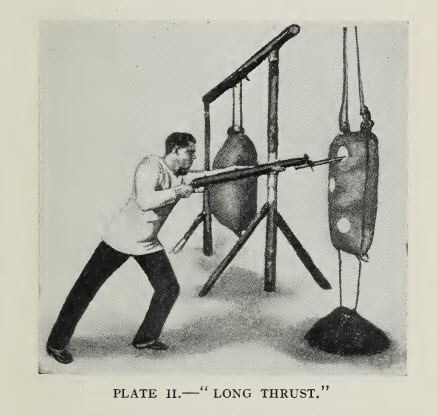
My initial attack was to the student’s inside line with the “long thrust,” that is, a thrust Long Thrust Bayonetmade from about 4-5ft away–as with the sword, bayonet and rifle move first. The student takes a half-step back, parries in prima, then steps slightly to their right and delivers a cut to the arm or down the barrel to the attacker’s hands (this second riposte must be made carefully, one reason that this is not a drill I run with beginners). There are other options, such as a cut to the head via molinello, but we were doing our best to maintain the requisite distance in light of Covid.

The next drill started the same way, but as soon as I saw the student shift to prima, I made a cut-over the parry to the outside line. The student then had to take a second half-step and sweep back to seconda or terza. From there they stepped slightly to the left and delivered a cut to the forward hand on the rifle., before detaching and delivering a thrust with cover.

It was a valuable exercise for a number of reasons. First, because we were on grass, it mean having to be careful with footwork. Given the length of the bayonet trainer the student had to move–to plant and attempt to defend would mean a best we both got hit. Best of all, seeing the versatility of the first triangle parries–1st, 2nd, and 5th–cemented why we focus on them so much. Lastly, it was fun, and that is important.

Sabre vs. Smallsword

Yesterday, in a another lesson, I had a different student defend against smallsword.

angelo smallsword vs sabre
D. Angelo, School of Fencing, 1765

This particular student has considerable experience, and at this stage of his training it’s possible to incorporate more and more of the more advanced, less standard material. Among the traditions he has studied is long experience with KdF (Kunst des Fechtens), which means that dealing with a variety of weapons is not new to him, and, that use of the weapon for defense as well as strategies for coming to the grapple are second-nature. He is far more comfortable with grappling/stretto play than I am, but I am learning a lot from him in the process (what little I’ve studied comes down to a few years studying Fiore’s armizare and weapon-seizures in sabre and smallsword or spada).

Here too we were keen to maintain “social distance,” so as per current custom attacks were mostly to the forward target. My initial guard was Girard’s high tierce/3rd, his was his choice of 2nd or 3rd. As with the bayonet drill, I focused first on attacks to the inside line, mostly toward the wrist; he countered with 1st or 4th depending on where he was as my lunge completed. Ripostes were generally to the arm, or, with a diagonal forward step right, to the head. Next, I performed a simple disengage/cavazione moving from the inside to the outside line. He countered with 2nd or 3rd, again, depending on where our relative distance was and how time affected the choice.

Finally, I adopted Girard’s guard of high quarte/4th, and attempted a variety of thrusts

Girard feint from quarte
Girard, Traité des armes, 1740

with opposition or via a feint. My student countered these as before, either attempting a stop-cut or arrest with a parry-riposte, or, when unsure of the tempo just parry/riposte.

I was surprised, but thrilled he enjoyed this exercise as much as he did.


The quickness of the smallsword and the fact that the point was always on him meant that he had to be conservative. Any attack, as he put it, had to deal with that preeminent fact. A little over a century after Girard another Frenchman, Baron César de Bazancourt, remarked in his Secrets of the Sword that

La pointe d’une épée est une réalité qui fait disparaître bien des fantômes.

“The sharp point of a sword is a reality which quickly makes illusions disappear.” My translation is a bit free, and less eloquent than de Bazancourt’s translator, C. F. Clay, but I think illustrates the lesson well. [2]

In the attack, this same point had to be dealt with safely before anything else. A decent sforzo or expulsion was effective, but had to be measured well since the lightness of the smallsword makes recovery to line a little easier. Since his weapon is heavier–he was using Castille Armory’s 16mm blade in a Radaellian guard–feint via cut was less safe than a feint followed by a thrust. This is yet another reason that the guard of 2nd is so excellent.

He did well in both offense and defense; his key concern was not to be hit, and so, if there was the slightest chance of mishap, he regrouped or attempted to provoke me to attack. I am really happy with how well he has taken to sabre, how skillfully he adapts to different and often difficult scenarios, and how much he enjoys it.

What’s Next?

I plan to continue the inclusion of both bayonet and smallsword on occasion. It’s fun, diverting, and forces the student to apply what they know to a new situation. As my student and I discussed yesterday, exercises like this force one to look at their toolbox and figure out how to make a hammer perform like a screwdriver, or, vice versa. Against the advantage in reach offered by a bayonet, one must adapt to handle that; against the lighter, faster, and more nimble smallsword larger actions and those to deeper target are dangerous, and so to achieve either option one must plan well or be hit.

I do not yet have a smarra, but I have an Italian epee that will perform the job until I do, and I may pair that with an off-hand dagger. I have not explored off-hand options with these students yet, and we have a lot to choose from, from cape (one of my favorites since a jacket, towel, or blanket remain similarly useful today) to buckler to dagger. In each case, it’s important to note, much of what we are doing is examining how we use the fundamental science within sabre to tackle non-standard scenarios. It’s a good mental exercise, forces the student to consider those fundamentals from a different perspective, and it’s a ton of fun.


NOTES:

[1] The one I had in mind as I typed this up was Domenico Angelo’s The School of Fencing, first published in 1765. In the edition I have he treats the use of the smallsword against various nationalities of fencer, Spanish, German, and Italian, and against a variety of weapons and off-hand accessories, dagger, dark lantern, cloak. A few other works of note that deal with multiple weapons include Pierre Girard’s Traité des armes (1740), which likewise pits his student against various European foes and their “favorite” guards; Charles Roworth’s The Art of Defence on Foot, 2nd ed. 1798, includes directions for sabre or broadsword against smallsword, spadroon, and musket and bayonet; and Nicola Terracusa e Ventura, True Neapolitan Fencing (1725), which includes defense against sword and dagger, buckler, rotella, and cape (an excellent English translation of this was made by Christopher A. Holzman in 2017 (available via LuLu Press).

[2] The English translation of C. F. Clay, originally published in 1900, was reprinted by Laureate Press in 1998. It was first published, in French, in 1862, and then again in 1875.

Historical Fencing Pedagogy, a Few Guiding Principles

IMG_6222 (2)In watching several recent historical fencing events friends and I got to chatting about effective (and ineffective) teaching methods, and, of the difficulties that tentative endeavors such as interpreting extinct fight-systems presents any instructor. In so many ways we lack a blueprint for how to teach some of these past arts. Many of us draw from the venerable advice and time-tested techniques of established fencing programs, such as the Scuola Magistrale Militare di Roma [Military Fencing Masters School of Rome] and its North American Counterpart or the USFCA.[i] We consult other instructors, our own or colleagues, and between the collective wisdom of the schools, other instructors, and our own experience we can do a lot. We also mine the pages of works like László Szabó’s Fencing and the Master and adapt ideas and drills to our own context. Happily, this is a problem all of us share, and increasing the issue of pedagogy is coming more into the larger dialogue.[ii] There’s a small, but growing corpus of literature about pedagogy making the rounds in historical fencing circles too.[iii] These are important conversations for us to have, and as the community grows we can expect discussions of pedagogy to garner more attention. That’s a good thing.

There are a few principles that I want to share here, ideas we discussed post-event, but also some which I’ve learned as a professional teacher. I don’t claim to be novel, I don’t want to reinvent the wheel (the ones we have work fine), but these principles might be handy to others pondering the place of pedagogy in historical fencing. What follows might be a solid collection of discussion topics if not a nice primer on some simple ideas every teacher should embrace.[iv] Some I’ve covered before, many others have treated far better, but for any set of drills, exercises, and the other elements of a successful curriculum attitude about them, about teaching, is everything.

Humility

Victory of Humility over Pride from Jungfrauenspiegel ca 1200
Victory of Humility over Pride, from _Jungfrauenspiegel_, ca. 1200

No one can learn anything who lacks humility. Those who believe they have it all figured out are fooling themselves; don’t let them fool you. The texts we work with are often difficult to interpret, no one has all the answers, and that’s okay. It’s the fact that we do not know, but wish to that drives us to study.

Historical fencing is unique in that there’s no official certification program, not yet anyway, for creating a master and this means a number of things. Given the nature of the evidence, the fact that most extinct arts have no surviving tradition, it’s highly probable that the nature of any such program will be different than say a fencing master’s schooling when we finally develop such a certification. Until then, and arguably after then, even the best interpretation will only stand until a better one comes along, so, take heart, be honest, and do your best. Don’t worry about mastery—that isn’t really a concern here in the conventional sense. We’re going to get things wrong, and a humble person will more easily handle that and change.

Collaboration & Sharing

This seems like a no-brainer, but it isn’t; not everyone wants to play nicely with the other kids. Sometimes this unwillingness stems from fear—perhaps one is working on a beloved project and doesn’t want anyone else beating them to the punch in publishing. Sometimes this fear stems from insecurity about one’s approach, interpretation, ability, or effectiveness in teaching (imposter syndrome is a common issue for many instructors). Whatever might stop you from reaching out, make the effort—there’s no shame in learning from others, in asking for help, from working together.

At the event that first sparked this conversation about pedagogy there was an impressive assembly of talent, from those working in the medieval Italian and German traditions, to classical Italian, to eastern martial arts, to everything in between. Such opportunities are ideal for exploration, for presenting what one’s been working on and getting valuable feedback from people as jazzed as you are about the topic. Working together benefits everyone. Also, it’s fun—how often at work or in other social settings can you discuss the finer points of a parry? How often do you get to take swords in hand and work out some play? Talk, share, make friends—it will only help. Don’t make the mistake of working in isolation.

55a4eae5a90f78e4a119c3531a75aa77--fencing-lessons-fencing-gearCultivate a Willingness to admit “I don’t know”
Not having all the answers is okay. No one in their right mind will ever assume you do. Not knowing is what spurs us to learn. Saying “I don’t know” is never the wrong answer, however terrifying it is to say, and once said puts you on the path to changing an “I don’t know” to an “I’m going to find out to be best of my ability.”

I offer the following somewhat humorous and embarrassing example. In the oral portion of my doctoral exams, one professor, a stand-in for the Greek expert my school never seemed to be able to keep (allusions to Spinal Tap’s drummer have often been made…), turned out to be one of the two types of examiners one will face in such exams, in this case, the person who wants to see what you don’t know. His first question, of a sort, was to shoot a clay tablet to me across the table and ask “what is that?” I looked at it, replied that the clay was modern, that the script looked to be Linear B but that I wasn’t completely sure (I spent far more time on Latin and Celtic). I thought crap, this is going to be some everyone-knows-this-inscription and I’m screwed. He said it was the first line from Homer’s “Iliad.” I raised an eyebrow in disbelief, said that was impossible as Homer post-dates the Mycenaeans by a good stretch, and waited for the hammer to fall. Satisfied, he then proceeded over the next half hour to ask me random questions about Greek history from Troy to the fall of Greece to the Romans. I cannot tell you how many times I said “I don’t know.” If I seemed to know anything, he quickly changed the topic. I left feeling that I’d failed, that I was washed up, that I’d embarrassed myself, shamed my advisor, and should find a nice heavy rock to crawl under. Despite this emeritus jackanapes’ glee in stymying me, I passed, and only passed his section because what I could answer I answered well, AND, and this is the important part, because I was smart enough not to bullshit, but to admit “I don’t know.” That’s hard to do under pressure—I know, believe me—but it’s sometimes the only answer you can and should give.

Cultivate a Willingness to Remain a Student

I used to teach college courses, mostly working adults in community colleges, and it’s seriously one of the most dynamic arenas in which to learn or teach. Where a room of 18 year olds will have some decent conversation and insight, a room of 16 to 75 years olds, many of whom have acquired expertise and experience in fields from mining to combat, from factory floors to homemaking, is so full of knowledge and experience that discussions are usually richer, more full of insight, debate, and fun.

I firmly believe that the best teachers never stop being students. Good teachers learn from their students, from other teachers, and from anyone whose line of work involves instructing others, be they foremen, former drill sergeants, mothers of six kids, or farmers. My students make me a better teacher, yours will too if you listen.

Own your Expertise

József Keresztessy, around 1892

This can be a tough one, least it is for me, and it’s because it must jive with humility. No one wants to be that insufferable know-it-all or be taken for one. If you’re teaching then chances are good that you have enough experience to do so, are the only option, or are spear-heading a study group and by default have to lead. Maybe you have more formal training, and/or certification via accredited fencing programs. If you’ve earned it, own it.

We can err the other way and undermine ourselves too. If you’re too quick to point out shortcomings, things you don’t know, then that is what people will hear—people are more likely to question you if you question yourself. It can be a fine line. I learned this lesson as a first-time college teacher. I was teaching on an army post and decided not to list my name as “dr” or “name, PhD” on the board, and at the end of the first term an older man, a sergeant, approached and asked me about it. I told him something to the effect of wanting to create an open room where they felt free to talk, to disagree with me, etc. His reply was awesome and a powerful: “Sir, this is an army post—everyone has a rank. You earned those credentials, you earned your rank—don’t be afraid to share that. Whether people feel free to chat or not doesn’t depend on your rank, but how you use it and how you show respect to them. There is room for both command and respect.”

Own your expertise, but do not wave it in people’s faces; share it with them through appropriate means, through scholarship, through teaching, and by living the example. If you are out there reading this Sgt. Bond, again, thank you.

Be Open to Revision as Necessary

With an endeavor as tentative as research into historical martial arts one must be willing to revise any interpretation, no matter how good, should new evidence come to light or a more logical interpretation enter the picture. There’s no shame in ceding place to a better interpretation, only in pig-headingly holding on to one that’s been superseded.

This should drive all of us to work even harder at drawing conclusions that follow from the texts and which make sense logically, in terms of body-mechanics, and fit the historical context. None of this work is wasted. So your conclusions about Fiore have been bested by a new theory, don’t fret—scholarship doesn’t happen in a vacuum and it may be that Jane Schmoe relied on your work to devise her own interpretation (if Jane is a good scholar she will admit that too).

Give Credit where it is Due

Following closely on the last point, always cite your source, and, always give proper credit to the scholars, researchers, and fencers whose hard work, dedication, and passion have helped your own path of study. This goes beyond leaving a paper trail or protecting oneself from plagiarism—it’s just the right thing, dare I say it the chivalric thing, to do. Everyone gets a kick out of seeing their name in a footnote, dedication, acknowledgements, or Facebook post. It honors them, and, in honoring them you honor yourself for you demonstrate that you’re a team-player, an ally, someone who is working to provide the best research, teaching, and interpretation of these martial arts as you can. Stay chivalrous my friends.

Have FunMarozzo (2)

Why do we pursue historical fencing? Why do we spend so much time pouring over the often cryptic passages in old fight manuals? We do this because it’s fun, it makes us happy, and fun is good for us. Don’t lose sight of the value of play—historical fencing exercises your mind and body, and done right, can give your spirit a workout too.

NOTES:

[i] See http://www.fencingmastersprogram.com/about.html

[ii] László Szabó’s Fencing and the Master, Staten Island, NY: SKA Swordplay Books, 1997; see also, among many others, Zbigniew Czajkowski, Understanding Fencing: The Unity of Theory and Practice, Staten Island, NY: SKA Swordplay Books, 2005; Ziemowit Wojciechowski, Theory, Methods and Exercises in Fencing, Datchet, Berkshire, UK: Amateur Fencing Association, 1993.

[iii] For a good place to start (in fact, just read this, it’s fantastic ) see Roger Norling, “HEMA Pedagogics Part 1: The Pedagogics Pioneers & The Role of a HEMA teacher,” at HROARR, November 21st, 2014, http://hroarr.com/hema-pedagogics-part-1-the-pedagogics-pioneers-the-role-of-a-hema-teacher/ (part 2 is here http://hroarr.com/hema-pedagogics-part-2-the-implications/ , part 3 here http://hroarr.com/hema-pedagogics-part-3-how-to-create-a-good-learning-environment/ ); see also a breakdown of a typical practice at The Phoenix Society for Historical Swordsmanship in “How we Train” by Richard Marsden, http://phoenixsocietyofhistoricalswordsmanship.webs.com/apps/blog/show/31776335-how-we-train-by-richard-marsden .

[iv] Pedagogy is a giant subject—here I will discuss some general ideas, but in the next installment on this I will discuss some real-time strategies for teaching.