REVIEW: swordshop.ca Fencing Kit

[3 Oct. 2023]

A few weeks ago my friend and colleague Jay Maas (Broadsword Manitoba, CA) kindly sent me a few items from his new store, swordshop.ca, in hopes that I might review them. Happily, this is easy to do as I love the pieces he sent. For some perspective, I’ve been wearing various fencing jackets, masks, shoes, etc. since the late 1980s, so if I may say so have a decent notion of what works, what doesn’t, and what should one avoid.

PLUNDERHOSEN [black, CAD $100]

To be honest I never imagined trying on a pair of the ubiquitous “poofy pants” so popular in HEMA circles, let alone liking them, but damn it they’re honestly the most comfortable pair of fencing knickers I’ve yet worn (for readers in the UK I use this in the Yankee meaning of culottes or knee-breeches, not underwear). They are roomy. I mean, you could carry a friend about with you in those things, but sad attempts at humor aside the value of this is that stray shots to the legs are absorbed by the pants. [1] I normally wear a pair of soccer goalie pants under my tracksy pants, but the Plunderhosen do a better job of preventing bruises, least in my experience. To be fair, I don’t have students typically target the legs unless they’re tiny, but even so, they’re stout pants.
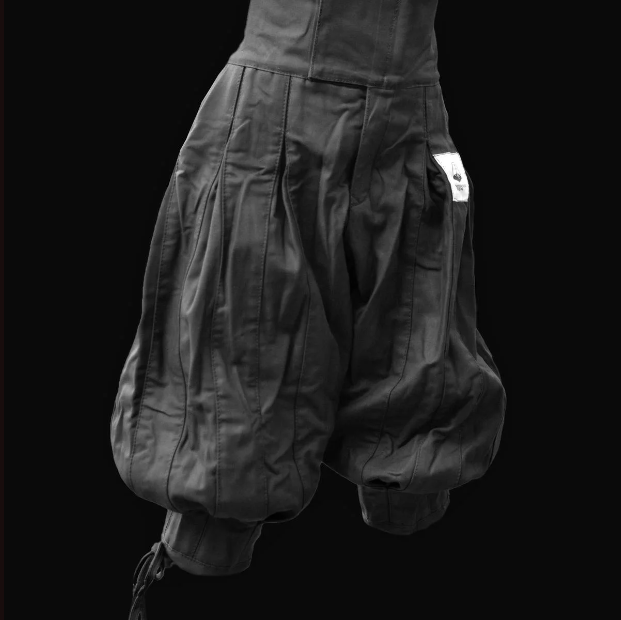
Plunderhosen, swordshop.ca

The material is a tough canvas and the seams are reinforced, an important consideration in fencing pants. I was relieved to see that the pant legs sport larger openings for the lower legs. In the past I’ve burst seems on fencing knickers, and I’m not particularly muscle-bound. The ties, which for me, fall just below the knee, did not come undone once. Sizing is a bit more fluid than one might expect, but this was not a problem and I doubt would be for most people–so long as one picks the closest size, something Jay is happy to assist one with, the fit is adjustable thanks to cinches on the side of the belt-line, suspenders, and a wide, comfortable Velcro closure where one normally finds a zipper.

These giant pants may become my standard pants for fencing–I liked them that much.

Swordshop Light Jacket [CAD $80; available in black or white]

When I first took this jacket out of the bag I was worried it might be too light, too thin to offer much protection, but I my apprehension was unwarranted. This jacket, while definitely lighter than the canvas I normally wear, did a fantastic job of protecting the torso and arms. The zip closure is happily on the off-hand side instead of the back, and reinforced. The material stretches too, which is important not only when lunging, for example, but even just when transitioning through parries (it sometimes takes time to break in canvas).
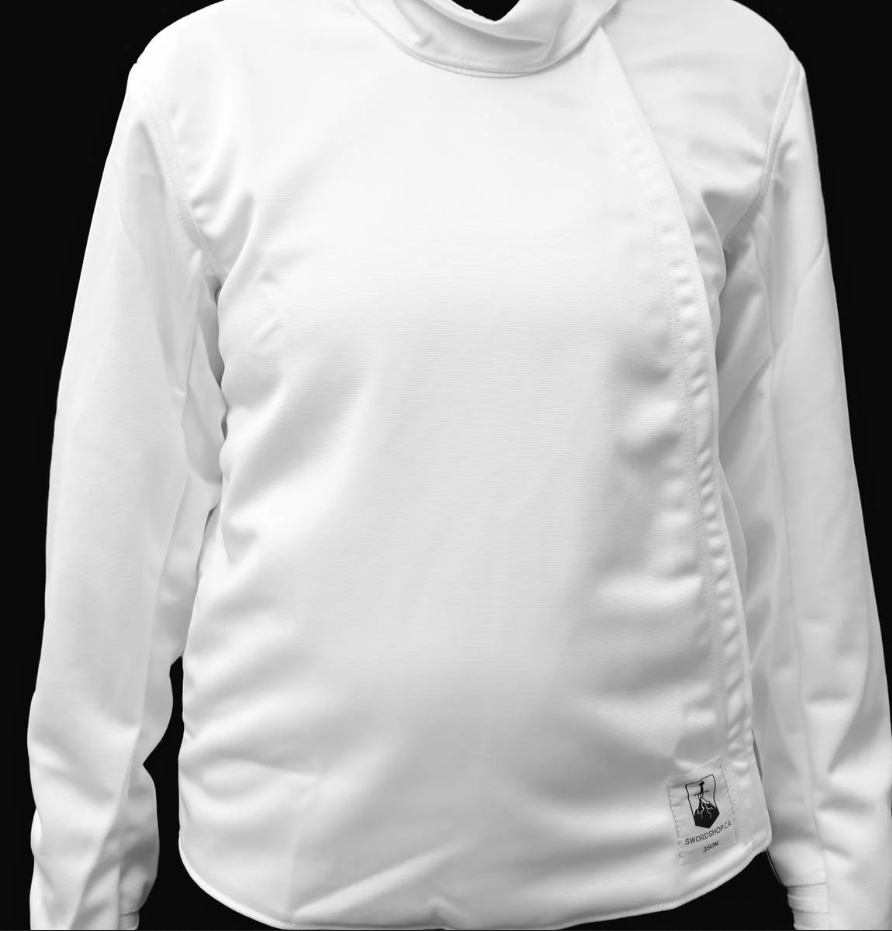
Light Jacket, swordshop.ca

One thing I noticed immediately was that this jacket was longer; it extends down to just over the hips. Normally I wear a sabre jacket, so one sans cuissard, which hangs just above the hips. Aesthetically I’m still on the fence about it, but I didn’t notice it and the jacket was super comfortable. With autumn here, and winter not far behind, it may be a bit thin for working outside, but come spring and summer this jacket will be my go-to.
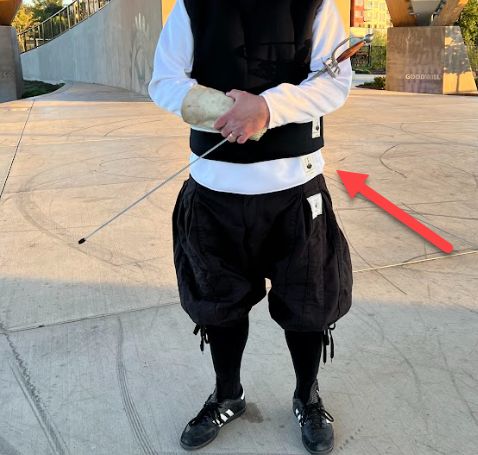
The vest stops where my sabre jacket normally does; the jacket extends a bit lower

Coaching Vest [ CAD &80; available in black and in white]

I normally wear Absolute Fencing’s Proflex Coach Vest [USD $79; https://www.absolutefencinggear.com/af-proflex-coach-vest.html] and I like it, but I tend to wear it for hours at a time and while the drooping front is great protection it makes sitting… difficult. Least one has to be careful and sit a bit like Prince Akeem in “Coming to America” if one doesn’t want a fabric guillotine to regions south.
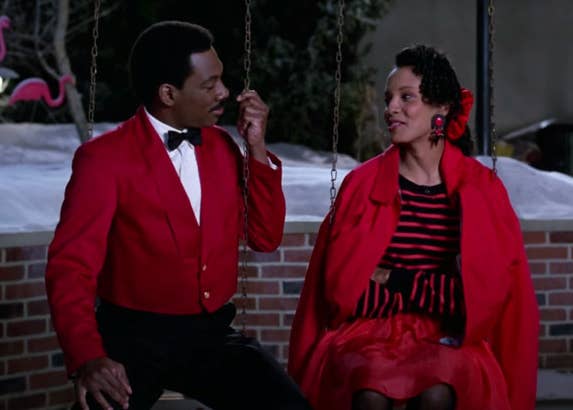
Prince Akeem (Eddie Murphy) sitting rigidly in “Coming to America” (1988)

The other disadvantage with the AF coaching vest is that the internal plastic strips mean that one must roll the vest in order to place it in a bag. That’s okay, but if one travels a lot and needs room for additional gear, the vest can take up a lot of space.
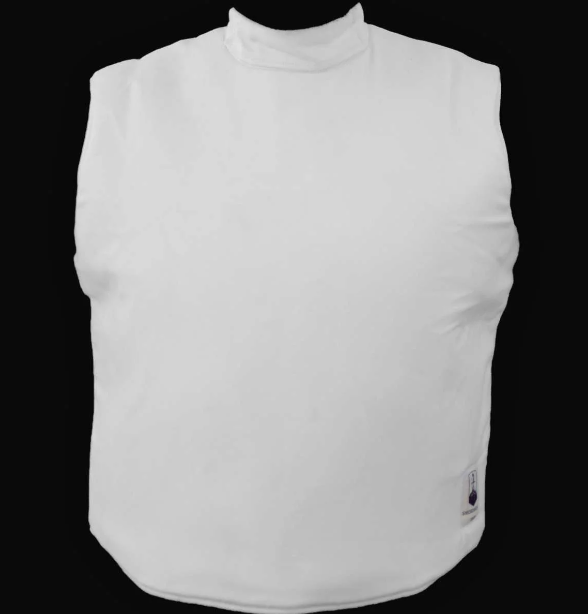
Swordshop.ca Coaching Vest

Swordshop’s Coaching Vest, on the other hand, is half as heavy, more easily transported, and still offers superb protection. The foam front is thick and covers the entire target. The material is stout, but light and unlike the AF version one forgets one is wearing it.

The one downside to the vest–a fault in many if not most of them–is that it’s a backzip, so one might need assistance zipping it up. One unique feature of Swordshop’s vest is that in addition to the zipper it has three sets of ties. These can be used to secure the vest further or in lieu of the zipper. In warmer months I suspect I’ll only use the ties. With a jacket and vest, it gets pretty hot and being able to tie the vest on, with ample ventilation, is attractive.

Summary

These three pieces from Swordshop.ca are well-made, comfortable, and affordable. Even with a fluctuating exchange rate they’re a good deal. I’m not one to plug a product or trainer unless I believe in it, and I’m already recommending these items to students based on my experience with them (btw: Jay does not pay me to hawk his wares 😉 )

If you’re looking for a light weight jacket or vest, if you want some stylish Meyer-esque enormo-pants, check out Swordshop.ca.

NOTES:

[1] Yes, legs are targets in many systems, and with good reason, but I maintain they’re not an ideal target one-on-one unless one is fighting uphill. Cf. https://saladellatrespade.com/2021/03/23/military-vs-dueling-sabre-revisited/

Review: Shrike’s Forge Broadsword

[26 April 2022]

Mid-18th Century Style Highland Broadsword
Smith: Mark H0wland, Shrike’s Forge, Medford, Oregon, USA
https://www.shrikesforge.com/
+15418215857

SPECS:
Total Length: 41.5″/1.05m
Blade Length: 36″/91.44cm
Blade Width: 1.75″/44.45mm
Grip Length: 4.5″/11.43cm
POB: 3.5″/8.89cm
Weight: 2.91lb/1.32kg

Materials: steel; grip is wood covered with leather

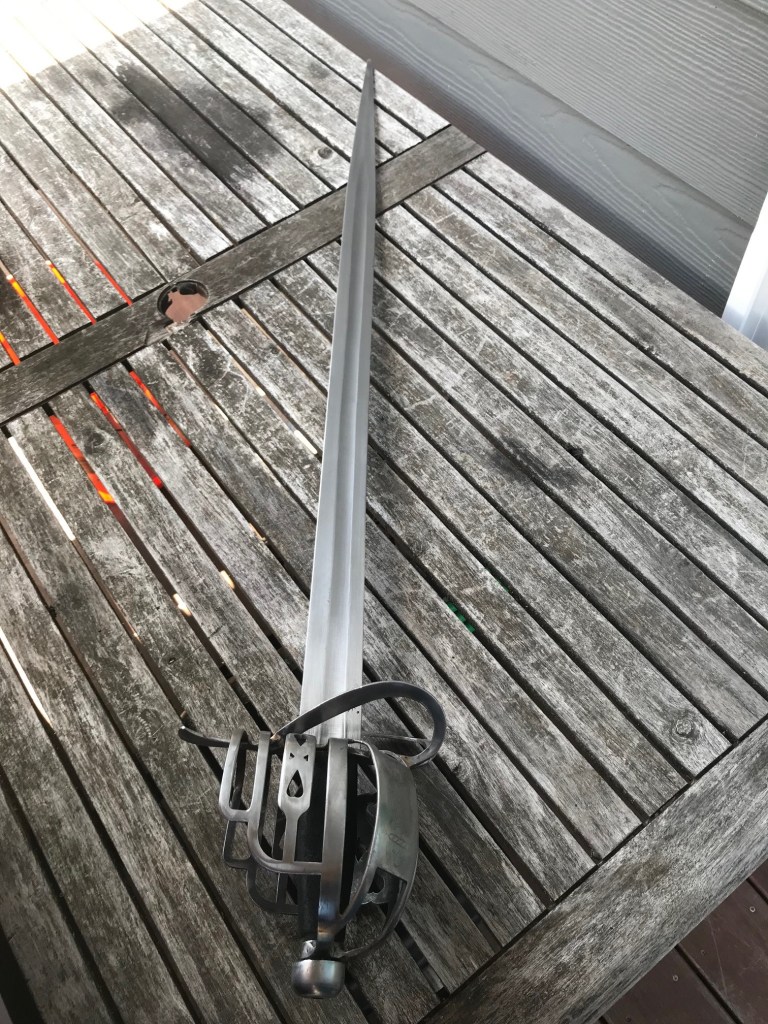
Shrike’s Forge Broadsword

There are times when the challenge of writing a review consists of fighting the urge to gush with praise about the object of that review. Too effusive and the reader may suspect one of collaboration with author or creator. However, the pure joy in wielding and using this beautiful weapon makes it impossible for me to hold back praise. This is easily the finest sword I have ever used in a bout, and by finest I mean in every way: balance, sturdiness, performance, and design. The closest analogues I have to using this broadsword by smith Mark Howland are the legendary weapons made by Gus Trim. The latter are sharp, and thus only used for cutting practices, but in terms of quality, handling, and artistry Mark’s weapons are the blunt equivalent. If you know Gus’ work then you will know that is extremely high praise.

This weapon, a gift presented to me by the broadsword group at Northwest Armizare, was a deep honor to receive. How does one thank people for such an exquisite gift? I did my best to express my gratitude when the broadsword was handed to me, but this is the sort of thing that goes beyond words–it means a lifetime of trying to do right by the givers. [1] Each time I pick up this weapon I am reminded of my debt to them and encouraged to give them all I can as friend, peer, and instructor.

Close up, Portrait of Jas. Carnegie and Family, ca. 1809, Cork, Ireland

Background: This broadsword, the first of a batch Mark is making for the broadsword pod, is based on one my great-great-grandfather carried. [2] The blade, least as far as I can make out from the painting my cousin has, is a later design: it is thinner, more like the later 19th century regimental blades than something from the time of the ’45. The sword is lost, so far as the family knows, as is any idea of provenance or history. I opted for an earlier blade profile and heft as I have suitable trainers for later broadsword, but not for the earlier period, and, it changes things.

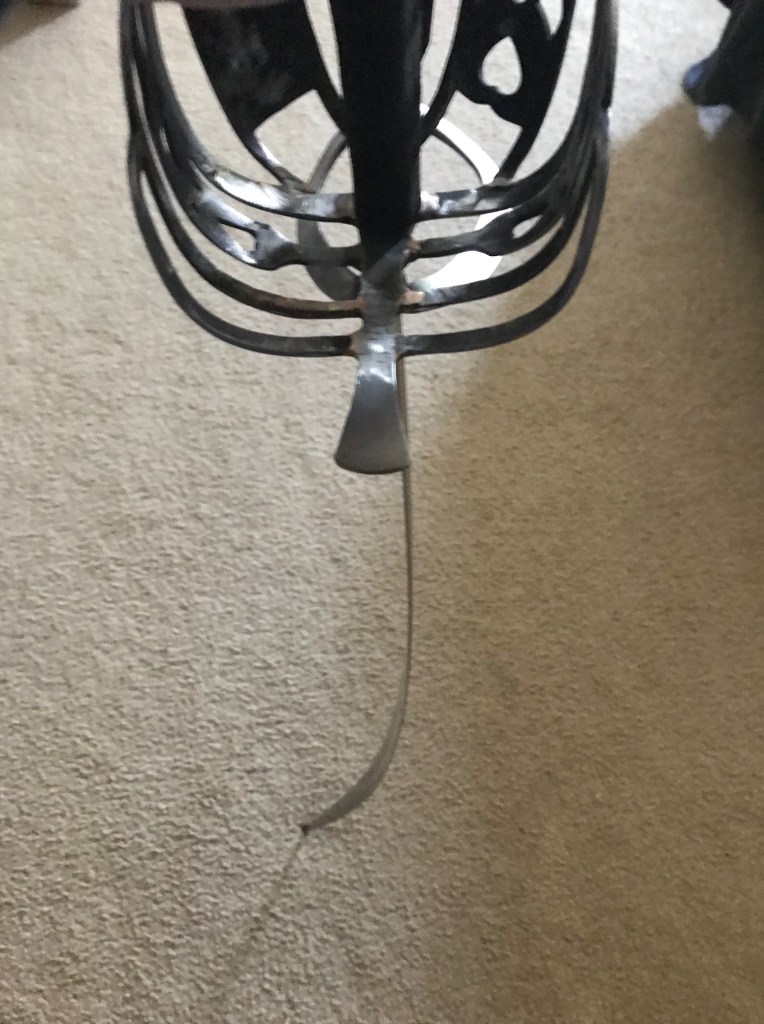
Overview: This is a stout blade, but nimble. Mark can speak better to the science behind this than I can, but from a user’s perspective one wants a robust blade that still has enough flex to manage the shock received in striking and parrying. This blade easily flexes several inches and returns to true–a good indication of quality.

7x7mm spatulate tip

The spatulate tip, now standard I think on many of Mark’s training weapons, is my preferred tip. It’s ample in size, but not so globulous that it’s comic. That’s a tough balance to strike. The blade’s edge is nicely rounded too, so between the two cuts and thrusts can be delivered–assuming appropriate use–safely. [3] Even with the control that my opponent, Josh Campbell, and I possess, these are heavy blades and can land with significant force. Any such danger is increased if the weapon in question lacks attention to the vital details that make a training blade a training blade. Mark put a lot of consideration into the width, flex, and tip, and for the size and heft of this broadsword one would be hard put to find a better, safer version.

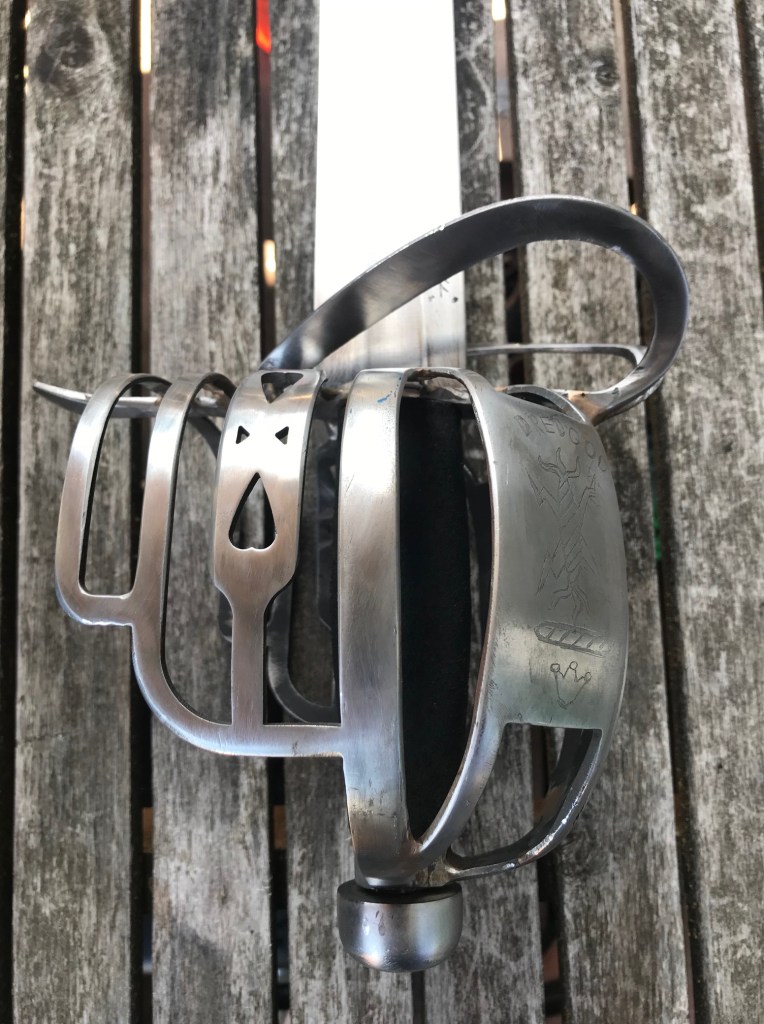
Basket, right side, Carnegie family crest badge slightly visible on the plate

The guard is tough. In it’s inaugural bout, “Morag” fared well against a similar broadsword that is about a half-pound heavier, and the guard took no damage. [4] This is critical as a sword of this heft can break fingers more easily than a lighter one. The grip is lovely–the leather is turned suede-out which really sticks to the glove well, and the shape is perfect. These weapons are held with more of a hammer/racquet grip, and even without measuring my hand Mark managed to produce a grip that fits perfectly in my palm. Many on the market are too wide or too thin.

Handling & Performance: We often refer to swords in anthropomorphic ways. For example, we might say one should “listen” to the sword, or remark that “it wants to move” in such and such a fashion, and all are shorthand expressions for describing a complicated combination of weight, balance, and movement. This broadsword, for example, just as it should be has the point of balance (POB) father back than my usual sabres. It’s a weapon optimized for foot combat, and heavy, so having the balance closer to the hand reduces fatigue and allows the fencer to use more of the wrist in making cuts. In contrast, with Radaellian sabre, the POB is farther out as it would be for most mounted combat. So weighted, however, the elbow is a better axis for rotation.

Josh is a strong man, much stronger than I am, and, much younger, so the fact that I could bout with him and hold my own speaks volumes about how well-made Mark’s tools are. I let the sword move as it was intended to, which comes down in part to knowledge and training, but also and importantly to the right tool. This sword was constructed to move as broadswords did—not all broadsword trainers are balanced properly or perform like Mark’s. This one makes it far easier to appreciate what one reads in Thomas Page, for example, and that is important for anyone keen to understand how the tradition may have changed over time. While this broadsword has definite presence, it does not feel or function like it a ponderous club–it is nimble, quick, and seems almost to float.

If you’re in the market for a truly outstanding broadsword trainer, contact Mark. I have handled several of his weapons, from the khamlis he has made for Mike Cherba to several swords he’s made for Josh Campbell. They are impressive to behold and use. Wait time can be a while, but these are hand-made, and worth the wait.

NOTES:

[1] This is the second time I have been honored with a superior sword. It is extremely humbling. The first, a gorgeous Gus Trim early Hungarian sabre, was presented to me at Swordsquatch in 2017 for helping promote historical sabre in the PNW. Honored as I am, I also feel the responsibility that comes with such gifts, and strive to be worthy of them.

ATrim, early Hungarian sabre

[2] My father’s great-grandfather, James Carnegie, joined the Duke of Albany’s Own Highlanders, the 72nd Foot (later the Seaforth Highlanders) and saw action in the late 18th and early 19th centuries. When he demobbed he didn’t return to St. Vigeans, in Angus, Scotland, but settled in Cork, Ireland. The portrait close-up comes from a family portrait my cousin Rosanna displays in her home in the UK. We also have some photos taken of James, then a very elderly man, in Highland dress with what appears to be the same sword. These too helped Mark design the basket for mine. [For students of Scottish history and highland dress, yes, this is a hodgepodge of kit. Best we can tell James missed home and put together various items to honor it. Tartan experts, so far, believe it was some general plaid vs. anything related to the Carnegie pattern (itself modeled on the MacDonald)]

[3] Proper fencing is the best insurance for safety. Weight can add to any force multiplication, so optimizing a weapon for safety is all the more important.

[4] The minor surface scratches are normal, ditto tiny dings in the blade, both of which one removes with light Emory paper on a regular basis. This not only helps preserve the blade’s life (they are consumables after all), but also one’s opponent’s clothing.

I’m not in the habit of naming swords, but Josh in his eagerness to see how mine would do remarked that his broadsword, “Bessy,” was keen to play with her little sister. I figured it was only fitting to come up with a suitable name 😉

Additional Images:

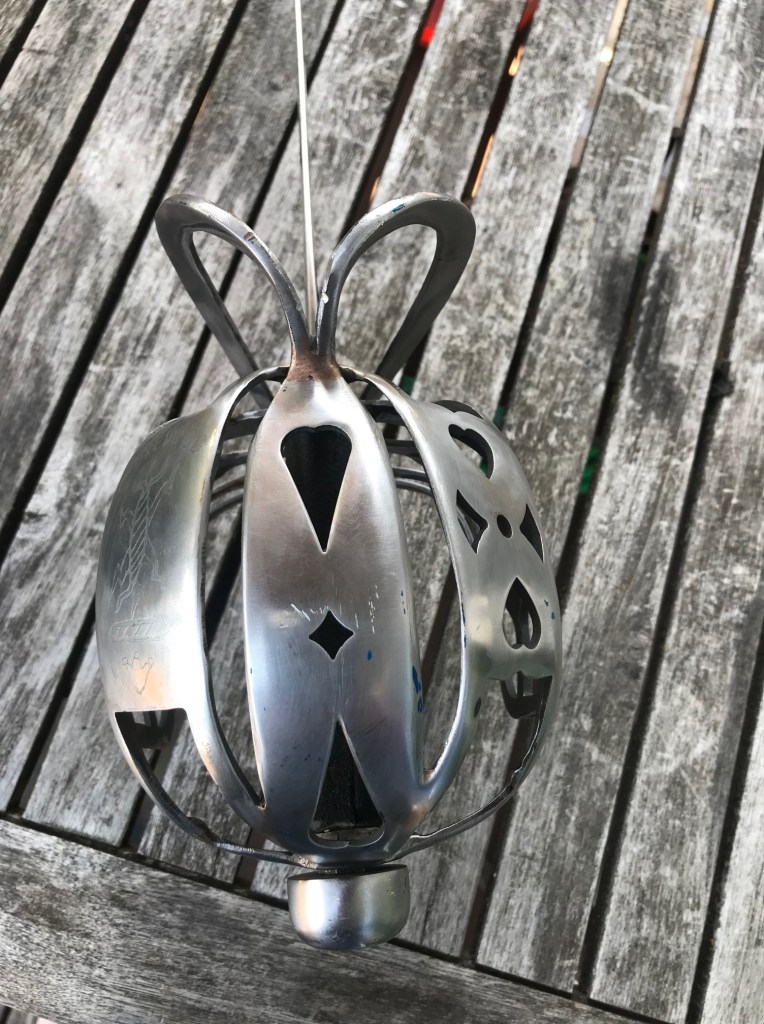
Basket, interior and grip
Basket, left side

Knucklebow–some slight scratches and paint from Mike’s rotella
Flex!!!!