Raising the Bar Ever Higher—The St. George’s Day Exhibition of Arms

[29 April 2024]

Mike Cherba on Georgian Sword & Buckler

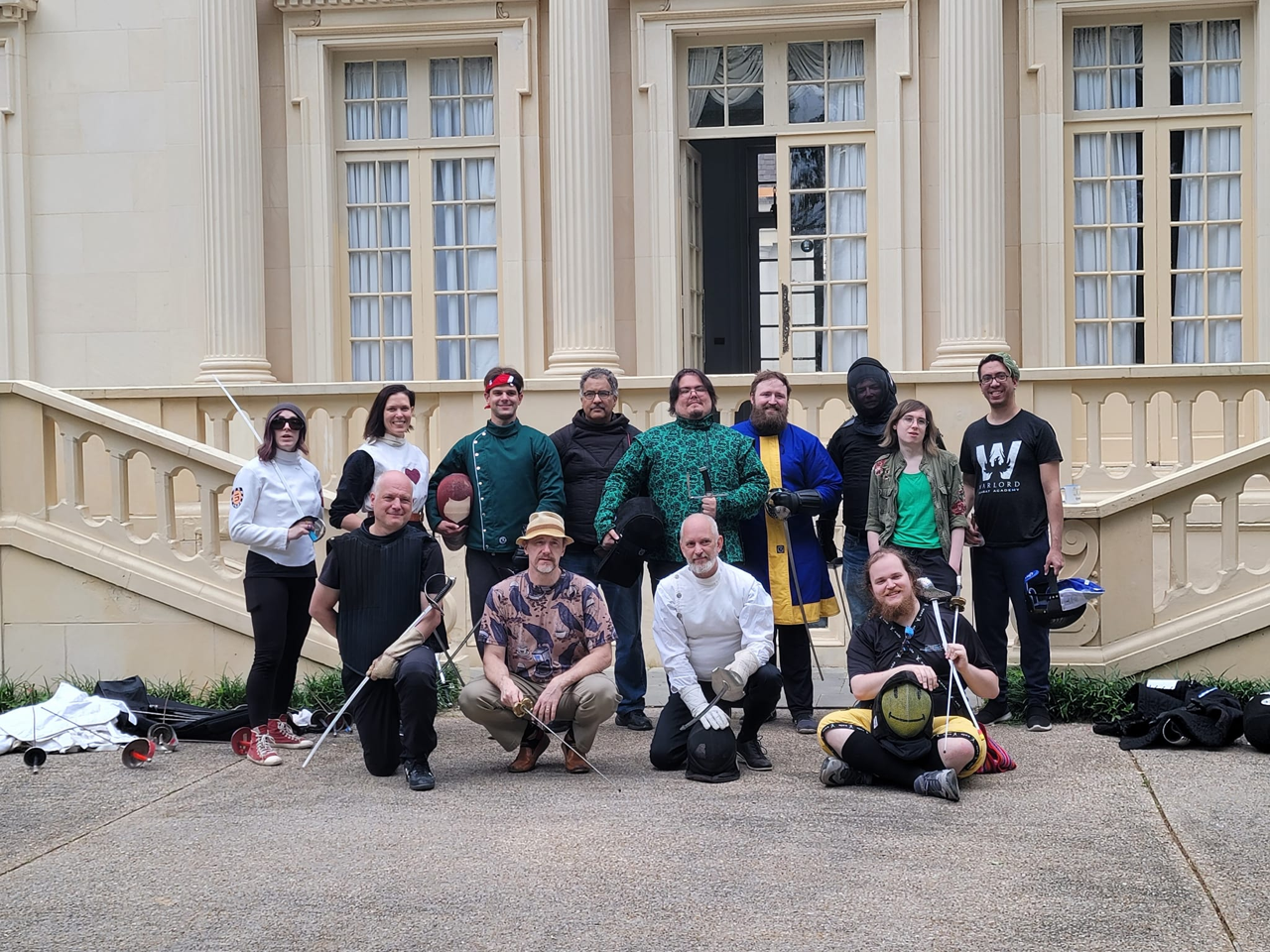
It was a pleasure not only to share more Radaellian sabre fun with people, but also to be a student again at this year’s St. George’s Day Exhibition of Arms at the gorgeous Chateau South in Atlanta, Texas. This event, created and orchestrated by one of my favorite people, the redoubtable Russ Mitchell, with help from the lovely people at Winged Sabre Historical Fencing (based in Dallas), is part class, part graduate seminar, and all brilliantly enjoyable. A little over a year ago I wrote up a short piece on this event in which I called this weekend of classes, discussion, and bouting a bar raiser. [1] It was, and, it is. In fact, in year two Russ and friends have placed that bar at least a few feet higher.

There are many tells beyond my high opinion of the event, and to be fair, they are likely better gauges than whatever I might think; after all, Russ is a researching fencer and thus I may be slightly biased in his favor. He is a wonderful human in addition to his vast knowledge of fencing, history, and how the two mix, but again, I acknowledge the potential bias. In light of that, I offer the growth of the Exhibition—we had more people this year; the variety of classes—we had everything from 18th cen. Broadsword to Georgian sword and buckler to a deep dive into the various types of molinelli/moulinets one can make; and, the diversity of the crowd, already solid, expanded—to name one example, this was the first time—ever—I had a chance to cross swords with someone using Meyer’s system for single-handed cutting weapons. In sum, word of this special weekend clearly reached deep into corners of the historical fencing map this past year, and hopefully will continue to do so this year as word spreads.

The St. George’s Day Exhibition of Arms is one of the three events I point to for how we should be doing things. This is not to say that there are not other important events, only that of the many I have attended these three stick out. They are exemplars, models, paths to follow, with one caveat and a potentially contentious one—one must know what one is doing, or, know whom to invite in the case one does not. SabreSlash in Prague, The Exhibition, and Rose & Thorns all share common themes and ingredients. They are run by knowledgeable people, both in their own right and in whom they seek out to teach. Each of these events is run well and offers the attendee better cuisine than the average tournament of weekend seminar. The level of ability, of skill, not to mention knowledge, is high. Not above average—HIGH. This is true not only in terms of know-how, but in terms of execution. One test of this for me is how beginners are treated and what they take away from these events.

Come one, Come all

Among the new folks this year were also newer fencers. One of the things I watched closely was the degree to which beginners understood what the instructors were teaching and how more experienced fencers treated them. Full disclosure I was not worried much about this knowing what I know about Russ and his people, but all the same given the different backgrounds each had even the best designed event and intentions of the organizers can fail. One would have to ask those beginners, but from what I saw not only were newer people brought into the fold, but accommodated seemingly without effort. The first is less surprising—outside a few bad apples, most historical fencers are welcoming and just happy to find yet more sword nerds with whom to play. As Alex Spreier, who taught a fantastic course on the broadsword system of Zach Wylde said to one new person, who was a bit shocked at the open invitation to join us in the PNW (where we tend to house people to save them money), “Of course! You’re sword family!” This was beautiful and proper and makes me love Alex that much more, but more impressive were the ways in which Alex, Kat, Mike, and Russ arranged their classes to meet the needs of students of any level. This can be extremely difficult to do.

The Classes

Alex working Wylde with Jake

Kat’s class on footwork, a topic easily made way too challenging, was disarmingly unintimidating. Her explanations were simple, but dead-on to what was most important, and everything we explored one did at one’s own pace. She was there to answer questions, and at each turn exuded a “you can do this” demeanor that just made one want to try harder. In like vein, Russ’ class on the molinelli/moulinets was a textbook model for how to cover a complex topic effectively and in ways useful to beginner and experienced fencer alike. Starting with the shoulder alone and working our way slowly to using wrist and fingers, Russ enabled everyone to see the variety of methods used in various systems, but also foreshadowed and for-armed everyone for what they would need for each subsequent class. Mike Cherba’s class on Georgian sword and buckler is one I have attended, even assisted with, numerous times, but hands down this was his best iteration of it. He made converts. It’s dynamic, different, interesting, and so damn fun it’s hard not to fall in love with khmali and pari. The standout heretic—to use his own words—was Alex Spreier’s presentation of Zachary Wylde’s broadsword system. This early 18th century method tends to be snubbed by fencers better acquainted with salle fencing—Wylde’s English is not posh, and his system is bare-bones self-defense. It is also brutally effective (as it should be). Alex also made converts. I offered a close look at Radaellian molinelli and how one might use them via one tactical set up. This introduced a laboratory experiment taking that Radaellian version and seeing how it might apply, change, work, or not work in the Hussar system Russ teaches. [2]

Discussion at meals, over the oceans of coffee consumed, and in between classes was jovial, curious, and informative. It is often said that we learn more at these events after classes in small discussions, and that is likely true. Between the two there was a rich banquet of knowledge to digest. One of my favorite such moments was sitting by the atrium pool listening to Russ’ quick summary of the history of Hungarian fencing (yes, I took notes and yes some of these gems will find their way onto this page, guaranteed). Related to the last, several of Russ’ students were preparing to be examined as peers on the final day. Being the responsible man he is, Russ has avoided the pitfalls of ranking systems that often undermine the goal of such systems—to become a peer means demonstrating an ability to carry on the tradition should, as he put it, Russ been unable to do so himself. [3] Proof of stewardship is provided via an oral examination and in bouting, and if applicable, teaching. I am honored to announce that both Kat Laurange, whom I deeply respect, and Coleman Franchek, whom I just met but took an immediate liking to, both passed and are now instructors within the system.

OF NOTE: Russ, an expert in the Feldenkrais Method, once again and free of charge, helped me with a gimpy hip and the equally wonky wrist he helped me supinate when he was last in Portland–thank you Russ! If you’re in the DFW area, and need help with any movement challenges, see Russ [4]

Russ Feldenkraisening my wonky wrist; Coleman in mirror

FIGHT!

I have two favorite forms of public bouting. Accolade tournaments and exhibition bouts, and to be honest, of the two the latter appeals to me more and more. An “exhibition of arms,” as the name suggests, is a chance to highlight, to celebrate the particular approach to a weapon or system as a master or school envisioned it. The goal is not to win, though that’s nice, but to exemplify as best as possible what makes that tradition unique, distinct from others. There are a number of reasons this is important and useful, but it’s also just plain fun to watch. It says a lot that we kept score mainly just to ensure everyone had a turn to bout everyone else, and it perhaps says that much more than many of us had trouble even doing that. Russ at one point asked his student Jake, currently bouting with me, what the score was and neither of us had remembered to! So, we said “two to two” and kept playing.

We started with bouts between the instructors, one of my favorite things to do, and then each instructor did their best to fight everyone. I mean everyone. It can be exhausting, especially if like me one hasn’t been bouting qua bouting so much as engaging in teaching bouts, but it’s worth the exhaustion. It was a pleasure to cross swords with Russ who is as skilled as he is gracious; these traits are also shared by his students, old and new, and they are seriously challenging opponents. I won’t lie—they are among my favorite people to fight because it is always difficult and always super fun. Last year, Kat trounced me beautifully, and she did so again this year only differently—never saw that long, deep thrust coming since I was so concerned about my wrists lol. Kat is one of those fencers you should fence as often as you can and at any opportunity—she will make you a better fencer. Fighting Russ, Kat, Kevin, Jake, Jacob, Austin 1 and Austin 2, all of the Hussar fencers, was one of the reasons I made the trip. Quentin Armstrong, whom I just met, came to the event from Louisiana and offered me my first bout against someone who really understands Joachim Meyer’s sword in one hand. I am seriously hoping to do that again soon. I didn’t have a chance to fight everyone, so owe the first dance to Ellie and then next to Trevor, but I look forward to that eagerly,

Gratitude

I would like to thank Russ and the fine folk of Winged Sabre Historical Fencing, including not only his students but wonderful partner in life, Anna, for the invite and for taking such good care of us. Kat Laurange waited patiently for me at the airport despite a serious delay, and then graciously gave me a place to stay until we left the next morning (thanks Kat and Scott!). Russ and Anna gave me a lift to the venue and arranged for instructor rooms at the Chateau.   Thank you Raoul for such generous use of this beautiful site (https://www.chateau-south.com/)!

Thank you to all the fencers who attended my class, chatted, and worked with me this weekend. I was and remain honored to have taught at The Exhibition and in such good company.

As a final note, before I left for Texas a friend of mine, a life-long martial artist, asked me if this was a paying gig. Having run a do-jang for years he knows how things work. Not being involved in historical fencing, I had to explain to him that for the most part renumeration is not standard, partly because we all do this because we love it, and partly because few programs can afford to cover travel, room and board, and food—most clubs are struggling to acquire the most basic, economically sourced gear that won’t break or fail. Then I told him, that in the case of The Exhibition, this is the sort of event one happily pays to attend. It’s the kind of event one saves money all year to attend. So dedicated are some attendees that they camp on site in tents, despite humidity, bugs, and new this year—tornado warnings! This is important and worth consideration.
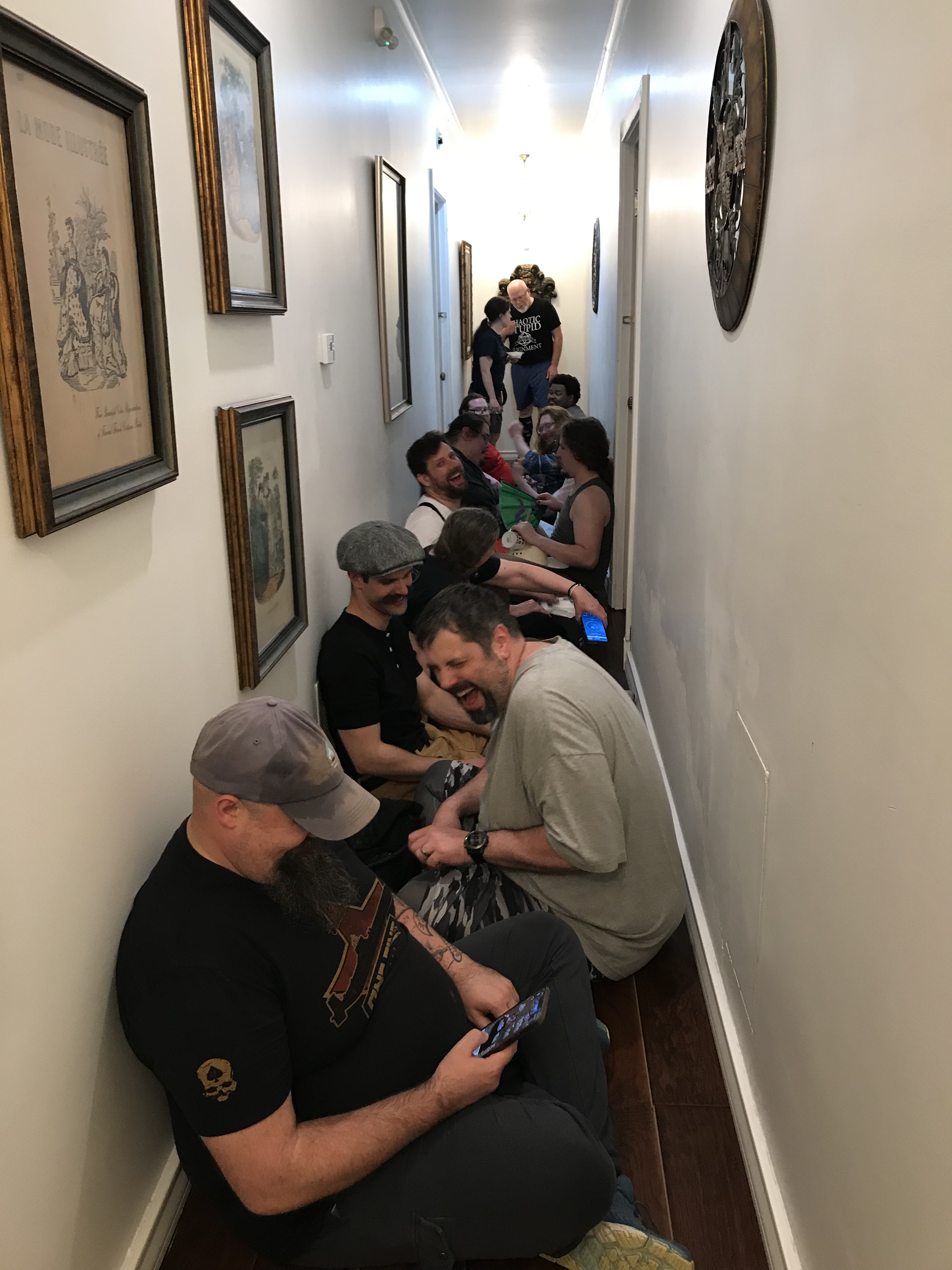
Waiting out the Tornado Sirens

NOTES:

[1] cf. https://saladellatrespade.com/2023/04/24/a-bar-raiser/

[2] https://www.ticketleap.events/tickets/chateau-south/exhibition-of-arms

[3] As a note on this, Storica Defensa’s ranking system is not a “belt system” either, but a way a) to categorize competitors by skill level, and b) a way to classify levels of coaching.

[4] https://www.irvingfeldenkrais.com/?fbclid=IwZXh0bgNhZW0CMTAAAR2-2VE3_CN6p80i8mZhdsIW58HjErNPRoi1nyA9v-MeD1k2vtlKoNYLlEg_aem_ATY4HDbQ3EnxTDZyQwTDElgc_-24Xn7IU4t1OwHQlXaewpWQ3ajV9WKEwuYYOvE4hYlqL9vhlAVRWOQUOSFPxTVC

Hussar Sabre & Fokos Seminar with Russ Mitchell

[A short review/overview of the Hussar Sabre & Fokos seminar featuring Russ and hosted by Mike Cherba and the folks at Northwest Armizare, Sherwood, OR, USA, 4-5 Nov., 2023]

Hussar Sabre & Fokos Seminar, 4-5 Nov., 2023, with Russ Mitchell, hosted by Northwest Armizare

A core aspect of teaching, of the Art, is remaining a student. Whenever I can, I take lessons, classes, any seminars to learn, unlearn, or improve, because we’re never finished learning. As my old kendo master once shared, even at his level his own master would fix things as elemental as his grip whenever they met up. In tandem with cultivating a student mind, I encourage my own students (when they’re ready) to seek out other teachers, and, better fencers.

This past weekend I had another chance to work with a better fencer, the excellent Russ Mitchell (Winged Sabre Historical Fencing, Irving, TX, USA), and explore new material. [1] One of the traditions Russ learned while in Budapest was a broken lineage for sabre, one adapted to the unique needs of early 20th century soldiers in greatcoats, carrying packs, and either in ranks or in trenches. Professor Hidán Csaba, with whom Russ studied in the late 1990s, learned this system from his grandfather, a drill master in the later years of the Great War, and from his grandfather’s friends. [2] Russ will be the first to add that we lack much of the pedagogical apparatus for the system, but through study and his time in Hungary, he is confident that much of the physical game is correct. If I may offer a proof for it, I have found fencing his students extremely difficult—they are not duelists where most of us, whether we admit it or not, are.

Movement & Bones

Among the many hats Russ wears he’s also an expert in movement. A student of the Feldenkaris Method, his approach to martial arts includes many of the tenets of the Method, and, for the better. [3] To be quite honest, I had not heard of FM until this weekend, but have now seen, firsthand, its effectiveness. In grade school I fractured my right wrist badly—the bones were all but poking out of the skin. It did not set super well, and so for decades I’ve not been able to supinate fully. Years of fencing, racquet sports, etc. added layer upon layer of compensation for this issue. Then, in 2001, I was in a serious auto accident, one that injured my shoulder and released all the horrors that might not have appeared until later, tennis elbow chief among them.

Sunday, before the second day of class, Russ kindly took a look at my arm. We chatted first and I gave him the history and general problems I experience with it. He examined my arm, had me perform a few exercises, and then had me supinate again. I believe I said, well, shouted, “WTF…” in disbelief. Where I had been able to turn my hand maybe 120 degrees on a good day, here I was supinating to about 170 degrees. I couldn’t believe it. I have homework to do, and I’ve never been more motivated to do it, but I have far more mobility in my wrist, and best of all, did not experience the usual, weekly night of hell with a neck and backache I cannot treat save through heat, ice, and leaning into the pain. [4]

Lest one think that the seminar included certain smokable plants and esoterica, it didn’t. Russ explained much of what we were doing in terms of what bones, muscles, and tendons were working at any one time. The first half of Saturday, for example, explored balance, weight-shifting, and the biomechanics of the lunge. I said last April that Russ had changed my understanding and approach to teaching the lunge—this portion of the class added to that understanding, and, as before, though we spent a LOT of time lunging, no one was tired. For anyone who has spent time in an Olympic school and knows how challenging footwork drills can be, that should reveal just how effective Russ’ system is.

Hussar Sabre

Following the lunge portion, we then learned the rudiments of the Hussar sabre system Csaba imparted to Russ. The footwork, cutting mechanics, and options this system uses are simple, but not simplistic. The videos that Russ has shared on YouTube will give one a far better idea than any description I provide can, so please see the link below to his channel. [5] Of note, this is an unforgiving, effective, and brutally efficient system of sabre.

Russ and Noah demonstrated how to parry low-line

Significantly, this system assumes a curved sabre, and, takes complete advantage of false-edge cuts. Measure is generally closer than someone from my background is comfortable with, but this said it fits the system well. The first four cuts, one through four, bisect the target in an “X” formation: cut 1 descends from the right, cut 2 from the left; cut 3 ascends from the right, 4 from the left. There are other cuts, including horizontal blows, but we spent the most time with 1 and 2, and, options from there as both attacker and defender. This was especially valuable to me as having fought a school of people using this system, and knowing how challenging it is, I know have a better idea of how it works.

Fokos

Sunday we started out with more bio-mechanic work to prep us for working with the fokos or shepherd’s axe. Sometimes described Stateside as a long-hafted tomahawk (an apt analogy), this axe was long-used by shepherds, but was also used in the Great War. Russ showed us the military application he was taught, but also some of the “folk” uses. The latter, for example, might help one collar old uncle Boris after he overindulged at the pub. Like the sabre, one is using more of the hips and torso to propel the weapon and block. This means that one turns to stay behind the weapon.

One thing I did not anticipate, it not being my thing, was the amount of grappling one can do with the fokos, either against someone without the weapon or with one. The hooking ability of the axe can bind up not only an opposing fokos, but limbs. We explored this aspect in the “folk” portion, and like most folk arts a fair amount of learning how to use the axe to assist grappling is experimental. Russ armed us with a few principles, demonstrated a few set-ups, and then had us play with these actions and ideas.

The military portion was more intuitive for me as the starting position is one shared with bayonet. That is not an accident. Given the weight of the average rifle ca. 1915 the fokos makes for a much faster, nimble tool. Our brief exposure to this weapon only increased my sense of horror that attended trench warfare. [6] It’s a delightfully nasty weapon.

Take Aways

Russ told us our brains would be full and he wasn’t wrong. I’m still processing a lot of what we covered, never mind reeling from the fact I can supinate on my right side now. That still seems unreal.

At the risk of sounding sycophantic, Russ is one of a handful of instructors whom I would advise anyone to work with regardless of what he’s teaching. His knowledge is as deep as it is varied, his skill impressive, and he has a fantastic sense of humor. Moreover, and one sees this is his books, Russ is aware that not everyone is 19 and a paragon of fitness. As easily the oldest person at the seminar this weekend, I might have special appreciation for this fact, but what this means is that regardless of one’s shape, ability, or fitness level, Russ can and will work with you, and, you’ll get something out of it. A lot of something.

In addition to his videos (see link below), Russ is a prolific author, and produces works that combine the rigor of his academic training with an ease of reading that is often rare in our field. Buy his books and read them; watch his videos; and if you have a chance to take a class with him, whatever it is, take it. You need not thank me, but you might wish to. [7]

NOTES:

[1] See https://saladellatrespade.com/2023/04/24/a-bar-raiser/

[2] Russ Mitchell, Hungarian Hussar Sabre and Fokos Fencing, Irving, TX: Happycrow Publishing, 2019, xiii-xvi.

[3] For more on the Feldenkrais Method, see https://www.sciencedirect.com/topics/medicine-and-dentistry/feldenkrais-method ; see also https://www.ncbi.nlm.nih.gov/pmc/?term=feldenkrais+method ; the Wikipedia entry, one should know, was written and monitored by an opponent of the school.

For Russ’ practice, see https://irvingfeldenkrais.com/

[4] I have spent a lot of time, off and on, studying both yoga and MBSR (mindfulness-based stress reduction), the latter thanks to the cancer program at OHSU (see for example https://www.apa.org/topics/mindfulness/meditation). Much of what we covered echoed what I have learned in these disciplines as well as in various PT sessions for injuries.

[5] Russ’ YouTube channel: https://www.youtube.com/@russmitchellmovement/playlists

[6] My paternal grandfather fought in the Great War, and though he didn’t like to talk about it, I learned from my own father that between the sound of gas canisters and trench warfare, it was utterly terrifying. I can’t imagine having to face one of these axes–they may look small and delicate, but they’re effective and quick.

[7] Cf. https://www.amazon.com/stores/Russ-Mitchell/author/B006PFZ3IS?ref=ap_rdr&store_ref=ap_rdr&isDramIntegrated=true&shoppingPortalEnabled=true

A Bar Raiser

Chateau South, Atlanta, Texas

Super late last night I returned from a weekend of instruction, teaching, discussion, bouting, and all manner of swordy fun at the St. George’s Day Exhibition of Arms held at the beautiful Chateau South, Atlanta, Texas. The event was put on by Russ Mitchell and the excellent people at Winged Sabre Historical Fencing, and hosted by the generous owner of the Chateau, Raoul, who not only trusted us to honor the integrity and safety of this property, but also who grilled a feast for us. If you’re in eastern Texas, “Piney Texas,” and need a venue for any event–wedding, family reunion, business retreat, you name it–I can’t recommend Chateau South enough (https://www.chateau-south.com/). Raoul and the family who take care of the property and are helping to restore it, Shawn and Rebecca, put the hospitality in southern hospitality. Seriously nice and generous folk.

Learning, Camaraderie, and Cross-Fertilization

I hope that the St. George’s Day Exhibition of Arms will become a regular event, because it needs to be. We have tournaments, we have seminars, conferences, and in some rare instances a mix of the three, but in some cases the dates are tough to make, the cost prohibitive, or the environment/attitude less than welcoming. Russ Mitchell and the fine folk at Winged Sabre put together a fantastic event–it was friendly, open-minded, and welcoming, but more than that the classes and discussion, the chat over meals or between sessions, all were informative and thought-provoking.

In addition to my two classes, there were a class on movement and balance by Russ that has changed not only my understanding of footwork, but also how I will teach it from here on out; there were two by Francois Perrault (Montreal, CAN), first on French foil as a way to understand the second topic, contre-pointe (the French approach to sabre ca. 1800-1908); and two by Jonathan Carr (Dallas, TX), one that made more sense of Hutton’s sabre than anything I’ve read, seen, or heard until then, and then a fascinating lecture on Sir Richard Francis Burton’s 1875 sword system.

Some of the Attendees late Saturday, 22 April 2023 (photo by Annamarie Kovacs)

Discussion between classes, over meals, and especially at the end of the instruction-day, were as valuable. They were also a chance to get to know one another, share ideas, and increase understanding on the various tangents covered in the topics. For someone as introverted as I am, and who normally has to bow out to recharge, the fact I wasn’t once in need of that recharge should suggest a lot.

Tired, but still in for chatting–Aaron, Michael, and myself

Exhibition of Arms vs. Deeds of Arms

Both have their place, but what an exhibition of arms seeks to do is share a particular style or tradition’s uniqueness within the Art, that is, what makes it what it is. While I cannot say to have represented the Radaellian school particularly well in my own bouts, I will say that my compatriots did a wonderful job. Russ’ students have been studying hussar sabre, which is very different than the profiled styles that predominate; Francois’ early French approach and Jonathan’s debt to English sabre and broadsword were clear as well. The focus in our bouts was to do our best to fight within the body of techniques and tactics of our specific traditions, and, to have fun doing it.

We also had time to explore a venerable Hungarian weapon, the fokos, a shehpard’s axe that the Magyars brought with them from the Steppes in the Early Middle Ages and which was used in the trenches of the Great War. Never have I faced a more challenging weapon sabre in hand than I have that wee axe. Russ made a few converts among us, I’m sure; least, I’m looking into the more than academically now.

Russ arresting a cut with a fokos

Raising the Bar

Winged Sabre’s “St. George’s Day Exhibition of Arms” raises the bar for what we can and should be doing more often in historical fencing. Each of the classes had students drilling. There, I said it, the “d-word,” drill. It’s become a dirty word in “HEMA,” and to the detriment of that community. The garbage posted so often on Youtube as championship sabre is a case in point. The hop and chop, simultaneous single-tempo cuts lauded as the end-all be-all of sabre are to Plato’s cave what shadows on the wall are to the sun outside the cave that creates them.

Drill. Hard work. Effort, time, and sweat. These are what make a decent fencer. One can spend weeks, years even, in study, but if intentional, well-designed drill is missing, there is only far someone will go in that time. Another way to say this is that much of HEMA is doing it wrong, and should seek better methods, better instructors. I’ll not go so far as to list myself among their number, but I will say that I know some people you should talk to.

Russ Mitchel on Timmlich

As someone who regularly points out how daft it is to use a trooper-weight sabre for foot combat (tough to make any complicated action well), I feel it only right to share this lovely video from Russ. Timmlich’s excellent treatise provides the historical fencer into BIG sabres a way to use them, on foot, effectively. Check it out!

Leszák’s _Sabre Fencing_ (1906)!

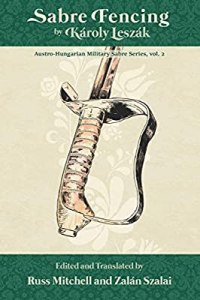
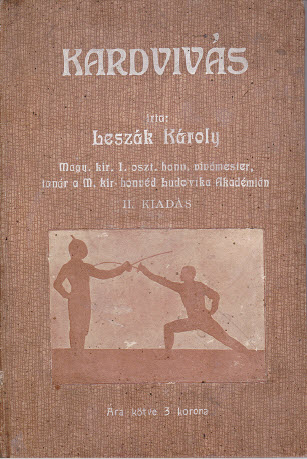
Karoly Leszák, Sabre Fencing, (Budapest: Adopted by the Ludovika Military Academy, 1906), translated by Russ Mitchell and Zalán Szalai, (Irving, TX: Happycrow Publishing, 2020), 158p. ISBN: 9798695368253. $20 US


Russ Mitchell, scholar, fencer, and instructor at Winged Sabre Historical Fencing school (Irving, Texas, USA), has published a translation of Károly Leszák’s Sabre Fencing (Kardvivás, 1906). This is the second in a series of works covering Austro-Hungarian Military Sabre (the first is Hungarian Hussar Sabre and Fokos Fencing, 2019). With this translation Russ and his colleague Zalán Szalai have opened an otherwise mostly shuttered window into this key fencing tradition. It can be obtained here:

Sabre Fencing: by Károly Leszák https://www.amazon.com/dp/B08N5LDY7P/ref=cm_sw_em_r_mt_dp_Br1RFb9VYENH8

This is an important text on multiple levels. First, most manuals written in Hungarian have not been translated into English, so unless one can read the original language the value of such works remains either unknown or incompletely understood. Since the importance of Hungary in the development of sabre cannot be overstated each new translation increasing access to that corpus is a boon. Second, any student of the Italo-Hungarian tradition should have an interest in this work as it was written at a pivotal time. Italo Santelli brought the Radaellian tradition to Budapest, Luigi Barbasetti to Vienna, and it was the merger of Italian and Hungarian elements that formed the system so many of us learned last century. Even today’s Olympic sabre program, though different in some key respects, owes most of their curriculum to the Italo-Hungarian system.

What works like Leszák’s give us is a look at a stage in development between Radaelli’s late 19th cen. students, men such as Barbasetti and Santelli, and what in some circles became the “bible” for mid-century sabre, Z. Beke and J. Polgár’s The Methodology of Sabre Fencing, published in 1963 (Budapest, HG: Corvina Press). The crucible which produced the mid-century game was largely the rise of the Olympics in the first half of the 20th century, a period that also witnessed the swan-song of the sword in combat. [1] What we see, in Sabre Fencing, then, is a snapshot of a tradition in transformation. Leszák was one of the masters at the Ludovika Military Academy–though these academies trained soldiers, the theater for combat they were increasingly preparing for was not a battlefield, but international competition.

If I may beg the reader’s forgiveness, I’d like to contextualize the importance of this as a product of the Italo-Hungarian school. Most of my sabre training came via Albert Couturier and his students, especially Larry Dunn and Brian Peña, though I also had the honor to take a few lessons with Ferenc Lukacs. Al’s master, Joseph Vince, was trained in Budapest when the system that Leszák describes was in place. Both Giorgio Santelli and Vince emigrated to the US, to New York, the same year, and went on to spread the mixed school on both coasts (Vince taught in New York, but is better known for his sala in Beverly Hills, California, where Tony Curtis, Cornel Wilde, and others studied fencing). [2] I have yet to determine which of the three schools in Budapest Vince attended, but if it is true that he was in the military then either Ludovika or the Toldi Miklos Royal Hungarian Sports Institution are the most likely (the third, the BEAC, the main university club, is also a possibility). Leszák, however, had studied at Weiner Neustadt Military School, Barbasetti’s campus, and both he and Gusztáv von Arlow (who authored another work on fencing, also entilted Kardvivás, 1902) studied the Italian school there. [3] For many years I’ve have researched the tradition in which I came up to see just what was Italian, what Hungarian, and how they mixed. Now, for the first time, and thanks to Russ’ expertise, one can do this more effectively. I’ve been reading Leszák with Joseph Vince’s Fencing (1940) next to me, and the parallels are striking, but so too are the departures. One can actually see, right there on the page, what is clearly Radaellian, what is Hungarian, and importantly how the two worked together to fuse what most people know as sabre. Looking through Vince’s work after reading Sabre Fencing is to see it in a new light; for one, though familiar with and an admirer of the French school, Vince’s foundation is Italian. One sees this in his foil and especially in sabre. Where Leszák included both direct cuts and Radaellian molinelli, Vince mentions the latter but focuses on the former. The realities of competition from 1906 to 1940 demonstrated that the traditional Italian extended guards left fencers’ arms vulnerable to wrist cuts; so too did the larger cuts. [4] This is just example of how access to a key Hungarian text informs our understanding of works we already know.

Russ’s work is a pleasure to read. His style is engaging, his obvious skill and insight into the context and material are matched in how humbly and good-naturedly he explores it. Few people possess the combination of talents to do this project justice, but Russ tops this short list. [5] There has been an explosion of translations, especially through print-on-demand self-publishing operations, and too often the hard work of the translators is undercut by their lack of expertise in the language, by failure to have skilled editors examine their drafts, and in failing to have another expert in that language go over their translations. With Russ Mitchell’s work we are on firm ground. He has lived and studied in Hungary, and he knows Hungarian, but he also enlisted the help of a native speaker to ensure accuracy. He had another brilliant translator, Christopher A. Holzman, read through the text as editor and to check the author’s use of Italian terminology and ideas. Moreover, Russ has the academic credentials, and experience, to conduct this type of research responsibly.

As to its contents, readers familiar with most works out of Italy in the 19th and 20th centuries may be startled by how similarly organized Sabre Fencing is. Like his contemporaries to the southwest, Leszák begins with the parts of the sabre, grip, first position (“basic stance”), the line of direction, and a break-down of the cuts. The cuts, significantly, he divides into “sabre swings”–following Hungarian and German terminology, and, molinelli, following Italian practice. Later, in section 21, he covers direct cuts. Both direct, short-path cuts and circular cuts from the elbow are there–this is just one example of the blending of traditions.

The author covers guards next and these are, with some minor changes, the guards of the Radaellian school, just positioned a little differently. The guard/invitation/parry of second, for example, is held more at chest height than shoulder height. Third is also lower than one sees in most Radaellian works. One version of low-fourth that may surprise is Leszák’s second way to form it–students of Hutton would call this a way to defend the “fork:” the hand and guard are to the right, the blade extended out left, straight, to defend/deflect a low thrust or ascending cut below the belt (cf. 27-28). A chapter on “parrying swings” and shadow-cuts (cuts made against an imaginary opponent) follows and reminds the reader that active-parries are an important part of the system. Molinelli, after all, we use in attacks, but can be used defensively too. The parrying swings were meant to help students hone the positioning required to defend themselves; today we refer to this exercise more often as “changes of engagement,” that is, moving from 2nd to first and back, from 2nd to 5th and back, etc.

Leszák Kardvivás, p. 10, two versions of Quarta Bassa/Low Fourth

Part Two, “School Fencing,” is an invaluable look at specific drills and lessons. A key pedagogical tool here, and one employed often in historical fencing, is pair-drills, only here students take turn as “master” and assist one another. Leszák notes that this allows them to be out of guard and rest, and thus fence longer, but that also it starts priming students who may go on to teach. It is, as he says, a more effective way to teach than group instruction. For fencers today, the lessons contained in part two run the gamut from actions on the blade to binds, from yielding/ceding parries to the counter-parry riposte game. Also included at the tail end of Part II are discussions of when and how one should begin bouting, some of the rules students were expected to follow in his time, and how to deal with both lefties and “instinctive” fencers.

Sabre Fencing is a rich source and the single most complete in English concerning the early Italo-Hungarian tradition. Leszák provides a thorough look at defense, offense, and tactics. Though “obviously, it is not possible to learn fencing from books” (9), as the author reminds us, this treatise will prove invaluable for those interested in the development of Hungarian fencing, the deep impact the Radaellian school had outside of Italy, and especially for students of the Italo-Hungarian tradition who wish to see, first-hand, what the Hungarian side of their heritage looks like up close. Parts of the book may be dense for some readers, especially newer fencers, because the author was writing for people with some training, and to a lesser degree because he knew that some students would arrive at the academy with a degree of experience in fencing (cf. 9), but Russ provides numerous notes to assist the reader with the more confusing or unusual aspects of the book. This is a must-have translation, and while perhaps of most interest to fencers in the Italian and Italo-Hungarian orbit, sabre fencers of any school will find much to mine within this text. Go. Buy it. Read it. Read it again, and start drilling.

NOTES:

[1] There were units in various armies issued swords in the Second World War, but they saw little action in most theaters. Japanese use in China and elsewhere is well and often graphically documented (a trip through the museum dedicated to the victims of the massacre in 1937 in Nanjing is not an experience one forgets). There were soldiers in the European theater who carried and/or used swords as well.

[2] Vince’s Fencing (1940) contains a little biographical material, but less than one might like. See also https://www.westcoastfencingarchive.com/project/joseph-vince/ &

https://emerituscollege.asu.edu/sites/default/files/ecdw/EVoice7/touche.html

[3] Károly Leszák, wrote the manual for the Ludovika Military Academy’s program, Kardvívás [Sabre Fencing], in 1906, yes the one discussed here. He had been a student of the fencing school at Wiener Neustadt Military School, and so, was a product of Barbasetti’s program. I need to verify this, but one chap, Hungarian, claims that two Austrian lieutenants, Rudolph Brosch and Heinrich Tenner, learned Barbasetti’s method, introduced it to W-N, and in 1899 translated Barbasetti’s text into German. This same commentator says that both Leszák and another author, Gusztáv von Arlow (who authored a sabre text in Hungarian in 1902), were students of the Italian school as shared at W-N. For more on Barbasetti’s work within the Austro-Hungarian Empire, see http://www.ars-dimicatoria.cz/en/barbasetti-military-sabre-since-1895-2/

[4] The lighter blade developed in the early 20th cen. changed everything. Those quick to criticize the excesses possible with the sport blade often find the system guilty by association. This is to mistake effect for cause. As most works on sabre make clear, aberrations in rule-sets and nonstandard techniques reflect a concern for victory in sports, not inherent flaws within the tradition itself. My generation, for example, was taught proper edge-alignment and was penalized when we failed to execute an attack with it. Many within that same generation, to win, adopted the low-hanging fruit of whipover to score when sabre went electric.

[5] Russ has the chops to conduct research well. He possesses advanced degrees in history and in medieval studies, has experience publishing in academia, and studied in Hungary. His first book in this series set the bar high for publishing in historical fencing, and serves as a fantastic guide to sharing difficult information (in this case a broken sabre tradition) in a responsible, approachable, and useful way.