I started the day off in a rapier lesson with one of the students with whom I’ve worked longest. I have often said that teaching is a two-way street, that both instructor and student—ideally—learn, grow, and improve as they work together. During one drill, my friend stopped, said “question,” and we stopped to chat. “Is there a reason you’re taking such a big second?” It was an easy observation, but one I had not made—was I? Was I taking too large a parry? He then asked “what else are you working on right now?” and then it hit me. What followed was a lovely chat about the ways in which different weapon tracks can “leak” into one another, something that can be a benefit, but in good cosmic equilibrium, can also work against us.
In this case, it was the latter, and I was grateful for his observation and said so. Focused as I was on the lesson plan, and on making purposeful mistakes, I didn’t notice an unintentional one, another insight Ken shared with me. There are many instances in which the instructor makes mistakes on purpose—it’s critical for teaching a fencer what to look for, how to take advantage of such issues, and it’s all valuable, but it’s sometimes a difficult thing to switch off, which is to say that a lot of us find ourselves struggling not to be in teacher mode when we’re bouting to bout.
The Drill
Here, the danger was not only my own overblown parry of second, but also undermining an otherwise valuable drill. At Ken’s level, we work on a lot of tactical set-ups, on second intention, traps, and ways to conserve energy. For me to drop the ball in any one section breaks the drill, and, potentially—were Ken not so aware—upsets the student’s learning. The drill in question started with a classic, workaday action:
Student: feint thrust to hand from 2nd or 3rd Instructor: parries 4th Student: disengages to strike outside of the hand or arm
Next, we added a second exchange:
Student: feint thrust to hand from 2nd or 3rd Instructor: parries 4th Student: disengages to strike outside of the hand or arm Instructor: takes a half-step back, parries 2nd, thrusts with opposition Student: transitions from 2nd to 3rd to block, ripostes over the instructor’s weapon
In taking my parry of 2nd so vertically, I made it a lot easier to hit me, something someone on their game would be less likely to do. After Ken’s correction, my parry reverted back to what it should be in this case, shallower, point closer to him, and danger way more real should he not cover.
Whither yon Leak?
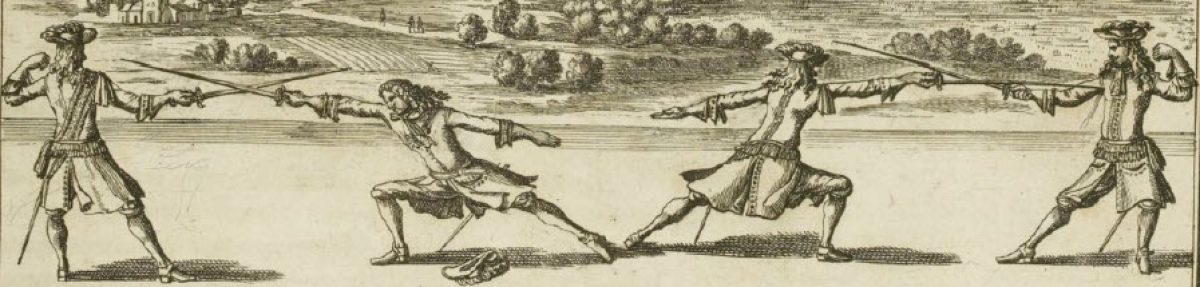
It didn’t take me long to figure out what was happening. What I was doing in the instant was not so much taking 2nd as it was dropping into what broadsword sources refer to as an “outside half-hanging” parry, that is, a block defending the same area as 2nd, but which has the blade hanging more vertically. The “outside hanging” parry defends the upper half well in the same way.
For some time now I’ve been spending more time on “Old Style” broadsword. Thomas Page is the major source I am using, and the nature of that style of fight, never mind the change in heft and balance with a baskethilt, enables one to drop the blade more to parry in an outside half-hanger because the axis of rotation is the wrist, and, it’s thus quick for a riposte.
In rapier, such a deep parry is to invite a counter-attack or fail to cover a line, and so while there are similarities between them, they work differently. With Ken’s help, I now can start to work on better compartmentalizing these weapons.
Stopping the Leak
Awareness is the first step. Thanks to Ken, I am aware of that issue, and best of all, will double-check everything else I am doing.
Next, I drill both weapons with specific attention to the techniques unique to them. It always comes down to drill, more and more drill. I will also be far more mindful now, which is never bad, and with work not only will I fix some of these issues, but better serve my students.
As a coach of other fencers, and thus responsible for raising them up, challenging them, helping them reach the next goal, correct technique, just like proper timing, distance, everything, is a must. As a coach to other coaches, there is also benefit—each pitfall I encounter is another lesson for my colleagues, especially those starting out and yet unaware of problem X or issue Y. We are never finished learning, and, so long as we retain a “beginner’s mind,” we will continue to grow and be better able to make corrections as we discover places that require them.
Manitoba Highland Gathering Tournament, East Selkirk, Manitoba, Canada, 22-23 June 2024
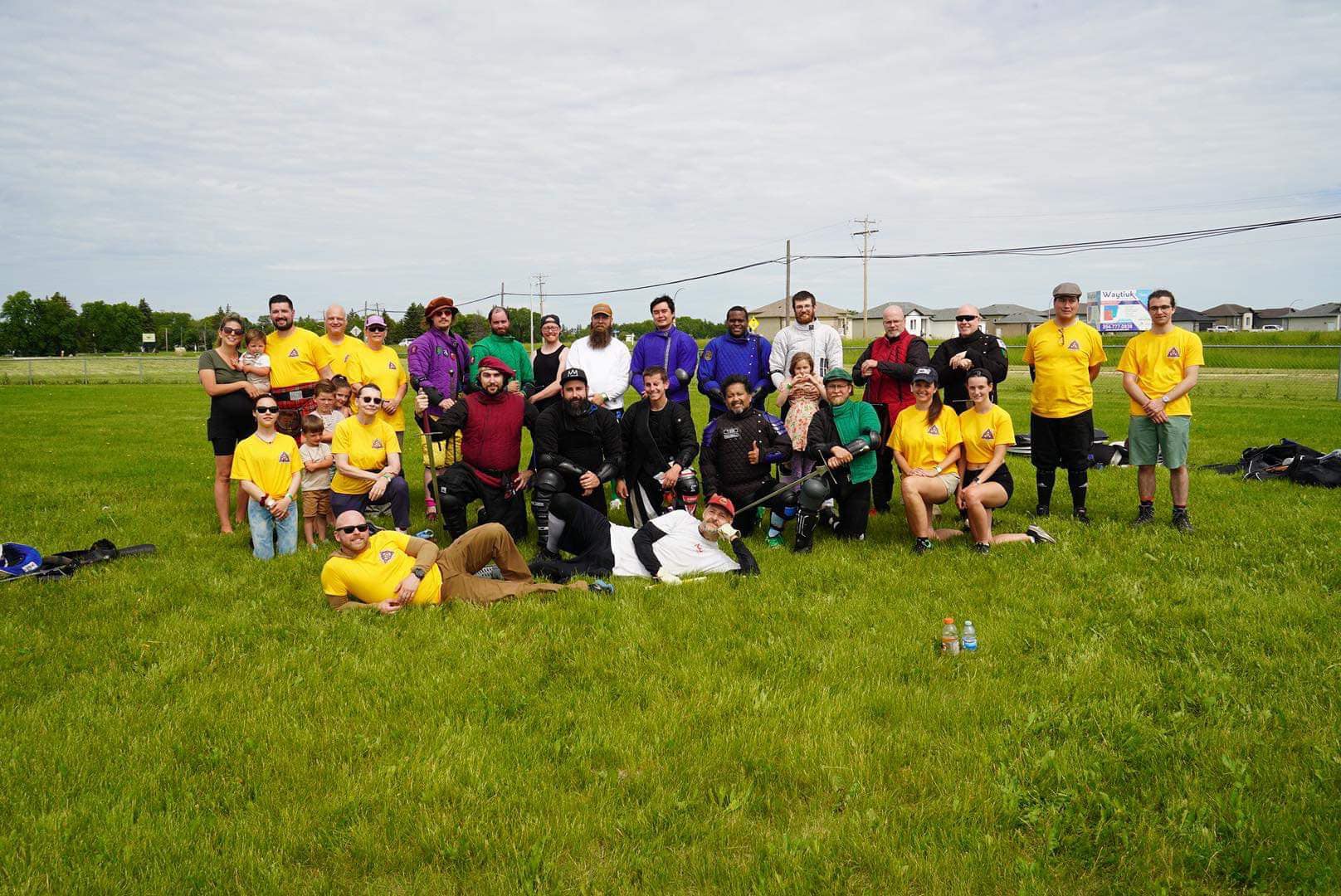
This past weekend, I had the great privilege to attend and assist my Storica Defensa colleagues in the various tourney pools at the Manitoba Highland Gathering in East Selkirk, Canada (held June 22nd and 23rd). This two-day event included longsword, veteran’s sabre, broadsword, and women’s smallsword. Despite some truly warm weather, some swampy fields, and a few moves between gyms, everything went amazingly well. The MHG Tournament marks the seventh SD event and serves to add another data point in support for the approach we are taking to competition.
In terms of safety, no one was hurt. Not one. To date, there have only been two minor injuries in SD events, both involving a failure in gloves to protect forefingers. This is more a kit issue than one of safety culture, and no such injuries occurred last weekend. We place heavy emphasis on safety and no hard-hitting is permitted. So far as I know, not one judge had to remind anyone about force levels. Club members, especially Eric Elloway, army veteran and first-aid certified, brought a giant cooler of water and officials pushed hydration hard. In fact, my friend Xian Niles noticed I was starting to stare off and had me get water, then go sit in the shade (thank you my friend, that was a wise decision). Best of all, the fencers looked out for one another—on two occasions I witnessed, fencers halted action so their opponents could fix gear.
Very Serious Fencing…
The camaraderie was visible and honestly endearing. Most bouts ended in hugs as well as handshakes, and people were keen to keep fencing post event. This is not to say that the competition wasn’t high, because it was as any clip of footage will demonstrate. The hush that fell upon us all watching some of those final matches… I don’t think anyone made a peep during the final broadsword match between Xian Niles (Niles’ Fencing Academy, Halifax, Nova Scotia, Canada: https://www.nilesfencingacademy.com/) and Zach Brown (Superior HEMA, Thunder Bay, Ontario, Canada: https://www.superiorhema.com/?fbclid=IwZXh0bgNhZW0CMTAAAR0noPMDPX7PaM8kxh8SpQdf-e15Ie53xzsJucV58BZno1pycKsN_r25q9I_aem_yB6MUK3J6OWM7jK68jGjaQ). People were quick to concede points and generally did so appropriately, and were gracious when calls didn’t go their way. If anyone needed gear, another fencer was happy to help. Rarely have I seen so many competitors as generous in assistance to one another as I have here.
The level of skill was high. The pools were designed around Storica Defensa competitive levels as much as possible. Most action was easy to follow, and thus, easy to judge (comparatively speaking—judging is never easy). The timbre of an event, the expectations that are set, do much to determine how an event goes. SD’s rules and expectations are clear in the ruleset, and so from the off everyone was more or less on the same page. In specific terms this means that people knew any hard-hitting would be called out, that fencers were honor bound to admit a hit, and that there would be zero tolerance for poor behavior. We also hit the safety aspect hard. I mean, HARD. To put this another way, these expectations attract a particular type of fencer, and in doing so, discourage those fighters keen for garbage like heavy-hitting, use of the afterblow to gain points, and other b.s. Free-fencing post pools was common, and speaks again to the level of positive interaction—people wanted to keep fencing one another.
Eric Elloway with a beautiful running attack in the vets’ sabre event
Organization is critical to running a good tournament, and it is a testament to the planning Jay and crew had that even with a few hick-ups everything went smoothly. Day one was super hot, not a cloud in the sky, and in the morning the ground was a bit damp; day two we had to switch gyms. In each case everyone just got to work and made things happen. We carried tables, gear, scoring placards, everything, and neither day went late. In fact, on both days we ended in time for people to free fence for hours before the Gathering shut down for the night.
SUMMARY:
The MHG Tournament is growing, and in time I suspect will double in size. It’s not just the fact that winners in each event received lovely prizes—sharps, training weapons, and discounts for gear—but that people were safe, enjoyed the fights, and were eager to socialize afterwards. This event is one I am adding to my list of go-to, must-attend events (the others being SabreSlash in Prague, Rose & Thorns Historical Fencing Symposium, and the St. George’s Day Exhibition of Arms).
Following fast on the heels of another two-day tournament I attended, this time as a live-stream announcer, the contrasts stood out starkly. That first event was large, and in most respects typical of “HEMA” events. [n] For example, I witnessed a fencer injure another—twice. The offender was barely censured, but should have been black-carded, and the victim, though evaluated by a medic, was not taken to the hospital. He should have been as he received a pommel-strike, full on, from a running opponent, and was visibly shaken, never mind nursing a mask-waffle print on his nose. The judging was also poor. The silver medalist in rapier, for example, should have taken gold, but the judges failed to call the action correctly. Many, I found out later, were pretty new fencers.
One of Storica Defensa’s goals is to provide better tournaments, not only safer ones, but better run, better judged ones. In this it is exceeding expectation, and I’m keen to see this develop. True, I have a stake in it as a coach for SD, but I stand by what we’re doing. It’s working.
In discussion with a local group studying Insular broadsword [1] the topic of what makes sabre “military” or “dueling” came up, again. We explored the place of context and how it’s the key to the distinction, such as it is. This may seem a pedantic topic, and it’s one I’ve covered before [see n. 10 below], but because of the popularity of works for infantry drill it’s an important one. If accuracy in our practice is at all a concern, then we need to view all the myriad videos, fb pages, pdfs, and seminars carefully. Many instructors are, without realizing it, instilling an inaccurate distinction between military and dueling sabre. They are not so much different species as they are siblings who chose different MOSes in the army. [2] Failing to realize this results in poor recreation of past fencing systems.
“Military” Sabre
Often synonymous with “sabre” in “HEMA,” the idea of “military” sabre is a term that is generally used only with reference to European systems developed for and used by various branches of period militaries. English sources are arguably the most popular, though Dutch, German, Spanish, and Portuguese works are also in wide circulation. Preference is for earlier sources, and thus the 18th and 19th century English works, particularly those for broadsword as penned by Roworth, Page, Angelo, and others enjoy great popularity. It was not until after the Napoleonic Wars that the English government issued regimental manuals, so prior to that various treatises written by military men, such as Charles Roworth, provided the necessary instruction. While less popular within HEMA, for reasons I’ll share below, most French and Italian sources used in HEMA are also military works or were produced by military men.
In commonwealth and former colonial countries there is a parallel and sometimes dual fascination with Scottish “highland” broadsword, particularly in Canada and the United States. These fencers look to Henry Angelo, Sir William Hope, Thomas Mathewson, Donald McBane, Archibald MacGregor, G. Sinclair, and other sources, such as the Penicuik Drawings. The romance and reputation for ferocity associated with the highland clans of Scotland is as powerful now as it was in the late 18th century, a fact not lost on those, like Henry Angelo Sr., whose use of exotic adjectives and nods to exotic warriors helped popularize his system. [3] After all, in some ways the ’45 was just history enough to the generation writing fencing treatises in England ca. 1775-1800 to have accrued legend and wonder, similar in a way to what World War II was for interested children (not to mention adults) in the 1970s and 1980s. It helped too that the enrollment of Scots into the English army as “ethnic” units meant that kilt, bagpipe, and broadsword remained fixed in the minds of English people. Broadsword, however, was not unique to Scotland, but widely used in the Isles from at least the time of The-Englishman-What-Shouldna-be-Named, George Silver. It was during the 17th century rebellion against the crown that the broadsword came into its own, particularly with cavalry, both Cavalier and Roundhead.
The military connection with this collection of works is obvious. However, because fencers often read these texts shallowly, without understanding the context, they form conclusions that are incorrect or at best incomplete. One result of this is that military sabre has become associated with interpretations that are not wrong per se, but which place undue importance on certain elements common to most infantry sword manuals. [4] There are two examples I will cover here. First, is the widespread practice in HEMA of always fighting in close measure. There is a notion that one doesn’t retreat or recover out of the lunge in defense. This is sometimes the correct action, but it is not a rule written in stone, and in fact is sometimes exactly what someone should not do. We are meant to use measure even if it means retreating. Second, there is a fetish for attacks to the leg in much of HEMA sabre; it’s not that leg cuts and defense weren’t part of these systems, they were, but that too much focus is given to them in a context where they make less sense, a bout between two opponents.
Hug Me, No, Closer Brother
One of the most common features of HEMA bouting is sticking to close measure to fight. There are a few reasons for this. On the one hand, one must be close enough to strike, so on a simplistic level the closer one is, the more likely one can strike—conversely, the more oneself is at risk. On the other, because there is a tendency to take images in our sources at face value many fencers, with the best intentions, assume the same distance they see in these images.
A further complication, and a critical consideration of context, is the attention paid in infantry manuals to both footwork and measure. Henry Charles Angelo, in his Infantry Sword Exercise (1845), remarks that his work is intended as
the surest and quickest mode of forming Swordsmen; and the Drill Officers are to understand clearly, that when Recruits have completed their Preparatory and Drill Practices, without and with the sword, they need no longer be required to remember the precise order in which they are here given; nor to repeat them, if sufficiently instructed to go through the Review Exercise effectively, where every Cut, Point, and Parry is shown. [Introductory Remarks]
The language here explains that the goal was forming competent, not expert swordsmen. Further reading illustrates that Angelo assumed that the men trained together, in ranks, and assumed this position or that attack on command (see for example page 28). This is not close, individual training, but training writ large—corrections were made, but not as a maestro might working one-on-one with a student. Given the fact the men were in “Files” (rows) and thus close together, there is little discussion of footwork or measure.
Angelo mentions the advance, retiring (the retreat), and the lunge (36), and further specifies that there can be no set distance for how large the step is, but that the men should shoot for a step of about six inches (11-12). In Section VI Angelo expands slightly upon measure, mentioning both the line of direction (36) and seeking the most advantageous position so that one may effect “a decidedly quick movement in that direction where your opponent has the least means of resistance (35).” What detail he provides pertains to which guard is best against which attack, not how one might move. There is discussion of shifting the leg against leg attacks (cf. 30), but also attention paid to the issues the men will face in rows. Taken together, there is very little to go on in terms of movement and manipulating distance. Angelo mentions “proper distance” (e.g. 30), but doesn’t elaborate. While the regimental swordmaster’s knowledge aided the men in learning that all important information, no such aid is available to those exploring this text. Angelo assumed that his professional readers knew that information. Today’s fencers are left with the barest descriptions.
from Henry Angelo Sr.’s “Ten Divsions of the Highland Broad Sword,” 1799
This paucity of explanation, coupled with images from works like Henry Charles Angelo’s father’s (Henry Angelo Sr.) “Ten Lessons of Highland Broad Sword” (1799), suggest that fencers are more or less always in close distance to strike. Without study of traditional fencing theory, or of the first Angelo’s The School of Fencing (1763/1765), any fencer working from this collection of sources is at a disadvantage. One should not stay in measure all the time. Traditionally, depending upon which source one reads, there are three critical measures—out of distance, where one must advance and then lunge to target; in measure, where one can lunge to target; and close measure, where either party may strike the other. [5] Knowledge of measure and how it works, for offense and defense, means that one should be able to get in and out of distance, even if that means making a small tactical retreat to give oneself more room and time to defend. There is nothing cowardly about that at all—it’s tactical. A retreat is not the same thing as turning tail and running.
Ankle-Biters and Eating Thrusts
Why do so many regimental works include leg defense? Training soldiers en masse was not intended to create expert swordsmen, only effective swordsmen, as Angelo remarked; in most cases the focus was and remained on the effective use of firearms. Second, because soldiers might easily find themselves in situations where their legs were vulnerable, leg defense was included. This is one reason there is so much focus on the head and the leg. The question today’s fans of regimental broadsword need to ask, however, is why?
19th cen. engraving depicting
Colonel Wm. Prescott in the redoubt on Breed’s Hill, Battle of Bunker Hill, 17 June 1775.
There are no rules when it comes to fighting with a sword in war. Any polite, genteel nicety picked up in a gentleman’s salle is inapplicable in such chaos. Attacks from multiple directions, punching, kicking, grappling, the mix of bayonet and rifle-butt, not to mention musket and cannon-balls flying amidst the combatants make that impossible; likewise the noise, blood, mud if it is present, smoke, uneven or challenging terrain, and minimal control over distance also affect everything. In such a context it is far more likely that one may have to defend the legs, and all the more so if one is defending a high position such as a bastion or redoubt. Without considering this vital piece of the puzzle fencers today wishing to recreate Napoleonic era sabre will put undue emphasis on a target that in their own context is more likely to earn them a double or counter-attack in time. Too many fencers take these ideas out of context and use them as a litmus test for how “martial” a tradition is—that doesn’t follow, not if examined in context. Put another way, attacking the legs doesn’t make one’s approach more “military,” though arguably knowing how to defend the legs might. Even the authors who cover leg cuts are quick to advise against the practice—it is a prime way to east a thrust al la Calvalotti.
With the exception of reenactors, most of HEMA does not engage in mock battles, and if so, these are more performance piece and living history than accurate reproductions of those battles. They can’t be otherwise, because people would be hurt. Just like the best options today for steel swords, bayonet trainers are dangerous; the introduction of cavalry is a force-multiplier that would make a lawyer drool. This isn’t to knock these events, not in the least, only to state that our ability to stage period “battles” will lack the very things that make the difference: horror, fear, and the threat of death. Most people, whatever it is they study, are—whether they like it or not—fighting in conditions that are closer to the duel than to combat. A few of us cover multi-opponent scenarios, but even these tend to read more like kung-fu theater than the reality, that is, where each of the “baddies” waits their turn rather than doing what they would really do if it were safe, flank or stab from behind. [6] Most HEMA bouts are one on one, or, a duel, however “military” the approach.
“Dueling” Sabre
The complex nexus of relationships around the duel of honor, from its civilian and military contexts to the length of time it remained important (which also varied by culture), make it less easy to “unpack.” There are a few such relationships that one must consider and which temper the attempt to see “dueling” sabre as some completely different species. It would be better to refer to dueling sabre, if one must separate it out, as a subset of military sabre, and one for the most part confined to officers.
Within HEMA one reason that dueling sabre is believed to be “other” is the connection it has to modern fencing; this, combined with the fact that modern weapons are lighter makes modern (or anything smacking of modern fencing) immediately suspect. The poor logic behind this is that “modern” equals “bad” and that lighter weapons are unrealistic or worse, effeminate and unmanly. [7] The issues here should be obvious, but won’t be unless someone has spent some time studying traditional or modern fencing, has done their homework as to weapon weights, and admits that the somewhat Freudian obsession with big, heavy weapons has less to do with historical fencing than it does immature notions of masculinity and unsophisticated locker-room notions of sexual and gender politics.
Most fencers can relate that the duel of honor started in the “Renaissance” and survived into the twentieth century, but what they often fail to mention is that this odd adjunct to European manners didn’t have a linear trajectory. Its practice varied by nation, culture, and time period. For example, while the duel survived a long time in Italy and France, it was actually less long-lived in England more or less ending in the mid-19th century. Some look to 1852, others 1845, in marking the end of the duel in England. [8] The duel in German states began to shift toward a preference for legal proceedings in some cases, and into ritualized student combats, the Mensur, in another. In some places the duel never really took off, the New England region of the United States being one such example. [9] In some areas, like Ireland, dueling enjoyed a violent if again relatively short tenure, and there, as in the US, the preference was more often than not for lead rather than steel. These differences are critical in understanding why works on fencing from countries like France and Italy not only were written and published more often, but also why modern fencing owes so much of its methodology and technique to them. In both nations, though it was usually illegal, duels continued to take place well into the twentieth century, and for several decades one might study with a maestro for a duel in either country who was also training Olympians.
This is important on several levels. First, the general disregard within HEMA for later Italian and French fencing owes much to the connection to modern fencing. Second, because the duel lasted so long in Italy, and because it was especially prevalent within the aristocracy, government, and military, the manuals for sabre reflect as much concern for the duel as the battlefield. This is a critical aspect too often glossed over in the critiques of Italian sabre. As I’ve stated before, the demands of the duelist require more than the demands of a soldier relying on a sabre as a side-arm he may rarely or never use.
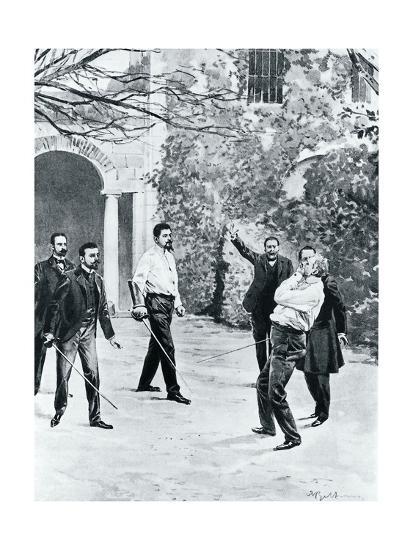
Death of Felice Cavalloti, 1898–he died via a thrust from a less-experienced fencer that entered his mouth and pierced an artery as it passed through the back of his head.
Third, most of the influential works on sabre produced in Italy were either written by military men or were intended for use in the military. From Del Frate’s distillation of Giuseppe Radaelli’s revolutionary new method onward nearly every work of note has some connection to the military. Dueling, though certainly well-attested in the civilian world, was perhaps most prevalent in the military. It was one of the Napoleonic era’s most lasting legacies in Italy. Thus, the officers and soldiers who wrote these works knew that in addition to having to provide basic instruction for the soldiery, these works might also be used to teach officers who might, like it or not, be called out to fight. The inclusion of synoptic tables for lessons in Del Frate, Masiello, and others offer far more than the short tracts on basic sabre for the infantry and reflect this very concern. A duelist might face a complete duffer, or, an accomplished fencer, so preparation for the duel demanded more than what an infantry private needed.[10]
So What?
Does any of this matter. It can. It sort of depends. For fencers who see the larger picture everything mentioned here will earn a “yeah, and…?,” but for those who have not yet studied outside their chosen tradition or who think it is a waste of time there’s at least one take away. If these fencers reject Italian or French fencing because it is “only dueling” sabre, then they may wish to reexamine that position. The military sources for sabre produced in France and Italy, because their officers might have to fight duels, include more than infantry manuals, because one needs more in one’s toolkit to fight one-on-one. No comrade is going to flank and spike the enemy focused on you; no stray musket ball is going to remove the soldier behind that enemy. It is one on one, and there is as much if not more danger fighting the unskilled as there is fighting an expert.
If you find yourself fighting in close distance; if you realize you never really move a lot; if you are obsessed with your opponent’s juicy armor-clad thigh; then there is a lot you might mine from French and Italian military sources. You lose nothing in doing so, and here is why—if not exactly contemporary, you will find fuller discussions of footwork in Italian works back to the 17th century, and thus “period” justification for more sophisticated movement. None of this material existed in a vacuum. Moreover, Domenico, Henry Angelo Sr, and Junior ran a salle in London that taught more footwork than the bare-bones infantry manuals. More attention to the richer sources, even within one’s own tradition, will aid rather than undermine your “military” sabre.
NOTES:
[1] I use this as a collective term for those works, mostly Scottish and English, written for the use of sabre or broadsword from the 18th to 20th centuries. It’s a handy way to refer to these popular works. At present I’m meeting with this group to help them with interpreting the texts.
[2] MOS: in the US Army this acronym stands for “military occupational specialty,” e.g. Combat Engineer (MOS 12B) or Cannon Crewmember (MOS 13B).
[3] Angelo, for example, wisely termed his broadsword method “Highland” and “Hungarian.” Like highland Scotland, the influx of Hungarian hussars who revolutionized light cavalry and fashion alike loomed large in popular imagination.
[4] Of note, not all of the Insular works are as skimp on details as to measure and movement, and again context helps us. If one examines Charles Roworth’s The Art of Defence on Foot with Broad Sword and Sabre (I’m looking at the 1804 edition), to name one example, one will see that the author spends more time discussing these vital considerations of fencing (distance, 37ff; the advance, 39; the retreat, 40; various forms of traversing, 41-43). Unlike later official publications, which were written for professionals teaching soldiers, texts like Roworth’s, though written by military men, covered more ground as readership might include non-professionals. For those keen to stick to works like the Infantry Sword Exercise, adding a study of Roworth, McBane, or Hope will provide much needed elucidation as to footwork, measure, and tempo, and, from the same group of islands.
Today, these three critical distances are still taught, though sometimes with further divisions, at least for coaching. In the French school, for example, coaches employ six distances for epee. There are nuances I glossed over as well. For example, depending on distance and reach, a fencer in distance to lunge to the body might be able to reach out and hit the extended target/arm without a lunge.
[6] Armored combat is an exception, but in most cases our safety gear doesn’t encourage the realities of multiple opponent attacks. The back, for one, if it is protected is normally only covered by a jacket however heavy, and the back of the legs probably never. Thus, it’s not that we can’t have people avoid kung fu theater queuing, but that we shouldn’t. There are ways to teach multiple opponent scenarios, and they add a bit of flavor to the usual fare, but much of what we will do will mimic rather than recreate out of safety concerns.
[7] HEMA, like most things, is no stranger to what people now call “toxic masculinity.” This is a notion that gets thrown around a lot, sometimes without justification, but it is accurate as it pertains to big man/big sword dick-measuring stupidity and its attendant vices. It will be clear that I have little patience for this business—aside from the idiocy of it, it gets in the way. Fencing is difficult enough with adding onto it.
[8] See for example Martyn Beardsley, “England’s Last Duel,” 8 July 2019, https://www.historyanswers.co.uk/people-politics/englands-last-duel/ ; Jeremy Horder, “The Duel and the English Law of Homicide,” Oxford Journal of Legal Studies 12: 3 (Autumn, 1992): 419-430; R.B. Shoemaker, “The Taming of the Duel: Masculinity, Honour and Ritual Violence in London, 1660-1800,” The Historical Journal 45: 3 (2002): 525-545.
[9] There is a lot of work on American duels, and to repeat, I’m not saying we didn’t have them. We did, clearly. But culturally the idea was less “native” to the US, and didn’t survive long, because our people have historically had few qualms about shooting without ceremony those we don’t like and because of an unfortunate and unbecoming love of litigation, two problems we are, alas, still infamous for world-wide and for good reason. For some of the works on dueling in the Americas, see for example Baldick, The Duel: A History (1970), Freeman, Affairs of Honor: National Politics in the New Republic (2002), Holland, Gentlemen’s Blood (2004), and Murray, The Code of Honor: Dueling in America (1984) are informative. See also Stevens, Pistols at Ten Paces: The Story of the Code of Honor in America (1940), Williams, Dueling in the Old South: Vignettes of Social History (1980), and Burchfield, Choose your Weapon: The Duel in California, 1847-1861.
[10] I discussed this early on this page, see “Dueling” or “Military” Sabre, May 15th, 2019. It should be obvious why an infantryman, relying on his rifle and bayonet more than a sabre or hanger, would require less training, but for those who don’t see that then a side-by-side comparison of Roworth or Angelo set against Del Frate, Masiello, or Rossi should make it pretty clear even if one is only counting techniques per source. I also believe that competition among military fencing masters for the honor of running the national school meant that they approached their treatise writing almost like a resume. Chris Holzman has been working on some juicy bits from Jacopo Gelli that provide additional details about the rivalry between southern and northern Italian masters for control. I’m not sure when that will be available, but I’m eagerly awaiting it.






 Capitale Escrime Historical Fencing