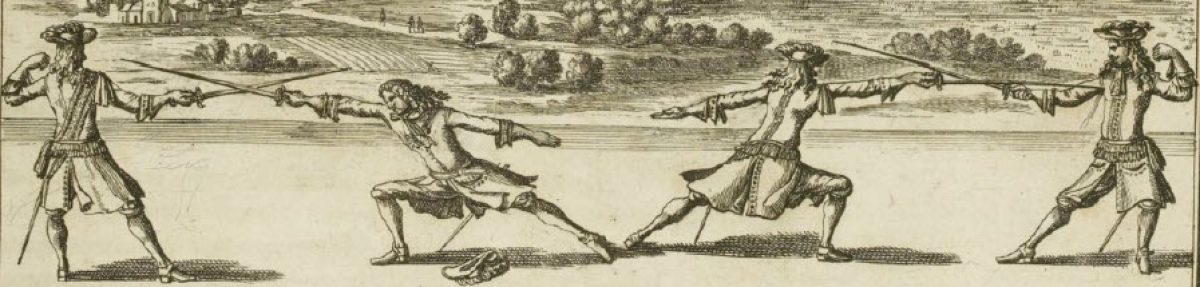
 In watching several recent historical fencing events friends and I got to chatting about effective (and ineffective) teaching methods, and, of the difficulties that tentative endeavors such as interpreting extinct fight-systems presents any instructor. In so many ways we lack a blueprint for how to teach some of these past arts. Many of us draw from the venerable advice and time-tested techniques of established fencing programs, such as the Scuola Magistrale Militare di Roma [Military Fencing Masters School of Rome] and its North American Counterpart or the USFCA.[i] We consult other instructors, our own or colleagues, and between the collective wisdom of the schools, other instructors, and our own experience we can do a lot. We also mine the pages of works like László Szabó’s Fencing and the Master and adapt ideas and drills to our own context. Happily, this is a problem all of us share, and increasing the issue of pedagogy is coming more into the larger dialogue.[ii] There’s a small, but growing corpus of literature about pedagogy making the rounds in historical fencing circles too.[iii] These are important conversations for us to have, and as the community grows we can expect discussions of pedagogy to garner more attention. That’s a good thing.
There are a few principles that I want to share here, ideas we discussed post-event, but also some which I’ve learned as a professional teacher. I don’t claim to be novel, I don’t want to reinvent the wheel (the ones we have work fine), but these principles might be handy to others pondering the place of pedagogy in historical fencing. What follows might be a solid collection of discussion topics if not a nice primer on some simple ideas every teacher should embrace.[iv] Some I’ve covered before, many others have treated far better, but for any set of drills, exercises, and the other elements of a successful curriculum attitude about them, about teaching, is everything.
Humility
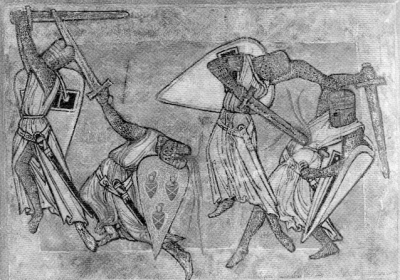
No one can learn anything who lacks humility. Those who believe they have it all figured out are fooling themselves; don’t let them fool you. The texts we work with are often difficult to interpret, no one has all the answers, and that’s okay. It’s the fact that we do not know, but wish to that drives us to study.
Historical fencing is unique in that there’s no official certification program, not yet anyway, for creating a master and this means a number of things. Given the nature of the evidence, the fact that most extinct arts have no surviving tradition, it’s highly probable that the nature of any such program will be different than say a fencing master’s schooling when we finally develop such a certification. Until then, and arguably after then, even the best interpretation will only stand until a better one comes along, so, take heart, be honest, and do your best. Don’t worry about mastery—that isn’t really a concern here in the conventional sense. We’re going to get things wrong, and a humble person will more easily handle that and change.
Collaboration & Sharing
This seems like a no-brainer, but it isn’t; not everyone wants to play nicely with the other kids. Sometimes this unwillingness stems from fear—perhaps one is working on a beloved project and doesn’t want anyone else beating them to the punch in publishing. Sometimes this fear stems from insecurity about one’s approach, interpretation, ability, or effectiveness in teaching (imposter syndrome is a common issue for many instructors). Whatever might stop you from reaching out, make the effort—there’s no shame in learning from others, in asking for help, from working together.
At the event that first sparked this conversation about pedagogy there was an impressive assembly of talent, from those working in the medieval Italian and German traditions, to classical Italian, to eastern martial arts, to everything in between. Such opportunities are ideal for exploration, for presenting what one’s been working on and getting valuable feedback from people as jazzed as you are about the topic. Working together benefits everyone. Also, it’s fun—how often at work or in other social settings can you discuss the finer points of a parry? How often do you get to take swords in hand and work out some play? Talk, share, make friends—it will only help. Don’t make the mistake of working in isolation.
 Cultivate a Willingness to admit “I don’t know”
Not having all the answers is okay. No one in their right mind will ever assume you do. Not knowing is what spurs us to learn. Saying “I don’t know” is never the wrong answer, however terrifying it is to say, and once said puts you on the path to changing an “I don’t know” to an “I’m going to find out to be best of my ability.”
I offer the following somewhat humorous and embarrassing example. In the oral portion of my doctoral exams, one professor, a stand-in for the Greek expert my school never seemed to be able to keep (allusions to Spinal Tap’s drummer have often been made…), turned out to be one of the two types of examiners one will face in such exams, in this case, the person who wants to see what you don’t know. His first question, of a sort, was to shoot a clay tablet to me across the table and ask “what is that?” I looked at it, replied that the clay was modern, that the script looked to be Linear B but that I wasn’t completely sure (I spent far more time on Latin and Celtic). I thought crap, this is going to be some everyone-knows-this-inscription and I’m screwed. He said it was the first line from Homer’s “Iliad.” I raised an eyebrow in disbelief, said that was impossible as Homer post-dates the Mycenaeans by a good stretch, and waited for the hammer to fall. Satisfied, he then proceeded over the next half hour to ask me random questions about Greek history from Troy to the fall of Greece to the Romans. I cannot tell you how many times I said “I don’t know.” If I seemed to know anything, he quickly changed the topic. I left feeling that I’d failed, that I was washed up, that I’d embarrassed myself, shamed my advisor, and should find a nice heavy rock to crawl under. Despite this emeritus jackanapes’ glee in stymying me, I passed, and only passed his section because what I could answer I answered well, AND, and this is the important part, because I was smart enough not to bullshit, but to admit “I don’t know.” That’s hard to do under pressure—I know, believe me—but it’s sometimes the only answer you can and should give.
Cultivate a Willingness to Remain a Student
I used to teach college courses, mostly working adults in community colleges, and it’s seriously one of the most dynamic arenas in which to learn or teach. Where a room of 18 year olds will have some decent conversation and insight, a room of 16 to 75 years olds, many of whom have acquired expertise and experience in fields from mining to combat, from factory floors to homemaking, is so full of knowledge and experience that discussions are usually richer, more full of insight, debate, and fun.
I firmly believe that the best teachers never stop being students. Good teachers learn from their students, from other teachers, and from anyone whose line of work involves instructing others, be they foremen, former drill sergeants, mothers of six kids, or farmers. My students make me a better teacher, yours will too if you listen.
Own your Expertise

This can be a tough one, least it is for me, and it’s because it must jive with humility. No one wants to be that insufferable know-it-all or be taken for one. If you’re teaching then chances are good that you have enough experience to do so, are the only option, or are spear-heading a study group and by default have to lead. Maybe you have more formal training, and/or certification via accredited fencing programs. If you’ve earned it, own it.
We can err the other way and undermine ourselves too. If you’re too quick to point out shortcomings, things you don’t know, then that is what people will hear—people are more likely to question you if you question yourself. It can be a fine line. I learned this lesson as a first-time college teacher. I was teaching on an army post and decided not to list my name as “dr” or “name, PhD” on the board, and at the end of the first term an older man, a sergeant, approached and asked me about it. I told him something to the effect of wanting to create an open room where they felt free to talk, to disagree with me, etc. His reply was awesome and a powerful: “Sir, this is an army post—everyone has a rank. You earned those credentials, you earned your rank—don’t be afraid to share that. Whether people feel free to chat or not doesn’t depend on your rank, but how you use it and how you show respect to them. There is room for both command and respect.”
Own your expertise, but do not wave it in people’s faces; share it with them through appropriate means, through scholarship, through teaching, and by living the example. If you are out there reading this Sgt. Bond, again, thank you.
Be Open to Revision as Necessary
With an endeavor as tentative as research into historical martial arts one must be willing to revise any interpretation, no matter how good, should new evidence come to light or a more logical interpretation enter the picture. There’s no shame in ceding place to a better interpretation, only in pig-headingly holding on to one that’s been superseded.
This should drive all of us to work even harder at drawing conclusions that follow from the texts and which make sense logically, in terms of body-mechanics, and fit the historical context. None of this work is wasted. So your conclusions about Fiore have been bested by a new theory, don’t fret—scholarship doesn’t happen in a vacuum and it may be that Jane Schmoe relied on your work to devise her own interpretation (if Jane is a good scholar she will admit that too).
Give Credit where it is Due
Following closely on the last point, always cite your source, and, always give proper credit to the scholars, researchers, and fencers whose hard work, dedication, and passion have helped your own path of study. This goes beyond leaving a paper trail or protecting oneself from plagiarism—it’s just the right thing, dare I say it the chivalric thing, to do. Everyone gets a kick out of seeing their name in a footnote, dedication, acknowledgements, or Facebook post. It honors them, and, in honoring them you honor yourself for you demonstrate that you’re a team-player, an ally, someone who is working to provide the best research, teaching, and interpretation of these martial arts as you can. Stay chivalrous my friends.
Have Fun
Why do we pursue historical fencing? Why do we spend so much time pouring over the often cryptic passages in old fight manuals? We do this because it’s fun, it makes us happy, and fun is good for us. Don’t lose sight of the value of play—historical fencing exercises your mind and body, and done right, can give your spirit a workout too.
NOTES:
[i] See http://www.fencingmastersprogram.com/about.html
[ii] László Szabó’s Fencing and the Master, Staten Island, NY: SKA Swordplay Books, 1997; see also, among many others, Zbigniew Czajkowski, Understanding Fencing: The Unity of Theory and Practice, Staten Island, NY: SKA Swordplay Books, 2005; Ziemowit Wojciechowski, Theory, Methods and Exercises in Fencing, Datchet, Berkshire, UK: Amateur Fencing Association, 1993.
[iii] For a good place to start (in fact, just read this, it’s fantastic ) see Roger Norling, “HEMA Pedagogics Part 1: The Pedagogics Pioneers & The Role of a HEMA teacher,” at HROARR, November 21st, 2014, http://hroarr.com/hema-pedagogics-part-1-the-pedagogics-pioneers-the-role-of-a-hema-teacher/ (part 2 is here http://hroarr.com/hema-pedagogics-part-2-the-implications/ , part 3 here http://hroarr.com/hema-pedagogics-part-3-how-to-create-a-good-learning-environment/ ); see also a breakdown of a typical practice at The Phoenix Society for Historical Swordsmanship in “How we Train” by Richard Marsden, http://phoenixsocietyofhistoricalswordsmanship.webs.com/apps/blog/show/31776335-how-we-train-by-richard-marsden .
[iv] Pedagogy is a giant subject—here I will discuss some general ideas, but in the next installment on this I will discuss some real-time strategies for teaching.


 Capitale Escrime Historical Fencing