I’ve been meaning to write something up since I returned late Tuesday, but between work and an unexpected veterinarian adventure, I’ve not had time to do this event justice. It was, in a word, amazing, and so much so that I truly hope it becomes a regular event. Patrick Bratton and team put on one hell of a seminar–it was not just the classes, though those were great, but that the setting was apropos and unique, we had behind-the-scenes access to some of the museum, and ample chances to eat, laugh, and get to know one another. Yes, we also fenced, or many did–it was all I could do not to break my doctor’s orders and jump in, but for once I was a grown-up about it (and appropriately as bitter as a toddler told “no”).
By most definitions, I don’t think people would consider me particularly “lucky,” but when it comes to finding myself at truly impressive, informative, and fun events, I’m as rich as Croesus. To the list of favorites–SabreSlash, The St. George’s Day Exhibition of Arms, Rose and Thorns Historical Fencing Symposium–I can now add a fourth, Patrick’s French Fencing weekend. One reason, beyond the obvious draw of all things hoplological or fencing-related, is that it combined three branches of the community: historical, Olympic, and reenactment. The benefits of such cross-over should be obvious, but may not be, so to illustrate this I cite the example of a fascinating chap, Matthew Schlicksup, an artisan of historical footwear currently working at Ft. Ticonderoga in New York.
Historical Artisans
Matthew makes historical footwear, among other period items, and is a master craftsman. Trained in Williamsburg, Virginia, he has made shoes, attended events, and conducted research that most of us might not think about, and, despite the fact we all wear shoes. We take them for granted. Ft. Ligonier, however, has the world’s largest collection of period shoes thanks to the accident of 18th century castoffs and the powers of anaerobic preservation. An archaeologist in initial training, Matthew brings science to his craft, and with impressive results.

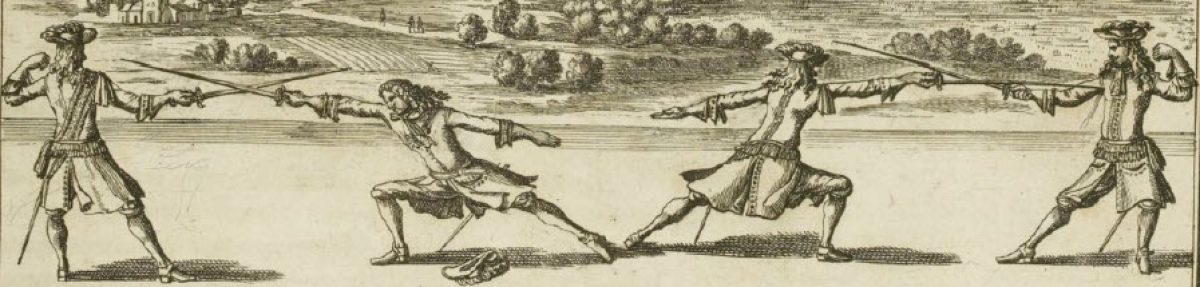
This weekend he shared, and wore, his version of the fencing shoes or sandals depicted in de la Touche’s seminal treatise, Le vrays principes de l’espée seule (1670). So, here we are at an historical fencing seminar with a man who makes shoes from the period for that very purpose. This may not seem important, but it is. A few years ago I spent considerable time researching the development of the lunge and this included a look at footwear–would that I had known Matthew then! In discussion with him about de la Touche’s sandal, I learned so much more than I might have, not only about construction, but also about how such shoes function. Put simply, this was a window into period fencing via a single often unconsidered artifact.
Museum
Our host at Ft. Ligonier, Matthew Tristan, was accommodating, supportive, and generous with his time. It was he who gave us the behind-the-scenes tour. It says a lot that he and the foundation were open to having us there: a busy historical site and nuts with swords sounds like an insurance adjustor’s nightmare. With Patrick and others in period dress, and quick to chat with visitors, it went well and we hope added something to the experience. When trusted with the safety of the site and its guests, one wants to do all one can to make it go well, and under Patrick’s excellent leadership this was not even in question. With all the discussion of clubs losing insurance because of unsafe and/or stupid activities, with some unfortunate high-profile legal cases, a win like this is easy to dismiss. We shouldn’t–this was a success and a sign that things can be done correctly.
Classes
In terms of classes, I participated as much as I was able–stupid injury maintenance–but was super keen to see what Justin Aucoin did with the work of Charles Besnard, one of my favorite masters. Justin has long experience with fencing and the SCA, and runs a seriously fantastic class. People loved his classes. I loved his classes. He taught one on Besnard and a second on the bâton à deux bouts or French double-spear in Pascha. I had been looking forward to meeting Justin for some time–Patrick spoke highly of him, I liked what I saw in his videos, and he is a die-hard fan of Dumas and The Three Musketeers, that last fact which immediately endeared him to me.

Justin combines deep knowledge with obvious skill and a passion for his topic. It’s infectuous. Moreover, he works with a diverse student population–always a good sign–and so was quick to suggest work-arounds and ideas to make each thing he covered work for different folks. If he is teaching anything near you or you have the chance to travel to work with him, do.
Bridge-Building
I tend to gravitate towards and work with other folks interested in bridge-building. It’s not just the strengths that collaborative work brings, but the sort of people that go in for it. Among these, I have worked most often outside my immediate surroundings with Patrick. He is, quite honestly, a model coach and advocate for what we do. As a trained teacher (he’s a professor at a college in Pennsylvania), researcher, fencer, and man of eclectic and fascinating interests, from vintage fashion to hunting lore, Patrick perhaps more easily combines disparate strings together to make a viable tapestry.
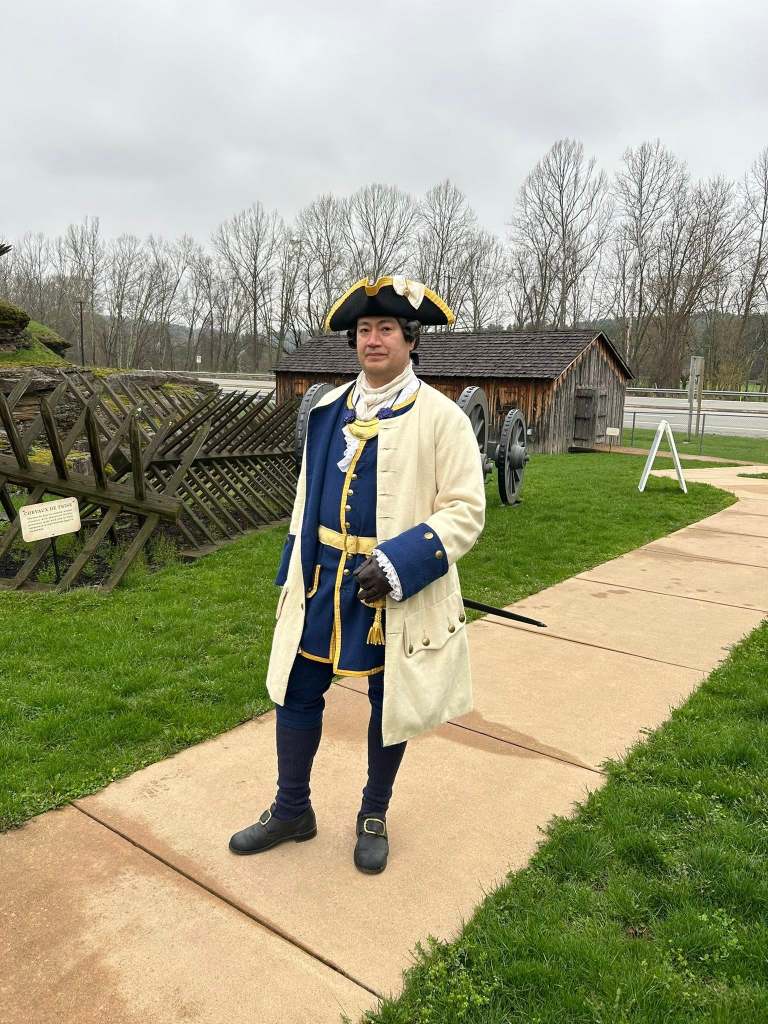
The historical reenactment group he is involved in, a detachment of mid-18th century French marines, has worked at Ft. Lignonier, among others, before, and it was an ideal location for a look at several late 17th century fencing masters. Some students were in costume, some not, but the addition of period appearance added a lot. Having good relations with the museum staff meant not only a chance to hold the seminar on site, but also see parts of the museum most people do not see. The historian and former archaeologist in me was seriously thrilled about that, but I wasn’t alone.
The only other event that I have attended that combined all these elements so successfully was my mentor Master Michael Knazko and company’s SabreSlash–we had fencers from all walks, reenactors from Krakow (17th Polish hussars), and tours of various sites within Prague relating to fencing (among other historical subjects). In both cases the camaraderie was the finest.
A Model for Future Events
Until recently, until this latest trip actually, I had planned some invitational tournaments. Now, while there may be a tournament element, I am planning to put together something closer to what Patrick and Maestro Knazko have done. It’s a good mix–class for those who like it, some history and other activities (we ate well for example), and some fencing or lessons. It is my hope that Patrick makes this event a regular one–we’ll be lucky if he does.

 Capitale Escrime Historical Fencing