[29 April 2024]

It was a pleasure not only to share more Radaellian sabre fun with people, but also to be a student again at this year’s St. George’s Day Exhibition of Arms at the gorgeous Chateau South in Atlanta, Texas. This event, created and orchestrated by one of my favorite people, the redoubtable Russ Mitchell, with help from the lovely people at Winged Sabre Historical Fencing (based in Dallas), is part class, part graduate seminar, and all brilliantly enjoyable. A little over a year ago I wrote up a short piece on this event in which I called this weekend of classes, discussion, and bouting a bar raiser. [1] It was, and, it is. In fact, in year two Russ and friends have placed that bar at least a few feet higher.
There are many tells beyond my high opinion of the event, and to be fair, they are likely better gauges than whatever I might think; after all, Russ is a researching fencer and thus I may be slightly biased in his favor. He is a wonderful human in addition to his vast knowledge of fencing, history, and how the two mix, but again, I acknowledge the potential bias. In light of that, I offer the growth of the Exhibition—we had more people this year; the variety of classes—we had everything from 18th cen. Broadsword to Georgian sword and buckler to a deep dive into the various types of molinelli/moulinets one can make; and, the diversity of the crowd, already solid, expanded—to name one example, this was the first time—ever—I had a chance to cross swords with someone using Meyer’s system for single-handed cutting weapons. In sum, word of this special weekend clearly reached deep into corners of the historical fencing map this past year, and hopefully will continue to do so this year as word spreads.
The St. George’s Day Exhibition of Arms is one of the three events I point to for how we should be doing things. This is not to say that there are not other important events, only that of the many I have attended these three stick out. They are exemplars, models, paths to follow, with one caveat and a potentially contentious one—one must know what one is doing, or, know whom to invite in the case one does not. SabreSlash in Prague, The Exhibition, and Rose & Thorns all share common themes and ingredients. They are run by knowledgeable people, both in their own right and in whom they seek out to teach. Each of these events is run well and offers the attendee better cuisine than the average tournament of weekend seminar. The level of ability, of skill, not to mention knowledge, is high. Not above average—HIGH. This is true not only in terms of know-how, but in terms of execution. One test of this for me is how beginners are treated and what they take away from these events.
Come one, Come all
Among the new folks this year were also newer fencers. One of the things I watched closely was the degree to which beginners understood what the instructors were teaching and how more experienced fencers treated them. Full disclosure I was not worried much about this knowing what I know about Russ and his people, but all the same given the different backgrounds each had even the best designed event and intentions of the organizers can fail. One would have to ask those beginners, but from what I saw not only were newer people brought into the fold, but accommodated seemingly without effort. The first is less surprising—outside a few bad apples, most historical fencers are welcoming and just happy to find yet more sword nerds with whom to play. As Alex Spreier, who taught a fantastic course on the broadsword system of Zach Wylde said to one new person, who was a bit shocked at the open invitation to join us in the PNW (where we tend to house people to save them money), “Of course! You’re sword family!” This was beautiful and proper and makes me love Alex that much more, but more impressive were the ways in which Alex, Kat, Mike, and Russ arranged their classes to meet the needs of students of any level. This can be extremely difficult to do.
The Classes

Kat’s class on footwork, a topic easily made way too challenging, was disarmingly unintimidating. Her explanations were simple, but dead-on to what was most important, and everything we explored one did at one’s own pace. She was there to answer questions, and at each turn exuded a “you can do this” demeanor that just made one want to try harder. In like vein, Russ’ class on the molinelli/moulinets was a textbook model for how to cover a complex topic effectively and in ways useful to beginner and experienced fencer alike. Starting with the shoulder alone and working our way slowly to using wrist and fingers, Russ enabled everyone to see the variety of methods used in various systems, but also foreshadowed and for-armed everyone for what they would need for each subsequent class. Mike Cherba’s class on Georgian sword and buckler is one I have attended, even assisted with, numerous times, but hands down this was his best iteration of it. He made converts. It’s dynamic, different, interesting, and so damn fun it’s hard not to fall in love with khmali and pari. The standout heretic—to use his own words—was Alex Spreier’s presentation of Zachary Wylde’s broadsword system. This early 18th century method tends to be snubbed by fencers better acquainted with salle fencing—Wylde’s English is not posh, and his system is bare-bones self-defense. It is also brutally effective (as it should be). Alex also made converts. I offered a close look at Radaellian molinelli and how one might use them via one tactical set up. This introduced a laboratory experiment taking that Radaellian version and seeing how it might apply, change, work, or not work in the Hussar system Russ teaches. [2]
Discussion at meals, over the oceans of coffee consumed, and in between classes was jovial, curious, and informative. It is often said that we learn more at these events after classes in small discussions, and that is likely true. Between the two there was a rich banquet of knowledge to digest. One of my favorite such moments was sitting by the atrium pool listening to Russ’ quick summary of the history of Hungarian fencing (yes, I took notes and yes some of these gems will find their way onto this page, guaranteed). Related to the last, several of Russ’ students were preparing to be examined as peers on the final day. Being the responsible man he is, Russ has avoided the pitfalls of ranking systems that often undermine the goal of such systems—to become a peer means demonstrating an ability to carry on the tradition should, as he put it, Russ been unable to do so himself. [3] Proof of stewardship is provided via an oral examination and in bouting, and if applicable, teaching. I am honored to announce that both Kat Laurange, whom I deeply respect, and Coleman Franchek, whom I just met but took an immediate liking to, both passed and are now instructors within the system.
OF NOTE: Russ, an expert in the Feldenkrais Method, once again and free of charge, helped me with a gimpy hip and the equally wonky wrist he helped me supinate when he was last in Portland–thank you Russ! If you’re in the DFW area, and need help with any movement challenges, see Russ [4]

FIGHT!
I have two favorite forms of public bouting. Accolade tournaments and exhibition bouts, and to be honest, of the two the latter appeals to me more and more. An “exhibition of arms,” as the name suggests, is a chance to highlight, to celebrate the particular approach to a weapon or system as a master or school envisioned it. The goal is not to win, though that’s nice, but to exemplify as best as possible what makes that tradition unique, distinct from others. There are a number of reasons this is important and useful, but it’s also just plain fun to watch. It says a lot that we kept score mainly just to ensure everyone had a turn to bout everyone else, and it perhaps says that much more than many of us had trouble even doing that. Russ at one point asked his student Jake, currently bouting with me, what the score was and neither of us had remembered to! So, we said “two to two” and kept playing.
We started with bouts between the instructors, one of my favorite things to do, and then each instructor did their best to fight everyone. I mean everyone. It can be exhausting, especially if like me one hasn’t been bouting qua bouting so much as engaging in teaching bouts, but it’s worth the exhaustion. It was a pleasure to cross swords with Russ who is as skilled as he is gracious; these traits are also shared by his students, old and new, and they are seriously challenging opponents. I won’t lie—they are among my favorite people to fight because it is always difficult and always super fun. Last year, Kat trounced me beautifully, and she did so again this year only differently—never saw that long, deep thrust coming since I was so concerned about my wrists lol. Kat is one of those fencers you should fence as often as you can and at any opportunity—she will make you a better fencer. Fighting Russ, Kat, Kevin, Jake, Jacob, Austin 1 and Austin 2, all of the Hussar fencers, was one of the reasons I made the trip. Quentin Armstrong, whom I just met, came to the event from Louisiana and offered me my first bout against someone who really understands Joachim Meyer’s sword in one hand. I am seriously hoping to do that again soon. I didn’t have a chance to fight everyone, so owe the first dance to Ellie and then next to Trevor, but I look forward to that eagerly,
Gratitude
I would like to thank Russ and the fine folk of Winged Sabre Historical Fencing, including not only his students but wonderful partner in life, Anna, for the invite and for taking such good care of us. Kat Laurange waited patiently for me at the airport despite a serious delay, and then graciously gave me a place to stay until we left the next morning (thanks Kat and Scott!). Russ and Anna gave me a lift to the venue and arranged for instructor rooms at the Chateau. Thank you Raoul for such generous use of this beautiful site (https://www.chateau-south.com/)!
Thank you to all the fencers who attended my class, chatted, and worked with me this weekend. I was and remain honored to have taught at The Exhibition and in such good company.
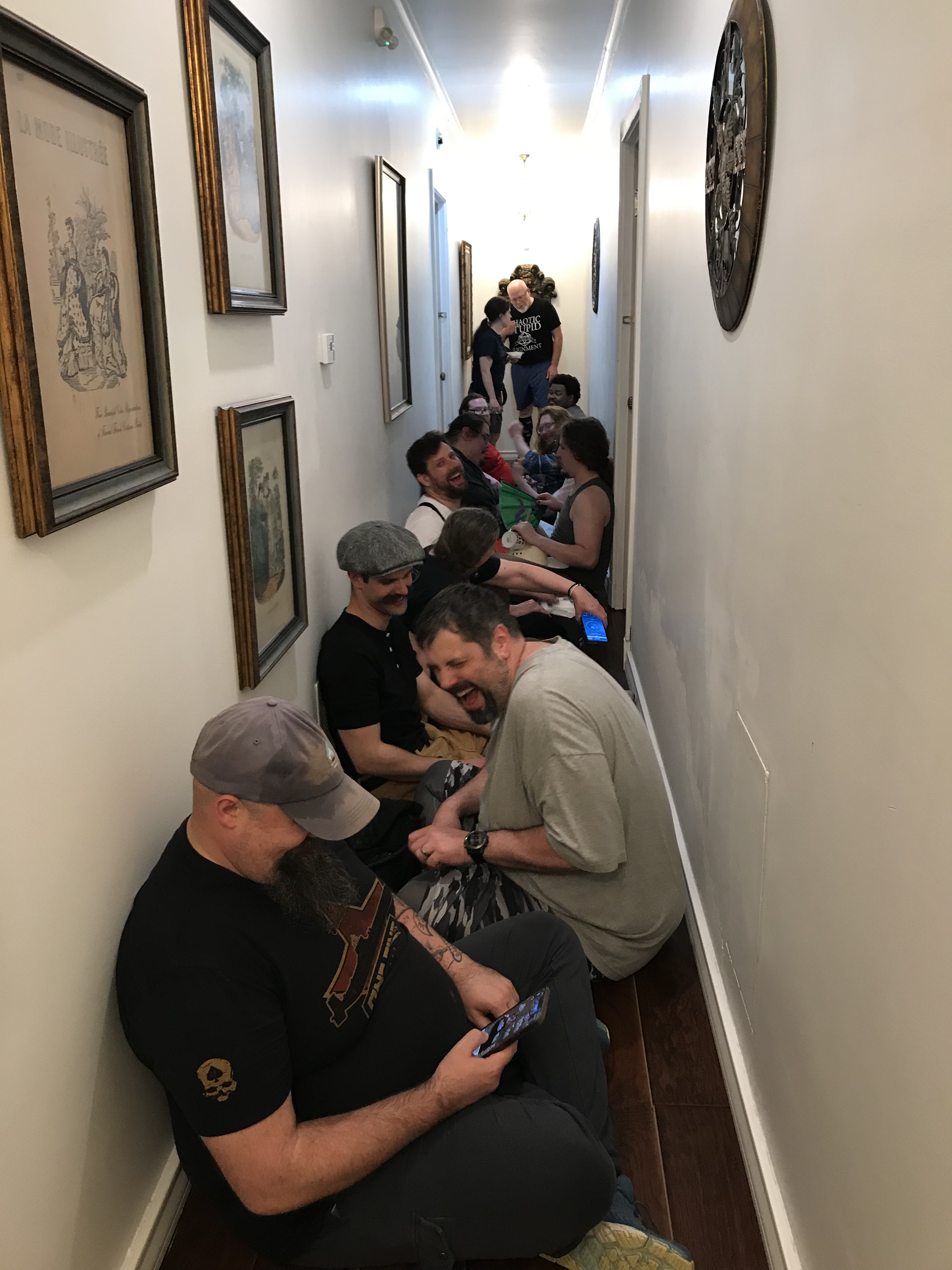
As a final note, before I left for Texas a friend of mine, a life-long martial artist, asked me if this was a paying gig. Having run a do-jang for years he knows how things work. Not being involved in historical fencing, I had to explain to him that for the most part renumeration is not standard, partly because we all do this because we love it, and partly because few programs can afford to cover travel, room and board, and food—most clubs are struggling to acquire the most basic, economically sourced gear that won’t break or fail. Then I told him, that in the case of The Exhibition, this is the sort of event one happily pays to attend. It’s the kind of event one saves money all year to attend. So dedicated are some attendees that they camp on site in tents, despite humidity, bugs, and new this year—tornado warnings! This is important and worth consideration.
NOTES:
[1] cf. https://saladellatrespade.com/2023/04/24/a-bar-raiser/
[2] https://www.ticketleap.events/tickets/chateau-south/exhibition-of-arms
[3] As a note on this, Storica Defensa’s ranking system is not a “belt system” either, but a way a) to categorize competitors by skill level, and b) a way to classify levels of coaching.

 )
)
 Capitale Escrime Historical Fencing