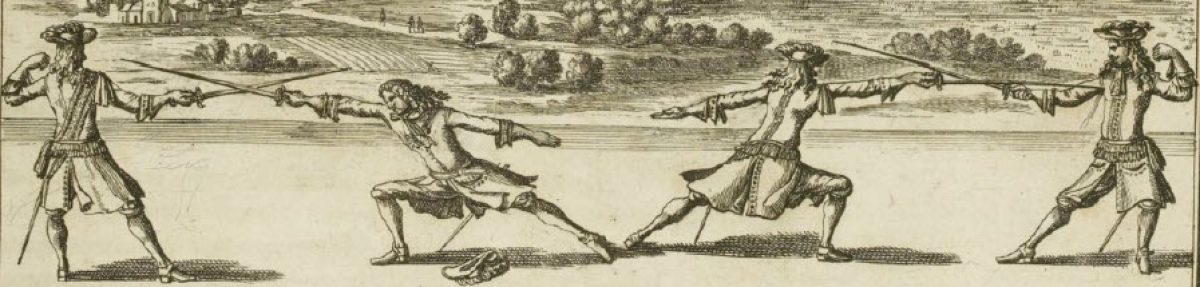
Gang Affiliation or Natural Allies? Fencers and their Camps

fencer-delmar-calvert from west coast fencing archive
Maitre Delmar Calvert, 1924-2019; photo from Westcoast Fencing Archive

This past weekend I attended the memorial for one of my instructors, Matire Delmar Calvert, and among the many thoughts that assailed me while there was a realization that despite the fact I was surrounded by mostly Olympic fencers I was with “family.” I didn’t expect that. These are all people I like, but I’ll be honest, I often have felt like I don’t belong with them.

More often than not I’ve felt like an outsider in fencing. When I stopped competing, many of my fellow fencers thought I was over-reacting or was just full of sour grapes, and when I started doing research into fencing, technique, etc. the kindest thing I was called was “nerd.” When I started trying to find and use more historically appropriate blades a fair number of people thought I was crazy (the historical community as we know it didn’t exist then). Working from books was bad enough. It didn’t get better.
1801366_10203266909176461_1837749499_o (1)
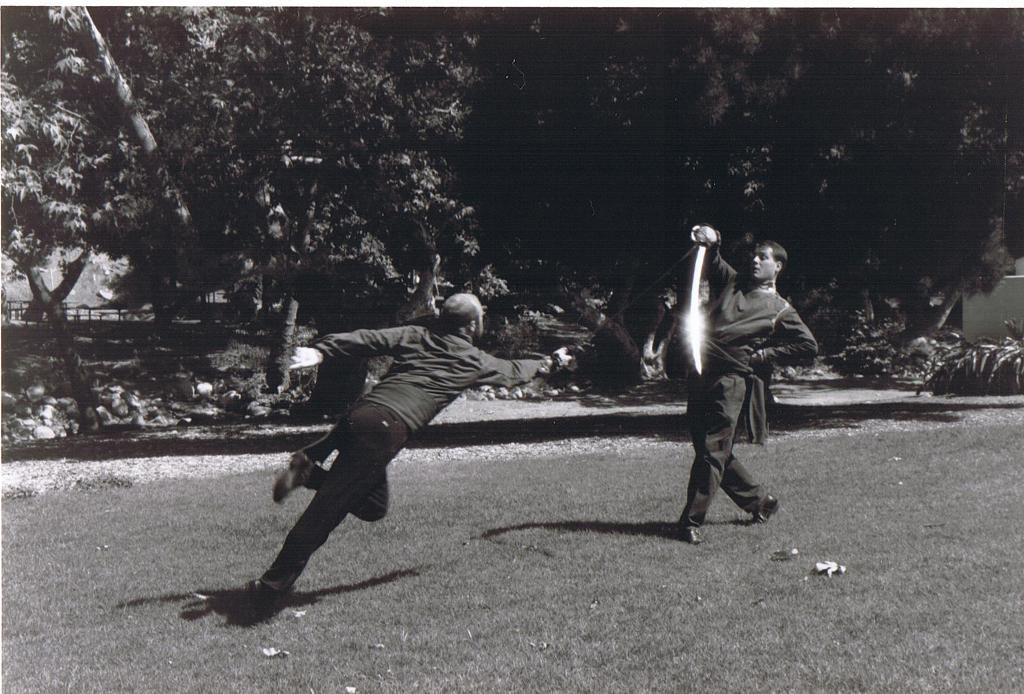
Jon Tarantino and I doing a photo-shoot, Oaks Park, Santa Barbara, for a friend in 1997–aside from schlager blades, these crappy Indian-made repro cavalry blades were all we had, and yes, they were rubbish.

I left the competitive world in 1996—I was disgusted with the band-aid vs. cure approach of the FIE/USFA to the issues in electric sabre. It just wasn’t fun anymore, not for me, and so I left. I began pursuing “Classical” or “Traditional” fencing, but understand that in saying that I don’t mean the artful dance variety—I wanted to return to sabre pre-electric, and that led me further and further back, ultimately to the core texts that created what I knew as sabre. Labeled “too sporty” and failing to pay homage to what has become the established “Classical” community, there was no welcome there either. It’s just as cliquish as the Olympic world, maybe more so for being smaller, though I’m happy to say that in more recent months I’ve had the pleasure to get to know more people within that community and hope it’s a sign that we’ll communicate more.

Time in historical fencing has proved just as difficult, if in different ways. The first historical club I attended, off and on, I entered at a difficult time for me and my family. I needed an out, something that wasn’t standing uselessly next to a pregnant spouse undergoing treatment for cancer and trying to keep a four-year old’s world as normal as possible. I should’ve done more research. I knew of Maestro Hayes’ school in Eugene, but with my schedule at the time I couldn’t make that drive. I did what anyone might do instead—I saw the need at the club I was in and decided I’d try to help. It was an utter and complete failure—fragile egos too often see help as a threat. This proved the case at this school.
abject failure of a seminar
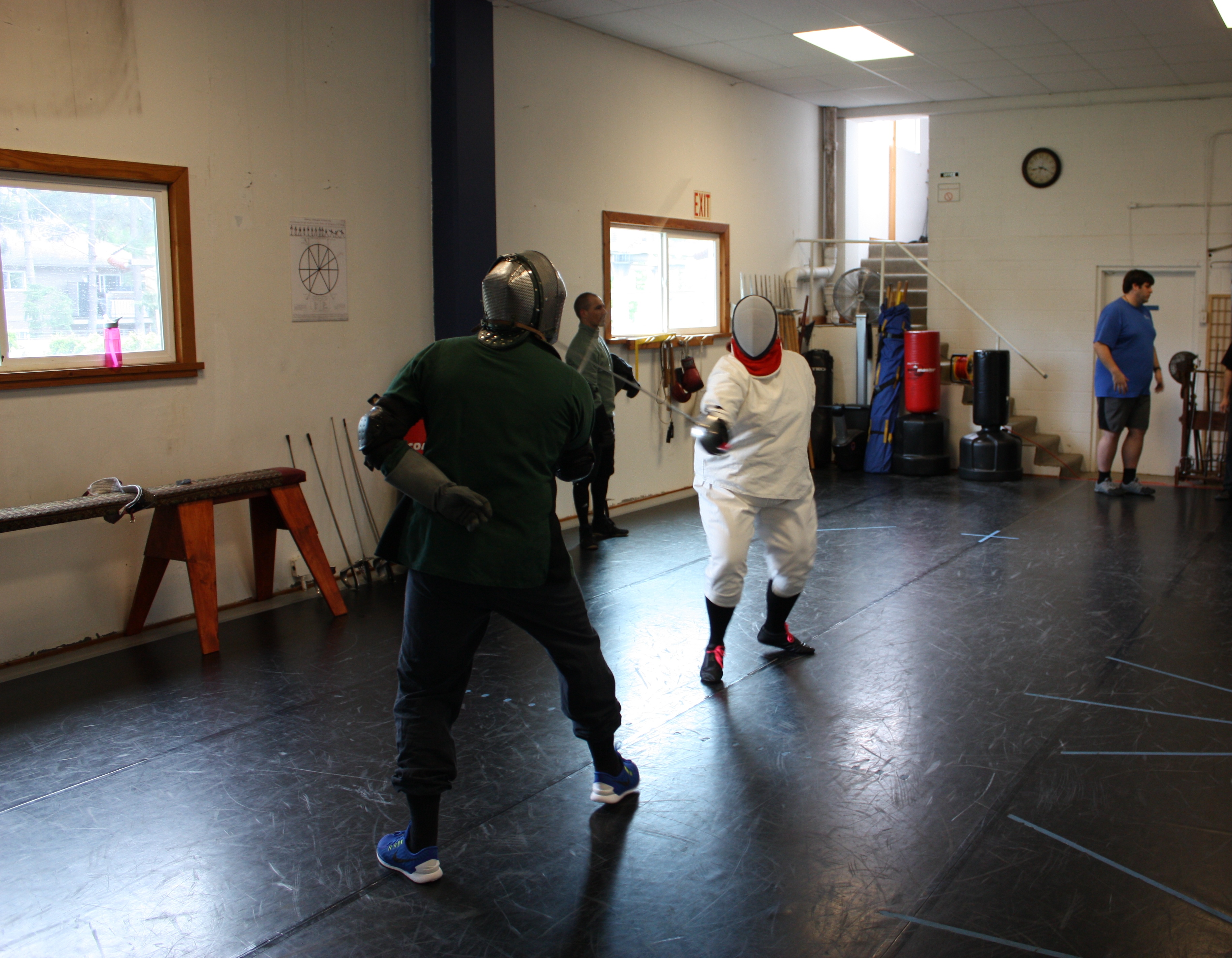
Alex Spreier of High Desert Armizare, vs. Velah Gilbert (Military and Classical Sabre page, FB), with Christopher Bigelow (Northwest Fencing Academy) in green and Mike Cherba (Northwest Armizare) in blue, both in the background, 2015, at the ill-fated seminar on Angelo’s sabre and broadsword I put together

My last event there, one I put together to help them, but which ended up being micromanaged by the guy in charge of sabre there (first by planting his student in the seminar to keep an eye on me, and then, at the last minute, by showing up himself and taking over the seminar), was the last straw. After sharing my thoughts about it with him, I left and never looked back, though happily and ironically, became the best of friends with his student, and, met two people better connected with the larger historical community. I visited one of their schools, one super close to my house as it turns out, and was there for several years.

IMG_4385
Swordsquatch 2017, class I co-taught with a friend, covering Parise’s “On the Ground”

Having spent time in each camp’s turf, having fought side by side with each gang, hearing what they have to say about one another, themselves, all that, is illuminating. More than ever I think that despite the differences there’s more that we have in common that we think. This is a hard sell—group identity, misunderstanding, envy, ignorance, all work together to prevent more interaction. We are all the sorrier for it.
1-fencing-at-dickels-academy-frederic-remington
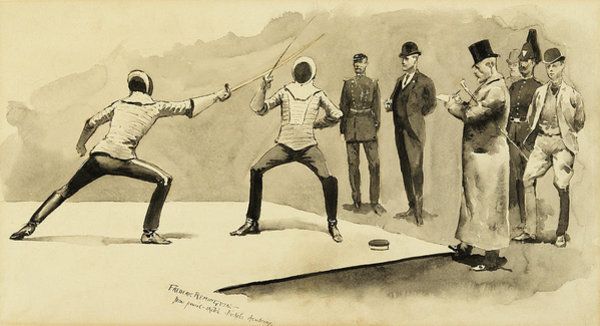
Fencing at- Dickels Academy, by Frederic-Remington

One of my goals with Sala delle Tre Spade is, to the degree possible, to bridge these divides. ALL fencers, whatever gang affiliation, are welcome—our turf is their turf. We are all united by study of the sword, and, we might learn a lot from one another. It makes me happy to know that in our tiny group we have historical, classical, and Olympic fencers; some have been or are in the SCA; some pursue several “styles” of fencing at different times in the week. We’re a small school, and so have very little influence in the larger fencing world, any of those worlds, but it’s a worthy goal trying to get people together to share what they know, because it builds ties and expands the parameters for what we might learn. We’re the richer for it, and while it’s anyone’s guess how long we’ll last, I know in a way that I know few things that it will have been worth it. We’ll all keep fencing regardless.
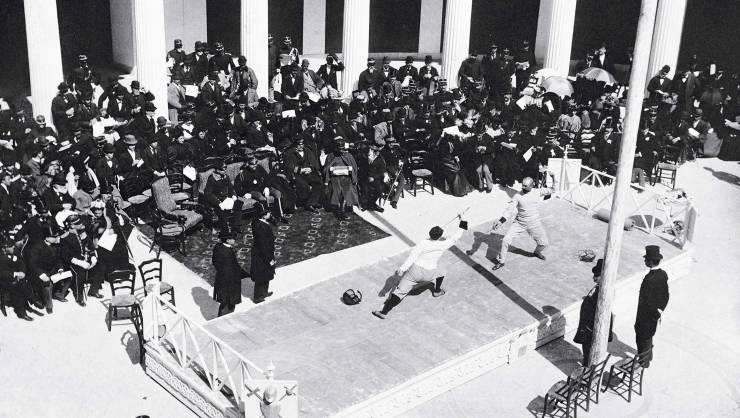
Of Medals and the Illusion of Mastery

With our tourney coming up—an invitational sabre match—I’m always conscious of how difficult these things are to do. I’ve either fenced in or judged a lot of tournaments, both Olympic and HEMA, and with each new historical tourney I’m struck by a disturbing fact—pound for pound, a tournament in HEMA and one in Olympic circles are not so very different. In both, too many fighters are playing the system, and worse, too many have zero regard for being hit. In both tournament worlds there is also a tendency to take medaling as the litmus test for excellence. Placing well can correlate with skill, but it’s not a sure thing. There are a number of reasons why this is so.

Everyone likes to win. Emerging the victor in a bout, or better still a tournament, is a nice feeling. It’s validating. It is important, however, to put any such victory in context and remember that however well one does, victory on its own does not mean mastery. There are several reasons for this and if you’re serious about your development as a fencer you need to know this. You ignore it at your peril, at the risk of further improvement, and it can easily lead to a false sense of ability with all the ego problems that creates.

There is always someone out there better than you are. This is just true. Theoretically, out there somewhere, there is one fencer who truly is better than everyone else, but see point two 😉  A prime example of this is a close friend of mine—we’ll call him “Dennis.” He’s a beautiful fencer, tactically brilliant, graceful, powerful, the kind of fighter who makes you look even better than you are when you fight him and he’s destroying you. Yes, that good. In the early 00’s, he entered an epee event open only to fencers ranked B or higher; most everyone there was an A-rated fencer. As this was epee, that ranking actually meant something too–epee is the only weapon of the three to have retained much of its martial ethos. No one there knew Dennis, and they expected to clean the floor with him. He beat every single one of them, badly, and they were really ticked when they realized that this was just something he did for fun, that he wasn’t a “normal” tournament guy; he fenced enough to keep his rating, but otherwise he’d just as soon be working on other hobbies. Dennis is a good example of the unknown ego-check, of the truly gifted fencer out there who is, quite literally, better than you or me.

Great fencers have bad days; poor fencers good days. No matter how good someone might be, even the best fencers have an off day. If this day happens to be on a tournament day, chances are good they may not clear the pools. In like guise, the poorest noob may end up taking the day. It just depends. Maybe they just had more fire and the better fencers either underestimated them or misapplied their skill. Maybe the directing was crap. Maybe it was a combination. One can’t take anything for granted.

Tournament victory is only as good as the quality of the pools. Not all gold medals are the same. Medaling in a minor tournament with twenty fencers of basic skill is not the same as medaling in a tournament where half or more of the fifty competitors are truly skilled. Herein is one major problem for WMA—what defines skill? Many people equate tournament victory with it, but that’s a false equivalency, one only embraced by people who don’t know better or who benefit from the fallacy. This is hard to combat because the same egos that benefit from this, who derive their value from it, are quick to say any naysayer is suffering sour grapes. Sort of makes discussing and fixing that, demonstrating the problem, difficult.

Skill vs. Attribute Fencing One of the elephants in the ring is the issue of attribute fencing versus a more comprehensive skill-set well-applied. To be fair, most attribute-fencers have skill, but often this is a specific set of skills that exploit their reach, speed, etc. to the exclusion of a more comprehensive game. The thing is it works. If you’re fast, if you have reach, if you hit harder and intimidate people, it will take you pretty far. People medal and win tournaments all the time armed only with a few tricks that they have optimized. The confidence that comes with that cannot be underestimated. The test though, for those fencers, is what happens when they run into someone whose skill-set is broader, whose experience is deeper, and who knows how to nullify the advantages their opponent’s attributes offer. If attribute fencers are lucky, they’ll meet that opponent; if they’re smart, they’ll learn something from it.

Gaming the Tourney is another major issue. This isn’t new and it’s not confined to WMA, but a major problem for Olympic fencing as well other sports. There are advantages to winning, and so, some people are willing to do whatever it takes to make it happen. For just a few examples, be wary of anyone hosting a tournament that only enlists directors and/or judges from their school or who stack staffing in their favor.[i]

Related tactics include attempting to intimidate officials and other competitors, arguing for rule changes that favor one’s approach and fencers, and hard-hitting. These kids don’t play with others, and worse, can give a tournament, even a region, a bad rep. You don’t want that.

I’m not saying don’t fence in tourneys—you should if you want, they’re fun, but, you should go into them with your eyes open and for the right reasons. Not to wax too Miyagi, but primarily a tourney is a place to test, in real-time, your skills and tactics; it’s a lesson, a chance to learn, an opportunity to see what works and what doesn’t. It should also be fun. The illusion of mastery, and especially of tourney gold as evidence of it, is a problem for any fencer who truly wishes to improve. Mastery is less a destination than it is a goal which pushes our training, which keeps us honest, which keeps us striving.[ii]

This doesn’t mean don’t do your best, that you’re not trying to win—you can’t test what you know if you’re going through the motions. The pressure, the chance to think on your feet, to adapt, and all within seconds is a fantastic way to see how well we apply what we’ve learned. If it all works, and you grab that trophy, great! It is healthy, maybe after celebratory beers, to reflect on the nature of the competition, to weight that against the heft of the medal around your neck. That awareness shouldn’t detract from victory, but merely inform it, and, better prepare you for the next one.


[i] This isn’t universally true of course. In small tournaments, especially where there is no one else to staff, one has little choice but to use who is on hand. Whenever possible, SdTS tries to enlist friends from other salas to help direct–our judges are pulled from the competitors.

[ii] A black belt in TKD, for example, has demonstrated that they are now ready to begin to study in earnest; a fencing master, in a slightly different way, isn’t necessary the best fighter, but a teacher, someone who has command of a particular pedagogical approach and is capable of teaching other teachers.