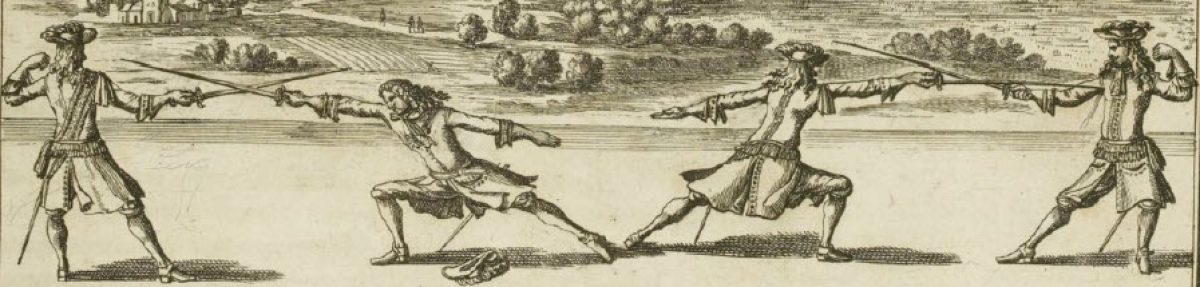
“Show, don’t tell,” was some of the best teaching/writing advice I ever received. To that end, I’m adding some specific drills to illustrate what I shared in the last post on this topic better (https://saladellatrespade.com/2023/10/31/yes-yes-very-nice-but-how-cultivating-defense/ ). Many, if not most of these drills, are venerable—if anything I may have adapted things here or there, but all of what follows are standard drills or types of drills. [1]
These progressive option drills start with a basic action and build in complexity. If a student is new or struggling, one may stop with the first version and work on that, or, aspects of it. For more advanced students, one can add an additional layer of difficulty as required. In the first example, for smallsword, one could simplify the drill even more by having the student initially deny the engagement and break measure. This would observe the “don’t get hit” rule, but not set them up well for a strike of their own.
Two things I didn’t add below, but which apply are first, that it’s important to switch roles, that is, have both the student and instructor initiate the action. This gives the student a chance to act as attacker and defender. Second, movement and varying distance is critical for success. If one starts “firm-footed,” that is, in place, fine, but then add movement. Chase the student, have the student chase the instructor; start out of measure, start in measure. For more advanced students, another option we can layer in is varying tempo and speed.
Drills & “Realism”
On their own, there is little inherent in most drills to make them impart a defensive mindset automatically. All the drills I provide below, for example, can be gamed to current tourney standards easily if one wishes. How “realistic” or not they are depends on explanation and reiterating correct principles over and over and over again within each element of the drill.
One of the most frequent questions I get in drills and lessons, and a good one, is “but why wouldn’t I just do this?” This simple question has become one of the single most important ways in which I push correct mindset. To cite one example from this past week, one student in a smallsword class asked me why they couldn’t just disengage and thrust against the glide in third. I told them that they could, but then asked what would happen if they did—what is the opponent doing? If the opponent is gliding to target, and one ignores that to strike… one is still hit. Not good enough. IF one wishes to disengage in response, fine, but don’t do so into absence, do so with opposition in the new line, a shift of the body to one side, or both. [2]
Ex. for Smallsword:
Option Drill with the Glizade/Glide in Third
To Start:
S [student]: in guard of third
I [instructor]: in guard of third
*engaged on the outside line
Option 1A: Student Attacks
- S: finds measure and gains weak of I’s blade with middle of own [3]
- S: performs glide in 3rd, maintaining opposition, and strikes target (forward target or chest)
2A:
- S: finds measure and gains weak of I’s blade with middle of own
- S: performs glide in 3rd, maintaining opposition, and thrusts
- I: parries 3rd, ripostes; S. parries in 3rd and ripostes [4]
3A
- S: finds measure and gains weak of I’s blade with middle of own
- S: performs glide in 3rd, maintaining opposition, and thrusts
- I: parries 3rd, begins riposte; S. disengages, engages in 4th, thrusts to target with opposition
4A:
- S: finds measure and gains weak of I’s blade with middle of own
- S: performs glide in 3rd, maintaining opposition, and thrusts
- I: makes dérobement to avoid glide and engages in 4th
- S: via circular 3rd, retakes line and glides in 3rd to target
Option 2A: Instructor Attacks
- I: finds measure and gains weak of I’s blade with middle of own
- I: performs glide in 3rd, maintaining opposition, and thrusts
- S: parries 3rd, ripostes
2A:
- I: finds measure and gains weak of I’s blade with middle of own
- I: performs glide in 3rd, maintaining opposition, and thrusts
- S: parries 3rd, begins riposte; S. disengages, engages in 4th, thrusts to target with opposition
3A:
- I: finds measure and gains weak of I’s blade with middle of own
- I: performs glide in 3rd, maintaining opposition, and thrusts
- S: makes via dérobement avoids glide and engages in 4th
- I: via circular 3rd, retakes line and glides in 3rd to target
- S: parries in 3rd, ripostes
Ex. for Rapier:
Finta Scorsa or Advancing Feint of Marcelli
To Start:
- S: in guard of prima
- I: in guard of third
Option 1A: Student Attacks
- S: in prima, makes false attack to the high inside line
- I: parries in 4th
- S: via cavazione /disengages to outside line, and strikes target (forward or chest)
2A:
- S: in prima, makes false attack to the inside line
- I: parries in 4th
- S: via cavazione /disengages to outside line; I parries 3rd, begins riposte
- S: parries in 3rd (or 4th depending) and ripostes, striking target
3A
- S: in prima, makes false attack to the inside line
- I: parries in 4th
- S: via cavazione /disengages to outside line; I parries 3rd, begins riposte low-line
- S: takes 2nd, ripostes with opposition
4A:
- S: in prima, makes false attack to the inside line
- I: parries in 4th
- S: via cavazione /disengages to outside line; I parries 3rd, begins riposte low-line
- S: takes 2nd and thrusts; I. parries 2nd, begins riposte
- S: parries 2nd, ripostes with opposition
Option 2A: Instructor Attacks
- I: in prima, makes false attack to the high inside line
- S: parries in 4th
- I: via cavazione /disengages to outside line, and thrusts
- S: parries in 3rd, ripostes to target
2A:
- I: in prima, makes false attack to the inside line
- S: parries in 4th
- I: via cavazione /disengages to outside line; S. parries 3rd, begins riposte
- I: disengages to 4th, starts riposte with opposition
- S: disengages to 4th, ripostes with opposition to target
3A:
- I: in prima, makes false attack to the inside line
- S: parries in 4th
- I: via cavazione /disengages to outside line; I parries 3rd, begins riposte low-line
- S: takes 2nd and thrusts; I. parries 2nd, begins riposte
- S: parries 2nd, ripostes with opposition
- I: with parry in 2nd, passes left foot forward in order to seize guard
- S: steps back, attacks to body
Ex. For Rapier and Dagger:
Working from Mezzaluna (Marcelli)
To Start:
- S: in guard of mezzaluna
- I: in fourth guard [5]
Option 1A: Instructor Attacks
- I: in fourth guard, makes attack to the inside line
- S: parries with dagger; with sword ripostes to target (forward or deep)
2A:
- I: in fourth guard, makes false attack to the inside line
- S: attempts to parry with dagger (downwards and out)
- I: disengages to strike hand
- S: parries with dagger (upwards and out), ripostes with sword to target
3A:
- I: in fourth guard, makes beat attack against sword to open the inside line
- S: parries in 4th to close line, ripostes with opposition
- I: parries with dagger (upwards and out), ripostes with sword inside line
- S: parries with dagger (downwards and out), ripostes to arm
Option 2A: Student Attacks
- S: makes false attack to face
- I: parries with dagger (upwards and out)
- S: disengages and strikes arm or hand
2A:
- S: makes false attack to face
- I: parries with dagger (upwards and out); ripostes to arm
- S: disengages and strikes to arm or hand
- I: parries with dagger, ripostes
- S: parries with dagger (downwards and out); ripostes to arm
3A
- S: makes false attack to face
- I: parries with dagger (upwards and out); ripostes to arm
- S: makes circular parry in 3rd; ripostes via glide to outside line
- I: parries in 3rd, checks with dagger, ripostes in high line over engagement [6]
- S: parries with dagger (upwards); shifts right, ripostes to body
Ex. for Sabre:
Options from an Engagement in Second
S &I: in 2nd, at punta spada/last third/weak of the sword; then, start out of distance
Option 1A: Student Attacks
- S: cuts over to threaten face with feint via half thrust
- I: moves to parry in 1st
- S:
a. performs molinello ristretto or coupé to the arm [7]
b. performs molinello ristretto via rising cut to the bottom of the arm
2A:
- S: cuts over to threaten face with feint via half thrust
- I: moves to parry in 1st
- S: performs molinello ristretto via rising cut to the bottom of the arm
- S: secondary attack: pushes through to thrust or cut flank
3A:
- S: cuts over to threaten face with feint via half thrust
- I: moves to parry in 1st
- S: a. performs molinello ristretto or coupé to the arm
- I: parries 3rd, cuts to head
- S: parries 5th, cuts via molinello to head
4A:
- S: cuts over to threaten face with feint via half thrust
- I: moves to parry in 1st
- S: performs molinello ristretto via rising cut to the bottom of the arm
- S: secondary attack: pushes through to thrust or cut flank
- I: parries in 2nd; ripostes via thrust
- S: makes ceding parry in 2nd, ripostes via thrust to target
Option 1A: Instructor Attacks
- I: cuts over to threaten face with feint via half thrust
- S: moves to parry in 1st, parries via molinello to head
2A:
- I: cuts over to threaten face with feint via half thrust
- S: moves to parry in 1st
- I. disengages and cuts to arm
- S: parries 3rd, cuts head
3A:
- I: cuts over to threaten face with feint via half thrust
- S: moves to parry in 1st
- I. disengages and cuts to arm
- S: parries 3rd, cuts head
- I: parries 5th, cuts to flank
- S: parries in 2nd, thrusts to target
NOTES:
[1] To name one example, and analogous to the first one I share here, there is the discussion of options facing an opponent in 4th in Charles Besnard, Le maître d’arme liberal, 1653, 43 (63 [orig. French] and 161 [English] in the translation by Anne Chauvat and Rob Runacres, The Free Master of Arms, Glasgow, UK: Fallen Rook Publishing, 2022).
[2] The use of the inquartata or demi-volte, for example, would work in this instance.
[3] Two ways to vary this are to have the student find measure by a short extension of the arm from critical distance, in order to gain the weak with the middle of their weapon, or, have them step into measure to engage. The first is more conservative, but the second option is important—ideally, students learn to find measure and exploit it both ways.
[4] As set up here, the final actions are a battle of ceding/yielding parries and glides. Both help students cultivate better awareness of presence, varying pressure, measure, and opposition.
[5] Marcelli’s fourth guard for rapier and dagger is depicted thus:

Mezzaluna, on the right, needs explanation. Chris Holzman points out that Terracusa e Ventura (1725) remarks that the tips of the two weapons are close enough to form a “half moon” shape. Here, there is a much wider gap between them. The accompanying text, however, tells us that the fencer “carries the dagger forward covering all the upper parts in such a way that the opponent only sees the chest below the dagger as target to strike.” [Holzman, Marcelli, Rules of Fencing, 1686, Wichita, KS: Lulu Press, 2019, 273; see also n. 115 that page.
Hà portato il Pugnale avanti, coprendosi tutte le parti superiori, di modo che il nemico vedesolo per bersaglio da colpire il petto per le parti di sotto il Pugnale [Marcelli, Regole della Scherma, Lib. I, Cap. III, 4]
[6] Here, the instructor, having parried the incoming sword in 3rd, uses the dagger to hold the opposing weapon in place in order to swing their weapon around obliquely to the right and up (assuming a right-hander) in order to threaten the face.
[7] The coupé , in Radaellian sabre as taken down by Del Frate, is also known as the colpo di cavazione or cavazione angolata. It is made by bending the forearm back a bit to increase power. Chris Holzman, in his gloss, remarks that it’s similar to the last step of the molinello. See Christopher A. Holzman, The Art of the Dueling Sabre, Staten Island, NY: SKA Swordsplay Books, 2011, 234.


 Capitale Escrime Historical Fencing