Tag: Sieur de la Touche
Old Wine in New Bottles: Fencing Theory and Interpretation
The much-maligned maestro, Nick Evangelista, turned a phrase that I have long used, “the logic of the sharp point.” [1] For anyone interested in fencing as more than an elaborate game of tag in unfortunate polyester uniforms, the logic of the sharp point should guide all they do. In short, this logic boils down to one idea:
If attacked, defend
When we don’t envision that point as sharp, we make poor choices—most doubles and the obsession with the after-blow stem from misunderstanding or misapplication of this logic. Why is it that in historical fencing, supposedly keen for fostering “realism,” we see such a gap between theory and practice? In short, the divergence stems from failure to learn and apply the most basic tenets of fencing theory. The reason for that is simple: too many historical fencers refuse to examine what modern fencing has to teach them.
This is a topic I’ve spent a lot of time on, but when a problem persists, we keep at it or quit. One fact I must accept, however, is that no matter how much time I or anyone spend on this, no matter how much evidence or analysis we throw at things, it won’t matter to most people in “HEMA.” There is daily proof of this, but there is also precedent: similar issues plagued the Olympic fencing world in the 1990s and early 2000s and then as now most people didn’t care. That doesn’t make them right. Their discomfort with a truth in no way changes the fact of that truth. I will argue until I’m worm-food that one should extend on a thrust, that the flat of the sabre shouldn’t score, and that off-target is, ultimately, illogical.
In like manner, not to avail oneself of modern fencing theory is to hobble our efforts at understanding fencing of the past. Modern theory was not created in a vacuum—it is the product of quite literally centuries of work. As always, one must distinguish between theory and how that theory is applied or misapplied. They are separate things.
For a quick example, applying right of way (ROW) to sabre, in theory, is sensible. ROW, in its way, attempts to enforce the logic of the sharp point, but being a game, a sport, this rule is less doctrinaire than it is for historical fencers. Historical fencers balk that ROW allows consideration of off target, and that one may win the point but still be hit. However, despite those aspects, despite the tyranny of electric scoring, the rule states that an attack should be dealt with, not just reacted to via counterattack out of time. One should defend if attacked—that is basic logic, the point, really, of fencing, defense. Thus, the ruling idea is sound, but how that rule is abused and interpreted is a mess.
Case Study: Passing Attacks
In one of the most recent and unfortunate fracases on social media, over a specific type of attack [see the post 13 August 2023, “Shadows in Caves,” https://saladellatrespade.com/2023/08/13/shadows-in-caves/], we have another example of the perils of interpretation. As I stated in an earlier post, part of it vested interest in maintaining a perceived status within the community, part of the problem was vocabulary, and partly it was a failure to understand how the sources and modern theory intersect. I’m fed to the teeth criticizing the all-consuming horror that ego plays in all this, so this post will instead focus on terms and misapplication of theory.
One mistake that people are making is equating a modern version of a species of attack for one of the same class from the past. It might help to illustrate how the terms relate. “Passing attacks” comprise a category of attacks where the rear foot passes the lead foot. Just how one does this changes. The terms and description vary as well. For two examples, we have the lunge made on the pass in de la Touche (1670), his “thrust of the pass” (l’estocade de passe), his “the finished pass” (la passe finie), and the modern flèche. [2]
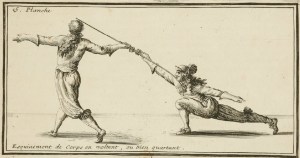
No one in de la Touche’s time called any passing attack I’m aware of a “flèche.” Those quick to decry the use of a “flèche” in a recent Canadian tournament cite the use of a passing attack as modern and anachronistic, and thus out of keeping with period practice. It’s important to break down the attack, and criticism, to see if this criticism holds.
I’ve selected de la Touche in part because detractors have cited him for proof, but also because de la Touche did a fantastic job of explaining many aspects of technique. He was not the only one to include thrusts of the pass, but he is a good example. [3] The section on his thrust of the pass is long, thorough, and informative. In speaking of thrusts generally, de la Touche reminds us that one should be careful to aim for the most uncovered section of target, and, that one must thrust with conviction, that one should let oneself “go and extend as much as you can, so that the action has more force and swiftness of reach.” [4] I note this because swiftness, speed, is a critical consideration, one detractors downplay.
The master observes that one’s reach is longer with the thrust of the pass, and thus that the measure is larger so it requires more time to make. This is a crucial point. If one can hit with a thrust of the firm foot, then one shouldn’t use the thrust of the pass, unless one was initially aiming for the arm and decides to go for the body. It is particularly useful if the opponent is breaking measure (retreating) and if one wishes to surprise the adversary. Most importantly, one must accustom oneself to “execute the thrust of the pass with great swiftness, in order to compensate for the length of the action by the promptness of the execution.” [5]
Important to note, and a point in favor of the critics, de la Touche’s thrust of the pass assumes that the lead foot does not move. One advances the weapon, arm, body, and rear foot, but the front foot remains in place. [98] However, in the next section, De la Passe finie, “Of the Finished Pass,” de la Touche remarks that
The finished pass is an action by which, commanding the weak of the enemy’s sword with the forte of one’s own, one advances the foot which is behind the other in order to take the enemy in the body or to seize the sword to strike or snatch it.
La Passe finie es une action, par laquelle en dominant le foible de l’Espee de l’ennemy du fort de la vostre, on avance le pied qui se trouve derriere devant l’autre, a dessin deprendre l’ennemy au corps, ou de luy faisir l’Espee pour le frapper, ou pour luy arracher. [6]
De la Touche discusses this action, of moving the rear foot past the front, within the context of weapon-seizures. Such seizures are, as he observes, incredibly dangerous and chancy, especially if attempted when attacking (he is less uncomfortable with such seizures when defending). [7] One question arising from this is whether or not the master recommended this passing step only for weapon seizures. In answering this question one must interpret since de la Touche is not specific. How best to do that?
First, we must examine the action in the context in which the master shares it. It makes sense to include this passing step in a section relating to seizing the weapon as the distance one must travel is, arguably, longer than it is when lunging or lunging on the pass. Of note, this step is more connected to attempting a seizure when attacking than defending, as ostensibly the opponent is either standing firm-footed or breaking measure to defend.
Second, we must compare the advice in this passage with the rest of his work, with the general timbre of his approach. This is, granted, where we enter the world of conjecture. Thus, it is all the more important to work from the text, not just one passage or section. We must apply logic to any such comparison; it is, really, the only way to avoid the more obvious pitfalls, such as selecting only what supports our point of view or cherry-picking.
Whenever evidence works against us, we must deal with it honestly. In this case, the thrust of the pass itself does not appear to include moving the front foot from its place. De la Touche makes this clear. Those unhappy with the attack my friend and colleague made at An Cruinneachadh this past month are not incorrect about that. [8] However, I believe they are on far less firm ground if they suggest that the finished pass, that is a pass where both feet move, is only advisable when attempting a weapon seizure. Yes, that is the section in which it appears, but on its own that doesn’t make for a strong case. De la Touche covers the lunge in one section too, but one assumes that he wants one to use it whenever applicable.
Herein lies the crux of the problem—applicability. What follows is my take, my interpretation of de la Touche, and I will be the first to admit it is more spirit than letter of the law. I have reasons for that—we do our best to conform to what a text says, but we must remember the purpose of a source. De la Touche was concerned first and foremost with effective fencing. The goal, quite literally, was to strike and hopefully not be struck as one did so, because failure meant injury or death. If that was the goal, then slavish attention to any action makes little sense. Put another way, if one attempts a thrust of the pass, but the opponent retreats slightly more, one can either break off the attack, or, continue it (assuming the same elements of surprise and safety) by moving that immobile front foot. Fencers make different choices depending on the situation; technique, ultimately, backs up tactics, not the other way around. The attacker is at risk regardless—should they continue an already long attack, they increase the chance of failure, but should they recover needlessly just to follow the letter of the law they may create an opportunity for the adversary to attack in their turn.
In my reading, what Jay used in that match follows the logic of the finished pass and the thrust of the pass. Both fencers were working measure, but Jay launched his attack (about :07/:08 seconds in the video on fb) as his opponent (the chap in green) was in negative balance, as he was just about to initiate an action. Jay threw his arm and body forward, a la the thrust of the pass, but then crossed his feet a la finished pass in order to reach his now retreating opponent. Nothing in this action is out of keeping with what we read in de la Touche.
In fact, Jay used the proper speed to execute this attack successfully, an aspect de la Touche was quick to point out. Judging by both video of their fencing and from what I have observed on my own in person, many of Jay’s detractors do not employ speed in their own fencing, and one fears that they may not realize its importance. No attack made from just out of distance will succeed without it.
But his Fleche!
Now, what is the modern, well, 20th century flèche? It depends upon how one defines it. Generally, in French fencing, the fleche is a “running attack,” but in this can be further explained as Gaugler put it, as “a running attack executed following a loss of balance by an exaggerated forward displacement of the center of gravity.” [9] Maitre Robert Handleman provides a fuller description:
Flèche: an accelerating offensive footwork progression that may start from on guard with a rapid extension of the arm and back leg which causes the body to lean forward and become unbalanced. The front leg then releases like a coiled spring causing the fencer to leap or run forward. The rear leg comes forward to land first, in a running-like movement; the hit should arrive as the legs cross or before. The flèche is used in foil and epee and may be delivered at any distance but is most effective as a surprise in shorter or medium distance. Another variation includes bringing the front foot towards the rear to shift the balance forward and then a rapid extension of the arm in the attack and a forward drive off the front leg. [10]
Handleman’s work was published in 2014, the flèche outlawed for sabre in 1994, but older works discuss the use of the attack in all three weapons. The flèche is still legal in modern foil and epee competitions.
So, did Jay flèche? Yes and no. Yes, he made a running attack, and going by just one definition, Gaugler’s above, we can call it a flèche. However, nothing in that action was out of keeping with what de la Touche, among others, described in their coverage of passing attacks. So where does that leave us?
Old Bottles, New Wine
Often in historical examinations we employ the simple tools of comparison and contrast. Examining patterns of what is similar, what different, we can unpack a source and see relationships, connections, and with further analysis, reach conclusions about what we are studying. In some cases, one type of comparison may reveal more to us. As a related example, from the study of myth, Joseph Campbell’s The Hero with a Thousand Faces does a great job of finding cross-cultural similarities in what he called the “monomyth,” but his study is only so useful because he did not, and did not intend, to examine the differences in how this motif was or is used. A hero’s motivations, for example, may be vastly different even if the narrative construct is similar; those differences will be far more revealing about cultural values than similarities.
In contrast, the situation here is one where similarities should help make sense of the sources, but which do not thanks to bias. Prejudice against the “new wine” of modern fencing, an outgrowth of the reactionary period in which modern historical fencing was born, has persisted and continues to affect how those suffering this bias view the “old bottles” that are period sources. The flèche as they see it is an artifact of modern, 20th century fencing, not that particular century’s version of an old and time-worn attack. Why? Because in their view nothing modern is legitimate.
In fairness to his critics, if one places a photo from mid-century where a fencer is nearly horizontal in the air as they flèche, and then a plate from de la Touche side by side, then the differences are obvious. It’s clear these are not exactly the same, but they’re not the same in execution, and it should be easy to see why: the contexts are different.


This has been obvious to other scholars of fencing. Morton’s A-Z of Fencing contains a lengthy entry on the flèche as well as one for the pass which, so Morton states, was an older method of movement, and, one in which the lead foot might, if necessary, move as well. [11] As a last example, Nick Evangelista, in defining the flèche, echoes the same cautions as de la Touche, reminds the reader it is best used sparingly and as a surprise, and most importantly, that “the pass on avant of the eighteenth century is considered the forerunner of the flèche as it is practiced in modern times.” [12] These writers see continuity as well as change, versus change alone, and with good reason. No aspect of modern theory was created ex nihil—all of it is built on precedent.
De la Touche on more than one occasion is at pains to warn the reader against actions that will get them hurt, because in 1670 people were using swords and intended harm with them. No one of sound mind is fencing in that context today—realistic as we may wish to be, we do this for fun, not because our lives may depend on it; we fence with friends, not people keen to kill us; we use safer trainers and wear safety equipment, not a simple shirt or the lack of one. In contrast, fencers using the flèche in Olympic fencing, and especially in sabre in the late 1990s, not only had no fear since they were going for points, but especially in the case of the latter could stretch the action to ridiculous lengths to game the system. Indeed, so abused was the flèche that they outlawed crossing the legs in sabre.
Wine is Wine, Old Bottle or New
In the sitcom “Schitt’s Creek,” one of the main characters, David Rose, explains his sexual outlook to Stevie, a woman who works at the hotel where he is staying, and with whom he had hooked up:
Stevie Budd : So, just to be clear, um… I’m a red wine drinker.
David Rose : That’s fine.
Stevie Budd : Okay, cool. But, uh, I only drink red wine.
David Rose : Okay.
Stevie Budd : And up until last night, I was under the impression that you too only drank red wine. But I guess I was wrong?
David Rose : [nods knowingly] I see where you’re going with this. Um… I do drink red wine. But I also drink white wine.
Stevie Budd : Oh.
David Rose : And I’ve been known to sample the occasional rosé. And a couple summers back, I tried a merlot that used to be a chardonnay…
Stevie Budd : Uh… okay.
David Rose : …which got a bit complicated.
Stevie Budd : Yeah, so… you’re just really open to all wines.
David Rose : I like the wine and not the label. Does that make sense?
Stevie Budd : [smiles] Yes. That does. [13]
In addition to being a wonderful way to explain pansexuality, I see an analogy in re fencing theory. Fencing is, ultimately, fencing, and it is either effective or not. Contexts, purposes, equipment, and ethos all change, but should one lay out the better modern works on fencing side by side with those from the past the kinship becomes absolutely clear. Yes, there are differences, and in historical fencing in particular to ignore those differences makes what we do ridiculous. However, it’s double-edged—to ignore what modern theory provides any fencer, especially those attempting to interpret past sources for the Art, is to handicap one so terribly that the interpretation too easily becomes something other than what it should be, fencing. A prime example, which I’ve covered in other contexts, is the abject devotion to the images in the Bolognese corpus which produce versions of fencing more graceful than effective. [14] The desire to make “sidesword” different obscures the fact it was a cut and thrust weapon, and, that cut and thrust weapons existed before and after the 15th century. If pose becomes more important than purpose, one has lost one’s way.
The logic of the criticism used against the passing attack Jay used at An Cruinneachadh is faulty. The operating assumption is that anything that looks like a flèche, or indeed may be one, is automatically illegitimate and anachronistic. That doesn’t follow. One can make a fair case that the passing attack Jay employed abided all the cautions and guidelines that masters like de la Touche put forth, and as such, should not be classified as some aberration. [15]
NOTES:
[1] Nick Evangelista, “When Classical Fencing Goes Bad,” The Evangelista School of Fencing, 20 April 2014, https://www.evangelistafencing.com/blog/2014/4/20/9swnz7n7n709uvg9cko2hkh5a1h3n5
[2] Philibert, Sieur de la Touche, Les vrais principes de l’Espée seule, 1670, 66 (plate just before page 65); see also Reinier van Noort and Antoine Coudre, The True Principles of the Single Sword, Glasgow, UK: Fallen Rook Publishing, 2016, 88ff.
[3] For other examples, among others, see de Liancour’s passes to the inside and outside p. 24ff in Le maître des armes (1696), Girard’s pass of quarte p. 71ff Traité des armes (1740), and Angelo’s pass in carte over the arm p. 62 The School of Fencing (1787). Of note, many works cover passing steps in connection with weapon-seizures.
[4] Van Noort and Coudre, The True Principles of the Single Sword, 90.
[5] Ibid., 100.
[6] de la Touche, Les vrais principes de l’Espée seule, 75; cf. Van Noort and Coudre, The True Principles of the Single Sword, 108. I translated this passage myself, so it differs from that of van Noort and Coudre.
[7] de la Touche, Les vrais principes de l’Espée seule, 75-78; cf. Van Noort and Coudre, The True Principles of the Single Sword, 108-109.
[8] For the bout in question, see https://www.facebook.com/groups/261251458841817/permalink/835017504798540/?ref=share&mibextid=NSMWBT
[9] Willam M. Gaugler, A Dictionary of Universally used Fencing Terminology, Bangore, ME: Laureate Press, 1997, 34.
[10] Rob Handelman and Connie Louie, Fencing Foil: A Practical Training Guide for Coaches, Parents and Young Athletes, San Francisco, CA: Pattinando Publishing, 2014, 444.
[11] E.D. Morton, Martini A-Z of Fencing, London, UK: Antler Books, 1990, 67; for the pass, see 132-133.
[12] Nick Evangelista, The Encyclopedia of the Sword, Westport, CT: Greenwood Press, 1995. 250. Queen City Classical Fencing’s glossary, supplies
passe avant [Fr., “pass forward”]: a step in which, from the en garde position, the fencer places his rear foot in front of the lead foot and the latter is immediately replaced forward, returning the fencer to the en garde position. [https://queencityclassicalfencing.com/fencing-terms/#p]
Important to note, the terms for passing attacks varied. Hope, for example, referred to the “true-pass” and the “half-pass:”
According to the Rules, a True-Pass is a running Motion, which a Man makes bye his Adversary’s Right-Side, in the time he is performing his Thrust against him; whereas a Thrust is commonly delivered with a close and fixed Left-foot. ‘Tis true, both of them terminat in a Thrust; but there is this Difference, that in all Thrusts wherein the different Lessons terminat, the Left-Foot is generally kept fixed; whereas Passing is performed, as I said, but a running Motion, the Body stooping forewards and the Thrust delivered, just as a Man is passing bye his Adversary’s Right-Side.
[Sir William Hope, A New, Short, and Easy Method of Fencing, Edinburgh, 1707, 136-138]
[13] This quotation was obtained from IMDB, https://www.imdb.com/title/tt3653932/characters/nm2391794
[14] 10 June: Lecture Transcript: “Prance or Pounce? Interpreting Images in Bolognese Treatises,” Northwest Armizare Weekly Online Meetup, https://saladellatrespade.com/instructors/research-media/
[15] Jay’s fencing is effective and he is doing well in competition, so it is possible that maybe that is the real issue: envy.
Jay, like me, like others, approaches past sources with the tools and theory that they bequeathed to modern fencing, and he is an effective fencer. Those aping the plates devoid of actual understanding are not doing as well, because their study is incomplete. When one is absolutely convinced that one’s point of view is correct, and especially when that stance is backed by those believed to wield authority (however true or untrue), then one is not only losing matches but forced to confront an even harder possibility: their training, however long, however passionate and dedicated, has been flawed. This is extremely painful and unpleasant, and my heart goes out to them. At the same time, it is something one can fix. Jay, in fact, can speak to this better than I can, as it happened to him. He didn’t quit, but put his disappointment and regret aside and started over with a better training regimen.
 Capitale Escrime Historical Fencing