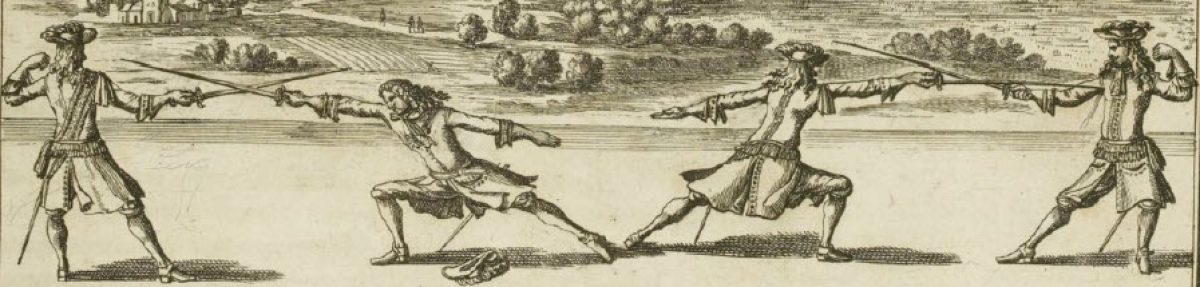
Liancour’s 1686 Le Maitre d’Armes presents a plate with five figures, each of which illustrates core principles of his approach. So far as I am aware, no one to date has pointed out that the descriptions and images for figures four and five are reversed. It is a minor point, perhaps, but important when reconstructing Liancour’s method. Historical fencers rely heavily on text and plates (when the latter are present), but in this case they may be confused and juxtapose these two core actions.
Tag: small sword
Ft. Ligonier French Fencing Weekend
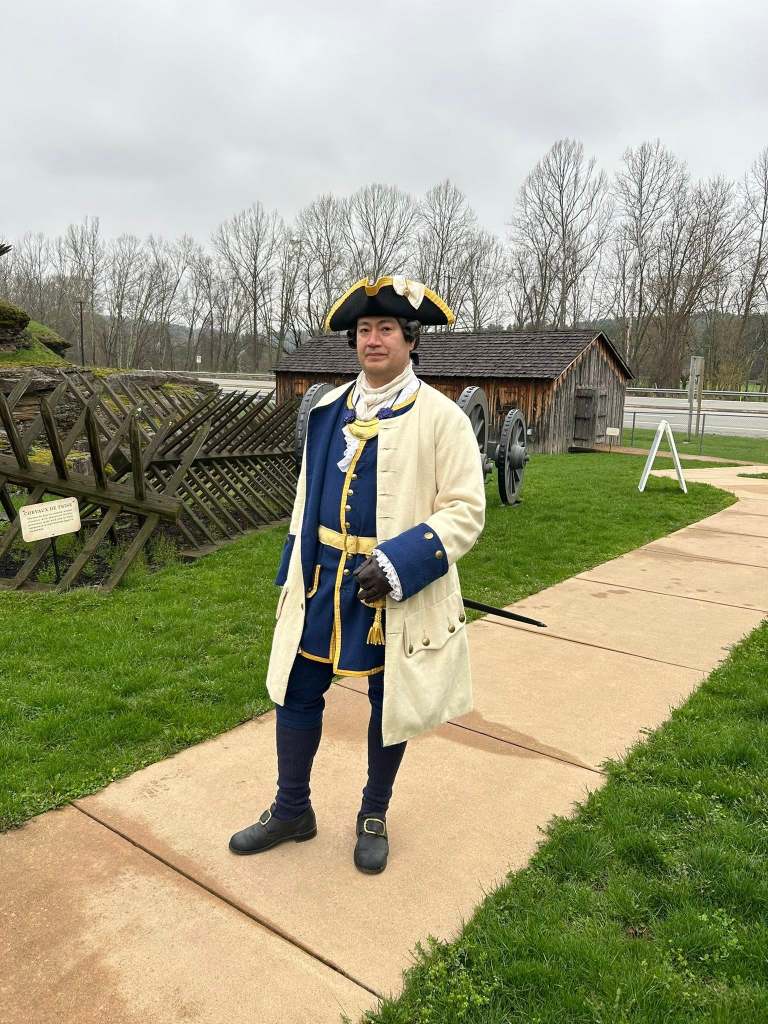
I’ve been meaning to write something up since I returned late Tuesday, but between work and an unexpected veterinarian adventure, I’ve not had time to do this event justice. It was, in a word, amazing, and so much so that I truly hope it becomes a regular event. Patrick Bratton and team put on one hell of a seminar–it was not just the classes, though those were great, but that the setting was apropos and unique, we had behind-the-scenes access to some of the museum, and ample chances to eat, laugh, and get to know one another. Yes, we also fenced, or many did–it was all I could do not to break my doctor’s orders and jump in, but for once I was a grown-up about it (and appropriately as bitter as a toddler told “no”).
By most definitions, I don’t think people would consider me particularly “lucky,” but when it comes to finding myself at truly impressive, informative, and fun events, I’m as rich as Croesus. To the list of favorites–SabreSlash, The St. George’s Day Exhibition of Arms, Rose and Thorns Historical Fencing Symposium–I can now add a fourth, Patrick’s French Fencing weekend. One reason, beyond the obvious draw of all things hoplological or fencing-related, is that it combined three branches of the community: historical, Olympic, and reenactment. The benefits of such cross-over should be obvious, but may not be, so to illustrate this I cite the example of a fascinating chap, Matthew Schlicksup, an artisan of historical footwear currently working at Ft. Ticonderoga in New York.
Historical Artisans
Matthew makes historical footwear, among other period items, and is a master craftsman. Trained in Williamsburg, Virginia, he has made shoes, attended events, and conducted research that most of us might not think about, and, despite the fact we all wear shoes. We take them for granted. Ft. Ligonier, however, has the world’s largest collection of period shoes thanks to the accident of 18th century castoffs and the powers of anaerobic preservation. An archaeologist in initial training, Matthew brings science to his craft, and with impressive results.

This weekend he shared, and wore, his version of the fencing shoes or sandals depicted in de la Touche’s seminal treatise, Le vrays principes de l’espée seule (1670). So, here we are at an historical fencing seminar with a man who makes shoes from the period for that very purpose. This may not seem important, but it is. A few years ago I spent considerable time researching the development of the lunge and this included a look at footwear–would that I had known Matthew then! In discussion with him about de la Touche’s sandal, I learned so much more than I might have, not only about construction, but also about how such shoes function. Put simply, this was a window into period fencing via a single often unconsidered artifact.
Museum
Our host at Ft. Ligonier, Matthew Tristan, was accommodating, supportive, and generous with his time. It was he who gave us the behind-the-scenes tour. It says a lot that he and the foundation were open to having us there: a busy historical site and nuts with swords sounds like an insurance adjustor’s nightmare. With Patrick and others in period dress, and quick to chat with visitors, it went well and we hope added something to the experience. When trusted with the safety of the site and its guests, one wants to do all one can to make it go well, and under Patrick’s excellent leadership this was not even in question. With all the discussion of clubs losing insurance because of unsafe and/or stupid activities, with some unfortunate high-profile legal cases, a win like this is easy to dismiss. We shouldn’t–this was a success and a sign that things can be done correctly.
Classes
In terms of classes, I participated as much as I was able–stupid injury maintenance–but was super keen to see what Justin Aucoin did with the work of Charles Besnard, one of my favorite masters. Justin has long experience with fencing and the SCA, and runs a seriously fantastic class. People loved his classes. I loved his classes. He taught one on Besnard and a second on the bâton à deux bouts or French double-spear in Pascha. I had been looking forward to meeting Justin for some time–Patrick spoke highly of him, I liked what I saw in his videos, and he is a die-hard fan of Dumas and The Three Musketeers, that last fact which immediately endeared him to me.

Justin combines deep knowledge with obvious skill and a passion for his topic. It’s infectuous. Moreover, he works with a diverse student population–always a good sign–and so was quick to suggest work-arounds and ideas to make each thing he covered work for different folks. If he is teaching anything near you or you have the chance to travel to work with him, do.
Bridge-Building
I tend to gravitate towards and work with other folks interested in bridge-building. It’s not just the strengths that collaborative work brings, but the sort of people that go in for it. Among these, I have worked most often outside my immediate surroundings with Patrick. He is, quite honestly, a model coach and advocate for what we do. As a trained teacher (he’s a professor at a college in Pennsylvania), researcher, fencer, and man of eclectic and fascinating interests, from vintage fashion to hunting lore, Patrick perhaps more easily combines disparate strings together to make a viable tapestry.
The historical reenactment group he is involved in, a detachment of mid-18th century French marines, has worked at Ft. Lignonier, among others, before, and it was an ideal location for a look at several late 17th century fencing masters. Some students were in costume, some not, but the addition of period appearance added a lot. Having good relations with the museum staff meant not only a chance to hold the seminar on site, but also see parts of the museum most people do not see. The historian and former archaeologist in me was seriously thrilled about that, but I wasn’t alone.
The only other event that I have attended that combined all these elements so successfully was my mentor Master Michael Knazko and company’s SabreSlash–we had fencers from all walks, reenactors from Krakow (17th Polish hussars), and tours of various sites within Prague relating to fencing (among other historical subjects). In both cases the camaraderie was the finest.
A Model for Future Events
Until recently, until this latest trip actually, I had planned some invitational tournaments. Now, while there may be a tournament element, I am planning to put together something closer to what Patrick and Maestro Knazko have done. It’s a good mix–class for those who like it, some history and other activities (we ate well for example), and some fencing or lessons. It is my hope that Patrick makes this event a regular one–we’ll be lucky if he does.

The En Garde Position & Weight Distribution
[Originally posted 2 March 2023 on the now-defunct CEHF site] One of the most important positions we employ in fencing is the guard position. It’s the starting place from which pretty much everything happens, and thus it pays to work on it, practice it, and perfect it as much as possible. This means not only standing in guard and checking the position of everything head to toe, but also moving from that position, forward, backward, and side to side.
Like many works on rapier, a good number of those on small sword recommend a rear-weighted stance. For example, di Liancour offers little explanation apart from his belief that a rear-weighted stance makes it easier to recover to guard. One suspects the stance may also help remove one from target that much more:
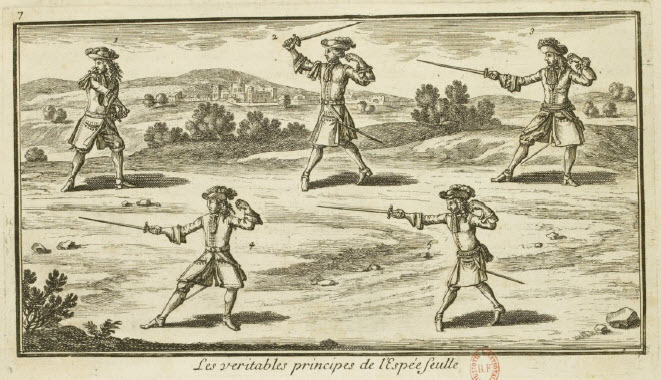
His body, as we see [fig. 3], is held back, resting on the left leg which is slightly bent, the knee more outward than inward, with the toes of the left foot on a traversing line. The right leg is fully extended and bears no weight, the right foot is crosswise such that the laces of the left shoe face the right heel directly, with the distance between them being two and a half shoe lengths or so. [1]
Domenico Angelo appears to prefer weight on the rear leg as well. Though one can never be completely certain with images, the plates Angelo provides do, throughout the work, suggest a rear-weighted stance. He writes
you must observe that the bend on the left side should not in the least take off from that ease with which the body ought to be supported; and, to render yourself firm, bend the right knee a little, but not too much, for, if it is too much bent, the body may fall forward, and if not bent at all, neither the thigh, nor the leg, would be flexible, and you would, consequently, not have sufficient elasticity nor strength to longe [lunge], nor agility to advance or retire [retreat]. [2]

Other masters advocate more equal distribution of weight. L’ Abbat, for example, says
The Body must be upright, which gives it a better Air, greater Strength, and more Liberty to advance and retire, being supported almost equally by the two Feet. Some Masters teach to keep the Body back in Favour of Measure, which cannot be broke by the Body when ’tis already drawn back, tho’ it is often necessary, not only to avoid a Surprise, but also to deceive a Man of superior Swiftness who pushes [lunges] a just Length [3]
In similar language, a master active a century after L’ Abbat, James Underwood, argued for a more equally weighted stance.
I am of the opinion, that the distribution of the duty laid upon each leg ought to be equal, and the more equally they share in the weight, I will venture to say the body will so much more supported… If too great a stress lie upon the left leg, your retreat must be obviously the more unsteady, and weaker; if upon the right, you are crimped and checked in your advancing. [4]
Underwood adds that the shift in weight to advance or retreat costs one time, and that everything depends on time. He was certainly correct–any additional, unnecessary movement that impedes an action only gives one’s opponent tempo to strike or change the field of action to their advantage.
SO, what should one do? Which is correct or better?
Yes. This is to say that both approaches are worth trying as they were both in use at the time. Ultimately, we tend to fare best with what works for us. I teach both, but prefer to be more equi-weighted. My suggestion, once I show someone the critical parts of the guard, is to have them adjust for their own bodies–we’re all built a little differently so it makes sense to adjust things to accommodate that.
So long as the critical aspects of the guard position are present, so long as one is balanced and can react and move efficiently, so long as one is well-protected, it will be fine. The critical aspects are
- to have the lead foot pointing forward–it can help to picture the imaginary line, the line of direction, that connects the lead foot of each opponent and along which both parties move
- to have the weapon arm, assuming an outside guard, in line and just outside the body to close off the lead arm’s side/outside line (those adopting a middle guard should have the arm and weapon mid-body)
- to have about two of one’s own shoe lengths between the feet (the goal is a stable, easy to move in starting position)
- to have the torso upright, head up, and as much as possible the body relaxed
- to have some bend in the legs; these are the springs and need to be coiled, as it were, so one can move or lunge
- to have the rear arm held back behind the head or at the chin, palm out (the latter is used to check a blade after making parries to the inside line, i.e. in quarte, prime, or seventh/half circle)
NOTES:
[1] Sieur di Liancour, The Master of Arms, 1686, Ch. 3, p. 18 in Lynch’s translation.
[2] Domenico Angelo, The School of Fencing, 1763/1787, 6.
[3] L’ Abbat, trans. by Mahon, 1734, The Art of Fencing, (Lector House edition), 4-5.
[4] James Underwood, The Art of Fencing or the Use of the Small Sword, Dublin, 1798, 4-5.
Manitoba Highland Gathering Tournament (22-23 June 2024)
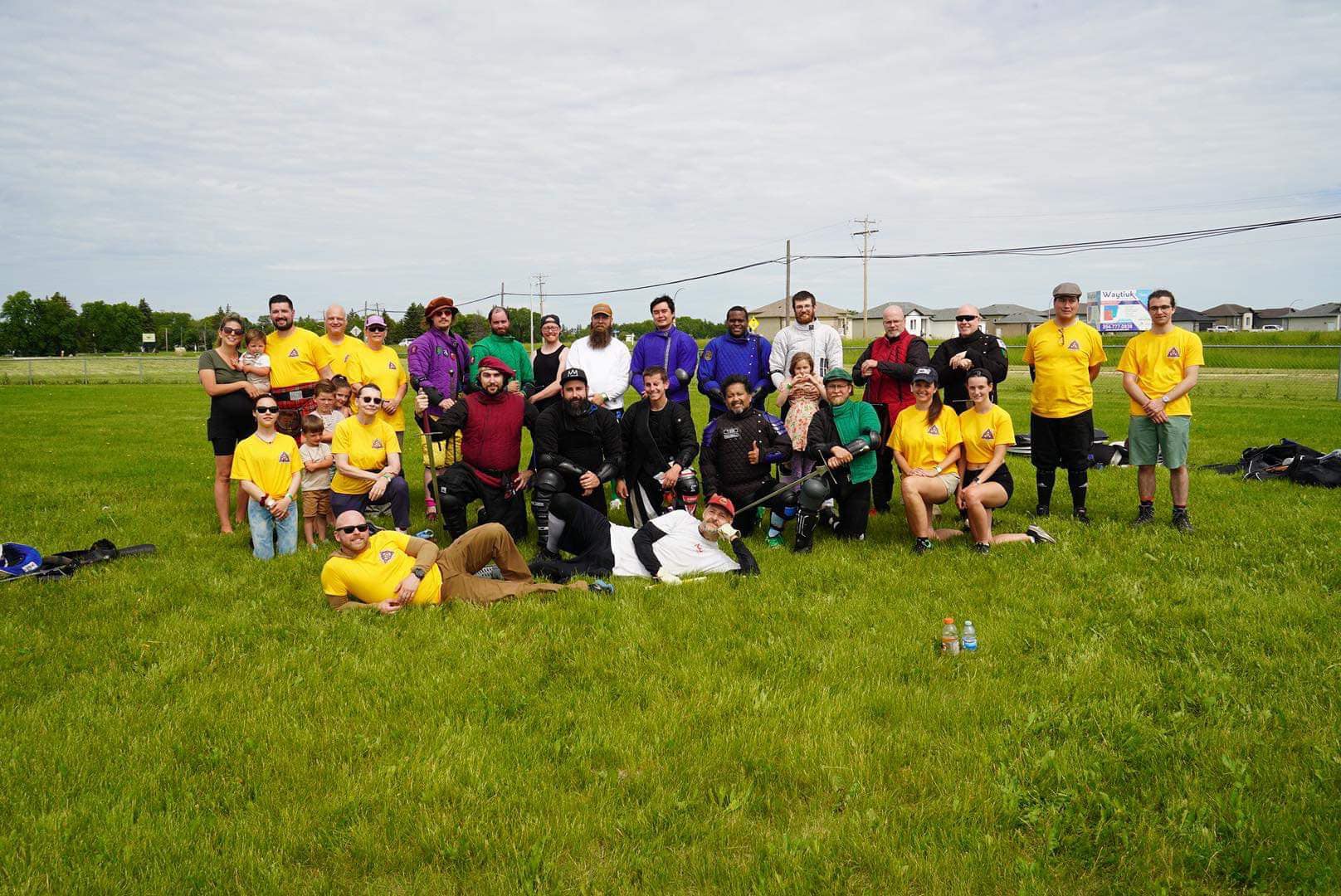
This past weekend, I had the great privilege to attend and assist my Storica Defensa colleagues in the various tourney pools at the Manitoba Highland Gathering in East Selkirk, Canada (held June 22nd and 23rd). This two-day event included longsword, veteran’s sabre, broadsword, and women’s smallsword. Despite some truly warm weather, some swampy fields, and a few moves between gyms, everything went amazingly well. The MHG Tournament marks the seventh SD event and serves to add another data point in support for the approach we are taking to competition.
In terms of safety, no one was hurt. Not one. To date, there have only been two minor injuries in SD events, both involving a failure in gloves to protect forefingers. This is more a kit issue than one of safety culture, and no such injuries occurred last weekend. We place heavy emphasis on safety and no hard-hitting is permitted. So far as I know, not one judge had to remind anyone about force levels. Club members, especially Eric Elloway, army veteran and first-aid certified, brought a giant cooler of water and officials pushed hydration hard. In fact, my friend Xian Niles noticed I was starting to stare off and had me get water, then go sit in the shade (thank you my friend, that was a wise decision). Best of all, the fencers looked out for one another—on two occasions I witnessed, fencers halted action so their opponents could fix gear.

The camaraderie was visible and honestly endearing. Most bouts ended in hugs as well as handshakes, and people were keen to keep fencing post event. This is not to say that the competition wasn’t high, because it was as any clip of footage will demonstrate. The hush that fell upon us all watching some of those final matches… I don’t think anyone made a peep during the final broadsword match between Xian Niles (Niles’ Fencing Academy, Halifax, Nova Scotia, Canada: https://www.nilesfencingacademy.com/) and Zach Brown (Superior HEMA, Thunder Bay, Ontario, Canada: https://www.superiorhema.com/?fbclid=IwZXh0bgNhZW0CMTAAAR0noPMDPX7PaM8kxh8SpQdf-e15Ie53xzsJucV58BZno1pycKsN_r25q9I_aem_yB6MUK3J6OWM7jK68jGjaQ). People were quick to concede points and generally did so appropriately, and were gracious when calls didn’t go their way. If anyone needed gear, another fencer was happy to help. Rarely have I seen so many competitors as generous in assistance to one another as I have here.
The level of skill was high. The pools were designed around Storica Defensa competitive levels as much as possible. Most action was easy to follow, and thus, easy to judge (comparatively speaking—judging is never easy). The timbre of an event, the expectations that are set, do much to determine how an event goes. SD’s rules and expectations are clear in the ruleset, and so from the off everyone was more or less on the same page. In specific terms this means that people knew any hard-hitting would be called out, that fencers were honor bound to admit a hit, and that there would be zero tolerance for poor behavior. We also hit the safety aspect hard. I mean, HARD. To put this another way, these expectations attract a particular type of fencer, and in doing so, discourage those fighters keen for garbage like heavy-hitting, use of the afterblow to gain points, and other b.s. Free-fencing post pools was common, and speaks again to the level of positive interaction—people wanted to keep fencing one another.

Organization is critical to running a good tournament, and it is a testament to the planning Jay and crew had that even with a few hick-ups everything went smoothly. Day one was super hot, not a cloud in the sky, and in the morning the ground was a bit damp; day two we had to switch gyms. In each case everyone just got to work and made things happen. We carried tables, gear, scoring placards, everything, and neither day went late. In fact, on both days we ended in time for people to free fence for hours before the Gathering shut down for the night.
SUMMARY:
The MHG Tournament is growing, and in time I suspect will double in size. It’s not just the fact that winners in each event received lovely prizes—sharps, training weapons, and discounts for gear—but that people were safe, enjoyed the fights, and were eager to socialize afterwards. This event is one I am adding to my list of go-to, must-attend events (the others being SabreSlash in Prague, Rose & Thorns Historical Fencing Symposium, and the St. George’s Day Exhibition of Arms).
Following fast on the heels of another two-day tournament I attended, this time as a live-stream announcer, the contrasts stood out starkly. That first event was large, and in most respects typical of “HEMA” events. [n] For example, I witnessed a fencer injure another—twice. The offender was barely censured, but should have been black-carded, and the victim, though evaluated by a medic, was not taken to the hospital. He should have been as he received a pommel-strike, full on, from a running opponent, and was visibly shaken, never mind nursing a mask-waffle print on his nose. The judging was also poor. The silver medalist in rapier, for example, should have taken gold, but the judges failed to call the action correctly. Many, I found out later, were pretty new fencers.
One of Storica Defensa’s goals is to provide better tournaments, not only safer ones, but better run, better judged ones. In this it is exceeding expectation, and I’m keen to see this develop. True, I have a stake in it as a coach for SD, but I stand by what we’re doing. It’s working.
NOTES:
[n] This was IFG’s Spring Fling, cf. https://www.youtube.com/live/ZUvk5lwEusc?si=2MXmquPiMMjVqaNE. The rapier pools were, by far, far less problematic than longsword and the sword & buckler.
Slides from Interview with Dr. K, 27 Feb. 2024
I had the great pleasure to meet again with my friend Dr. Manouchehr M. Khorasani of Razmafzar TV. This session we explored a bit about using sources in historical fencing–it’s just a cursory, basic look, but slides help so I am attaching them here as a pdf.
The next planned meeting will explore using a specific text in more depth, and, with luck I’ll have someone able to assist me in demonstrating the various things we cover.
Specific Drills & “Realism”
“Show, don’t tell,” was some of the best teaching/writing advice I ever received. To that end, I’m adding some specific drills to illustrate what I shared in the last post on this topic better (https://saladellatrespade.com/2023/10/31/yes-yes-very-nice-but-how-cultivating-defense/ ). Many, if not most of these drills, are venerable—if anything I may have adapted things here or there, but all of what follows are standard drills or types of drills. [1]
These progressive option drills start with a basic action and build in complexity. If a student is new or struggling, one may stop with the first version and work on that, or, aspects of it. For more advanced students, one can add an additional layer of difficulty as required. In the first example, for smallsword, one could simplify the drill even more by having the student initially deny the engagement and break measure. This would observe the “don’t get hit” rule, but not set them up well for a strike of their own.
Two things I didn’t add below, but which apply are first, that it’s important to switch roles, that is, have both the student and instructor initiate the action. This gives the student a chance to act as attacker and defender. Second, movement and varying distance is critical for success. If one starts “firm-footed,” that is, in place, fine, but then add movement. Chase the student, have the student chase the instructor; start out of measure, start in measure. For more advanced students, another option we can layer in is varying tempo and speed.
Drills & “Realism”
On their own, there is little inherent in most drills to make them impart a defensive mindset automatically. All the drills I provide below, for example, can be gamed to current tourney standards easily if one wishes. How “realistic” or not they are depends on explanation and reiterating correct principles over and over and over again within each element of the drill.
One of the most frequent questions I get in drills and lessons, and a good one, is “but why wouldn’t I just do this?” This simple question has become one of the single most important ways in which I push correct mindset. To cite one example from this past week, one student in a smallsword class asked me why they couldn’t just disengage and thrust against the glide in third. I told them that they could, but then asked what would happen if they did—what is the opponent doing? If the opponent is gliding to target, and one ignores that to strike… one is still hit. Not good enough. IF one wishes to disengage in response, fine, but don’t do so into absence, do so with opposition in the new line, a shift of the body to one side, or both. [2]
Ex. for Smallsword:
Option Drill with the Glizade/Glide in Third
To Start:
S [student]: in guard of third
I [instructor]: in guard of third
*engaged on the outside line
Option 1A: Student Attacks
- S: finds measure and gains weak of I’s blade with middle of own [3]
- S: performs glide in 3rd, maintaining opposition, and strikes target (forward target or chest)
2A:
- S: finds measure and gains weak of I’s blade with middle of own
- S: performs glide in 3rd, maintaining opposition, and thrusts
- I: parries 3rd, ripostes; S. parries in 3rd and ripostes [4]
3A
- S: finds measure and gains weak of I’s blade with middle of own
- S: performs glide in 3rd, maintaining opposition, and thrusts
- I: parries 3rd, begins riposte; S. disengages, engages in 4th, thrusts to target with opposition
4A:
- S: finds measure and gains weak of I’s blade with middle of own
- S: performs glide in 3rd, maintaining opposition, and thrusts
- I: makes dérobement to avoid glide and engages in 4th
- S: via circular 3rd, retakes line and glides in 3rd to target
Option 2A: Instructor Attacks
- I: finds measure and gains weak of I’s blade with middle of own
- I: performs glide in 3rd, maintaining opposition, and thrusts
- S: parries 3rd, ripostes
2A:
- I: finds measure and gains weak of I’s blade with middle of own
- I: performs glide in 3rd, maintaining opposition, and thrusts
- S: parries 3rd, begins riposte; S. disengages, engages in 4th, thrusts to target with opposition
3A:
- I: finds measure and gains weak of I’s blade with middle of own
- I: performs glide in 3rd, maintaining opposition, and thrusts
- S: makes via dérobement avoids glide and engages in 4th
- I: via circular 3rd, retakes line and glides in 3rd to target
- S: parries in 3rd, ripostes
Ex. for Rapier:
Finta Scorsa or Advancing Feint of Marcelli
To Start:
- S: in guard of prima
- I: in guard of third
Option 1A: Student Attacks
- S: in prima, makes false attack to the high inside line
- I: parries in 4th
- S: via cavazione /disengages to outside line, and strikes target (forward or chest)
2A:
- S: in prima, makes false attack to the inside line
- I: parries in 4th
- S: via cavazione /disengages to outside line; I parries 3rd, begins riposte
- S: parries in 3rd (or 4th depending) and ripostes, striking target
3A
- S: in prima, makes false attack to the inside line
- I: parries in 4th
- S: via cavazione /disengages to outside line; I parries 3rd, begins riposte low-line
- S: takes 2nd, ripostes with opposition
4A:
- S: in prima, makes false attack to the inside line
- I: parries in 4th
- S: via cavazione /disengages to outside line; I parries 3rd, begins riposte low-line
- S: takes 2nd and thrusts; I. parries 2nd, begins riposte
- S: parries 2nd, ripostes with opposition
Option 2A: Instructor Attacks
- I: in prima, makes false attack to the high inside line
- S: parries in 4th
- I: via cavazione /disengages to outside line, and thrusts
- S: parries in 3rd, ripostes to target
2A:
- I: in prima, makes false attack to the inside line
- S: parries in 4th
- I: via cavazione /disengages to outside line; S. parries 3rd, begins riposte
- I: disengages to 4th, starts riposte with opposition
- S: disengages to 4th, ripostes with opposition to target
3A:
- I: in prima, makes false attack to the inside line
- S: parries in 4th
- I: via cavazione /disengages to outside line; I parries 3rd, begins riposte low-line
- S: takes 2nd and thrusts; I. parries 2nd, begins riposte
- S: parries 2nd, ripostes with opposition
- I: with parry in 2nd, passes left foot forward in order to seize guard
- S: steps back, attacks to body
Ex. For Rapier and Dagger:
Working from Mezzaluna (Marcelli)
To Start:
- S: in guard of mezzaluna
- I: in fourth guard [5]
Option 1A: Instructor Attacks
- I: in fourth guard, makes attack to the inside line
- S: parries with dagger; with sword ripostes to target (forward or deep)
2A:
- I: in fourth guard, makes false attack to the inside line
- S: attempts to parry with dagger (downwards and out)
- I: disengages to strike hand
- S: parries with dagger (upwards and out), ripostes with sword to target
3A:
- I: in fourth guard, makes beat attack against sword to open the inside line
- S: parries in 4th to close line, ripostes with opposition
- I: parries with dagger (upwards and out), ripostes with sword inside line
- S: parries with dagger (downwards and out), ripostes to arm
Option 2A: Student Attacks
- S: makes false attack to face
- I: parries with dagger (upwards and out)
- S: disengages and strikes arm or hand
2A:
- S: makes false attack to face
- I: parries with dagger (upwards and out); ripostes to arm
- S: disengages and strikes to arm or hand
- I: parries with dagger, ripostes
- S: parries with dagger (downwards and out); ripostes to arm
3A
- S: makes false attack to face
- I: parries with dagger (upwards and out); ripostes to arm
- S: makes circular parry in 3rd; ripostes via glide to outside line
- I: parries in 3rd, checks with dagger, ripostes in high line over engagement [6]
- S: parries with dagger (upwards); shifts right, ripostes to body
Ex. for Sabre:
Options from an Engagement in Second
S &I: in 2nd, at punta spada/last third/weak of the sword; then, start out of distance
Option 1A: Student Attacks
- S: cuts over to threaten face with feint via half thrust
- I: moves to parry in 1st
- S:
a. performs molinello ristretto or coupé to the arm [7]
b. performs molinello ristretto via rising cut to the bottom of the arm
2A:
- S: cuts over to threaten face with feint via half thrust
- I: moves to parry in 1st
- S: performs molinello ristretto via rising cut to the bottom of the arm
- S: secondary attack: pushes through to thrust or cut flank
3A:
- S: cuts over to threaten face with feint via half thrust
- I: moves to parry in 1st
- S: a. performs molinello ristretto or coupé to the arm
- I: parries 3rd, cuts to head
- S: parries 5th, cuts via molinello to head
4A:
- S: cuts over to threaten face with feint via half thrust
- I: moves to parry in 1st
- S: performs molinello ristretto via rising cut to the bottom of the arm
- S: secondary attack: pushes through to thrust or cut flank
- I: parries in 2nd; ripostes via thrust
- S: makes ceding parry in 2nd, ripostes via thrust to target
Option 1A: Instructor Attacks
- I: cuts over to threaten face with feint via half thrust
- S: moves to parry in 1st, parries via molinello to head
2A:
- I: cuts over to threaten face with feint via half thrust
- S: moves to parry in 1st
- I. disengages and cuts to arm
- S: parries 3rd, cuts head
3A:
- I: cuts over to threaten face with feint via half thrust
- S: moves to parry in 1st
- I. disengages and cuts to arm
- S: parries 3rd, cuts head
- I: parries 5th, cuts to flank
- S: parries in 2nd, thrusts to target
NOTES:
[1] To name one example, and analogous to the first one I share here, there is the discussion of options facing an opponent in 4th in Charles Besnard, Le maître d’arme liberal, 1653, 43 (63 [orig. French] and 161 [English] in the translation by Anne Chauvat and Rob Runacres, The Free Master of Arms, Glasgow, UK: Fallen Rook Publishing, 2022).
[2] The use of the inquartata or demi-volte, for example, would work in this instance.
[3] Two ways to vary this are to have the student find measure by a short extension of the arm from critical distance, in order to gain the weak with the middle of their weapon, or, have them step into measure to engage. The first is more conservative, but the second option is important—ideally, students learn to find measure and exploit it both ways.
[4] As set up here, the final actions are a battle of ceding/yielding parries and glides. Both help students cultivate better awareness of presence, varying pressure, measure, and opposition.
[5] Marcelli’s fourth guard for rapier and dagger is depicted thus:

Mezzaluna, on the right, needs explanation. Chris Holzman points out that Terracusa e Ventura (1725) remarks that the tips of the two weapons are close enough to form a “half moon” shape. Here, there is a much wider gap between them. The accompanying text, however, tells us that the fencer “carries the dagger forward covering all the upper parts in such a way that the opponent only sees the chest below the dagger as target to strike.” [Holzman, Marcelli, Rules of Fencing, 1686, Wichita, KS: Lulu Press, 2019, 273; see also n. 115 that page.
Hà portato il Pugnale avanti, coprendosi tutte le parti superiori, di modo che il nemico vedesolo per bersaglio da colpire il petto per le parti di sotto il Pugnale [Marcelli, Regole della Scherma, Lib. I, Cap. III, 4]
[6] Here, the instructor, having parried the incoming sword in 3rd, uses the dagger to hold the opposing weapon in place in order to swing their weapon around obliquely to the right and up (assuming a right-hander) in order to threaten the face.
[7] The coupé , in Radaellian sabre as taken down by Del Frate, is also known as the colpo di cavazione or cavazione angolata. It is made by bending the forearm back a bit to increase power. Chris Holzman, in his gloss, remarks that it’s similar to the last step of the molinello. See Christopher A. Holzman, The Art of the Dueling Sabre, Staten Island, NY: SKA Swordsplay Books, 2011, 234.
Paul Wagner & Dan, Four Antique Small Swords
My thanks to Sean Mueller, High Desert Armizare, Bend, Oregon, for this link. Paul and Dan share four excellent antique small swords and discuss their features.
Curricula, Completeness, & Choice

One of the best things about fencing are the interesting people one meets along the way. Say what one will about “nerds” and niche interests, rarely are they boring, and in some cases it’s precisely their eccentricity that bridges the gap between niche-folk and those just other side the creative wall. For example, a few years ago a writer contacted me with questions about sabre for a project he had in hand. Over the course of our many conversations, we became friends. In a discussion this morning, he asked me for my take on the issue of true teachers versus the McDojo sort who just out to make a buck.
One point I made was that there is often, sadly, a gulf between what we can actually use in martial arts, should we need it, and what a school or teacher makes their focus. For example, in one ruleset for competitive Tae Kwon Do, one can kick at the head, but not punch. [1] If one is studying at a school adhering to this ruleset, they may be doing themselves a disservice if the goal is training to keep themselves and others safe. This is not to say that competitively focused schools are inherently bad, they can be fun and build one’s confidence, etc., but one should not mistake them for what they’re not, either.
As we continued to chat, I brought in a few examples from historical fencing, and this raised a related set of questions. Do we try to share all aspects of a particular treatise? Should we? What if an action is dangerous? What if it’s safe to do in our context, but would be dangerous were the blades real? My short answer is “it depends.” There are sometimes reasons to teach dangerous maneuvers, but any time one does considerations of safety must come first.
Not all Masters Agreed; Not all were Equal
One of the most “medieval” aspects of historical martial arts, and “HEMA” in particular, is an almost blind faith in written words of the past. Textual authority, given that it is 90% of our evidence, makes sense, but reason must still be applied. Modern doctors do not rely on ancient Greek medicine for guidance in obstetrics, and it would be both unethical and criminal if they did. [2] Not everything written in the past was good.

It can be difficult to assess the worth of an old fight manual. Our distance in time, methods of conducting violence, notion of law, everything is different. This said, there are times when we get help from within the texts themselves. For example, in de Liancour’s Le maitre d’armes/The Master of Arms, 1692, he says of the counter attack that
C’est une chose si difficile à prendre que les Temps, l’Epée à la main, que je ne conseille personne de s’y trop hasarder. J’estime mieux une bonne parade, ou un bon battement sec & tiré droit le long de l’Epée ennemie, sans oster la sienne de devant soy…
Je m’étendrois beaucoup sur ce Chapitre, mais comme j’ay résolu de ne parler que des choses essentielles, je dirary seulement que c’est in jeu de Salle, où ces coups se pratiquent allez souvent, mais fort rarement l’Epée à la main.
It is such a difficult thing to take on the Times, sword in hand, that I do not recommend anyone to risk it too much. I consider a good parry better, or a good dry/sharp beat & thrust along the enemy’s sword without removing his from your own.
I would dwell long on this Chapter, but as I have resolved to speak only of essential things, I will only say that it is a Salle game, where these blows are often practiced, not often sword in hand. [13 in the pdf of 1692; Lynch, 36] [3]
Here is a master pointing out the inherent danger in choosing a counter-attack over a solid defense. It’s an important point, and one I am quick to mention when I cover counter-attacks, but I still teach it. For one, though we aspire towards realism, the fact is we do this for fun and no one is in danger of actual injury. Second, and more importantly, though I advise students not to select a counter-attack save under specific circumstances, they need to know how to recognize them and practice defeating counter-attacks when this action is used against themselves.
For another example, Capt. John Godfrey, in his A Treatise upon the Useful Science of Defense, 1747, rails against an action common to most small sword works, the flanconade:
That Thrust called the Flanconade, I pronounce an Anathema upon, as being easily proved to be the most lewd and vile Debaucher of the Art, the Dignity of which consists chiefly in its generous Allowance of a proportionable Chance to the weak man. The other Thrusts depend upon a timely Swiftness mostly: Though to say, that equal Knowledge with more Strength has not the Advantage, would be preposterous, as certainly the greater the Velocity is, the greater the giving Strength must be… [12ff]
Godfrey’s argument is that a weaker person will be less likely to pull off the flanconade than a strong person. He was correct. His pro-English and anti-French bias, given his background, are not surprising but likely informed his position as well. He published, after all, during the War of the Austrian Succession (1744-1748), where the two nations were in conflict over territory in North America (among other theaters). One example should suffice:
The Art we had from the French; no Flaconade was thought of for some Time; but upon finding us very apt Scholars, and being willing to be our distinguished Masters, they brought the Flanconade and many tawdry Embroideries, which they are as famous for inventing, as, I am sorry to say, we are degenerate enough to imitate, and even mimick. Pity! that we should be so fond of imitating a Nation, who have always been deceiving us. Rouse then, though noble British Spirit! (for sure no Time more calling than the present) lift up they brave fronted Head above these dandling Actions, and become thy wonted self! Love thy King, love the Country; stay they Heart his these, and thou art safe.
Thus I take my hearty farwel[sic] of the Flanconade. [13] [4]
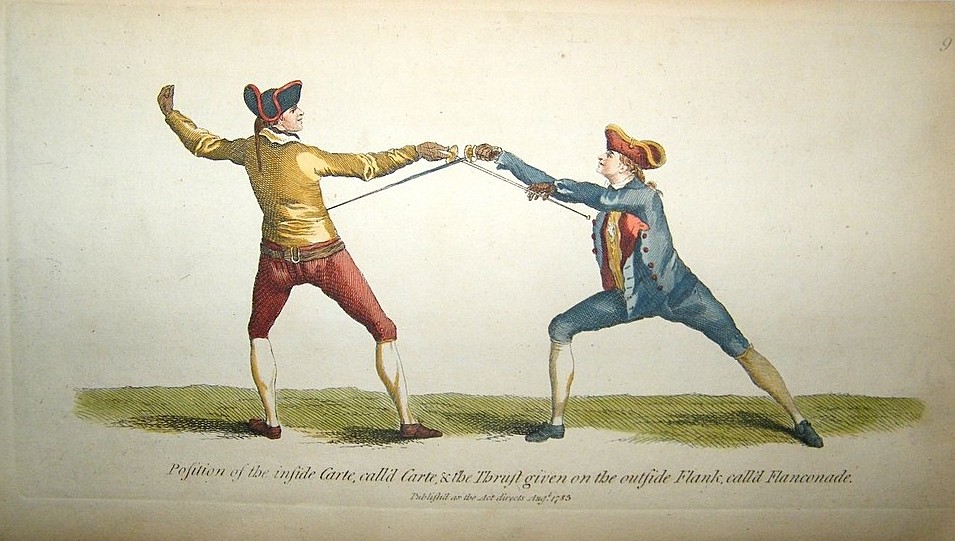
Tin-foil tri-corn hats aside… the flanconade is a relatively difficult action to learn at first, but easier with practice. It does require, as Godfrey points out too, that the off-hand must come into play to stay the opposing blade after parrying in order that one doesn’t double as they go to target. [5] I teach this action too, and as with counter-attacks, because while difficult one must still know how to defend against it.
For a last example, this time in re position, James Underwood’s The Art of Fencing or the Use of the Small Sword, 1798, is instructive. In many, maybe most treatises the author advises one to be back-weighted while on guard. Underwood, however, disagreed:
I am of opinion, that the distribution of the duty laid upon each leg ought to be equal, and the more equally they share in the weight, I will venture to say the body will be so much more supported. But let us examine into the consequential practice, by the disadvantage of laying a greater stress upon one leg than the other, or the advantage to be expected from the strength accruing from the proper weight given to both. If too great a stress lie upon the left leg, your retreat must be obviously the more unsteady, and weaker; if upon the right, you are crimped and checked in your advancing. If the greater share of weight lie upon the right, the left leg must take that share off, before you can advance, and so, vice versa, the right must act for the left in the retreat. But then this is the loss of your time, upon which every thing depends; whereas by equilibrial weight upon the legs, that time is saved. Here your body will be equally supported, therefore stronger and steadier; but by recovering and shifting in the other way, the motion of the body must be so much greater, that your arm is more likely to be thrown out of line. [4-5]
Many fencers are taught this way today, that is, instructed to distribute their weight equally. It works fine. However, the rear-weighted stance was common and works equally well provided one distributes one’s weight properly. I had doubts about it myself, but in discussion with Russ Mitchell, and especially after his how-to-lunge class, I finally understood how it is supposed to work. [6] I teach students both. First, I show them what a majority of the texts advocate and why—our en garde position, and the lunge especially, are compromises between proximity to target and removal of our own target. Next, I show them the equi-weighted stance. Purists may balk, but I focus on the goal of our stances, not the letter of the law—bodies are different and so supplied with a few principles, I advise students to find a position that is comfortable and yet still meets the critical aspects. The front foot should be straight ahead, their bodies turned about 3/4, and fist and weapon just outside the body if on guard in tierce. If the rear heel is not precisely on the line of direction and in line with the front, no matter—are they stable, balanced, and can they move in any direction required? That’s what’s important.
Selective Reading & Teaching
When using a fencing treatise, I read it all and more than once, but I do not necessarily include all I read in class. I am selective in what I use—not in what I read. I read page to page, because I need to see the author’s approach in toto, and, compare it to other, related works—but not everything is equally important. I rely on Girard’s Traité des arms/Treatise on Arms, 1740, for much of my small sword curriculum, but I have no plan to include his short section on defense against grain flails. I use Domenico Angelo’s L’École des armes/School of Fencing, 1763/1787, as well, but spend very little time if any on weapon seizures outside demonstrations. They are, again to quote dance master Les Kendall in “Strictly Ballroom,” largely “flashy, crowd pleasing steps,” and less secure than a firm grounding in parry-riposte and thrusts made in opposition.
There are things I include for reasons of completeness or because it explains or aids core material. For example, there is good reason to believe that prime in small sword derives from broadsword practice. Angelo says as much, and this guard and parry are redolent of the hanging species of guard often used in sabre and broadsword, but I share that fact, if I do, because someone asked or because of some similar prompt. Girard covers the use of multiple feints, actions like the 1-2-3, but rarely does one need to resort to three feints in an actual bout. Complicated maneuvers like this are what we call “medicine for the hand:” we drill a triple feint because it will, we hope, make our single feint that much sharper and crisp. Have I seen anyone use a triple feint in a bout? Yes, among high level foilists thirty years ago, but in historical fencing circles? No. We still have to contend with people who believe feints are not “martial” enough (despite how often they pop up in the military sources…).
My goal is two-fold in most lessons and classes. First, I want to present and teach as accurately as I can either the tradition I was taught, or, those from the past I have studied. For the latter I always provide the caveat that we can never recreate these extinct fight systems perfectly, but we can, hopefully, get a good idea of how they might have worked. Second, I want what students learn to be both reflective of its sources and useful—I see no reason to teach anyone actions that are more likely to get them hit than not, so when I teach counter-attacks, when I teach the flanconade, I do so at the appropriate time and with the necessary warnings.
Curriculum building is selective, personal, and should be subject to revision as new insights, ideas, and flaws in the existing approach appear. Historical fencing is a research and experimental archaeology driven field. Unlike colleagues in the Olympic world, who are not uncovering hitherto unknown material or inventing new actions, our understanding changes with newly discovered texts and better interpretations. [7] If we are not open to new, better information, our programs become moribund and stagnate. Moreover, what we choose to teach and how is everything, but it depends on what our goals are. Unless we wish to produce graceful puppets, we should know not only what to teach, but why. What one selects is up to the individual instructor, but have a reason and be able to explain your choice.
NOTES:
[1] See for example https://olympics.com/en/news/know-your-sport-taekwondo-rules-scoring-equipment, “Scoring,” and “Penalties and Prohibited Acts.”
[2] To name only one example, the Hippocratic school concluded that most illness women faced was due to the uterus. From a very large sample, see Lesley Dean-Jones, Women’s Bodies in Classical Greek Science, New York, NY: Oxford University Press, 1994; Rebecca Flemming, “Women, Writing, and Medicine in the Classical World,” In The Classical Quarterly 57: 1 (2007): 257–79; Helen King, Hippocrates’ Woman: Reading the Female Body in Ancient Greece, New York, NY: Routledge, 1998; Vivan Nutton, Ancient Medicine, New York, NY: Routledge, 2005; Soranus, 1927.Gynecology. Edited by Ioannes Ilberg, Corpus Medicorum Graecorum/Latinorum, Berlin, DE: Teubner, 1927. [what, historians gonna history 😉 ]
[3] French speakers I ask your apologies for my loose translation. M.P. Lynch put out an edition in English (2021), which is useful, but which also has some translation choices that one might find less ideal, e.g. p. 110 where he uses “snafu;” for the original passage, see Ch. 17, p. 64:
Je répons que si l’on étoit affeuré que ce fùt un veritable coup tiré de droite ligne, sans feint, on pourroir y parer en opposant la main gauche, comme je l’ay fait voir dans mes autres Planches. Mais l’on peut étre trompé par des feintes, ou par des demy coups, & étant surprise, cette parade de cercle enveloppera tous ces coups qui pourroient vous étre poussez, & même fera perdre tous les desseins de vostre ennemy.
[4] American sentiment, which has long baffled me given our long friendship with France, tends to back the English view on everything from the Hundred Years War to the colonial contests of the 18th and 19th centuries. Had it not been for French support, we may well have lost our rebellion against England. More recent history makes this all the odder given that England and France were allies, as were we with both nations, in the world wars. Just something to think about.
[5] The flanconade, often called a “high-low” attack in modern epee, is effected by parrying a thrust in the high line in fourth, then dropping the point to the outside over the opponent’s weapon. One then thrusts to the outside low line. Many earlier works advocate using the off-hand to secure the opposing steel after beginning the thrust to avoid a double. For a useful modern example, my go-to is professionescherma.org’s channel on Youtube: https://youtu.be/4G63pNHS90M
[6] See Russ Mitchell, Basic Body Mechanics for Martial Artists, 2018.
[7] One outcome of the unfortunate merger between the USFCA (the US Fencing Coaches Assoc.) and the USFA (US Fencing Association, the body that governs the sport; the US branch of the FIE), is that instructors are encouraged to “renew” their certifications yearly, much as someone say in a profession like pharmacy might with CEs (continuing education courses). While admirable that the organization(s) are interested in ensuring a higher degree of ability among instructors, there are issues with this decision. For one, this is expensive and assumes—as ever—full-time coaches with some manner of decent pay. That is not true for most coaches. Second, unlike pharmacy, no one is inventing new ideas or actions that we must learn to stay current. It’s difficult not to see this measure as a money-grab.
The Grip in Small Sword
One of the questions I’m asked frequently is how one should hold a smallsword. With a large corpus of treatises upon which to draw this is, lucky for me, a relatively easy question to answer, and, with some degree of certainty. There are differences among the masters, but most are subtle and have more to do with the positioning of the hand than in how the fingers grasp the weapon.
My approach, an amalgam based on the sources, is typical of “most” works:
- The thumb extends along the grip towards the guard and stops 12mm/.5” from the shell
- The forefinger rests just opposite the thumb so that thumb and forefinger are sort of pinching the guard
- The three remaining fingers grasp the grip and help keep the pommel, while in guard, against the wrist
- The fingers do not go through the Arms of the Hilt/annulets


Remember that in French fencing the numbers we use, prime, seconde, tierce, etc., refer to hand positions. There is not, for example, an ideal form of quarte–if the hand is in quarte, one is in quarte, whether parrying high, low, or midline. This is likely one reason, for example, that some masters referred to “quarte over the arm” (modern sixte) when parrying in quarte (hand in quarte) on the tierce side. Here is a handy reference and visual representation of this:

In the two bottom quadrants, the lower outside and lower inside lines respectively, the parries for the former are octave (supinated-ish) and seconde (pronated-ish), and for the later septime (supinated-ish; a.k.a. “half circle”) and prime (knuckles up). Quinte, 5th, is a bit different than the similar position for sabre:
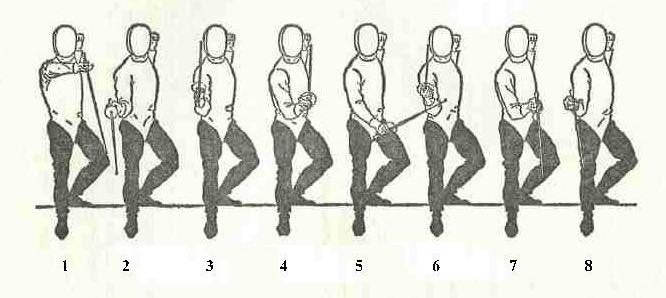
NB: 5th as positioned here is not set in stone, but reflects how the hand is held–this can be raised or lowered.
What do the Sources Say?
Below are excerpts from a few sources, mid-17th century to just before 1800, that cover the grip. Where possible I’ve added the original language if it was written in one other than English. For those without a translation, or for which I do not have one, I’ve summarized the import of the passage rather than offer a translation of my own. I’ve added images from the works when possible too—these are taken from public domain copies, but vary in quality.
NB: going from MS Word to WordPress, never mind the evils of autocorrect, often means errors in transliteration. I do my best to proofread, but if you notice misspellings, wonky accent marks, etc., please let me know and I will correct the error.
Charles Besnard, The Free Master of Weapons, 1653, p. 7 in ENG ver. by Rob Runacres and Reinier van Noort
To properly place oneself in guard and posture in order to practice the single sword or foil, one must first place the sword or foil in hand so that the thumb is placed on the cross or flat of the sword, and the index finger under the flat of the same in a half circle, and right under the thumb. Then tighten the grip of the three other fingers…
Pour bien se mettre en garde et posture pour faire l’exercice de l’épée seule ou fleuret, il faut premièrement mettre l’épée ou fleuret à la main, que le pouce soit posé sur la croisée ou plat de l’épée, et le doigt index soit sous le plat de celui-ci en demi rond, et droit sous le pouce, et serrer fermement la poignée des trois autres doigts…
[p. 7 in the Fr. Transcription by same editors]
De la Touche, The True Principles of the Single Sword, 1670
Next, you must draw the sword, taking it by the grip with the right hand and holding the scabbard with the left hand so that it does not follow the sword, and then draw it. This you can do in several manners, but it is done the easiest and the quickest by always keeping the thumb in the same position as it has in the first figure, and advancing and raising the hand until the sword is out of the scabbard, with the point turned towards the enemy, the thumb on the outside, that is to say, on the right side, and the sword on the edge, as in the second plate. [31 in van Noort and Coudre]
Les Vrais Principes [Ch. 2, p. 7]
Apres cela il faut tirer l’Espée, en la pregnant par la Poignée avec la main droite, & tenant le sourreau de la main gauche de peur qu’il ne suive l’Espée, & ensuite la tirer, ce que l’on peut faire de plusieurs manieres, mais la plus simple & la plus courte se fait en tenant toûjours le poulce dans la mesme situation qu’il a dans la premerie Figure, & avançant & levant la main jusques à ce que l’Espée soit hors du sourreau, la pointe tournee vers l’ennemy, le poulce en dehors, c’est a dire, du costé droit, & l’Espée sur le trenchant, comme dans la deuxiéme Planche.

Sir William Hope, Scots Fencing Master, 1686
Ma. You must hold your Sword after this manner; hold your Thumb upon the broad side of the Handle with your Fingers quite round it, as in the second Figure of the first Plate marked F and not as some do, who put their foremost and middle Fingers through the two arms of the Hilt, thinking that by doing that, they hold their Sword firmer, some use onely to put their foremost Finger through, which the Spainards did of old, and many even to this day do it; but both ways are most ridiculous, and dangerous.
Sch. I think any Man of common sense may perceive that, for when a Man holdeth his Sword in that fashion, with his Finger through the arms of the Hilt, he is in danger of having his Fingers broken, if his Adversary should inclose with him, and offer to force the Sword out of his hand, for holding it that way he cannot so easily quit with it, as he should, and therefore will infallibly in my opinion be in hazard of losing his Fingers, if not his life in the cause.
Ma. Sir, You have found exactly the hazard that a Man is in, in holding his Sword after that manner, but when you hold it, as I have before told you, you must hold it fast and firm, and not gently, so that your Adversary with the least sudden beat or twist may force it out of your hand. [11-13]

di Liancour, The Master of Arms, 1686
Let the right hand be turned half to tierce with the fingernails facing the ground, such that in parrying we need only turn the hand to half fourth, parrying straight thrusts to the inside from fourth with the cutting edge of the sword. [Lynch, 19]
Que la main droite soit tournée demy-tierce, les ongles vers la terre; d’autant qu’en parant l’on n’a qu’à tourner la main demy-quarte, l’on parera les coups poussez tout droit de Quarte dans les Armes, du trenchant de son Epée. [p. 8, Ch. III]

Jean-François Labat, The Art of Fencing, 1696/1740
…the Hilt of the Sword a little above the Hip, turning towards half Quart, the Thumb extended, pressing the Middle of the Eye of the Hilt, keeping the Fingers pretty close to the Handle, especially the little one, in order to feel the Sword firmer and freer in the Hand. [5, McMahon, Lector House edition]
L’art en fait d’armes ou de l’épée seule, avec les attitudes
…que le poignet de l’épée soit un peu plus haut que la hanche, tournant un peu vers la demi-quarte, le pouce étendu & apyué sur le milieu du corps de la garde entre les deux tranchains, serrant suffisament les doigts, sur tout le petit, asin de sentir l’épée plus ferme & plus libre dans la main. [9-10, L’Abbat]

Zachary Wylde, The English Master of Defense, 1711
your Hand fast gript about the hand of your Foil or Rapier, then put your Thumb long ways or forward upon it, your Arm quite extended from the Center of your Body, the Point of the Weapon being directed in a true Line against your Opponent’s right Pap, sinking somewhat low with your Body, your right Knee bowing or bent over the Toes of your right Foot, (tho’ some Masters teaches a strait Knee,) your left Knee more bent, inclining towards the Toes of your left Foot; lying in this Order is the Posture, which I call, Stand your Line, the Medium Guard then is fixt [p. 6 in the pdf]
Donald McBane, The Expert Swords-man’s Companion, 1712, p. 3-4:
Let the Grip of your Sword or Fleuret be no bigger, than that you can close your little Finger round it, and touch the Palm of your Hand; and let all your Fingers be round the Grip, and the point of your Thumb close too or near the Shell, which Guards your Hand, much more than as some People hold it, with the Pummel in the Hand, and fore Finger stretch’d out toward the Shell, they then can not command the Sword so well, and all the Advantage of hold it so, is, that they have a greater length from the Point to the Body, than if they held it with the Thumb close to the Shell. If the Grip of their Sword or Fleuret be larger than as here mention’d, it will be easily be Beat out of your Hand by a Batter.
When you are to Offend, whether at the Wall, or on the Floor, keep your and Hand Breast high, and Point rather below your Hand, and if you are to Defend at the Wall, keep your Hand as low as your or Hipp, and your Point as high as your Forehead; but for Defence on the Floor keep the proper Quart Guard, and by turning your Hand, you may Parie all high Thrufts, or Thrufts made at the Level of your Hand, and above; for Thrufts below the Level of your Hand, the Low Quart, and Seconde will Parie them.

Alexander Doyle, Neu Alamodische Ritterliche Fecht und Schirm-Kunst, 1715
Die Erstere nun/ Prima genennat/ belangend/ ziehet selbige ihren Nahmen daher/ wann man den Degen aus der Scheiden ziehen will/ denselben mit verkehrster Faust aud der Seiten ergreisset/ und nach dessen Entblosung sienem Feinde die spize bietet; da dann mit dem kleinen Finger in der Höhe/ dem Daumen unten/ mit zugelegter Faust und ausgeisirechtem Urm gegen die Uchsel die Spize praesentirt wird: Und in solcher Positur wird die so genannte Prima formiret [p. 1]
[Summary: prima/first is named for the fact that this is the position one is in after drawing the sword; one grabs it with the fist inverted; in this position, the thumb faces down, the little finger up; NB in the image below the fencers are not in prima]

Henry Blackwell, The English Fencing Master, 1730
Secondly, To hold a good Guard to defend your Body, your Right-Hand must be straight out with a little bend in your Arm, the Point against your Adversary’s Right-Breast, with your Four Fingers bent under one part of the Handle, and your Thumb over the upper part, with the Pummel close to your Wrist, as you shall see in the Posture, etc. [2]

Girard, Traité des armes, 1740
III. Que la poignée soit serrée près du pommeau avec le petit doigt, & le second doigt, & que la milieu du poulce soit apuyé à plat sur ladite poignée de l’Epée près de la sous-garde; laquelle poignée étant soutenuë du dedans la jointure du premier doigt, on aura la facilité de dégager & de tirer.
IV. Avoir le bras droit, & le poignet flexible & tourné demi quarte, de sorte que le demi trenchant de la lame regarde la terre, comme il est dit, & que le bout des ongles des trois derniers doigts de la main droite regarde le Ciel, & la plus grande partie de l’ongle du poulce, ainsi que le bout du premier doigt. [5-6]
Crawley, Philip T. The Art of the Smallsword, Featuring P.J.F. Girard’s Treatise of Arms. Wyvern Media, UK: 2014, 38.
3. That the handle is gripped near the pommel with the little finger & the second finger, & that the middle of the thumb is laid flat on the grip, near to the body of the hilt; of which is supported by the inside of the knuckle of the index finger, which will give greater ease in disengaging and thrusting.
4. The right arm & the wrist flexible & turned to demi-quarte, in such a way that the ridge of the blade is toward the ground, as stated, & that the fingertips and nails of the three last fingers point towards the sky, as the greater part of the thumbnail and the tip of the index finger.

Le Perche du Coudray [attrib.], L’exercise des armes ou le mainement du fleuret, 1676/1743
Voila de Toutes les Gardes
La Situation la plus naturelle, la plus gratieuse, et la moins dangereuse, Car toutes les autres sont Exposée, a tant de Contrecoups qu’il ny [ne?] faut pas penser, cest pourquou je Conseilleray toujours aux Amateurs de ce noble exercise de ne s’Escarter jamais des regles de cette garde, qui sont dabord de bien tenir son Epeé, ayant pour cette Effet la poulce sure le plat de la poigneé, la pointe a la Hauter de l’Epaule, que le pomeau de l’Epeé tombe en ligne directe sur la pointe du pied droit, qu’il soit a la hauteur de la hanche droite, il faut que le Corps soit droit sur les deux hances, et posé entierement sur la partie gauche, Cavant bien la hanche droit, et Effacant bien l’Epaule gauche, pliant le genoüil gauche et laissant beacoup de liberté dans le droit, asin de n’etre point Embarassé ny pour marcher, ny pour faire les Engagements d’Epeé; il faux que les deux pieds soient dans la même ligne et que les deux Talons se respondent l’un a lautre. Il faux être sendu Environ de deux semeles il faut que le bras gauche soit èlevé en faisant un de ny Cercle et que le creux de la main soit directment a la hauter de l’Oeil gauche, la tête droite le Corps bien effacé et observer tourjours une g. de liberté, le talon droite vis a vis l’Oeil du soulier gauche [1]
[Summary: thumb is flat on the handle, point shoulder high, pommel in direct line with tip of the right foot, at height of right hip]

Juan Nicolás Perinat, Arte de esgrimir floret y sable/Art of Fencing, 1757/8 [from the transcription and translation by Tim Rivera, 2018]
It is necessary to be in guard in the mode that is seen in the figures of the first plate, both feet on the same line, both legs bent, the left more than the right, the hip supported on the left side, both arms half extended, the left higher and arched, the head erect, looking at the enemy, the hand turned between fingernails up and fingernails down, or in the regular posture, and the thumb over the plane of the sword, presenting the point to the enemy. [1]
Es menester ponerse en guardia del modo que se vé en las Figuras de la Lámina primera, ambos piés sobre una misma línea, las dos corvas dobladas, la izquierda mas que la derecha, la Cadera apoyada en la parte izquierda, ambos brazos médio tendidos, el izquierdo mas levantado y arqueado, la cabeza derecha, mirando al Enemigo, la mano vuelta entre uñas arriba y uñas abaxo o en postura regular, y el pulgár sobre el plano de la Espada, presentando la punta al Enemigo. [1]
Domenico Angelo, The School of Fencing, 1763/1783
You must observe that the gripe of the sword be put on quite centrical to the heel of the fort of the blade, which should have a little bend above the fingers, when in hand, and let the whole mounting be turned a little inward, which will incline your point in carte. This way of mounting your sword will facilitate your disengagements, and give you an easy manner of executing your thrusts. [2 in the 1787]
Il faut ausi que la garde de l’epée porte juste sur l’affiette du talon du lame, laquelle doit baisser un peu sur les doigts de la main, & le corps de la garde doit être tourné un peu en quarte. Cette maniere de monter uné epée donne de la facilité pour dégager & de la liberté pour tirer les coups d’armes. [p. 21 in the pdf from the BNF Gallica site]

Andrew Lonnergan, The Fencer’s Guide, 1771
In holding your Foil observe, that you must lay your thumb upon the flat of the handle, or grip, somewhat extended with your fore finger on the other flat behind, forming a square with the point of your thumb. Sometimes you will find a Foil, with a square handle, where no flat side can be distinguished; in such case, the flat of your Foil’s blade must guide you as before; but now the Foil blades are also square, therefore you must be guided by the kind of shell the Foil has; which shews you where the real flats of the handle and blade are, though still square. Now the whole hand should be at such a distance from the shell, so that the little finger should lock into the hollow part, or neck of the pummel; yet practice will allow you to shift your hand hereafter. Observe, when the handle or blade of your Foil is bent, or arched, you must always lay your thumb upon the round side; and the inside of your fingers ends on, or against, the hollow side, or part of the blade, griping the handle gently, and with as much freedom as if on a flute.
Some make a practice of holding the Foil between the fore and middle fingers, with the thumb propped against the fore-finger; yet this method, though successful enough to many by long practice, is not so recommendable to begin with as the former. [1-3]
J. Olivier, Fencing Familiarized/L’Art des armes simplifie, 1771
Ch. 2 How to hold the Sword
In order to hold a sword well, the hilt must be flat in your hand, your thumb stretched and at an inch distance from the shell, the pummet under your wrist.
Never keep the sword fast in your hand, but when you parry or thrust. For, if you hold it always with strength, the muscle of your thumb will soon grow stiff. [9]
Ch. 2 Maniere de tenir l’Epée
Pour bien tenir votre épée, il faut que la poignée se trouve à plat dans votre main, le pouce etendu à la distance de 12 lignes de la coquille, le pommeau sous le poignet.
Ne serez jamais l’épée en votre main, que lorsque vous parez ou tirez car, si vous la teniez toujours avec force, vous vous engourdiriez bientôt le muscle du pouce. [p. 10]
John MacArthur, The Army and Navy Gentleman’s Companion, 1780 [NB: fan of J. Olivier’s teaching and method]
Lesson 1: The Manner of Holding the Sword or Foil, etc.
In order to hold your sword well, the hilt must be flat in your hand; so that the two edges will be nearly horizontal when you throw yourself upon guard; your thumb stretched along the upper flat part of the hilt, within half an inch of the shell, and the pummet is to rest under your wrist. [p. 3]

Danet, L’Art des armes, Paris, FR: Chez Herissant, Fils, 1788
Manière de tenir l’Epée
Pour tenir avantageusement l’épée, il faut que la poignée se trouve entre le tenar & l’hypotenar, & le pommeau à la naissance de la main; que le pouce soit allonge jus-qu’à la distance d’environ douze lignes [*] de la coquille sur le plat de la poignée; qu’en même temps le milieu de l’index se place dessous la poignée près de la coquille; que la poignée soit étroitement embrassée par le doigt majeur, & encore serrée contre le tenar vers la pommeau, par l’annulaire & l’auricularie: mais il ne faut serrer la poignée que dans l’instant seulement que vous tirez, ou que vous parez; parceque les muscles due pouce, de l’index & du doigt majeur s’engourdissent promptement, au lieu qu’il n’en est pas de même de ceux qui sont agir le petit doigt & l’annulaire.
Il est des occasions où il convient de lâcher ces deux doigts pour faciliter l’exécution de cetain coups. J’aurai attention de vous en prevenir quand il le saudra. [3]
[Summary: the thumb is extended along the grip and a short distance from the shell; index is under the grip, opposite the thumb; of note, Danet reminds the fencer not to grip tightly save when thrusting or parrying; the three remaining fingers keep the weapon secure, pommel is against the wrist]
* The ligne, “line,” was a unit of measure in pre-Revolution France. This particular measure had an English parallel, of the same name, which varied in length between 1/10 and 1/40 of an inch. The French ligne corresponds to about 2.3mm. Incidentally, a pouce, or “thumb” [approx. 27mm] was also a measurement within this system, but that is not how the word is used here. For more on this, a useful summary is provided in William A. Smeaton, “The Foundation of the Metric System in France in the 1790s: The Importance of Etienne Lenoir’s Platinum Measuring Instruments,” in Platinum Metals Rev. 44:3 (2000), 125ff [https://technology.matthey.com/article/44/3/125-134/]; see also Suzanne Débarbat,”Fixation de la longueur définitive du mètre,” in Ministère de la culture et de la communication (1999): https://francearchives.gouv.fr/fr/pages_histoire/39436 ; of note, the ligne is still used by some milliners, cf. https://www.levinehat.com/blogs/levine-hat-blog-1/19189051-what-are-french-lignes
Carlo Parisi on Small Sword
The excellent Carlo Parisi shared a new video, one in which he takes an unkind comment on some recent bouting footage he shared, and makes it a teachable moment. This is what scholar and gentiluomo do. Well done Carlo.
 Capitale Escrime Historical Fencing