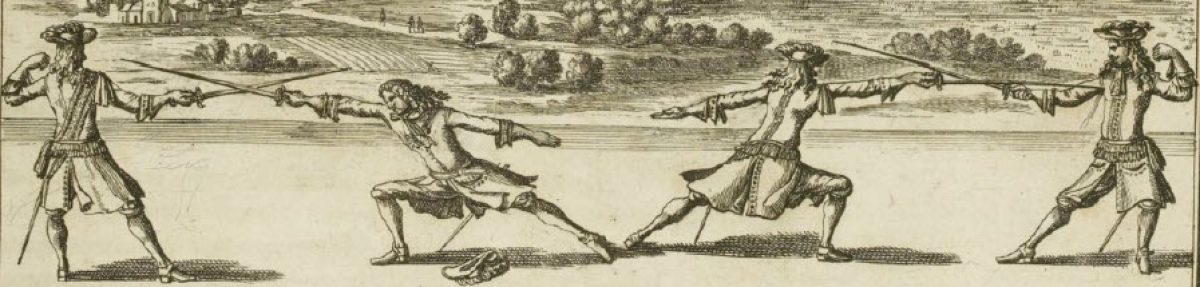
[Originally posted 2 March 2023 on the now-defunct CEHF site] One of the most important positions we employ in fencing is the guard position. It’s the starting place from which pretty much everything happens, and thus it pays to work on it, practice it, and perfect it as much as possible. This means not only standing in guard and checking the position of everything head to toe, but also moving from that position, forward, backward, and side to side.
Like many works on rapier, a good number of those on small sword recommend a rear-weighted stance. For example, di Liancour offers little explanation apart from his belief that a rear-weighted stance makes it easier to recover to guard. One suspects the stance may also help remove one from target that much more:
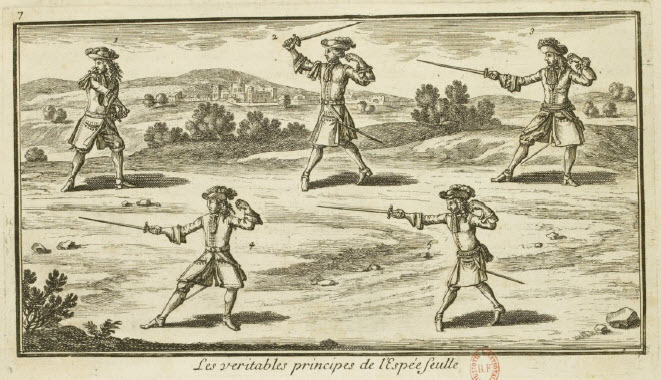
His body, as we see [fig. 3], is held back, resting on the left leg which is slightly bent, the knee more outward than inward, with the toes of the left foot on a traversing line. The right leg is fully extended and bears no weight, the right foot is crosswise such that the laces of the left shoe face the right heel directly, with the distance between them being two and a half shoe lengths or so. [1]
Domenico Angelo appears to prefer weight on the rear leg as well. Though one can never be completely certain with images, the plates Angelo provides do, throughout the work, suggest a rear-weighted stance. He writes
you must observe that the bend on the left side should not in the least take off from that ease with which the body ought to be supported; and, to render yourself firm, bend the right knee a little, but not too much, for, if it is too much bent, the body may fall forward, and if not bent at all, neither the thigh, nor the leg, would be flexible, and you would, consequently, not have sufficient elasticity nor strength to longe [lunge], nor agility to advance or retire [retreat]. [2]

Other masters advocate more equal distribution of weight. L’ Abbat, for example, says
The Body must be upright, which gives it a better Air, greater Strength, and more Liberty to advance and retire, being supported almost equally by the two Feet. Some Masters teach to keep the Body back in Favour of Measure, which cannot be broke by the Body when ’tis already drawn back, tho’ it is often necessary, not only to avoid a Surprise, but also to deceive a Man of superior Swiftness who pushes [lunges] a just Length [3]
In similar language, a master active a century after L’ Abbat, James Underwood, argued for a more equally weighted stance.
I am of the opinion, that the distribution of the duty laid upon each leg ought to be equal, and the more equally they share in the weight, I will venture to say the body will so much more supported… If too great a stress lie upon the left leg, your retreat must be obviously the more unsteady, and weaker; if upon the right, you are crimped and checked in your advancing. [4]
Underwood adds that the shift in weight to advance or retreat costs one time, and that everything depends on time. He was certainly correct–any additional, unnecessary movement that impedes an action only gives one’s opponent tempo to strike or change the field of action to their advantage.
SO, what should one do? Which is correct or better?
Yes. This is to say that both approaches are worth trying as they were both in use at the time. Ultimately, we tend to fare best with what works for us. I teach both, but prefer to be more equi-weighted. My suggestion, once I show someone the critical parts of the guard, is to have them adjust for their own bodies–we’re all built a little differently so it makes sense to adjust things to accommodate that.
So long as the critical aspects of the guard position are present, so long as one is balanced and can react and move efficiently, so long as one is well-protected, it will be fine. The critical aspects are
- to have the lead foot pointing forward–it can help to picture the imaginary line, the line of direction, that connects the lead foot of each opponent and along which both parties move
- to have the weapon arm, assuming an outside guard, in line and just outside the body to close off the lead arm’s side/outside line (those adopting a middle guard should have the arm and weapon mid-body)
- to have about two of one’s own shoe lengths between the feet (the goal is a stable, easy to move in starting position)
- to have the torso upright, head up, and as much as possible the body relaxed
- to have some bend in the legs; these are the springs and need to be coiled, as it were, so one can move or lunge
- to have the rear arm held back behind the head or at the chin, palm out (the latter is used to check a blade after making parries to the inside line, i.e. in quarte, prime, or seventh/half circle)
NOTES:
[1] Sieur di Liancour, The Master of Arms, 1686, Ch. 3, p. 18 in Lynch’s translation.
[2] Domenico Angelo, The School of Fencing, 1763/1787, 6.
[3] L’ Abbat, trans. by Mahon, 1734, The Art of Fencing, (Lector House edition), 4-5.
[4] James Underwood, The Art of Fencing or the Use of the Small Sword, Dublin, 1798, 4-5.
 Capitale Escrime Historical Fencing