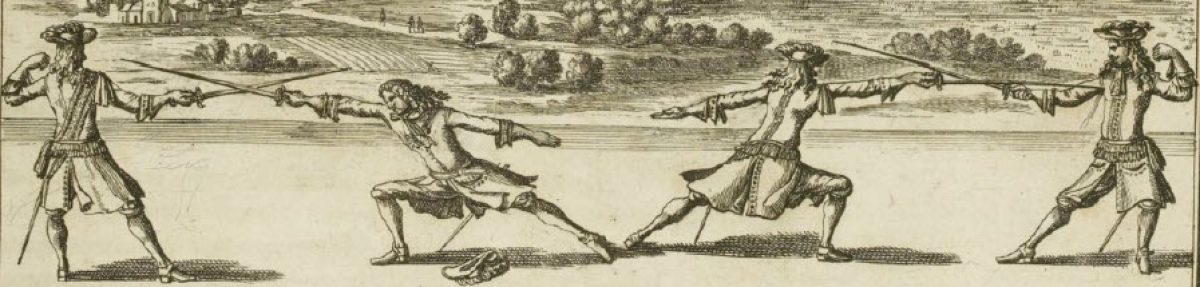
They Call it “Macaroni”

The Much-Maligned Smallsword and Foil and why it Matters
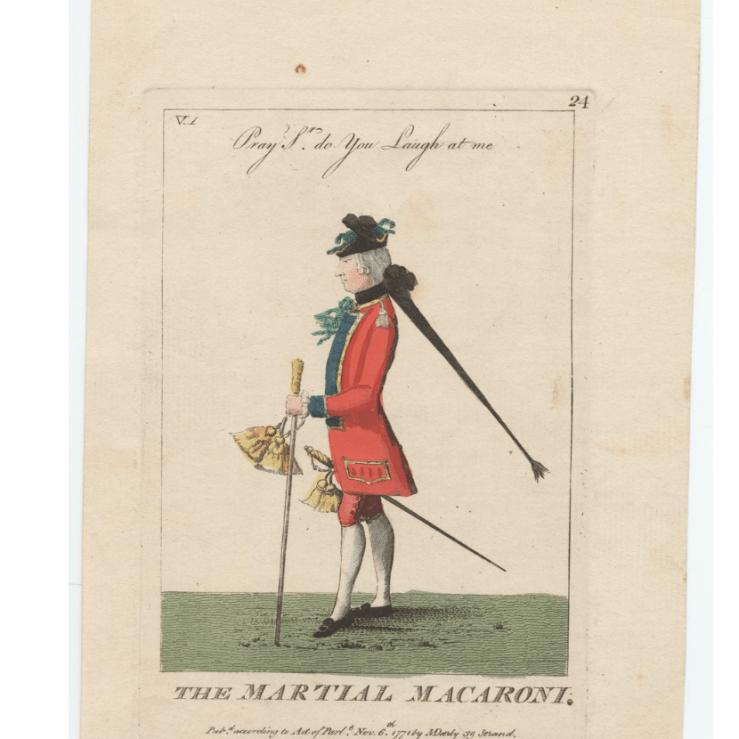
from Brown University Digital Repository [https://repository.library.brown.edu/studio/item/bdr:244908/]

One of my favorite weapons to fence and teach is smallsword. I started fencing foil—a descendant of smallsword—in the 1980s, and though obviously adapted for safer training and the sport of fencing the fundamental elements of foil impart more than most people in “HEMA” believe. Moreover, my initial training was French, and the smallsword being perhaps the early modern French weapon par excellence there is something familiar and nostalgic (if that is the right word) about it. One benefit of subsequent training in a related, but distinct tradition (in my case Italian with Hungarian elements) is that one gains another view of that previous study, just as studying another language can illuminate one’s native grammar. While modern foil and smallsword are different, it is context more than anything else which separates them. The rebated weapons of two centuries ago, while similar to the tool of today, were used to mimic actual combat safely, not used purely as a game, and in this one key difference everything rests. Because so few people within historical fencing understand or accept this, however, one of the most deadly, sophisticated swords ever devised, and its descendant, is often the object of amusement and mockery. Sad as that is, what is worse is that in discounting smallsword and foil they lose the single greatest method by which to explore the extinct sword arts that do interest them.

Wigs, Lace, and Lorgnettes

“The Macaroni: A Real Character at the Late Masquerade,” (1773), Philip Dawe

The derision that smallsword suffers in “HEMA” reflects several failures within the community. Arguably it reveals a latent and wide-spread species of bigotry. The abuse aimed at this “dainty” or “tiny” or [insert equally facile insult here] weapon highlights the thinly veiled prejudice in HEMA’s macho culture, far too much of which poisons the community and retards its progress. Aside from compensatory attention devoted to big weapons, go hard or go home, and “I gots brusies bruh!” there is the bigoted notion where sophisticated = weak/effeminate/gay, the idiocy and ignorance of which speaks volumes. Second, dismissal of smallsword, just as with its descendants, indicates a complete failure to grasp the depth and importance of the primary means by which one learns the universals of fencing. This is not merely my opinion, but demonstrable on a number of levels, from the wide array of works on fencing published over the past five hundred years to the gulf in quality one sees in the historical community, not only in terms of performance, but also in terms of translation and teaching.

While fascinating, the parallels between modern disdain for smallsword and 18th century censure of the young people of fashion called “Macaroni” and “Macaronesses” goes beyond the confines of this piece. There are better places to go for the exploration of prejudice in the 18th century as well as the on-going discussion of the battle for equality and civil rights today. My stance on all that, for what it matters, should be obvious from previous posts, but I cannot speak to either issue as appropriately as I can to the second failure, that is, the mistake that most of HEMA makes with regard to anything they define—however poorly or inaccurately—as “sporty” versus what they deem “martial.” [1]

I dtir na Ndall [“In the Land of the Blind…”] [2]

As the old saying goes, in the land of the blind the one-eyed man is king, and if any one maxim summarizes HEMA it’s this one. Examining the usual allegations against smallsword and foil one sees how poorly they are glimpsed without full vision. First, the chief bias appears to be that smallsword (a weapon), because it is related to foil (a training device), is less a weapon than say broadsword. If foil is for sport, then anything like it must be too. Second, for those who see it as a weapon its size, complex method of use, and “late” appearance make it suspect. The logic here, such as it is, suggests that the older a system is, the more legitimate it is; that lighter weapons must be less “martial;” and that anything related to the duel—save rapier—are again less serious than the “heavier” and more manly longsword, axe, etc. The ridiculousness of each of these assertions is underserving of attention, so to be brief:

  • a foil is a practice weapon, be it the modern foil, a feder, or wooden wasters—that Messer you use? Yep, it’s a foil. Ditto your Albion, Regenyi, or Ensifer
  • puncture wounds, made by triangular bayonets or the often triangular smallsword blades, leave really nasty injuries; before the innovations of 20th cen. medicine there was little one could do to repair these wounds or deal with the infections that often resulted (cf. sepsis)
  • fighting in judicial combats with a pole-axe, sword, or anything else was just as formal and bound by convention as late period duels were by the restriction of ground and etiquette

These are all well-established by histories old and new. In truth the bias really has nothing to do with history at all, but with a strong desire to differentiate oneself from “sport.” Anything that is remotely connected to sport, then, is suspect in the eyes of HEMA-Bro. Late 19th century sabres of 650-800g? Too close to the modern sport sabres. Smallsword? Too much like modern foil. That’s it. That’s really all it comes down to, and such short-sightedness cripples not only their research, if they do any, but their own practice and pursuit of the Art.

Why Later Period Systems and Modern Fencing Matter

Misplaced bias against both later period historical systems and modern fencing means, in most cases, that these fencers lack a firm foundation in fencing universals and pedagogy. This lack is what tends to undermine their study most. For example, because they have no idea what actual fencing fundamentals are, they mistake aberrations for norms. When they see the problems that are easy to spot, such as the whip-like strikes from electric foils behind competitors’ heads or the floor-dragging sabre slap to a guard, they assume that what they see is the system. Wrong. Even now, decades into the worst offenses in foil, students are normally taught that extending the weapon proceeds movement of the foot and the body. This is universal and is reflected in literally centuries of treatises and hundreds of modern schools. Thus, when viewing anything in the Olympics, the World Cup, or the local NAC, one must differentiate between how a fencer performs that extension as well as how a director views and calls that same action, and examine it against what is taught. They’re often different. Competition, like it or not, comes down to successful exploitation of a rule-set. One doesn’t have to be the Chevalier de Saint-Georges or the Chevalier d’Éon to win; determination and skillful use of attributes win more fights than most fencers wish to admit.
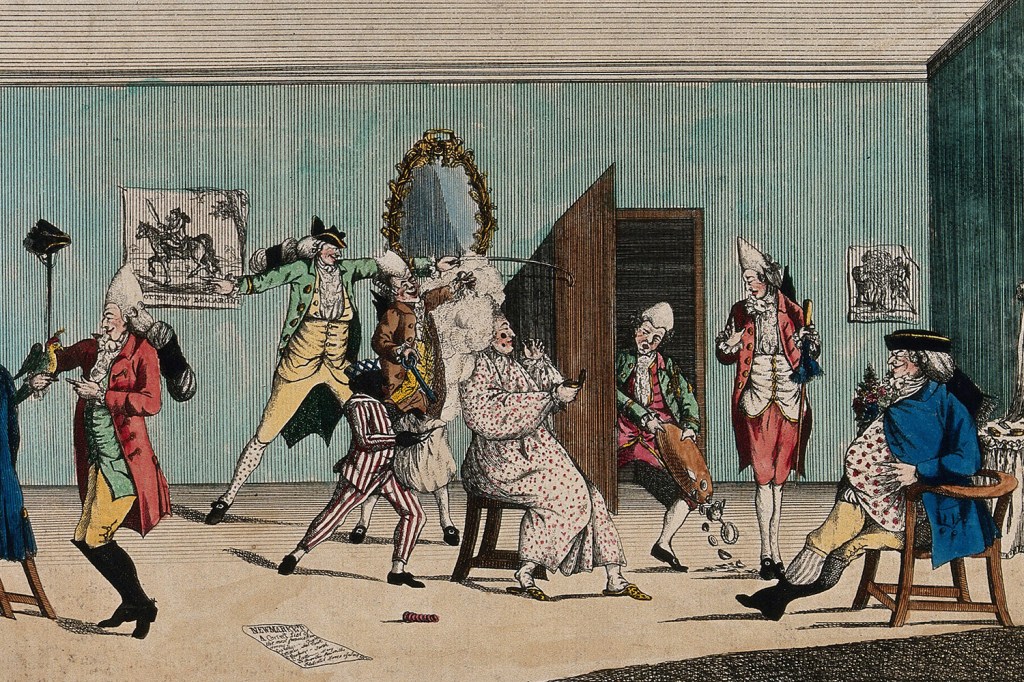
“A macaroni dressing room,” (26 June 1772) by I.W.

Not only do they fail to distinguish between what is taught and how it is used, but HEMAland also rejects traditional and sport pedagogy. They lose far more than they gain from this. Open most any decent work on fencing published in our own time and one will see first, that most do not include the ridiculous point-eating techniques, and those that do often with qualification—that is an admission, by the way, that the authors recognize that the technique is not part of the received tradition. [3] A fencing treatise is more than a collection of “moves;” it is an organized program that orders techniques, drill, and lessons in a meaningful way. It also instructs one in a vocabulary shaped by centuries of development, one benefit of which is that it provides a more effective means to discuss one’s study. Most of all, a year of foil—and this is reflected in the better modern works—imparts fundamentals that transcend foil. Knowing, for example, how the chief universals—time, measure, judgment/method—operate, and how one manipulates and achieves those universals effectively through movement, is crucial in examining any other system of martial arts, but especially those from which the modern version derives. [4] That may not seem important, but for the historical fencer it ought to be, because it is far easier to understand the unknown through the known than to come at the former with nothing or some half-conceived theory of one’s own.

In my last post (Sept. 20, 2020) I mentioned the infamous example of the misreading of Capoferro where the untutored surmised outlandish theories about his lunge. Had they had proper training in the modern lunge, done a bit more digging in the sources between now and Capoferro’s time, then the great mystery of Capoferro’s lunge would not be a mystery to them. Armed with even a nodding acquaintance with modern theory and practice would’ve helped those fencers avoid a grave mistake. Put bluntly, throwing out all that modern fencing has to teach, a system built—again literally—on centuries of work, is stupid and self-defeating. Modern fencing no more exists in a vacuum than did early modern or medieval fencing.

The Problem

For the same reason they poo poo later period weapons and modern fencing, HEMA-Bruhs refuse to listen to those who’ve studied them. Only people with the benefit of that training, or who take the trouble to learn about it, can see how all of this is actually a problem and not just sour-grapes or envy. The HEMA equivalent of anti-vaxers are convinced they have it right, refuse even to entertain that there might be something to learn from late period systems (though they’re ready enough to apply Japanese cutting mechanics and poorly understood kinesiology…), and so dismiss it out of hand. This is not a problem limited to the States either, though it’s perhaps particularly entrenched in American HEMA. We see it in the posers who ape the scholars they denigrate, in the sad attacks on established researchers by people who either deliberately misrepresent their position or are too stupid to understand it, in the idea that a few seminars make one an instructor, and in the odd notion that a 12 page pamphlet contains the same depth and sophistication as the works of Rosaroll & Gristetti or Prevost.

If those with respectable experience in Olympic and traditional fencing are ignored, then the only way to realize the value of later period arts or modern fencing is for the SPES-clad fencer to take that painful step and look at it more closely. Few do, and the results to an informed perspective are disappointing—half-baked theories, ill-conceived approaches, flawed interpretations, and a near complete lack of awareness of the importance of drilling fundamentals. [5] Our interpretations of past combat systems are only as good as the effective use of our research tools—studying extinct sword arts without some knowledge of fencing is akin to entering a bout without a weapon. Together, these flaws mean that much of HEMA is getting it wrong, and for a community supposedly interested in producing as accurate an interpretation of these extinct arts as possible, that makes little sense.

NOTES:

[1] I’m male, middle-aged, white, and hetero, and thus should not and will not speak to the experience of women or LGBT people. Friends and family who fall into either category, however, have shared a LOT with me about their own experience with bigotry so concluding that it juuuuust might bother them doesn’t seem too crazy to me. Just saying.

For related 18th cen. views, interested parties may wish to read some of the literature about notions of “masculine,” “feminine,” and the connections to contemporary ideas about sexuality in the Baroque and Georgian eras:

[2] For the person interested in the full Irish version: I dtir na ndall is rí fear na leathshúile.

[3] Compare for example Maxwell R. Garret, et al., Foil, Sabre, and Épée Fencing: Skills, Safety, Operations, and Responsibilities, University Park, PA: University of Pennsylvania Press, 1994, p. 134 on the “Flick (Cutover)” and Henry de Silva, Fencing: The Skills of the Game, Ramsbury, UK: The Crowood Press, 1997, p. 23, “The Cut-over or French Coupé.” Maxwell presents the flick as a cut-over, a reflection of how it was treated in competition in the mid-90s, where de Silva, writing a few years later, treats only the cut-over sans “flick.” It’s a subtle distinction, but for those of us competing at the time that remember the controversy over the flick and ROW, this reads a certain way.

[4] The universals always include tempo and measure, but the third term varies. Marcelli in The Rule of Fencing (1686) supplies “method” to the first two terms; Terracusa e Ventura, True Neapolitan Fencing (1725), speaks of velocity, tempo, and measure; de Bazancourt in Secrets of the Sword (1862) refers to judgment, control, and speed; Castello in The Theory and Practice of Fencing (1933) prefers distance, timing, calculation. To understand how these relate, why different masters chose different terms, requires reading them, not only for why they say what they do, but for how these terms relate to one another. Without a handle on the universals one’s ability to make sense of most works on fencing is hobbled—Girard (though see Traite des armes, Part III, “Advice for Good Composure when Fencing,” XI), Angelo, and many others assume the reader understands these or explains them within particular sections, so while not spelled out these concepts underlie all that they discuss.

[5] An informed perspective includes but is not limited to professionally trained fencing instructors, experienced fencers, or credible researchers. These is wiggle-room within these terms and I mean for there to be. There are veteran fencers, for example, who know more than many masters and teach as well or better; amateur researchers (vs. university trained researchers) who help us push the boundaries of what we know responsibly; and there are masters and professional scholars who raise the bar higher for our study of historical fencing. However, there are a lot of people who are teaching and shouldn’t be; there are a lot of people playing scholar who haven’t the least idea how to conduct research; and there are professional academics and maestri who don’t play well with others.

It is telling to me, for example, that while details may be in dispute among the maestri, scholars, and veteran fencers I know, none subscribe to the ridiculous theories that plague historical fencing, such as the silly theory of the lunge where the toe/balls of the feet land first. They are, generally, more open to new interpretations when those interpretations are better; less ready to make firm conclusions, especially for the medieval works; and understand the differences in the types of texts, how illustrations can work, and that the less a source contains, the more careful we must be. Most of all, they possess more sophisticated reading skills and realize that what they read or say must be analyzed, not just taken at face value. As a close friend has remarked, the “plates and plays” approach to HEMA is flawed; it fails to take into account all that is not right there in the image.

Dealing with the Pointy End(s)

Sabre vs. Bayonet & Sabre vs. Smallsword


Bayonet En GaurdeWith the disadvantages we face during the pandemic it helps to think outside the piste. Drill is rote even in the best of the times, but lessons often afford us that sense of time moving, of progression. As students we work on something, then next lesson may work on something new as well. Improvement may be slow sometimes, but it still feels more like progress than the same set of exercises month after month with no variation.
When it’s less safe to do much of the usual work, especially that which puts us well within six feet of one another, lessons can become repetitive and dull. In truth, doing the same thing over and over again in attempt to do it better is just part of fencing, but even with that acknowledgement there are only so many ways, for example, to attack and defend the extended target.

I have a few students right now who are at a stage where some attention to tangential material is possible. By tangential I mean aspects of sabre that have disappeared in the modern game. These were, however, once a necessary part of one’s training. It was only last century that competitive bayonet fencing died out; smallsword died out nearly a century before that in most places, but a number of works treat dealing with different types of swords. [1] Sabre vs. bayonet was a key aspect of most military training programs, whether for infantry or cavalry, and still has application today.

Sabre vs. Bayonet

Last weekend I introduced one student to the rudiments of defense against bayonet. Some of the maneuvers one can employ, for reasons of safety, I left out, such as parry, seize rifle, pommel strike with follow-up attack. Everything we did started with the student in seconda/2nd while I adopted one of the basic guard positions with bayonet, in this case what the English called “High Port:”

Bayonet Training for British Forces
“High Port” from Bayonet Training Manual, 1917

As you see here, the left hand grips the rifle and is level more or less with the left shoulder; the right hand is centered above the fork and just in front of the solar plexus; left foot forward. The student might assume the guard of terza/3rd just as easily, but seconda is the preferred guard for several reasons. First, it places one squarely and safely behind the steel, the point threatening the opponent. Second, from 2nd, the shift to quinta/5th or prima/1st is quick. Both of these parries are quick, sweep the line, and set up powerfull molinelli.

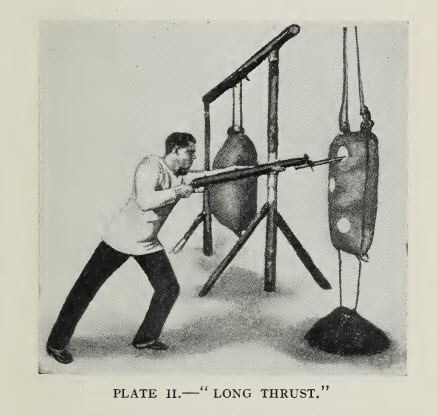
My initial attack was to the student’s inside line with the “long thrust,” that is, a thrust Long Thrust Bayonetmade from about 4-5ft away–as with the sword, bayonet and rifle move first. The student takes a half-step back, parries in prima, then steps slightly to their right and delivers a cut to the arm or down the barrel to the attacker’s hands (this second riposte must be made carefully, one reason that this is not a drill I run with beginners). There are other options, such as a cut to the head via molinello, but we were doing our best to maintain the requisite distance in light of Covid.

The next drill started the same way, but as soon as I saw the student shift to prima, I made a cut-over the parry to the outside line. The student then had to take a second half-step and sweep back to seconda or terza. From there they stepped slightly to the left and delivered a cut to the forward hand on the rifle., before detaching and delivering a thrust with cover.

It was a valuable exercise for a number of reasons. First, because we were on grass, it mean having to be careful with footwork. Given the length of the bayonet trainer the student had to move–to plant and attempt to defend would mean a best we both got hit. Best of all, seeing the versatility of the first triangle parries–1st, 2nd, and 5th–cemented why we focus on them so much. Lastly, it was fun, and that is important.

Sabre vs. Smallsword

Yesterday, in a another lesson, I had a different student defend against smallsword.

angelo smallsword vs sabre
D. Angelo, School of Fencing, 1765

This particular student has considerable experience, and at this stage of his training it’s possible to incorporate more and more of the more advanced, less standard material. Among the traditions he has studied is long experience with KdF (Kunst des Fechtens), which means that dealing with a variety of weapons is not new to him, and, that use of the weapon for defense as well as strategies for coming to the grapple are second-nature. He is far more comfortable with grappling/stretto play than I am, but I am learning a lot from him in the process (what little I’ve studied comes down to a few years studying Fiore’s armizare and weapon-seizures in sabre and smallsword or spada).

Here too we were keen to maintain “social distance,” so as per current custom attacks were mostly to the forward target. My initial guard was Girard’s high tierce/3rd, his was his choice of 2nd or 3rd. As with the bayonet drill, I focused first on attacks to the inside line, mostly toward the wrist; he countered with 1st or 4th depending on where he was as my lunge completed. Ripostes were generally to the arm, or, with a diagonal forward step right, to the head. Next, I performed a simple disengage/cavazione moving from the inside to the outside line. He countered with 2nd or 3rd, again, depending on where our relative distance was and how time affected the choice.

Finally, I adopted Girard’s guard of high quarte/4th, and attempted a variety of thrusts

Girard feint from quarte
Girard, Traité des armes, 1740

with opposition or via a feint. My student countered these as before, either attempting a stop-cut or arrest with a parry-riposte, or, when unsure of the tempo just parry/riposte.

I was surprised, but thrilled he enjoyed this exercise as much as he did.


The quickness of the smallsword and the fact that the point was always on him meant that he had to be conservative. Any attack, as he put it, had to deal with that preeminent fact. A little over a century after Girard another Frenchman, Baron César de Bazancourt, remarked in his Secrets of the Sword that

La pointe d’une épée est une réalité qui fait disparaître bien des fantômes.

“The sharp point of a sword is a reality which quickly makes illusions disappear.” My translation is a bit free, and less eloquent than de Bazancourt’s translator, C. F. Clay, but I think illustrates the lesson well. [2]

In the attack, this same point had to be dealt with safely before anything else. A decent sforzo or expulsion was effective, but had to be measured well since the lightness of the smallsword makes recovery to line a little easier. Since his weapon is heavier–he was using Castille Armory’s 16mm blade in a Radaellian guard–feint via cut was less safe than a feint followed by a thrust. This is yet another reason that the guard of 2nd is so excellent.

He did well in both offense and defense; his key concern was not to be hit, and so, if there was the slightest chance of mishap, he regrouped or attempted to provoke me to attack. I am really happy with how well he has taken to sabre, how skillfully he adapts to different and often difficult scenarios, and how much he enjoys it.

What’s Next?

I plan to continue the inclusion of both bayonet and smallsword on occasion. It’s fun, diverting, and forces the student to apply what they know to a new situation. As my student and I discussed yesterday, exercises like this force one to look at their toolbox and figure out how to make a hammer perform like a screwdriver, or, vice versa. Against the advantage in reach offered by a bayonet, one must adapt to handle that; against the lighter, faster, and more nimble smallsword larger actions and those to deeper target are dangerous, and so to achieve either option one must plan well or be hit.

I do not yet have a smarra, but I have an Italian epee that will perform the job until I do, and I may pair that with an off-hand dagger. I have not explored off-hand options with these students yet, and we have a lot to choose from, from cape (one of my favorites since a jacket, towel, or blanket remain similarly useful today) to buckler to dagger. In each case, it’s important to note, much of what we are doing is examining how we use the fundamental science within sabre to tackle non-standard scenarios. It’s a good mental exercise, forces the student to consider those fundamentals from a different perspective, and it’s a ton of fun.


NOTES:

[1] The one I had in mind as I typed this up was Domenico Angelo’s The School of Fencing, first published in 1765. In the edition I have he treats the use of the smallsword against various nationalities of fencer, Spanish, German, and Italian, and against a variety of weapons and off-hand accessories, dagger, dark lantern, cloak. A few other works of note that deal with multiple weapons include Pierre Girard’s Traité des armes (1740), which likewise pits his student against various European foes and their “favorite” guards; Charles Roworth’s The Art of Defence on Foot, 2nd ed. 1798, includes directions for sabre or broadsword against smallsword, spadroon, and musket and bayonet; and Nicola Terracusa e Ventura, True Neapolitan Fencing (1725), which includes defense against sword and dagger, buckler, rotella, and cape (an excellent English translation of this was made by Christopher A. Holzman in 2017 (available via LuLu Press).

[2] The English translation of C. F. Clay, originally published in 1900, was reprinted by Laureate Press in 1998. It was first published, in French, in 1862, and then again in 1875.

Conan the Barbarian, Sir Percival Blakeney, and the Cult of Machismo in Historical Fencing

C91Vzz0WsAA_8_w

There are times when our lives in and outside the sala intersect. Recently I experienced this with regard to advocacy for women’s rights, equality, and representation. Whatever one’s politics—mine are apparently less clear than I thought—this is an issue not only as an instructor and fencer, but as a human being, especially one living in the topsy-turvy world of the United States in 2019. There’s no middle-ground—either you believe in equality and fight for it, or, you don’t. There’s no fence-sitting, because by definition—in this case—inaction is tantamount to action: it is to be complicit in those customs, laws, and attitudes that are prejudicial. As a middle-aged white male, though, it’s often difficult to appear to be an advocate; I look like “the enemy,” after all, and though I do my best to support anyone really who’s not an a-hole, only continuous action might convince those who think otherwise.

In fairness, our attempts to advocate for others can fail, we can be taken for what we’re not, but that doesn’t mean one shouldn’t try. It’s all the more important to me as an instructor, because in my own, small way I have a chance to make a difference. The adults who train with me are, not surprisingly, on much the same page.[1] Preaching to the chorus is affirming, but it’s work already accomplished. With my younger students, however, I can do a lot of good, or, a lot of harm. I have an opportunity to make a difference, but I also feel I have a duty to make that difference, to create a safe, encouraging, and supportive spot for everyone. This I try my best to do. In part this is a carry-over from parenting—my wife and I are keen to raise our boys to be part of the solution, not the problem—but it also comes of seeing the damage bad coaches can do over a life-time of watching it happen.

From the adults, feedback is constant, and I’m thankful for that. At present we have one adult woman who regularly attends and happily she’s a good gauge for how well we’re doing, how well I’m doing, to create a safe spot. She has suffered a lot of abuse at the hands of men in fencing, from disregard to the actual threat of violence, and it’s a testimony to her strength and passion that she didn’t just quit. A long-time friend, she has been a good guide for me, not only from what I’ve picked up in trying to help her through so much b.s., but also in the fact the she has shared her ideas, experiences, and feedback. She speaks her mind; she will call me on poor choices and then it is up to me to be a large enough human to consider what she says. My younger students, most of whom are between the ages of 9 and 16, are less forthcoming with feedback, less capable of that insight as yet, and so I have to do the heavy-lifting for them.

Conan and Sir Percy

Sir Percy
Anthony Andrews as Sir Percy in the 1982 “Scarlet Pimpernel”

Anyone who spends much time in historical fencing is going to run into the Janus-faced Macho “HEMA Bruh.” He isn’t confined to our community; wherever there are combat-related past-times you’ll find this guy.[2] On the one hand he exemplifies the most facile, shallow notions of western masculinity—one sees this in the focus on victory above all, physical strength and size, his romanticism of violence, and a misplaced sense of his own ability. On the other hand, the second face is often more subtle. It’s homophobia expressed in humorous attempts to belittle other fencers. The math here, such as it is, reads like this: smaller sword = weak, “gay,” lesser, etc. If HEMA Bruh is Conan the Barbarian, then as far as Bruh is concerned smaller men, especially if they fail the big-sword test, are all the public persona of Sir Percy Blankeney-as-dandy, i.e. cowardly snobs who hide their weakness behind fancy dress and witticisms, or in this case, avoid “real” sword-fighting by using less scary weapons.[3] Wimps like that, so Conan thinks, have as much business pursuing “MAN” activities as women do. The 1950s middle-school nature of this thinking is sad, but they’re telling too coming from grown men. For those of us teaching later aspects of the Art, for example, the fact we don’t wrestle or use big swords makes us easy marks. Teach foil or smallsword in HEMA-land and you’ll see what I mean. Among adults it’s easy to see this and avoid such people, but what about for kids?

Instructor as Role Model

Like it or not, if you coach younger people you’re a role model; not the most important one in most cases, but one example of an authority figure that can have significant influence on a young person’s development. Acting the part of Conan the Barbarian, even making room for the HEMA Bruh or similar clowns, are all detrimental to any training program—the best such programs create are future HEMA Bros and considerably more people turned off to the Art. That is a net loss for everyone. I’ve watched this happen. [4]

Instructors must be ever mindful of how they act, what they say and how they say it, of the example they set. One of the ways this is made easier in fencing (of any kind) are the niceties and cult of manners inherent in the tradition. We salute in and out of class, we address people politely, we comport ourselves in the sala with self-respect and respect for others. All these things help but on their own are not enough. Just as old as the salute are double-standards, and though these are less evident today than they once were, they’re still around. For example, there are still instructors out there that either believe or unwittingly apply double-standards to female fencers, who think they can’t or shouldn’t do X. Claptrap. They can do whatever they want, and like anyone who applies themselves, do well.

Is Conan Really so Bad?

Arnie as Conan (1982)

How is the Cult of He-Man detrimental? Starting with the less pernicious effects, focus on facile notions of masculinity—strength, aggression, dominance, power, fame, victory, etc.—undermines the value of these concepts and removes them from what they should be.

  • Strength one develops for health and to practice the Art
  • Aggression, in a sportive context, is better developed as appropriate offensive strategy
  • Dominance of self outweighs any other version
  • Power should be a measure of control over the weapon and ourselves, so modulating not only one’s strikes, but oneself
  • Fame, like anything that serves ego alone, takes one’s attention away from the Art—if you bump into it, fine, enjoy it, but keep it in check
  • Victory is a diagnostic tool for measuring growth, tactics, and identifying areas for work.

I’m not trying to take the joy out of a win or suggest we all meditate in the ring or on the piste rather than fight. I’m suggesting that we get far more out of the Art, out of all our hours and training and hard work, if we look deeper.

Another issue is that these same He-Man values favor only one type of fencer—the larger, stronger, brutal fighter. Is there room for him? [5] Yes, but only if that same fencer is keen to grow beyond what nature provided him. He will be a liability otherwise. The instructor’s job with this fencer is to impart more of the Art to him, to round the corners off him, and teach him to harness and make the best use of those natural gifts (if he’s up for it). This is, in essence, what the instructor should be doing with each student, but that’s easier to do if one’s values extend beyond the physical. Focus on the big guy as a way to gain tourney gold and reputation at the expense of also putting in as much time with smaller, less powerful fencers might bring short-term gains, but at great cost.

To name one current example from one of my kids’ classes, there are two elementary school girls who are picking up technique quickly, but also who understand what they’re doing and why. Will they continue to fence? I don’t know, but my job is to give them all I can to help them find out, to encourage them, improve what they do well, and help them build those parts of the game they are struggling with. I also have a male middle-schooler in that class as tall as I am, and while strong that asset is little use to him in foil. With him my job is to help him channel his size and strength into more effective uses, in this case reach and stamina. Whatever size they are, whatever sex or gender, they’re my students and my task is to share the Art with them, to help them grow.

Put short, whatever a student’s gifts, whatever their challenges, we work with them—we do not favor one type over another. To do so limits us, limits the students, and sets a poor example. The motto of my school is Vis enim vincitur Arte, “For strength is conquered by Art,” because the Art can aid the powerful, but it can make the weak fencer overcome the powerful one.

How I treat them individually, but also as a class, is important too. I’m an adult teaching them something very complicated and difficult to do–that is challenge enough without inane ideas about boys being better at this, girls better at that. To me they’re potential fencers, fellow students only younger, and I must strive to set the best example I can for them.

The Truth about Attribute Fencers

The truth is that one can go far embracing the Conan the Barbarian approach—not everyone responds to them well and they can easily overwhelm many opponents. That doesn’t mean one is successfully expressing the Art, however, and while that can correlate with skill, they’re not one in the same. This is to say just because one is fast and powerful doesn’t mean one has good technique or understanding—you can win through intimidation and power too.

The half-life with this approach is short. If injury doesn’t take one out of things, burn-out will. Some experience that burn-out as frustration when they reach an opponent who’s a better Conan than themselves. Others quit at whatever it is they consider the top of their game convinced there is no one left to beat. The first can be fixed, the second is a sign of deeper problems. This same type of fencer is demoralized or becomes convinced things are rigged if a smaller, but more skilled opponent beats them. This is much the instructor’s failure as the fencer’s, more so for it shows the instructor failed to teach them one of the more important lessons we learn in the study of arms—how to lose with grace and use that loss to improve.

Attribute fencers often do well, for a time, but the longer they stay in the game the more they’ll discover that reliance on their speed or strength is limiting. Skill will win out in the end. One doesn’t stay strong and fast forever. This will sound funny to anyone who hasn’t experienced it, but if you face an opponent over 70 you’re in trouble—no matter how fast you are, how strong, etc., if that person is still fencing at that age then they know something, a lot of somethings, and you’re going to have your work cut out for you. The best losses I’ve experienced were to opponents over 70—they were great lessons. He would be 106 now if he is still alive, but being bagled 5-0 by the then 80 year old Fred Razor in 1993’s Hack und Slasch tournament in Victorville, California, was an indelible lesson for me.

The Deeper Danger of Conan

Robert Mark Kamen as “Johnny” from Cobra Kai in the 1984 “Karate Kid”

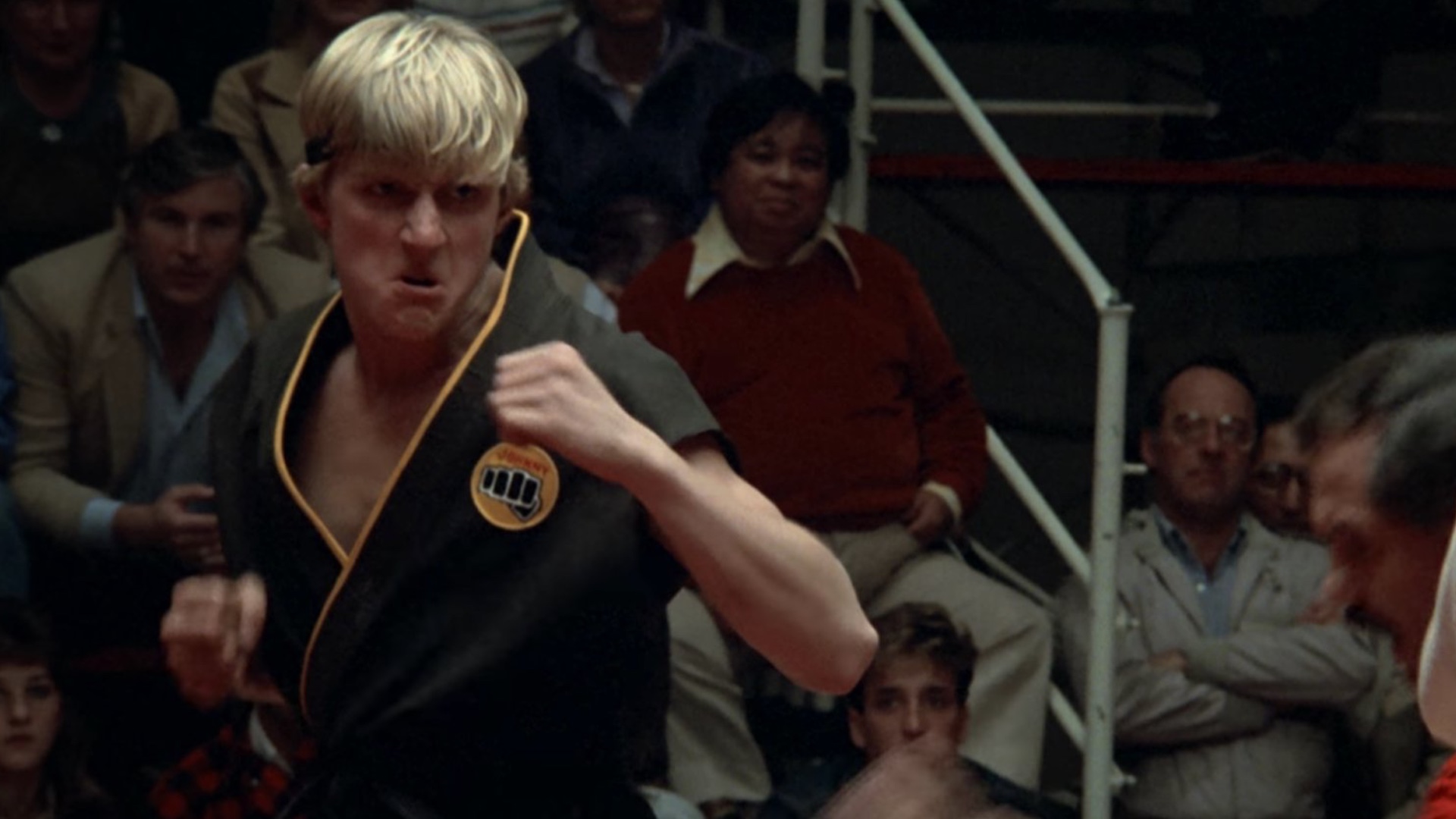
The real evil in this Cult of MAN is that it fosters unhealthy attitudes and beliefs. It provides an arena for those to grow. When this happens, people get hurt, but more than that, the same fragile notions of masculinity carry over into other areas of life. If the example we set for younger fencers is that might makes right, that our genitals determine our success or suitability for X, and that the gifts of nature in terms of size or strength outweigh the hard road of study, then we do more than create Cobra Kai fencers—we help shape, even if in small ways, the same monsters who plague our society at large. This is as true if we ignore it–it’s tacit approval.

This is not just “liberal propaganda” either—there is science here (nb: science, contrary to public opinion, is not a liberal conspiracy). Reinforcing pernicious social mores across activities, locations, and populations helps solidify those ideas. With fewer areas of life demonstrating competing views it is easier, especially for the very young, to accept those ideas as normal. Each of us in our own way, to the degree that we can, is responsible for the world we live in; we have a choice in how we engage others, what we accept and reject, and if we truly believe that equality matters, that respect for others and ourselves is worth cultivating, and that these values make for a better society, then everything we do, from how we vote to how we approach a sabre lesson echoes. This isn’t to say a fencing instructor makes or breaks things, but it is to say that it matters—if the Art is more than a body of technique and tactics, if it does relate to our growth as individuals, then it matters. [6]

I’m not an enemy of big dudes–some of my closest friends are big dudes. I also value the role that wrestling and grappling have played in the Art; more than that, I like to dabble in longsword too, and if the chance came up to take a class on spadone/montante, I would. Interest and pursuit of these is fine, perfectly awesome really, but like anything it is how we go about it, how we treat others, and all of these aspects of the Art can be approached sans Conan’s fur speedo.

———–

Notes:

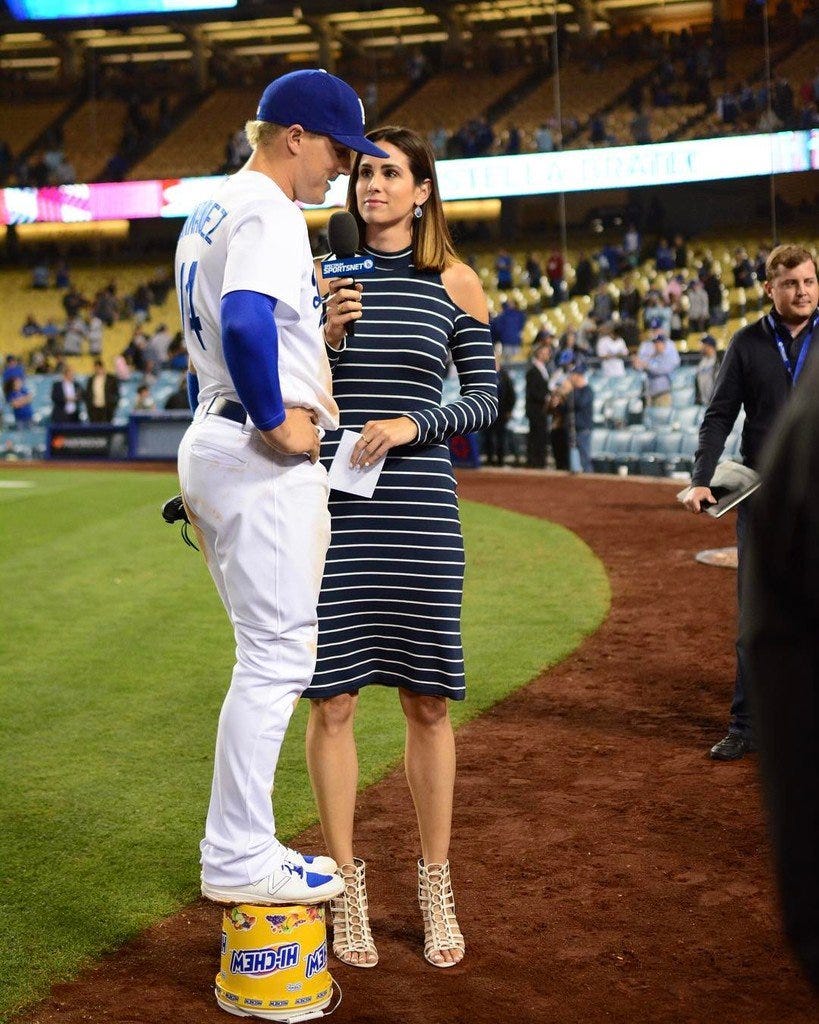
*Photo of Dodgers player Kiké Hernandez and reporter Kelli Tennant. This photo was widely shared and the subject of a popular meme. It’s been cited as classic example of “fragile masculinity,” but there is evidence–in this case–to suggest that Kiké, a notorious prankster, might have been up to something else. At the very least he shared the same photo himself in 2017 as a short-person joke.   For the initial photo–see https://www.washingtonpost.com/news/the-intersect/wp/2018/07/13/a-baseball-player-stood-on-a-bucket-and-sparked-an-online-debate-about-masculinity/

See also, https://www.chicagotribune.com/columns/heidi-stevens/ct-life-stevens-tuesday-kike-hernandez-bucket-masulinity-0710-story.html

[1] I’m lucky to work with good people. Among the many civic and socially minded examples of their excellence, one even serves as an escort/guard for any woman fearful of protestors wishing to go to Planned Parenthood.

[2] “Bro” culture is rife in sports as it is in most places. Historical fencing, because it has larger weapons, because so many of the traditions dealt with war as well as the duel, and because physical size can make more of a difference in grappling is perhaps more prone to this sort of machismo where other branches of fencing—saving perhaps Bohurt—are less likely to see it.

[3] For those unfamiliar with the character, Sir Percy is the hero of Baroness Orczy’s The Scarlet Pimpernel (1905), a wonderful tale of an English aristocrat who hides his heroic rescue of the French noblesse from the guillotine behind the mask of a dandy among other personas. There are a number of film versions of the book as well (my favorite remains the portrayal by Leslie Howard’s from 1934). There was, it seems, a popular trope in swashbuckling literature of the inept, questionably hetero hero who adopts this persona to hide his more “manly” heroics. The other classic example being Zorro. It is telling that in 1981 “Zorro the Gay Blade” made this suggestion overt. Conan the Barbarian was the creation of Robert E. Howard whose series of stories first appeared in 1932. The most famous film version, recently remade, is the 1982 “Conan the Barbarian” starring Arnold Schwartzenegger. Both big-bad-ass-barbarian and sly-dandy films reflected, and helped cement, ideas about masculinity, sexual orientation, and what was and wasn’t acceptable: modern audiences (hopefully) will experience these older movies differently.

[4] It can be easy to forget how long childhood extends. Teens can look older, present older, but are nonetheless kids; even those in their early twenties have brains still in development. In the few instances where I’ve seen adults forget this, I’ve tried to help both the child and the coach, but sometimes the issues those adults face can blind them to the reality of the situation—kids, even 17 or 18 year olds, do not think or act like adults, so expecting from them what one does from a 30 year old is misguided at best.

There are also schools, some infamous in the States, for encouraging “Bruh” culture, but not so surprisingly they’ve run into more and more trouble. If you don’t play nice, people won’t want to play with you. Guess they never learned that.

[5] Yes, “him.” I try to use gender/sex neutral language as much as possible, but in my experience to date the worst offenders of macho-man syndrome have been male. Naturally there are fencers who identify in other ways that may be just as annoying to deal with.

[6] One standout example of a fencer’s moral choice during trying times is Nedo Nadi who repeatedly refused to join, represent, or work with Mussolini’s fascist regime. See Richard Cohen, By the Sword, New York, NY: Random House, 2002, 326 ff.

NB: My friend, and a gracious Big-Dude, Mike Cherba of Northwest Armizare, is using this post in class, so I have edited some of it, mostly removing excess words, repetition, and trying to tighten up the sentences a bit. What, I’m long-winded, I like long sentences…. I blame Latin. [4-8-2020]