Specific Drills & “Realism”

“Show, don’t tell,” was some of the best teaching/writing advice I ever received. To that end, I’m adding some specific drills to illustrate what I shared in the last post on this topic better (https://saladellatrespade.com/2023/10/31/yes-yes-very-nice-but-how-cultivating-defense/ ). Many, if not most of these drills, are venerable—if anything I may have adapted things here or there, but all of what follows are standard drills or types of drills. [1]

These progressive option drills start with a basic action and build in complexity. If a student is new or struggling, one may stop with the first version and work on that, or, aspects of it. For more advanced students, one can add an additional layer of difficulty as required. In the first example, for smallsword, one could simplify the drill even more by having the student initially deny the engagement and break measure. This would observe the “don’t get hit” rule, but not set them up well for a strike of their own.

Two things I didn’t add below, but which apply are first, that it’s important to switch roles, that is, have both the student and instructor initiate the action. This gives the student a chance to act as attacker and defender. Second, movement and varying distance is critical for success. If one starts “firm-footed,” that is, in place, fine, but then add movement. Chase the student, have the student chase the instructor; start out of measure, start in measure. For more advanced students, another option we can layer in is varying tempo and speed.

Drills & “Realism”

On their own, there is little inherent in most drills to make them impart a defensive mindset automatically. All the drills I provide below, for example, can be gamed to current tourney standards easily if one wishes. How “realistic” or not they are depends on explanation and reiterating correct principles over and over and over again within each element of the drill.

One of the most frequent questions I get in drills and lessons, and a good one, is “but why wouldn’t I just do this?” This simple question has become one of the single most important ways in which I push correct mindset. To cite one example from this past week, one student in a smallsword class asked me why they couldn’t just disengage and thrust against the glide in third. I told them that they could, but then asked what would happen if they did—what is the opponent doing? If the opponent is gliding to target, and one ignores that to strike… one is still hit. Not good enough. IF one wishes to disengage in response, fine, but don’t do so into absence, do so with opposition in the new line, a shift of the body to one side, or both. [2]

Option Drill with the Glizade/Glide in Third

To Start:
S [student]: in guard of third
I [instructor]: in guard of third
*engaged on the outside line

  • S: finds measure and gains weak of I’s blade with middle of own [3]
  • S: performs glide in 3rd, maintaining opposition, and strikes target (forward target or chest)

2A:     

  • S: finds measure and gains weak of I’s blade with middle of own
  • S: performs glide in 3rd, maintaining opposition, and thrusts
  • I: parries 3rd, ripostes; S. parries in 3rd and ripostes [4]

3A

  • S: finds measure and gains weak of I’s blade with middle of own
  • S: performs glide in 3rd, maintaining opposition, and thrusts
  • I: parries 3rd, begins riposte; S. disengages, engages in 4th, thrusts to target with opposition

4A:

  • S: finds measure and gains weak of I’s blade with middle of own
  • S: performs glide in 3rd, maintaining opposition, and thrusts
  • I: makes dérobement to avoid glide and engages in 4th
  • S: via circular 3rd, retakes line and glides in 3rd to target
  • I: finds measure and gains weak of I’s blade with middle of own
  • I: performs glide in 3rd, maintaining opposition, and thrusts
  • S: parries 3rd, ripostes

2A:     

  • I: finds measure and gains weak of I’s blade with middle of own
  • I: performs glide in 3rd, maintaining opposition, and thrusts
  • S: parries 3rd, begins riposte; S. disengages, engages in 4th, thrusts to target with opposition

3A:

  • I: finds measure and gains weak of I’s blade with middle of own
  • I: performs glide in 3rd, maintaining opposition, and thrusts
  • S: makes via dérobement avoids glide and engages in 4th
  • I: via circular 3rd, retakes line and glides in 3rd to target
  • S: parries in 3rd, ripostes

Finta Scorsa or Advancing Feint of Marcelli

To Start:

  • S: in guard of prima
  • I: in guard of third
  • S: in prima, makes false attack to the high inside line
  • I: parries in 4th
  • S: via cavazione /disengages to outside line, and strikes target (forward or chest)

2A:     

  • S: in prima, makes false attack to the inside line
  • I: parries in 4th
  • S: via cavazione /disengages to outside line; I parries 3rd, begins riposte
  • S: parries in 3rd (or 4th depending) and ripostes, striking target

3A

  • S: in prima, makes false attack to the inside line
  • I: parries in 4th
  • S: via cavazione /disengages to outside line; I parries 3rd, begins riposte low-line
  • S: takes 2nd, ripostes with opposition

4A:

  • S: in prima, makes false attack to the inside line
  • I: parries in 4th
  • S: via cavazione /disengages to outside line; I parries 3rd, begins riposte low-line
  • S: takes 2nd and thrusts; I. parries 2nd, begins riposte
  • S: parries 2nd, ripostes with opposition
  • I: in prima, makes false attack to the high inside line
  • S: parries in 4th
  • I: via cavazione /disengages to outside line, and thrusts
  • S: parries in 3rd, ripostes to target

2A:     

  • I: in prima, makes false attack to the inside line
  • S: parries in 4th
  • I: via cavazione /disengages to outside line; S. parries 3rd, begins riposte
  • I: disengages to 4th, starts riposte with opposition
  • S: disengages to 4th, ripostes with opposition to target

3A:

  • I: in prima, makes false attack to the inside line
  • S: parries in 4th
  • I: via cavazione /disengages to outside line; I parries 3rd, begins riposte low-line
  • S: takes 2nd and thrusts; I. parries 2nd, begins riposte
  • S: parries 2nd, ripostes with opposition
  • I: with parry in 2nd, passes left foot forward in order to seize guard
  • S: steps back, attacks to body

Working from Mezzaluna (Marcelli)

To Start:

  • S: in guard of mezzaluna
  • I: in fourth guard [5]
  • I: in fourth guard, makes attack to the inside line
  • S: parries with dagger; with sword ripostes to target (forward or deep)

2A:     

  • I: in fourth guard, makes false attack to the inside line
  • S: attempts to parry with dagger (downwards and out)
  • I: disengages to strike hand
  • S: parries with dagger (upwards and out), ripostes with sword to target

3A:

  • I: in fourth guard, makes beat attack against sword to open the inside line
  • S: parries in 4th to close line, ripostes with opposition
  • I: parries with dagger (upwards and out), ripostes with sword inside line
  • S: parries with dagger (downwards and out), ripostes to arm
  • S: makes false attack to face
  • I: parries with dagger (upwards and out)
  • S: disengages and strikes arm or hand

2A:     

  • S: makes false attack to face
  • I: parries with dagger (upwards and out); ripostes to arm
  • S: disengages and strikes to arm or hand
  • I: parries with dagger, ripostes
  • S: parries with dagger (downwards and out); ripostes to arm

3A

  • S: makes false attack to face
  • I: parries with dagger (upwards and out); ripostes to arm
  • S: makes circular parry in 3rd; ripostes via glide to outside line
  • I: parries in 3rd, checks with dagger, ripostes in high line over engagement [6]
  • S: parries with dagger (upwards); shifts right, ripostes to body

Options from an Engagement in Second

S &I: in 2nd, at punta spada/last third/weak of the sword; then, start out of distance

  • S: cuts over to threaten face with feint via half thrust
  • I: moves to parry in 1st
  • S:
    a. performs molinello ristretto or coupé to the arm [7]
    b. performs molinello ristretto via rising cut to the bottom of the arm

2A:

  • S: cuts over to threaten face with feint via half thrust
  • I: moves to parry in 1st
  • S: performs molinello ristretto via rising cut to the bottom of the arm
  • S: secondary attack: pushes through to thrust or cut flank

3A:

  • S: cuts over to threaten face with feint via half thrust
  • I: moves to parry in 1st
  • S: a. performs molinello ristretto or coupé to the arm
  • I: parries 3rd, cuts to head
  • S: parries 5th, cuts via molinello to head

4A:

  • S: cuts over to threaten face with feint via half thrust
  • I: moves to parry in 1st
  • S: performs molinello ristretto via rising cut to the bottom of the arm
  • S: secondary attack: pushes through to thrust or cut flank
  • I: parries in 2nd; ripostes via thrust
  • S: makes ceding parry in 2nd, ripostes via thrust to target
  • I: cuts over to threaten face with feint via half thrust
  • S: moves to parry in 1st, parries via molinello to head

2A:

  • I: cuts over to threaten face with feint via half thrust
  • S: moves to parry in 1st
  • I. disengages and cuts to arm
  • S: parries 3rd, cuts head

3A:

  • I: cuts over to threaten face with feint via half thrust
  • S: moves to parry in 1st
  • I. disengages and cuts to arm
  • S: parries 3rd, cuts head
  • I: parries 5th, cuts to flank
  • S: parries in 2nd, thrusts to target

NOTES:

[1] To name one example, and analogous to the first one I share here, there is the discussion of options facing an opponent in 4th in Charles Besnard, Le maître d’arme liberal, 1653, 43 (63 [orig. French] and 161 [English] in the translation by Anne Chauvat and Rob Runacres, The Free Master of Arms, Glasgow, UK: Fallen Rook Publishing, 2022).

[2] The use of the inquartata or demi-volte, for example, would work in this instance.

[3] Two ways to vary this are to have the student find measure by a short extension of the arm from critical distance, in order to gain the weak with the middle of their weapon, or, have them step into measure to engage. The first is more conservative, but the second option is important—ideally, students learn to find measure and exploit it both ways.

[4] As set up here, the final actions are a battle of ceding/yielding parries and glides. Both help students cultivate better awareness of presence, varying pressure, measure, and opposition.

[5] Marcelli’s fourth guard for rapier and dagger is depicted thus:

Marcelli, Rules of Fencing, “fourth guard” (L) and “mezzaluna (R)

Mezzaluna, on the right, needs explanation. Chris Holzman points out that Terracusa e Ventura (1725) remarks that the tips of the two weapons are close enough to form a “half moon” shape. Here, there is a much wider gap between them. The accompanying text, however, tells us that the fencer “carries the dagger forward covering all the upper parts in such a way that the opponent only sees the chest below the dagger as target to strike.” [Holzman, Marcelli, Rules of Fencing, 1686, Wichita, KS: Lulu Press, 2019, 273; see also n. 115 that page.

[6] Here, the instructor, having parried the incoming sword in 3rd, uses the dagger to hold the opposing weapon in place in order to swing their weapon around obliquely to the right and up (assuming a right-hander) in order to threaten the face.

[7] The coupé , in Radaellian sabre as taken down by Del Frate, is also known as the colpo di cavazione or cavazione angolata. It is made by bending the forearm back a bit to increase power. Chris Holzman, in his gloss, remarks that it’s similar to the last step of the molinello. See Christopher A. Holzman, The Art of the Dueling Sabre, Staten Island, NY: SKA Swordsplay Books, 2011, 234.

Curricula, Completeness, & Choice

The Noviciate of a Macaroni. Ranelagh. 1772. Colonial Williamsburg Museum

One of the best things about fencing are the interesting people one meets along the way. Say what one will about “nerds” and niche interests, rarely are they boring, and in some cases it’s precisely their eccentricity that bridges the gap between niche-folk and those just other side the creative wall. For example, a few years ago a writer contacted me with questions about sabre for a project he had in hand. Over the course of our many conversations, we became friends. In a discussion this morning, he asked me for my take on the issue of true teachers versus the McDojo sort who just out to make a buck.

One point I made was that there is often, sadly, a gulf between what we can actually use in martial arts, should we need it, and what a school or teacher makes their focus. For example, in one ruleset for competitive Tae Kwon Do, one can kick at the head, but not punch. [1] If one is studying at a school adhering to this ruleset, they may be doing themselves a disservice if the goal is training to keep themselves and others safe. This is not to say that competitively focused schools are inherently bad, they can be fun and build one’s confidence, etc., but one should not mistake them for what they’re not, either.

As we continued to chat, I brought in a few examples from historical fencing, and this raised a related set of questions. Do we try to share all aspects of a particular treatise? Should we? What if an action is dangerous? What if it’s safe to do in our context, but would be dangerous were the blades real? My short answer is “it depends.” There are sometimes reasons to teach dangerous maneuvers, but any time one does considerations of safety must come first.

Not all Masters Agreed; Not all were Equal

One of the most “medieval” aspects of historical martial arts, and “HEMA” in particular, is an almost blind faith in written words of the past. Textual authority, given that it is 90% of our evidence, makes sense, but reason must still be applied. Modern doctors do not rely on ancient Greek medicine for guidance in obstetrics, and it would be both unethical and criminal if they did. [2] Not everything written in the past was good.

An Englishman and his Fencing Master, British Museum

It can be difficult to assess the worth of an old fight manual. Our distance in time, methods of conducting violence, notion of law, everything is different. This said, there are times when we get help from within the texts themselves. For example, in de Liancour’s Le maitre d’armes/The Master of Arms, 1692, he says of the counter attack that

C’est une chose si difficile à prendre que les Temps, l’Epée à la main, que je ne conseille personne de s’y trop hasarder. J’estime mieux une bonne parade, ou un bon battement sec & tiré droit le long de l’Epée ennemie, sans oster la sienne de devant soy…

Je m’étendrois beaucoup sur ce Chapitre, mais comme j’ay résolu de ne parler que des choses essentielles, je dirary seulement que c’est in jeu de Salle, où ces coups se pratiquent allez souvent, mais fort rarement l’Epée à la main.

It is such a difficult thing to take on the Times, sword in hand, that I do not recommend anyone to risk it too much. I consider a good parry better, or a good dry/sharp beat & thrust along the enemy’s sword without removing his from your own.

I would dwell long on this Chapter, but as I have resolved to speak only of essential things, I will only say that it is a Salle game, where these blows are often practiced, not often sword in hand. [13 in the pdf of 1692; Lynch, 36] [3]

Here is a master pointing out the inherent danger in choosing a counter-attack over a solid defense. It’s an important point, and one I am quick to mention when I cover counter-attacks, but I still teach it. For one, though we aspire towards realism, the fact is we do this for fun and no one is in danger of actual injury. Second, and more importantly, though I advise students not to select a counter-attack save under specific circumstances, they need to know how to recognize them and practice defeating counter-attacks when this action is used against themselves.

For another example, Capt. John Godfrey, in his A Treatise upon the Useful Science of Defense, 1747, rails against an action common to most small sword works, the flanconade:

That Thrust called the Flanconade, I pronounce an Anathema upon, as being easily proved to be the most lewd and vile Debaucher of the Art, the Dignity of which consists chiefly in its generous Allowance of a proportionable Chance to the weak man. The other Thrusts depend upon a timely Swiftness mostly: Though to say, that equal Knowledge with more Strength has not the Advantage, would be preposterous, as certainly the greater the Velocity is, the greater the giving Strength must be… [12ff]

Godfrey’s argument is that a weaker person will be less likely to pull off the flanconade than a strong person. He was correct. His pro-English and anti-French bias, given his background, are not surprising but likely informed his position as well. He published, after all, during the War of the Austrian Succession (1744-1748), where the two nations were in conflict over territory in North America (among other theaters). One example should suffice:

The Art we had from the French; no Flaconade was thought of for some Time; but upon finding us very apt Scholars, and being willing to be our distinguished Masters, they brought the Flanconade and many tawdry Embroideries, which they are as famous for inventing, as, I am sorry to say, we are degenerate enough to imitate, and even mimick. Pity! that we should be so fond of imitating a Nation, who have always been deceiving us. Rouse then, though noble British Spirit! (for sure no Time more calling than the present) lift up they brave fronted Head above these dandling Actions, and become thy wonted self! Love thy King, love the Country; stay they Heart his these, and thou art safe.

            Thus I take my hearty farwel[sic] of the Flanconade. [13] [4]

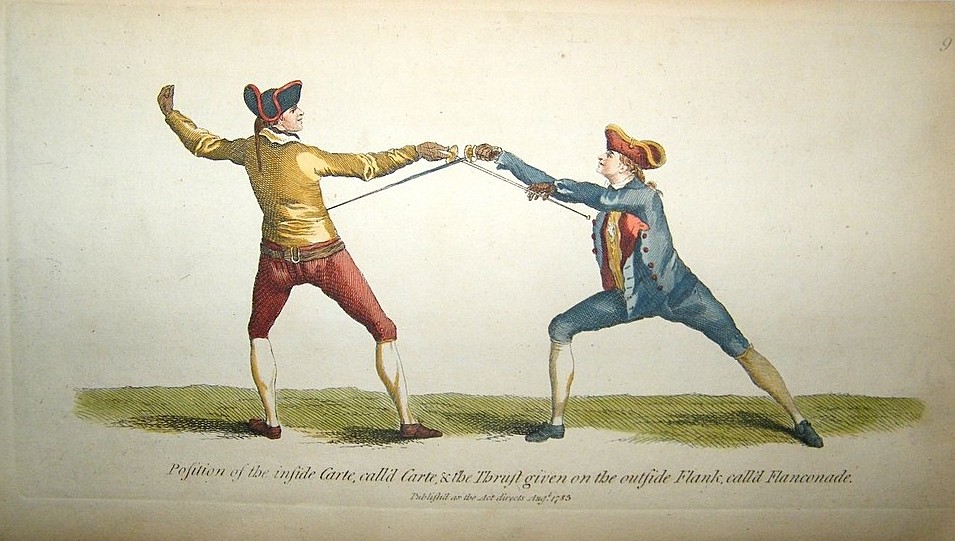
The Flanconade, Domenico Angelo, The School of Fencing, 1763/1787

Tin-foil tri-corn hats aside… the flanconade is a relatively difficult action to learn at first, but easier with practice. It does require, as Godfrey points out too, that the off-hand must come into play to stay the opposing blade after parrying in order that one doesn’t double as they go to target. [5] I teach this action too, and as with counter-attacks, because while difficult one must still know how to defend against it.

For a last example, this time in re position, James Underwood’s The Art of Fencing or the Use of the Small Sword, 1798, is instructive. In many, maybe most treatises the author advises one to be back-weighted while on guard. Underwood, however, disagreed:

I am of opinion, that the distribution of the duty laid upon each leg ought to be equal, and the more equally they share in the weight, I will venture to say the body will be so much more supported. But let us examine into the consequential practice, by the disadvantage of laying a greater stress upon one leg than the other, or the advantage to be expected from the strength accruing from the proper weight given to both. If too great a stress lie upon the left leg, your retreat must be obviously the more unsteady, and weaker; if upon the right, you are crimped and checked in your advancing. If the greater share of weight lie upon the right, the left leg must take that share off, before you can advance, and so, vice versa, the right must act for the left in the retreat. But then this is the loss of your time, upon which every thing depends; whereas by equilibrial weight upon the legs, that time is saved. Here your body will be equally supported, therefore stronger and steadier; but by recovering and shifting in the other way, the motion of the body must be so much greater, that your arm is more likely to be thrown out of line. [4-5]

Many fencers are taught this way today, that is, instructed to distribute their weight equally. It works fine. However, the rear-weighted stance was common and works equally well provided one distributes one’s weight properly. I had doubts about it myself, but in discussion with Russ Mitchell, and especially after his how-to-lunge class, I finally understood how it is supposed to work. [6] I teach students both. First, I show them what a majority of the texts advocate and why—our en garde position, and the lunge especially, are compromises between proximity to target and removal of our own target. Next, I show them the equi-weighted stance. Purists may balk, but I focus on the goal of our stances, not the letter of the law—bodies are different and so supplied with a few principles, I advise students to find a position that is comfortable and yet still meets the critical aspects. The front foot should be straight ahead, their bodies turned about 3/4, and fist and weapon just outside the body if on guard in tierce. If the rear heel is not precisely on the line of direction and in line with the front, no matter—are they stable, balanced, and can they move in any direction required? That’s what’s important.

Selective Reading & Teaching

When using a fencing treatise, I read it all and more than once, but I do not necessarily include all I read in class. I am selective in what I use—not in what I read. I read page to page, because I need to see the author’s approach in toto, and, compare it to other, related works—but not everything is equally important. I rely on Girard’s Traité des arms/Treatise on Arms, 1740, for much of my small sword curriculum, but I have no plan to include his short section on defense against grain flails. I use Domenico Angelo’s L’École des armes/School of Fencing, 1763/1787, as well, but spend very little time if any on weapon seizures outside demonstrations. They are, again to quote dance master Les Kendall in “Strictly Ballroom,” largely “flashy, crowd pleasing steps,” and less secure than a firm grounding in parry-riposte and thrusts made in opposition.

There are things I include for reasons of completeness or because it explains or aids core material. For example, there is good reason to believe that prime in small sword derives from broadsword practice. Angelo says as much, and this guard and parry are redolent of the hanging species of guard often used in sabre and broadsword, but I share that fact, if I do, because someone asked or because of some similar prompt. Girard covers the use of multiple feints, actions like the 1-2-3, but rarely does one need to resort to three feints in an actual bout. Complicated maneuvers like this are what we call “medicine for the hand:” we drill a triple feint because it will, we hope, make our single feint that much sharper and crisp. Have I seen anyone use a triple feint in a bout? Yes, among high level foilists thirty years ago, but in historical fencing circles? No. We still have to contend with people who believe feints are not “martial” enough (despite how often they pop up in the military sources…).

My goal is two-fold in most lessons and classes. First, I want to present and teach as accurately as I can either the tradition I was taught, or, those from the past I have studied. For the latter I always provide the caveat that we can never recreate these extinct fight systems perfectly, but we can, hopefully, get a good idea of how they might have worked. Second, I want what students learn to be both reflective of its sources and useful—I see no reason to teach anyone actions that are more likely to get them hit than not, so when I teach counter-attacks, when I teach the flanconade, I do so at the appropriate time and with the necessary warnings.

Curriculum building is selective, personal, and should be subject to revision as new insights, ideas, and flaws in the existing approach appear. Historical fencing is a research and experimental archaeology driven field. Unlike colleagues in the Olympic world, who are not uncovering hitherto unknown material or inventing new actions, our understanding changes with newly discovered texts and better interpretations. [7] If we are not open to new, better information, our programs become moribund and stagnate. Moreover, what we choose to teach and how is everything, but it depends on what our goals are. Unless we wish to produce graceful puppets, we should know not only what to teach, but why. What one selects is up to the individual instructor, but have a reason and be able to explain your choice.

NOTES:

[1] See for example https://olympics.com/en/news/know-your-sport-taekwondo-rules-scoring-equipment, “Scoring,” and “Penalties and Prohibited Acts.”

[2] To name only one example, the Hippocratic school concluded that most illness women faced was due to the uterus. From a very large sample, see Lesley Dean-Jones, Women’s Bodies in Classical Greek Science, New York, NY: Oxford University Press, 1994; Rebecca Flemming, “Women, Writing, and Medicine in the Classical World,” In The Classical Quarterly 57: 1 (2007): 257–79; Helen King, Hippocrates’ Woman: Reading the Female Body in Ancient Greece, New York, NY: Routledge, 1998; Vivan Nutton, Ancient Medicine, New York, NY: Routledge, 2005; Soranus, 1927.Gynecology. Edited by Ioannes Ilberg, Corpus Medicorum Graecorum/Latinorum, Berlin, DE: Teubner, 1927. [what, historians gonna history 😉 ]

[3] French speakers I ask your apologies for my loose translation. M.P. Lynch put out an edition in English (2021), which is useful, but which also has some translation choices that one might find less ideal, e.g. p. 110 where he uses “snafu;” for the original passage, see Ch. 17, p. 64:

Je répons que si l’on étoit affeuré que ce fùt un veritable coup tiré de droite ligne, sans feint, on pourroir y parer en opposant la main gauche, comme je l’ay fait voir dans mes autres Planches. Mais l’on peut étre trompé par des feintes, ou par des demy coups, & étant surprise, cette parade de cercle enveloppera tous ces coups qui pourroient vous étre poussez, & même fera perdre tous les desseins de vostre ennemy.  

[4] American sentiment, which has long baffled me given our long friendship with France, tends to back the English view on everything from the Hundred Years War to the colonial contests of the 18th and 19th centuries. Had it not been for French support, we may well have lost our rebellion against England. More recent history makes this all the odder given that England and France were allies, as were we with both nations, in the world wars. Just something to think about.

[5] The flanconade, often called a “high-low” attack in modern epee, is effected by parrying a thrust in the high line in fourth, then dropping the point to the outside over the opponent’s weapon. One then thrusts to the outside low line. Many earlier works advocate using the off-hand to secure the opposing steel after beginning the thrust to avoid a double. For a useful modern example, my go-to is professionescherma.org’s channel on Youtube: https://youtu.be/4G63pNHS90M

[6] See Russ Mitchell, Basic Body Mechanics for Martial Artists, 2018.

[7] One outcome of the unfortunate merger between the USFCA (the US Fencing Coaches Assoc.) and the USFA (US Fencing Association, the body that governs the sport; the US branch of the FIE), is that instructors are encouraged to “renew” their certifications yearly, much as someone say in a profession like pharmacy might with CEs (continuing education courses). While admirable that the organization(s) are interested in ensuring a higher degree of ability among instructors, there are issues with this decision. For one, this is expensive and assumes—as ever—full-time coaches with some manner of decent pay. That is not true for most coaches. Second, unlike pharmacy, no one is inventing new ideas or actions that we must learn to stay current. It’s difficult not to see this measure as a money-grab.

Get Out of Your Way

Following on the heels of the last post (about the place of calm in our study of the Art), the following may feel like overkill, but it’s related and as important. Among the deceased equines to which I regularly apply a cat o’ nine tails is the problem of ego. Ego gets in our way; it impedes growth. Over concern with how we will be perceived affects calm; it takes us out of the moment. With our own path to self-improvement, just as in most any larger venture, we tend to succeed best when we don’t get in the way.

Why harp on so much about ego and arrogance? It goes beyond my own study and experience with the martial arts or life-experience, though the combination has done nothing to shake my belief that arrogance and misplaced confidence are bad for us and everyone else. Great confidence can read, sadly, like competence—that’s how unfit businessmen become president for example—but they’re different, and there are consequences to a misguided and overblown sense of self, just as there is in placing our faith in someone else’s inflated sense of self.

The Font of Awesomeness-ness

James Earl Jones as Thulsa Doom in 1982’s “Conan the Barbarian”

Arrogance has a variety of sources, but at the root is low self-esteem. I’m not a psychologist, so I say that as an observer and fellow human who wrestles with ego like anyone else, but I think it holds. In some, arrogance is a mask, a persona they adopt to navigate social environments in which they’re uncomfortable (or maybe all environments). For others, too high an opinion of themselves derives from life-long coddling and commensurate insulation that never put any of the wonderful things they heard growing up to the test. Still others truly believe in their own greatness. Whatever the reason, the egotistical person is generally less inclined to listen, to consider other opinions, or play well with others. They always know better.

Miles Gloriosus

Arrogance is common in fencing as indeed it is in most combat sports. In part, it’s theater—Mariel Zagunis, for example, in the gold medal bout in Athens 2004, more convincingly ripped her mask off and screamed than did her opponent, Xue Tan (China), and went onto win. On the other hand, there are people who for one reason or another think they are the Chevalier St. Georges or La Maupin reborn.

Basis for this is emotional, not rational. On the one hand, typical big fish/little pond dynamics often weigh into things, especially with regard to individual clubs and in tournaments. On the other hand, it’s easy for some to convert an activity they enjoy into a sense of identity; the more narrow that identity is, the easier it is to take criticism poorly. It becomes a personal slight rather than a comment on the acquisition of a difficult skillset (learning to fence is not easy for anyone).

Big Fish  & Identity

One compounding problem that clouds the fact that emotion drives so much of this is the place of the false-positives people take away from events and practices that on the surface appear neutral. More often perhaps than anyone should I’ve mentioned the iffy waters of the tournament scene as the litmus test for skill. It’s not. There are a host of considerations about competition that undercut the lesson so many take away from these events.

Those without serious competitive experience tend to fall prey to the lie more than others. Those who do have that experience and claim it counts for more than it does generally have benefited personally and thus have a vested interest. No one who’s made a name for themselves is quick to question the legitimacy of how that name was made. Zagunis, for example, is very good at the game that sabre has devolved into, but would likely take it badly should someone point out issues with edge alignment, the place of doubles, etc. in her fencing. It’s human nature.

Leaving aside issues with rulesets and officiating, it’s the collective level of ability that defines what first place means. This is important. Too often each tournament is approached as if neutral, as if medaling by definition reveals the superior fighter. It “can,” but it’s not automatic, and superior… how? In relation to whom? Only to who showed up and who had less of a good day than the winner. First place at Event X really only provides data for that one day and that group of fencers. The outcome form the same pools next week could look very different.

An important caveat is that this is not always the case—proper training and knowledge of tactics (both on the strip/in the ring and as far as playing to the director go) will normally out. The mistake is assuming that this particular skilled fencer is the same as the attribute fencer. The former, through skill, can win through the application of skill; the latter relies mostly on reach, speed, or strength. They’re not the same. The more actual, high-level fencers (which can be evaluated) at an event, the more likely that victory in that event means something.

“HEMA” in particular suffers from this—many events, even large ones, might collect a lot of attendees, but the actual skill level is generally quite low. [1] To win at one of these events speaks to stamina, no doubt, but so much of it is a roll of the dice. Attribute fencers do extremely well, as most rulesets don’t and in many ways can’t adjust for physical advantage. A rapier fencer over 6’ with a 42” weapon is going to have an edge over the 5’4” fencer with a 40” blade. Even when that taller fencer makes some daft action, something suicidal, their reach will often win out. The trog that blasts through any guard because he can isn’t better, just less concerned for his opponent’s safety. After all, what’s a double if it helps one “win,” right? No one was hurt, at least hurt too badly, so what’s it matter? Stupid, yes, but evident in most tournament footage. How these same fighters reconcile being hit so often, especially with doubles, and the purported concern for realism in so-called historical martial arts, isn’t a mystery—there sense of self demands it. It must be “good” fencing because they won. Their sense of self, their self-worth, requires that they be the best and be recognized as such. However untrue that might actually be, it feels true, and in large degree too many people believe that what feels true is true. Extreme political stances, be it qanon idiocy or the belief that vaccinations cause autism, are prime examples outside of fencing. Effective self-reflection is a lot harder to do when those around one help feed the fires of fandom. Too few fencers examine their need for victory, but they should.

To compound matters, those who can afford to attend many events and do well, gather a data set of victories, and with it a subsequent belief in their own ability based on false premises. On the face of it, multiple victories appear meaningful, and in some degree it is for that individual’s own progress, maybe, but what does it mean beyond that? It depends on many factors. Are all tournaments equal? Was the level of skill that high at each and every one of them? What ruleset was in use? How did they game the ruleset? How good were the officials? Much of HEMA is judged by the other competitors, most as green as their colleagues, so how accurately they understand let alone see what is happening is an open question more often than not.

To reiterate: I’m not against tournaments. I’m not against competition when approached correctly. [2] Every competitor, every instructor involved in training them, must understand the nature of tournament fighting and adjust for it (a topic for another time).

The Would-be Maisters

Arrogance can be infuriating in a student or opponent, but it can be a recipe for disaster with a coach. This said, in many endeavors, and fencing perhaps first among them outside ballet, coaches are often extremely full of themselves. When that same proud instructor gets results, people tend to look the other way. This is a lot easier to get away with in the Olympic world. There are three weapons, and there are three-weapon masters; to achieve that one must have at least a solid grasp of each one. In “HEMA,” however, there is no such oversight program or board for an instructor’s competence, and even sadder, a fair degree of active hostility toward those from closely related certification programs who might, conceivably, bring up the teaching level. There are a lot of people teaching, but not all have ample background to do so well.

Tim Roth as the smug Macaroni, Cunningham, in “Rob Roy” (1995)

Thus, a second problem with ego is that extends beyond misjudging our own ability or knowledge—it reaches into misjudging and assessing that of others too. To use another contemporary example, a half-wit pundit may appear on tele utterly convinced of a position, but nothing about that confidence or the smug delivery says a single thing about the accuracy of the message. People see the delivery and take it for the thing itself.

In the martial arts, and specifically in this case in historical fencing, there are those who put great weight on people who for lack of a better term are “celebrities.” They are known, and for that reason alone some have faith in them. To be fair, there are times when that faith is warranted, but that faith should be measured against demonstrable skill, knowledge, and importantly, suitability to a topic. If I may, I feel confident to speak on things Radaellian sabre, French smallsword, or late period rapier, but know I have no business teaching Brazilian Jiu Jitsu or Mair’s polearms. I know what they are, and I’ve read about them, and know people who actively study those branches of the Art, but I myself am not qualified and shouldn’t do anything more than point an interested party to those people. To pretend otherwise is dishonest.

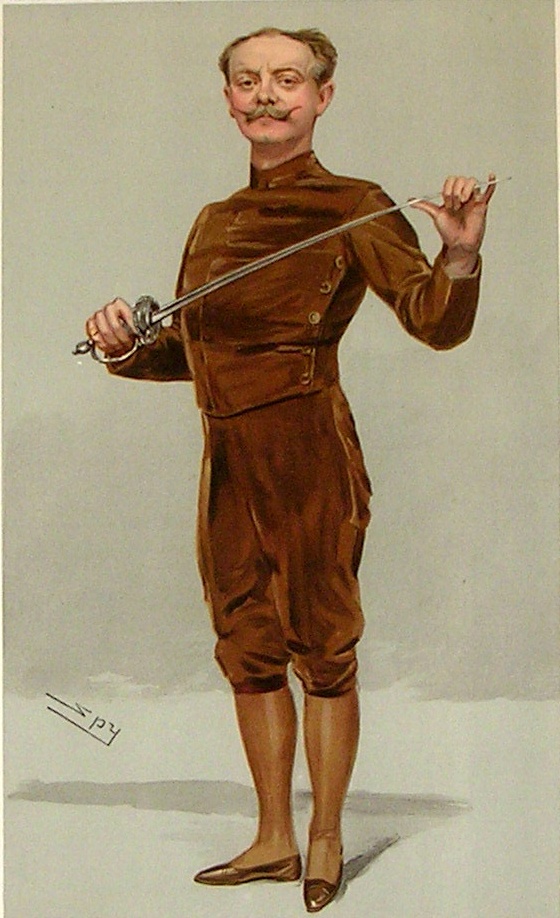
Cartoon of Egerton Castle (1905)

An inflated ego can blind us to the expertise around us. A big head more easily leads us to see what we want to see, not what is actually there. More times than I can count I’ve seen a HEMA player discount a person of experience, skill, and smarts in favor of some Youtube personality. In the best cases, that celebrity (again, small “c”) is good at something and/or has some serious training under their belts, but anyone can set up a Youtube channel and unless one knows what to look for it’s easy to be taken in and fall prey to these would-be experts. Few, luckily, fall into the same category as the fake martial arts masters who look at a room full of students and knock them down through a glance chockablock full o’ chi, but all the same, some get close. There is a prominent tourney goer, for example, that has fetishized his off-hand. Apparently, no one has told him that unless there is a weapon in that off-hand, such as a dagger or buckler, that no one should be looking at it. Ever. There’s no reason too. IF people are falling for this hand sans puppet or marotte, that doesn’t mean that the puppeteer has done anything other than select an event where the average skill is so low that competitors don’t know this. Given that a new foilist learns not to pay mind to the rear arm should illuminate just how sad this is.

As a last example, there are prominent figures who have skill, but misapply it. Were I to offer a class on poleaxe based on late French foil play I would be doing my students a disservice. The universals apply no matter what weapon, but how they apply, differs not only by shape, heft, and purpose, but context too. However, there are well-known personalities who do exactly this, who take a weapon they are proficient with and create a methodology they then attempt to apply to unrelated weapons. At best it confuses things, at worst students—should they continue—will realize one day that their time, effort, and significant financial investment… would have been better spent reading the actual manuscripts, wrestling with the difficult material, and talking to those who have done so before them. There is no royal road to skill. Get your ego out of the way and do the work.

“If You’ve got a Black-List, I Want be on It”

His antiquated and unfortunate politics aside, Billy Bragg’s line seems an appropriate one with which to close. [3] I know, should some read this post, that they will take it personally and call me names. That’s okay. Go nuts. Some may even recognize the unnamed examples I’ve provided and take affront. That too is okay. I stand by what I said—ego needs make for poor choices and big egos make for poor role models.

Age and experience offer little consolation to us, but two things they do offer are perspective and less need for recognition. I’ve spent considerable time taking myself out of the way; I think it helps, not only in my personal life, but as importantly in the larger projects in which I choose to participate. A desire for public validation tends to distract us and detract from what it is we wish to do, and what’s more important, the work (if it is important) or that people know we were involved? As a coach, what is more important, my experience during a lesson or the student’s? What matters more, how that lesson appears to others, or the content of that lesson and its effectiveness in conveying information? The correct answer is the student’s experience, because otherwise why is one coaching?

I don’t need my name in lights, and don’t want it to be for that matter. I don’t need widespread recognition, because just trying to do the best I can for students and colleagues is work enough. I’m content to be one way-station on what my prove a long path for my students. If I help them when they need it, and it moves them forward to wherever they’re going, then I’ve done my part, whether they or anyone else remembers that I did it. I don’t need lots of medals, a social media presence, or any of the other stuff that would take my focus from what I do well and care about.

Not everything is about me, and in fact, very few things are about me. It’s not usually about you either. When we know who we are and what we stand for, that fact tends to stand out pretty starkly. Our egos suggest to us that everything is about us, but few things are; the belief that it’s about us is no more true at 30 than it was at 3.

Get out of your way.

NOTES:

[1] The average skill level in HEMA is poor. Those inside HEMA are accustomed to what they see and scale within that, but the bar never having been high, there is only so “good” most people get. I’m talking average HEMA here, not everyone. I’ve mentioned a number of excellent students of the Art in these posts, and will do so again. The point is that much of what people see, if they knew better, would not impress them.

[2] What tourneys are for is debatable, but in addition to being good fun—ideally, they are also an additional method of learning. Yes, it’s nice to win, but bouting is to fencing what a pressure cooker is to the ingredients in a dish.

[3] Billy Bragg is proof of something my graduate advisor often said in re Communism—the only place it was alive and well post 1989 was in one or two offices at Oxford or Cambridge. Mr. Bragg, whom I believe has a good heart, championed the pie-eyed politics of Marx, something I suspect easier to do even in Thatcher’s England than in East Berlin or the gulags of the former U.S.S.R.

The Problem with Bouting

Bouting is easily one of the most enjoyable aspects of fencing, but it can also prove to be a troublesome problem. The fact that it’s so fun only helps mask the issue. In this case I do not mean those clubs who focus on little else but “sparring,” a different misfortune, but the misuse of bouting, specifically focusing so much on winning that the value of bouting as a pedagogical tool is all but lost.

“HEMA,” because it lacks a robust coaching pool, is all over the map when it comes to teaching.[1] Some groups do their best to work fundamental actions, but many do not. Too many put a weapon in a new person’s hand, give them five minutes of instruction, and push them into the ring. People with busy lives and for whom swords are recreation often want to get fighting as soon as they can; it’s understandable, but lamentable. Instructors cater to this desire because they don’t want to lose people. That too is understandable, but again, lamentable. Given the audience for this site, and the unpopularity of my position on this, I don’t expect to sway many to adopt the approach I have embraced, but it would be remiss of me not to try, because I’m convinced after decades of watching what happens when people bout too early that there’s a better way to build solid skill.

Why Bouting Too Early is Unwise

There are several reasons why new students shouldn’t bout from the off, but spend time acquiring and drilling good technique, building a keen appreciation for measure, and an equally keen sense of timing. 

Safety: First, fighting even with blunted weapons is dangerous. New fencers hit hard because they lack control and the fine motor skill required to modulate their attacks. Thrown into the stress and excitement of a bout in real time, these fencers are unlikely to learn finer motion because they’re too keen to strike and to a lesser extent defend. Their actions tend to be larger and harder, neither of which are hallmarks of skill.

Stunted Growth: Traditionally there’s a reason why new fencers weren’t thrown into the assault too early. Without solid fundamentals fighting before one is ready is a prime way to cement bad habits, none of which are easy to correct once they become ingrained. One of the reasons that “HEMA” suffers so badly from shoddy fencing is because many fencers are, ironically, rewarded for crappy fencing. It’s not hard to “git gud” in one’s local group, jump into a local tourney, and intimidate and/or hurt one’s opponents on the path to a medals and glory. I’ve judged a lot of tournaments and have seen this over and over again. Worse, these same fencers take their good luck for skill and start teaching, thus creating another generation of hard-hitting louts convinced of their own genius.

Wasted Opportunity: Bouting, approached correctly, is a pedagogical tool, at least that’s what it is supposed to be. It’s a chance for both fencers to test out what they’re learning in real time. Ideally the first bouts a fencer has is with their coach–these teaching bouts, as they’re often called, require a lot from the instructor. They must possess the skill to alter how they present an action, change tempo, play with distance, all of these things in order to provide the student with realistic scenarios.

Drill, good as it is, often consists of snapshots of actions made in an actual assault. The feint to the inside line, disengage to the outside line, for example, is something two fencers can practice and within a short time get down because they establish a rhythm. Fighting isn’t like that. The metronome effect that can occur in drills creates a fencer who can only make that action if the same, exact conditions are present. [2]

Free-bouting, as opposed to a teaching-bout, ideally takes the conditions a coach changes on purpose and randomizes them. This is to say that a coach usually tells a student what it is they’re working on, what they will set up, and what the student must try to do, at least at first. As a student advances, a coach can say less about the specifics. With a fellow fencer, however, the student normally does not get any advanced warning. They just jump in and either seize the initiative or react to that of their opponent. This can be a super effective learning tool IF both fencers take advantage of it, if both realize that the bout is way to test, break, and improve their tool sets.

One Upsmanship: No one is immune from ego issues. Competition is one place where we often see these normally hidden issues emerge. Whatever self-worth concern drives a person can easily take over a bout, because “winning” makes people feel good and serves as a species of external validation. When the goal is winning, in feeling good about one’s skill and self, then learning normally takes a back seat. One becomes more concerned with getting the touch than in how one makes the touch, and that how matters. It’s easy to hit an opponent, but not easy to hit them and not be hit oneself–that requires far more attention and presence of mind, far more calm and mental fortitude, and none of that is fostered well when the concern is ego-driven.

Moreover, too much concern with winning can make things ugly; it can break down what should be a partnership in learning into a battle of egos. If one person crows about landing a touch, the other may not take it well. Resentment may fuel hard-hitting in both directions, shots after the halt, and ill-will. Learning and improvement, the purpose of a class or lesson, suffers when behavior like this enters the picture. People tend to struggle to learn in a place where they don’t feel safe. Class should challenge students, but because it should push them it must be a place where other stressors are removed or at least reduced. Behavior which introduces needless distraction, which engages emotions unhelpful in the acquisition of skill, have no place in the sala.

Bouts as Learning Tools

The bout within the context of a class is not the place for the same energy, ethos, or goals as one has in competition. A fencing class is a cooperative learning lab, not the piste, not the ring. Everyone will get far more use and enjoyment from bouts when they bring the right mind-set to it. Use these bouts as a way to practice, to learn, to see what works and what doesn’t. Use them to play with measure and tempo, to test them out with different techniques and tactics.

Inevitably instructors will encounter students who struggle to embrace this notion of bouting as really just more or less unplanned drills in real time. My advice, if this goes against one’s plans, is to quash it immediately. I have a sort of “Defcon Levels” approach to managing this problem in my classes:

Level 1–Student is no longer allowed to bout
Level 2–Less gentle reminders and a review of my approach to bouting
Level 3–Gentle reminders that we’re partners in learning, opponents not adversaries
Level 4–Cultivating and reemphasizing expectations about bouting
Level 5–Establishing clear expectations about bouting

First, I make sure that my rules and expectations for bouting are explicit, not only when someone joins a class, but before each portion of class that includes bouting. 

RULES for BOUTING

  • Safety equipment–mask, jacket, glove, etc.–are mandatory
  • Be respectful: your opponent is your partner in learning
  • Be gracious: acknowledge a hit and refuse to accept a touch you know you didn’t make
  • Be humble: we’re here to learn. Save all the fire and drive for competitions
  • Be gentle: hard-hitting is the mark of a poor fencer, of an untutored brute
  • Be curious: ask questions if you have them; observe and analyze the action
  • Have fun!

Second, I actively cultivate the proper approach and do my best to model the behavior I want to see, from congratulating my partner on a good touch to keeping the mood light. When a student breaks protocol, if they crow about a point, get too aggressive, or start talking about who won/lost I remind them that we are here to learn, we are working together toward that goal, and that it’s not about win or lose, but improvement. If the gentle reminder fails, and it does sometimes, I stop class, have everyone remove their masks, and I lecture them: I reiterate the rules and expectations, and inform them that future infractions will mean no bouting for that person. If after a more stern warning a student persists, I stop the class and remove them from bouting. It’s not happened (yet…) but should a student persist in such behavior, I will ask them to leave until they’re ready to act responsibly.

What we do is dangerous. Part of my job as an instructor is to help students hone a dangerous skill set safely, to learn to use it responsibly, and in the spirit of camaraderie that should unite us all as comrades-in-arms. One of my goals is to instill in my students the truth of the school motto, vis enim vincitur arte, “for force is conquered by art.” Strength, power, all of these have their place in fighting, but our tools in fencing–applied correctly–replace and mitigate force. That’s why we use them. [3] 

Each club or school will have its own approach and protocols for bouting. I have found, having visited so many schools, having fought so many people from different club cultures, that treating the bout as a tool produces better results. The assault engaged in as a learning exercise can still be fun, it can still be a fight, but with the focus on improvement over net performance, students are better prepared for competitions, they’re more likely to help others improve, and generally they’re a lot more fun to fight because they’re there to learn and have fun instead of beating people down. There is a time and place for the aggressive, go-get-’em approach, but generally it’s untoward and unhelpful within a class setting.

NOTES:

[1] There are many good instructors out there. However, there are also a lot of horrificly poor ones.

[2] This is one reason altering drills, even simple ones, via the universals is so important. In the example used here, changing the measure and footwork, changing the tempo the feint and thrust/cut are made in, changing the set up, all work to make this one action far more useful when the fencer needs to use it in a bout.

[3] We talk a lot in historical fencing about attribute fencers, about this person’s speed, that person’s strength, and we tend to downplay them because the milieu in which we work is focused on skill, not the application of natural abilities. In an actual fight, however, and depending on the context, something like strength does matter. It might not in a duel between two people with smallswords, but it almost definitely would in armored combat in the lists.