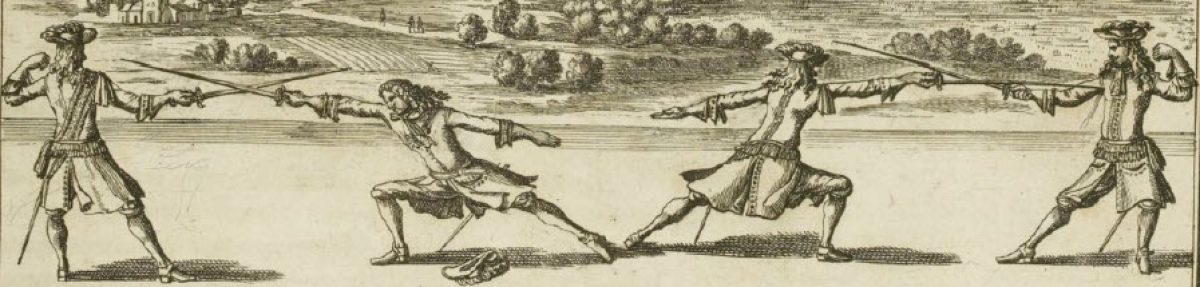
“Cela est bien dit, répondit Candide, mais il faut cultiver notre Jardin.”
Candide, Voltaire (1759)
Unlike most posts here this one, while it deals with some aspects of historical fencing, likely will say far more about me than anything sword-related [readers keen for the former can stop reading here]. We each of us have our karmic burdens, our boulders to push uphill over and over again, and so long as we don’t go completely mad or become crushed by those boulders, so long as we take a look around us, chances are good we may learn something. If nothing else perhaps we build resilience and in a chaotic, irrational, and unerringly unfair world, that counts for something. Not to admit defeat, at times, is the best middle-finger one can extend to that chaos.
In my case, and returning to karmic burdens, I seem to require relearning certain lessons repeatedly. Perhaps I’m uncommonly thick-headed (jury is mostly still out on that) or perhaps I was born under an unlucky star, but regardless the one lesson I’ll be highlighting here concerns assumptions about how people think. Fair to say, I’m a walking poster-child for all manner of mistakes, but this one, because it might conceivably help a reader, seemed appropriate to share. It’s also an issue I run into all the time in the historical fencing community: I assume reason; I assume evidence matters; I assume people look to these even when first experiencing something emotionally, but by and large they do not. I always fail to realize most people work off emotion with little to no rational reflection. [n]
When we lack or fail to use more rational introspection, we can come to the wrong conclusions. That can be especially dire if the conclusions are about another person’s intentions, because we may blame them or attribute motives to them that are not there. There are many explanations as to why this happens, and while interesting to analyze, the why is less important than developing ways not to make the mistake. Our operating assumptions, viewpoint, and experience can be at complete variance, and we need to be aware of this fact. Sometimes we may look at the exact same thing, but we come away with different conclusions, and the more we realize that this might be in play, the more likely we are to find happier solutions.
It may be my age or life-experience (it’s no doubt both), but it’s clear to me that often I’m not, to quote Inigo Montoya, “using the same wind they are using.” I run into this time and time again, and because I value reason, analysis, etc., and because life has not allowed me much opportunity if any to assume I’m always correct, I look at this and think that the one common denominator is me. Somehow, I must be doing something wrong, or expressing things in a less ideal way, something. Often that is true, but, just as often the problem isn’t me.
When we find ourselves in any disagreement or confrontation, it’s healthy to ask what our responsibility is and what we may have contributed to the problem. Emotion is not our friend in this instance—depending on one’s emotional make-up and experience, guilt, fear, anger, all manner of unhelpful emotions, often unrelated to the event at had but the awful gifts of past trauma, infect the current problem. So, we have to think, analyze evidence, and as much as possible work from facts. It’s not that emotion is wrong or bad, it just is, but if we act on emotion alone we get into trouble. Sometimes a lot of trouble.
One thing I try to remember is that very few things in life are about us. The me-o-centric universe that so often seems to shape behavior today, while common in the age of the selfie and instatwitterbook, is a deviation from normal. Put another way, not everything is about you. In the example that spawned this post I realized pretty quickly that while directed at me, the issue was not about me at all, but another’s own doubts and sense of self. That is liberating for me, and that’s nice, but out of concern for the other party I felt compelled to respond to their message.
Even when insulted, angry, or hurt, some pause, some time to allow ourselves to feel something, and then time spent thinking about it, applying the tools of reason, is vital. Analysis makes emotion take a back seat. Analysis clears the way for us to be more compassionate, odd as that may sound, and in most human interactions if not all compassion is a far better response than any other. What I know, just from my own collection of personal hells, is that very very few people know I have them, and so, I suspect that everyone else does too.
When I received that recent complaint, one I felt was unjust, I was angry—it’s an extremely short trip as I am baseline angry all the time and have been since I was eleven. I also knew that responding in anger would do nothing, in fact, it might make things worse. I let that wash over me, just as one might a wave too large to surf, and thought about it—why did they send this? What is it that they’re upset about, and what if anything does it have to do with me? Do I own any part of it? What steps make the most sense to improve if not solve this?
When I responded, it was after sober reflection, well after the immediate emotional response, and I did my best to be polite and fair. This person felt hurt whether I believed they should or not, and so it made sense to tread lightly, to be compassionate. This doesn’t mean I didn’t explain things from my perspective—I’m not good at taking things on the chin—but my hope was that what I shared might help them reevaluate their own perspective and maybe reexamine their own assumptions. I have no idea how they responded, as they didn’t reply, but I hope that they realize that some of their fears were without foundation, and, that I in no way had it in for them. I have monsters enough to fight without trying to creating enemies.
The Point: the reason I am sharing this extremely personal, embarrassing, and uncomfortable stuff is because the approach so closely matches the decision making in fighting, in fencing, and especially in a competitive space. Emotion is not our friend in fighting—it will steer us wrong. Good fencers spend years learning to think versus feel, as do most martial artists, and there is a good reason, one beyond the benefits in fighting. It is practice for life. If one spends hours and hours a week actively choosing to think rather than react emotionally; if one works at keeping a cool head; if one does one’s level best to see each opponent as a teacher, a learning opportunity, as an equal, a partner; if one approaches a fight of any kind with understanding and compassion; then one is more likely to use the same approaches and point of view in other aspects of life. Make no mistake—it takes considerable strength to wield understanding and compassion in a disagreement; it’s far harder than anger. Anger is easy.
As a caveat, I am not saying don’t feel things or that one should stifle emotion, not at all. FEEL what you feel, give yourself space to feel whatever it is as powerfully as you must, for as long as you need, but then set it aside. We feel all kinds of things, and no matter how real, legitimate, or illegitimate, one should always think before one acts. It’s a cycle, because we will (hopefully) always feel things, but rarely is it wise to act on feeling alone, this is as true in fighting as it is in romance, as true at family dinners as in one’s workplace.
Fencing, I know, rarely applies the same life lessons that one more commonly finds in East Asian martial arts, but it’s there. The Art is one. It belongs to all people, all nations, and no matter what it is, Muy Thai, fencing, boxing, BJJ, Tai Chi, you name it, one can find meaning in the study of the Art beyond the piste or ring. There is something to be said for a path that helps reduce the pain of existence, ours, but maybe that of those around us too. We are better able to, as Candide recommended, tend our garden. One thing Voltaire left out, that I’d like to add is that our gardens invariably lie adjacent to those of many others, and so part of tending our garden is being mindful of those next to us, that even those in gardens far away, face the same struggles, the same challenges, and thus deserve some empathy.

 There is a simplicity, something natural about teaching out of doors. It’s not for everyone. Living in the Pacific Northwest means that one needs to be comfortable with months of rain and grey skies—two of my favorite things—but this means that by definition I’ll see fewer students. Rather than view that as another proof of failure, which it may very well be, I instead choose to see it as weeding out those who shouldn’t be working with me. [4]


 Capitale Escrime Historical Fencing