
Thanks to long-standing injuries and their maintenance I’ve not been teaching as much sabre than I have in the past, but I still have a few students grand-fathered in as well as one or two new people whom I’ve agreed to meet for Radaellian sabre. This summer I’ve had the pleasure to work with two adult fencers, both with experience, but new or newer to Radaelli’s method. As a firm believer that a teacher is (and should always remain) a student, I’ve found that no matter how many times I’ve taught the same, day-one material, that there’s always something new to learn, or, to appreciate in a way that I didn’t before. Students have a way of asking questions that help me refine answers, make them more succinct and intelligible, and that changes not only how I see the material, but also and importantly how I teach it.
The Scarto
In this post I’d like to focus on the scarto, a “shying away,” which was a key feature of Radaellian sabre, and, what sometimes proves a missing piece in modern reconstructions. In March of 2021 I added a post here entitled “Italian Sabre & ‘HEMA'” where I explored some of the reasons for the lack of popularity for this system. [1] One of the major criticisms leveled at the Radaellian method is the size of the cuts and the relative time it takes to make them. I’ve hear this from people in the community as well as from new students with some experience. It’s an important observation, and reveals to me that those of us teaching Radaellian sabre likely need to make the purpose of the scarto far more clear in our lessons.
What’s Up with this Leaning Stuff?
A natural question comes up in viewing the scarto–why should one do it? Everything we teach should have a solid reason for inclusion; it’s never satisfactory to say “because it’s in the treatises.” The why is critical. In origin, this shift of the trunk likely derives from fencing in the saddle. Giuseppe Radaelli, after all, was a cavalryman and his system was designed to revamp then current practice. Before Radaelli, the wrist was used as the axis of rotation for cuts, but in actual use some troopers found it ineffective in battle and thus Radaelli’s innovation, the elbow-driven cut. [2]
Christopher A. Holzman, who more than anyone else has opened up the Radaellian corpus to the English reading world, discusses briefly the connection between the scarto and mounted combat. His take on the scarto in The Art of the Dueling Sabre, which provides a translation of the 1876 edition of Del Frate’s manual–the first to codify Radaelli’s method–is corroborated by the evidence contained in Ferdinando Masiello’s 1891 Sabre Fencing on Horseback [3]. In short, from the saddle, both cuts and thrusts include a slight lean towards the target; in part this is explained by the height of one in the saddle, but it also helps ensure, for cuts, that enough of the weapon meets target to be effective.
Remember that when mounted one’s feet are in stirrups, one’s thighs grip the flanks of the horse, and one’s left-hand grips the reins (all troopers regardless of handedness were trained as right-handers)–all of these contact points affect movement of the upper body. Reach and angle are both affected–even in late cavalry practice we see troopers leaning forward if not to the side in stills from drill and maneuvers.

French Dragoons illustrating the lean in the saddle
Though I’m not a great fan of Patton’s sabre, his Sabre Exercise from 1914 is another excellent point of reference for the place of the lean or scarto:
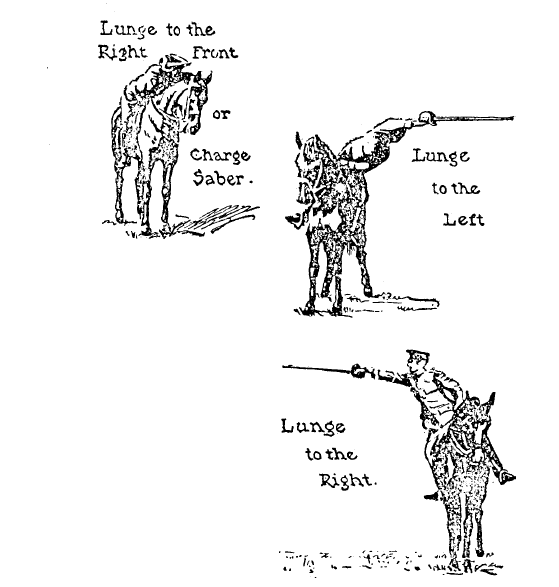
Patton, Sabre Exercise, 1914
Moreover, and without meaning to upset animal-right’s activists, the lean we often see in period photographs and illustrations owes something to the fact that the horse’s head and breast offered some cover as one faced the enemy. Though most late period cavalry engagements did not assume one-on-one melees between troopers, the lean toward the enemy may have helped one void the enemy’s weapon as well as assist reach to target. In reverse, leaning back to parry introduced that much more distance to attempt to defend.
Unmounted cavalry sabre exercise in Italy, as in other places, included the use of the lean. [4] Even for exercise on foot, which is to say not standing as if mounted, we see this lean:
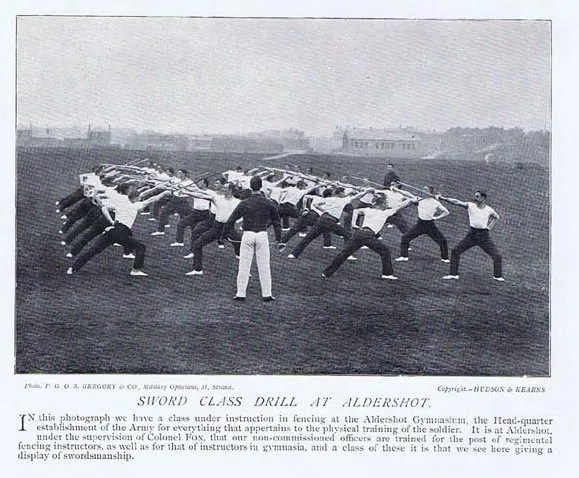
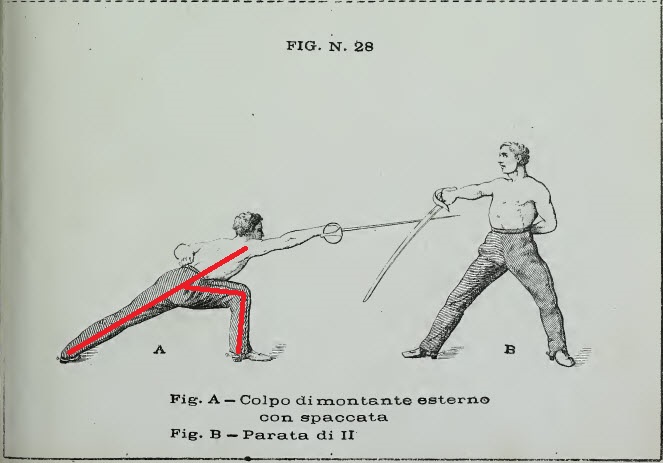
Compare the angle of the trunk here, in line with the rear leg, to that in Del Frate:
What the Scarto Achieves
The historical precedent for the scarto is important to know, but for the vast majority of us fencing only on the ground vs. in the saddle, what good does it do us? Everything. The scarto, combined with proper management of measure, tempo, and judgment is what makes the system work against those traditions which rely more on quickly made direct cuts.
It’s the scarto which provides that additional bit of insurance when we attack or defend, and which when used properly discourages counter-attacks to the forward target. It should anyway. If you’re a Radaellian fencer and you’re experiencing stop-cuts or an arrest when you make your cuts, then add the scarto.
There is one caveat and a vital one for anyone mixing with non-Radaellians in “HEMA:” many if not most opponents will try to hit you anyway.
I forget which number of dead horse this is that I regularly beat, but many opponents will ignore the giant cut speeding toward them and select the ify counter-attack. They will argue that they hit you, and sure, they did, but they should not have: they should have opted to defend themselves first. Here as in most things we must artificially remove the mask and safety gear and imagine the weapons in our hands are sharp. NOTHING we do in historical fencing makes sense if we neglect this.
For example, imagine an opponent makes a cut to your head. You parry in 5th, then start the molinello from 5th to the inside cheek (assuming two right-handers). Made with the torso upright you might get the cut out without being hit with an incidental slice, but with the opposing steel there, and the tempo the elbow-generated cut takes, it’s possible for the opponent to draw the sabre back to guard and rake the arm as they do.
Now, add the scarto. When you take 5th, you add a little more distance with the slight lean back; this not only charges the blow a bit more, but importantly means that you start the cut from slightly farther away. The weapon always leads the way–it’s a universal–so… with the cut starting sooner, from juuuust out of distance, they have a choice: stop the giant cut or go for the counter.[5] One of these is sensible, one stupid. For it to work, however–and this is the important part–the opponent has to recognize the difference. Thanks to the fact that too many in HEMA are thinking more in terms of points than imagining sharps, one is likely to be hit a lot trying this out.
Do it anyway. We shouldn’t limit ourselves because our opponents are poorly-trained and approaching bouts as if slapping bells, however “martially,” with their cousins, Olympic sabreurs.
Incorporating the scarto will take some practice if you’re not already doing it, but it’s worth the effort. Start by employing the scarto in solo drills. [6] Next, use them in pair drills–a simple parry/riposte exercise is perfect for this. Once you’re comfortable, add it into all drills and into any bouting. With your fellow Radaellians, this will improve your appreciation for the system. Used against skilled opponents, the addition of the scarto will demonstrate why it is Radaelli who has been called the “father of modern sabre” and not someone else. [7] Lastly, remember against the average “HEMA” sabreur you cannot expect them to understand why despite their sense of victory they’re actually getting spanked, but you can take some comfort in knowing that you’re doing right by the system we study and more closely approaching what historcal fencing should be.
NOTES:
[1] Cf. https://saladellatrespade.com/2021/03/22/italian-sabre-hema/
[2] For the impact of Radaelli’s innovation, see William M. Gaugler, The History of Fencing: Foundations of Modern European Swordplay. Bangor, ME: Laureate Press, 1998, 166-167; see especially 194-205.
[3] Much of Chris Holzman’s work is available at Lulu Books, https://www.lulu.com/search?gclid=CjwKCAjwloynBhBbEiwAGY25dD4EsfGlo8I0X-ZcEcP7Pb5PF4NejSh4IpqJtYqE0iGWEChGQcQiRRoCBhMQAvD_BwE&page=1&q=christopher+a.+holzman&pageSize=10&adult_audience_rating=00, but his seminal The Art of the Dueling Sabre (2011) is of print. He has plans to revise and reissue it, but no word yet as to when.
[4] We see use of the lean in other systems–this image from Aldershot, for example, would suggest the influence of Masiello on the 1895 English Infantry Sabre Exercise. NB: Radaellian sabre was split into three expressions–mounted practice, drill as if mounted but on the ground, and, on foot, the latter intended for combat as well as the growing agonistic sphere. What does “unmounted cavalry drill look like?” Like this:

English cavalry recruits, unmounted drill, 1914
[5] Counterattacks are a risk against a certainty. In the sport, so long as one makes the touch before the light (i.e. as if “in tempo”), fine, but it doesn’t work that way when they’re sharp. Put another way, if something sharp and pointy is about to hit one the smartest thing to do is go on defense, to parry, not to think “oh yeah, I’m just gonna go for it and hit them first; should work fine, no problem.” No, it might not work out if one’s goal is not to be hit too. In teaching counterattacks, regardless of weapon, I generally advise students to counterattack only if they’re at least one tempo ahead of the opponent’s attack; it follows, then, that in most cases the opponent has made a tactical error. They might have started the attack from out of distance; they might have started the attack with a bent arm or foot/body before weapon; or maybe they’ve just failed to cover their arm on the way in; in these cases one should, distance, timing, and judgment allowing, have a chance to attempt the counterattack and cover with a parry/riposte should it land or fail. If it looks like one might not have time to cover, don’t try it. Just parry and riposte.
[6] For a great example see the gifs Sebastian Seager made for his site: http://radaellianscholar.blogspot.com/2017/10/
[7] See Gaugler, The History of Fencing, 194. See also, https://www.ars-dimicatoria.cz/en/italian-military-sabre/

 Capitale Escrime Historical Fencing