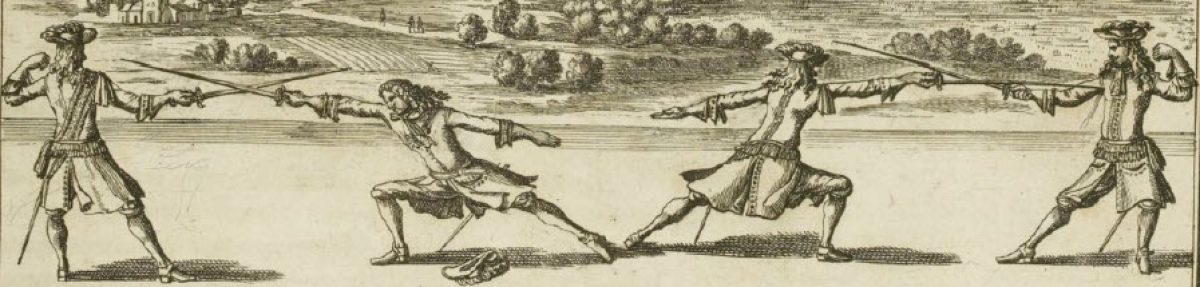
[14 Nov. 2023] It’s been busy lately, but I finally had a chance to make improvements to my three part series on the demi-pointe lunge. It is important to recognize a colleague’s contributions, and to that end I would like to thank Ian Brackley whose knowledge of both smallsword and 18th century history have done much to bolster several points I make. Even better, he provided another perspective on the protruding piece of leather on some fencing sandals–I have made sure to include his ideas in part three where footwear is covered. He raises an excellent alternative or additional reason for these bits of leather, and it is important to share it. Ian also shared a few more resources with me, down to page numbers, passages, and select images, some of which I missed in my own readings, some of which are new to me. Few people ever take me up on my offer in these papers to add additional information, proper criticism, or corrections, but when they do, and have the delicacy and sincerity Ian does, it only makes a paper better. IF you see this Ian, again, thank you.
NB: for those to whom this topic is new, and who are wondering why I spent so much time on it, I’m happy to explain. Reading the articles one might think that there is a major movement of people who think one should land on the toes or balls of the feet in historical fencing–I don’t believe this is true. Happily, most people don’t seem to have fallen prey to this interpretation. However, there are enough people out there (usually Scadians) who do buy into it that one may run into the notion, or, see yet another one of the queries about it that pop on some social media platform with some regularity.

It came up, again, for me earlier this month during Russ Mitchell’s recent seminar at Northwest Armizare. One of my fellow seminar-goers, when asked if we had questions about movement, was quick to ask whether one lands on the heel or balls of the feet when lunging. The person in question is also in the SCA, the likely origin of this garbage, and from the timbre of his inquiry thinks little of my study (or didn’t read it or did and doesn’t agree with it). Lest one think this is some manner of paranoia or arrogant assumption on my part, I was not the only one who found the question jarring and out of place in the discussion. Most advocates of the toe-tapping lunge tend to dig in when asked about it, so this isn’t unusual.
The purpose of the study is mostly to offer people an examination of the arguments people have presented for the demi-pointe lunge, and, how those arguments fail to hold up. There is no support for it in the sources. A number of those works they cite they have, quite clearly, misunderstood or misinterpreted.
If the snarky question at the recent seminar is any guide, no evidence, reason, or number and variety of proofs will sway those who, for whatever reason, find this daft way of landing appealing. People believe what they like. However, for those of us for whom evidence and reasoned analysis matter, my hope is that these articles will afford them some ammunition should they have the misfortune to run into this remora on the belly of historical fencing.

 Capitale Escrime Historical Fencing