This past Sunday at a Capitale Escrime Historical Fencing practice one fencer raised an excellent question—does one always have the hand at the same height when lunging? As so often happens with drills, this sparked great discussion and steered my plan for the evening in a new, and more immediately useful direction. [1] For those familiar with the source material, hand height at the termination of the lunge varied considerably across masters and time. Different contexts, changing uses of the weapon, all these things explain the variation, but for smallsword fencers today this same variety can complicate study. [cf. “Reach for the Sky—Hand Height in the Smallsword Lunge” 11 November, 2022, https://wordpress.com/post/saladellatrespade.com/2647]
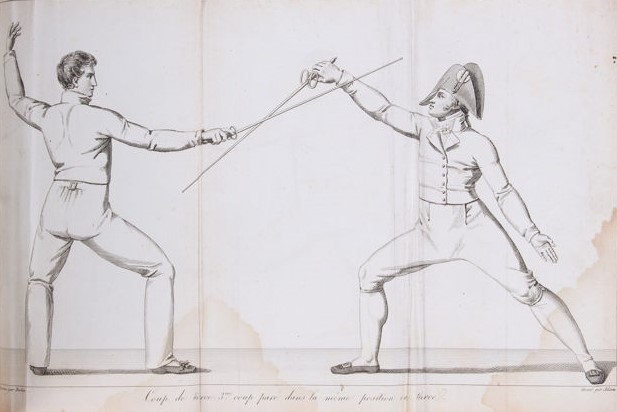
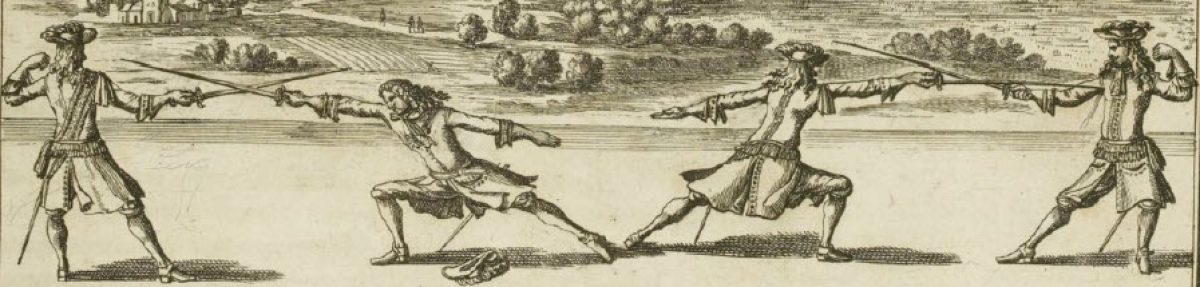
Generally, I recommend that fencers have the hand at a height between the chin and nose upon completion of the lunge. There is ample source support for this, but I’ve also found it works well in most cases. However, when a 6ft fencer and a much shorter fencer are drilling or bouting, this needs adjustment. If, for example, the taller fencer sticks to the rule of chin-nose height, even with the point down, they may be open to an arrest because they create more space under the arm. The shorter fencer, on the other hand, may need their hand slightly higher in order to close the line and/or avoid a double.

The question arose during a drill that focused on the redoublement. The redoublement is a double lunge. In practice, however, we often take an additional forward movement in other contexts, say when stepping or with the advance-lunge/pattinando. [2] These are technically different actions, but should the first movement fall short, sometimes we have the option to redouble. It is not wise in every situation. Normally it works best against an opponent who fails to riposte upon parrying or who takes too long to make the return.
One of the taller fencers found that they were keeping the hand at their own chin height upon the second lunge, but were vulnerable to a shorter’s fencer uncanny point-control and sense of timing and distance with their counterattacks. In the former’s case, it made sense to lower the hand to dissuade the opponent from attempting the counter. Important to note, distance as so often governs much of this—his opponent was merely taking a half-step back to parry or counter, and as a fencer with a longer lunge his hand had to be lower lest it be open. However, had the defender taken a full step or a second short step, the taller fencer may well have needed to keep the hand at more chin height.
But my Source Says… The Picture Suggests…
What we read in a source, and especially the images we often encounter within them, are excellent and helpful guides, but must be viewed against the needs of particular moments in a bout.
There is no platonic ideal for either parry or attack—most often what we read is base-line, a starting place, because in that position or method it sets us up and defends us well, and, because it’s an easier place from which to make adjustments. Fencing is action, a movie vs. a collection of still shots. A parry on the outside line, for example, may be a few centimeters higher or lower depending on the height of an opponent, the angle of their attack, or terrain. We adjust usually without thinking about it.
The same is true with the thrust, with attacks, especially when the goal is to strike and not be stricken. We are at our most vulnerable when attacking, because we’re placing ourselves in the measure of our opponent at speed, and so adjusting the hand, the line, anything we must alter, is vital if we are to maximize safety and reduce the chances of being hit as we strike.
NOTES:
[1] It’s often best to adjust on the fly, uncomfortable as it can be to depart from a lesson plan. This question raised a critical point, a fundamental one, and thus was worth exploring in depth.
[2] To be clear, I’m not arguing that a redoublement and an advance-lunge are the same. They’re not. They are both actions, however, that consist of two movements forward, and outside of a sporting context where ROW (right of way) dictates tactics, both expose one to potential risk being longer actions that cover more ground.


