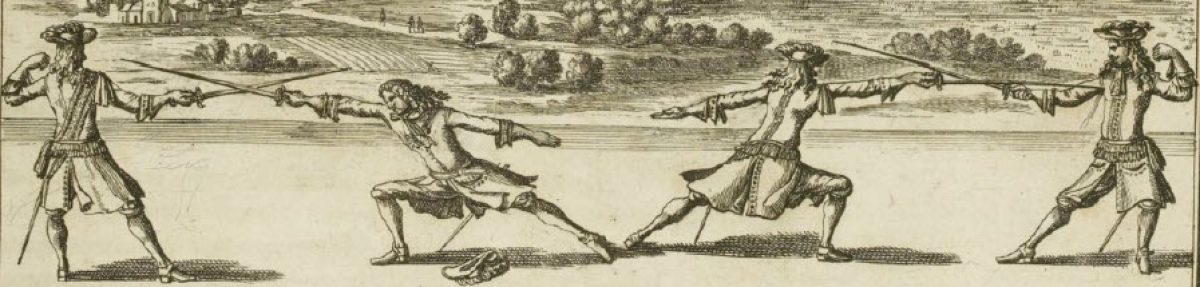

Can You Be a Master of Historical Fencing / HEMA?
While many of the fencing traditions we study eventually disappeared, survived only in isolated pockets, or evolved into modern sport fencing, the tradition of training and certifying fencing masters through national, military, university, and private organizations continued. Some of these institutions, including our own, can trace their roots directly to such traditions. Several of our Masters at Arms also hold qualifications in modern and classical fencing, while others have achieved a high level of coaching and competitive experience in other combat sports and martial arts.
Accordingly, our program does not claim to produce “masters of a dead style.” Rather, it trains Masters at Arms specializing in Historical Fencing. Candidates are expected to be capable of teaching at least three weapons to a high level of performance, while developing a particular specialization in a specific historical tradition and period at the master’s level.
Historical research is an essential component of this study. Our program is supported and led by individuals with PhDs in history, ensuring that the reconstruction and teaching of historical fencing are grounded in serious academic and primary-source research.
The competitive elements of Historical Fencing have also played an important role in the development of our program. Competition provides a valuable environment in which techniques, tactics, training methods, and pedagogical approaches can be tested under pressure. At the same time, Historical Fencing encompasses a wide range of competitive formats and levels of participation, from recreational practice and local competition to highly skilled and professional-level performance.
Innovation has always played a role in the development of martial arts and fencing. In disciplines such as Olympic fencing and Kendo, new rulesets, training methods, equipment, and interpretations have continually been introduced. Historical examples include the adoption and development of épée de combat in nineteenth-century fencing salles, the development of bayonet fencing, the evolution of Niten Ichi-ryū traditions, and the blending of Japanese and European fencing methodologies, such as the influences seen in works like Kenjutsu Kyōhan. Fencing masters of these periods were often responsible for teaching newly introduced weapons, adapting existing systems, or preserving and reconstructing older, more martial traditions. In this respect, what we are doing today is not fundamentally different.
Historical Fencing follows a similar trajectory.
The modern HEMA movement seeks to revive and reconstruct historical fencing traditions while necessarily employing modern training equipment, safety practices, pedagogical methods, and competitive formats. In doing so, we draw upon both the historical sources we study and the classical and modern traditions from which our instructors and masters have been trained. Where historical sources leave gaps, we also draw upon related combat sports and martial arts to inform training methods, physical preparation, pedagogy, and the practical application of fencing principles.
The title Maestro, Maître, or Master at Arms traditionally denotes a senior level of fencing instruction within many established fencing systems. In everyday club environments, however, instructors may simply be addressed by their first name or as “coach.” We find the title Maestro particularly meaningful and appropriate within the context of Historical Fencing because of its historical connection to the fencing-master tradition.
Ultimately, the art we practice today is a synthesis of historical sources, classical traditions, and modern innovation. A Master at Arms in Historical Fencing is an instructor who has completed a rigorous program under the direction of established Masters at Arms and demonstrated the ability to teach their areas of specialization to the standards expected of a professional fencing instructor.
They are not less professional, nor are they less capable as teachers, than a Master of Olympic Fencing. They represent a different specialization within the broader fencing tradition—one focused on the study, reconstruction, preservation, and teaching of historical fencing systems.
Our hope is that Historical Fencing will continue to develop not only as a field of historical study and martial practice, but also as a modern combat sport and competitive discipline. The possibility exists for Historical Fencing to develop into a fully professional sporting environment, with organized leagues, professional athletes, and eventually recognition at the highest levels of international sport. Perhaps, one day, that could even include the Olympic Games. The potential is there; our responsibility is to continue developing the art with the professionalism, scholarship, athleticism, and institutional standards necessary to make that future possible
[From the MAHF facebook page]
Our salle’s connection to the MAHF
This program grew out of the work Storica Defensa has been pursuing as well as some ideas Jim had for creating a master’s program. Any such endeavor is complicated and requires many hands to make it work. It is evolving, as new programs do, and at the same time is already working with interested candidates.
Interested parties are asked to visit the school’s facebook page [https://www.facebook.com/profile.php?id=61591369719292]. As an international organization based in Canada, fb is an easy way for the MAHF to communicate and works for now. Not everyone uses it, so feel free to contact Jim for more information.


CEHF is a member school of Storica Defensa
WHAT IS STORICA DEFENSA?
Storica Defensa means Historical Defense in Latin. We are an organization that is dedicated to creating safety and best practices in the world of Historical Fencing. With the rapid spread of HEMA globally as a grassroots movement, giving fencers, instructors and clubs the tools to accomplish their personal and community goals has been challenging. While we have seen a lot of positives with rapid expansion, in other areas such as safety, coaching abilities, rulesets based on experience in the art, organizing tournaments, and classifying fencers into skill categories has some room for growth. Some of these are urgent (avoiding sports injuries, safety in terms of sexual harassment scandals) and others are just for the betterment of the general community.
Storica Defensa started as the brainchild of Xian Niles in initial drafts as a project to positively influence his larger geographical area. From there in discussions with Jay Maas, the project expanded into coaching, ranking, tournament rulesets across multiple weapons, a tournament league, rulesets and a code of conduct (created by Coach Bob Spracklin of the Prince Albert Northern Knights for an initial Canadian Federation), as well as a focus on Canada-wide participation. Drs Patrick Bratton and Jim Emmons, both long time sport, classical and historical coaches were consulted on the project, and it again expanded internationally as a number of clubs became interested.
Currently we have participants across North America, Asia and Europe and are experiencing continued growth.
Storica Defensa Coaching Program combines coaching practices from Modern Olympic Fencing, Classical Fencing and HEMA as well as elements and experience from Muay Thai, Kickboxing, Boxing, MMA, Wrestling and Brazilian Jiu Jitsu.
The ranking system which is fully discussed in the Ranking Handbook, was developed with the assistance of Coach Stephen Symmons of Phoenix fencing, a long time professional Olympic Fencing coach with a classical background and former president of the Canadian Fencing Federation. The ranking system was based heavily off of the Canadian and French Armband Programs, but was also modified significantly for the context of Historical Fencing. The symbols were created by Xian Niles and Jay Maas, the artwork done by member Rui Ferreira.
NOTE
Storica Defensa does not control members. They are encouraged to train under as many affiliated and unaffiliated coaches as possible in a number of different martial arts and compete at outside events under diverse rulesets. This includes at a club level. While we enforce safety at SD sanctioned events and affiliated clubs, they may also participate in non SD activities.

