“HEMA,” Elitism, and all That

In a response to some of the comments on a video by another Youtuber, Matt Easton (Schola Gladitoria) shared some important insights about what HEMA is, and whether or not it is beset by deep elitism, gate-keeping, etc. [1] Much of what he has to say I’ve touched on here before, and Matt’s presentation is more eloquent than mine would be, so it’s best to watch his video for yourself. Here is the link:

However, there is one thing Matt left out that I’d like to address, again, because it can’t be stressed enough, and that is quality of interpretation. What makes HEMA unique is the “H,” the history part. Few people involved in historical fencing lack at least some interest in history, but very few actually have the skills to do it properly when it comes to the research aspect.

To quote Matt, one doesn’t need to do that research–one can learn from someone who has, or from someone who learned from someone who has. Most people, in my experience, fall into that category, and like Matt I think it’s great. There’s nothing wrong with that. As I remind myself when people decide to skip class the fact is that most of the adults who work with me are busy people, with families, jobs, other hobbies, and they do this stuff for fun, the same way they might go camping, or run, or see friends for game night. The amount of time I spend on the Art is not the norm.

Where I see the real problem is in the hubris too many in “HEMA” display in believing that cracking a book and offering up an interpretation is as easy as a fourth grade book report. It’s not. Call it gate-keeping if you will, by my history PhD says you’re wrong, and unless you have the same training and can make a better case, it might be worth considering that promoting and defending daft theories not only makes one a fool, but also may potentially mislead people. If that doesn’t seem like that big of a deal, perhaps a few analogies will help.

I like science. I read about it, I watch documentaries, and what little news I still follow is mostly science and/or history, art, or archaeology oriented. My spouse was a research scientist, and her family on both sides worked for or works for NASA. As a student I took classes in biology, botany, physics, chemistry, and geology. Despite this interest, you will not see me attempting to write articles on particle physics, Fermat’s theorem, or the latest work in RNA vaccine production. I am not qualified to do so. Even with a bachelor’s of science it would be inappropriate, even dangerous for me to try to speak on a professional level about these things. Outside a book club or circle of fellow-enthusiasts I have no business whatsoever making pronouncements about the latest black hole research. I don’t feel less a person for not having any works listed in PubMed.

One of the most interesting books I ever read was on 18th century medicine. It covered everything from vestigial ideas about the “humors” to surgery, and the illustrations–especially for amputation tools–were as chilling as they were morbidly fascinating. I’ve been to see a doctor countless times, been put under twice so far, had stitches, bones set, and I know a fair number of doctors. I’ve seen them portrayed on t.v., I’ve taken first-aid classes, and having health-care professionals in the family I hear a lot, A LOT, about trends in medicine. Much as I’ve learned, this is another subject that I will not be writing about or teaching, and I certainly won’t be submitting anything to Lancet or offering to perform that triple by-pass for your uncle. I’m not qualified to do any of those things. I know better than to try, and not just because of the jail-time I’d likely face; it would be irresponsible of me to play surgeon or dentist when I’m not one.

In the past, when I’ve made these types of analogies one of the first responses I get is “but those are important–they affect lives or wallets.” True. But, history is no less important, and getting it right is too. Without proper history and professional historians we can get important things wrong. Even now, and outside “HEMA,” we see this–there are the cretins who deny the Holocaust, despite ALL the evidence, and worse, attribute that evidence to some world-wide conspiracy. There are the sad cases that buy the “ancient aliens” bullshit that has made the shareholders of the “History Channel” wealthy. There are people who continue to argue that the Confederacy wasn’t about preserving slavery, but “culture” or “heritage,” ignoring the fact that this “culture” only existed because of slavery and that the “heritage” they celebrate is a slap in the face to citizens of our country whose ancestors were enslaved (and who continue to suffer discrimination).

It’s fair to say that interpreting historical fencing manuals is not on par with cases as severe and important as Holocaust denial. However, there are dangers to poor theories on the Art. On the one hand some interpretations might get one injured. [2] On the other hand, there is a danger in perpetuating the widespread crisis that is ignoring reason and handling evidence irresponsibly. It takes training to analyze and make sense of evidence effectively and responsibly, and like it or not some people have more of that training than others. That’s not gatekeeping, no more than telling your plumber that he’s not a neurosurgeon or your lawyer that they have no business discussing ethics.

If this sounds angry and disappointed–two things I’ve been accused of for daring to call out the poseurs playing historian–well, it is. Being angry about something doesn’t automatically make one wrong. It’s insulting to those of us who spent years learning to read, analyze, and communicate research to have untrained people attempt to shame us for it and call that training into question. They have no right to do so, and the only shame belongs to them.

Notes:

[1] The video in question was shared by “Skallagrim,” cf. https://youtu.be/DauXo_Hg7l0

I don’t follow this chap, but he’s well-known in HEMA circles.

[2] In the past year, to name one example, one theorist shared video that defies all reason, not just in what it depicts, but in the fact that he shared it as supposed proof for his theory. Does he not see how bad this is to anyone who actually knows anything about fencing?

The section of “HEMA” that buys into this b.s. has been remarkably silent about it–either they now see the b.s. for what it is and shame-faced haven’t recanted, or, they don’t see the problem and think it’s great. I’m not sure which is worse. Just as they don’t care for professional researchers who don’t agree with them, they also care nothing for long-established agreement on the fundamentals of fencing. One example should suffice to illustrate the problem: in the video, Fencer A steps into critical distance (close enough to be hit) without presenting a threat or covering himself; he is then clobbered, and after being hit finally reacts. Amazing and sad. The guy literally steps into be hit before doing anything… and this is a crowd that swallows the equally daft heavy-hitting is manly garbage. Not safe.

Disparate Places, Liminal Spaces

When we occupy any space lacking clear definition it can be both unsettling and liberating. In either case much of what feeds our experience in threshold areas comes down to external reaction to it, our earlier experiences, and our expectations. I’m not sure which is harder to manage; each in its own unique ways can play merry hell with us. Now three quarters through what is easily the best fencing course I’ve ever had the pleasure to take, I’ve had another chance to examine, closely, life-in-the-limen. This class, a twenty-one week exploration of everything one could wish to know about the techniques and teaching of epee, is fantastic, but it has reminded me powerfully that I am too “historical” for my Olympic colleagues, and too “Olympic” for my historical ones. I don’t really belong in either camp, but value both for what each offers. One of many pluses to being stuck in some ill-defined space is that for all the confusion there is clarity too—one is just distant enough to see things more objectively provided one is honest and looking. About a year ago I posted a piece, “Gang Affiliation or Natural Allies? Fencers and their Camps” [22-7-21], that touched on a few aspects of having one’s feet in multiple spots. This post picks up where that one stopped.

Culture & Tunnel Vision

We like to be comfortable, so we seek out and nestle into communities where we suffer less cognitive dissonance. While opinions vary in such communities there’s nonetheless a general acceptance of operating truths that allow for easy interaction, predictable outcomes, and a sense of contentment. We don’t like when someone disrupts the illusion. Sometimes we experience that as mild frustration and bewilderment, at others we become actively hostile. We don’t always pause, step back, and regard the scene with an analytical eye, though we should. This is all the harder to do when we’re used to a degree of conformity; any outlier can be dust in the eye, nothing necessarily fatal but nonetheless annoying. [1]

No one is exempt from the tunnel vision that comes with a culture, any culture, but it’s also true that one’s vision can widen. The more one struggles to see things within a different culture, the wider that perspective can become. It’s one reason that travel and exposure to other ways of life, of thinking, to different values, are so vital—not everyone emerges from those experiences more open-minded and compassionate, but many do. In a way it’s a particular form of learning how to pay attention, even knowing to, and that on its own is reason enough to try.

Too “Historical” for Olympic?

As a caveat, this particular master and I have not chatted about any of this, so what follows is nothing save my musings about a possible interpretation of what I’m seeing. I could be dead wrong. This is something I must be aware of and note: knowing my own mixed history with the competitive world I might be applying a bias where there isn’t one. With this said, there are a few things that have struck me that speak to the gulf in culture.

This class, online thanks to Covid, is taught by a well-known, talented, and excellent master. I’ve come to have a lot of respect for this man—he’s kind, a teacher’s teacher, and inclusive in outlook (e.g. he discusses the differences in teaching children, adults, and veterans [40 years +], and doesn’t just focus on male instructors). But as a long-time maestro in the competitive world he, like any of us, has assumptions when interacting with other fencers. Most of the people in this class, so far as I can tell, belong to more traditional salles, and thus have potential students working in the same way close to hand. A few of us do not. This matters, because teaching a fencer who has decent training in Olympic fencing will read differently than those of us who work with a wide variety of fencers.

A sport fencer understands, among other things, how individual lessons normally proceed. It’s part of their culture. Likewise, there are types of drills, expectations about practice, and attitudes toward new material that make it easier in a class like this to work with like-minded people. In contrast, my students come from very different backgrounds—not one, at present, has ever stepped foot in a typical Olympic salle. Some have never fenced or studied any martial art; others have studied empty-hand traditions, but nothing weapon-oriented; still others have extensive experience in other martial arts and weapons, and most of these I have met through “HEMA.” [2] Thus, when working with one of these students, in most cases they did not come up via the same individual lesson system. Their basis for authority is different, and, unlike most sport fencers they are more likely to question it. [3] One can tell not only by their kit, which is immediately recognizable in most instances from that worn for sport, but in how they move and their responses to particular actions. [4]

Even knowing (or accepting) that there are different types of fencers is not something one can take for granted. I have seen this play out many times, not only in Olympic contexts, but also in historical ones. As I’ve often remarked, on either side most people are familiar only with the excesses—to the degree that anyone is aware of historical fencing, they know it primarily through its least robust if most popular expressions, the sort of thing that makes for good t.v. (this is not a compliment). Olympic fencers see people in black (a color only masters in their world wear), whacking away at one another with little sense of tactics, poor fundamentals, and what appears to be a sad display of might makes right. HEMA players, on the other hand, mock the size of Olympic weapons, the lack of attention to fencing’s past, and that sport’s own celebration of the ridiculous (to cite an easy example the fact that any part of the sabre blade may score). Both camps are correct. Both are incorrect. However, unless one has spent sufficient time in either world that dichotomy will be hard to accept.

Too “Olympic” for Historical?
Bias belongs to all, and having talked about many such examples before I will share one that I hope I’ve not already cited: if I did, my apologies (I searched this site for key words, but it’s not the most fine-tuned search tool). In 2016, at a large event, I had a chance to bout with a well-known HEMA personality. I was struck by how poorly this individual read the room. It’s normal practice to size up other fighters—we can tell a lot from watching them fight, but so too can we glean a lot from their kit. The kit my two friends and I wore should have told him a few things.

Santelli Sabre Mask, old sabre jacket, and three “non-standard” (as an instructor once remarked to me on seeing the one bottom right) sabres

If my age wasn’t something to notice (it should have been), then an old, battered Santelli sabre mask, an even older sabre jacket held together in parts by dental floss sutures, and a mix of weapons that included old AFS parts as equally unavailable as that mask should have said something. [5] That it didn’t told me a lot—this was someone who didn’t recognize that my gear was at least 16 to 20 years old; at my age this gear was likely mine and not an older sibling’s or parent’s, so… by process of elimination I had probably been fencing at least 16-20 years (at that time I had been fencing 29 years). I was polite, because one should be, but amused that this individual then proceeded to explain to me and the others what a “sabre” is, and, that we wouldn’t be using the point as his aluminum tools didn’t flex. His gear—his choice, but that was telling too: he doesn’t fence with people who have sufficient control to work with stiffer weapons.

I was the first to bout with him, and the little bit of intel I had gathered proved reliable. We set-to a few times, and it was eye-opening. Given his popularity I assumed, incorrectly, that this guy must be at least a decent fighter—he’s not. In fairness, I assumed he was likely dealing with some manner of health issue or had recently been ill (he was rather gaunt), something that seemed all the more likely when he stopped after a few passes, out of breath, and replied to my query of whether or not he was okay with “I just didn’t think it would last this long.” One of my two friends fought him next, with similar results, and after that he wouldn’t fence anyone save the friends who came with him. With his reputation I imagine that being schooled by two unknowns was unappealing press: again, very telling. Having been advised always to seek out better fighters by my masters, eastern and western, I would have wanted to chat with my opponent after the bout, maybe see about learning more from them.

As I thought about it that day, and as it has increasingly appeared to me since then, it’s not that my famous opponent hadn’t done his intel, but that he drew the wrong conclusions from it. He saw old Olympic equipment, and in my case, a man slightly older than himself, and assumed easy pickings. After all, what could a former sport fencer possibly know that would be of use in “real” sword-fighting? It’s a bias I’ve run into more often than not in “HEMA” contexts. It’s as erroneous an assumption as concluding that all HEMA is bad. It’s not. Some is great. Much of the tragedy both ways is a lack of ability to separate good and bad fencing. If nothing else during quarantine my interactions with a number of HEMA and Olympic folk have proved how painfully true this is.

Sword-bridges & the Time between Times

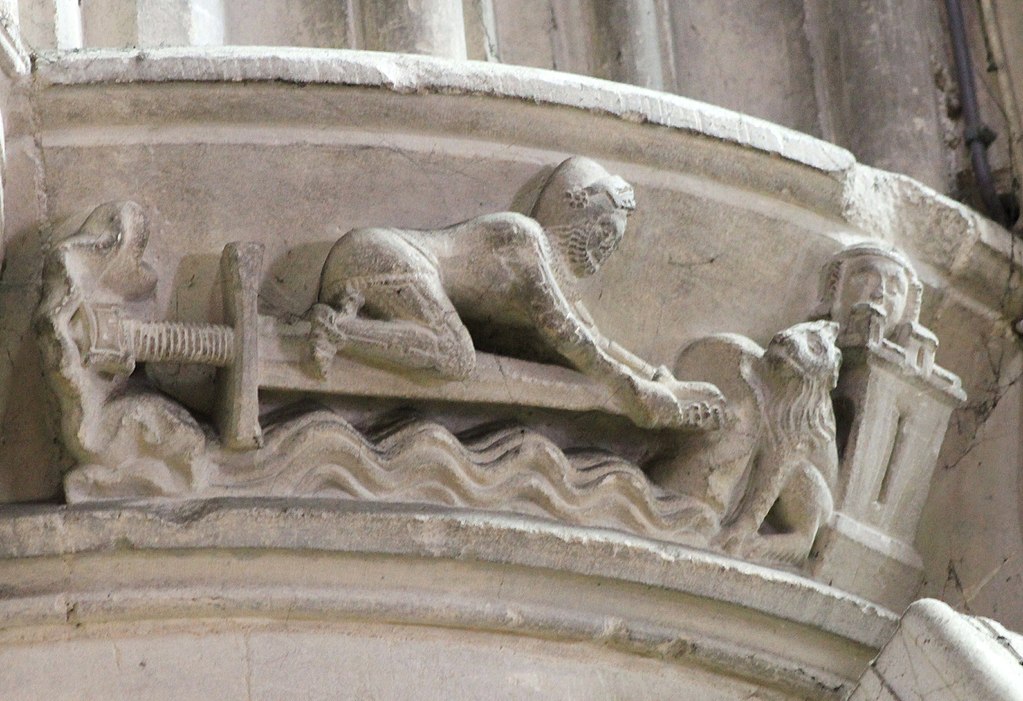
Sir Lancelot crossing the sword-bridge; relief from Sainte-Pierre, Caen, Normandy, France, ca. 14th century

In Chrétien de Troyes’ Chevalier de la charrete (The Knight of the Cart), Sir Lancelot must cross a bridge consisting of a sharp sword. Medieval images of the poor knight traversing this pointed symbol were popular, and regardless of what one may know about armor and its effectiveness, upon first viewing what we tend to see is a person trying to get across something dangerous. [6] They’re powerful, vivid images. In like guise, poised between two worlds but belonging to neither of them, is similar in that it often feels like one is walking a knife’s edge. Disaster, in this latter case, is less a danger than discomfort, but I wouldn’t discount that discomfort. It can be surprisingly brutal and difficult to navigate. If nothing else, where is one when the only two communities seemingly the most likely to take one seriously both consider one an oddball?

One thing that makes it easier is finding other oddballs—the handful I know, and I mean “oddball” here as a compliment—are spread out across the globe. They are the only reason I still have fb messenger. Interaction with them, normally virtual, is a lifeline, and sometimes the only medicine against the feeling that maybe we’re completely insane. Another product of not buying either branches’ interpretation in toto is that the confidence that comes with such conviction—however great a mistake—is a stranger to us. No one likes being told that a cherished belief might benefit from further study or reconsideration, but objective looks at both camps quickly demonstrates that neither is perfect. [7] The only antidote to misplaced conviction is to make such questioning habit, and we’re not living at a time when rational inquiry enjoys much popularity.

The uncertainly projected at us can undermine everything we do if we let it. However, it doesn’t have to, because if mythology teaches us anything it’s that liminal spaces are where things happen. Dawn or dusk, the meeting of sea and land, doorways, and similar boundaries are all locations of significance, preserves of magic, of change, of adventure, from Pwyll on the gorsedd to Halloween night. [8] This is to say that occupying a middle ground doesn’t have to be negative; it can be transformative. Following the mythological parallel, this change is rarely comfortable, in fact it is often harrowing, but it’s anything but boring. It’s not an easy place to be; it can be extremely disorienting and lonely. People will not understand it sometimes, they will judge it and us, but there is always a cost to growth. If the goal of martial arts is ultimately personal growth, with all the attendant good that should follow from it, then discomfort is worth it.

So What?

Why does this matter? How might the experience of one obscure fencer affect you? It depends. If you’re a fellow traveller, then you have another oddball in your corner. If you’re in a similar position in re being sort of stuck between two worlds, then maybe this offers some comfort or a way toward it. Maybe it means nothing—that’s okay too. Beyond the personal, though, there are some important ramifications for examining the boundaries we operate within or set up.

There are changes, for example, coming to Olympic fencing in the United States that will likely affect many of us. The official fencing organization, the USFA (United States Fencing Association), which is tied to the Olympic team, and the USFCA, the United States Fencing Coaches Association, which has overseen the training of instructors, will come together to meet the dictates of the US Olympic Committee which mandated that “coaching education be provided by each Olympic/Paralympic sports organization in order to be certified as a governing body in 2021.” [9] It goes beyond space to cover this adequately here, but on the ground this means the creation of even more effective gate-keeping.

I’m all for ensuring qualified coaches and instructors—regardless of one’s camp—but both organizations, especially the USFA, only acknowledge one type of fencer and one type of coach, both competitive. It remains to be seen how this will affect instructors like myself who teach on the local level and who are not sport-oriented. The first question I was asked when I approached my local parks & rec organization about starting a class was about my qualifications. “Time in the saddle” was the most honest answer I could offer along with a resume of experience. Will that work in a few years? I don’t know, but one thing I do know, and am happy to prove is that I can teach your kid basic foil, epee, and sabre. [10]

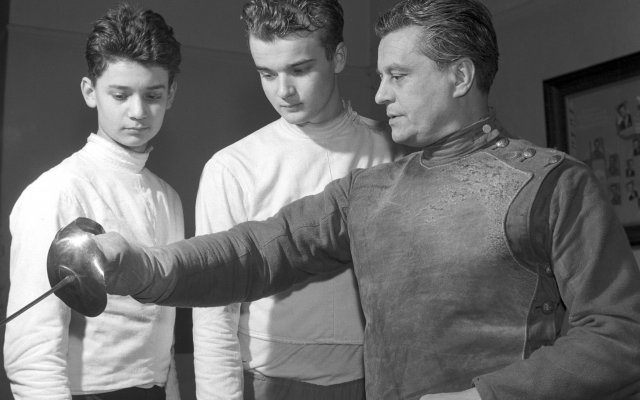
Maestro Gerevich with students [https://sportmonitor.info/?p=14739]

I don’t pretend to be a maestro, I don’t attempt to teach what I haven’t had sufficient training in, and I am quick to recommend other coaches as appropriate. My goal with the introduction to fencing class is exactly that, an introduction, exposure to the exciting world that is fencing in all its guises. That has value, but not all fencers see it that way, and it seems to me that allowing any hardliner to create and enforce boundaries that affect everyone is a bad idea. Reasoned arguments and rhetoric will not move anyone, but action might, so maybe the best preparation as these changes appear, as others attempt to pigeon-hole us, is to cultivate our inner Aladár Gerevichs. This fencer, at 50, was told by the Hungarian Olympic committee that he was too old to fight, so he challenged the entire team and beat the snot out of all of them. He then went on to win yet more gold medals. He didn’t let the committee define him, and we should let anyone else tell us who to be either.

NOTES:

[1] I will not talk current politics and society… I will not talk current politics and society…  I will not talk current politics and society… I will not talk current politics and society…

[2] Among my current students are those with no martial arts training whatsoever; a former KdF longsworder, several current students of Fiore (whose works offer an unified approach to wrestling, dagger, sword in one hand, sword in two, polearms, and mounted combat), and a mix of people with some sabre, MMA, Eastern Martial Arts, and wrestling backgrounds.

[3] Authority in Olympic is rarely questioned. One is taught, one uses what is taught, and if it’s not effective (as happens sometimes) the reaction by most is “where did I go wrong with this?” vs. “this must be bunkum.” Authority rests with the body of technique and tactics passed down over centuries and taught by the maestri and their junior instructors. It is not source-based. Most Olympic fencers have little interest in the sources, and to be fair they don’t need them to do well in competition. The early sources approached fencing as martial art, not a sport, and the requirements in each are different however much they share.

[4] Kit differences are most obvious in masks and jackets. HEMA, for some reason, adopted black as its basic color, perhaps as a middle-finger to Olympic. I don’t know. The weapons too are often different. Sabres, for example, tend to be training copies of period weight versions. Responses are different as well. For example, a friend of mine this past weekend agreed to help me with my epee class homework—the assignment was to film a short teaching lesson on parry-riposte. He’s an experienced sabre fencer (ditto Fiore, Georgian, and MMA), so he was a quick study for what we were doing (I opted to work on parry seven)—as we added complexity to the basic p/r, we ended up in infighting distance. Modern epee employs a variety of techniques for this, but not grappling… My partner’s first reaction was a weapon-seizure—very historical. It wasn’t wrong, but wasn’t right for modern epee 😉

[5] Sabre-specific gear disappeared with the demise of Santelli Fencing in 2004. This company, which had been around since 1942, was the only one still making jackets without the cuissard, the section that covers the groin, as well as masks with leather attached to the top. The sabre jacket was outlawed for competition not long after sabre went electric in NCAA competition—sorry, forget which year that was—but if I recall correctly the latter years of the 1990s. Thus, anyone of a certain age still using this sort of gear should stand out, but won’t unless one knows the difference. Zen Warrior Armory/Triplette Competition Arms, makes a “Classical” jacket sans cuissard that many of us accustomed to the older sabre jacket wear. They’re excellent.

[6] Chrétien de Troyes, the French author and major figure in producing and spreading Arthurian romance in the Middle Ages, produced some of the most beloved Arthurian stories. Most of his work was penned, probably, between the 1150s and 1190s. In some depictions the knight is bleeding from his crossing, even when clad in armor of the time (mail). This is another reminder that art is tricky to use: clad in mail, and assuming that it would be in contact with the bridge, carefully crawling one’s way would not slice through the armor. For a few examples, and my source for the image above, see:

Crossing the Sword Bridge. Sir Lancelot of the Lake in Medieval Art

[7] Hard-liners either side of the divide often believe that their way and their way alone is best. Support for these assertions is often only gathered within the bubble they occupy. For example, HEMA players are quick to dump on Olympic right-of-way/ROW rules. The fact that both fencers might be hit, but only one scores sits ill with them. I get it. Were the weapons sharp… that would be bad, but no one in Olympic fencing is fighting as if the blades were sharp. They haven’t for a very long time. Instead, they’re playing a game, a sport based on fencing with sharps. It derives from the martial art—it is not the martial art. It’s the same for kendo, competitive TKD, etc.

Olympic fencers, on the other hand, find the lack of consistency in HEMA training abhorrent. Faced with such a wide variety of texts, weapons, and interpretations, quality is all over the map. It’s hard to point to any one place as a rubric by which to measure what they see, and to be fair most of HEMA is an absolute mess. The schlock people take for insightful interpretations would be laughably bad were it not so entrenched and popular. It’s hard to blame any sport fencer who pokes fun at some chump in black stepping into distance first, being brained, and only then making an action. It’s as baffling to them as it is to me that these same fighters then defend whatever the hell it is they think they’re doing. In contrast, traditional pedagogy is venerable and well-documented; it provides an easy check (or should) when a sport fencer sees something off in the sport.

All this said, ROW makes a lot of sense IF one understands it. Likewise, the difficulty in analysing and interpreting period texts would make sport fencers less likely to crow if they tried it themselves. Traditional pedagogy is the single most effective training in unpacking those ancient works, but it’s not automatic—the sport has changed a lot in the past century, in the past twenty to thirty years, so one can’t assume automatic equivalence between even the most basic concepts. They might be the same, but it has to be tested, compared, and verified, and even then unless the master who wrote the work is explicit it remains an interpretation.

[8] The tale of Pywll, Prince of Dyfed (POO-ilk *, Prince of DUH-ved) is one of the four tales in the Mabinogi, a collection of medieval Welsh tales. The gorsedd (GOR-seth), or hill, that he sits upon one morning while hunting, is a common motif in Celtic mythology, cf. Brú na Bóinne/Newgrange, north of Dublin, Ireland, and its associated mythology to name only one example. Patrick Ford’s The Mabinogi and Other Medieval Welsh Tales (Los Angeles, CA: University of California Press, 1977) is an excellent edition in English by a noted scholar. The stories were written in Middle Welsh, but there are good Modern Welsh versions too, e.g. Pedeir Keinc y Mabinogi: Allan o Lyfr Gwyn Rhydderch, edited by Ifor Williams (Caerdydd, CY: Gwasg Prifysgol Cymru, 1996). [*The double “l” in Welsh is hard to render in print, especially for me as I’ve only formally studied Middle Welsh, but this link provides some help: https://youtu.be/hQBGOb7iQZ0%5D

Halloween, All Hallow’s Eve, All Saints’ Day, etc. was originally the Celtic new year, Samhain (SAH-win), one of four major days marking the year (the others coinciding with the other major events in the agricultural year, though they also correspond more or less to the vernal equinox and the winter and summer solstices). The others are Beltaine (BEL-tinuh), May 1st; Lugnasa (LOO-nussa) Aug. 1st; and Imbolc (IM-bol-eg; there is an epenthetic vowel between “l” and “g”), Feb. 1, though in each case these dates are reckoned by night so that the last days of April, July, and January figure into the dating as well. For those familiar with the Venerable Bede’s account of the Augustinian mission to Britain ca. 600 CE (cf. The Ecclesiastical History of the English People, I.23ff), and especially Pope Greogry the Great’s advice in re adapting whatever might be from native Anglo-Saxon belief, the association between “pagan” festivals and Christian holy days should come as no surprise. Though dated, Rees and Rees Celtic Heritage remains one of the best explorations via myth, folklore, and late observations of certain traditions (Alwyn and Brinley Rees, Celtic Heritage: Ancient Tradition in Ireland and Wales, New York, NY: Thames & Hudson, 1990).

[9] Cf. Alternative 2, https://cdn1.sportngin.com/attachments/document/2321-2361357/BOD_Meeting_Agenda_Feb_24_2021.pdf#_ga=2.58283373.695458512.1623795741-742804632.1623795740 The minutes of this meeting, as of 15 June 2021, are no longer accessible.

[10] One reason I am taking the class is to obtain certification that may become necessary down the road. Epee, as the most historical of the three weapons, and as the one in which I’ve received the least amount of training, seemed an ideal place to start. I’m on the fence in re foil and sabre—both have changed so much that I’m not sure the rubber stamp is worth the frustration of having to suffer through explanations for the perversities afflicting the teaching and use of either weapon.

Da’Mon Stith on Razmafzar TV

One of the researchers I most respect and enjoy chatting or bouting with is Da’Mon Stith, one of the driving forces behind HAMAA, the Historical African Martial Arts Association. The challenges faced in studying such a vast collection of arts, so few of which were codified, and which have survived in part via dance, sport, and as elements of later systems present hurdles that require delicate, sophisticated approaches. He does this remarkably well, and in my view sets an excellent example for how one should set about exploring a rich, difficult corpus with appropriate caution, passion, and effectiveness.

I say often that if Da’Mon is teaching anything, take it—you will learn something and have a blast. This is part one of his interview with the equally wonderful Dr. Khorasani.

Georgian Sword & Buckler

My friend Mike Cherba (Northwest Armizare, Sherwood, OR, USA) recently shared some basic drills for Georgian sword & buckler with renowned scholar and martial artist Dr. Manouchehr Moshtagh Khorasani (Razmafzar Persian martial arts organization;  Frankfurt School of Finance and Management and ISM (International School of Management, Germany). I had the pleasure to serve as Mike’s pell and drill partner for this video, something I’m always happy to do as Mike is doing important work and this fight system is extremely fun to fight.

NB: There is a lot here, so for those interested, start with the first few exercises before moving onto the more intermediate drills.

The link to part one is here:  https://youtu.be/hUVOj_A1Grs

Alex Spreier on Universals

Alex Spreier of High Desert Armizare (Bend, OR, USA) is my go-to for any question about universal principles across systems. Trained as I am to recognize and analyze patterns, it’s natural to him and he does it better. The piece below is a short one he shared with me ; I asked if I might share it, because it’s good, to the point, and gives solid reasons for why we should bother looking across systems in our own study of the Art.

Fiore’s segno, ca. 1410

“The first step on the road to being able to discern patterns, principles, and universal aspects of the Art is the one I expect will be the most controversial – you need to spend 3 to 5 years focusing on developing your skills within one system. This allows you to build up a “vocabulary” of how to move your body, how to respond to threats, how to create threats, and ultimately this vocabulary will enable you to start recognizing patterns. And recognizing patterns is key to uncovering principles.

    To deal straight with the elephant in the room (Hi Gerald!) is that several years of dedicated study is hard. Of course it’s hard. A key part of studying anything is the struggle of learning something new. An often used quote about training from Bruce Lee states “Absorb what is useful, discard what is useless and add what is specifically your own.” This is a great mindset and one I wholeheartedly encourage. However, many folks who use this quote fail to mention that in order to know what is useful, useless, and your own, you need to have a base level of understanding. The most common mistake made by beginners is for them to approach any training with that Bruce Lee quote in mind and neglect/refuse to train certain actions because they are uncomfortable. If a movement is uncomfortable when first training it first of all, ask your instructor what to do about it. Whenever we start training something there will be some discomfort as we learn how to move our bodies in a new way. This discomfort is very different from a movement being “useless” but that can be for another paper.

Anyone who knows me knows I am a huge fan of analogies so here we go: When you start learning to read you need to develop phonemic awareness; the understanding that specific letters equate to specific sounds. From phonemic awareness you move on to learning how those letters combine into words, then the words combine to become sentences, then paragraphs, etc. This process takes years before you are proficient enough to really read. Phonemic awareness is a foundational skill and without it learning to read is exponentially more difficult; even though it’s something that a skilled reader rarely thinks of anymore. In the same way, when you start learning a martial art you learn basic movements (footwork, attacks, defenses, etc) and these components build up to more complicated movement patterns, which creates your “vocabulary” through which you understand your art. This is your phonemic awareness – you are beginning to equate certain words/phrases with certain movement patterns. You cannot begin to recognize patterns without having an understanding of how your art creates patterns.

“Light,” a Chinese character commonly used as a cutting pattern in Korean Gumdo

    Humans love patterns. We love them so much we will create patterns out of whole-cloth! Because of this predilection towards pattern recognition and creation, anything created by a human mind will have an underlying pattern to it. Martial arts are no different. As you spend your time studying your Art, you will naturally start to recognize patterns in movement built into your art. These patterns are HOW your art works.  If you are struggling to find patterns might I suggest:

  • Footwork – how does your art use footwork to attack? To defend? To evade?
  • Attacks – how does your art attack? Are the attacks from certain angles all built the same? Are there any restrictions on attacks?
  • Defenses – how does your art defend? Different motions than attacks or the same?
  • Set plays – does your art feature any set plays, sets of movement that are repeated in different situations?

    Once you have spent time studying your system and have begun to recognize the patterns in footwork, attack, and defense come the fun part – Play around. If your system has multiple weapons try the techniques for one weapon with a completely different weapon (i.e. think about Fiore says about dagger defenses and use that with a single hand sword). Or grab a weapon from a completely different system and try to apply your techniques, your patterns, your Art. 

    In both cases, whether what you tried worked or did not work, ask yourself the important question – Why? If it worked, why did it work? What about that movement pattern makes it work with a different weapon? If it didn’t work ask yourself the same things. Hopefully you will come to recognize two big things:

One – if a movement pattern works no matter the weapon, that pattern will be repeated in your system and other systems.

Two – if a movement pattern doesn’t work then there is something particular to that weapon/system that makes it unique.

One of the hardest things about Universals is recognizing them in other arts. This is because they may not look like what you’ve trained and internalized. So we need to look beyond the explicit movements and look at what the movements are trying to accomplish. A boxer bobbing to avoid a punch and countering with their own punch, a Khevsureti from Georgia dropping to their knees & thrusting to avoid a blow, a tai chi practitioners slightly twisting their shoulders to avoid a punch, a rapier fencer executing a passata sotto, a wrestler sprawling to avoid a double leg takedown. Despite these motions looking very different from each other, each is an example of a Universal Principle: Evasion is an excellent defense. This is why looking at what the movement accomplishes is so important.

Henry Angelo, Naval Cutlass Exercise

    After all, the movements themselves are the means to an end. This is why it is also important to allow students (and yourself) to make each technique and movement their own – so long as it still accomplishes the goal of the technique. “If it’s dumb and it works it ain’t dumb.”. 

    The major benefit to all of this work of finding principles is that it allows one to become a martial arts translator. If you are able to recognize that a particular movement is a forehand descending blow with a weapon then when teaching you can explain that it is a fendente, or an oberhau, or an Angle 1, or a mandritto, or a kesa giri, you are able to translate what you want to see into what the student already knows. This closes the understanding gap and allows them to practice, in a way, their Art with a new weapon which cuts down on the amount of explanation and talking time and increases the hitting/throwing time we all come for.

    So a practice for this is to watch videos or take classes in another Art and translate what you see into your own Art. If there is not a term for what you see in your Art, how can you define what you saw in your language?

“It is important to draw wisdom from many different places. If we take it from only one place, it becomes rigid and stale.” – Uncle Iroh

If you keep asking why you eventually end up here – why bother? Why do this at all? Why not just study my system, or several related systems, and just do my thing? You can do that and be very happy and a very accomplished student of the Art. But stretching your boundaries does nothing except deepen your understanding of the Art. You understand what things seem to work in a variety of places and what things are heavily dependent on context. 

Ultimately the wisdom of Iroh rings true (as it almost always does). Understanding how to find principles lets you gain wisdom from many sources. I have never studied Japanese sword arts but by perusing “The Sword and the Mind” (Thanks Jim) I have been able to put into practice some new techniques and gain some new insights all without ever picking up a bokken. Could I do this without my years of training in Armizare? I don’t think so. 

I’ll leave you with a final analogy – the Art is a big color wheel. The principles are the primary colors. The multitude of techniques are what happens when you mix all those primary colors. This is how you create works of art. Of Art.

(I’ll be Your) Steppin’ Stone

Minor Threat, “Minor Threat,” 1984 (Discord Records, DC)

With apologies to Minor Threat (and ultimately to Paul Revere and the Raiders) there are times when it’s appropriate to act as a stepping-stone. [1] Granted, in a political and social context it’s a condition to avoid, but as a teacher it’s a model I rather like. I don’t mean that in the sense of someone walking over me or anyone else, but in the sense of approaching our particular instruction as just one stop along a longer path. There are a few reasons I prefer this model to the top-down one too often assumed.

Top-Down Teaching

Despite centuries of change our conception of teaching is more or less medieval. The university, for example, was born in the Middle Ages and was, like most of society at the time, hierarchical. It’s not a bad system, and it works for many things, but it has been slow to adapt as societies have changed, as the purposes of education have changed. Other guild systems, particularly in skilled trades, have adapted better. [2] In fencing, as I’ve shared here before, the traditional model of master and student has worked well, and working one on one it’s still the best way to learn (assuming good rapport). I maintain it is still a discussion rather than a lecture, or ought to be, but I’ve worked with masters who definitely saw it as a one-way transfer and still I learned a lot. Group instruction tends to follow the same notion of information transfer.

No one in traditional or historical fencing is unaware of the challenges in teaching groups—it’s just plain harder to do. [3] Attention is divided, skill levels and experience can vary widely, and some systems are harder to teach than others. Seminars, for example, can be great, but we have to be realistic about our goals with them. That holds for students as much as instructors. Typically an instructor runs a class in a short window, from say two hours to a day, and in most cases expects attendees to keep up. Seminars are great for exposing people to something new, but not so great for retention or skill-growth unless the students are relatively advanced and know how to learn. [4] Meeting different needs in different ways is extremely difficult to do, and few top-down models accommodate the flexibility to do any of that well. So, one downside to the top-down model is that it tends to be unadaptive; this is more true in group settings than in individual lessons since an experienced instructor can read a student’s skill level and identify problem areas more easily. With a small group one can move among students and manage more individually, but in cases where one student needs far more help than the others figuring out how much to dial back or press on is a tough call. Finding a happy medium in cases like that is challenging—too often we either leave someone behind or hold everyone else back.

But… but my medals Bruh!

An additional issue with the top-down model centers around expectations. People who seek out a fencing master at a traditional or Olympic school accept that someone will be teaching them, and, that the person in question has information or skills that they themselves do not yet possess. Thus, a maestro, by virtue of training and experience, has built-in authority than no historical fencing instructor without such certification can assume. For the most part, “HEMA” has been more grass-roots, and authority far less obvious or certain. It’s a perennial problem. HEMA is ever at the whim of demagoguery. Popularity spreads via social media and has more weight than most anything else save tournament success. The problems with both should be obvious, but they aren’t. There is no automatic equivalency between fame and skill; they can correlate, sure, but that’s a maybe, not a given. Likewise, tournament performance can mean something, but it doesn’t mean what those who hold it up as the tantamount benchmark think it does. This is one reason that movements like HEMA eventually fracture—no amount of evidence puts the slightest dent in anything driven more by ego than sense, and both popularity and naivete about tournament success are, by and large, inseparable from ego needs and external validation.

In a related way, instructors who favor the top-down model sometimes suffer a strange mix of imposter-syndrome and arrogance. This drive for success is fueled by a wish for recognition from students and fellow instructors and/or a fear that they’re letting their students down. In this version they feel they aren’t doing enough or that their efforts are inadequate, or, that their work is unappreciated. That’s a lot of pressure to put on oneself. We must be concerned about doing the best work we can do, absolutely, but the responsibility to learn is not the instructor’s alone. Students must carry their burden too. People learn in different ways, at different rates, and try as we might there is only so much a diligent instructor can do. Sometimes no matter what we do, we are just the first to acquaint students with a new idea; this means that often they will not realize it let alone recognize each step or person who helped them. If our goal is sharing the Art more than appreciation then we should be happy with the fact they have that new understanding. If they remember us, great, but they don’t have to.

Allied/Collaborative Teaching

My preferred method of instruction is collective, mutual, because in teaching others we learn and grow too, least we should. However skilled, a teacher is nothing without students—it’s somewhat symbiotic. One of the benefits to this model is that it assumes and incorporates student skill and experience, and thus the burden to “teach” while still on the instructor is a burden in some respects shared. For example, for the last few months I’ve been advising a local branch of a larger club in Insular broadsword. Thanks to Covid, this school, one of the largest in our area, can’t meet en masse, and so they’ve divided in two for the time-being. The head instructor, Mike, is a close friend of mine; I check in with him about my curriculum, our progress, and keep him informed because I’m working with part of his crew. It’s collaborative in the sense that my friend trusts me to give them what they need, and that I’m coaching some of his people, but it goes a step deeper than that.

I rely on the experience and perspective of these students. Most have studied Fiore’s Armizare, some fight in harness, and most have also studied other branches of the Art, from MMA to other schools of fencing. Because they were taught well, they understand the basic, universal principles behind sword-arts, and thus are quick studies. I speak just enough Fiore to help them bridge the differences, say in comparing Roworth or Angelo’s cutting charts, Radaellian molinelli, and Fiore’ segno—all cover the same lines (not an accident), and, all enshrine critical aspects of their respective systems. Working from the familiar they more easily gain the unfamiliar. They ask questions, we break to discuss what they discover during the drills I put them through, and as a result they’re building not just technique, but as importantly, understanding by applying it in problem-solving. [5] Time will tell how many stick with it, but their time will not have been wasted. The knowledge, understanding, and appreciation for the Art will have grown.

Like a well-placed, solid stepping-stone my function is to support them best as I can while they’re with me. Some will continue down this path, a few may follow the same path but with a different instructor, and many more will take another route all together, but if I’ve done my job I’ve given them what they need while their feet stood on the stone I manage. Kahil Gibran (d. 1931) famously wrote that “Your children are not your children/They are the sons and daughters of Life’s longing for itself./They come through you but not from you,/And though they are with you yet they belong not to you.” [6] A less poetic by equally powerful analogy is the unsung hero of any nation, the elementary school teacher. They teach students for a year, teaching them the skills they will need in life and that will enable them to continue learning. They get little respect, next to no pay, yet no one has a more important task than they do. No one. Nothing I teach is as important—people can live with knowing how to feint-cut head or disengage—but like them most fencing instructors are a temporary fixture in a fencer’s life. That’s not always the case, but I think it’s a healthy approach—it keeps us responsible and on task, and helps us avoid concerns over turf, ownership, and other distractions. So, “my” students are mine while they work with me, and in the sense that they may carry on to others what was passed on to me, but their journey with the Art is their own. This doesn’t mean I have no responsibility, quite the opposite, but it does mean that my focus remains on the material, on sharing it effectively, and in helping others learn and enjoy skills difficult to acquire rather than on numbers, reputation, or a legacy. I must make the absolute best use of the time I have with them, and since it’s usually short, I must stay sharp too, reading, drilling, and improving.

Mixed Approach

The collaborative model is more result than method. In truth, when I’m teaching or advising generally it’s because I have the background, education, and training to teach that topic. I won’t teach things I know I’m not qualified or ready to teach (yet another plug for continuing education). One reason people go to me, when they do, is because I know the sources well, and I’ve been fencing and researching it for a very long time. None of it “belongs” to me; it was all devised and written by others, some of which was passed on to me, some of which I have studied, but regardless I’m more a conduit than anything else. A blocked pipe is inefficient, it doesn’t do its job well, so potential clogs, especially those of ego, have no place in teaching. One needs to be confident, but any real confidence is born of ability, not desire, and smart students quickly spot the difference.

In sum, what I want is for them to learn and enjoy the material, not shower me with attention, kudos, or external validation. The top-down model can work, but it more easily facilitates those interested in self-worth generation than the Art. For instructors like that, because they are the font of information, it can be harder to be questioned, less comfortable working with other equally skilled (never mind superior fighters), and easier to worry too much about rep and not enough about the material and the best strategies for sharing it.

An important caveat: all of us have an ego. Most if not all of us struggle with self-worth in some fashion. I’m no exception. The difference is I’ve been lucky, or unlucky depending upon how one views it, to have spent far, far too much time around people driven by ego, and I’ve seen the results both to those same people and those they teach, in fencing and in academia. The fewer the rewards, the more savage the fight over scraps.

Young Kendoka in mokuso, via Pinterest

Having started in Asian martial arts, where Buddhist ideas of the annihilation of the ego inform so much, I view the Art, whatever the branch, fencing included, as paths by which to grow. [7] Decades of training, wherever I’ve had it, have only proven to me how important it is to get out of our own way. Li Mu Bai, one of the protagonists in “Crouching Tiger, Hidden Dragon” (2000), said “No growth without assistance. No action without reaction. No desire without restraint. Now give yourself up to find yourself again.” This applies to many things, teaching included, and I believe that we do our best work, teach the most effectively, when we recognize the gifts others bring to a class, when we try to meet them in the middle, and when our focus is genuinely on the Art rather than ourselves.

NOTES:

[1] Cf. Paul Revere and the Raiders, “(I’m Not Your) Steppin’ Stone,” Midnight Ride, 1966, Vinyl; the song was written by Tommy Boyce and Bobby Hart. I’d heard the original and the cover by the Monkees, but by age and location I always think of this as track by Minor Threat, “Steppin’ Stone,” Minor Threat/First Two Seven Inches, 1984.

[2] There is a lot of literature about medieval education. See for example John W. Baldwin, The Scholastic Culture of the Middle Ages, 1000-1300 (Prospect Heights, Ill: Waveland Press, 1997); Charles Homer Haskins, The Renaissance of the 12th Century (New York, NY: Meridian, 1972) & The Rise of Universities (Ithaca, NY: Cornell University Press, 1965) are now dated, but classics and worth a read; Edward Grant, The Foundations of Modern Science in the Middle Ages (Cambridge, UK: Cambridge University Press, 1996); L.D. Reynolds and N.G. Wilson, Scribes and Scholars: A Guide to the Transmission of Greek & Latin Literature, 3rd Ed. (Oxford, UK: Clarendon Press, 1991);

[3] See especially László Szabó, Fencing and the Master (Staten Island, NY: SKA Swordplay Books, 1997, 11-14; see also Zbigniew Czajkowski, Understanding Fencing: The Unity of Theory and Practice (Staten Island, NY: SKA Swordplay Books, 2005), 132139; 182-187; 280.

[4] Advanced students, because they have a solid knowledge of universal principles, can more easily “mine” a class than can new or intermediate students. Newer students still benefit, and as I’ve set things up they intermix with more advanced students for whom broadsword is new too. This brings them all up faster. In the past, this has worked well, and seems to be doing so now. The only hiccups hitorically have been unteachables, i.e. students who believe they already know everything and dismiss what we’re doing because it doesn’t conform to their notion of things. They tend to be disruptive, critical, and keen to put the stupid instructor in their place—happily, they don’t last and leave when they can’t “spar.” Until recently I was keen to try to help them out, convert them as it were, but there is an old saying about arguing with a fool only makes two fools, so…

[5] More and more I’ve been working to adapt some of the approaches we use in individual lessons for groups. My plan for the next post is to explore some of this in more detail.

[6] Kahil Gibran, The Prophet (West Molesey, UK: Senate, 2004), 20.

[7] Lest anyone think that self-improvement via fencing is unique to Asia I’d like to share this short passage from J. Olivier’s smallsword treatise from 1771:

It is the cultivation of this art that unfetters the Body, strengthens it, and makes it upright; it is it, that gives a becoming gait, and easy carriage, activity and agility, grace and dignity; it is it that opportunely awes petulance, softens and polishes savageness and rudeness; and animates a proper confidence; it is it which, in teaching us to conquer ourselves that we may be able to conquer others, imprints respect and gives true valour, good nature and politeness; in fine, which makes a man fit for society.

[J. Olivier, Fencing Familiarized: or, A New Treatise of the Art of Sword Play, 1771 (London, UK: John Bell, Google Books), xliv-xlvi.]