Social media may herald in the end of the world as effectively as it has poisoned politics, but it’s fantastic where fencing is concerned. A recent post on smallsword garnered questions about what it is, exactly, that I do–am I a foilist? A sabreur? Both? Something else?
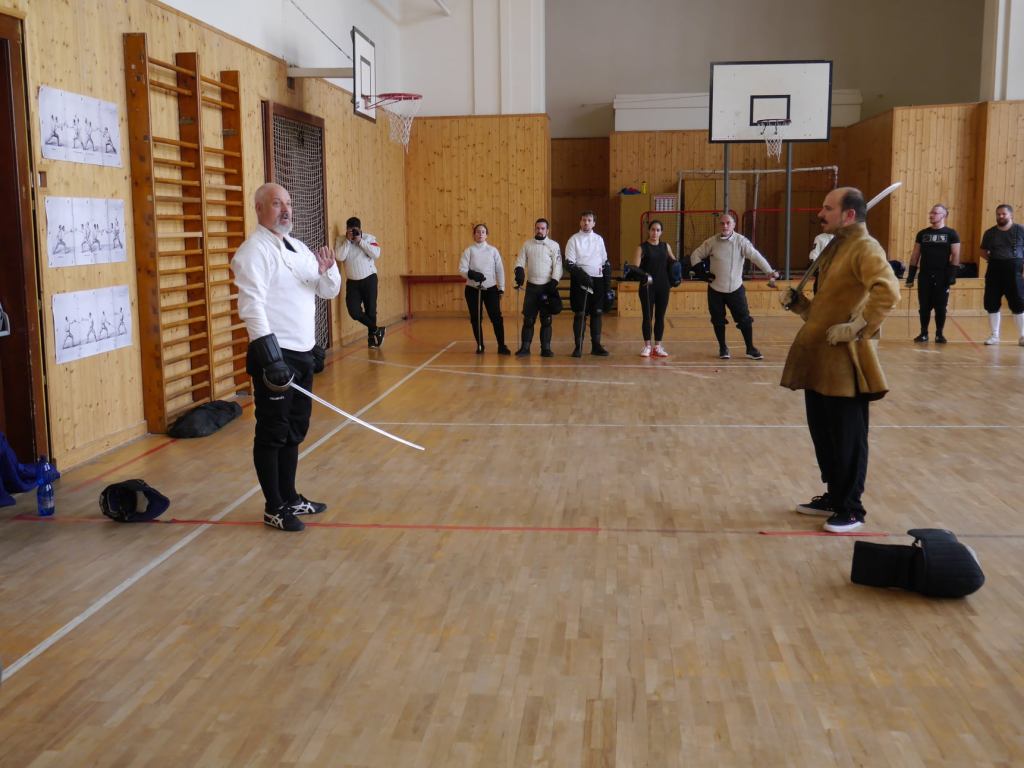
The simple answer is “yes,” all of the above, but we focus on different things at different times. There can be many reasons for this. To the person’s first question, yes, I am still a sabre fencer, though more coach than anything else at this point. My main source is Luigi Barbasetti’s _The Art of the Sabre and Epee_ (1899/1936), not only because it is the text I’ve come back to time and again since the 1990s, but also and especially because his work formed the foundation for the school in which I am a student, Barbasetti Military Sabre since 1985, headquartered in Prague, Czechia.
Between some injury maintenance and a brutal schedule in my day job, Barbasetti’s approach has, as ever, proved solid and rewarding. Nearly all my students use s2000 Olympic blades, though several use historical trainers (two have Swordsmithy’s, two those by other makes, but all hovering around 650-700g). The system is such I could use sticks.
I am not taking new students for sabre, that is true, but mostly due to time constraints–I am unable to teach as often as I was and the larger the class, the less effective the instruction. I make exceptions for visitors and for the few people who seek me out from out of town, but otherwise my focus has been on related projects, teaching, and working on some international efforts to improve both coaching and fencing.
As ever, I’m happy to answer questions, so please feel free to do so–as I did here, I’ll do my best to answer promptly and succinctly.
Wound Man from the Feldtbuch der Wundartzney of Hans von Gersdorff (Strasburg, 1519)
In two separate conversations in the last twenty-four hours the topic of martial arts, combat sports, and injury has come up. My spouse’s uncle, yesterday, remarked that when he was a teen studying TKD they viewed the semi-ambulatory middle-aged coaches as old men—now much, much older, he realizes that they were not old really, but battered and damaged from hard-training and fighting. This morning, I had a chat with a friend and college, Matt L., in California, about avoiding the very thing my uncle in law noted—early decrepitude thanks to martial arts. As someone navigating that very issue I have some perspective, and some advice for those not yet there about how to avoid, or at least forestall, the physical consequences of our training.
This is a post I’ve started a number of times, then put aside. It’s not that I don’t know what to write, but that there is so much to say, and, so little that most people will find motivating. I was no different, so if this sounds judgmental, know that I’m including myself in the censure. When I was in my teens and twenties, I could do things, and so, I did. I fought in a collegiate tournament on a sprained ankle that I taped up; I didn’t wait long enough to start training again after a slight tear in the meniscus of my right knee or years later after a chance stab wound to the same knee, one that nearly severed the LCL; I didn’t take a break, but taped and armored up my torso after a missed parry meant two cracked ribs. These were not smart choices, and, they’re choices that in one way or another I have to manage now.
Injury & Recovery
If you are injured, be it while fencing or in some other activity, take-a-break. Let yourself heal. This can be especially challenging when one is an active competitor, because the fear of losing ground, of any break affecting one’s standings, rank, or success is strong. Add to that the desire not to miss favorite events and it’s a double whammy.
You have time, use it. One “can” fence on injured joints or strained muscles, but one shouldn’t. I’ve likely stateed this on this site before, but we pay for all the fun of our teens and twenties in our forties and fifties, so, the better you manage yourself when younger, the less you’ll suffer when you’re older.
A good coach, by the way, will not only support a break to heal, but actively encourage or even order it. I’ve worked with ones who said tough it out, and, a few who told me to stop and take a break. Maitre Delmar Calvert, for example, when tennis elbow started plaguing my right arm again, told me to take a break and go to PT. Maitre Handleman just a few years ago told me and one other grey-bearded chap to take more breaks and to use walking steps during a weekend coaching seminar. This is good, proper coaching, and, good advice.
As a younger person, I fought competitively for several years in ITF conference TKD, and, at a time where the pads we had were good, but only so much. A smaller glove could easily reach through headgear; the footpads we wore had no sole, so a side-kick landed as it would in earnest; and we had no chest protection. By the age of 13 or 14 I’d had two ribs and my nose broken, never mind the damage I inflicted on people the same way. When a fellow student, a bit over-zealous, broke my nose in the practice right before a tournament, my coach—who was excellent—was more worried about my mother freaking out than the fact I’d been injured. It’s fighting, and well, we get hurt sometimes—it’s “normal.” He and another coach set my nose (NOT fun), told me to go and change out of my dobak (which was covered in blood), and to keep the paper-towel under the nostril inside my lip there until it stopped bleeding (a great way to stop a bloody nose by the way).
Muhammad Ali, a hero of mine since childhood, was “the Greatest,” but paid dearly for repeated punches to the head
We accept injury as normal, but should we? Would it not be better to prevent it? I’m not sure I have a great answer or solution. On the one hand, I’m grateful for having learned early how much punching and getting punched can hurt—it no doubt helped me avoid trouble I was likely to be in otherwise. On the other hand, as a parent, well, I don’t like seeing any children hurt, especially when it isn’t necessary. My solution has been to focus on the mental side of all this, to help students cultivate mental toughness, confidence, calm, and wisdom to avoid trouble if at all possible.
Time & Repetitive Movement
Even if you are lucky to escape injury, years and years of repetitive actions take a toll on us. At 45, I started having an odd pain in my right leg and so saw my doctor. She ordered x-rays and other tests, and turns out my right hip was in the early stages of arthritis. I thought that was crazy; “I’m only 45!” was my reaction, but she then reminded me that I had been lunging on that same leg since I was 16. How many thousands and thousands of times had I likely lunged? Never mind other traumas to that leg.
It was the same with my elbows—Radaellian sabre mechanics use the elbow as axis, and even my Olympic training retained vestiges of this approach to cutting. I have tennis elbow in both arms, ironically because in 2001 I was in a serious car accident that all but destroyed my right shoulder, and so I started training as a leftie.
Neither of these issues arose from anything improper or stupid—they are the result of activity and repetition. While some degree inevitable, depending on one’s genetics and training, there is a lot we can prevent by taking simple steps. For example, had I rested my elbows longer; had I continued my PT exercises; had I taken better care of myself I wouldn’t be in as bad a condition as I am. I’ve been slightly wiser with my hip, though it has cost me some fun—I use more walking steps than fencing stance and footwork when teaching, and, hardest of all, force myself not to do things I actively want to do. At Rose & Thorns earlier this year, I desperately wanted to bout with people, but with my hip acting up after a misstep while teaching, I know I’d be on a cane, again, if I did. Missing out on the fun makes this a lot harder, but, if I can attend in 2026, hopefully that choice means I will be able to fence people.
Be Kind to your Future Self
Many of us want to fence into old age, right up until we drop, and generally we can IF we take care of ourselves. Nothing I say or write is likely to change anyone’s mind—I didn’t listen well when I was 18 or 28 either—but I’ve reached the age where it’s now my turn to take up the mantle and sound like Chicken Little.
If you’re injured, take a break and heal. If you are fencing a lot, warm-up, stretch properly, and after your workout cool down and maybe stretch again. If you are doing stupid things, and let’s be honest, at some point many of us have, at least consider first what that choice will look like in twenty to thirty years. I can’t say for sure that twice jumping out of a second-story window also contributed to my hip issues, but… [1] Fencing with seriously garbage repro sabres in the mid-90s while understandable given interest in historical fencing, meant that injuries from them were a magnitude higher than with an Olympic or Schlager blades. Neither of the latter ever cracked my ribs, sunk into my knee, or broke my fingers protected poorly by a brass knuckle-bow. The truth is the training I received, particularly from Maestro Al Couturier and his assistants, was perfect for studying Radaellian sabre, and the cutting dynamic doesn’t need a 100% accurate tool to work—one can use an Olympic sabre, something slightly heavier, or a stick. It’s the mechanics, not the tool. [2]
Ideally, in addition to fencing one is also exercising for health. This not only contributes to your general condition and well-being, but will aid you in preventing injury. A solid program for cardiovascular health and an appropriate weight-lifting/condition regimen only help. [3]
To the examples of Masters Albert and Delmar already mentioned, I’d like to point out some of the masters I’m working under in Barbasetti Military Sabre since 1895, Josef Šolc, who is 89 years old, has fenced for 75 years and is still going.
Exhibit A: Me
In much the same way as Sy Sperling was both president and a client for his “Hair Club for Men,” I’m not just advocating that you take care of yourself, but I’m a living example of what happens when you don’t. [4] I’ve been better about it in the last decade or so, but consider how late that is—I was in my 40s when I finally started paying attention to the good advice I got from coaches, maestri, and health professionals. There is no round-trip ticket to yesterday, so I can’t undo that or go back and smack sense into my younger self, but for many of you it’s not too late.
You can avoid being the middle-aged person often on a cane, or sitting out from the fun, or taking extended breaks to fix something you made worse by not taking that break earlier. We often say that the most difficult opponent we face is ourselves, and this can be as true on the piste or in the ring as it is outside of them. It will take willpower, discipline, and strength to avoid some of the pitfalls I’ve outlined here, but it can be done. You’re future self will thank you if you start taking care of yourself now.
NOTES:
[1] Details are unimportant, but needless to say jumping out of windows, for whatever reason, if it can be avoided, should be. When I talk about being young and dumb, I speak from experience 😉
[2] This is an important point and one often misunderstood, despite the fact that most of the historical fencing community is aware that people in the past often trained with sticks. The value of using a period-weight trainer isn’t that one is required to do things correctly, but that it helps us understand why certain aspects were necessary. For example, many cavalry sabres, especially mass-produced trooper blades, are front-weighted. It’s not only harder to use the wrist to move them, but it’s a less effective way to use the weapon. Radaelli’s innovation provided a better approach. One can, however, use the same elbow-as-axis mechanics with a sport sabre or stick.
[3] Beach muscles (or would we say Instagram/Tiktok now?) are not generally helpful in fencing. One needs strength in some degree, but the real value is in muscular support of joints, the cultivation of stamina, and the side benefits for one’s general health.
In my sabre lesson this morning my student and I explored some options from the invitations in 3rd and in 4th. Like a feint, these actions (hopefully) encourage an opponent to attack where we want them to. Baseline, what we’re setting up is a parry-riposte. Against a newer, less experienced fencer, this might be enough, but a more advanced fencer will see the trap and have some idea where one might go with it. There are, happy to say, more options from this simple set-up than meet the eye.
Student’s Invitation in 4th
After the basic parry-riposte set up, a solid next step is an indirect riposte—this requires us to hold the parry before making the riposte. It is best used when our opponent is too quick to parry. For example, if we have made a few cuts to the head, even probing, or better yet from this same set up but slightly out of distance, an opponent might expect us to cut head and so they assume parry 5. If we see them do that once or twice, we can invite, parry, wait a sec, then as they preemptively parry head we strike in an open line. One of the safest strikes is to the lead arm, thrust or cut, as this keeps us back a bit and puts more steel between us and the opponent. One can, though, attack almost anywhere so long as one covers on recovering from the lunge.
Another option is a compound parry-riposte. This is closely related to the indirect riposte as it assumes similar conditions. Where the latter hesitates, the former feints. Following the example above, if one invites in 4th and parries 3rd as the opponent takes the bait, one then might feint head to cut arm, flank, or chest. The feint might be made to any line, but works best against a known proclivity. Here, again, some probing actions or false attacks can sometimes tell us which parries an opponent is quick to take.
These are all defensive responses set up via second intention. However, one question today was can one make a counter-attack from this set-up. Yes, and, no. At its root, invitations set up defensive responses, but this said there are ways to include a counter-offensive action given certain conditions. This part is critical. It is possible to make oppositions cuts into the attack from an invitation. These are similar to what we call “bearing” in Insular broadsword. Using the same example, from 4th, should your opponent attack a little out of distance or with a poorly extended arm—either one provides a bit more tempo to act—then from 4th one would but cut in such a way that one simultaneously closes the line as one lands. [1] From 3rd, one would cut across closing the inside line and landing at the same time (often this means striking the arm). It is not easy to set up as it requires the opponent to make specific mistakes, but if they do, this is a fun conclusion to the invitation.
Student Initiated Attack–Shutting Down the Trap
When we switched roles and I adopted the invitation, my student had a chance to explore ways to shut down the trap. Timing, speed, and choice of action all meet in a tight place when we succeed. Using the false-edge, for example, I did not expect, and it succeeded beautifully. Many fencers will be unprepared for that. It can made from farther away, again limiting the danger faced by the attacker.
The simplest option in springing the trap is to attack knowing they will parry-riposte, and then making one’s own counter parry-riposte. I didn’t want to complicate things, but in that counter parry-riposte one can do much the same as the person inviting: one can use an indirect riposte, compound parry-riposte, even an opposition parry and cut if conditions allow it. Naturally, one’s feet are critical in success. If, for example, my student lunged her attack, then I would take a step back to parry. If she recovered quickly, I would have to lunge to riposte; if not, I might do it from standing. Regardless, we need enough room–and thus time–to act.
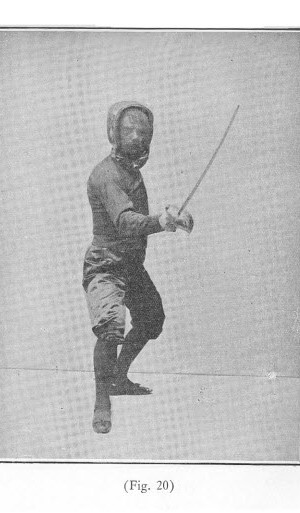
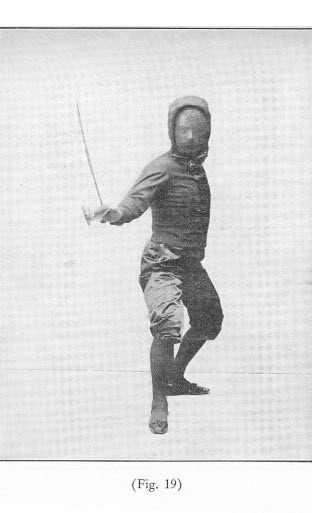
Invitation in 3rd–Barbasetti (1899/1936)
We also discussed the difference between an obvious invitation, e.g. taking 4th, and an invitation disguised to look like either incompetence or inattention to the line. For the latter, one might invite in 4th barely exposing the outside line of the sword-arm. This can appear like a lazy or untutored guard. One can feign being tired and thus sell the lazy guard too. All about selling it, a major aspect of tradecraft. [2]
If we want to invite in similar fashion in 3rd, we might hold that guard a bit too far out exposing the inside of the wrist. Many of the same options we covered with an obvious invitation apply here too, but this style is more likely to work against a fencer farther along in their training.
When we switched roles, one effective and less risky attack she made was to thrust to the inside wrist when I adopted a lazy 3rd, allow me to parry, and then thrust with opposition (usually with an advance-lunge or redoublement). If I adopted a lazy 4th, she could feint to the outside, and when I parried in 3rd cut around and cut with opposition to the arm or chest, or, make a bandolier cut and step a little back and to the right. Getting good extension on the cut—which keeps one safer—means having enough distance to extend, thus moving more back and right versus in and right.
Tactical Application
This lesson was a mix of types–we covered technique, options, and tactics. Not every lesson need do this, and in fact many should not. Today I was working with an extremely gifted fencer, one with a deep foil background, and with whom I’ve been working sabre for several years. Even today, though, in the last drill she realized she was pulling her chest cut, so we stopped and spent the last ten minutes of our time just working on getting proper extension on her cuts.
The tactical considerations for using invitations should derive from whatever intel we’ve been able to gather about our opponent. Sometimes we have next to no time–we meet someone new in the ring or on the strip and have to triage our choices via testing, probing, and false attacks. Sometimes we have had a chance to watch them fence and see what they typically do, how they respond, and larger picture considerations–are they calm? Nervous? Excited? More defensive? Offensive?
Considerations of another fencer’s proclivities is vital, because no matter how sound or expertly an action might be, it might be the wrong one to use against that opponent or at that time. For example, if my favorite action were to invite in 4th, but my opponent is likewise a defensive fighter, then we’re as likely to run out the clock as anything else. Boring. If, however, I’ve made some assessments, have some idea of how they play, then I can pick actions which might work better. If they’re more defensive, then I’ll start with the more offensive options in the tool box.
This may seem obvious, and it is, but it’s easy to focus on something to our detriment. I know that more than once coming up I had learned a new, cool maneuver and couldn’t wait to try it out, but in my zeal tried it when there was next to no chance it would work. I have been extremely lucky to work with awesome coaches, and they would ask me, post bout, why I had tried it. They knew I was working on it, but had to remind me that not every action will work in every instance.
In terms of large, obvious invitations, they can work super well, but if they’re not–don’t use them against that opponent. Today, for example, my student is far faster than I am. Even playing the invitee role I struggled to parry some of her cuts; I know how to compensate for that, but even so had our lesson been a bout I would have realized quickly that obvious invitations were a super bad idea in fighting her.
Use the right tool for the job.
NOTES:
[1]Opposition Cuts: I do not spend a lot of time on them, but they do exist, even for systems that seemingly don’t include them. Where bearing doesn’t work well with a curved guard, it works super well with a basket-hilt’s flatter guard top.
Within a Radaellian context, opposition cuts normally mean making one’s molinelli in such a way that they simultaneously strike and close the line.
[2] Tradecraft: a universal of fighting, tradecraft refers to all the intelligence gathering and mind-games we play with an opponent. In addition, it is a game we play with officials too.
In addition to being one of my favorite works on sabre, Luigi Barbasetti’s The Art of the Sabre and the Épée (1899/1936) is a core text within the pedagogical system at Barbasetti Military Sabre (since 1895). Under the guidance of my friend and colleague, Maestro Michael Kňažko, I am steadily if slowly working towards further certification as a fencing instructor, and naturally much of the material we draw upon, and upon which I will be tested, consists of Barbasetti’s take on the Radaellian corpus. No matter how long I spend time with this text, I always find some new value in it, and/or come to understand something better than I did previously.
In another post I mentioned my long-standing dependence on Barbasetti, that it was the first book I read after leaving competition, and just how great the influence it has had in my approach to teaching. When I first started teaching on my own, which is to say without being ordered to by a master, I looked to Barbasetti and Del Frate for inspiration and lesson plans. My co-instructor at the time and I would sit down and pour over Barbasetti discussing lesson ideas, adaptation for new or more advanced students, and even now as I teach on my own this is a weekly practice.
In preparation for future examinations, but also because the book contains so much, I mine it weekly for drills, lesson plans, and exercises. This past week I decided to take my sabre students through a drill I had never had any of them do, a drill I have not used probably since 2016, namely, working from the invitation in 5th.
Invitation in Fifth
There is some fuzziness between the guard, invitation, and parry of 5th, and on first glance they may appear the same, but they are not. For the most part, 5th does not constitute a guard, least not one anyone typically uses—held above and out from the head, to hold it long would be tiresome and limit one to certain actions. Second and third are vastly superior guards. As a parry 5th is the stand-out, standard head parry, one of the first we learn. Though unusual, the invitation of 5th is valuable, and while seemingly too open to be realistic, this is a false conclusion. Moreover, the benefits for working out of 5th go beyond the tactical use of the invitation.
Here is, verbatim, the drill as Barbasetti laid it out:
In devising my sabre lesson this week this is the example with which I started. I changed a few things, added a few things, but this was the core of the drill. Post warm-up, the first thing I did was have the student invite in 5th. This meant that the student more or less assumed the parry of 5th. [2] I would attack, first with a thrust, then a cut, and the student would drop from the invitation of 5th to the parries of 2nd or 1st depending on where I was aiming. As two of the “first triangle” of parries, and working from the third, this is good foundational practice for covering those lines, and effecting good ripostes.
Next, we switched roles, so that the student made the attack. This portion of the drill was meant to help them work a simple feint. In 5th, everything below is open, and so there are myriad feints one might make. I had them start with a feint thrust from 2nd, and when I dropped to parry in second, the student made a molinello to the head. While this can be done from the lunge, I had them work this from advance-lunge range. This means that the preparatory action, the feint, was best made on the advance to force me to cover, and once I had, they could lunge with the actual attack. Since we spend so much time at this distance, it’s a good practice to put everything together in real time. From a stationary distance, we then moved back and forth and the student decided when to launch their attack, again, in an effort to resemble the conditions of a bout more closely.
The variation we added was a feint cut to the flank, which again I could cover in 2nd, and which allowed them a chance to cut to the top-inside of the arm or head. A critical aspect of this version is coverage after the attack. Increasingly I have added in counter-measures to prevent being hit by suicidal fencers. The fetish for the “after-blow” and the practice of doubling when one is ahead in competition, while insipid nonetheless provide an opportunity to pay better attention to the dictum “don’t be hit.” Ever. In this case, a student might cut to the head, then cover in 4th as they recover out of the lunge.
Next, the student feinted with a thrust or cut to the inside line to draw me into parrying in 1st. This version allowed the student to work on cut-overs, either with a thrust in 2nd and with opposition, or, a rising cut to the flank or bottom of the arm. To extricate themselves and avoid an after-blow, etc., a slight step left as they thrust with opposition or cut via molinello, moves them a bit offline, but also allows them a tempo to drop into 2nd or 5th depending on what response I give them.
Drills like this afford instructor and student a lot of options. They not only exercise fundamental actions, but also provide opportunities to work on getting to target and back out again safely. If a student is newer or struggling with the first action, one can stay there and work solely on that. If it is easy and they can perform the action with ease, one can build from there. Moreover, there are ways to make the lesson an exploration of tactical options, both offensively and defensively.
Often, and we see it in this case, the details provided in the drill are minimal, so the onus is on the instructor to know every aspect of each action, each idea, and how they can be combined and applied. As a final note, a drill such as this one provides a template for similar lessons, but in other weapons. My theme this week in smallsword was different—we worked almost exclusively on getting to target and back out safely—but looking over my notes I see that the actions I chose to drill all that were essentially the same actions I used in the sabre lessons, only with modification for the requirements of smallsword.
NOTES:
[1] Luigi Barbasetti, The Art of the Sabre and the Épée, New York, NY: E.P. Dutton & Co., Inc., 1936, 69. This is the fifth example in his section on feints with the cutting edge.
[2] In 3rd, for example, the invitation could be just being in guard, or, taking a poor 3rd, say leaving the inner or outer arm just barely exposed, the idea being to project a sense that one is careless and doesn’t know they’re open. One can merely take the parry position in 5th.
I have the deep honor to announce that I have officially joined the ranks of our sister school, Barbasetti Military Sabre (since 1895), based in Prague, Czechia. Though already close to the school, and counting Maestro Michael Knazko a dear friend, I’ve been keen to strengthen ties and build bridges, and this seemed an important, logical next step.
Moreover, it is a fantastic way to continue learning, as the maestri there are talented, experienced, and excellent ambassadors of the Art.
I am very pleased to share good news from my esteemed colleague Michael Kňažko–he has passed his master of arms exam!
Blahopřeji!/Congratulations!!!
Photo/fb post courtesy of Mike Cherba
Michael is one of the masters at our sister school, Barbasetti Military Sabre (since 1895) in Prague, Czechia, and a dear friend. See the link in “Our Sister School and Affiliates” for more information.
Sala delle Tre Spade & Barbasetti Military Sabre since 1895, Partners in Fencing
This weekend our sister-school, Barbasetti Military Sabre since 1895, based in beautiful Prague, Czechia, will host its annual event: SabreSlash! Day one consists of classes; day two presents a cutting event, the Zabłocki Sabre Tournament, and the highlight of the day, the Moustache Challenge, easily one of the more difficult historical fencing contests.
This year Michael Kňažko of Barbasetti Military Sabre is joined by another close friend, the excellent Patrick Bratton (Sala della Spada, Carlisle, PA). Patrick will be exploring Radaellian actions on the blade. They are joined by several other instructors, including Maestro Leonid Křížek (CZ), and Leonardo Britto Germoglio (D). Here is the full program:
SabreSlash 2022 program:
Saturday, October 1st – ”Actions on the blade in Radaellian sabre”, workshop led by Patrick Bratton, Sala Della Spada, Carlisle, PA, USA.
– “Akademische Fechten”, workshop led by Leonardo Britto Germoglio, Germany.
– “Molinelli in Barbasetti sabre”, workshop led by Leonid Křížek, Barbasetti Military Sabre (since 1895), Prague, Czech Republic.
– “Sciabola in Mano, controlled and conserved strength for cuts and thrusts”, workshop led by Michael Kňažko, Barbasetti Military Sabre (since 1895), Prague, Czech Republic.
Sunday, October 2nd – “SabreSlashing with light sabres”, test-cutting workshop
– “SabreSlash Moustache Challenge”. All gentlemen are encouraged to attend the event wearing a fully grown Ferdinando Masiello style moustache. The wearer of the most classical moustache will be awarded a very special prize.
– „ Zabłocki Sabre 2022“. The biggest Barbasetti sabre fencing tournament since the legendary 1895 Prague military fencing tournament organized by k.u.k lieutenant Dominik Riegel. The winner of the tournament will receive a brand new Swordsmithy practice sabre.
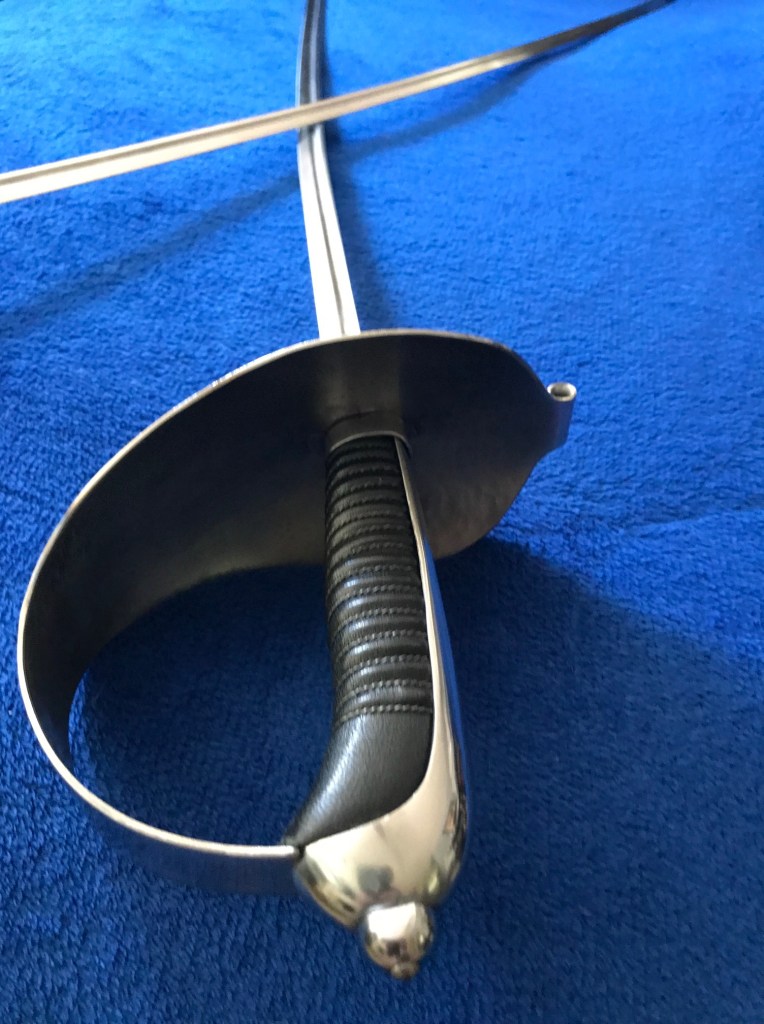
Guard Width at Widest: 9cm/3.54”; at mid-Knucklebow, 3cm/1.18”
POB: 9.5cm/3.74”
Weight: 663g/1.46lbs
Materials: steel, wood, leather
I had the privilege to borrow one of these excellent sabres in October 2021 at SabreSlash in Prague, Czech Republic, for several days. For handling, my portion of teaching day provided me a great opportunity to assess balance, heft, and nimbleness. Thanks to a bad leg which acted up, I was unable to bout as much as I should have liked, but did bout with one the redoubtable reenactors from Warsaw, Poland, Jaroslaw Kubacki from Kompania Czarnej Szabli (Black Sabre Company). As the photo demonstrates, he was using a larger sabre than I was, but the Swordsmithy sabre held its own well. In brief, these are fantastic sabres, well worth the cost (they’re handmade) and wait.
Handling
Despite ”HEMA’s” obsession with beefy, heavy sabres, most sabres intended for more than chopping from the saddle were lighter and more nimble than our trainers. J. Christoph Amberger provided a nice, small survey in an article in Fencer’s Quarterly Magazine that concluded that the difference between say Italian “featherweight” sabres and “other, heavier German-made broadswords” was about as much as a block of chocolate. Humor aside, his sample ranged from 1350 to 300g for the period between 1780 and 2000. Anecdotally, the historical examples I own or have held confirm that most sabres were not the clubs modern reproductions would have us think. Swordsmithy sabres, because they are handmade, vary slightly in weight, but the six in my order weighed on average 660g, which is within the typical range for sabres of this period. [1]
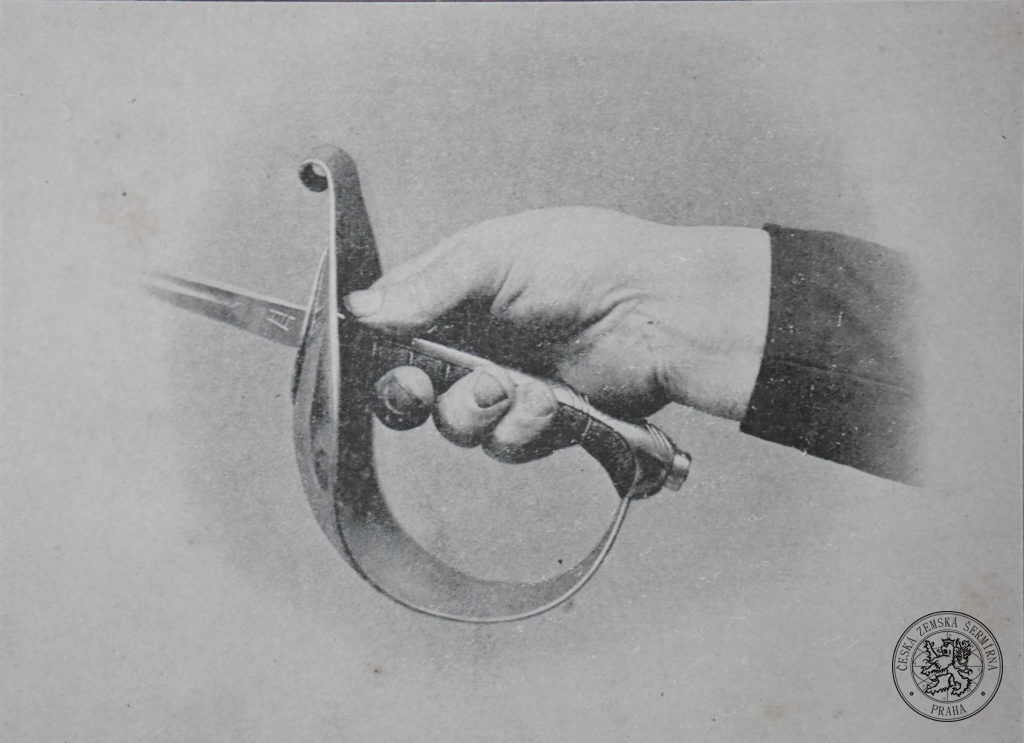
The balance is perfect for Radaellian/late period Italian sabre, but will work equally well for many other traditions. The model for these sabres is a Viennese sabre similar to what we see in Luigi Barbasetti’s The Art of the Sabre and Epee; it was a common trainer used in the Austro-Hungarian Empire. [2] My class at SabreSlash focused on various uses for the molinelli, the elbow-driven cuts that are a hallmark of this system. The Swordsmithy sabres performed perfectly, whether for molinelli as exercise or as offensive or defensive maneuvers.
Sabre in Barbasetti, courtesy Ars Dimicatoria, CZ
One of the best features of these sabres are the grips. They are large enough for normal hands, a clear advantage on most options out there today, and comfortable. The slight swell mid-grip makes for good purchase on the grip, and the ribbed leather seats nicely against the glove. The steel backstrap is solid and close to if not identical to original examples. The only change I might suggest is to score the portion where the thumb rests with some manner of cross-hatching to make one’s grasp that much more secure. However, so long as one wears a glove there’s no need for cross-hatching. The Swordsmithy’s grip is my favorite of all the options available now.
Durability & Performance
There’s no criticism I can make about the way these sabres handle and hold up in use. They’re stout, well-made, and perform equally well against different sabres as well as when a matched pair. It is saying something that Michael Knazko, one of the people behind Swordsmithy Sabres, has used the same six weapons in the tournament portion of SabreSlash three years running. I challenge most other events to make such a boast. [3]
The one major difference with these sabres is the hardness of the blades. Some fencers will balk at this, because most other options are made in such a way that when a sabre bends badly that’s that; we replace the blade. Swordsmithy sabres, however, are so constructed that one can beat the blade back into shape. I have seen this myself: one of the background sounds at SabreSlash is the ringing of Michael’s hammer as he beats a sabre back into shape on a lead plate (wood works too). There is an art to this, but it is easily learned and with practice easy to do. It is, however, more labor than many fencers expect or may wish to take on, though to be honest much of this depends on how they are used. Tournaments, for example, tend to be higher stress than practices, and some fencers struggle to fight with control; they hit harder and the weapons take more abuse. This matters. The fact that Michael has used the same six sabres, in such a high stress environment, speaks volumes for the design Swordsmithy has selected.
The guard is stout, strong, and well-shaped. They’re ambidextrous, a real plus for those of us who fence right and left-handed, and wide enough—assuming good structure–more than ample to cover the hand when parrying. On a personal note, I really like the hammer marks barely visible on the inside of the guard. The thickness is perfect and more than sufficient to parry a hard blow.
The blade length is just right for most systems, and the width well within historical parameters. The tip is constructed for safety, being wide enough that it’s extremely unlikely to pierce safety equipment. [4] I prefer spatulate tips, but even without this these blades—assuming normal practice–more than meet safety requirements.
Conclusion
Swordsmithy sabres are worth the cost. In the US, they go for about $390 which is expensive compared to the offerings from popular options such as Hanwei. They are, however, better made, and handmade, and this explains the price. Castille Armory’s “Italian Dueling Sabre” is, at the time of writing, $490; Darkwood’s sabres are $360. [5] Until I handled the Swordsmithy sabres the Castille was my favorite–they’re good blades and the guards, while undished, stout.
My go-to now, however, is this Czech-made trainer. They are not inexpensive, and the temper on the blade requires more work on part of the fencer, but in terms of longevity alone these blades will last longer than most others I’ve used, and, with fewer problems. Swordsmithy sabres are worth the cost.
On a side note, shipping in and out of Czechia can be pricey, but ordering more than one at a time (two friends and I went in on an order) helps. Michael packs these weapons well and they arrived far faster than I expected.
Notes:
[1] See J. Christoph Amberger, “Inference and Imposition: Anachronism in Fencing Historiography,” in Fencer’s Quarterly Magazine/FQM (Summer 2004): 25-28. Amberger sampled 17 weapons (p. 26), the heaviest at 1350, the lightest at 300, with an average of 682g.
“The weight difference between the Radaelli and the lightest German Fechtsäbel–exported in large quantities to and used in Britain throughout the late 19th century as practice ‘broadsword,’ is only 40g. The much-vaunted 1796-model British Light Cavalry sabre weighs in at only 80g more. And the weight difference between the Italian ‘featherweight’ and other, heavier German-made broadswords and the model 1899 British Gymnasia Pattern practice sword corresponds to that of a bar of Milka chocolate.” [26]
A more recent tally, the spreadsheet maintained by Maestro Kevin Murakoshi, examines both historical examples and modern reproduction trainers, and here too we see more sabres in the 600-800g range. The examples over 1000g are all trooper sabres and thus not so much meant for “fencing” as braining retreating infantrymen.
[2] Luigi Barbasetti, The Art of the Sabre and Epee (1936), was published earlier in German (1899) and Italian. NB: my thanks to Chris Holzman for the correction as to type.
[3] In contrast, at an open sabre tournament in 2017 multiple Hanwei and Coldsteel sabres were broken; this was also the first time I’d seen anyone obtain a concussion in sabre.
[4] I say ”unlikely,” becauase it depends on how one fences. In Radaellian sabre we use the point a lot, but learn in such a way to minimize risk. Any sabre might potentially damage someone or equipment. Hanwei’s ”Hutton” sabre and Darkwood’s ”dueling” sabre blade both present a danger, the first because it’s tip is pointed, the second because the tip is too thin and is not wide enough. Twice I have had a DW blace pierce a glove while giving lessons.





 Capitale Escrime Historical Fencing