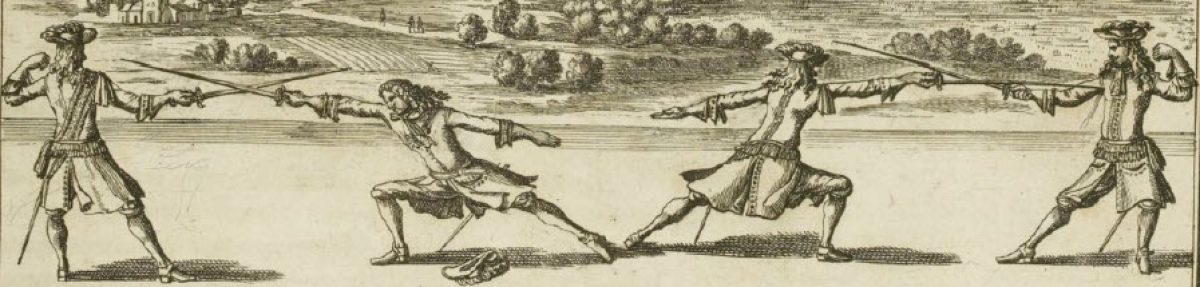
Tag: Fencing culture
Masks & What Matters
[I’m not a fan of “trigger-warnings,” but as most folks who read this page read it for fencing, this post has a fair amount of politics as they relate to sport, etc. Unless you’re up for reading a beat-down of right-wing idiocy, don’t read this]
This summer’s Olympics have witnessed considerable controversy, from artistic choices in the opening ceremonies to some truly strange debates over sex and gender. I won’t waste anyone’s time with my views on artistic expression, but I’d like to address the vitriol a few man-boys have made about female athletes, gender, and athletics. As a coach, as a human being, and especially as one who works with a diverse clientele, I have a responsibility to do right by them.

Predictably, the men whinging most are the least fit intellectually or physically to attack a world champion like Simone Biles or Imane Khelif. I have no idea what made them so intimidated by women, but regardless of cause there’s zero justification for it. These idiots make the rest of us look bad, and I resent that. Having been raised by a single-mother; having only a sister as sibling; having had mostly female teachers and bosses; and having been fortunate to marry a woman who deserves better than me, it’s possible that I’ve just been super lucky to see how empty any notion of female inability is. Whatever the reason, it’s important to show my colors, not just to reassure my students, but because one cannot sit on fence when it comes to bigotry.
I am not female and will not dare speak for women. [1] Women are perfectly capable and happy to put morons in their place, and I don’t wish to be lumped in with the morons (not any more than I might be already). With that caveat, I have some perspective on sex, gender, and sports, and think it is important to offer some real-life examples for the simple men who likely have not worked closely with women. Moreover, at the moment, most of my students are, or identify as, female. Most are young, between the ages of 11 and 15, so there is an added impetus to be a good role model and influence.
As a middle-aged, cis, white chap there is an important responsibility on me not to be part of the problem. It seems like common decency to me to support, advocate, and build-up my students, especially as there are so many men who look like me spouting horseshit. Often, these same clowns are vocal, loud, and quick to say things that can hurt regardless of the fact there is no truth to them.
Persistent Perils
I don’t follow the news much, because with treatment resistant depression the news does little to lift my mood, but I follow enough to know that athletics, across the board, continues to be plagued by horrors that should never happen anywhere. From coaches molesting their young charges, to sexual harassment of colleagues, to downright dismissal as serious competitors, women face a disproportionate amount of abuse. It’s utterly shameful.
We are making some progress, but we clearly have a long, long way yet to go. Organizations like Safe Sport have done much to increase awareness of the issues, and importantly, educate coaches about better, more professional and appropriate interactions. This, of course, won’t fix creeps, but it can reduce both unintended line-crossing and foster both better awareness and behavior.
Real change begins with us, each of us, in our homes, at work, with friends and family. Not to wax hippie, but we have to be the change we want to see. It won’t convince everyone, but it will convince someone.
Sex, Gender, and Fencing
Historical fencing falls under the general heading of “combat sports,” and traditionally such pursuits are a “male” arena. Despite historical precedent, science, and good sense, there are still men quick to say that while women might play sportsball, they have no business boxing, or wrestling, or using hand-to-hand weapons. Claptrap.
Absolutely women should be able to pursue these arts. There’s no reason why they shouldn’t. This is especially true where weapons are concerned.
The truth was summed up beautifully by Francesco Marcelli in 1686:
Vis enim vinictur Arte
“For strength is conquered by Art.” [2] The use of weapons changes whatever physical advantages one was born with—it does not level the field automatically, but it can, and, regardless of whatever one has in the way of genitalia. In many martial arts, size and strength play a greater role, and so weight-classes, age brackets, division by skill level, all characterize competition. This is sensible. A 5’ 9,” 140lb woman might be plenty strong and skilled, but in grappling arts she will be at a disadvantage against a man 6’ 5” and 350lbs. Put a weapon in her hand, though, the math changes.
Sad as it is to say, I remember when women were finally allowed to fence epee and sabre. It’s not that women didn’t dabble in these weapons, but that they could not compete. It was not until 1996 that we saw women’s epee in the Olympics. Women’s sabre did not appear in the Olympics until 2004! Up until then, the only weapon women were allowed to compete in was foil. It seems ludicrous now, and it should, but these changes only happened twenty to thirty years ago.
You are a Mask
Outside of severe physical or mental limitations, anyone can and should be allowed to fence, box, or wrestle. One advantage to fencing is that the addition of a weapon can—again can—mitigate size and strength differences.
In my classes, in my lessons, everyone is a MASK: their sex, gender, sexual orientation, all of that is largely irrelevant. Not unimportant, but in the context of what we do—fencing—irrelevant. Identity makes no difference. In the HBO series “Game of Thrones,” Aria’s sword-master, Syrio Forel, shares a similar view. When his new student remarks that she is a girl, he replies “Boy, girl… You are a sword. That is all.” [3] Though fiction, the author, George R. R. Martin, shares a truth most serious martial artists know–skill is skill.
For me, the acquisition of skill is challenging enough without adding additional hurdles—as a mask, one has only one task, one focus. In the salle/sala, the only concern is growth.

In truth, there are still some considerations; anatomy, for example, sometimes dictates decisions about safety-gear. Women with larger chests, for example, often struggle to find suitable protection. Most of the off-the-shelf stuff is one-size-fits-all, and I’m told uncomfortable to wear. There is a major opportunity for an enterprising person to devise better solutions for chest coverage.
Every body is different, regardless of sex or gender, and so my job as a coach is to help each person find a way to stand and move that takes into account their unique shape. If one’s hips are a little wider, fine, then try standing a bit more square versus in profile. Likewise, if one’s chest is broader, one may have to turn at the hips to make an inside parry. If one is recovering from injury, has balance issues, whatever, there are ways to make it work most of the time.
Mask & Culture
Happily, the culture I’ve worked hard to create has tended both to minimize problems in class and scare away people who don’t share the same values. Advertising one’s stance on key issues, as I do on this site (go to “About Us” and scroll all the way down), does much to send bigots packing. It’s rare, but on occasion I have had to reeducate young men who “didn’t want to fight a girl” or had something outdated to say about either the ability or suitability of women in combat sports.
As I’ve remarked here before, I’ve fought alongside female martial artists all my life. When my formal training began, so did my sister’s. In college I fought alongside female fencers. I know women in a variety of martial arts, from fencing to BJJ, and a lot of female coaches and club-heads. They are my colleagues, peers, and friends. Their identity as female, again, doesn’t weigh into things for me because what matters is their ability and outlook. If we share the same values and they’re good at their job, then great.
There is only one place where I feel I need to pay more attention to their identity—as an ally. This is true as colleague, coach, or student, in any role I assume. This is to say that men should advocate for their colleagues regardless of sex or gender, and, regardless of where that man is in a hierarchy.
At my age, I have seen a diverse range of behaviors towards women in sports, some great, some bad. Current politics in the United States has reached a point where it’s no longer enough merely to support—one must act. What one does may not be national or international in scale; it may be local. As an obscure coach in a small city next to miles of vineyards and hop-fields, I see firsthand, every day, the very same problems we see on a national scale. My focus, thus, is here, helping where I can, as I can. I do my best to model a better way for my students, and, I do my best to create an inclusive, safe atmosphere in which to learn.
I don’t talk about any of this much, because being an ally is something one does, and in a day where “virtue-signaling” is as ugly as a running mate plugging a book arguing that “progressives” are “subhuman,” I’d just rather not contribute to useless, ego-driven posturing. [4] Ideally, advocacy comes out in all that we say and do. I’m talking about it here because the comments about Ms. Khelif, the addition of a new student in my sabre class, and the observations one of my 12-year-old female fencers shared last Sunday highlight the importance of the issues. Each example highlights either the problem with attitudes toward women, as was the case with Khelif, or, gives the lie to ideas that women might be less skilled or knowledgable.
From the Mouth of Babes (NB: “babes” in the age sense)
To give the lie to the idea that women have no place in sports, I submit the following, recent examples. First, there is a 15-year-old female fencer who just started attending my Sunday sabre class. She has worked with me for several years via the parks and rec class, but she caught the bug—she loves this stuff, wants to do more, and is keen to improve. In consultation with her parents, I invited her, and them, to the class. [5] When I told the existing students we would have a new fencer, they were excited as it’s been a while since a new person started.
To my delight, they greeted her with open arms, and couldn’t wait to work with her. She soundly defeated the three boys who were there. I am not one to crow, but if I may, I was so proud of all of them. She acquitted herself super well, and was gracious in victory. For the boys—they were thrilled to meet so good an opponent. They complimented her fencing and told her that she would love fencing G., my longest attending student.
This past week, when he returned, everyone had trouble focusing on drills because of the anticipation of what all expected to be a high-level bout. My most experienced student found a serious challenge in the newcomer, and at the end extended his hand and complimented her. She is one of them now, as if she had always been, and for me if I have done nothing else right, I have at least created a safe, healthy culture for these kids however they might identify. They’re mutually supportive, humble, eager to learn, and enjoy a good challenge. If they don’t fence later in life, hopefully the environment in which they did fence, and the implicit lessons they’re learning, will stay with them.
As a second example, in an earlier class that day, the youth foil/smallsword class, one of my 13-year-olds wanted to talk about the Olympic fencing she had seen on tele. Her first question was why everyone was hopping about like rabbits and failing to extend the arm on the attack. I nearly cried with joy. We then discussed why what we do seems so different from what they’re seeing in Paris. Since the mid-1990s I have tried, largely in vain, to argue with other adults for the time-honored wisdom of extending the weapon first, and here was a room of young middle-schoolers who not only understand it, but also can call out the very same issues when they see footage of modern fencing bouts.
Sports, Identity, and a Healthy Society
Within that discussion, we discussed the issue of people gravitating to what is easy versus what is hard. In explaining why modern fencing allows silly things like not extending the arm we discussed how hard it can be to change large organizations, to change what people find comfortable, and what benefits those in control. Change, all change, begins with an individual. Working together we can do more. This rounded back to why we look at things the way we do in our club. I have always reminded them that what we do is super difficult and takes a long time to learn and do well. They know that one is never finished learning. Our way is harder, but richer.
There is a real-world parallel. Bigotry is generally born of ignorance and fear. It’s lazy, comfortable, easy. It takes zero strength or courage. It is harder to rid oneself of bigotry if one benefits from it. These are the reasons it is so entrenched in American culture, and, one reason many people are so afraid. It takes courage to face something or someone new. It takes courage, strength, an open mind, and a willingness to change one’s stance given new data. Much as I don’t want a bunch of bigots at my sala door, I would honor the chance to introduce them to people that terrify them and let them learn for themselves that regardless of gender, sex, race, or sexual orientation, they’re all just people.

Traditionally, fencing is male dominated, and a “white” sport, but it hasn’t been that for a long time if ever. History recounts a number of female fencers, fencers of color, not to mention some pretty fluid gender identities. Whether we’re talking about one of my favorites, Julie d’Aubigny—better known as “La Maupin”(d. 1707), or the Chevalier Saint-Georges (d. 1799), who was of color, or the Chevalier d’Eon (d. 1810), who wore women’s clothing, fencing has never been exclusively male or white. More recent history indicates just how much it has all changed– Peter Westbrook, Ibtihaj Muhammad, and Sada Jacobson are just a few examples.

after William Ward, after Mather Brown
reproduction of mezzotint, original published 1788, National Portrait Gallery, London
The Person in the Mask is a Person
Despite my being an old white dude, over the past few years more young women have enrolled in my classes as have many LGBTQIA+ fencers. Not all stay, but some do, and that is significant. There is no magic involved—retaining anyone comes down to one simple factor: how we treat them. Honor another human being as a human being, as a person. It has proved important for several reasons.
First, I have been told by several LGBTQIA+ fencers of the relief they have felt in knowing they are free to be themselves, and safe, at my school. Locally, the past few years have seen increased hostility towards any student that is not white and straight. The effort by alt-right school board members in my city, for example, to ban any symbol but the American flag was a clumsy attempt to ban both Pride and BLM flags. [6] I got involved with this as parent, educator, and coach, and like others ended up the blacklist of one alt-right supporter. No one shares a list like this on the internet to send one cake…
TWO of my students at the time were directly affected by this. One, who bravely spoke up during one of the virtual board meetings, told me his heart about sank when he saw me on screen, a wall of books and a giant American flag behind me—it’s our flag too, and, propaganda works both ways. He was relieved when he realized that I was sharing the same message of inclusion he did. Another student ended up moving when one of his parents, at the time involved in education, received death threats. I could not let these students down, I didn’t want to let any child down.
Second, I have no illusions or fantasies about my role. I’m a recreational coach in a small, rural city, and while I have had the great fortune to work outside it, even in other countries, what will matter most in the end is the impact I have here. Each generation, if it’s on its game, does what it can to help and prepare the one to follow. I want these kids to grow up and inhabit a world where we see less of the idiocy around sex, gender, and sexual orientation. It causes so many people so much pain, and for the lamest of reasons. We can do better, but only if we ourselves actually do better, and, give these kids a map for social interaction that emphasizes their common humanity. My hope is that what little I can do will help, at least enough so that when they leave the salle each week, they will carry some of the lessons with them they learned while in their masks.
NOTES:
[1] Someone like me can support, can advocate for, and stand with women, but as a male I have no business speaking for them. That has always been part of the problem–witness the idiocy of men determining national and state policy with regard to women’s reproductive issues and rights.
NB: in using the term “women” I mean those born so or who discover that they are. Each person has the task of determining what their identity is, and yes, in some cases it may change or defy easy definition. So what? Regardless of how they identify they’re a fellow human, and that is what matters.
[2] Francesco Antonio Marcelli, The Rule of Fencing, Book 2, Ch. 1, 55-56 in Holzman’s translation.
[3] Game of Thrones, HBO, “Lord Snow” S1: E3.
[4] The alt-right rejects data, evidence, and reason. Denying facts is not disagreement, but willful denial of fact. Everything comes down to their “values.” As an historian who spent a lot of time studying the early church, I especially challenge them on their persistent use of OT lawbooks rather than the NT commands of Christ. Lists of dos and don’ts are easy, convenient, and do not require one to think or choose. The second great commandment Jesus laid down was to love one’s neighbor as oneself. He didn’t include exceptions. Moreover, he expressly told people not to judge others. Somehow, though, judging others and choosing exclusion over love and understanding defines their “Christianity.” On a similar note, the cover of the book Vance touted features a hammer and sickle, a nod to rightwing fears of Commies. There are no commies. Both of them are keeping pretty quiet right now. What we do have, and what the DHS and FBI have released reports about, is the great danger we face from right-wing terrorists. But again, facts don’t matter to them.
[5] Complete transparency is an absolute must when working with minors. I encourage parents to stay for practices—it reassures them, often makes the kids more comfortable, and no one is better to help a child with an ill-fitting jacket or the like than one of their parents. If a lone child is waiting for a parent, we wait outside at the grange or in the public lobby if at The Aquatic Center. There should never, ever be any question as to one’s ethics. Working with children is a sacred trust and must be honored as such.
[6] The damage that the alt-right members of the school board did has been considerable. This was, of course, part of the plan—fascism thrives best where people are not educated in anything other than party dogma. Two articles should suffice to explain the issues:
Budget Crisis: https://www.kgw.com/article/news/education/newberg-school-district-faces-more-than-3-million-dollars-in-debt/283-4639e728-df91-4082-80be-487fc871df9b
Alt-Right on the School Board: https://www.oregonlive.com/education/2023/11/trial-begins-challenging-alleged-secret-meetings-to-discuss-firing-newberg-schools-superintendent.html
Just this weekend, so 17 Aug., a LGBTQAI+ student informed me that my attitude is one reason she has stuck with my program. I honor her for who she is, and while I will fight to the death to protect her right to love whomever she might love, the fact of her orientation is, again, irrelevant in learning fencing.
How to Tournament, Deuxième Partie
[This is a continuation of the post “How to Tournament” posted yesterday (19 June 2023)–much of what I say here has been said before, including by me, but since it is on theme, here it is anyway]
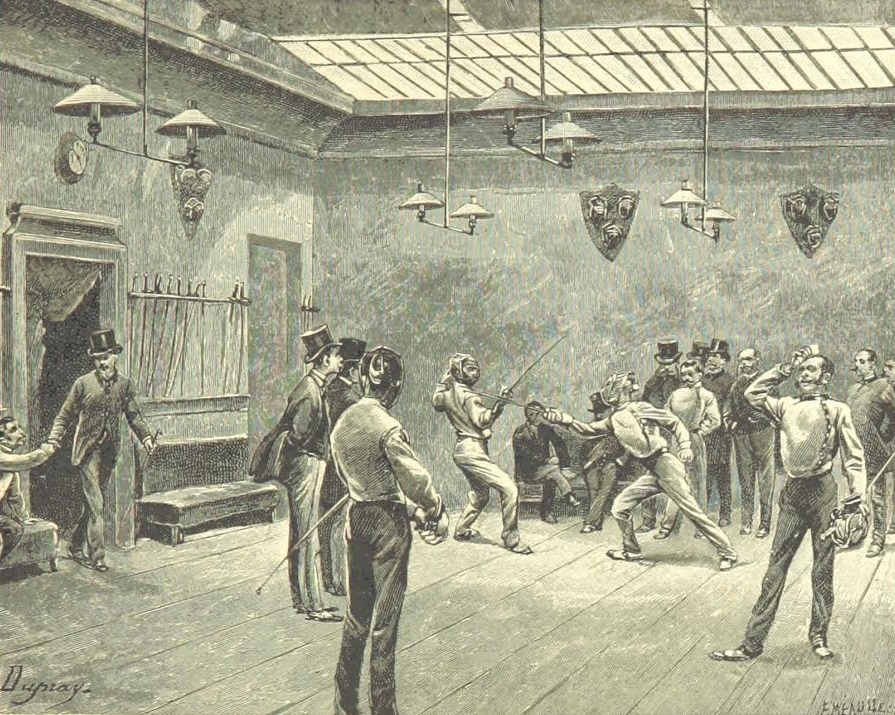
In part one of “How to Tournament,” I focused mostly on intelligence gathering and assessing the competition. Here, I’d like to discuss mental preparation, a topic covered earlier in part by the “The All-Important Place of Calm” [15 May 2023, https://saladellatrespade.com/2023/06/19/how-to-tournament/]. The approach to managing emotion is key here too, because nerves, excited or fearful or nervous, can derail us no matter how well-trained we are or ready we are to compete and succeed. One way to think of it is akin to drill. We tend to fight as we drill, because we condition ourselves to respond to certain actions and situations and reinforce this via repetition. We can do the same thing mentally—without meaning to sound like Moonbeam the Hippy or some faux guru on tele, cultivating calm and simultaneously picturing ourselves in an event, start to finish, and in specific instances of action, can do much to help us the day of the event. What is familiar is less likely to unsteady us, so from physical training to mental training, we can make even competition just another day sword in hand.
Calm, Revisited
Not to repeat the earlier post, but calm is something we can choose and practice like anything else. In this instance, this means consciously focusing on one’s place in the event and when necessary supplanting negative emotions (nerves, anxiety, fear, whatever) with concrete thought. For the first, visualizing our performance, from the moment we enter the event to specific actions, beforehand can do a lot to prime us. It’s not magic (sorry Moonbeam). Whatever other benefits visualization may have, the process of making something familiar helps remove uncertainty. The more we know something, the more comfortable we are with it, and thus, the less likely nerves take over. [1] [yes, I did just repeat this… see? repetition!]

When nerves pop up, and they sometimes will, we’re better prepped to manage them having already envisioned the situation, but we can apply active replacement too. This requires noticing, consciously, that we feel nervous, and then pausing to distance ourselves long enough to set that emotion aside and replace it with something more useful. For example, Fencer X has just completed the first pools, and is nervous about the second. The competitors here are strong and Fencer X begins to doubt. Noticing this, Fencer X stops, takes a deep breath, and says to themselves “No. Focus on what you know. You’ve seen these people fight; you know how to counter them. Relax and have fun.” Conscious thought, that focus, can—with practice—remove some degree if not all of the negative emotion that undermines us in a fight.
Constructive Visualization
In no way is this a nod to crystal-thumping charlatans; I draw upon a few sources for this, but maybe the most important being well-attested memorization protocols. [2] Self-help books from the 1980s aside, all this is really is a form of meditation, just very focused meditation. Simply put, one focuses on imagining oneself at the event. If one can visit the venue first, that helps—gives a face to things. It might help to visualize oneself entering the facility, full of calm, and warming up. Next, one might visualize a specific action one’s been working on lately and successfully executing it in a bout. Perhaps an entire bout, maybe even against a specific opponent, is worth contemplating.
None of this determines the outcome, but what it does do is prime the mind for action and reduce potential nerves. Ideally, one gets on the strip or steps up to the ring and is utterly calm or maybe just in state of happy excitement. One can tell, by the way, when this happens. It shows. I have found in competition, as well as in at least two actual fights (fists, not swords), that steady calm can utterly unnerve some opponents. Calm suggests confidence, and with that, skill. This can affect what judges see too (remember: competition is a game, as psychological as physical if not more the former). [3]
Pre-Tourney Practice
In conjunction with mental preparation, one normally trains physically before an event too. This exercise may take place during regular practices or within individual lessons if one is taking those, but people often add additional drill in the mix too. Much of this may be one’s normal cardio and/or weight etc. training—all ideal times by the way to visualize things the day of.

For those practices focused on fencing, emulating the warm-up or pre-competition lesson tends to work best. This style of lesson is similar to a technical lesson, but the goal is to build confidence in the fencer, not to impart new skills. Keep things simple and focus on those actions a fencer does best—drill so as to make these actions as crisp, tight, and well-timed as they can be. Warm-up lessons are also typically short, maybe 10 minutes, tops 15. My approach in the past has been to include some of these types of lesson a few times in the weeks leading up to an event. The week of, we focus hard on these things, and, anything that the fencer may have had trouble with in the past. [4] The day of the event, I would have them warm up, then put them through the same short, 10 minute warm-up. Like contemplating success, this style of lesson has them work things they do well, all of which build confidence and ready them for the pools.
Intent, Expectations, and Take Aways
As in so many things, we get out of them what we put into them, but added to this much comes down to how we do this, what it is exactly that we invest. I tell my students and any colleague I prep for an event, to set goals. What do they want out of this event? How does it fit into their growth and experienced as a fencer? Laying all that out helps set expectations for an event, and thus, helps prevent the common distractions that come up when things don’t go as planned.
Versatility is a vital skill for any fighter—if weapons break, does one have a backup? If one’s tactics are failing, can one notice, adapt, and continue the fight? How does one handle victory in a bout? How does one handle defeat? The culture we create in a club or school goes a long way in shaping and cultivating this skill.
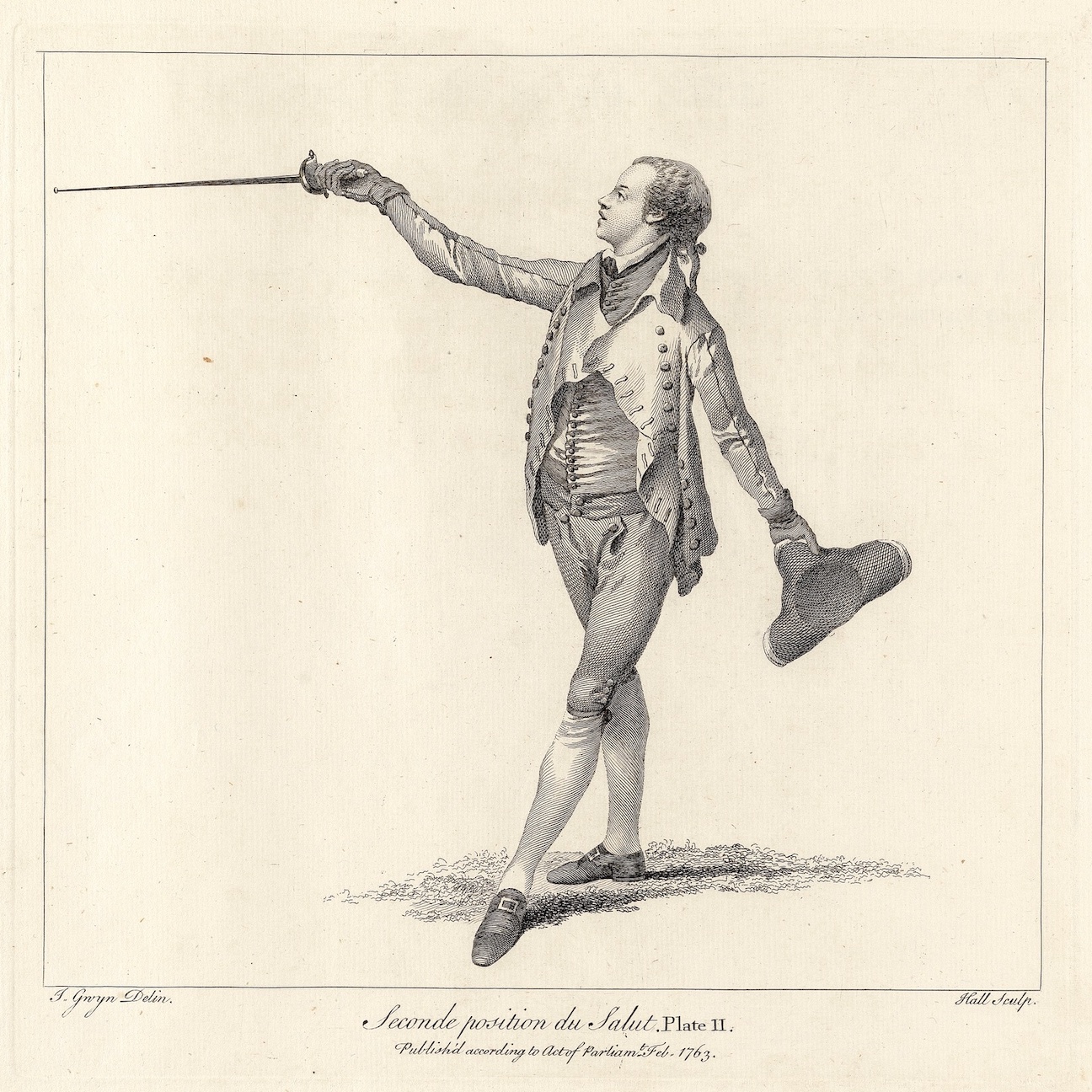
Be gracious, be courteous, and show largesse win or lose. I’m a strong advocate for managing both victory and defeat with a becoming grace and humility. Today it went one’s way—great; tomorrow it might not. No one with any aspiration to sanity dislikes a generous, gracious fighter. In fact, people will want to fight with that person because their heads are screwed on right and they make it fun. Fencers like that make the bout about the bout; they think in terms of a shared, dare I say it intimate experience and not just what these tiny victories might do for their self-worth. Officials like them too, because they don’t whine when they lose a point, even if unfairly, and use proper channels to protest something they find illegitimate or untoward.
After the Event
Conducting a post mortem after the tournament is important. With any fencer I have prepped, I like to follow up with them and see what they thought went well, what not so well, and how the experience might guide future training. This helps me, as their instructor, but it helps them too. It’s a chance to see that what they’ve learning is working as well as those areas that might benefit from additional practice.
Lastly, I always asked them if they had fun. Fencing tournaments, of any kind, are not famous for making any participant rich. We don’t have pay-per-view prize fights with purses to match. In the U.S. one never sees fencing on tele unless it’s the Summer Games and we have high level fencers in the run for medals.
We fight in tournaments, for the most part, because they’re fun. I have written a lot about tournaments and bouting as learning tools, and they are, but they should be enjoyable as well. Looked at in this way, a good tournament (emphasis on good events…), can push our skills forward and be a blast at the same time, and there are not many areas in our lives to day to day where we can often say that.
NOTES:
[1] We are resilient creatures. One of the best, if more extreme examples of this, emerges powerfully from combat and the process by which many military folks become accustomed to the extremes of life-threatening horror. I leave it to those military personnel and veterans willing to talk about it to explain this as they can do so better than I can.
[2] I mean no offense to modern spiritualists etc., just those trying to make a buck off of people. There was a spate of new-agey self-help books in the 1980s that mixed decent advice with a lot of b.s. Check the shelves of most any bookstore and these scams are still on the shelves. There has been a lot of work on how we can use, even improve memory, and condition ourselves. One of the more influential books for me, odd though it may sound, is M. T. Clanchy’s From Memory to Written Record, England 1066-1307, Hoboken, NJ: John Wiley & Sons, 2009. I also recommend, for a broader look, Fances A. Yates, The Art of Memory, Chicago, IL: University of Chicago Press, 1974.
[3] I remain convinced that I will never acquit myself better in a fight than I did in the last one I had, or didn’t have rather, in college. A sub-letter got nasty with my girlfriend at the time about rent, and I told him to knock it off. He decided to take it outside, and once outside, kicked off his shoes and danced about posturing. I stood across from him, ready, and waited. At one point he started to approach, so I started to raise my hands and smiled. He stopped, and a few second later walked over with his hand outstretched. Having had excellent masters, I didn’t trust this gesture and made it clear that if it was a ploy it wasn’t going to work. He was, happily, sincere. So, we walked away from the small crowd that had gathered and talked it all out. I was just looking after my girlfriend, and he was trying to save face, both understandable places to land, and since I had no ill will toward him, nor he toward me so far as I know, it was easy to fix.
[4] I didn’t invent this style of lesson. They’re well-known in Olympic circles. For a solid explanation of warm-up lessons, among other types, see Maitre Robert Handelman and Maitre Connie Louie, Fencing Foil: A Practical Training Guide for Coaches, Parents, and Young Athletes, San Francisco, CA: Pattinando Publishing, 2014, 324-325.
The Importance of Measure
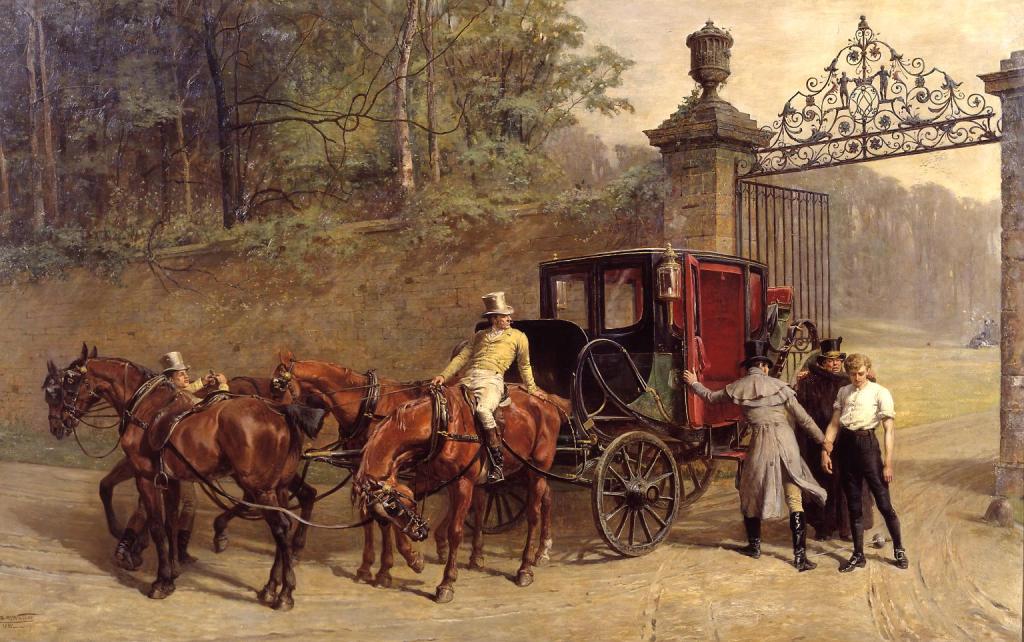
A number of dueling histories record the horrific duel between Colonel Barbier-Dufai and a young Captain, Raoul de Vere. According to most versions, the older adherent to Napoleon attempted to pick a fight with this member of the Royal Guard, but was initially unsuccessful. Barbier-Dufai, frustrated in finding the young man so unflappable, finally remarked that he was not insulting him, but his cockade, and after a heated exchange challenged the captain. However, when asked to select a weapon the captain replied that he had insufficient training in all of them. The colonel said he would not fight a child, a comment that irked de Vere and led him to slap the older man. A duel was now inevitable. In the ensuing sword fight, Barbier-Dufai disarmed his opponent several times. Finally, in frustration, the colonel suggested they hop into a carriage, arm themselves with daggers, tie their left arms to one another, and take two turns about the Place du Carousel. The young de Vere agreed and they set off in their mobile piste. When their seconds opened the carriage, blood was everywhere, Raoul clearly dead, and the colonel next to death. Both men died and honor was apparently satisfied. [1]
I share this story because it highlights the pure idiocy of fighting in close measure. There are times when it is unavoidable, but generally—unless one is in a confined space—there are means by which to extricate oneself from such proximity. One of the chief faults I see in both the wider community and among some of my own students is mismanagement of measure. Usually in my own classes, the culprit is a mix of well-intentioned aggression and fun—so intent on making the touch, some students neglect their own safety. I never want to chip away at the fun they’re having, especially among the younger students, because having fun is one reason people fence, but at the same time I need to ensure that they learn properly.
There are a few things we can do to ensure that our students have a proper notion of measure, and that can help them remember to use distance well in their bouts.
Teach them What Measure Is
First and foremost, from the off we need to teach them the various measures appropriate to their weapon or tradition. Regardless of the weapon or era my students study, I introduce them to the traditional breakdown of measure into three main categories:
- Out of measure
- In measure
- Close measure
Out of measure, what Giordano Rossi calls “double measure” and Luigi Barbasetti refers to as “normal distance,” is the distance that requires us to make an advance first in order to lunge to target.[2] In measure means that one can lunge to target. Close measure is that spot were either opponent can reach one another without the lunge. There are some subsets to this, but to start this is ample.
I hesitate to say that “all” systems of measure reflect these basic breakdowns, but I feel safe to say that measure, being a fight universal, is common to all systems however described. Even in those like Rossi’s “measure” and “double measure” or Fiore dei Liberi’s “largo” and “stretto,” there is implied space between these two poles. Regardless of nomenclature, one must learn how to navigate any space along the continuum of “measure.”
Measure Drills
Measure drills by definition involve footwork. Ideally, any footwork drill save perhaps those used in warming up a class—where everyone advances and retreats down the hall using various types of footwork—will work distance too. Below are several drills I typically use in classes:
Glove Tag is a crowd favorite and very much a game. One can run this as a linear partner drill, or, as a general melee. I usually ask if anyone wants to be it, and if not then select someone. Fencers must use the appropriate footwork only, and, can only target the wrist. There is no parry. One has to move, or, parry with the feet (in the non-pejorative sense). [3] Fun as this is, and much as it helps them move, making it a bit more realistic is helpful (see Mask Tag below).
Foil-Push or mask-push, have the students, in guard, suspending a foil/sabre/etc. or mask between their lead hands. The goal is to move back and forth without dropping the foil or mask. I emphasize that while they are taking turns driving, so to speak, they are working as partners—the only way to keep that foil up is to move in concert. If fencer A steps back, B needs to step forward, and vice versa.
Mask-Tag and 1-Touch Tag, fencers don their masks and use the weapon to tag. For sabre, students target only the head, and, cannot parry. Thrust fencers can only target the chest (or arm depending on what we’re working on), and, as with sabre, cannot parry. They must move their feet. Students must use distance to their advantage. Success depends on moving, recognizing someone fell short and is now vulnerable in the recovery, or, selecting the moment the opponent is occupied, such as mid-step, to strike. If the attack fails, then retreating under guard or behind the point is the best option, and the fencers reset.
Mask-Tag Plus takes this drill one step farther—each opponent can parry and riposte once per action, that’s it. So, if Fencer A lunges with a thrust to the chest, B can parry in quarte and riposte, but if A retreats half a step, then B must recover—B can’t redouble. For more advanced students one can allow the redoublement. This option should be included at some point as so many students starting out stop just shy of the target.
Two-Step Tag is something I’ve used with foil and smallsword students. Two of my foilists, for example, are offensively-minded, so tend to close quickly at “Allez!” and descend into a flurry of jabs, thrusts, etc. I don’t want to take that drive away, so I’m trying to channel it instead. In this version, the only attack they can make is an advance-lunge to the chest. It’s super hard to do, especially since one’s opponent knows what’s coming, so everything depends on precise and keen use of footwork, timing, and distance.
The goal with all of these drills is to emulate, as much as one can, the conditions of a bout, but restrict the options so that the students are forced to use measure. It’s not that good handwork is unimportant or cheating, but that it can easily become clatter and chaos instead of well-planned attacks and responses. It becomes reactive, not active. I teach them that if an attack fails or if something isn’t working, to retreat, regroup, and try something else. Persistence in the face of stout defense is brave, sure, but foolhardy—if what we’re doing isn’t working, we try something else. [4].
Reinforcing Proper Use/Awareness of Measure in Bouting
It does little good to encourage proper measure in drills if we fail to do so in bouts. There are a few way to do this. In both classes and individual lessons I save any bouting we might do for after any focus on technique and drills. [5] This helps prime the pump as it were—students are more likely to consider measure if they’ve spent a bit of time focusing on it before bouting.
Within the bout, I have students actively bouting and those observing analyze the action, not only because it reinforces attention to measure, but also because it buttresses other important aspects, from recognizing who had initiative/started the attack to breaking down each action within a given exchange. Too few fencers learn to analyze bouts well, and the sooner they start the better.
Why Measure Matters
If you view most any bouting footage posted to sites like Youtube you will see, or should see, why better attention to using measure is worth one’s time. In one recent video, for example, one fencer analyzes his bout, but misses the reason that he found himself in the situation he did—they were fighting too close to one another. [6] If their sabres cross near the middle, they’re too close. Certain actions are harder to thwart at such proximity—in this case, a slip of the leg will likely fail because there is insufficient measure to remove the leg and strike the opponent’s head without being hit. More likely, and we see it in this example, both parties will be hit.
In fairness to this fencer, the rule-set he’s likely fighting under is not as doctrinaire as I am about the guiding principle of “don’t be hit.” Even when a rule-set is explicit, so much depends upon judges who know what to look for and how to make sense of what they’re seeing, and by and large tourney HEMA lacks a reliable pool of judges capable of analyzing the action at such a level. Add to this the excitement and/or nerves in a bout and of course things can turn out less ideally than we plan. It is not my intention to denigrate my fellow fencer, only to point out something important he didn’t address (his focus was on the slip). Were he my student, we’d likely work on this very set of actions at the proper distance, that is, set it up so that he is just about a step or so farther back then we see in the video. From punta spada/sword tip one is more likely in a place not only to make the attacker’s feint and strike more successfully (i.e. without be clobbered doing it) but also provide the defender sufficient measure (and thus time) to assess and adjust.

Not all clubs or instructors take the same view I do. The more I read, the more I teach, the more I see how fencers learn, the more inclined I am to championing the goal of “don’t get hit.” It does change how we fence; it makes for a more circumspect, conservative, and hesitant game. The flash and fire, the dynamic move and rococo blade-work tend to impress, and that is what attracts many of us in the first place. It looks cool and we want to do that cool thing. While perhaps less flamboyant and exciting, I’d argue that there is as much beauty to the cold efficiency, exactness, and finality of a one-touch exchange. Moreover, training this way adds something else extremely important—improved confidence. The more one succeeds in gaining the line, striking, and getting out without suffering a counter-attack or double, the more one trusts themselves and the weapon they have in hand. In no way does that make one invulnerable, of course but confidence does much to help us cultivate the calm we need to fight with our heads and not our hearts. [7]
NOTES:
[1] There are a number of popular histories and websites that mention this duel, few with adequate citations. See for example Robert Baldick, The Duel: A History, New York, NY: Barnes & Noble, 1965, 164-165; Major Ben C. Truman, The Field of Honor, New York, NY: Fords, Howard, & Hulbert, 1884, 236, available online at [https://archive.org/stream/fieldofhonorbein00trumuoft/fieldofhonorbein00trumuoft_djvu.txt]; Thimm records a duel with daggers, minus a carriage, between two men in Italy in 1891, A Complete Bibliography of Fencing and Dueling, Reprint (Gretna, LA: Pelican Publishing, 1998), 457.
[2] Giordano Rossi, Sword and Sabre Fencing, Milan: Fratelli Dumolard Editori, 1885; translated by Sebastian Seager, Melbourne Fencing Society, 2021, 49-50; Luigi Barbasetti, The Art of the Sabre and Epee, New York, NY: E. P. Dutton & Co., Inc, 1936, 15-16. Cf. Gustav Arlow, Sabre Fencing, 1902, translated by Annamaria Kovacs and edited by Russ Mitchell, Austro-Hungarian Sabre Series, Vol. 3, Happycrow Publishing, 2022, 35.
The term “normal measure” is revealing–this is the distance from which one is still safe, but close enough to mount an attack. In other words, one isn’t four meters away from the opponent, and, isn’t in their lap.
[3] The “Coward’s Parry” or “Ninth Parry,” according to Morton, is the derisive term applied to those who avoid at attack by means of a step back. Where this idea originated I’m not sure, but it’s alive and well in HEMA. My guess, like Morton’s, is that this harkens back to the time with salle fencing, particularly in France, sought complex, elegant handwork over retreating (a “ninth” parry suggests an acceptable eight, and the French school in the 19th century looked to that number). See E.D. Morton, Martini A-Z of Fencing, London, UK: Antler Books, 1990[?], 43, 126.
[4] There are instances, of course, were it’s wiser not to break off the attack. If say one thrusts to the chest but lands short, and the opponent isn’t reacting properly, then redoubling to strike makes good sense.
[5] Most of my bouts are teaching bouts, that is, bouts in which I present what we covered in a lesson so that the student may work on those topics in real time. For classes, I still do this, but often include a little free-bouting at the end of class provided the students have enough in their toolkit to do so, otherwise I have them engage in restricted bouts where they move at real speed, but are restricted in what they can do.
[6] I do not know “@HEMA_Fight_Breakdowns,” and again, do not wish to disparage them in any way. Their video provided a great example of what I cover here, but my topic was not the same as theirs and I want to make that clear. To blast someone for not covering something we want them to, when that isn’t what they set out to do, is silly if all too common. This fencer has some good things to say about slipping the leg and one response to it–the topic of the video–it can be found here: https://youtu.be/Bk32YMYqiwA
[7] For this notion, see Master Perigore of Paris in the film adaptation of “Scaramouche” (1952): https://youtu.be/FQfsvMENYgc
The Problem with Bouting

Bouting is easily one of the most enjoyable aspects of fencing, but it can also prove to be a troublesome problem. The fact that it’s so fun only helps mask the issue. In this case I do not mean those clubs who focus on little else but “sparring,” a different misfortune, but the misuse of bouting, specifically focusing so much on winning that the value of bouting as a pedagogical tool is all but lost.
“HEMA,” because it lacks a robust coaching pool, is all over the map when it comes to teaching.[1] Some groups do their best to work fundamental actions, but many do not. Too many put a weapon in a new person’s hand, give them five minutes of instruction, and push them into the ring. People with busy lives and for whom swords are recreation often want to get fighting as soon as they can; it’s understandable, but lamentable. Instructors cater to this desire because they don’t want to lose people. That too is understandable, but again, lamentable. Given the audience for this site, and the unpopularity of my position on this, I don’t expect to sway many to adopt the approach I have embraced, but it would be remiss of me not to try, because I’m convinced after decades of watching what happens when people bout too early that there’s a better way to build solid skill.
Why Bouting Too Early is Unwise
There are several reasons why new students shouldn’t bout from the off, but spend time acquiring and drilling good technique, building a keen appreciation for measure, and an equally keen sense of timing.
Safety: First, fighting even with blunted weapons is dangerous. New fencers hit hard because they lack control and the fine motor skill required to modulate their attacks. Thrown into the stress and excitement of a bout in real time, these fencers are unlikely to learn finer motion because they’re too keen to strike and to a lesser extent defend. Their actions tend to be larger and harder, neither of which are hallmarks of skill.
Stunted Growth: Traditionally there’s a reason why new fencers weren’t thrown into the assault too early. Without solid fundamentals fighting before one is ready is a prime way to cement bad habits, none of which are easy to correct once they become ingrained. One of the reasons that “HEMA” suffers so badly from shoddy fencing is because many fencers are, ironically, rewarded for crappy fencing. It’s not hard to “git gud” in one’s local group, jump into a local tourney, and intimidate and/or hurt one’s opponents on the path to a medals and glory. I’ve judged a lot of tournaments and have seen this over and over again. Worse, these same fencers take their good luck for skill and start teaching, thus creating another generation of hard-hitting louts convinced of their own genius.
Wasted Opportunity: Bouting, approached correctly, is a pedagogical tool, at least that’s what it is supposed to be. It’s a chance for both fencers to test out what they’re learning in real time. Ideally the first bouts a fencer has is with their coach–these teaching bouts, as they’re often called, require a lot from the instructor. They must possess the skill to alter how they present an action, change tempo, play with distance, all of these things in order to provide the student with realistic scenarios.
Drill, good as it is, often consists of snapshots of actions made in an actual assault. The feint to the inside line, disengage to the outside line, for example, is something two fencers can practice and within a short time get down because they establish a rhythm. Fighting isn’t like that. The metronome effect that can occur in drills creates a fencer who can only make that action if the same, exact conditions are present. [2]
Free-bouting, as opposed to a teaching-bout, ideally takes the conditions a coach changes on purpose and randomizes them. This is to say that a coach usually tells a student what it is they’re working on, what they will set up, and what the student must try to do, at least at first. As a student advances, a coach can say less about the specifics. With a fellow fencer, however, the student normally does not get any advanced warning. They just jump in and either seize the initiative or react to that of their opponent. This can be a super effective learning tool IF both fencers take advantage of it, if both realize that the bout is way to test, break, and improve their tool sets.
One Upsmanship: No one is immune from ego issues. Competition is one place where we often see these normally hidden issues emerge. Whatever self-worth concern drives a person can easily take over a bout, because “winning” makes people feel good and serves as a species of external validation. When the goal is winning, in feeling good about one’s skill and self, then learning normally takes a back seat. One becomes more concerned with getting the touch than in how one makes the touch, and that how matters. It’s easy to hit an opponent, but not easy to hit them and not be hit oneself–that requires far more attention and presence of mind, far more calm and mental fortitude, and none of that is fostered well when the concern is ego-driven.
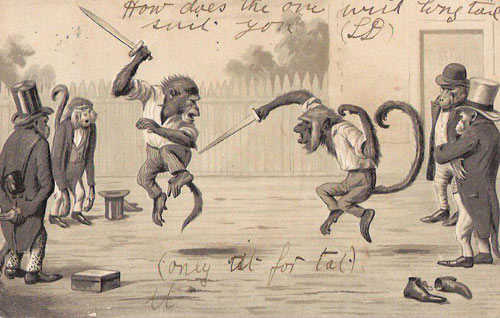
Moreover, too much concern with winning can make things ugly; it can break down what should be a partnership in learning into a battle of egos. If one person crows about landing a touch, the other may not take it well. Resentment may fuel hard-hitting in both directions, shots after the halt, and ill-will. Learning and improvement, the purpose of a class or lesson, suffers when behavior like this enters the picture. People tend to struggle to learn in a place where they don’t feel safe. Class should challenge students, but because it should push them it must be a place where other stressors are removed or at least reduced. Behavior which introduces needless distraction, which engages emotions unhelpful in the acquisition of skill, have no place in the sala.
Bouts as Learning Tools
The bout within the context of a class is not the place for the same energy, ethos, or goals as one has in competition. A fencing class is a cooperative learning lab, not the piste, not the ring. Everyone will get far more use and enjoyment from bouts when they bring the right mind-set to it. Use these bouts as a way to practice, to learn, to see what works and what doesn’t. Use them to play with measure and tempo, to test them out with different techniques and tactics.
Inevitably instructors will encounter students who struggle to embrace this notion of bouting as really just more or less unplanned drills in real time. My advice, if this goes against one’s plans, is to quash it immediately. I have a sort of “Defcon Levels” approach to managing this problem in my classes:

Level 1–Student is no longer allowed to bout
Level 2–Less gentle reminders and a review of my approach to bouting
Level 3–Gentle reminders that we’re partners in learning, opponents not adversaries
Level 4–Cultivating and reemphasizing expectations about bouting
Level 5–Establishing clear expectations about bouting
First, I make sure that my rules and expectations for bouting are explicit, not only when someone joins a class, but before each portion of class that includes bouting.
RULES for BOUTING
- Safety equipment–mask, jacket, glove, etc.–are mandatory
- Be respectful: your opponent is your partner in learning
- Be gracious: acknowledge a hit and refuse to accept a touch you know you didn’t make
- Be humble: we’re here to learn. Save all the fire and drive for competitions
- Be gentle: hard-hitting is the mark of a poor fencer, of an untutored brute
- Be curious: ask questions if you have them; observe and analyze the action
- Have fun!
Second, I actively cultivate the proper approach and do my best to model the behavior I want to see, from congratulating my partner on a good touch to keeping the mood light. When a student breaks protocol, if they crow about a point, get too aggressive, or start talking about who won/lost I remind them that we are here to learn, we are working together toward that goal, and that it’s not about win or lose, but improvement. If the gentle reminder fails, and it does sometimes, I stop class, have everyone remove their masks, and I lecture them: I reiterate the rules and expectations, and inform them that future infractions will mean no bouting for that person. If after a more stern warning a student persists, I stop the class and remove them from bouting. It’s not happened (yet…) but should a student persist in such behavior, I will ask them to leave until they’re ready to act responsibly.
What we do is dangerous. Part of my job as an instructor is to help students hone a dangerous skill set safely, to learn to use it responsibly, and in the spirit of camaraderie that should unite us all as comrades-in-arms. One of my goals is to instill in my students the truth of the school motto, vis enim vincitur arte, “for force is conquered by art.” Strength, power, all of these have their place in fighting, but our tools in fencing–applied correctly–replace and mitigate force. That’s why we use them. [3]
Each club or school will have its own approach and protocols for bouting. I have found, having visited so many schools, having fought so many people from different club cultures, that treating the bout as a tool produces better results. The assault engaged in as a learning exercise can still be fun, it can still be a fight, but with the focus on improvement over net performance, students are better prepared for competitions, they’re more likely to help others improve, and generally they’re a lot more fun to fight because they’re there to learn and have fun instead of beating people down. There is a time and place for the aggressive, go-get-’em approach, but generally it’s untoward and unhelpful within a class setting.
NOTES:
[1] There are many good instructors out there. However, there are also a lot of horrificly poor ones.
[2] This is one reason altering drills, even simple ones, via the universals is so important. In the example used here, changing the measure and footwork, changing the tempo the feint and thrust/cut are made in, changing the set up, all work to make this one action far more useful when the fencer needs to use it in a bout.
[3] We talk a lot in historical fencing about attribute fencers, about this person’s speed, that person’s strength, and we tend to downplay them because the milieu in which we work is focused on skill, not the application of natural abilities. In an actual fight, however, and depending on the context, something like strength does matter. It might not in a duel between two people with smallswords, but it almost definitely would in armored combat in the lists.
Keeping our Fencers Safe
Below is a link to an important piece by Maestro Jen Oldham—it details ways to foster a heathy community and fight abuse. No matter with whom one might work this is a crucial aspect of an instructor’s job, but it is all the more important for those of us working with children.
I’ve written about this before and will again, because creating safe spaces to learn is not a one-and-done event, but a way of working, a way of creating and maintaining a healthy community. An instructor should be above reproach: they should be a role model, an advocate, a guardian, and conduct themselves in as transparent a manner as possible.
There are few crimes or sins lower than hurting children—it’s a triple evil: they cannot defend themselves like an adult, their stage of life hasn’t prepared them to recognize or manage threats as easily making them more vulnerable, and some abused children become abusers in turn. Adults have a collective responsibility to protect children—each of us must do our part. Maestro Oldham’s list below is a nice primer:
The Collective: You will be Assimilated. Resistance is… up to You, Really

As Thanksgiving, a national holiday here, approaches I’ve been juggling lessons and classes as one does around any such occasion where both work and school schedules are in flux. Issues with the holiday aside—a different discussion—one doesn’t need an event to be reminded that it pays to be thankful. I don’t mean this in the trite, “live, laugh, love” sense, but in the active consideration of the myriad ways one should cultivate gratitude. My sad nod to Star Trek’s aggressively assimilating baddies notwithstanding, this post is a public celebration and confession of thankfulness for what several of us locally term “The Collective.” [1] The Borg, to be fair, are a poor analogy for what we aim to do with this conglomeration of fencers and clubs, but we do share one thing with the Cubist cyborgs: we are a tight-knit group.
What is this “Collective?” It’s not some quasi-communist organic hop-farm, though in Oregon perhaps that wouldn’t be a bad guess, nor is it a collection of silent-musicians or driftwood artists who work out of a local barn, but a loose confederation of fencers and clubs who have decided that they want to work together and that they like doing so. Generally, the fencing world is divided much like ancient Greek poleis were, this is to say that they are independent, sovereign, and while united by common purpose and sometime-allegiance to umbrella organizations, they are more or less rivals and constantly competing for the same meagre resources. That isn’t good or bad, just the way it is, but several of us, united by common purpose and similar values, have decided to buck the norm and form (following the nerdy Greek analogy) our own Boeotian League. Well, hopefully minus the issues that assailed that alliance post Persian Wars. [2]

This is an informal alliance, one open to anyone with similar goals and outlook, and all without meetings, dues, or anything else. It grew naturally out of the ever-changing landscape of local historical fencing but, being flexible, has tended to weather such changes better, and more than that, provide support as our own schools are buffeted. Clubs pop up and then disappear, grow great then decline, or somehow sustain themselves, but as all this happens the Collective continues and thrives. It’s hard for me not to conclude that despite what we might lose individually we gain a lot more collectively.
It may seem counter-intuitive, but in supporting one another, in helping with classes or seminars, in plugging one another’s events, in sending students to an instructor who might be a better fit, in loaning gear, whatever it is, we end up with stronger clubs. One of the schools in the collective is large, easily the largest in the state, whereas the rest of us run groups consisting of a few people; how the numbers fall out per location matters less than they what they represent as a whole. Any student from one of these schools is welcome at the others; instead of one head for help or advice they get multiple people with varied and deep backgrounds in various branches of the Art. These days, sadly, it’s worth noting that they are safe at any one of these schools as well. [3]
Personally I experience this collective on two fronts. First, and close to home, are friends, colleagues—family really—from An Tir, High Desert Armizare, Historic Combat, and Northwest Armizare; and second via the mixed modern miracle/curse of the internet, I also enjoy the wisdom, wit, and work of more extended kin from Barbasetti Military Sabre since 1895, The Guild of the Silent Sword/HAMA, Sala della Spada, and Sword School Wichita. Then there are the students I teach and the colleagues with whom I work each week.
Each of these individuals I chat or interact with regularly or failing that as often as I can. I learn from them, laugh with them, and do what I can to support and promote them. I’m grateful for their instruction, advice, humor, and backing. Thank you, each of you, for all that you do.
NOTES:
[1] I don’t know enough about Star Trek to provide a lot of guidance, but this is one place to check out if you’re into things Kirk/Picard/Cisco/Janeway/etc.: https://www.syfy.com/syfy-wire/star-trek-picard-essential-borg-episodes#:~:text=Although%20the%20first%20canonical%20appearance,The%20Best%20of%20Both%20Worlds.%22
[2] The Boeotian League formed in the mid-6th cen. BCE under Thebes. When the allied Greek forces lost at Themopylae, the League sided with the Persians, the smart money being on the powerful rival from the east. When the Greeks managed to beat back the Persians they naturally were unhappy with those states that had supported the enemy. The League was broken in the wake of that victory and didn’t reform until 446 when with Spartan help the Boeotians successfully left the Athenian Empire. In the 4th century BCE the League’s allegiance switched back to the Athenians, but crises with the rise of the Macedonians led to a revolt against Alexander that was crushed. For more information cf. Raphael Sealey, A History of the Greek City States 700-338 BC (Berkeley, CA: University of California Press, 1976), esp. Chs. 16 & 17.
[3] News reports, regardless of bent, require far more corroboration than they should, especially for anything that will make for ratings, but this said Oregon has had a rough go the last few years. For all the blather about individuality, toughness, etc. the truth is that it only took a mask-mandate to undermine any pretense to civility or toughness. The small city where I teach harbors in microcosm what the rest of the state, the nation really, wrestles with in macrocosm. This is not just posturing either: I work with students who feel the prejudice leveled at them by those keen to return the US to 1850 (or make it Berlin ca. 1940); it’s not theoretical for them nor is it for me.
All for One, One for All: Teaching other Teachers
Lehr tuht viel, aber Aufmunterung tuht alles.
Goethe, letter to Adam Friedrich Oeser, 9 Nov. 1768
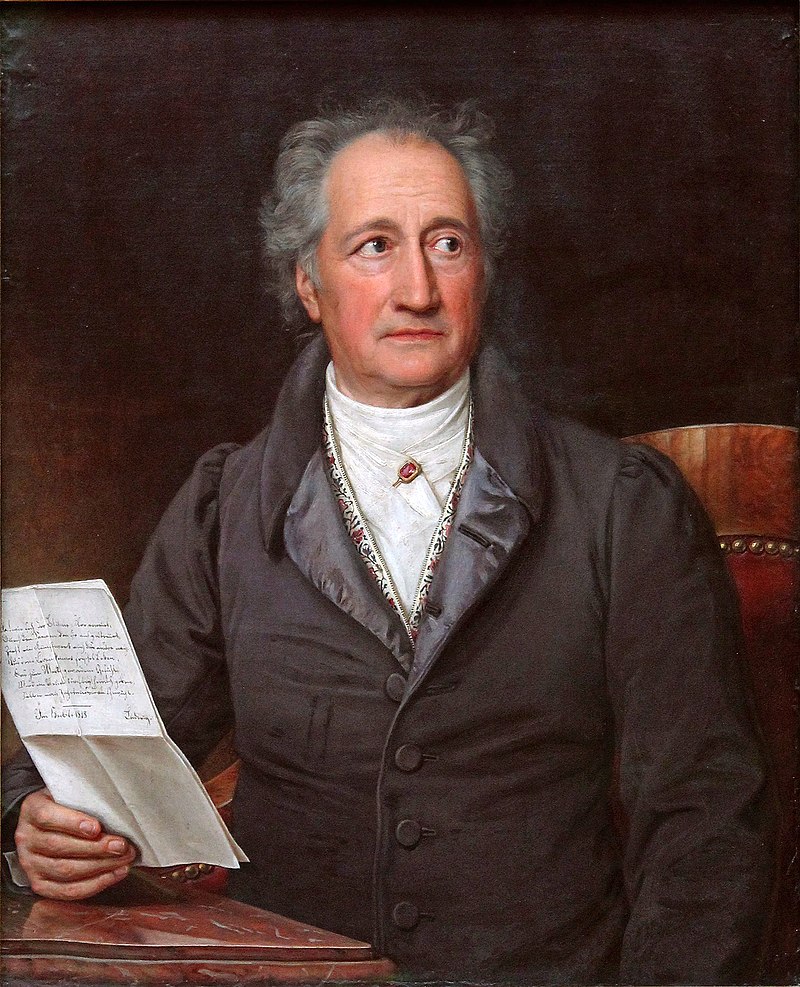
“Teaching does much, but encouragement does everything.” So wrote Johann Wolfgang von Goethe to a fellow artist in Leipzig. [1] This is one of those quotations that speaks to me because I’ve seen the truth of it borne out again and again. It’s not enough to know something—we have to believe we’re able to do it in some degree, and while most of that must come from within, encouragement never hurts so long as it’s not empty. Having studied with a variety of teachers, some supportive, some arguably abusive, and moreover having watched others study with the likes of both, I’ve become a firm believer in the adage about honey and vinegar.
Some corners of the historical fencing world have embraced the notion that “what hurts, teaches,” and on a very superficial level this is true—if one grabs a hot pan and is burned, one is less likely to make the same mistake again. However, what might work for a toddler acquiring knowledge of how to navigate hot or sharp things is generally an extremely poor way to learn a sophisticated body of skill requiring mental and physical dexterity and agility.
Teaching other Teachers
In this post I’d like to focus on teaching other teachers. Sometimes we do this collaboratively, that is, by working together. Where I live there is a small group of us who do this most of the time. We ask one another to help with demos, run classes or specific seminars, and send one another students who might be a better fit for that colleague. We can pick up a lot by watching how others teach, how they solve problems, how they manage questions, challenges, or hecklers. It’s an informal, somewhat organic process when we’re in it, but usually we discuss these occasions too. It’s sometimes scary asking a colleague how something went, especially if we know they’ll be honest, but then this is why we ask—that honest answer, however uncomfortable, is what can help us grow.
We might share lesson plans, offer a different take on a drill, or recommend a source. Often, though, what we offer is encouragement. To teach is to be, at times, a cheerleader. Few tasks are as difficult as teaching—one must have sufficient command of a subject, sure, but no amount of knowledge means much if one can’t share it effectively with others. Much of the worry that informs imposter syndrome and other varieties of doubt stems from this concern. That’s the goal, after all, to share information, and when it comes to teaching other teachers what we’re doing goes beyond the subject and into how one shares that subject. Experience helps temper doubt just as it helps us see and correct mistakes.
This process, the challenge and excitement of it, has been on my mind a lot this past year. I’ve spent more time advising and/or helping newer instructors gain skill and confidence in their teaching than before; it’s more one to one versus collective, though it’s still a collaboration. It’s one of the hardest, most demanding responsibilities I have, but also one of the most rewarding. When it comes to raising up new instructors one of the most critical things we must do is also one of the hardest—help them develop their own style.
Learning Styles
In the late 4th century CE Symmachus, a late Roman statesman, in an attempt to reintroduce the Altar of Victory into the Senate House, asked the Emperor Valentinian “What difference does it make by what pains each seeks the truth? We cannot attain to so great a secret by one road…” [2] In a similar way there is no one way to learn. As with students, when we help other instructors, we have to remember that our goal is to help them teach as best they can, in their way. The goal is not to reproduce ourselves, but to produce an effective teacher. What does such a teacher (usually) require?
Experience
There are many ways to learn, and what works for some may not work for others. As an instructor or teacher it behooves us to remember this. I’d like to cite a friend of mine, an instructor I’m working with, as an example. He is a martial artist with a long and varied background—this is important. If he only had a year of study chances are good I’d not be working with him on teaching. [3] Experience matters. This friend is in a place in his career where the logical next step is to teach, not only because it will help him grow, but also and perhaps most importantly because he wants to teach. To be clear: no one needs to teach. One should only teach if one wants to, if called as it were, and not out of sense of obligation or because they think they need to in order to be taken seriously. Many of the best fighters in history were not instructors. [4]
Acquiring what They Need
My friend has studied sabre/broadsword off and on for about four years in addition to other weapons. When I first chatted with him and pondered what he needed most it came down to two things: a deeper acquaintance with the corpus of texts and more experience teaching. In some cases, most really, I’m also working with a new instructor on the skillset, but in this case he has more than ample technical skill. That can and will improve as he learns the corpus and shares it, so we focus on what needs the most work.
He learns differently in some ways than I do. I know because I asked him; whenever I’m unsure, I ask and it saves a lot of time and hassle. Reading, for example, is not his favored way to take in new information, so instead of having him read a source front to back, he reads a chunk, thinks about it, and then we discuss it. If he incorporates it into a lesson plan, he shares it with me and we discuss it again. He’s a super intelligent chap, so understanding the material is not the issue, and in this way he tackles sections at a time. Part of my job is helping him relate these sections to the whole. Thankfully his experience in martial arts, and with swords of various types, makes that more enjoyable than laborious, but if he required it we would spend time on fitting all the pieces together too.

We’re also about to start meeting regularly, probably over zoom or google-meet for convenience, to discuss what he is studying and got through it on camera. Fencing is movement, it’s visual, and so meeting in person and via technology if one needs to is vital. The first source I assigned him we’re nearly finished with, and so we’ll start the video meets with the next one. In order to relate the individual texts within the whole we’ll periodically discuss them together, comparing and contrasting them in most every sense, from content to context. In the aggregate his understanding of the body of knowledge not only increases, but importantly how the various branches relate. Putting that knowledge to use in class helps cement it.
Time in the Saddle
Theory, discussion, subject guides, all that is essential, but time spent doing the job, on the job, is the crucible by which the raw iron is converted into steel ingot. My friend has been leading the broadsword pod I initially ran for months now, and from where I sit the transition has been about as smooth as it can go. When I’m there, I’m one of his students. I don’t interfere with his process, I don’t talk over him, try to take over, correct him, or anything else that might undermine him in class. To do any of that adversely affects him and makes me out to be either an ego-maniac or in far worse shape self-worth and public image-wise than I in fact am. Trust your students, trust your colleague to do the job. Chances are good they will not do things your way—the only question the advisor need ask is “is their method effective?” If it is, great; the job becomes helping them make their approach work as effectively as possible. [5]
IF something deserves further discussion that can be managed after class and out of view of students. I ask my friend how he felt it went each week, and then we discuss what went well, what could have gone better. He has his own style and I can happily report that it really works for this group—he combines a passion for the topic with a sincere concern for each person there. He wants them to learn and have fun and it shows in everything he does. There is nothing I can do to improve on that, so, my job is to support him, encourage him to keep doing what’s he doing, and tackle the corpus. The latter will come in time, but the critical thing, his ability to communicate and impart new information to the pod, that he has down. Over time, as he continues to see success with this, his confidence will grow and he’ll be even more at ease than he is now. I’m super proud of him, and I’m happy for him and the pod, because he is proving himself a stellar custodian of the tradition.
What Not to Do
I’ve alluded to some no-nos in teaching already. We never undermine, embarrass, or undercut our colleagues, especially those we are advising. That is a bad example to set—it humiliates them and shames us. Any approach that tears someone down rather than builds them up is likely flawed.
However well-meant we can do more harm correcting something at the wrong time, and so we must remember that we’re dealing with a peer, a fellow-instructor, and that our task is to pull them up as we ourselves were or wish to be. Effective teaching requires a step of faith on the part of students. If they don’t believe one can teach them, they will find another place to learn. Thus, to call into question another instructor’s ability in class—outside inappropriate or dangerous behavior—is easily one of the worst things we can do. If one is advising or teaching other teachers then cover any such issue privately.

Egos there are and plenty in historical fencing circles, but since we lack an official certifying organization our legitimacy derives from other sources—one part of that, for me, is how we treat others, how we treat students and how we treat our fellow teachers. Do we build them up (appropriately) or do we tear them down? There is a correlation between true skill, knowledge, and how one acts; we learn a lot about a person in the goals they set for themselves and their students, and in how they treat rivals and peers. The best teachers focus on the student, not on how the “success” of the student reflects upon them. Most of the evils I see in “HEMA” relate to failures in knowledge, respect for others, or both.
All for One, One for All
Learning is something we start in infancy, and unless something goes wrong it’s something we continue to do until we journey into the great question. Traditionally fencing is taught very top-down, and that’s okay—what makes the difference is how we define “top” and “down.” Top should mean “has sufficient skill, knowledge, and know-how to share the topic,” not some sad sense of superiority. Down here ought to refer to sharing that topic with someone who doesn’t have as much of it. It’s an exchange, because in truth the best maestri and instructors learn from their students too—they refine their sense of the Art, their approach to teaching, all of that by interacting with different students.
It’s no secret to anyone who knows me or who might chance to read the material on this site that I am a serious fan of collaborative learning. For me, teaching another teacher is something I do because I want to help my friends and because I have enough background to do so (I also know my limitations). I want them to grow in the Art and in themselves. It’s why we’re here, well, one reason anyway. No one learns easily or well in a hostile environment, and so to the degree possible we remove those things likely to create any hostility or impediment. Very often it is our own emotional or psychic needs that create the problems, so the best thing we can do is take ourselves out of the picture—teaching or advising a colleague or a new fencer is not about me, but about them. What I have is a little knowledge and some skill and I’m sharing all of it with them. I’m a conduit, a means to an end, and the reward is sharing all the excitement, fun, and history of fencing with another. [6] There are so few of us, really, and we are in a very real sense in this together. The sense of comradeship, the idea of unity one sees between a certain Gascon and his fellow musket-bearing soldiers need not be confined to the pages of literature. It’s a goal to which we can all aspire, as teacher, as student, as fencer.
NOTES:
[1] For the German text, see chrome-extension://efaidnbmnnnibpcajpcglclefindmkaj/viewer.html?pdfurl=https%3A%2F%2Fresources.warburg.sas.ac.uk%2Fpdf%2Feeh1470b2248436A.pdf&clen=24544708&chunk=true ; for an English version, see Johann Wolfgang von Goethe, Early and Miscellaneous Letters of J. W. Goethe: Including Letters to His Mother. With Notes and a Short Biography, Edward Bell, ed., London: G. Bell & Sons, 1884.
[2] There are a number of places one can go for this exchange, but an easy one is the Medieval Sourcebook, https://sourcebooks.fordham.edu/source/ambrose-sym.asp . Halsall and co. used the venerable version from the series Nicene and Post Nicene Fathers, Vol. 10, New York: 1896).
[3] Traditional programs back in the day could churn out instructors in less time, but that was a very different context. Military fencing instructors, for example, spent nearly every day for that year or two before being examined. Few of us can study that way today.
[4] The ability to teach well may correlate with exceptional fighting ability, but outside of movies, sorry to say, they’re less often paired than one might think—some are Achilles, some Chiron, few are Scatha.
[5] This is where experience teaching matters most. It’s easy to get hung up with how one imparts an idea, but if one truly understands the idea itself, then it’s easier to separate it from how its delivered. The guiding principle should be faithful transmission of the idea, topic, skill, etc., and whether or not the delivery was effective, not the style of delivery unless it impedes that transmission.
[6] The rewards in teaching are, as most know, few and small. When I was teaching college and confronted with the tired question from some business person at dinner about “why” I worked in such a tragically non-profitable field I took to saying “are you kidding? For the money and women.” It was a lot funnier to me than to them, but truth is they likely wouldn’t understand why people teach knowing that their paychecks and public respect will be low.
Disparate Places, Liminal Spaces
When we occupy any space lacking clear definition it can be both unsettling and liberating. In either case much of what feeds our experience in threshold areas comes down to external reaction to it, our earlier experiences, and our expectations. I’m not sure which is harder to manage; each in its own unique ways can play merry hell with us. Now three quarters through what is easily the best fencing course I’ve ever had the pleasure to take, I’ve had another chance to examine, closely, life-in-the-limen. This class, a twenty-one week exploration of everything one could wish to know about the techniques and teaching of epee, is fantastic, but it has reminded me powerfully that I am too “historical” for my Olympic colleagues, and too “Olympic” for my historical ones. I don’t really belong in either camp, but value both for what each offers. One of many pluses to being stuck in some ill-defined space is that for all the confusion there is clarity too—one is just distant enough to see things more objectively provided one is honest and looking. About a year ago I posted a piece, “Gang Affiliation or Natural Allies? Fencers and their Camps” [22-7-21], that touched on a few aspects of having one’s feet in multiple spots. This post picks up where that one stopped.
Culture & Tunnel Vision
We like to be comfortable, so we seek out and nestle into communities where we suffer less cognitive dissonance. While opinions vary in such communities there’s nonetheless a general acceptance of operating truths that allow for easy interaction, predictable outcomes, and a sense of contentment. We don’t like when someone disrupts the illusion. Sometimes we experience that as mild frustration and bewilderment, at others we become actively hostile. We don’t always pause, step back, and regard the scene with an analytical eye, though we should. This is all the harder to do when we’re used to a degree of conformity; any outlier can be dust in the eye, nothing necessarily fatal but nonetheless annoying. [1]
No one is exempt from the tunnel vision that comes with a culture, any culture, but it’s also true that one’s vision can widen. The more one struggles to see things within a different culture, the wider that perspective can become. It’s one reason that travel and exposure to other ways of life, of thinking, to different values, are so vital—not everyone emerges from those experiences more open-minded and compassionate, but many do. In a way it’s a particular form of learning how to pay attention, even knowing to, and that on its own is reason enough to try.
Too “Historical” for Olympic?
As a caveat, this particular master and I have not chatted about any of this, so what follows is nothing save my musings about a possible interpretation of what I’m seeing. I could be dead wrong. This is something I must be aware of and note: knowing my own mixed history with the competitive world I might be applying a bias where there isn’t one. With this said, there are a few things that have struck me that speak to the gulf in culture.
This class, online thanks to Covid, is taught by a well-known, talented, and excellent master. I’ve come to have a lot of respect for this man—he’s kind, a teacher’s teacher, and inclusive in outlook (e.g. he discusses the differences in teaching children, adults, and veterans [40 years +], and doesn’t just focus on male instructors). But as a long-time maestro in the competitive world he, like any of us, has assumptions when interacting with other fencers. Most of the people in this class, so far as I can tell, belong to more traditional salles, and thus have potential students working in the same way close to hand. A few of us do not. This matters, because teaching a fencer who has decent training in Olympic fencing will read differently than those of us who work with a wide variety of fencers.
A sport fencer understands, among other things, how individual lessons normally proceed. It’s part of their culture. Likewise, there are types of drills, expectations about practice, and attitudes toward new material that make it easier in a class like this to work with like-minded people. In contrast, my students come from very different backgrounds—not one, at present, has ever stepped foot in a typical Olympic salle. Some have never fenced or studied any martial art; others have studied empty-hand traditions, but nothing weapon-oriented; still others have extensive experience in other martial arts and weapons, and most of these I have met through “HEMA.” [2] Thus, when working with one of these students, in most cases they did not come up via the same individual lesson system. Their basis for authority is different, and, unlike most sport fencers they are more likely to question it. [3] One can tell not only by their kit, which is immediately recognizable in most instances from that worn for sport, but in how they move and their responses to particular actions. [4]
Even knowing (or accepting) that there are different types of fencers is not something one can take for granted. I have seen this play out many times, not only in Olympic contexts, but also in historical ones. As I’ve often remarked, on either side most people are familiar only with the excesses—to the degree that anyone is aware of historical fencing, they know it primarily through its least robust if most popular expressions, the sort of thing that makes for good t.v. (this is not a compliment). Olympic fencers see people in black (a color only masters in their world wear), whacking away at one another with little sense of tactics, poor fundamentals, and what appears to be a sad display of might makes right. HEMA players, on the other hand, mock the size of Olympic weapons, the lack of attention to fencing’s past, and that sport’s own celebration of the ridiculous (to cite an easy example the fact that any part of the sabre blade may score). Both camps are correct. Both are incorrect. However, unless one has spent sufficient time in either world that dichotomy will be hard to accept.
Too “Olympic” for Historical?
Bias belongs to all, and having talked about many such examples before I will share one that I hope I’ve not already cited: if I did, my apologies (I searched this site for key words, but it’s not the most fine-tuned search tool). In 2016, at a large event, I had a chance to bout with a well-known HEMA personality. I was struck by how poorly this individual read the room. It’s normal practice to size up other fighters—we can tell a lot from watching them fight, but so too can we glean a lot from their kit. The kit my two friends and I wore should have told him a few things.

If my age wasn’t something to notice (it should have been), then an old, battered Santelli sabre mask, an even older sabre jacket held together in parts by dental floss sutures, and a mix of weapons that included old AFS parts as equally unavailable as that mask should have said something. [5] That it didn’t told me a lot—this was someone who didn’t recognize that my gear was at least 16 to 20 years old; at my age this gear was likely mine and not an older sibling’s or parent’s, so… by process of elimination I had probably been fencing at least 16-20 years (at that time I had been fencing 29 years). I was polite, because one should be, but amused that this individual then proceeded to explain to me and the others what a “sabre” is, and, that we wouldn’t be using the point as his aluminum tools didn’t flex. His gear—his choice, but that was telling too: he doesn’t fence with people who have sufficient control to work with stiffer weapons.
I was the first to bout with him, and the little bit of intel I had gathered proved reliable. We set-to a few times, and it was eye-opening. Given his popularity I assumed, incorrectly, that this guy must be at least a decent fighter—he’s not. In fairness, I assumed he was likely dealing with some manner of health issue or had recently been ill (he was rather gaunt), something that seemed all the more likely when he stopped after a few passes, out of breath, and replied to my query of whether or not he was okay with “I just didn’t think it would last this long.” One of my two friends fought him next, with similar results, and after that he wouldn’t fence anyone save the friends who came with him. With his reputation I imagine that being schooled by two unknowns was unappealing press: again, very telling. Having been advised always to seek out better fighters by my masters, eastern and western, I would have wanted to chat with my opponent after the bout, maybe see about learning more from them.
As I thought about it that day, and as it has increasingly appeared to me since then, it’s not that my famous opponent hadn’t done his intel, but that he drew the wrong conclusions from it. He saw old Olympic equipment, and in my case, a man slightly older than himself, and assumed easy pickings. After all, what could a former sport fencer possibly know that would be of use in “real” sword-fighting? It’s a bias I’ve run into more often than not in “HEMA” contexts. It’s as erroneous an assumption as concluding that all HEMA is bad. It’s not. Some is great. Much of the tragedy both ways is a lack of ability to separate good and bad fencing. If nothing else during quarantine my interactions with a number of HEMA and Olympic folk have proved how painfully true this is.
Sword-bridges & the Time between Times
In Chrétien de Troyes’ Chevalier de la charrete (The Knight of the Cart), Sir Lancelot must cross a bridge consisting of a sharp sword. Medieval images of the poor knight traversing this pointed symbol were popular, and regardless of what one may know about armor and its effectiveness, upon first viewing what we tend to see is a person trying to get across something dangerous. [6] They’re powerful, vivid images. In like guise, poised between two worlds but belonging to neither of them, is similar in that it often feels like one is walking a knife’s edge. Disaster, in this latter case, is less a danger than discomfort, but I wouldn’t discount that discomfort. It can be surprisingly brutal and difficult to navigate. If nothing else, where is one when the only two communities seemingly the most likely to take one seriously both consider one an oddball?
One thing that makes it easier is finding other oddballs—the handful I know, and I mean “oddball” here as a compliment—are spread out across the globe. They are the only reason I still have fb messenger. Interaction with them, normally virtual, is a lifeline, and sometimes the only medicine against the feeling that maybe we’re completely insane. Another product of not buying either branches’ interpretation in toto is that the confidence that comes with such conviction—however great a mistake—is a stranger to us. No one likes being told that a cherished belief might benefit from further study or reconsideration, but objective looks at both camps quickly demonstrates that neither is perfect. [7] The only antidote to misplaced conviction is to make such questioning habit, and we’re not living at a time when rational inquiry enjoys much popularity.
The uncertainly projected at us can undermine everything we do if we let it. However, it doesn’t have to, because if mythology teaches us anything it’s that liminal spaces are where things happen. Dawn or dusk, the meeting of sea and land, doorways, and similar boundaries are all locations of significance, preserves of magic, of change, of adventure, from Pwyll on the gorsedd to Halloween night. [8] This is to say that occupying a middle ground doesn’t have to be negative; it can be transformative. Following the mythological parallel, this change is rarely comfortable, in fact it is often harrowing, but it’s anything but boring. It’s not an easy place to be; it can be extremely disorienting and lonely. People will not understand it sometimes, they will judge it and us, but there is always a cost to growth. If the goal of martial arts is ultimately personal growth, with all the attendant good that should follow from it, then discomfort is worth it.
So What?
Why does this matter? How might the experience of one obscure fencer affect you? It depends. If you’re a fellow traveller, then you have another oddball in your corner. If you’re in a similar position in re being sort of stuck between two worlds, then maybe this offers some comfort or a way toward it. Maybe it means nothing—that’s okay too. Beyond the personal, though, there are some important ramifications for examining the boundaries we operate within or set up.
There are changes, for example, coming to Olympic fencing in the United States that will likely affect many of us. The official fencing organization, the USFA (United States Fencing Association), which is tied to the Olympic team, and the USFCA, the United States Fencing Coaches Association, which has overseen the training of instructors, will come together to meet the dictates of the US Olympic Committee which mandated that “coaching education be provided by each Olympic/Paralympic sports organization in order to be certified as a governing body in 2021.” [9] It goes beyond space to cover this adequately here, but on the ground this means the creation of even more effective gate-keeping.
I’m all for ensuring qualified coaches and instructors—regardless of one’s camp—but both organizations, especially the USFA, only acknowledge one type of fencer and one type of coach, both competitive. It remains to be seen how this will affect instructors like myself who teach on the local level and who are not sport-oriented. The first question I was asked when I approached my local parks & rec organization about starting a class was about my qualifications. “Time in the saddle” was the most honest answer I could offer along with a resume of experience. Will that work in a few years? I don’t know, but one thing I do know, and am happy to prove is that I can teach your kid basic foil, epee, and sabre. [10]
I don’t pretend to be a maestro, I don’t attempt to teach what I haven’t had sufficient training in, and I am quick to recommend other coaches as appropriate. My goal with the introduction to fencing class is exactly that, an introduction, exposure to the exciting world that is fencing in all its guises. That has value, but not all fencers see it that way, and it seems to me that allowing any hardliner to create and enforce boundaries that affect everyone is a bad idea. Reasoned arguments and rhetoric will not move anyone, but action might, so maybe the best preparation as these changes appear, as others attempt to pigeon-hole us, is to cultivate our inner Aladár Gerevichs. This fencer, at 50, was told by the Hungarian Olympic committee that he was too old to fight, so he challenged the entire team and beat the snot out of all of them. He then went on to win yet more gold medals. He didn’t let the committee define him, and we should let anyone else tell us who to be either.
NOTES:
[1] I will not talk current politics and society… I will not talk current politics and society… I will not talk current politics and society… I will not talk current politics and society…
[2] Among my current students are those with no martial arts training whatsoever; a former KdF longsworder, several current students of Fiore (whose works offer an unified approach to wrestling, dagger, sword in one hand, sword in two, polearms, and mounted combat), and a mix of people with some sabre, MMA, Eastern Martial Arts, and wrestling backgrounds.
[3] Authority in Olympic is rarely questioned. One is taught, one uses what is taught, and if it’s not effective (as happens sometimes) the reaction by most is “where did I go wrong with this?” vs. “this must be bunkum.” Authority rests with the body of technique and tactics passed down over centuries and taught by the maestri and their junior instructors. It is not source-based. Most Olympic fencers have little interest in the sources, and to be fair they don’t need them to do well in competition. The early sources approached fencing as martial art, not a sport, and the requirements in each are different however much they share.
[4] Kit differences are most obvious in masks and jackets. HEMA, for some reason, adopted black as its basic color, perhaps as a middle-finger to Olympic. I don’t know. The weapons too are often different. Sabres, for example, tend to be training copies of period weight versions. Responses are different as well. For example, a friend of mine this past weekend agreed to help me with my epee class homework—the assignment was to film a short teaching lesson on parry-riposte. He’s an experienced sabre fencer (ditto Fiore, Georgian, and MMA), so he was a quick study for what we were doing (I opted to work on parry seven)—as we added complexity to the basic p/r, we ended up in infighting distance. Modern epee employs a variety of techniques for this, but not grappling… My partner’s first reaction was a weapon-seizure—very historical. It wasn’t wrong, but wasn’t right for modern epee 😉
[5] Sabre-specific gear disappeared with the demise of Santelli Fencing in 2004. This company, which had been around since 1942, was the only one still making jackets without the cuissard, the section that covers the groin, as well as masks with leather attached to the top. The sabre jacket was outlawed for competition not long after sabre went electric in NCAA competition—sorry, forget which year that was—but if I recall correctly the latter years of the 1990s. Thus, anyone of a certain age still using this sort of gear should stand out, but won’t unless one knows the difference. Zen Warrior Armory/Triplette Competition Arms, makes a “Classical” jacket sans cuissard that many of us accustomed to the older sabre jacket wear. They’re excellent.
[6] Chrétien de Troyes, the French author and major figure in producing and spreading Arthurian romance in the Middle Ages, produced some of the most beloved Arthurian stories. Most of his work was penned, probably, between the 1150s and 1190s. In some depictions the knight is bleeding from his crossing, even when clad in armor of the time (mail). This is another reminder that art is tricky to use: clad in mail, and assuming that it would be in contact with the bridge, carefully crawling one’s way would not slice through the armor. For a few examples, and my source for the image above, see:
Crossing the Sword Bridge. Sir Lancelot of the Lake in Medieval Art
[7] Hard-liners either side of the divide often believe that their way and their way alone is best. Support for these assertions is often only gathered within the bubble they occupy. For example, HEMA players are quick to dump on Olympic right-of-way/ROW rules. The fact that both fencers might be hit, but only one scores sits ill with them. I get it. Were the weapons sharp… that would be bad, but no one in Olympic fencing is fighting as if the blades were sharp. They haven’t for a very long time. Instead, they’re playing a game, a sport based on fencing with sharps. It derives from the martial art—it is not the martial art. It’s the same for kendo, competitive TKD, etc.
Olympic fencers, on the other hand, find the lack of consistency in HEMA training abhorrent. Faced with such a wide variety of texts, weapons, and interpretations, quality is all over the map. It’s hard to point to any one place as a rubric by which to measure what they see, and to be fair most of HEMA is an absolute mess. The schlock people take for insightful interpretations would be laughably bad were it not so entrenched and popular. It’s hard to blame any sport fencer who pokes fun at some chump in black stepping into distance first, being brained, and only then making an action. It’s as baffling to them as it is to me that these same fighters then defend whatever the hell it is they think they’re doing. In contrast, traditional pedagogy is venerable and well-documented; it provides an easy check (or should) when a sport fencer sees something off in the sport.
All this said, ROW makes a lot of sense IF one understands it. Likewise, the difficulty in analysing and interpreting period texts would make sport fencers less likely to crow if they tried it themselves. Traditional pedagogy is the single most effective training in unpacking those ancient works, but it’s not automatic—the sport has changed a lot in the past century, in the past twenty to thirty years, so one can’t assume automatic equivalence between even the most basic concepts. They might be the same, but it has to be tested, compared, and verified, and even then unless the master who wrote the work is explicit it remains an interpretation.
[8] The tale of Pywll, Prince of Dyfed (POO-ilk *, Prince of DUH-ved) is one of the four tales in the Mabinogi, a collection of medieval Welsh tales. The gorsedd (GOR-seth), or hill, that he sits upon one morning while hunting, is a common motif in Celtic mythology, cf. Brú na Bóinne/Newgrange, north of Dublin, Ireland, and its associated mythology to name only one example. Patrick Ford’s The Mabinogi and Other Medieval Welsh Tales (Los Angeles, CA: University of California Press, 1977) is an excellent edition in English by a noted scholar. The stories were written in Middle Welsh, but there are good Modern Welsh versions too, e.g. Pedeir Keinc y Mabinogi: Allan o Lyfr Gwyn Rhydderch, edited by Ifor Williams (Caerdydd, CY: Gwasg Prifysgol Cymru, 1996). [*The double “l” in Welsh is hard to render in print, especially for me as I’ve only formally studied Middle Welsh, but this link provides some help: https://youtu.be/hQBGOb7iQZ0%5D
Halloween, All Hallow’s Eve, All Saints’ Day, etc. was originally the Celtic new year, Samhain (SAH-win), one of four major days marking the year (the others coinciding with the other major events in the agricultural year, though they also correspond more or less to the vernal equinox and the winter and summer solstices). The others are Beltaine (BEL-tinuh), May 1st; Lugnasa (LOO-nussa) Aug. 1st; and Imbolc (IM-bol-eg; there is an epenthetic vowel between “l” and “g”), Feb. 1, though in each case these dates are reckoned by night so that the last days of April, July, and January figure into the dating as well. For those familiar with the Venerable Bede’s account of the Augustinian mission to Britain ca. 600 CE (cf. The Ecclesiastical History of the English People, I.23ff), and especially Pope Greogry the Great’s advice in re adapting whatever might be from native Anglo-Saxon belief, the association between “pagan” festivals and Christian holy days should come as no surprise. Though dated, Rees and Rees Celtic Heritage remains one of the best explorations via myth, folklore, and late observations of certain traditions (Alwyn and Brinley Rees, Celtic Heritage: Ancient Tradition in Ireland and Wales, New York, NY: Thames & Hudson, 1990).
[9] Cf. Alternative 2, https://cdn1.sportngin.com/attachments/document/2321-2361357/BOD_Meeting_Agenda_Feb_24_2021.pdf#_ga=2.58283373.695458512.1623795741-742804632.1623795740 The minutes of this meeting, as of 15 June 2021, are no longer accessible.
[10] One reason I am taking the class is to obtain certification that may become necessary down the road. Epee, as the most historical of the three weapons, and as the one in which I’ve received the least amount of training, seemed an ideal place to start. I’m on the fence in re foil and sabre—both have changed so much that I’m not sure the rubber stamp is worth the frustration of having to suffer through explanations for the perversities afflicting the teaching and use of either weapon.
Piste & Page (Part I)
[I’ve been asked several times how I got into historical fencing, why I’m no longer competing, etc., and figured it would be helpful to me if no one else to spend some time on that. Thirty years of fencing, and forty of martial arts, puts a body through a lot so the easy answer to the competition question is “mileage.” For the literary minded this is a choice between playing Achilles or Nestor—the former’s path may gain one glory, but a shorter career; the latter a longer career, but less glory. I intend to do all I can to fence until I am utterly unable to do so, and so that means focusing more on teaching and research than it does tournaments. Few talk of Nestor, but he made it to Troy and acquitted himself well so while hardly the most exciting character among the Danaans, there are worse role-models 😉 In any event, here is part I of how I landed where I currently am]
A friend of mine, an author working on a new book, asked me why sabre is my favorite weapon. This sparked a longer conversation about how I got involved with historical fencing. I learned a long time ago to develop answers akin to those one uses in academia, that is, to have a soundbite, a two-minute answer, and then a full answer which might take a few minutes, each appropriate for specific instances. Most people, for example, when they find out you’re a professor ask “what do you teach?” and expect a short answer, such as “history.” Going into detail about Libanius’ support of the Emperor Julian or imported narrative tropes in Irish hagiography is usually only of any real interest to me and three other people. Neck-deep in graduate research, working alone for the most part, it’s easy to answer these questions with far more information than people want or need. It can take time to read that in people, least it did for me. They might ask, but they don’t really want to know.
It’s the same with fencing. I replied with a short answer, but my friend wanted more, so I told him that like many people I started in foil, but that the sabre squad at my university needed a fourth member so I volunteered. I had watched the sabreurs fence, and was attracted to the speed, noise, and violence of it. It looked fun!
Our coach at the time, Maestro Edwin “Buzz” Hurst, was strict, appropriately demanding, and quick to dress us down if we got lazy or our attention wavered.[1] This was difficult for many students. An Annapolis grad and retired naval officer, Buzz can summon that stern military demeanor when necessary. I learned a lot from Maestro Hurst, not only in terms of technique but in terms of tactics and strategy. One of the things I admire about him is that he never once refused to answer a question or explain something. I’ve met coaches who have 15-20 min. per student and little patience for questions. Busy as he was, Buzz was happy to answer questions after a lesson or if we happened to join him for lunch.

UCSB’s fencing club was just that, a club, which meant limited resources unlike NCAA supported teams. It was all on us for the most part to bring in additional money, something we did with everything from bake-sales to fencing demonstrations. Our numbers dipped, and about a year or so after Maestro Hurst helped us achieve the division championship (1992)—something a club team had not done in some 25 years—we found we could no longer afford him. [2] This affected the sabre squad perhaps most, but in time we were lucky to contract with another Los Angeles area maestro, Albert Joseph Couturier (d. 2014, aged 91), “Al” to us. Members of our foil squad had been visiting his salle in Culver City, and some of his students and assistants had helped direct our tournaments.

It was a long drive for Al, then in his early 70s, so two students, Larry Dunn and Brian Peña, usually drove up with him and assisted. Brian helped coach foil and epee (though he is a good sabreur too), and Larry assisted Al with sabre. The years I spent studying with Al and Larry, as I look back on it, were the years that shaped most of my game. Buzz had given me a solid foundation, and they helped me build a house on it.
SoCal NCAA Fencing, 1990s
Reputation for laxity and a “duuuuuude, the waves are like sooo killer brah” attitude aside, southern California was and remains a major hub for fencing in the United States.[3] In the early to mid-90s the level of skill in the collegiate division, fed as it was by parallel interest in USFA competition, was high among the top tier of competitors. With so many maestri in town, and post 1984 Olympics (Los Angeles), coaching was not only available, but often of extremely high caliber. It had long been this way. Some names are well-known in American fencing, such as Aldo Nadi and Henri Uyttenhove, but Delmar Calvert, Len Carnighan, Michael d’Asaro Sr., John MacDougall, Torao Mori, Heziburo Okawa, George Piller, Charles Sandberg, Doc O’Brien, Hans Halberstadt, and many others all taught at some point or other in California, and between them and their senior students the talent pool was as broad as it was/is deep. In addition to the masters resident in the area, many world competitors and instructors visited too. Daniel Costin, originally from Romania, directed some of our collegiate bouts, and I had a few lessons with Ferenc Lukacs when he was at Salle Couturier.[4]
When there is such a high level of coaching, so long as one is dedicated and puts in the time one will improve. Like many things, the more we know of something, the more we’re able to do, the more enjoyment we get out of it. Provided with frequent tournaments, in college or via the USFA, we didn’t lack for chances to hone our skills. One reflection of this mix of enjoyment and skill was the fact that after the sabre portion of a tournament was over—we were usually first to finish—a number of the schools in the conference would keep fencing. This was common pre-electric sabre.

We came to know many of the fencers at UCLA, USC, CS Fullerton, and others. Our major rivals, however, tended to do their own thing.[5] The chance to fence with some of the best fencers in our area, after the stress of competition, not only made for fun but allowed us to fight better fencers without the pressure. We learn a lot in friendly bouts with those more skilled—the fact that it’s fun helps too. As a much younger person fighting in competitive TKD tournaments I had been encouraged to seek out better fighters—one will face some tough bouts, but what we can learn there is invaluable. It is just as accurate in fencing. D’Artagnan Sr., one may recall, tells his son “Vous êtes jeune, vous devez être brave par deux raisons: la première, c’est que vous êtes Gascon, et la seconde, c’est que vous êtes mon fils. Ne craignez pas les occasions et cherchez les aventures. Je vous ai fait apprendre à manier l’épée; vous avez un jarret de fer, un poignet d’acier; battez-vous à tout propos; battez-vous d’autant plus que les duels sont défendus, et que, par conséquent, il y a deux fois du courage à se battre.” [6] This happy camaraderie changed dramatically with the advent of electric-sabre in collegiate fencing.
Electric Scoring: Sabre’s Charge at Krojanty [7]

Electrical scoring wasn’t new and had been a normal part of foil and epee for decades, but sabre proved far more difficult to convert.[8] Where depressing a button at the tip of the weapon is a fairly simple mechanical process, figuring out how not to make the non-dangerous portions of a sabre blade register as a hit is complicated. To this day no one has done it. It’s one piece of metal, but only the true edge, tip, and last third of the false edge—supposedly—should register a score. That is in keeping with real blades—the flat might smart, the forte might bruise, but neither is sharp. In the days when sabre was fenced dry, where we had a director presiding over the bout and four judges to assist, this was far easier to track. The director had to listen as well as look—if they heard fabric before steel, it was a hit; if steel before fabric, it was parried and the following “thwack!” was whip-over; if the sounds were simultaneous then chances were good it was a malparry or failed parry. The judges, ideally, helped determine this by acknowledging either a hit or miss, or in the event they were unsure or could not see, they could abstain.
Since the judges were pulled from the teams, and since some teams were open to cheating, the judges could and did try to game their role. A good director called them on it, however, and made it clear that such garbage wasn’t going to work. Given this potential problem with judges the appeal of electrical scoring was obvious; but it was introduced too soon. The technology only worked in ideal circumstances, but those with the power to do anything about it didn’t see that.
Whether used with an accelerometer/capteur (as we did initially) or without, electric scoring in sabre only works if everyone is playing according to ROW (right of way), is skilled enough to fence cleanly, and honest enough to acknowledge a fair hit against themselves or deny a poor hit awarded to them. Assuming well-trained fencers who are defense-minded, who aren’t adapting their technique to exploit the scoring system, it “can” work. However, because it was so easy to exploit weaknesses in the system, the lowest common denominator became the path to success. Crappy fencing could and consistently did beat out better fencing. To make matters worse, the rules, then as now, do not allow one to overrule the box. Worse still, the rules soon changed to reflect the new reality.
Almost overnight the problems became obvious. First, from the director’s call of “allez!” both fencers would fleche at one another and double out. In the next exchange, the better tactician might feign a fleche, but instead take distance, make say a beat-attack against the fencer making the fleche, and make the touch, but… lose the point. The reasoning behind this, such as it was, argued that since the attacker’s light went off the other fencer must have failed to make the beat-attack in time. Half the time the director called it a failed parry-riposte—understandable, perhaps, but less so when the fencer making the beat is taking distance and striking either the middle or last third of the blade… Part of a director’s job is to make the call as to who has ROW, the initial attacker or the person who made the counter-attack in tempo, and this was still required, but increasingly the director came to rely on the box versus their eyes and ears.
With both lights signaling, and thus both fencers “hit,” the fencer making a simple attack with a fleche, say a cut to the head, was awarded ROW mostly because their attack was straight-forward. Anything more complicated than hop-and-chop was too easily taken for a failed parry or searching for the blade. The problem with this is that the very same principle of ROW means that an attack into tempo, such as a beat cut–properly made–takes ROW away from that attacker. Relying on the lights rather than one’s senses was a natural mistake, one only encouraged by the director having to bow to the box. Between less focus on what the action actually was and expectations for bad fencing at the collegiate level, directing followed the fencing as it descended into the chimpanzee donnybrook it increasingly became. As for the parry-riposte game, it was gone.

The answer was a band-aid instead of a solution. They outlawed the fleche and any other attack where one crossed one’s legs. Fencers, however, who relied on it began to make a similar, if far more clumsy attack, the “flunge” (more or less a fleche except that the legs don’t cross). The en garde position went from mid-century third, a compromise between offense and defense, to a forward leaning position, one where the hand was held at about hip height, point near the floor, to facilitate a speedy slap at the bottom or side of the bell-guard. [9] These fencers were literally attacking the strongest part of one’s defense and scoring—it didn’t matter that this was whip-over. The light went off. One could take the Platonic ideal of a parry and it meant nothing. The entire ethos of the game changed, and the frustration of some combined with the glee of those getting away with it fostered a bully approach of mask-throwing, simian grunting, and screaming clownishness that has persisted. Had they addressed the one thing that would have fixed it all, the nature of the blade, they could have saved themselves a lot of trouble (and no, the s2000 blade did not solve the problem).
Disillusionment
Anyone who spends years dedicated to honing a complex set of sophisticated techniques is going to be a little disappointed that almost overnight they don’t matter. As in so many things, it also didn’t matter that one was right—that the logic of ROW argued against the ridiculousness, that both common sense and history were on one’s side. Nothing. What mattered was winning. The chimp who slaps at your bell-guard and makes a light go off has not proven that they’re the better fencer, only that they’ve learned a game using sabres well. There is a difference.
The lack of concern, even amongst our teammates, was disheartening. The coaches were sympathetic, but on the one hand hamstrung by the rules and on the other were accustomed to a different experience on the piste themselves. There was a short time where high-level competitors, who had been trained properly, could work around the nonsense. Directors too, since they were dealing with A-level competitors expected and looked for more than the hulk-smash blitz of the flunge at the bell-guard. Only later when these fencers started to suffer too did coaching change. In their view, I suspect, bad fencing is just bad fencing, and since they had less trouble, the problem wasn’t the electrical scoring system, just newer or less-experienced fencers than themselves.
Defection
I can’t recall the exact date, but it was during the last two years of my competitive life that I made the break. It wasn’t apparent to me then, in fact it wasn’t for a very long time, but looking back on it the decision to dive into the sources was a turning point. For a long time the sea-change in my imagination was the memory of a comrade and I cracking open two bottles of McEwan’s Export Ale after our last collegiate bout, but in hindsight that was just a sad denouement.
Carl Thimm’s bibliography and other works in the university library were my first stop. I combed bookstores, and the burgeoning internet where among other things I discovered that there were other weirdos like me as well as people like Patri J. Pugliese who had started scanning and sharing long out of print manuals and treatises. I discovered both further conviction for the cause and comfort in works like Barbasetti’s that were so close to what I had learned.

To most historical fencers this will sound pretty normal, i.e., looking at sources, but in Olympic circles it is, or was, less common. There was almost never any reason other than an individual’s curiosity to consult a work on fencing, especially in our region. We all took lessons from masters who had carried on centuries’ old methods, who could answer questions, and while the historical nugget here or there was fun trivia, the focus was improvement to advance and medal. One didn’t need books to do that.
If reading up on fencing, and reading old fencing manuals was odd, even worse were the attempts to create more realistic (yet still safe sabres). With apologies to my friends in the SCA, my teammates back then, viewed the various experiments that my good friend and fellow sabreur Jon Tarantino and I conducted as one step away from puffy shirts and bad Elizabethan accents. It cost us most of our credibility with the club. We were tolerated, but barely. Pity to say that now, some twenty-five years later, the ill-will people bore us remains strong with some former teammates. No amount of explanation, even apologies for souring newer fencers, has made a difference.
Dennis Nedry to Dodgson: “See? Nobody cares.”
One thing I believe to this day was that Jon and I found a simple solution, one we proved worked, and that would have helped alleviate a lot of problems if it didn’t outright fix electric sabre or make it unnecessary: a return to more historically accurate blades. The core issue was whip-over, so logically a slightly stiffer blade would help. This was the path the FIE took and the resulting s2000 blade is stiffer.
However, that was only part of the problem. Fencing with a weapon so light is fast, so fast that it allows one to do things that one cannot do, not safely anyway, with a weapon of period weight. This was less an issue when the lighter blade was invented for the sport because training still reflected the reality of the duel. After all, the duel had not disappeared in Italy yet, nor in France for that matter, and there were still people either issued swords or using them in war as late as World War II.
Stiffness was an easy solve, but adding weight is not something I think anyone official considered. Concerns over legal and safety issues were raised when Jon and I brought it up, but these were weak arguments. Produced correctly, blunted, with proper flex, a blade along late 19th century lines is as safe as anything else. The additional weight becomes negligible quickly after a little practice, and there is no marked increase in force—most of that comes down to training. Good fencers are not hard-hitters.
We sunk a lot of time and money into researching options for such a blade. The problem was no one made them. We went through a lot of crappy Indian-made “cavalry” repro-sabres, any theatrical blade even slightly robust, and at least two really lovely—but totally unsuitable for bouting—“Masiello” sabres made by Oscar Kolombatovich. In most cases we had to alter these weapons significantly to use them safely. With the repro cavalry sabres, for example, we tapped out the peen to remove the blade, ground it down to a more suitable length for use on foot, reground the tang, tapped the tang for a pommel nut, and reassembled the sabre. Even a clipped point that is rounded out by grinding, however, can be dangerous, and while these were fun they were never ideal.
We settled on schlagers, the oval ones still available then, as they had enough flex to thrust safely, were rigid enough not to whip, and were closer in weight to earlier blades. To test our hypothesis, we rigged two schlager blades for electric, accelerometers and all, as these were the closest thing we could then get to say late 19th century practice blades. Most of this was easy—we painted the inside of the bell-guard to insulate it, taped the pommel nut, and added an accelerometer jack into the last two steel guards we owned. These were robust, had a rolled edge, and lasted an impressive amount of time. All that remained was to suit up and try them out.

To say that we demonstrated that they worked well for electric would be too prosaic—it literally solved every issue. Even a panic parry close to the body didn’t incur whip-over. After we beta-tested it, we had one of the coaches try it. They agreed it was better, but sort of shrugged. Suited up as we were, and with tips wide and broad enough for safety, it was less a concern for any danger, I suspect, as it was that they were just too different. Jon and I explained that the increased weight was necessary, that current blades were too light and meant that speed dominated the game over proper technique (still the problem today). We added that it took a few weeks to adjust to the weight, but that it was worth it. For proof, here we were, sharing the fruits of our labor so others can see how easy it was. No amount of enthusiasm, no demonstration of proof of concept, nothing made the slightest dint in anyone’s opinion. Not even having them try it out helped. It didn’t matter to anyone but us. It’s not hard to set out on one’s own after that.
Glad as I am, thrilled as I am, that we have the blades that Castille Armory, Danelli/Balefire, and Darkwood make, it’s hard not to wish they’d been around in the 1990s. Castille’s 16mm sabre blade would have solved most of the issues. It still could. The daffy junk one sees in modern sabre won’t work with a proper blade.
In Desertum
The last half of the 1990s and the first decade of the new millennium I spent researching, drilling, fencing, and taking lessons whenever possible. Like Bracciolini, everywhere I went I hunted for books, buying whatever I could find that was useful. [10] I also worked on a few papers, one with Jon entitled “Is a Heavier Blade the Answer?” which never saw the light of day. I published another article in Fencer’s Quarterly, edited by Maitre Nick Evangelista, and was hopeful of publishing a second when the magazine folded. [11] I’ve continued to write, mostly for myself or students, ever since.
Eager for allies, I continued to look for them, but the few I found were as beleaguered as Jon and I were. Most had given up and left the competitive world. It was hard to blame them for it, but I didn’t want to do that. I wanted fencing to be what it had been, to fix something it ought to be able to do, and, that it could do safely. I wanted to compete again. My interest in classical and/or historical fencing, at the time, was largely geared toward improving Olympic fencing, but it had been clear for a long time, especially with the rise of both “classical” fencing and early historical experiments that this was a waste of time. Whatever I would do with fencing it seemed more and more likely I would be doing it alone until I could find other, like-minded people to fence with again.
NOTES:
[1] Maestro Hurst is an active coach, not only teaching out of his Cabrillo Academy of the Sword, but as a long-time officer, in many capacities, of the USFCA. https://www.cabrillosword.com/instructors
[2] I wasn’t part of club leadership and can’t say much about the decision process that led to us losing Maestro Hurst. Rumors must have been circulating as a chance meeting at my school library with a rival coach proved. The late Carlos Fuertes, a former Pacific Coast Sabre Champion and then a coach for Cal Tech, recognized me when I said hello, and asked if I had a moment. He was in the same tracksuit that I normally saw him in and was even wearing his “dancing bear” t-shirt. That “moment” turned into some 45 minutes of him cross-examining me (he was a lawyer as well) as to the “real” reason Buzz was no longer coaching at UCSB. It’s true that a few of my teammates were unhappy with Buzz and took his sometimes strong criticism personally, but as far as I knew while that might have made it easier for them to make the call, the fact was we were a club team and continually poor. Buzz was my second coach, but the first master I had the privilege to study under and there was no way I was going to feed rumors one of his rivals had heard. Buzz had no special affection for me—I was just one of many students–but he was my maestro, he gave me my start in sabre, and loyalty is important. I would not dishonor that or him. It’s not easy finding articles etc. for this period in California’s fencing history, rich as it is, but the source is the West Coast Fencing Archive, cf. https://www.westcoastfencingarchive.com/2015/05/18/san-jose-state-university-unknown-tournament/ . The LA Times archive also has some articles.
[3] Southern California has long boasted a thriving fencing culture. The large number of colleges and the proximity of Hollywood meant that there were always a lot of fencing masters resident in the area. There were also often close relationships between some college teams and public salles, because many collegiate fencers also fenced, outside the academic setting, for those salles. Maestro Couturier was with us long enough that UCSB at the time was a satellite as it were of his school, and the rivalries we had with schools like Cal Tech and its connection then to Salle Grenadier, meant that opponents often had twice the reason to defeat the competition. This was not as Jets and Sharks as it sounds, but as sabre culture soured in the late 90s these additional loyalties definitely played a role. For those interested in Hollywood and fencing, the standout work on the connection between fencing and Hollywood is Jeffrey Richard’s Swordsmen of the Screen (New York, NY: Routledge, 1977).
[4] Ferenc’s lesson was straight-up old-world Hungarian, and the only “t-shirt lesson” I ever had. These tend to stick in one’s mind as outfitted only with a mask and glove any failed parry means that an attack stings more than usual. There was a language barrier, so much of the lesson was carried out by repetition until I made the right correction. The one example burned in memory was that my guard of third was off just enough in one lesson that Ferenc cut at my arm, the whipover of which did a number on the top of my forearm, until I made the correction that prevented it. Though not my way of doing things, I will say it did make my guard and parry of third pretty decent.
[5] CSLB and CalTech were my school’s major, consistent rivals, but much of this varied by squad and over time. UCSB’s sabre squad, pre-electric, tended to meet up with that of UCLA, CS Fullerton, and some of USC’s sabreurs to get in some extra fencing. Reuben, whose surname I forget, from UCLA, and Jason Late of USC were two of the most enjoyable, skilled fencers we had the pleasure of facing, and, were always gracious win or lose. I learned a lot fencing with them.
[6] Alexandre Dumas, Les Trois Mousquetaires, Ch. 1. [“You are young; you must be brave for two reasons: the first is that you are a Gascon, and the second, you are my son. Do not be afraid of opportunities and seek adventure. I have taught you the sword—you have a leg of iron, a wrist of steel; fight about everything, fight all the more since duels are forbidden and therefore there is twice the courage in fighting.”] http://www.gutenberg.org/cache/epub/13951/pg13951.html
[7] The Polish cavalry charge against German mechanized infantry is proverbial for famous disastrous last stands. See for example https://worldhistoryproject.org/1939/9/1/charge-at-krojanty
[8] Epee was the earliest of the three to go electric (1931). Foil followed in 1956. The first more or less successful version for sabre saw service in 1986 for one event’s finals pool; the first complete event to feature an entirely electric sabre section was the 1989 World Championship. See Nick Evangelista, The Encyclopedia of the Sword (Westport, CT: Greenwood, 1995), 197-200; E. D. Morton, Fencing A-Z (London, UK: Antler Books LTD, 1988), 57-58; Julius Palffy-Alpar, Sword and Masque (Philadelphia, PA: F. A. Davis Company, 1967), 117-118.
[9] Stupid as this sounds, slapping at the bell guard was an easy way to take advantage of the modern blade and score. The s2000 blade, ostensibly less flexible and thus less prone to whipover, was an improvement on that particular blade design, but not a solution. It’s just too light, which encourages speed over proper technique. This doesn’t mean that there isn’t a technique to making a touch now, but to say that modern technique is at variance with an impressive amount of literary, even video evidence from a time when practice was closer to the real thing. The guard of third, which has become the standard en garde position, is due to Hungarian influence. Italian sabre, which transformed the Hungarian program, has a similar parry, terza bassa or low third, but historically this was a low-line option used in specific circumstances. The guard of choice, and in my view still the best guard, is second. It presents a threat, it puts the point on target and makes a thrust or actions with the point easier, and yet allows for quick parries in the first triangle (first, second, and fifth) as well as setting up various molinelli well.
[10] Like the generation of Italian humanists before him, like Petrarch and Boccaccio, Poggio Bracciolini stands alone as the finest discoverer of ancient books. As a Papal secretary, Poggio was ideally situated to explore libraries. The Council of Constance (1414-1417), which attempted to rectify the breach in the Church caused by the “Great Schism,” was a key event which allowed for a number of humanists to visit northern libraries. Poggio, for example, visited Cluny in 1415 and brought to light several works by Cicero unknown at the time, including speeches such as the Pro Roscio and Pro Murena. He later visited St. Gall where he uncovered a complete version of Quintilian. While many of the texts they found have since been lost, copies exist which led us back to them and their editions. Tireless, Poggio traveled through France, Germany, and England hunting for ancient manuscripts. Like other humanists, he was not simply a collector, but a scholar who edited copies of those new works that he found and who shared his ideas with other humanists. He even helped popularize a new style of handwriting, one based on the old Carolingian minuscule [this is an adaption of a piece I wrote for ABC CLIO).
[11] See “Fundamentally, we have gone off the track…,” in Fencers Quarterly Magazine 9:3 (Spring 2006), 26-28; a second article, one on the weird book that is Cut and Thrust: The Subtlety of the Sabre by Leon Bertrand (1927), was set to be printed but FQM folded. That piece lives on my academia.edu site, but is dated. The world is no poorer for the fact it wasn’t printed.
*Source: https://www.californiabeaches.com/beach/depressions-beach/
**Flunge photo via (source: https://www.reddit.com/r/Fencing/comments/f2i0p4/my_friend_pulling_off_a_flunge/)
 Capitale Escrime Historical Fencing