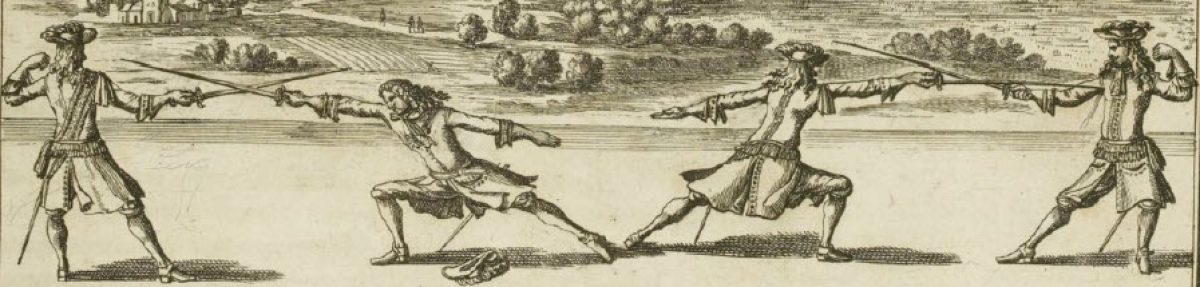
One of the questions I’m asked frequently is how one should hold a smallsword. With a large corpus of treatises upon which to draw this is, lucky for me, a relatively easy question to answer, and, with some degree of certainty. There are differences among the masters, but most are subtle and have more to do with the positioning of the hand than in how the fingers grasp the weapon.
My approach, an amalgam based on the sources, is typical of “most” works:
- The thumb extends along the grip towards the guard and stops 12mm/.5” from the shell
- The forefinger rests just opposite the thumb so that thumb and forefinger are sort of pinching the guard
- The three remaining fingers grasp the grip and help keep the pommel, while in guard, against the wrist
- The fingers do not go through the Arms of the Hilt/annulets


Remember that in French fencing the numbers we use, prime, seconde, tierce, etc., refer to hand positions. There is not, for example, an ideal form of quarte–if the hand is in quarte, one is in quarte, whether parrying high, low, or midline. This is likely one reason, for example, that some masters referred to “quarte over the arm” (modern sixte) when parrying in quarte (hand in quarte) on the tierce side. Here is a handy reference and visual representation of this:

In the two bottom quadrants, the lower outside and lower inside lines respectively, the parries for the former are octave (supinated-ish) and seconde (pronated-ish), and for the later septime (supinated-ish; a.k.a. “half circle”) and prime (knuckles up). Quinte, 5th, is a bit different than the similar position for sabre:
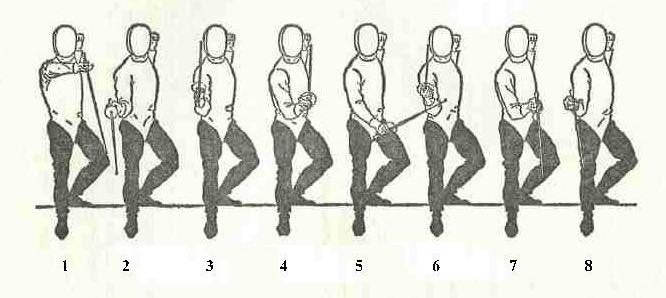
NB: 5th as positioned here is not set in stone, but reflects how the hand is held–this can be raised or lowered.
What do the Sources Say?
Below are excerpts from a few sources, mid-17th century to just before 1800, that cover the grip. Where possible I’ve added the original language if it was written in one other than English. For those without a translation, or for which I do not have one, I’ve summarized the import of the passage rather than offer a translation of my own. I’ve added images from the works when possible too—these are taken from public domain copies, but vary in quality.
NB: going from MS Word to WordPress, never mind the evils of autocorrect, often means errors in transliteration. I do my best to proofread, but if you notice misspellings, wonky accent marks, etc., please let me know and I will correct the error.
Charles Besnard, The Free Master of Weapons, 1653, p. 7 in ENG ver. by Rob Runacres and Reinier van Noort
To properly place oneself in guard and posture in order to practice the single sword or foil, one must first place the sword or foil in hand so that the thumb is placed on the cross or flat of the sword, and the index finger under the flat of the same in a half circle, and right under the thumb. Then tighten the grip of the three other fingers…
Pour bien se mettre en garde et posture pour faire l’exercice de l’épée seule ou fleuret, il faut premièrement mettre l’épée ou fleuret à la main, que le pouce soit posé sur la croisée ou plat de l’épée, et le doigt index soit sous le plat de celui-ci en demi rond, et droit sous le pouce, et serrer fermement la poignée des trois autres doigts…
[p. 7 in the Fr. Transcription by same editors]
De la Touche, The True Principles of the Single Sword, 1670
Next, you must draw the sword, taking it by the grip with the right hand and holding the scabbard with the left hand so that it does not follow the sword, and then draw it. This you can do in several manners, but it is done the easiest and the quickest by always keeping the thumb in the same position as it has in the first figure, and advancing and raising the hand until the sword is out of the scabbard, with the point turned towards the enemy, the thumb on the outside, that is to say, on the right side, and the sword on the edge, as in the second plate. [31 in van Noort and Coudre]
Les Vrais Principes [Ch. 2, p. 7]
Apres cela il faut tirer l’Espée, en la pregnant par la Poignée avec la main droite, & tenant le sourreau de la main gauche de peur qu’il ne suive l’Espée, & ensuite la tirer, ce que l’on peut faire de plusieurs manieres, mais la plus simple & la plus courte se fait en tenant toûjours le poulce dans la mesme situation qu’il a dans la premerie Figure, & avançant & levant la main jusques à ce que l’Espée soit hors du sourreau, la pointe tournee vers l’ennemy, le poulce en dehors, c’est a dire, du costé droit, & l’Espée sur le trenchant, comme dans la deuxiéme Planche.

Sir William Hope, Scots Fencing Master, 1686
Ma. You must hold your Sword after this manner; hold your Thumb upon the broad side of the Handle with your Fingers quite round it, as in the second Figure of the first Plate marked F and not as some do, who put their foremost and middle Fingers through the two arms of the Hilt, thinking that by doing that, they hold their Sword firmer, some use onely to put their foremost Finger through, which the Spainards did of old, and many even to this day do it; but both ways are most ridiculous, and dangerous.
Sch. I think any Man of common sense may perceive that, for when a Man holdeth his Sword in that fashion, with his Finger through the arms of the Hilt, he is in danger of having his Fingers broken, if his Adversary should inclose with him, and offer to force the Sword out of his hand, for holding it that way he cannot so easily quit with it, as he should, and therefore will infallibly in my opinion be in hazard of losing his Fingers, if not his life in the cause.
Ma. Sir, You have found exactly the hazard that a Man is in, in holding his Sword after that manner, but when you hold it, as I have before told you, you must hold it fast and firm, and not gently, so that your Adversary with the least sudden beat or twist may force it out of your hand. [11-13]

di Liancour, The Master of Arms, 1686
Let the right hand be turned half to tierce with the fingernails facing the ground, such that in parrying we need only turn the hand to half fourth, parrying straight thrusts to the inside from fourth with the cutting edge of the sword. [Lynch, 19]
Que la main droite soit tournée demy-tierce, les ongles vers la terre; d’autant qu’en parant l’on n’a qu’à tourner la main demy-quarte, l’on parera les coups poussez tout droit de Quarte dans les Armes, du trenchant de son Epée. [p. 8, Ch. III]

Jean-François Labat, The Art of Fencing, 1696/1740
…the Hilt of the Sword a little above the Hip, turning towards half Quart, the Thumb extended, pressing the Middle of the Eye of the Hilt, keeping the Fingers pretty close to the Handle, especially the little one, in order to feel the Sword firmer and freer in the Hand. [5, McMahon, Lector House edition]
L’art en fait d’armes ou de l’épée seule, avec les attitudes
…que le poignet de l’épée soit un peu plus haut que la hanche, tournant un peu vers la demi-quarte, le pouce étendu & apyué sur le milieu du corps de la garde entre les deux tranchains, serrant suffisament les doigts, sur tout le petit, asin de sentir l’épée plus ferme & plus libre dans la main. [9-10, L’Abbat]

Zachary Wylde, The English Master of Defense, 1711
your Hand fast gript about the hand of your Foil or Rapier, then put your Thumb long ways or forward upon it, your Arm quite extended from the Center of your Body, the Point of the Weapon being directed in a true Line against your Opponent’s right Pap, sinking somewhat low with your Body, your right Knee bowing or bent over the Toes of your right Foot, (tho’ some Masters teaches a strait Knee,) your left Knee more bent, inclining towards the Toes of your left Foot; lying in this Order is the Posture, which I call, Stand your Line, the Medium Guard then is fixt [p. 6 in the pdf]
Donald McBane, The Expert Swords-man’s Companion, 1712, p. 3-4:
Let the Grip of your Sword or Fleuret be no bigger, than that you can close your little Finger round it, and touch the Palm of your Hand; and let all your Fingers be round the Grip, and the point of your Thumb close too or near the Shell, which Guards your Hand, much more than as some People hold it, with the Pummel in the Hand, and fore Finger stretch’d out toward the Shell, they then can not command the Sword so well, and all the Advantage of hold it so, is, that they have a greater length from the Point to the Body, than if they held it with the Thumb close to the Shell. If the Grip of their Sword or Fleuret be larger than as here mention’d, it will be easily be Beat out of your Hand by a Batter.
When you are to Offend, whether at the Wall, or on the Floor, keep your and Hand Breast high, and Point rather below your Hand, and if you are to Defend at the Wall, keep your Hand as low as your or Hipp, and your Point as high as your Forehead; but for Defence on the Floor keep the proper Quart Guard, and by turning your Hand, you may Parie all high Thrufts, or Thrufts made at the Level of your Hand, and above; for Thrufts below the Level of your Hand, the Low Quart, and Seconde will Parie them.

Alexander Doyle, Neu Alamodische Ritterliche Fecht und Schirm-Kunst, 1715
Die Erstere nun/ Prima genennat/ belangend/ ziehet selbige ihren Nahmen daher/ wann man den Degen aus der Scheiden ziehen will/ denselben mit verkehrster Faust aud der Seiten ergreisset/ und nach dessen Entblosung sienem Feinde die spize bietet; da dann mit dem kleinen Finger in der Höhe/ dem Daumen unten/ mit zugelegter Faust und ausgeisirechtem Urm gegen die Uchsel die Spize praesentirt wird: Und in solcher Positur wird die so genannte Prima formiret [p. 1]
[Summary: prima/first is named for the fact that this is the position one is in after drawing the sword; one grabs it with the fist inverted; in this position, the thumb faces down, the little finger up; NB in the image below the fencers are not in prima]

Henry Blackwell, The English Fencing Master, 1730
Secondly, To hold a good Guard to defend your Body, your Right-Hand must be straight out with a little bend in your Arm, the Point against your Adversary’s Right-Breast, with your Four Fingers bent under one part of the Handle, and your Thumb over the upper part, with the Pummel close to your Wrist, as you shall see in the Posture, etc. [2]

Girard, Traité des armes, 1740
III. Que la poignée soit serrée près du pommeau avec le petit doigt, & le second doigt, & que la milieu du poulce soit apuyé à plat sur ladite poignée de l’Epée près de la sous-garde; laquelle poignée étant soutenuë du dedans la jointure du premier doigt, on aura la facilité de dégager & de tirer.
IV. Avoir le bras droit, & le poignet flexible & tourné demi quarte, de sorte que le demi trenchant de la lame regarde la terre, comme il est dit, & que le bout des ongles des trois derniers doigts de la main droite regarde le Ciel, & la plus grande partie de l’ongle du poulce, ainsi que le bout du premier doigt. [5-6]
Crawley, Philip T. The Art of the Smallsword, Featuring P.J.F. Girard’s Treatise of Arms. Wyvern Media, UK: 2014, 38.
3. That the handle is gripped near the pommel with the little finger & the second finger, & that the middle of the thumb is laid flat on the grip, near to the body of the hilt; of which is supported by the inside of the knuckle of the index finger, which will give greater ease in disengaging and thrusting.
4. The right arm & the wrist flexible & turned to demi-quarte, in such a way that the ridge of the blade is toward the ground, as stated, & that the fingertips and nails of the three last fingers point towards the sky, as the greater part of the thumbnail and the tip of the index finger.

Le Perche du Coudray [attrib.], L’exercise des armes ou le mainement du fleuret, 1676/1743
Voila de Toutes les Gardes
La Situation la plus naturelle, la plus gratieuse, et la moins dangereuse, Car toutes les autres sont Exposée, a tant de Contrecoups qu’il ny [ne?] faut pas penser, cest pourquou je Conseilleray toujours aux Amateurs de ce noble exercise de ne s’Escarter jamais des regles de cette garde, qui sont dabord de bien tenir son Epeé, ayant pour cette Effet la poulce sure le plat de la poigneé, la pointe a la Hauter de l’Epaule, que le pomeau de l’Epeé tombe en ligne directe sur la pointe du pied droit, qu’il soit a la hauteur de la hanche droite, il faut que le Corps soit droit sur les deux hances, et posé entierement sur la partie gauche, Cavant bien la hanche droit, et Effacant bien l’Epaule gauche, pliant le genoüil gauche et laissant beacoup de liberté dans le droit, asin de n’etre point Embarassé ny pour marcher, ny pour faire les Engagements d’Epeé; il faux que les deux pieds soient dans la même ligne et que les deux Talons se respondent l’un a lautre. Il faux être sendu Environ de deux semeles il faut que le bras gauche soit èlevé en faisant un de ny Cercle et que le creux de la main soit directment a la hauter de l’Oeil gauche, la tête droite le Corps bien effacé et observer tourjours une g. de liberté, le talon droite vis a vis l’Oeil du soulier gauche [1]
[Summary: thumb is flat on the handle, point shoulder high, pommel in direct line with tip of the right foot, at height of right hip]

Juan Nicolás Perinat, Arte de esgrimir floret y sable/Art of Fencing, 1757/8 [from the transcription and translation by Tim Rivera, 2018]
It is necessary to be in guard in the mode that is seen in the figures of the first plate, both feet on the same line, both legs bent, the left more than the right, the hip supported on the left side, both arms half extended, the left higher and arched, the head erect, looking at the enemy, the hand turned between fingernails up and fingernails down, or in the regular posture, and the thumb over the plane of the sword, presenting the point to the enemy. [1]
Es menester ponerse en guardia del modo que se vé en las Figuras de la Lámina primera, ambos piés sobre una misma línea, las dos corvas dobladas, la izquierda mas que la derecha, la Cadera apoyada en la parte izquierda, ambos brazos médio tendidos, el izquierdo mas levantado y arqueado, la cabeza derecha, mirando al Enemigo, la mano vuelta entre uñas arriba y uñas abaxo o en postura regular, y el pulgár sobre el plano de la Espada, presentando la punta al Enemigo. [1]
Domenico Angelo, The School of Fencing, 1763/1783
You must observe that the gripe of the sword be put on quite centrical to the heel of the fort of the blade, which should have a little bend above the fingers, when in hand, and let the whole mounting be turned a little inward, which will incline your point in carte. This way of mounting your sword will facilitate your disengagements, and give you an easy manner of executing your thrusts. [2 in the 1787]
Il faut ausi que la garde de l’epée porte juste sur l’affiette du talon du lame, laquelle doit baisser un peu sur les doigts de la main, & le corps de la garde doit être tourné un peu en quarte. Cette maniere de monter uné epée donne de la facilité pour dégager & de la liberté pour tirer les coups d’armes. [p. 21 in the pdf from the BNF Gallica site]

Andrew Lonnergan, The Fencer’s Guide, 1771
In holding your Foil observe, that you must lay your thumb upon the flat of the handle, or grip, somewhat extended with your fore finger on the other flat behind, forming a square with the point of your thumb. Sometimes you will find a Foil, with a square handle, where no flat side can be distinguished; in such case, the flat of your Foil’s blade must guide you as before; but now the Foil blades are also square, therefore you must be guided by the kind of shell the Foil has; which shews you where the real flats of the handle and blade are, though still square. Now the whole hand should be at such a distance from the shell, so that the little finger should lock into the hollow part, or neck of the pummel; yet practice will allow you to shift your hand hereafter. Observe, when the handle or blade of your Foil is bent, or arched, you must always lay your thumb upon the round side; and the inside of your fingers ends on, or against, the hollow side, or part of the blade, griping the handle gently, and with as much freedom as if on a flute.
Some make a practice of holding the Foil between the fore and middle fingers, with the thumb propped against the fore-finger; yet this method, though successful enough to many by long practice, is not so recommendable to begin with as the former. [1-3]
J. Olivier, Fencing Familiarized/L’Art des armes simplifie, 1771
Ch. 2 How to hold the Sword
In order to hold a sword well, the hilt must be flat in your hand, your thumb stretched and at an inch distance from the shell, the pummet under your wrist.
Never keep the sword fast in your hand, but when you parry or thrust. For, if you hold it always with strength, the muscle of your thumb will soon grow stiff. [9]
Ch. 2 Maniere de tenir l’Epée
Pour bien tenir votre épée, il faut que la poignée se trouve à plat dans votre main, le pouce etendu à la distance de 12 lignes de la coquille, le pommeau sous le poignet.
Ne serez jamais l’épée en votre main, que lorsque vous parez ou tirez car, si vous la teniez toujours avec force, vous vous engourdiriez bientôt le muscle du pouce. [p. 10]
John MacArthur, The Army and Navy Gentleman’s Companion, 1780 [NB: fan of J. Olivier’s teaching and method]
Lesson 1: The Manner of Holding the Sword or Foil, etc.
In order to hold your sword well, the hilt must be flat in your hand; so that the two edges will be nearly horizontal when you throw yourself upon guard; your thumb stretched along the upper flat part of the hilt, within half an inch of the shell, and the pummet is to rest under your wrist. [p. 3]

Danet, L’Art des armes, Paris, FR: Chez Herissant, Fils, 1788
Manière de tenir l’Epée
Pour tenir avantageusement l’épée, il faut que la poignée se trouve entre le tenar & l’hypotenar, & le pommeau à la naissance de la main; que le pouce soit allonge jus-qu’à la distance d’environ douze lignes [*] de la coquille sur le plat de la poignée; qu’en même temps le milieu de l’index se place dessous la poignée près de la coquille; que la poignée soit étroitement embrassée par le doigt majeur, & encore serrée contre le tenar vers la pommeau, par l’annulaire & l’auricularie: mais il ne faut serrer la poignée que dans l’instant seulement que vous tirez, ou que vous parez; parceque les muscles due pouce, de l’index & du doigt majeur s’engourdissent promptement, au lieu qu’il n’en est pas de même de ceux qui sont agir le petit doigt & l’annulaire.
Il est des occasions où il convient de lâcher ces deux doigts pour faciliter l’exécution de cetain coups. J’aurai attention de vous en prevenir quand il le saudra. [3]
[Summary: the thumb is extended along the grip and a short distance from the shell; index is under the grip, opposite the thumb; of note, Danet reminds the fencer not to grip tightly save when thrusting or parrying; the three remaining fingers keep the weapon secure, pommel is against the wrist]
* The ligne, “line,” was a unit of measure in pre-Revolution France. This particular measure had an English parallel, of the same name, which varied in length between 1/10 and 1/40 of an inch. The French ligne corresponds to about 2.3mm. Incidentally, a pouce, or “thumb” [approx. 27mm] was also a measurement within this system, but that is not how the word is used here. For more on this, a useful summary is provided in William A. Smeaton, “The Foundation of the Metric System in France in the 1790s: The Importance of Etienne Lenoir’s Platinum Measuring Instruments,” in Platinum Metals Rev. 44:3 (2000), 125ff [https://technology.matthey.com/article/44/3/125-134/]; see also Suzanne Débarbat,”Fixation de la longueur définitive du mètre,” in Ministère de la culture et de la communication (1999): https://francearchives.gouv.fr/fr/pages_histoire/39436 ; of note, the ligne is still used by some milliners, cf. https://www.levinehat.com/blogs/levine-hat-blog-1/19189051-what-are-french-lignes













 Capitale Escrime Historical Fencing