Among the many challenges we face as instructors is how to organize lessons and classes, what to emphasize when and how best to accomplish that. What follows here is not new, nor is it any invention of mine; this is just how I conceive of a well-known process and one possible way we can use this approach to teach historical fencing. I refer to it as the “recursive model,” because each lesson incorporates key elements of the one preceding it. [1]
Rotae/Wheels
I’m intensely visual as a learner and so tend to chart a lot on a white board and paper. I like to be able to see ahead and see how things interconnect; it can be especially useful when managing both the micro- and macro-views of a topic, say something as finite as an individual technique and each part which comprises it as well as something as large as a series of classes which explore that technique in different ways. One method to capture this visually is with intersecting circles.
As I’ve worked with these I referred to them as “circles,” “rounds,” or rotae, but whatever the terminology the idea is that each circle represents say a new lesson that also returns to core material from the previous lesson. [2] This reinforces what students learn by repeating core actions and ideas, but at the same time increases the awareness of how everything works together. It’s also a great way to build or plan ready-made drills. All of it is scalable—it works for a technique or action, say the lunge, as well as a system, such as Girard’s approach to smallsword. One lesson rolls naturally into the other, and builds off what one has covered previously, so we increase complexity as we proceed. In a glance we have a model in which we can shift elements of a lesson, examine the interval between those examinations, and isolate individual themes actions, plays, or techniques to cover.
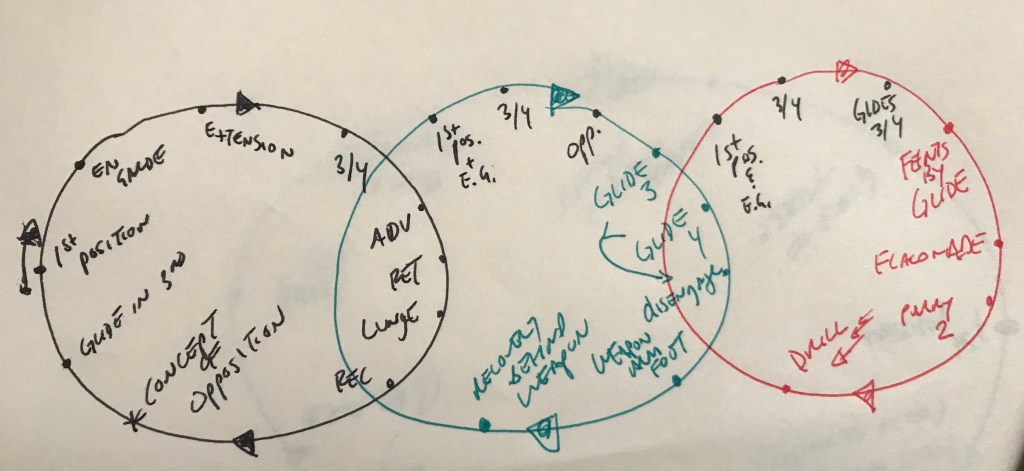
In my last post I discussed smallsword as a “gate-way drug” for historical fencing—that class is an experiment in using this approach in a formal way. For example, here are my initial notes for this class for the first three sessions, each an hour long:
First Three Lessons example*
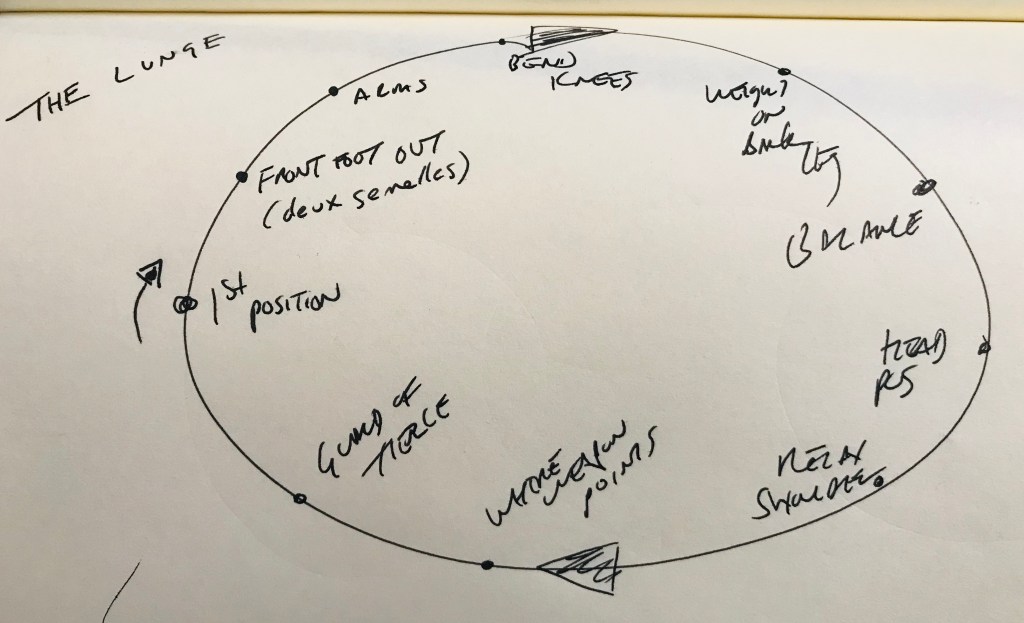
In the first, we cover moving from first position into the en garde position; the extension of the weapon from guard, the guards/parries of tierce and carte; we then cover the advance, retreat, lunge and recovery out of the lunge (backward initially). Offensively I start with the glide in tierce. Each of these we can depict in the round as well, most especially those maneuvers like stepping into guard or the lunge which involve multiple steps:
Use of Rota to Breakdown the Lunge**
If one looks at the second circle (in green), one will notice that some of the first lesson (in black) starts that session off; it’s followed by the logical steps that proceed from that first lesson. Thus, in green ink, we see the “glizade” or glide in 3rdand the glide in 4th; moving from the outside to the inside engagement means covering the disengage. Students drill these attacks with special focus on the point landing before the front foot; the lesson portion concludes with teaching the basic defense against these glides (stepping back and taking tierce or carte) and reemphasizing the importance of closing the line.
Each new lesson incorporates review of the critical actions necessary to take on new material. However, if a class is struggling, then it’s easy to stop, work the same material from the previous lesson, and try the new material again in the next class. Thus, if in the third lesson (red) students are struggling to make the feint by glide in third, one can have them drill the glide in third minus the feint. Perhaps have them work on tight disengages, then the glide; time permitting, I have them advance lunge the glide. This will help them hone the necessary skills to start working on the feint.
How this Works
There are a few important considerations in using this method. First, the instructor must have a decent command of the material or they cannot delineate what is fundamental, what composite. If new to the material, then sitting down with the source and organizing it is the first step; this recursive rota approach can help one do that. Perhaps in reading the source one notices that the author covers movement first, then defense, then offense in increasing complexity. If one outlines each of those areas, what are the first things the author covers in each section? What cross-over is there between them? One will notice, for example, that the first attack likely starts from a position of defense covered in the second theme and uses movement from the first. Taking the initial steps in each section—movement, defense, and offense—is not a bad way to start a first lesson; at the very least it’s a decent goal to set for it as it will mean covering fundamental actions and thinking required for that system.
Second, the instructor must have at least an approximate sense of how difficult each new element typically is for new students, that is, how easily or not they can acquire a given skill. The advance and retreat, for example, are generally something students get quickly; there will be refinements to make to them, but the basic concept of stepping forward and backward one foot following the other shouldn’t be a major hurdle, but the feint-1-2 might be a lot harder as it will require coordinating hand, feet, and eye. The sequence within each circle should proceed from simple to more complex—this is not only easier to teach and to learn, but helps students see more effectively what each technique, action, or concept involves.
Third, and related to the second point, the instructor must know how to assess problem areas and be willing to stop a lesson and focus on those When necessary. This can be done without haranguing a class or student; it can be as simple as noticing they’re really struggling to extend first and deciding to make that the focus for the day. Depending on the class, one can ask them directly if they’re struggling as well—this tends to be safer with adults than with children. For example, the advance is simple, but there are common problems one must be on the lookout for and correct, such as not pointing the front foot towards the front. Critical as it is to point the foot, correcting it doesn’t require shutting down all footwork until they point their feet—students should continue to work on footwork, drill, but the instructor will make corrections as they do so. It doesn’t have to be perfect to start—it just needs to work effectively enough. As students grow in comfort and stability, the instructor can make adjustments as necessary. If on the other hand no one is extending the arm before they lunge, then it is critical to correct that before moving to the glide or they’ll develop a dangerous habit that will affect their entire game.
Rotae and Recursive Learning as Continuing Program
Depending on one’s source material one may run through the circles in short time. It’s important to note too that going through some of the same material more than once is not only an option, but recommended. Using Girard as an example, one might get through most of his program in a few months (assuming say a few lessons a week and students who are dedicated). Fencing, any fencing, is about practice, drill, using the system; it’s not go through it once and done.
After an initial run through Girard’s system one might return to specific elements, say his section on beats. The choice comes down to a number of considerations. After one run through the circles, the instructor may notice areas the students are weak or where they struggled—that might be an ideal place to start for the second run through the circles. Once the students have acquired some familiarity and enough skill, it’s possible to mix up some of the circles, use them out of order, so that things stay “fresh.”
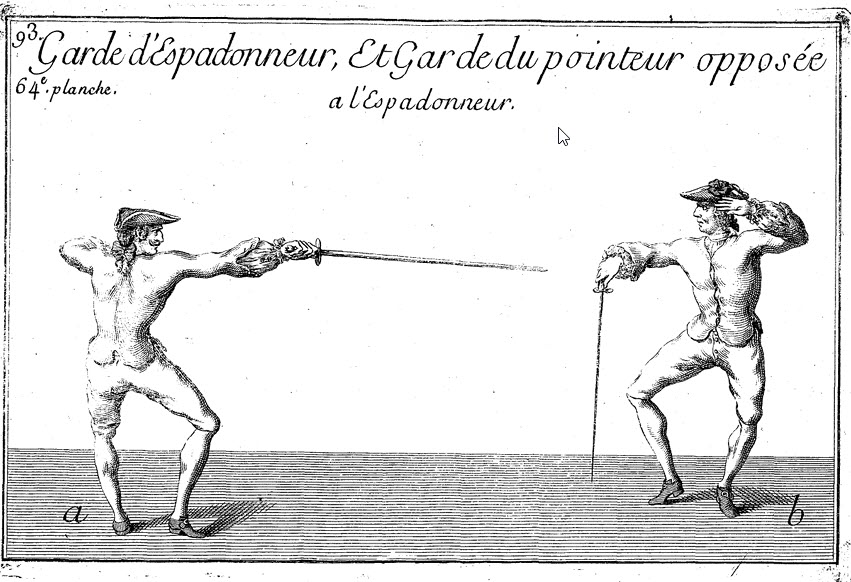
Girard, Broadsword vs. Smallsword (1740)
With some manuals, going through them the same way again and again will get old fast; boredom is the bane of learning (and teaching), so mixing things up, throwing in something different, can help. Returning to Girard, maybe peppering the lessons with attention to his sections on weapon-seizures or facing different weapons or national/ethnic guards will add a little “pop” and interest. For more advanced students, comparative analysis of Girard’s advice for facing a broadsword fencer or odd farm weapons with that of another master can be both fun and an effective way to widen and deepen their understanding of smallsword.
D. Angelo, Broadsword vs. Smallsword (1763/1787)
Multae Viae
There are many ways to learn, and instructors should use what works best for them and for their students. The recursive model is simply one method and one I find works well for teaching fencing. Most of us, I suspect, use a variety of methods; we adapt for different types of students, different contexts. Our goal as instructors is to share a body of knowledge and technique, to pass it on, and whatever helps us achieve that has merit.
NOTES:
[1] Online searching comes down to the terms we use, and I have to guess that I’m just not using the correct ones as I can’t find a formal name for the process I describe in this post. “Recursive learning,” “education,” and “model” all bring up a lot on machine languages and programming; I had much the same problem with the terms “reinforcement learning,” “rota learning method,” and similar iterations. A wider search for “curriculum design” or “styles” was likewise unhelpful. SO, if someone reading this knows what this approach is called, please let me know.
[2] Traditional fencing lessons work this way, at least they should. Students acquire new skills over time, but much of the lesson will incorporate or drill what they already know.
* My chicken-scratch is infamous, so here is a transliteration: –1. Black Circle: starting with 1st position, en garde, extension, guards/parries 3 and 4; movement: the advance, retreat, lunge, recovery out of the lunge; concept of opposition; glide in 3rd and defense –2. Green Circle: starting with review of 1st position and the en garde, guards 3 and 4, and opposition from first lesson; then the glide in 3rd, in 4th, and the disengage; importance of weapon-arm-foot; importance of recovering behind the point –3. Red Circle: review of 1st. pos. and en garde, guards 3,4, glides in 3/4; feint by glide in 3rd and 4th; flanconade; parry 2; drills building off of Fencer A makes feint by glide to outside line; Fencer B parries 3; Fencer A disengages, thrusts in 4th with opposition–> Fencer B receives the touch; then, same set-up, but Fencer B parries 4th and ripostes by flanconade [this sets up a future lesson were Fencer A will parry in 2nd]
**Key Components of the Lunge viewed as Depicted via Rota: –starting from 1st position; front foot extends out about two shoe lengths or so (Fr. deux semelles); position of arms; bending the knees; weight on back leg traditionally, but today often equi-weighted; balance and stability the goal so that en garde facilitates an explosive lunge; head position; importance of relaxing the shoulders; where to point the weapon; guard of tierce/3rd
Read enough and inevitably one will encounter one of those passages that for one reason or another seem tailor made to confuse us. Sometimes we’re just tired and need to take a break, sometimes translation or transcription issues are behind such problems. However, there are also instances when a passage, in any language, remains cryptic. The sentences are grammatical, the topic is in a logical place within the source, but somehow despite our best efforts we can’t unravel what it is the author meant.
Recently, a colleague in Passau, Germany, Christian Olbrich (Fechten Passau)* and I discussed one of the latter examples in a source we both value greatly, Maestro Luigi Barbasetti’s The Art of the Sabre and Epee (1936), itself a translation of the 1899 German edition Das Säbelfechten. [1] My friend asked me for my two cents on several passages in Barbasetti that even on second glance tend to make us scratch our heads. The first question, and my example here, concerns the molinello from an engagement in third. Here is the passage in question, both in English and in German:
English:
After Your Own Engagement
In Tierce—(a) With the aid of a horizontal molinello from the left to the right side, you can perform inward to the face, chest, or abdomen’
(b) If your adversary does not respond to your engagement by pressing your blade, you can, with the aide of the coupe, pass your blade to the inner opening and touch his head. [32-33]
Deutsch:
Aus der gegnerischen Bindung
In Terz, a) Mittelst einer wagrecht geführten Schwingung gelangt man von rechts auf die innere
Seite des gegnerischen Gesichtes, auf die Brust oder auf den Bauch.
b) Auf den Gegendruck der feindlichen Klinge rechnend, kann man mittelst Coupé – Bewegung auf die Innenseite übergehen, um mit einem Kopfhiebe zu enden. [57-58]
This particular action, a horizontal molinello from one’s own engagement in third (Terz, tierce), has popped up as a source of consternation several times. Some years ago, the sabre group at Indes WMA (now Indes Ferox Gladio, see links) brought this action up, and more recently Christian and I explored it via email. If one isn’t sure why this action seems odd, it may help to illustrate it.
Engagement in 3rd–a little exaggerated and at too extreme an angle, but both “fencers” here have their opponent’s blade to the right/outside, and are in third
By “my engagement” we mean that I have sought my opponent’s blade and made contact with it, in this case, “in tierce” or on the outside line, “outside” here meaning to the right of a right-hander. To perform a molinello, that is a circular cut using the elbow as axis, I must detach the weapon from my opponent’s to cut. Easy, right? Yes, but, there is an important question this raises: if one has control over the line by taking the engagement, and then leaves it to make a cut, what happens to the other blade? It is still out there, pointing at us, and threatening. From the sound of it, Maestro Barbasetti seems to be suggesting that we leave a place of security to attack without first removing the threat, a threat that we ostensibly had control over at the start. That doesn’t make a lot of sense, especially given how well-trained the maestro was and how well put-together his books are.
There are a few ways to make sense of this passage. A first and crucial step is to reread the passage, and, those which inform it. For example, I have defined “molinello” as a circular-cut employing the elbow as its axis of rotation, but earlier on page 29, where the master discusses cuts generally, he says
If you execute a circular movement ending with a final touch, the blow is called “cut by molinello.” The object of this preparatory circular movement is to disengage your blade from that of the opponent.
You must perform all cuts at the moment you detect an opening, retaking the position of guard immediately after. [29]
The German text says much the same, but is more specific:
Geschwungene Hiebe werden angewendet, wenn sich die Notwendigkeit ergibt, der Klinge des Gegners auszuweichen oder die eigene mittelst einer Schwingung von der gegnerischen Bindung zu befreien.
Hiebe sind zu führen, sobald der Gegner eine Blosse und die Zeit bietet, sie zu benützen; sodann muss die Waffe wieder in die Auslage zurückgeführt werden. [52-53]
My German is not great, but as I read this the 1899 edition explains that one uses these circular blows (Geschwungene Hiebe) either to elude (auszuweichen) or to separate (befreien) one’s blade from that of the opponent. [2] In either tongue, however, we are told that the “molinello” for Barbasetti involves disengaging one’s blade from that of the opponent. This is a subtle point, but an important one, because this is only one use of the molinelli. They are used as the maestro suggests, but also alone as exercises, as offensive actions, and—significant in this instance—as defensive actions.
We read “from our engagement” in a section on cuts and often assume we are on the offensive, but this can just as easily mean we are on defense. A parry, after all, involves engagements too; cuts include riposte options. Making a horizontal molinello from third makes the most sense to me as a riposte, which is to say that having parried in third one can reply with a horizontal molinello toward the right.[3] There are, however, not many instances in which I would choose this cut as a riposte from that parry—as a drill, however, as a way to practice this molinello, there is some merit, but as a riposte I would couple it with offline movement to the right and forward. The sketches I add here suggest rather than demonstrate, but hopefully provide some visual sense of what I mean:
Shifting right and diagonally forward with the riposte
Same idea, different view–here the idea of shifting the line of direction a few degrees is a little more clear
Read, reread, make sure of each term, and ask for help. There is no shame, ever, in asking other qualified people for their thoughts. When the people at Indes WMA asked me, we worked on it, but once home I sent a message to Chris Holzman to get his take as well. As Christian and I explored it this past week I once again checked in with Chris and Patrick Bratton. I wanted to be sure my own thinking wasn’t too far out before replying to Christian. Due diligence is important, and with something as odd as this one little passage, it pays to be cautious.
In the end, how we use the action and what the maestro intended may differ. In part this is down to context. Barbasetti, like many others of the Radaellian school, put his approach to paper, but as a working instructor he knew, as we do, that a book can inform but cannot teach. Fencing was and is, primarily, something one does. We learn it in person, individual to individual and/or group, and IF reading is involved it’s supplementary. Generally, a fencing book collects information, explains it, and serves as reminder and reference. [4] While Barbasetti offers his book as a pedagogical tool, he also assumes one has some knowledge of fencing. In the sala, when a question like this pops up, it’s far easier to manage because one can physically explore it with guidance. It’s far harder on one’s own. [5]
In classical and historical fencing not everyone has the same amount of experience, so seeking help is a logical step. This said, it is worth our time pondering these more challenging passages; the effort is not wasted, we learn something in the process, and our understanding deepens. It especially behooves an instructor to wrestle with the text—it forces close-reading, helps us avoid being cavalier with information that is actually rather complex, and better prepares us and students to tackle the material.
NOTES:
*For Christian’s club, see https://www.fechten-passau.de/ They do a lot–sport, classical, and theatrical–be sure to check out the photos and videos for the latter!
[1] The German language text is Cav. Luigi Barbasetti, Das Säbefechten, übersetzt von K.u.K. Linienschiffs-Lieutenant Rudolf Brosch und Oberlieutenant Heinrich Tenner (Wien: Verlag der “Allegemeinen Sport-Zeitung,” 1899. The English text is Luigi Barbasetti, The Art of the Sabre and Epée (New York, NY: E.P. Dutton & Co., Inc., 1936).
[2] NB: what follows stems from the German I learned in graduate school for reading—the class was tailored per field, and one of several I had to learn but which I am in no way expert.
For auszuweichen (infintive), I looked to ausweichen, v., the primary meaning of which in my basic Langenscheidt Standard German Dictionary, rev. 1993, is “to make way for (with the dative),” “get out of the way of,” “dodge,” but which may have a meaning specific to fencing my little dictionary does not contain. Jeffrey Forgeng, in his glossary of German terms in historical fencing, cites the use of this verb in Meyer (1570, 2.18v, 86v), and supplies “evading” [cf. https://wiktenauer.com/wiki/Fechtkunst_Glossary_(Jeffrey_Forgeng)#Glossary]. Befreien, however, is a little more straight-forward. This verb typically means to “free, liberate; release.”
As for Geschwungene Hiebe, the term here for “molinelli,” initial denotations are not much help. Geschwungen is an adjective meaning “curved,” but also the past participle of schwingen, ‘to swing, wave, brandish.” Hieb (m), means a “stroke, blow, punch.” To render this as “curved blow” seems clumsy, and I’m not much happier with “swinging blow,” though that perhaps gets closer.
German readers are encouraged to assist this thick-tongued Yank if they would be so kind (Danke an alle!)
[3] I am not alone in seeing this as really only viable as a riposte; Chris Holzman does as well. The logic here is that if one has stopped an attack, parried it, one has robbed it of its force, and while it’s true the point remains there (and must be considered), the opponent’s first thought should be their own defense, NOT a remise or counter-attack. This is the difference between the more sportive idea of ROW and approaching the weapons sans rules.
[4] Fencing books have served many purposes. Some were attempts to impress a patron and gain preferment or a job, others were vehicles to lambast opponents and explain the “true” way, and still others were meant to share a particular school’s view on the Art. Most modern works, and by modern I mean 19th and 20th century texts, assume some degree of familiarity on the part of the reader. True, some do not, but most maestri writing these books write them to help students and share their take on things, not as substitutes for lessons with themselves.
[5] Historical and classical fencers, unlike their cousins in the sport, rely far more on sources. How much differs widely, but reliance upon the source tradition and fencing’s early purpose is what tends to define these two branches. On the one hand, books are the primary way by which we know anything at all about pole-arms, sword in two hands, and rapier. On the other, later books help us peel back the layers accrued over the 20th century. It is still interpretive more often than not, but without books, without the sources, it would just be make-believe.
Yesterday I once again had the pleasure to chat with Dr. Manouchehr Khorasani on Razmafzar TV. This time we discussed the sabre system of Giuseppe Radaelli (d. 1882) and its legacy. I was lucky to have Mike Cherba from Northwest Armizare present to help demonstrate some of the key features of the system. In part 1 of the interview we discuss Radaelli, the works on his system, and his period. Part 2, coming soon, will share the demonstration portion.
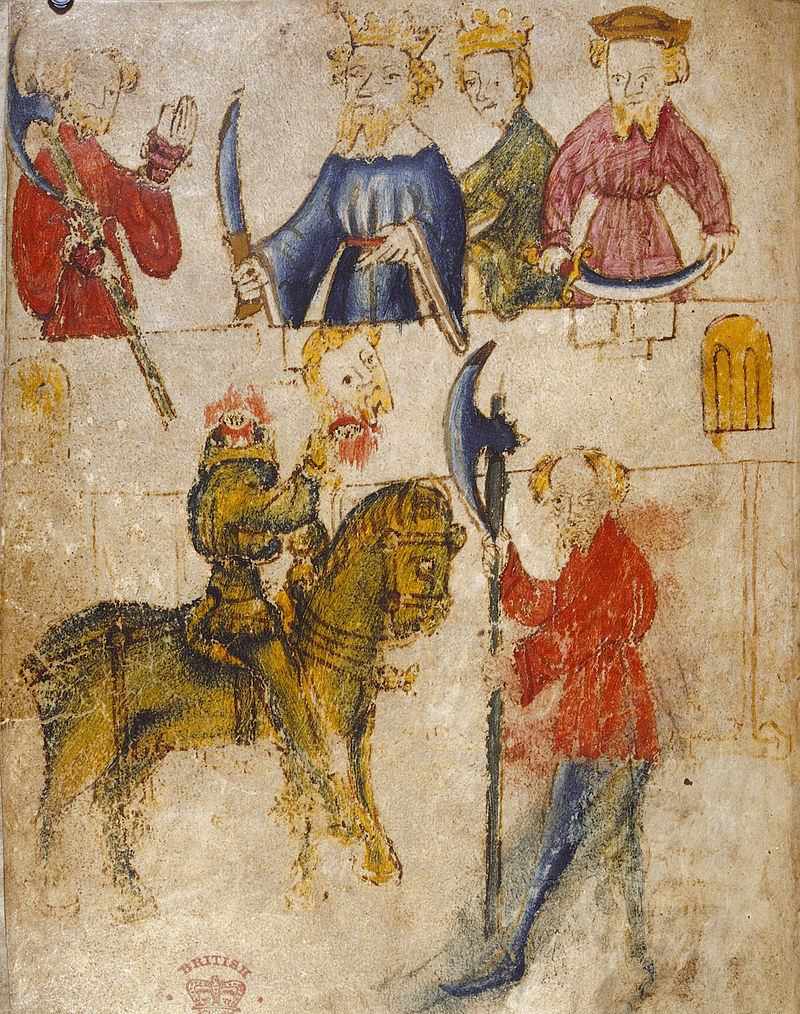
British Library MS Cotton Nero A.x. (art. 3) f. 090/94 verso, (from UCalgary, Canada, digital collections, Gawain Ms)
In most any quest one is more likely to find Tech Duinn than Tir n mBan or Kêr Iz. Only in stories is anyone, normally a hero, able to win a prize, earn a skill, or achieve much without effort. Even there the best efforts can fail—for every Gawain there is a Connla. [1] Not all effort is the same. Not everything is up to us. We can direct energy in the wrong direction, and so it’s worth pondering how we can best apply ourselves so that we don’t waste time or energy (all other factors notwithstanding). The importance of this goes beyond how we train and into how we lead our lives, into what battles we choose to fight, what company we choose to keep, and in what pursuits we direct our efforts. Everything.
I took as the motto for this school a line from F.A. Marcelli’s Rule of Fencing (1686), vis enim vincitur arte, “For force is conquered by art,” not because power doesn’t have its place, but because without art power only does so much. One may be a powerful speaker, but without some skill in rhetoric any speech will suffer no matter how passionately one delivers it. In the same section, Marcelli shared a Latin rendering of the first two lines in Hippocrates’ Aphorismi, Ars longa, vita brevis, that is, “the Art is long, life short.” [2] The cipher I adopted for myself (see image just below) I made from two bits of clipart (one must be mindful of intellectual property rights)—a skull argent, affronté, crowned, trisected by spada, sabre, and foil—and is meant to capture this notion, that is, that the Art is eternal and we are not. It plays well with the usual memento mori aspects of this specific charge. I noticed another fencer adopt it, a chap in Italy I believe, and if it speaks to him too, great.
Memento Mori
For me, there is a lot that this cipher encapsulates. We only have so much time, so we should use it well. We should face the Great Question as bravely as we face an opponent: eyes forward, devoid of emotion, and ready. Whatever the weapon (the three stand for all) we should be ruled by the Art and the respect and discipline it teaches. If we want what we do to matter, if it is to matter, then we must embrace that journey without simplistic expectations about the outcome or too much concern about how it will be received—we focus on the work instead. We focus on the Art, less so our experience of it. This is easy to say, but much harder to carry out; so, mindful that death wins in the end, that nothing comes without struggle, and that we should consider how we want to be remembered, we press on despite setbacks, criticism, or failure. Failure, after all, is just another teacher.
It’s difficult sometimes, and natural to ask, whether we’re wasting our time or effort. We should ask this frequently. We can’t always know when we are wasting our time, especially without a skilled coach or similar insight, but there are a few areas this tends to go wrong and that are worth monitoring. Unqualified to give anyone life advice—not like I’ve figured my own out yet—what follows focuses on a few aspects of the Art where we tend to go wrong.
Attribute vs. Technique Fencing
One area we see misplaced effort is in forcing through an action. It’s not that this didn’t happen—we can be pretty sure it did—but in and of itself relying on one’s strength, or speed, or reach only brings short-term benefits. Two caveats. One is that competitive “HEMA,” like it’s sibling Olympic competition, will sustain an attribute fighter or fencer a long time. At present it will serve one longer in HEMA, because there are fewer truly skilled fencers who compete. [3] I am not against tournaments—they’re fun—but they have garnered more weight than they should have. I’m not the only person who believes this; as Matt Easton and Mark from the Exiles recently commented, the goals, training, and attitude toward the Art differ across the historical fencing spectrum. As unpleasant as this may sound, success in competition may correlate with a high degree of skill, but it doesn’t have to; in fact, in general all one needs is the need to do well and a deep degree of commitment to each fight, each blow. Olympic is no exception. [4]
Second, there are situations, particularly in mixed-weapon settings, where differences in weapons tell. A recent example of my own was fighting with a friend, Josh Campbell; he was armed with a 3+lb (1.36kg) baskethilt; mine, a later period model, weighs in at 2.36 lbs (1.072 kg). One head parry I took I didn’t take at the right distance and the mass of the other weapon easily defeated my defense. I only bout full-tilt with people of appropriate skill and control—I can’t afford to be injured—and this man, strong as he is, is able to stop a blow on a dime. The touch was his—yes, I had “parried,” but insufficiently, and had the fight been in earnest that blow would likely have ended it right there. Using one’s natural abilities is not wrong, but the best fencers combine those gifts of heredity with technique and understanding. This is true regardless of the person. In the example above, Josh could push through most any blow he wants, but he doesn’t—he knows that he needs to let the sword do its job, he knows to use its weight to save him effort, and in situations where the mass of that weapon will overwhelm he has the control to moderate force.
As another example, height and reach can be a boon, but so too can the lack of it. A good coach will help each fencer develop those inborn abilities in conjunction with the technical repertoire both learn. When I am teaching a shorter fencer, even at the outset we discuss things that are not going to work against a much taller opponent. If fencer A is 4’ 5” and B is 6’ 4,” and B launches a head-cut, A can use parry 5, but will likely need better measure to create an angle that keeps them safe. Moreover, A probably shouldn’t riposte to the head—they’re at a disadvantage there. The lower lines are a safer bet as they’re closer to A and harder, generally, for B to cover as quickly. B, on the other hand, can more easily target the high lines and extended target—going for a leg shot against A, which is daft for a variety of reasons, is more so given the height difference. [5]
Drilling
The famous line attributed to Bruce Lee about kicks, “I fear not the man who has practiced 10,000 kicks once, but I fear the man who has practiced one kick 10,000 times,” highlights the importance of meaningful drill. If we practice something unimportant or incorrect 10,000 times, all we do is hone a skill we don’t need or which we should be using differently. One of the arguments for a capable instructor or sensible study group is that it’s so easy to go wrong and guidance can help prevent that. There are, sad to say, people out there who have been at all this a very long time, and yet have extremely little to show for it. It’s hard not to feel pity for people in that plight, especially when it’s public. To have devoted so much time, energy, and passion for so long and to have so little to show for is unfortunate. It is, however, fixable.
For historical fencers, any drill or exercise beyond typical warm-ups or well-known conditioning routines should rely heavily on whatever source or sources one is using. Those drills connected to using measure, footwork, tempo, or other universals should be in play, but may differ by weapon. One uses different footwork for longsword than smallsword, but both require one to be able to move in any direction; both employ different categories of measure; and both exploit tempo. If your group or coach isn’t having you work on universals, that’s a problem. So too are any of the “bullshido” sorts of drills. What are these? One example, for footwork, I experienced myself. In one class I tried (but left), the instructor insisted that one land demi-pointe in the lunge. Nothing in the corpus supports this idea—no lie, I’ve looked—and when questioned he just got angry. [6] Other common examples include too much focus on speed, hardness of a blow, and drills that train actions that run counter to universal principles and/or one’s source.
Another common problem, but not strictly bullshido in nature, is the type of drill that comes from a source but which is a dead-end. Another example from the same instructor was his use of the stick drill in Henry Angelo’s Infantry Manual (1845). It makes sense as a reminder of the author’s numbers for cuts and guards, and as a warm-up perhaps, but I never saw him go beyond that save to one other set-drill. In all the times I visited that group over a year the only thing they ever covered in their two hours of class consisted of those two drills. Every practice… Fencing instruction is progressive, not static. If you are still doing the exact same drill the same way a year later, and that is all you’re doing, that’s worth examining.
Yachts in Kiddie Pools
HEMA is riddled with people who shouldn’t be teaching. There is a difference between the most experienced person running a study group in some isolated place and the person with a few years’ experience who just decides they are good enough to teach. It can be subtle. The former teaches because it’s the only option; the latter teaches because their self-worth needs dictate that they must teach to feel legitimate and/or be seen as such. There is grey area in all this too.
Selecting an instructor is difficult sometimes. Personality fit, distance, and time conflicts are one thing, but among the trickier issues is assessing what experience means. Like effort, not all experience is the same—seven years of this class or that, some tourney wins, and a big head do not an instructor make. They “can,” but it all comes down to how those years were spent, the quality of that experience. Because HEMA at large lacks sufficient time in the saddle, because the average level of understanding and ability is so mediocre, not only do we see more run of the mill fencers attempting to coach, but also a concurrent disdain for actual training. Not everyone can manage being shown up, and since many of HEMA’s popular darlings enjoy the modicum of fame they’ve run into, anything that might chip away at it is unwelcome.
If you want to teach, if you’re drawn to it, great, but do it right. There are a number of ways to do this. One is to work with an established, well-respected, and viable program. I’m happy to suggest a few. If these options are unavailable for some reason, then reach out to a teacher of recognized skill. What does “recognized” mean? Good question. Assuming someone is out there teaching what you want to pursue, a few ways to assess them include
their relative experience (how long have they been fencing or studying that topic?)
their training (what training have they had? Where did they obtain it? How is it regarded outside its own circle?)
the quality of their research if they’ve conducted any (did an academic journal publish it or a personal website? Was it peer-reviewed, and if so, who are those peers? How does it read? How solid is their support? Their thesis?)
teaching experience (where and whom have they taught? Have they been asked back? Have they taught both beginners and advanced fencers? What do other teachers think of them?)
are there reports of inappropriate behavior or red flags as teachers (condescending, dismissive, abusive, etc.) [7]
These are general categories, so general that depending on how one assesses each of these even some of the worst instructors will likely make the cut. Popular doesn’t necessarily equal excellent. I don’t care to name names, and won’t, but I know some teachers who are hands down the best in their field who do not travel widely, do not have an entourage, or post a billion videos of themselves; they are people any one of us should hope to work with at least once. Some names are easy—if I ever have a chance to take a class with Chris Holzman, Dave Rawlings, Francesco Loda, Christian Tobler, Jess Finley, Tom Puey, Kaja Sadowski, Manouchehr Khorasani, or Da’Mon Stith (again) I will jump at the chance. Whatever it is, I will learn something, I’ll be challenged, and with luck grow. As a final consideration, the best teachers I’ve known may have known they were good, but not one was a braggart; in fact, I know a number of gifted teachers that constantly question their ability. Painful as that is for them, it indicates that they take the job seriously and want to do it right. The feel the weight of the responsibility that comes with teaching.
Research
I’ve covered this often and thus will be brief. There is good research, and there is poor research. Some practitioner’s Youtube video is likely going to have less weight than an article vetted by a peer-reviewed panel, an established historical authority or fencing master, or a well-respected translation of a key source. If that practitioner happens to be a maestro; if it’s a trained historian, archaeologist, or museum curator; if it is one of the handful of long-time historical fencers who have earned the authority that these others assign to them, then you’re on firmer ground. Naturally there are exceptions.
Anyone can be on Youtube; anyone can print a book; anyone can claim any number of things, but that doesn’t mean that what they have to say is worth considering. Lucky as we are to enjoy a period like that initial boom after Gutenberg with our on-demand and self-publishing, we get all the downsides too. For every Vasari’s Le Vite de’ più eccellenti pittori, scultori, ed architettori (1550) we also get far too many Nostradamus’ Les Phrophéties (1555)… It pays to be cautious.
All this Time Wasted—now What?!
What do we do if we realize we’re on the wrong track? What if one realizes one day that their coach only knows the first two pages of a manual or that they’re teaching something counter to all received knowledge? What if we realize we’ve used a bad translation? The good news is that when we realize we’ve wasted our time, on anything, we can stop and reorient. Jump off the wrong track and find the right one.
It’s become a commonplace to quote Edison about lightbulbs, but it holds: the years one may have spent pursing the Art in less effective ways are not wasted, not if one uses them. They amount to firsthand knowledge of what doesn’t work, and that becomes armor against future missteps. Even the awareness that it’s possible to land with a dud of a coach or use a bad interpretation affords some protection: it makes us more careful.
Wipeout!
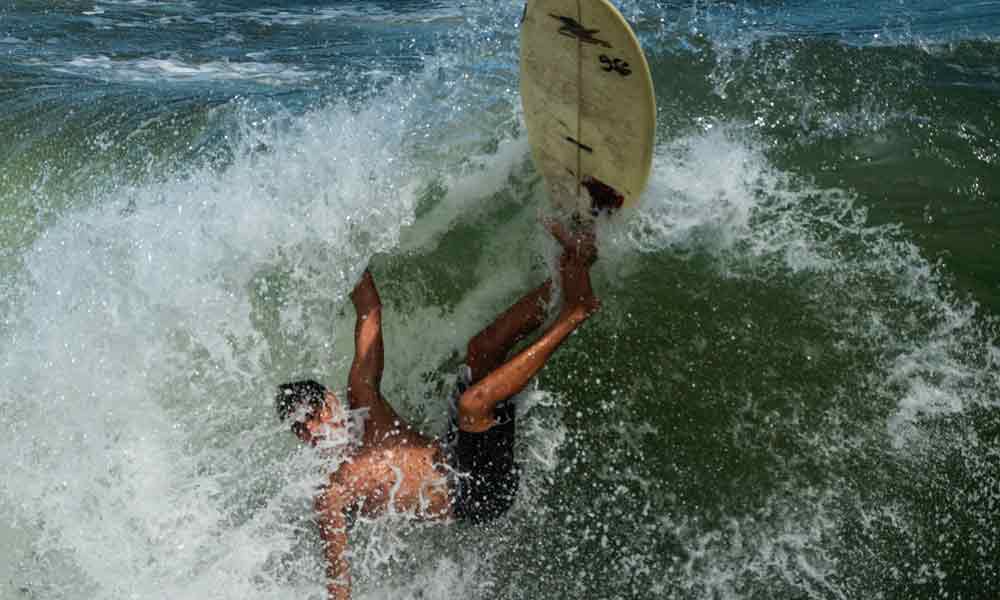
This discovery can be traumatic, deeply upsetting, and disorienting. Sometimes we need to sit with that disappointment for a while. To use a west coast analogy, it’s like being hit by a wave while surfing: one is knocked off the board, dragged underwater, and yet one doesn’t fight the wave; one lets it pass and then comes up, pulls in the board, and starts over. If one loves surfing, then one doesn’t quit, but tries again. It’s the same with fencing, with the Art. We will meet disappointment in many forms; that doesn’t mean we have to like it or quit. These are just moments of clarity, punctuated instances where we can actually see progress, funny as that might sound. These are the segues between levels of understanding, between jumps in skill, at least they can be if we use them as such.
NOTES:
[1]Tech Duinn, the House of Donn, is one of the Irish “Otherworld” locations, but has strong associations with death, Donn being the ruler of the dead in some accounts. Dursey Island, off the Beare peninsula, County Cork, Ireland, has often been linked to Donn’s House. Tir n mBan (“Land of Women”) or Kêr Iz (Breton, “City of Ys”) both refer to other popular versions of the Celtic Otherworld, the first in voyage tales like Imram Curaig Maíle Duín (The Voyage of Máel Dúin), the second in several Breton sources. Gawain, one of the knights of Camelot, is famous as the opponent of Bertilak, the Green Knight, and Connla, a son of the Irish hero Cú Chulainn and Aife, one of the two masters who trained the hero in Scotland. Connla dies fighting his father who only too late realizes that the conditions he left with Aife for the boy led to the child’s death.
[2] Francesco Antonio Marcelli, The Rule of Fencing, Book 2, Ch. 1, 55-56 in Holzman’s translation. More and more this book is one of my absolute favorites.
[3] I’ve discussed the issues around tourneys a lot. I do so because a) I actually like tourneys and b) hate seeing them conducted poorly and/or misinterpreted as the litmus test for skill.
[4] The drive to win, the self-worth need for it, will sustain a person a long time. I’ve observed this so many times in both TKD and in fencing (of all sorts). Our mental state in a fight will more often determine success than skill, because skill doesn’t work on its own—it requires a brain to make it work, and the calmer, more determined that brain, the better that skill presents. This is why at high levels of competition, where both skill and mental fortitude are stronger, skill can play out in ways that we do not see with beginner or intermediate fighters. This said, even skilled competitors can and do resort to theatrics to win when they arguably should not (e.g. certain bouts in women’s sabre, Athens, Summer Olympics, 2004).
[5] Yes, attacks to the leg are present in historical sources, but usually taken out of context and over-used. They make very little sense in the setting of a duel save where the height between the two opponents is so great that the shorter fencer might strike the legs more safely.
[6] The demi-pointe lunge, as I call it, has been the subject of my research this past year. I’ve spent probably way, way too much time on it, but with luck it will put the kibosh on this ahistorical practice.
[7] I’ve not been specific here to avoid unnecessary unpleasantness with those sections of the community who put their faith in the very people I’m saying one should avoid. The greatest hurdle in assessing any teacher by these rubrics is that each one can mean something different to someone else. What I think constitutes solid research is different than someone who hasn’t had my training; it’s why I believe in vaccines, it’s why I see racism as a current rather than historical problem, and my I lament the rise of the ancient-aliens method of [cough] “thinking.”
The training I think makes a good fighter has a proven track-record, an established and venerable pedagogy, and reams of supporting literature. This is why five years spent with a qualified epee coach means more to me than five years one has spent with JoJo the Knee-Hammer whose school mantra is the HEMA equivalent of Cobra Kai—the former will teach one universals that can be applied across weapons and periods. JoJo might stumble into some universals, but JoJo also doesn’t care about universals. JoJo thinks that wimpy sporty stuff is for dorks.
My idea of a good teacher is one who seeks to help one grow and actually has the ability to make it happen. A good teacher knows their own limitations and when to send a student onto someone more skilled or appropriate. They support, push, encourage, and set an example to follow. A good teacher doesn’t put down a student, doesn’t embarrass them, and doesn’t beat them up. A great teacher seeks to create students that surpass them. Generally, that teacher has some legitimate teaching; they’re not just the “best” fighter in their little mix of merry men, a mix they are careful not to leave lest their status be called into question. Good instructors remain students, remain open to growth and improvement, because they recognize that there is always more to learn, things to improve or fix, and that no one ever, ever masters it all. A good teacher also supports other teachers, helps them, and accepts help from them, and is willing to lose students to them if that student would be better served by another.
[NB: there are plenty of well-trained teachers who are duds too, I know, and I’ve worked with a few myself, but that fact doesn’t negate the value of solid training]
Last night I finished up the penultimate summer intro-to-fencing camp. These short courses are always challenging—they pack a lot (too much) into a handful of days, and the shorter the run the longer each individual class. Managing all that and keeping kids between 12 and 15 engaged is not for everyone. I like the challenge of it, and seeing children enjoy the class, and hopefully learn something in the process of it, makes it worthwhile.
One thing working with kids will demonstrate powerfully is that people learn in different ways. They also have different comfort levels. Being sensitive to these facts is vital. I always have a plan for class, but built into it is a degree of flexibility because once through the door it can all change. It usually does. However well planned, a lesson plan doesn’t determine how a class goes; the class does. It’s not just the class in toto, but individual students, sometimes both, that can mean leaning into that flexibility.
In the last two courses I’ve taught I’ve had a student in each hesitate to join. When it’s clear to me that they aren’t struggling with the oddities of fencing jackets or distracted by gym traffic, but hesitant for some other reason I find a way to get things going and then check in with them. One thing that makes that easier is letting students know from the off that if they need a break, they take it; if they have a question, they should ask. I do all I can to make it a safe environment. No one learns much, or has fun, if they don’t feel safe.
This past week, once the rest of the class was starting footwork drills, I checked in with this student. Just getting them talking can be hard—they don’t know me, they’re in a new class (and often with kids they don’t know), and however interested they might be all of that, not to mention other factors, can weigh into how present they are. The past school year’s stress, the mix of isolation and virtual life, all of that has taken a toll on children. It can be hard to snap back.
A parent had told me that before quarantine this child had advanced pretty far in Tae Kwon Do, so I figured their hesitation was less likely physical. Often a student just wants to get a feel for what we’re doing, so after asking them if they were okay and if I might help them with anything I told them that they could join, watch, or think about it, that there was no wrong answer. Over the course of the week this student mostly watched—each day I checked in with them before as well as a few times during class. The other students were curious, but followed my lead—I told them some people learn by watching, some by doing, etc., and that people join when they feel like it. That was enough for them.
I did my best to meet this student where they were. Having been in classes, having worked with instructors, and having spent so many years teaching I know that it doesn’t always go that way. Just as people learn differently, so too do they teach differently. No matter how hard we try, there will be people we can’t reach, people who just don’t take to us. That is part of teaching. However, we increase the chances of reaching more of them if we are sensitive to the fact that a student’s comfort level and/or learning style may vary.
This doesn’t mean we cater to each student. We can’t teach much of anything that way. I more or less stick to my lesson plan—the difference is that I don’t force students to conform to it as one might in boot camp. It’s an intro class, one designed to give the some sense of what fencing can be, and, for fun. If they take more classes, if they get serious, the necessary discipline will develop.
In Book 1 of “The Iliad,” when Achilles and Agamemnon quarrel over a question of honor, one of the first to attempt to speak reason is the aged warrior, Nestor. Though shown some deference, neither party is keen to accept Nestor’s wisdom–one almost gets the sense that they’re humoring him as they do often later in the poem. [1] To be fair, Nestor can go on a bit, and is quick to throw his age and associated experience at his junior colleagues. The thing is, Nestor was right–had Achilles and Agamemnon listened to him the problem would have been solved. Of course we wouldn’t have the poem either. In fencing we have a wide variety of Nestors. Sometimes it is a gimpy limb clamoring via pain to remind one that it might be best to stop a drill or sit out the next bout. Sometimes it is an elder fencer or an even older master. If we’re really unlucky, Nestor may take the form of one’s physician.
Achilles chose glory and a short life over less fame and a long one, and many fencers are the same. In one’s teens, twenties, even thirties one can still do many things one maybe shouldn’t, but since recovery time is relatively fast, since one is still nimble, strong, etc. it’s easier to go for broke and relegate any worry to later. I’m a good example. As a younger person, say 17-35, I could fence for hours; I fenced several days a week; any injury was normally minor and healed quickly; and I took chances that only those without larger responsibilities take, such as fencing with 3-4lb sabres and only a brass stirrup guard to protect the hand (or fail to protect it as I found out once). [2] There is no round-trip ticket to yesterday, so hindsight is as useless as it can be painful. However, like a Nestor, meaning I realize that neither Achilles nor Agamemnon are likely to listen, I feel compelled to encourage anyone keen to fence into their dotage to be mindful of their choices and take care of themselves. Cultivating sense at a younger age is tough, but ideal–the sooner we take care of ourselves, the longer we’re likely going to be able to fence.
Conditioning, Stretching, and Rest
We’re less likely to be injured if our over-all health is decent. If we eat right, exercise regularly, and maintain decent cardio everything is easier. For those keen to lift weights, fine, but for fencing you don’t need to be a body-builder or circus strongman. It’s better to build useful, appropriate strength than attempt to be yet another six-pack clad wanna-be model. [3] There are a number of resources for diet and exercise–if all else fails ask your doctor.
Stretching before and after fencing is important. Normally we warm up a bit, then stretch. None of this needs to be strenuous, just enough to keep you limber and less likely to pull or tear anything. Here too, it’s unnecessary to do the splits–don’t push anything, even a stretch, too far.
Equally important is recovery time. Our bodies need rest after exercise, and if we push past rest we only increase the chances of injury. This could mean tearing your ACL or striking an opponent too hard. Take breaks. It’s a fencing class, not boot camp, and no instructor should push anyone beyond reason. Likewise, no instructor should ever shame anyone for taking that break, being unable to do a particular exercise, or anything else. There are usually alternatives to many stretches and a decent instructor will suggest one of those if possible.
Injury and Recovery
If you end up with an injury take care of it. Happily, injuries are normally few and far between in fencing provided one isn’t a knucklehead. Wear your protective gear, observe the safety rules of the sala, and look out for one another. Most injuries occur because people fail to heed safety precautions, or they’re mucking about, or they purposefully disdain safety protocols out of some he-man notion of toughness.
For anything beyond the occasional bruise it’s often wise to see a medical professional. A deep cut, a stab wound, a potential concussion, a broken bone, a torn or pulled muscle or ligament, anything like this could have serious consequences. See a doctor, and see a proper one, one with MD behind their name, not one of the many purveyors of pseudo-science. [4]
Give yourself time to heal. I once sprained my ankle the night before a tournament, but being 21 just wrapped it tightly and fenced anyway. That wasn’t smart. If we start training before an injury heals we run the risk of making it worse, but sometimes we also ensure that we keep that injury for the rest of our lives. Most of the joints on my right side are compromised in some degree, and some of these injuries, such as tennis-elbow, could have been alleviated by dealing with them properly at the time.
Age: It just plain SUCKS
Goals 😉
Age in some degree is relative, but as a general rule the older we get the longer it takes to heal, the more recovery time we need, and much as we might hate it we slow down. It sucks. I know because I’ve fenced for over three decades. IF we want to keep fencing until we literally cannot, then we have to be cognizant of our choices early on.
Somethings, alas, are just a younger person’s game. Longsword, for example, one “can” do as an older person, but one probably shouldn’t. It’s one thing to dabble with another old codger or take the occasional seminar, but it’s less wise to enter tourneys at a certain age. They can be rough, and tough as some old people are the simple fact is that they break more easily. No 20 or 30 something is going to take it easy on you, and if they did, you’d only be insulted.
This can be super hard to accept when we really love something. In the past year or so I’ve realized that the clock is ticking for me and using appropriately weighted historical sabres. I “can” fence with them, and still do, but not as often as I did, because much as I miss it if I continue to use them all the time I won’t be fencing any sabre down the road. When this happens we have to make some difficult choices. I teach more than I fight now, I often use lighter sabres (such as the S2000 Olympic with kids), and I focus on other weapons I enjoy.
For example, though I’ve always read up on and dabbled in smallsword, it’s increasingly becoming one of my chief studies. [5] The others are largely related to it, such as late period rapier and smallsword’s 19th century descendent, epee. They don’t have the flash and fire of sabre, and I miss that, but they share the same intellectual aspects, rely on similar strategies, and even include, epee excepted, some of the more physical options in sabre and broadsword. Weapons seizures, for example, add a bit of spice.
The Take Away
Fence, and fence hard, but be smart. To me, the best approach is a middle-way, something between Sterne’s health miser and Blake’s supposed palace of wisdom. This is to say that we don’t want to be so careful that we’re bored and learn nothing–the Art is about fighting and thus must be practiced–but nor do we want to fight like our lives depended on it each and every time. Moderation will serve most of the time.
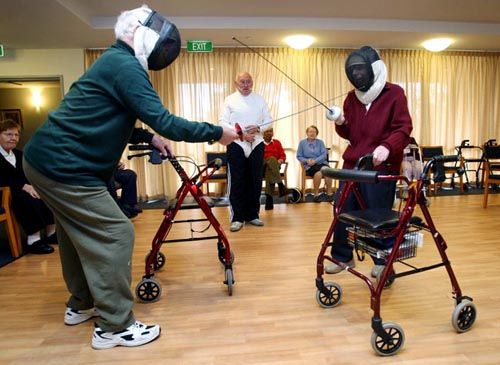
Whatever one fences, it pays to be aware of the wear and tear on your body, because it is a pain delayed. We pay for the fun of our 20s in our 40s, and it’s all downhill after that. If you don’t plan to fence into your 90s, cool, then go nuts. If you do think you might enjoy fencing until you drop, and you’d prefer not to do it from a wheelchair or from behind a walker, then maintain your health, fence responsibly, and let that ligament heal no matter how long it takes.
NOTES:
[1] Cf. “The Iliad,” Book 1, ll. 318ff
[2] In the age before better gloves, a guard that turned in a sweaty grip or broke could mean a trip to the ER. Pinky nails, btw, do grow back, but it takes months.
[3] I know a lot of people keen to lift, and some may be unhappy with this statement, but I stand by it. Unless one intends to wrestle a fair amount, where size and power mean more, any weight-training for fencing shouldn’t focus on bulk.
[4] This may also offend, but chiropractors, some massage outfits, and others are not doctors. In the PNW I have found that a lot of people go to chiropractors–I’m not sure why. While I’m sure there are some who provide what is probably decent massage, the “science” behind their practice is dubious. See for example:
[5] The first work on fencing I ever bought was a facsimile copy of Domenico Angelo’s The School of Fencing (1763; 1787); I found it at a used book store in 1986.
The title might make a decent band name, but no, I’m not starting a band. It’s meant to capture the common photo of an instructor grasping either their favored weapon or multiple arms. [1] Normally they’re clad in the jacket or gambeson that accompanies those tools best. Fancier shots have black backgrounds highlighting vaguely period expressions with a tinge of hipster coolness. Not knocking them, they can be nice, but it’s beyond whatever emotional depth or panache they’re meant to express which I wish to touch on here.
Many if not most fencers in the Olympic orbit become single-weapon fencers. It’s often true in historical circles too. They specialize. Historically, one started out in foil and then perhaps explored sabre or epee. The “three-weapon” fencer actually deserving of the name was, when I was starting out and even when competing, something of a special case. For context, I mean NCAA and USFA fencers between say 18 and 25. Many might dabble in the other weapons, but the fencer who could actually fence each as intended was less common. In my college club there was one fencer who was truly a three-weapon fencer, Dennis.
A close friend, and now one of my oldest, Dennis has more than once been a mentor to me. He will always be. When I was struggling with something new in sabre, for example, he would drill with me until I got it. When I destroyed my right arm in an auto accident, it was Dennis who agreed to train me as a lefty. Even now, Dennis has helped me as he could with an epee coaching class, playing the advanced student for me in video homework. A number of years ago when I was still working on competitive issues in Olympic fencing it was Dennis who ended up co-authoring a paper on difficulties in judging foil. He is versatile. He can help with all these things, and more, because of it.
Beyond the obvious perks to versatility, there is a still more important reason that it’s a goal worth pursuing: depth of understanding. It’s an analogy I’ve used a lot, but studying a different weapon or tradition is like learning a new language, one that helps you understand your own that much better. Over the past year, when most of us have been unable to meet up to fence, I’ve watched and/or advised people working in isolation. Some had partners to train with, many more did not. But what I noticed in each case was the more that these students included disciplines and weapons they didn’t normally study the better they got at their primary focus. More than that, their understanding of the universal principles underlaying all fencing increased. It was akin to watching what I imagine Dennis’ first few years fencing were like.
It can be daunting trying something new. At a certain point in training, however, it can be the catalyst one requires for growth. This raises an important question—when should one start dabbling in other weapons and forms? Alex Spreier (High Desert Armizare, Bend, OR), in a short thought-piece I shared here a while back (“Alex Spreier on Universals,” 2 May 2021), summed it up well:
The first step on the road to being able to discern patterns, principles, and universal aspects of the Art is the one I expect will be the most controversial – you need to spend 3 to 5 years focusing on developing your skills within one system. This allows you to build up a “vocabulary” of how to move your body, how to respond to threats, how to create threats, and ultimately this vocabulary will enable you to start recognizing patterns. And recognizing patterns is key to uncovering principles.
The idea of dedicated, formal study of one system or weapon for years goes against common practice in “HEMA,” but it is nonetheless the best path to improvement. As Alex explains, what this focused time does is impart the necessary skills to acquire new ones later; at the same time, it builds an intellectual framework and vocabulary that assists pattern recognition and retention in learning.
On an app that serves as the virtual lounge for the “collective” of schools that work together in this part of the PNW, we have had several ongoing discussions; in depth, evidence-driven conversations about key principles, ideas, or techniques that we have less information for than we’d like. One in particular highlights the importance of cross-training and text-diving.
Ex. Mezzo Tempo & Counter-time
The example in question was put forth by one of the instructors, Andy Playmate (Northwest Armizare), who has been running the longsword pod. In looking at tempo in longsword, and what a few different interpretations/translations say, he asked about Vadi’s notion of mezzo tempo or half-tempo and how it relates to counter time, attacks in preparation, etc. A rapier fencer as well, he asked questions related to both weapons: “what do you think the relationship is between mezzo tempo and stop cut/thrust? And second, did stop cut evolve from Mezzo tempo or somewhere else?” Great questions and ones which underscore how difficult it can be to unravel key concepts even armed with good training and vocabulary.
Starting with Philippo Vadi (fl. 1480), what does he say?
I do not have a copy of Vadi handy, so here I will rely on Guy Windsor’s translation available at Wiktenauer:
Chapter XIIII. Theory of the half tempo of the sword
I cannot show you in writing
The theory and way of the half tempo
Because the shortness of the tempo and its strike
Reside in the wrist. [2]
The half tempo is just one turn
Of the wrist: quick and immediately striking,
It can rarely fail
When it is done in good measure.
If you note well my text,
One who does not practice [the art] will get into trouble:[44]
Often the quick flight from one side to another
Breaks with a good edge the other’s brain.
Of all the art this is the jewel,
Because in one go it strikes and parries.
Oh what a valuable thing, To practice it according to the good principles,
It will let you carry the banner of the Art.[45] [3]
In my reading of Vadi, mezzo-tempo here suggests an action that blocks and cuts/thrusts at the same time. For once, Florio’s glossary [http://www.pbm.com/~lindahl/florio/] may be helpful here. He defines mezzo a few ways, but while it can mean “half,” it can also mean “a mediator, or intercessor. As a space or interveall of time or place” (313). Mezzo here may mean more “middle” as an action that either splits the difference or occurs during the “middle” of an opponent’s attack; mid-tempo. I can’t say that for sure, but given what Vadi says here—and going by Windsor’s translation—that makes sense to me. One way to illustrate this is to image that Fencer A throws a cut, a mandritto fendente, and B selects the time in which that cut is still developing to intercept it with a cut of their own, likely with a step somewhat to the side (to the right assuming two right-handers) that at once blocks and stops the incoming attack and that strikes at the same time. A close out like this, something later rapier masters saw as ideal, might be defined as a type of counter-attack, but perhaps the most accurate term would be an attack into preparation or an attack into tempo, that is, where one attacks as the opponent initiates their attack. Certainly what Vadi describes here is in line with later masters. [4]
Looking at what other masters say about mezzo tempo makes sense as we try to figure out Vadi. For Italy, the next generation of masters, especially the Bolognese school, is a logical next step. The Bolognese masters also employ the term, but don’t agree amongst themselves as to definition. The Anonimo and Viggiani, to name two, both use mezzo tempo but define it slightly differently. Viggiani, for example, wrote:
Sometimes one attacks with a half blow, in mezzo tempo. It is true that the majority of attacking is in mezzo tempo, since, when there are two who are well schooled in the art, he who wishes to attack will deceive his companion in such a fashion that, when his adversary is about to perform a blow, he enters with dexterity and speed and strikes in the middle of the adversary’s blow with a half blow
In the Anonimo, mezzo tempo is an attack into preparation, and contra tempo is what we see in Vadi, an attack into tempo that closes out the opposing steel and strikes simultaneously. The author of the Anonimo uses more ink to explain that there is no such thing as a half tempo, but that since one can make a “half attack,” that is, one that stops at stretto distance and is made more quickly, that they refer to it as “half” tempo (as an aside, this is a lovely example of a fencing text differentiating tempo and speed). Again, “mid-tempo” might be a better translation. Regardless, the Anonimo offers less detail about mezzo tempo. As to counter time, we read “Contratempo happens when the enemy wishes to strike, and you interrupt his attack, rendering it useless, while you simultaneously make one that strikes him.”
Dal’Aggochie, as Mike Cherba pointed out, was probably the clearest. For him, mezzo tempo is “A half tempo, the final one,… when you attack while the enemy is throwing his blow.” [5]
Um, they don’t Agree, so… what now?
So, what is the student to do with all this? How does one reconcile these disparate definitions? Vadi, Viggiani, the Anonimo, and Dal’Aggochie all include mezzo tempo, but don’t agree. It can help to group them together and see how they differ. All include an attack that interrupts that of the opponent. Vadi and Viggiani call this mezzo tempo; the Anonimo calls the same thing contra tempo. Dal’Aggochie may refer to the same thing; his half tempo sounds much the same as the others, but being less specific as to when exactly one attacks the enemy it’s less clear. Is the attack made as they are preparing (an attack in prep), as they are mid-strike (half-tempo), or is it in response to a counter attack (contra tempo)?
This is where looking at the modern definition, one derived from this tradition, can be helpful. It may not be the same, that is always a possibility, but it’s a place to start. Counter-time, sometimes referred to as contretemps (Fr.) or contra-tempo (It.), is different from the early notion of mezzo tempo. It’s usually a technique for more advanced fencers. Not each master in the past defined it quite the same way, though most tend to suggest the definition that survives today, that is, “a planned action made against an opponent’s stop-thrust or stop-cut. First draw out the stop hit, and then parry it and hit the opponent in a lunge.” [6] Other definitions are similar.
Here is one from the wiki at Academie Duello, Vancouver, Canada: “this is the opportunity to strike during an opponent’s offensive action with a shorter attack of your own that closes the line.” [7]
Masaniello Parise (1884), discussing counter time for sabre, not surprisingly is more in line with current definitions. This action is made “with veracity, advancing a step and immediately defending with a circular or opposition parry against the opponent’s action in tempo [i.e. counter-attack], and secure in defense, and ripostes without delay.” [8]
There are, however, exceptions. On one page of an old site at the University of Northern Arizona, guessing one of William Wilson’s, the editor quotes the Pallas Armata (1639) and defines contratempo as “a thrust in the same line that your adversary thrusts in (Pallas Armata, p. 6).” [9]
With the exception of this last definition, all describe a counter-offensive action made against someone making a counter-attack. It’s not specific to weapon, only the tempo in which a weapon, any hand-to-hand weapon, might be used. The distance required by such a maneuver is critical as is the speed and accuracy with which one strikes. Tempo, distance, speed, judgment, initiative, these are all universals, the elements underpinning all fencing.
Returning to Andy’s question, “what do you think the relationship is between mezzo tempo and stop cut/thrust? And second, did stop cut evolve from Mezzo tempo or somewhere else?” what can we say after reviewing some of the literature?
My answer would be that a stop thrust, if it closes the line as it lands, might be an example of mezzo tempo. Certainly that seems to fit the majority of the definitions we just examined. A stop cut might too, but these often do not close out the line—they are cuts made against an open line, but always followed by a parry and riposte in case the stop cut fails. Since it’s not usually the final blow, a stop cut doesn’t fit Dal’Aggochie’s definition well either; it’s a counter-attack followed by a defensive action. Stop-cuts, like stop-thrusts, are attacks of opportunity, but less likely performed with a close out. I’ve not touched the second question, but attacks against the forward target are reflected in more than one medieval source—for a graphic example the hands lopped off and flying in Talhoffer (ca. 1467) might serve. While the stop cut we use in sabre may derive from something native to cutting weapons, it’s not impossible that the later stop-hit/stop-thrust derived from the rapier iteration of mezzo-tempo. I’m not sure what work has been done on this if any, but it might be fun to explore.
So what?
What I’ve hoped to show with this example is two-fold. First, time spent (at the appropriate stage) working on additional weapons or systems increases our understanding. The fencers asking these questions arrived at them thanks to cross-training. They’re making connections, seeing parallels as well as key differences.
Second, the increase in awareness and understanding, in seeing yet again how the same universal principles apply, makes it that much easier to “unpack” the next new system or weapon. This doesn’t mean that it is easy, just easier. In the aggregate our knowledge and skill should grow and improve.
Importantly, one must be cautious not to misapply modern understanding, or worse—exceptions, onto the past. The more one knows of the universals across time, across masters and texts and periods, the less likely this is a danger. Many members of the historical community make the mistake of assuming anyone referencing modern works is, by definition, guilty of anachronism. That is not true, but it can look that way to someone unarmed with that knowledge and understanding. Since they cannot distinguish between excesses that help one gain points in a sport, and the universal principles that most fencers learn before they try on the silly stuff, they have trouble seeing how anything past 1500 can have any relevance. Modern discussion of the universal principles did not pop out of a cereal box on the 1 of January, 1900 or 2000; they derive from the corpus of works we read in historical fencing. Time spent with solid modern works, like time spent with another weapon, so long as approached responsibly, will help more than hinder.
NOTES:
[1] A quick google search using the terms “fencing instructor portrait” will bring up some decent examples.
[2] “Wrist” here makes more sense than “knot,” though polso is the modern Italian for “wrist.” Nodo, here, can mean knot, but it can mean junction, crux, etc., and my guess is that the other translators may have used Florio’s 1611 Dictionary (p. 333; cf. http://www.pbm.com/~lindahl/florio/), where he stipulates that Nódo can mean “also the joint of any cane.” By context Vadi clearly means turning the hands so that one simultaneously blocks and strikes. “Of all the art this is the jewel” certainly makes sense in light of that idea.
[4] Cf. Marcelli, Rules of Fencing (1686), I.I. Ch. IV., 23 in Holzman’s translation.
[5] For Viggiani, see W. Jherek Swanger, The Fencing Method of Angelo Viggiani: Lo Schermo, 64r; p. 7 of the pdf; for The Anonimo, see Stephen Fratus, trans., With Malice and Cunning: Anonymous 16th Century Manuscript on Bolognese Swordsmanship, Lulu Press, 2020, 64 (see also p. 49); for Dal’Aggochie, see The Art of Defense: On Fencing, the Joust, and Battle Formation, trans. Jherek Swanger, Lulu Press, 2018, 29v.
[6] Rob Handelman, and Connie Louie, Fencing Foil: A Practical Training Guide for Coaches, Parents and Young Athletes (San Francisco, CA: Pattinando Publishing, 2014),441.
[8] See Christopher A. Holzman, ed., The Roman-Neapolitan School of Fencing: The Collected Works of Masaniello Parise, Wichita, KS: Lulu Press, 2015, 272-273.
In a response to some of the comments on a video by another Youtuber, Matt Easton (Schola Gladitoria) shared some important insights about what HEMA is, and whether or not it is beset by deep elitism, gate-keeping, etc. [1] Much of what he has to say I’ve touched on here before, and Matt’s presentation is more eloquent than mine would be, so it’s best to watch his video for yourself. Here is the link:
However, there is one thing Matt left out that I’d like to address, again, because it can’t be stressed enough, and that is quality of interpretation. What makes HEMA unique is the “H,” the history part. Few people involved in historical fencing lack at least some interest in history, but very few actually have the skills to do it properly when it comes to the research aspect.
To quote Matt, one doesn’t need to do that research–one can learn from someone who has, or from someone who learned from someone who has. Most people, in my experience, fall into that category, and like Matt I think it’s great. There’s nothing wrong with that. As I remind myself when people decide to skip class the fact is that most of the adults who work with me are busy people, with families, jobs, other hobbies, and they do this stuff for fun, the same way they might go camping, or run, or see friends for game night. The amount of time I spend on the Art is not the norm.
Where I see the real problem is in the hubris too many in “HEMA” display in believing that cracking a book and offering up an interpretation is as easy as a fourth grade book report. It’s not. Call it gate-keeping if you will, by my history PhD says you’re wrong, and unless you have the same training and can make a better case, it might be worth considering that promoting and defending daft theories not only makes one a fool, but also may potentially mislead people. If that doesn’t seem like that big of a deal, perhaps a few analogies will help.
I like science. I read about it, I watch documentaries, and what little news I still follow is mostly science and/or history, art, or archaeology oriented. My spouse was a research scientist, and her family on both sides worked for or works for NASA. As a student I took classes in biology, botany, physics, chemistry, and geology. Despite this interest, you will not see me attempting to write articles on particle physics, Fermat’s theorem, or the latest work in RNA vaccine production. I am not qualified to do so. Even with a bachelor’s of science it would be inappropriate, even dangerous for me to try to speak on a professional level about these things. Outside a book club or circle of fellow-enthusiasts I have no business whatsoever making pronouncements about the latest black hole research. I don’t feel less a person for not having any works listed in PubMed.
One of the most interesting books I ever read was on 18th century medicine. It covered everything from vestigial ideas about the “humors” to surgery, and the illustrations–especially for amputation tools–were as chilling as they were morbidly fascinating. I’ve been to see a doctor countless times, been put under twice so far, had stitches, bones set, and I know a fair number of doctors. I’ve seen them portrayed on t.v., I’ve taken first-aid classes, and having health-care professionals in the family I hear a lot, A LOT, about trends in medicine. Much as I’ve learned, this is another subject that I will not be writing about or teaching, and I certainly won’t be submitting anything to Lancet or offering to perform that triple by-pass for your uncle. I’m not qualified to do any of those things. I know better than to try, and not just because of the jail-time I’d likely face; it would be irresponsible of me to play surgeon or dentist when I’m not one.
In the past, when I’ve made these types of analogies one of the first responses I get is “but those are important–they affect lives or wallets.” True. But, history is no less important, and getting it right is too. Without proper history and professional historians we can get important things wrong. Even now, and outside “HEMA,” we see this–there are the cretins who deny the Holocaust, despite ALL the evidence, and worse, attribute that evidence to some world-wide conspiracy. There are the sad cases that buy the “ancient aliens” bullshit that has made the shareholders of the “History Channel” wealthy. There are people who continue to argue that the Confederacy wasn’t about preserving slavery, but “culture” or “heritage,” ignoring the fact that this “culture” only existed because of slavery and that the “heritage” they celebrate is a slap in the face to citizens of our country whose ancestors were enslaved (and who continue to suffer discrimination).
It’s fair to say that interpreting historical fencing manuals is not on par with cases as severe and important as Holocaust denial. However, there are dangers to poor theories on the Art. On the one hand some interpretations might get one injured. [2] On the other hand, there is a danger in perpetuating the widespread crisis that is ignoring reason and handling evidence irresponsibly. It takes training to analyze and make sense of evidence effectively and responsibly, and like it or not some people have more of that training than others. That’s not gatekeeping, no more than telling your plumber that he’s not a neurosurgeon or your lawyer that they have no business discussing ethics.
If this sounds angry and disappointed–two things I’ve been accused of for daring to call out the poseurs playing historian–well, it is. Being angry about something doesn’t automatically make one wrong. It’s insulting to those of us who spent years learning to read, analyze, and communicate research to have untrained people attempt to shame us for it and call that training into question. They have no right to do so, and the only shame belongs to them.
I don’t follow this chap, but he’s well-known in HEMA circles.
[2] In the past year, to name one example, one theorist shared video that defies all reason, not just in what it depicts, but in the fact that he shared it as supposed proof for his theory. Does he not see how bad this is to anyone who actually knows anything about fencing?
The section of “HEMA” that buys into this b.s. has been remarkably silent about it–either they now see the b.s. for what it is and shame-faced haven’t recanted, or, they don’t see the problem and think it’s great. I’m not sure which is worse. Just as they don’t care for professional researchers who don’t agree with them, they also care nothing for long-established agreement on the fundamentals of fencing. One example should suffice to illustrate the problem: in the video, Fencer A steps into critical distance (close enough to be hit) without presenting a threat or covering himself; he is then clobbered, and after being hit finally reacts. Amazing and sad. The guy literally steps into be hit before doing anything… and this is a crowd that swallows the equally daft heavy-hitting is manly garbage. Not safe.
When we occupy any space lacking clear definition it can be both unsettling and liberating. In either case much of what feeds our experience in threshold areas comes down to external reaction to it, our earlier experiences, and our expectations. I’m not sure which is harder to manage; each in its own unique ways can play merry hell with us. Now three quarters through what is easily the best fencing course I’ve ever had the pleasure to take, I’ve had another chance to examine, closely, life-in-the-limen. This class, a twenty-one week exploration of everything one could wish to know about the techniques and teaching of epee, is fantastic, but it has reminded me powerfully that I am too “historical” for my Olympic colleagues, and too “Olympic” for my historical ones. I don’t really belong in either camp, but value both for what each offers. One of many pluses to being stuck in some ill-defined space is that for all the confusion there is clarity too—one is just distant enough to see things more objectively provided one is honest and looking. About a year ago I posted a piece, “Gang Affiliation or Natural Allies? Fencers and their Camps” [22-7-21], that touched on a few aspects of having one’s feet in multiple spots. This post picks up where that one stopped.
Culture & Tunnel Vision
We like to be comfortable, so we seek out and nestle into communities where we suffer less cognitive dissonance. While opinions vary in such communities there’s nonetheless a general acceptance of operating truths that allow for easy interaction, predictable outcomes, and a sense of contentment. We don’t like when someone disrupts the illusion. Sometimes we experience that as mild frustration and bewilderment, at others we become actively hostile. We don’t always pause, step back, and regard the scene with an analytical eye, though we should. This is all the harder to do when we’re used to a degree of conformity; any outlier can be dust in the eye, nothing necessarily fatal but nonetheless annoying. [1]
No one is exempt from the tunnel vision that comes with a culture, any culture, but it’s also true that one’s vision can widen. The more one struggles to see things within a different culture, the wider that perspective can become. It’s one reason that travel and exposure to other ways of life, of thinking, to different values, are so vital—not everyone emerges from those experiences more open-minded and compassionate, but many do. In a way it’s a particular form of learning how to pay attention, even knowing to, and that on its own is reason enough to try.
Too “Historical” for Olympic?
As a caveat, this particular master and I have not chatted about any of this, so what follows is nothing save my musings about a possible interpretation of what I’m seeing. I could be dead wrong. This is something I must be aware of and note: knowing my own mixed history with the competitive world I might be applying a bias where there isn’t one. With this said, there are a few things that have struck me that speak to the gulf in culture.
This class, online thanks to Covid, is taught by a well-known, talented, and excellent master. I’ve come to have a lot of respect for this man—he’s kind, a teacher’s teacher, and inclusive in outlook (e.g. he discusses the differences in teaching children, adults, and veterans [40 years +], and doesn’t just focus on male instructors). But as a long-time maestro in the competitive world he, like any of us, has assumptions when interacting with other fencers. Most of the people in this class, so far as I can tell, belong to more traditional salles, and thus have potential students working in the same way close to hand. A few of us do not. This matters, because teaching a fencer who has decent training in Olympic fencing will read differently than those of us who work with a wide variety of fencers.
A sport fencer understands, among other things, how individual lessons normally proceed. It’s part of their culture. Likewise, there are types of drills, expectations about practice, and attitudes toward new material that make it easier in a class like this to work with like-minded people. In contrast, my students come from very different backgrounds—not one, at present, has ever stepped foot in a typical Olympic salle. Some have never fenced or studied any martial art; others have studied empty-hand traditions, but nothing weapon-oriented; still others have extensive experience in other martial arts and weapons, and most of these I have met through “HEMA.” [2] Thus, when working with one of these students, in most cases they did not come up via the same individual lesson system. Their basis for authority is different, and, unlike most sport fencers they are more likely to question it. [3] One can tell not only by their kit, which is immediately recognizable in most instances from that worn for sport, but in how they move and their responses to particular actions. [4]
Even knowing (or accepting) that there are different types of fencers is not something one can take for granted. I have seen this play out many times, not only in Olympic contexts, but also in historical ones. As I’ve often remarked, on either side most people are familiar only with the excesses—to the degree that anyone is aware of historical fencing, they know it primarily through its least robust if most popular expressions, the sort of thing that makes for good t.v. (this is not a compliment). Olympic fencers see people in black (a color only masters in their world wear), whacking away at one another with little sense of tactics, poor fundamentals, and what appears to be a sad display of might makes right. HEMA players, on the other hand, mock the size of Olympic weapons, the lack of attention to fencing’s past, and that sport’s own celebration of the ridiculous (to cite an easy example the fact that any part of the sabre blade may score). Both camps are correct. Both are incorrect. However, unless one has spent sufficient time in either world that dichotomy will be hard to accept.
Too “Olympic” for Historical? Bias belongs to all, and having talked about many such examples before I will share one that I hope I’ve not already cited: if I did, my apologies (I searched this site for key words, but it’s not the most fine-tuned search tool). In 2016, at a large event, I had a chance to bout with a well-known HEMA personality. I was struck by how poorly this individual read the room. It’s normal practice to size up other fighters—we can tell a lot from watching them fight, but so too can we glean a lot from their kit. The kit my two friends and I wore should have told him a few things.
Santelli Sabre Mask, old sabre jacket, and three “non-standard” (as an instructor once remarked to me on seeing the one bottom right) sabres
If my age wasn’t something to notice (it should have been), then an old, battered Santelli sabre mask, an even older sabre jacket held together in parts by dental floss sutures, and a mix of weapons that included old AFS parts as equally unavailable as that mask should have said something. [5] That it didn’t told me a lot—this was someone who didn’t recognize that my gear was at least 16 to 20 years old; at my age this gear was likely mine and not an older sibling’s or parent’s, so… by process of elimination I had probably been fencing at least 16-20 years (at that time I had been fencing 29 years). I was polite, because one should be, but amused that this individual then proceeded to explain to me and the others what a “sabre” is, and, that we wouldn’t be using the point as his aluminum tools didn’t flex. His gear—his choice, but that was telling too: he doesn’t fence with people who have sufficient control to work with stiffer weapons.
I was the first to bout with him, and the little bit of intel I had gathered proved reliable. We set-to a few times, and it was eye-opening. Given his popularity I assumed, incorrectly, that this guy must be at least a decent fighter—he’s not. In fairness, I assumed he was likely dealing with some manner of health issue or had recently been ill (he was rather gaunt), something that seemed all the more likely when he stopped after a few passes, out of breath, and replied to my query of whether or not he was okay with “I just didn’t think it would last this long.” One of my two friends fought him next, with similar results, and after that he wouldn’t fence anyone save the friends who came with him. With his reputation I imagine that being schooled by two unknowns was unappealing press: again, very telling. Having been advised always to seek out better fighters by my masters, eastern and western, I would have wanted to chat with my opponent after the bout, maybe see about learning more from them.
As I thought about it that day, and as it has increasingly appeared to me since then, it’s not that my famous opponent hadn’t done his intel, but that he drew the wrong conclusions from it. He saw old Olympic equipment, and in my case, a man slightly older than himself, and assumed easy pickings. After all, what could a former sport fencer possibly know that would be of use in “real” sword-fighting? It’s a bias I’ve run into more often than not in “HEMA” contexts. It’s as erroneous an assumption as concluding that all HEMA is bad. It’s not. Some is great. Much of the tragedy both ways is a lack of ability to separate good and bad fencing. If nothing else during quarantine my interactions with a number of HEMA and Olympic folk have proved how painfully true this is.
Sword-bridges & the Time between Times
Sir Lancelot crossing the sword-bridge; relief from Sainte-Pierre, Caen, Normandy, France, ca. 14th century
In Chrétien de Troyes’ Chevalier de la charrete (The Knight of the Cart), Sir Lancelot must cross a bridge consisting of a sharp sword. Medieval images of the poor knight traversing this pointed symbol were popular, and regardless of what one may know about armor and its effectiveness, upon first viewing what we tend to see is a person trying to get across something dangerous. [6] They’re powerful, vivid images. In like guise, poised between two worlds but belonging to neither of them, is similar in that it often feels like one is walking a knife’s edge. Disaster, in this latter case, is less a danger than discomfort, but I wouldn’t discount that discomfort. It can be surprisingly brutal and difficult to navigate. If nothing else, where is one when the only two communities seemingly the most likely to take one seriously both consider one an oddball?
One thing that makes it easier is finding other oddballs—the handful I know, and I mean “oddball” here as a compliment—are spread out across the globe. They are the only reason I still have fb messenger. Interaction with them, normally virtual, is a lifeline, and sometimes the only medicine against the feeling that maybe we’re completely insane. Another product of not buying either branches’ interpretation in toto is that the confidence that comes with such conviction—however great a mistake—is a stranger to us. No one likes being told that a cherished belief might benefit from further study or reconsideration, but objective looks at both camps quickly demonstrates that neither is perfect. [7] The only antidote to misplaced conviction is to make such questioning habit, and we’re not living at a time when rational inquiry enjoys much popularity.
The uncertainly projected at us can undermine everything we do if we let it. However, it doesn’t have to, because if mythology teaches us anything it’s that liminal spaces are where things happen. Dawn or dusk, the meeting of sea and land, doorways, and similar boundaries are all locations of significance, preserves of magic, of change, of adventure, from Pwyll on the gorsedd to Halloween night. [8] This is to say that occupying a middle ground doesn’t have to be negative; it can be transformative. Following the mythological parallel, this change is rarely comfortable, in fact it is often harrowing, but it’s anything but boring. It’s not an easy place to be; it can be extremely disorienting and lonely. People will not understand it sometimes, they will judge it and us, but there is always a cost to growth. If the goal of martial arts is ultimately personal growth, with all the attendant good that should follow from it, then discomfort is worth it.
So What?
Why does this matter? How might the experience of one obscure fencer affect you? It depends. If you’re a fellow traveller, then you have another oddball in your corner. If you’re in a similar position in re being sort of stuck between two worlds, then maybe this offers some comfort or a way toward it. Maybe it means nothing—that’s okay too. Beyond the personal, though, there are some important ramifications for examining the boundaries we operate within or set up.
There are changes, for example, coming to Olympic fencing in the United States that will likely affect many of us. The official fencing organization, the USFA (United States Fencing Association), which is tied to the Olympic team, and the USFCA, the United States Fencing Coaches Association, which has overseen the training of instructors, will come together to meet the dictates of the US Olympic Committee which mandated that “coaching education be provided by each Olympic/Paralympic sports organization in order to be certified as a governing body in 2021.” [9] It goes beyond space to cover this adequately here, but on the ground this means the creation of even more effective gate-keeping.
I’m all for ensuring qualified coaches and instructors—regardless of one’s camp—but both organizations, especially the USFA, only acknowledge one type of fencer and one type of coach, both competitive. It remains to be seen how this will affect instructors like myself who teach on the local level and who are not sport-oriented. The first question I was asked when I approached my local parks & rec organization about starting a class was about my qualifications. “Time in the saddle” was the most honest answer I could offer along with a resume of experience. Will that work in a few years? I don’t know, but one thing I do know, and am happy to prove is that I can teach your kid basic foil, epee, and sabre. [10]
Maestro Gerevich with students [https://sportmonitor.info/?p=14739]
I don’t pretend to be a maestro, I don’t attempt to teach what I haven’t had sufficient training in, and I am quick to recommend other coaches as appropriate. My goal with the introduction to fencing class is exactly that, an introduction, exposure to the exciting world that is fencing in all its guises. That has value, but not all fencers see it that way, and it seems to me that allowing any hardliner to create and enforce boundaries that affect everyone is a bad idea. Reasoned arguments and rhetoric will not move anyone, but action might, so maybe the best preparation as these changes appear, as others attempt to pigeon-hole us, is to cultivate our inner Aladár Gerevichs. This fencer, at 50, was told by the Hungarian Olympic committee that he was too old to fight, so he challenged the entire team and beat the snot out of all of them. He then went on to win yet more gold medals. He didn’t let the committee define him, and we should let anyone else tell us who to be either.
NOTES:
[1] I will not talk current politics and society… I will not talk current politics and society… I will not talk current politics and society… I will not talk current politics and society…
[2] Among my current students are those with no martial arts training whatsoever; a former KdF longsworder, several current students of Fiore (whose works offer an unified approach to wrestling, dagger, sword in one hand, sword in two, polearms, and mounted combat), and a mix of people with some sabre, MMA, Eastern Martial Arts, and wrestling backgrounds.
[3] Authority in Olympic is rarely questioned. One is taught, one uses what is taught, and if it’s not effective (as happens sometimes) the reaction by most is “where did I go wrong with this?” vs. “this must be bunkum.” Authority rests with the body of technique and tactics passed down over centuries and taught by the maestri and their junior instructors. It is not source-based. Most Olympic fencers have little interest in the sources, and to be fair they don’t need them to do well in competition. The early sources approached fencing as martial art, not a sport, and the requirements in each are different however much they share.
[4] Kit differences are most obvious in masks and jackets. HEMA, for some reason, adopted black as its basic color, perhaps as a middle-finger to Olympic. I don’t know. The weapons too are often different. Sabres, for example, tend to be training copies of period weight versions. Responses are different as well. For example, a friend of mine this past weekend agreed to help me with my epee class homework—the assignment was to film a short teaching lesson on parry-riposte. He’s an experienced sabre fencer (ditto Fiore, Georgian, and MMA), so he was a quick study for what we were doing (I opted to work on parry seven)—as we added complexity to the basic p/r, we ended up in infighting distance. Modern epee employs a variety of techniques for this, but not grappling… My partner’s first reaction was a weapon-seizure—very historical. It wasn’t wrong, but wasn’t right for modern epee 😉
[5] Sabre-specific gear disappeared with the demise of Santelli Fencing in 2004. This company, which had been around since 1942, was the only one still making jackets without the cuissard, the section that covers the groin, as well as masks with leather attached to the top. The sabre jacket was outlawed for competition not long after sabre went electric in NCAA competition—sorry, forget which year that was—but if I recall correctly the latter years of the 1990s. Thus, anyone of a certain age still using this sort of gear should stand out, but won’t unless one knows the difference. Zen Warrior Armory/Triplette Competition Arms, makes a “Classical” jacket sans cuissard that many of us accustomed to the older sabre jacket wear. They’re excellent.
[6] Chrétien de Troyes, the French author and major figure in producing and spreading Arthurian romance in the Middle Ages, produced some of the most beloved Arthurian stories. Most of his work was penned, probably, between the 1150s and 1190s. In some depictions the knight is bleeding from his crossing, even when clad in armor of the time (mail). This is another reminder that art is tricky to use: clad in mail, and assuming that it would be in contact with the bridge, carefully crawling one’s way would not slice through the armor. For a few examples, and my source for the image above, see:
[7] Hard-liners either side of the divide often believe that their way and their way alone is best. Support for these assertions is often only gathered within the bubble they occupy. For example, HEMA players are quick to dump on Olympic right-of-way/ROW rules. The fact that both fencers might be hit, but only one scores sits ill with them. I get it. Were the weapons sharp… that would be bad, but no one in Olympic fencing is fighting as if the blades were sharp. They haven’t for a very long time. Instead, they’re playing a game, a sport based on fencing with sharps. It derives from the martial art—it is not the martial art. It’s the same for kendo, competitive TKD, etc.
Olympic fencers, on the other hand, find the lack of consistency in HEMA training abhorrent. Faced with such a wide variety of texts, weapons, and interpretations, quality is all over the map. It’s hard to point to any one place as a rubric by which to measure what they see, and to be fair most of HEMA is an absolute mess. The schlock people take for insightful interpretations would be laughably bad were it not so entrenched and popular. It’s hard to blame any sport fencer who pokes fun at some chump in black stepping into distance first, being brained, and only then making an action. It’s as baffling to them as it is to me that these same fighters then defend whatever the hell it is they think they’re doing. In contrast, traditional pedagogy is venerable and well-documented; it provides an easy check (or should) when a sport fencer sees something off in the sport.
All this said, ROW makes a lot of sense IF one understands it. Likewise, the difficulty in analysing and interpreting period texts would make sport fencers less likely to crow if they tried it themselves. Traditional pedagogy is the single most effective training in unpacking those ancient works, but it’s not automatic—the sport has changed a lot in the past century, in the past twenty to thirty years, so one can’t assume automatic equivalence between even the most basic concepts. They might be the same, but it has to be tested, compared, and verified, and even then unless the master who wrote the work is explicit it remains an interpretation.
[8] The tale of Pywll, Prince of Dyfed (POO-ilk *, Prince of DUH-ved) is one of the four tales in the Mabinogi, a collection of medieval Welsh tales. The gorsedd (GOR-seth), or hill, that he sits upon one morning while hunting, is a common motif in Celtic mythology, cf. Brú na Bóinne/Newgrange, north of Dublin, Ireland, and its associated mythology to name only one example. Patrick Ford’s The Mabinogi and Other Medieval Welsh Tales (Los Angeles, CA: University of California Press, 1977) is an excellent edition in English by a noted scholar. The stories were written in Middle Welsh, but there are good Modern Welsh versions too, e.g. Pedeir Keinc y Mabinogi: Allan o Lyfr Gwyn Rhydderch, edited by Ifor Williams (Caerdydd, CY: Gwasg Prifysgol Cymru, 1996). [*The double “l” in Welsh is hard to render in print, especially for me as I’ve only formally studied Middle Welsh, but this link provides some help: https://youtu.be/hQBGOb7iQZ0%5D
Halloween, All Hallow’s Eve, All Saints’ Day, etc. was originally the Celtic new year, Samhain (SAH-win), one of four major days marking the year (the others coinciding with the other major events in the agricultural year, though they also correspond more or less to the vernal equinox and the winter and summer solstices). The others are Beltaine (BEL-tinuh), May 1st; Lugnasa (LOO-nussa) Aug. 1st; and Imbolc (IM-bol-eg; there is an epenthetic vowel between “l” and “g”), Feb. 1, though in each case these dates are reckoned by night so that the last days of April, July, and January figure into the dating as well. For those familiar with the Venerable Bede’s account of the Augustinian mission to Britain ca. 600 CE (cf. The Ecclesiastical History of the English People, I.23ff), and especially Pope Greogry the Great’s advice in re adapting whatever might be from native Anglo-Saxon belief, the association between “pagan” festivals and Christian holy days should come as no surprise. Though dated, Rees and Rees Celtic Heritage remains one of the best explorations via myth, folklore, and late observations of certain traditions (Alwyn and Brinley Rees, Celtic Heritage: Ancient Tradition in Ireland and Wales, New York, NY: Thames & Hudson, 1990).
[10] One reason I am taking the class is to obtain certification that may become necessary down the road. Epee, as the most historical of the three weapons, and as the one in which I’ve received the least amount of training, seemed an ideal place to start. I’m on the fence in re foil and sabre—both have changed so much that I’m not sure the rubber stamp is worth the frustration of having to suffer through explanations for the perversities afflicting the teaching and use of either weapon.
Alex Spreier of High Desert Armizare (Bend, OR, USA) is my go-to for any question about universal principles across systems. Trained as I am to recognize and analyze patterns, it’s natural to him and he does it better. The piece below is a short one he shared with me ; I asked if I might share it, because it’s good, to the point, and gives solid reasons for why we should bother looking across systems in our own study of the Art.
Fiore’s segno, ca. 1410
“The first step on the road to being able to discern patterns, principles, and universal aspects of the Art is the one I expect will be the most controversial – you need to spend 3 to 5 years focusing on developing your skills within one system. This allows you to build up a “vocabulary” of how to move your body, how to respond to threats, how to create threats, and ultimately this vocabulary will enable you to start recognizing patterns. And recognizing patterns is key to uncovering principles.
To deal straight with the elephant in the room (Hi Gerald!) is that several years of dedicated study is hard. Of course it’s hard. A key part of studying anything is the struggle of learning something new. An often used quote about training from Bruce Lee states “Absorb what is useful, discard what is useless and add what is specifically your own.” This is a great mindset and one I wholeheartedly encourage. However, many folks who use this quote fail to mention that in order to know what is useful, useless, and your own, you need to have a base level of understanding. The most common mistake made by beginners is for them to approach any training with that Bruce Lee quote in mind and neglect/refuse to train certain actions because they are uncomfortable. If a movement is uncomfortable when first training it first of all, ask your instructor what to do about it. Whenever we start training something there will be some discomfort as we learn how to move our bodies in a new way. This discomfort is very different from a movement being “useless” but that can be for another paper.
Anyone who knows me knows I am a huge fan of analogies so here we go: When you start learning to read you need to develop phonemic awareness; the understanding that specific letters equate to specific sounds. From phonemic awareness you move on to learning how those letters combine into words, then the words combine to become sentences, then paragraphs, etc. This process takes years before you are proficient enough to really read. Phonemic awareness is a foundational skill and without it learning to read is exponentially more difficult; even though it’s something that a skilled reader rarely thinks of anymore. In the same way, when you start learning a martial art you learn basic movements (footwork, attacks, defenses, etc) and these components build up to more complicated movement patterns, which creates your “vocabulary” through which you understand your art. This is your phonemic awareness – you are beginning to equate certain words/phrases with certain movement patterns. You cannot begin to recognize patterns without having an understanding of how your art creates patterns.
“Light,” a Chinese character commonly used as a cutting pattern in Korean Gumdo
Humans love patterns. We love them so much we will create patterns out of whole-cloth! Because of this predilection towards pattern recognition and creation, anything created by a human mind will have an underlying pattern to it. Martial arts are no different. As you spend your time studying your Art, you will naturally start to recognize patterns in movement built into your art. These patterns are HOW your art works. If you are struggling to find patterns might I suggest:
Footwork – how does your art use footwork to attack? To defend? To evade?
Attacks – how does your art attack? Are the attacks from certain angles all built the same? Are there any restrictions on attacks?
Defenses – how does your art defend? Different motions than attacks or the same?
Set plays – does your art feature any set plays, sets of movement that are repeated in different situations?
Once you have spent time studying your system and have begun to recognize the patterns in footwork, attack, and defense come the fun part – Play around. If your system has multiple weapons try the techniques for one weapon with a completely different weapon (i.e. think about Fiore says about dagger defenses and use that with a single hand sword). Or grab a weapon from a completely different system and try to apply your techniques, your patterns, your Art.
In both cases, whether what you tried worked or did not work, ask yourself the important question – Why? If it worked, why did it work? What about that movement pattern makes it work with a different weapon? If it didn’t work ask yourself the same things. Hopefully you will come to recognize two big things:
One – if a movement pattern works no matter the weapon, that pattern will be repeated in your system and other systems.
Two – if a movement pattern doesn’t work then there is something particular to that weapon/system that makes it unique.
One of the hardest things about Universals is recognizing them in other arts. This is because they may not look like what you’ve trained and internalized. So we need to look beyond the explicit movements and look at what the movements are trying to accomplish. A boxer bobbing to avoid a punch and countering with their own punch, a Khevsureti from Georgia dropping to their knees & thrusting to avoid a blow, a tai chi practitioners slightly twisting their shoulders to avoid a punch, a rapier fencer executing a passata sotto, a wrestler sprawling to avoid a double leg takedown. Despite these motions looking very different from each other, each is an example of a Universal Principle: Evasion is an excellent defense. This is why looking at what the movement accomplishes is so important.
Henry Angelo, Naval Cutlass Exercise
After all, the movements themselves are the means to an end. This is why it is also important to allow students (and yourself) to make each technique and movement their own – so long as it still accomplishes the goal of the technique. “If it’s dumb and it works it ain’t dumb.”.
The major benefit to all of this work of finding principles is that it allows one to become a martial arts translator. If you are able to recognize that a particular movement is a forehand descending blow with a weapon then when teaching you can explain that it is a fendente, or an oberhau, or an Angle 1, or a mandritto, or a kesa giri, you are able to translate what you want to see into what the student already knows. This closes the understanding gap and allows them to practice, in a way, their Art with a new weapon which cuts down on the amount of explanation and talking time and increases the hitting/throwing time we all come for.
So a practice for this is to watch videos or take classes in another Art and translate what you see into your own Art. If there is not a term for what you see in your Art, how can you define what you saw in your language?
“It is important to draw wisdom from many different places. If we take it from only one place, it becomes rigid and stale.” – Uncle Iroh
If you keep asking why you eventually end up here – why bother? Why do this at all? Why not just study my system, or several related systems, and just do my thing? You can do that and be very happy and a very accomplished student of the Art. But stretching your boundaries does nothing except deepen your understanding of the Art. You understand what things seem to work in a variety of places and what things are heavily dependent on context.
Ultimately the wisdom of Iroh rings true (as it almost always does). Understanding how to find principles lets you gain wisdom from many sources. I have never studied Japanese sword arts but by perusing “The Sword and the Mind” (Thanks Jim) I have been able to put into practice some new techniques and gain some new insights all without ever picking up a bokken. Could I do this without my years of training in Armizare? I don’t think so.
I’ll leave you with a final analogy – the Art is a big color wheel. The principles are the primary colors. The multitude of techniques are what happens when you mix all those primary colors. This is how you create works of art. Of Art.