Shadows in Caves

One of the benefits of not having to suffer the tempests in teapots that boil over on social media is that I only hear of them second-hand. I’ve heard a lot in the past few days about an unfortunate debate on one of facebook’s smallsword pages concerned with a particular action. Controversies like this have a way of forcing people to show their colors, and this latest hullabaloo is no exception.

The lines, as I understand it, are drawn between those upset by the inclusion of a passing attack, a collection of enthusiasts including a number of English fencers, at least one sword-maker, and a few vocal students, largely American. Their opposition consists of an assortment of historical fencers who have argued for this attack based on the sources. If one is familiar with my posts here it will not be difficult to determine where I land in this debate (not that what I think will matter to many participants). However, as an instructor and historian I feel a duty to those I work with to say something.

False Equivalencies & the Fleche

The action in question is a rapid attack meant to surprise an opponent and one made by passing the back foot in front of the lead foot. To work, one chooses the right measure and tempo, and then applies the right speed and weapon angle to close the line. Whatever the name, these are the component features. It is, in truth, a dangerous action, especially if made poorly or at the wrong time or distance, but the fact that it shows up in so many works means it is worth study.

The criticism aimed at the passing-step proponents centers upon this action being too “sporty,” too “modern,” and since that first generation of classical and historical fencers arose in large part because of the excesses in the sport, anything remotely whiffing of the modern piste is immediately suspect. I  know because I was there, and like these poor folks, once over-compensated and over-corrected. This was easy to do in the 1990s and early 2000s for several reasons. The  complete lack of concern and disdain from fellow fencers about over-use of the fleche, of the flick in foil, of duck and cover, or any of the other aberrations was hard to understand and unpleasant to face. Second, and in ways that echo in the current debate, none of the evidence–and there was plenty–proving that these were departures from the point of fencing and ahistorical made the slightest dent in their resolve. On the one hand, older fencers unaffected by much of this failed to see the danger. On the other, many newer fencers, having made their reputations on these dubious actions were loath to condemn them; to do so would be to condemn themselves, to call into question their own position. 

Ego drove much of this, and, ego drives the anti-passing step side now. Combined with misunderstanding of the problem the anti-passing step faction has taken the suggestion that a move like the fleche is viable as a personal affront. Ironically, they decry the action despite the evidence from the very sources they claim to use. Ego is the first barrier: an inflated sense of self and one’s importance tends to blind one to reason. The second barrier is mistaking issues with a particular action for the action itself. Memories of fleche after fleche in the late 1990s and all the daft measures the FIE took have made any attack like it, never mind the fleche itself, anathema.

Of note, the pro-fleche camp, for lack of a better term, has not argued that the passing attack in Vadi or L’Abat is exactly the same as the flying leap sabreurs so took advantage of in the 1990s. Contexts are different, the weapons different. This said, the idea of a rapid, surprise attack made by throwing the weapon forward and passing the rear leg past the lead one is present in our sources. Whether one chooses to use it or not is another question. Whether one makes the attack well is another matter. Whether a master advocated it or merely included it is an additional consideration. Some masters specified that they didn’t care for an action, or, that it was dangerous outside the salle, but often we don’t know where they stood on its effectiveness or safety for actual fighting. [1] There is ample precedent for fleche-like actions on the record, so to poo poo the use of an effective passing attack in modern historical competitions, which we do for fun, is about turf and ego, not the sources.

Why the one faction should stubbornly argue against the evidence of the sources should make one pause. For smallsword works alone, the inclusion of the passing-step attack is common. It should be little wonder as to why. Given the place of cross-steps forward and back in earlier works (de Liancour, 1686, is a good example), adding speed to the same method of advancing follows logically. The same attack, however, appears earlier in the sources, from Vadi to many rapier treatises. What separates historical fencing from other branches is, supposedly, reliance on the sources, so to ignore the basis for interpretation, particularly when we can trace this action over time and across masters, is odd. If the source tradition isn’t their basis for support, then what is?

The Problem of Authority

One of the bugbears within “HEMA” is a blind appeal to assumed authority. In this case, a number of early researchers and their fan-base appeal to the early success and acclaim these luminaries enjoyed in the belief that it’s as valid now as it was in the early 2000s. That is, sadly, not often the case. Research has not stopped since their time, yet many of these same people stick to outdated theories and flawed interpretations.[2] Their argument, thus, is not made from evidence and analysis, but from ego, from fear of losing the status they depend upon from their acolytes. They fear being eclipsed. The last has already happened as this latest fracas, one skirmish of many in the past twenty to thirty years, demonstrates.

Time-in is another supposed source of authority. It can lend one credibility, but depends on other factors. On its own time-in means absolutely nothing. If one has been in “HEMA” for thirty years and has not only been working from poor theories, but also continues to argue that they were correct despite the evidence, then time-in means very little. This happens a lot–I’ve met many people who have wasted years with charlatans or in glorified fight-clubs or working from once key interpretations that have been superseded.

Complicating the stagnation is an often surprising lack of understanding of fundamental actions and concepts. For example, a well-known fencer recently quoted de Bazancourt with respect to rushing in, which not only demonstrates a failure to understand the intended use of the action, but also serves to corroborate the fact they are basing their view on misuse of the action. Preparation is everything in fencing, and attacks like the passing step and even its much abused 1990s version (ideally…) relied on setting an opponent up for it. The sabreurs who flung themselves stupidly at “allez!” and who never varied the game are a different animal. In the footage I’ve seen from a recent Canadian event, the fencer employing the “fleche” used it wisely, and, as intended: as a surprise against an unprepared opponent. I am a fan of much of de Bazancourt’s wisdom, but the quotation supplied is misapplied. Used at the appropriate time and in the right setting, the passing step or fleche is no more dangerous than a lunge. Both put one at risk. Every form of attack potentially does.

Another issue plaguing “HEMA” is the echo-chamber effect. Adherents to this idea or that group focus increasingly only on what those within their section of the community teach, believe, and use. Their views become myopic, limited, and prone to precisely the ego-driven arguing we see in this current example, because for them the debate is less about sources than it is their reputations as “authorities.” They view the shadows cast on the wall by the tiny flame in their hands or in those of their heroes and take those shadows for reality. It seems real and legitimate to them because they refuse to consider any other well-made argument. In like vein, if any light is cast from someone they don’t know or who fails to pass the anemic view of authority they employ, they ignore it, or, call them heretics.

Proof is in the Teaching

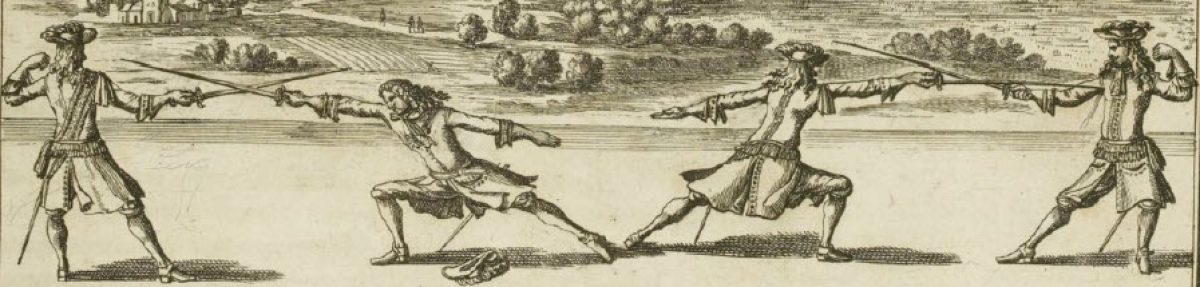
Perhaps it is the Hollywood notion of 18th century manners, of high style, and the romance around the waning influence and power of European aristocracy, but many of the interpretations from the anti-passing-step camp are wooden, slow, and lacking in vigor. They present more like demonstrations or dance than a fight. It’s form over function. For all the formality and etiquette that people of the past attempted to apply to personal conflict, in the end it was a sword fight. The intent was bodily harm or semi-acceptable ritual murder, and no evidence we possess suggests that two people, potentially angry and emotional, fighting fear, and terrified of public opinion, were more likely to square off and fight as if dancing. All evidence is to the contrary. Surviving footage of late period duels is no exception, and many of those were first-blood affairs, not to the death. For all the blather about “realism” few in “HEMA” spend much time if any pondering what that means, or, what it should mean in our context. [3]

The flaccid yet florid approach these fighters take to fencing reveals too much concern for aping the elegant plates within the treatises rather than what those treatises were meant to help teach: fighting. I am not the only one cautioning fencers about over-reliance on images, but time and again many in the community gravitate to the images because they don’t understand the text. [4] While language and diction are often challenging, the deeper issue is that these same fencers lack sufficient understanding to read the text. The one place they might go for help, a solid Olympic or traditional fencing program, is anathema among them, and so, they do their best to adopt what they see in the illustrations and produce pretty bouts largely devoid of any intent.

In the footage of their bouts, in their instructional videos, and especially in their attempts to shout down opponents, the shallowness of their understanding and skill emerge vividly. The inability to fence beyond a snail’s pace, the poor use of measure, and the more choreographed timing are red flags. No one fought in slow motion. It’s hard not to conclude that this is one reason that the clubs and cliques against passing step attacks avoid bouting anyone outside their little world. Against fencers with legitimate training and armed with sufficient knowledge they come up short. Such defeats should suggest to these fencers that maybe there is more to learn or better ways to learn it. In fairness to the newer students among them, hearing from their clubs that these defeats don’t count because others are wrong or too dangerous etc. is easier to accept within their echo chamber, when the only voices they hear are all part of the same program. [5]

Make the Bold Move

It takes courage to accept new ideas, even when well-presented and argued, but it remains the right choice if one wishes to retain any respectability. Lacking any official organization to manage these things, we are left only with each faction’s arguments and how to evaluate them. The best approach is to evaluate the respective arguments in light of the evidence, and, against what the purpose of fencing used to be. The masters who wrote these works, many of them anyway, meant for their books to help teach students how to fight. Sure, some, especially later, were more concerned with salle play than with duels, but for those clearly self-defense oriented, like many mentioned in the debate over the passing attack, the goal was effectiveness first and foremost. There was ample attention to deportment and conducting oneself with grace in many works, but this was, outside a fencing hall, a secondary goal. No master stayed employed long if their students died or were maimed for life. [6]

Those quick to condemn historical fencers using the passing step attack should take their example from other members of the older guard, people like Paul Wagner, Stephen Hand, and Dave Rawlings, all of whom have continued to learn, adapt, and alter their thinking based on new and better information. Though well-known, they have remained humble and thus open to learning, and between these factors and being gracious opponents, they have stayed relevant. They have not been eclipsed. 

When it comes to past fight systems, no one has a monopoly on the truth. Every interpretation must be tested and compared against the sources, and when new and better ideas make sense, when they follow from the sources, then they’re worth consideration however much that may disappoint one. At such times, hard as it is, once those shadows on the cave wall have been revealed for what they are, it’s time to do the hard thing and turn around. When one does, one sees better and grows, and often, one finds that those they have perceived as enemies turn out to be staunch allies.

Notes:

[1] De Liancour, for example, believed counter-attacks better suited for salle play than affairs on the ground (Le maitre d’armes/The Master of Arms, 1692, 13 in the pdf, 29; in Lynch’s translation, 36); Capt. John Godfrey, in his A Treatise upon the Useful Science of Defense, 1747, 12-13, expresses his dislike of the flanconade.

[2] A prime example is the demi-pointe lunge. See my papers related to this topic in the “Research” section found at the bottom of the Instructor page.

[3] I’ve spent a lot time on this in previous points, so here I’ll only add that while we strive to be historically accurate and as “realistic” as possible, the fact remains that we do this for fun, wear protective gear, and have no real need for this skillset in our own time and cultures.

[4] See my pieces on using and misusing images in historical fencing under “Research” in the Instructors section.

[5] Most fencing schools, most of the better martial arts programs, include working with and/or competing against those outside one’s own school. It’s critical for growth. It is never a good sign when instructors fear this or actively preach against it.

[6] Even in self-proclaimed self-defense works we see concern for deportment. In James Underwood, The Art of Fencing, Dublin, 1798, p. 7, he explains that he doesn’t like the off-hand arm forward because “I think the beauty of the figure is strangely disfigured by it, and that all fencers will allow that they cannot help being pleased with a symmetrical posture.”

Curricula, Completeness, & Choice

The Noviciate of a Macaroni. Ranelagh. 1772. Colonial Williamsburg Museum

One of the best things about fencing are the interesting people one meets along the way. Say what one will about “nerds” and niche interests, rarely are they boring, and in some cases it’s precisely their eccentricity that bridges the gap between niche-folk and those just other side the creative wall. For example, a few years ago a writer contacted me with questions about sabre for a project he had in hand. Over the course of our many conversations, we became friends. In a discussion this morning, he asked me for my take on the issue of true teachers versus the McDojo sort who just out to make a buck.

One point I made was that there is often, sadly, a gulf between what we can actually use in martial arts, should we need it, and what a school or teacher makes their focus. For example, in one ruleset for competitive Tae Kwon Do, one can kick at the head, but not punch. [1] If one is studying at a school adhering to this ruleset, they may be doing themselves a disservice if the goal is training to keep themselves and others safe. This is not to say that competitively focused schools are inherently bad, they can be fun and build one’s confidence, etc., but one should not mistake them for what they’re not, either.

As we continued to chat, I brought in a few examples from historical fencing, and this raised a related set of questions. Do we try to share all aspects of a particular treatise? Should we? What if an action is dangerous? What if it’s safe to do in our context, but would be dangerous were the blades real? My short answer is “it depends.” There are sometimes reasons to teach dangerous maneuvers, but any time one does considerations of safety must come first.

Not all Masters Agreed; Not all were Equal

One of the most “medieval” aspects of historical martial arts, and “HEMA” in particular, is an almost blind faith in written words of the past. Textual authority, given that it is 90% of our evidence, makes sense, but reason must still be applied. Modern doctors do not rely on ancient Greek medicine for guidance in obstetrics, and it would be both unethical and criminal if they did. [2] Not everything written in the past was good.

An Englishman and his Fencing Master, British Museum

It can be difficult to assess the worth of an old fight manual. Our distance in time, methods of conducting violence, notion of law, everything is different. This said, there are times when we get help from within the texts themselves. For example, in de Liancour’s Le maitre d’armes/The Master of Arms, 1692, he says of the counter attack that

C’est une chose si difficile à prendre que les Temps, l’Epée à la main, que je ne conseille personne de s’y trop hasarder. J’estime mieux une bonne parade, ou un bon battement sec & tiré droit le long de l’Epée ennemie, sans oster la sienne de devant soy…

Je m’étendrois beaucoup sur ce Chapitre, mais comme j’ay résolu de ne parler que des choses essentielles, je dirary seulement que c’est in jeu de Salle, où ces coups se pratiquent allez souvent, mais fort rarement l’Epée à la main.

It is such a difficult thing to take on the Times, sword in hand, that I do not recommend anyone to risk it too much. I consider a good parry better, or a good dry/sharp beat & thrust along the enemy’s sword without removing his from your own.

I would dwell long on this Chapter, but as I have resolved to speak only of essential things, I will only say that it is a Salle game, where these blows are often practiced, not often sword in hand. [13 in the pdf of 1692; Lynch, 36] [3]

Here is a master pointing out the inherent danger in choosing a counter-attack over a solid defense. It’s an important point, and one I am quick to mention when I cover counter-attacks, but I still teach it. For one, though we aspire towards realism, the fact is we do this for fun and no one is in danger of actual injury. Second, and more importantly, though I advise students not to select a counter-attack save under specific circumstances, they need to know how to recognize them and practice defeating counter-attacks when this action is used against themselves.

For another example, Capt. John Godfrey, in his A Treatise upon the Useful Science of Defense, 1747, rails against an action common to most small sword works, the flanconade:

That Thrust called the Flanconade, I pronounce an Anathema upon, as being easily proved to be the most lewd and vile Debaucher of the Art, the Dignity of which consists chiefly in its generous Allowance of a proportionable Chance to the weak man. The other Thrusts depend upon a timely Swiftness mostly: Though to say, that equal Knowledge with more Strength has not the Advantage, would be preposterous, as certainly the greater the Velocity is, the greater the giving Strength must be… [12ff]

Godfrey’s argument is that a weaker person will be less likely to pull off the flanconade than a strong person. He was correct. His pro-English and anti-French bias, given his background, are not surprising but likely informed his position as well. He published, after all, during the War of the Austrian Succession (1744-1748), where the two nations were in conflict over territory in North America (among other theaters). One example should suffice:

The Art we had from the French; no Flaconade was thought of for some Time; but upon finding us very apt Scholars, and being willing to be our distinguished Masters, they brought the Flanconade and many tawdry Embroideries, which they are as famous for inventing, as, I am sorry to say, we are degenerate enough to imitate, and even mimick. Pity! that we should be so fond of imitating a Nation, who have always been deceiving us. Rouse then, though noble British Spirit! (for sure no Time more calling than the present) lift up they brave fronted Head above these dandling Actions, and become thy wonted self! Love thy King, love the Country; stay they Heart his these, and thou art safe.

            Thus I take my hearty farwel[sic] of the Flanconade. [13] [4]

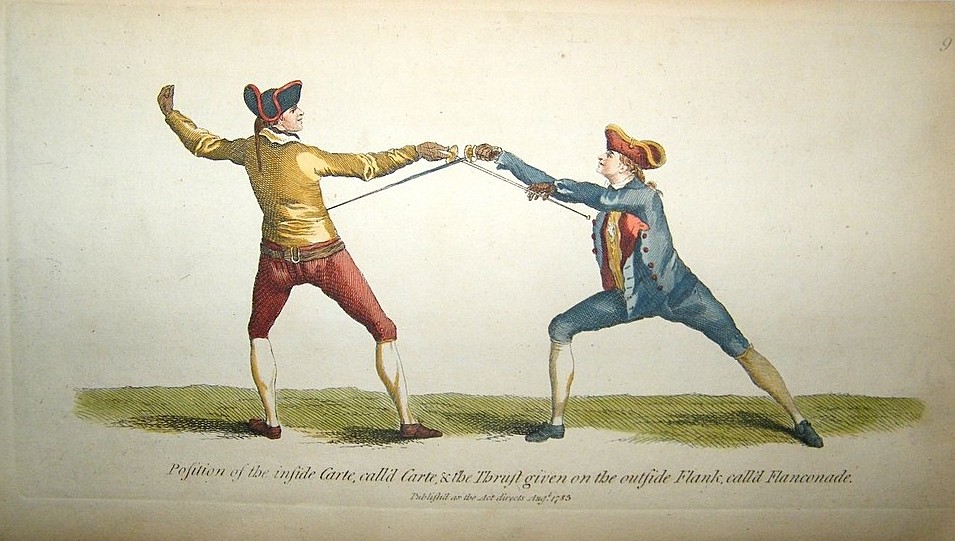
The Flanconade, Domenico Angelo, The School of Fencing, 1763/1787

Tin-foil tri-corn hats aside… the flanconade is a relatively difficult action to learn at first, but easier with practice. It does require, as Godfrey points out too, that the off-hand must come into play to stay the opposing blade after parrying in order that one doesn’t double as they go to target. [5] I teach this action too, and as with counter-attacks, because while difficult one must still know how to defend against it.

For a last example, this time in re position, James Underwood’s The Art of Fencing or the Use of the Small Sword, 1798, is instructive. In many, maybe most treatises the author advises one to be back-weighted while on guard. Underwood, however, disagreed:

I am of opinion, that the distribution of the duty laid upon each leg ought to be equal, and the more equally they share in the weight, I will venture to say the body will be so much more supported. But let us examine into the consequential practice, by the disadvantage of laying a greater stress upon one leg than the other, or the advantage to be expected from the strength accruing from the proper weight given to both. If too great a stress lie upon the left leg, your retreat must be obviously the more unsteady, and weaker; if upon the right, you are crimped and checked in your advancing. If the greater share of weight lie upon the right, the left leg must take that share off, before you can advance, and so, vice versa, the right must act for the left in the retreat. But then this is the loss of your time, upon which every thing depends; whereas by equilibrial weight upon the legs, that time is saved. Here your body will be equally supported, therefore stronger and steadier; but by recovering and shifting in the other way, the motion of the body must be so much greater, that your arm is more likely to be thrown out of line. [4-5]

Many fencers are taught this way today, that is, instructed to distribute their weight equally. It works fine. However, the rear-weighted stance was common and works equally well provided one distributes one’s weight properly. I had doubts about it myself, but in discussion with Russ Mitchell, and especially after his how-to-lunge class, I finally understood how it is supposed to work. [6] I teach students both. First, I show them what a majority of the texts advocate and why—our en garde position, and the lunge especially, are compromises between proximity to target and removal of our own target. Next, I show them the equi-weighted stance. Purists may balk, but I focus on the goal of our stances, not the letter of the law—bodies are different and so supplied with a few principles, I advise students to find a position that is comfortable and yet still meets the critical aspects. The front foot should be straight ahead, their bodies turned about 3/4, and fist and weapon just outside the body if on guard in tierce. If the rear heel is not precisely on the line of direction and in line with the front, no matter—are they stable, balanced, and can they move in any direction required? That’s what’s important.

Selective Reading & Teaching

When using a fencing treatise, I read it all and more than once, but I do not necessarily include all I read in class. I am selective in what I use—not in what I read. I read page to page, because I need to see the author’s approach in toto, and, compare it to other, related works—but not everything is equally important. I rely on Girard’s Traité des arms/Treatise on Arms, 1740, for much of my small sword curriculum, but I have no plan to include his short section on defense against grain flails. I use Domenico Angelo’s L’École des armes/School of Fencing, 1763/1787, as well, but spend very little time if any on weapon seizures outside demonstrations. They are, again to quote dance master Les Kendall in “Strictly Ballroom,” largely “flashy, crowd pleasing steps,” and less secure than a firm grounding in parry-riposte and thrusts made in opposition.

There are things I include for reasons of completeness or because it explains or aids core material. For example, there is good reason to believe that prime in small sword derives from broadsword practice. Angelo says as much, and this guard and parry are redolent of the hanging species of guard often used in sabre and broadsword, but I share that fact, if I do, because someone asked or because of some similar prompt. Girard covers the use of multiple feints, actions like the 1-2-3, but rarely does one need to resort to three feints in an actual bout. Complicated maneuvers like this are what we call “medicine for the hand:” we drill a triple feint because it will, we hope, make our single feint that much sharper and crisp. Have I seen anyone use a triple feint in a bout? Yes, among high level foilists thirty years ago, but in historical fencing circles? No. We still have to contend with people who believe feints are not “martial” enough (despite how often they pop up in the military sources…).

My goal is two-fold in most lessons and classes. First, I want to present and teach as accurately as I can either the tradition I was taught, or, those from the past I have studied. For the latter I always provide the caveat that we can never recreate these extinct fight systems perfectly, but we can, hopefully, get a good idea of how they might have worked. Second, I want what students learn to be both reflective of its sources and useful—I see no reason to teach anyone actions that are more likely to get them hit than not, so when I teach counter-attacks, when I teach the flanconade, I do so at the appropriate time and with the necessary warnings.

Curriculum building is selective, personal, and should be subject to revision as new insights, ideas, and flaws in the existing approach appear. Historical fencing is a research and experimental archaeology driven field. Unlike colleagues in the Olympic world, who are not uncovering hitherto unknown material or inventing new actions, our understanding changes with newly discovered texts and better interpretations. [7] If we are not open to new, better information, our programs become moribund and stagnate. Moreover, what we choose to teach and how is everything, but it depends on what our goals are. Unless we wish to produce graceful puppets, we should know not only what to teach, but why. What one selects is up to the individual instructor, but have a reason and be able to explain your choice.

NOTES:

[1] See for example https://olympics.com/en/news/know-your-sport-taekwondo-rules-scoring-equipment, “Scoring,” and “Penalties and Prohibited Acts.”

[2] To name only one example, the Hippocratic school concluded that most illness women faced was due to the uterus. From a very large sample, see Lesley Dean-Jones, Women’s Bodies in Classical Greek Science, New York, NY: Oxford University Press, 1994; Rebecca Flemming, “Women, Writing, and Medicine in the Classical World,” In The Classical Quarterly 57: 1 (2007): 257–79; Helen King, Hippocrates’ Woman: Reading the Female Body in Ancient Greece, New York, NY: Routledge, 1998; Vivan Nutton, Ancient Medicine, New York, NY: Routledge, 2005; Soranus, 1927.Gynecology. Edited by Ioannes Ilberg, Corpus Medicorum Graecorum/Latinorum, Berlin, DE: Teubner, 1927. [what, historians gonna history 😉 ]

[3] French speakers I ask your apologies for my loose translation. M.P. Lynch put out an edition in English (2021), which is useful, but which also has some translation choices that one might find less ideal, e.g. p. 110 where he uses “snafu;” for the original passage, see Ch. 17, p. 64:

Je répons que si l’on étoit affeuré que ce fùt un veritable coup tiré de droite ligne, sans feint, on pourroir y parer en opposant la main gauche, comme je l’ay fait voir dans mes autres Planches. Mais l’on peut étre trompé par des feintes, ou par des demy coups, & étant surprise, cette parade de cercle enveloppera tous ces coups qui pourroient vous étre poussez, & même fera perdre tous les desseins de vostre ennemy.  

[4] American sentiment, which has long baffled me given our long friendship with France, tends to back the English view on everything from the Hundred Years War to the colonial contests of the 18th and 19th centuries. Had it not been for French support, we may well have lost our rebellion against England. More recent history makes this all the odder given that England and France were allies, as were we with both nations, in the world wars. Just something to think about.

[5] The flanconade, often called a “high-low” attack in modern epee, is effected by parrying a thrust in the high line in fourth, then dropping the point to the outside over the opponent’s weapon. One then thrusts to the outside low line. Many earlier works advocate using the off-hand to secure the opposing steel after beginning the thrust to avoid a double. For a useful modern example, my go-to is professionescherma.org’s channel on Youtube: https://youtu.be/4G63pNHS90M

[6] See Russ Mitchell, Basic Body Mechanics for Martial Artists, 2018.

[7] One outcome of the unfortunate merger between the USFCA (the US Fencing Coaches Assoc.) and the USFA (US Fencing Association, the body that governs the sport; the US branch of the FIE), is that instructors are encouraged to “renew” their certifications yearly, much as someone say in a profession like pharmacy might with CEs (continuing education courses). While admirable that the organization(s) are interested in ensuring a higher degree of ability among instructors, there are issues with this decision. For one, this is expensive and assumes—as ever—full-time coaches with some manner of decent pay. That is not true for most coaches. Second, unlike pharmacy, no one is inventing new ideas or actions that we must learn to stay current. It’s difficult not to see this measure as a money-grab.

The Grip in Small Sword

One of the questions I’m asked frequently is how one should hold a smallsword. With a large corpus of treatises upon which to draw this is, lucky for me, a relatively easy question to answer, and, with some degree of certainty. There are differences among the masters, but most are subtle and have more to do with the positioning of the hand than in how the fingers grasp the weapon.

My approach, an amalgam based on the sources, is typical of “most” works:

  • The thumb extends along the grip towards the guard and stops 12mm/.5” from the shell
  • The forefinger rests just opposite the thumb so that thumb and forefinger are sort of pinching the guard
  • The three remaining fingers grasp the grip and help keep the pommel, while in guard, against the wrist
  • The fingers do not go through the Arms of the Hilt/annulets
Hand in Tierce
Hand in Quarte

Remember that in French fencing the numbers we use, prime, seconde, tierce, etc., refer to hand positions. There is not, for example, an ideal form of quarte–if the hand is in quarte, one is in quarte, whether parrying high, low, or midline. This is likely one reason, for example, that some masters referred to “quarte over the arm” (modern sixte) when parrying in quarte (hand in quarte) on the tierce side. Here is a handy reference and visual representation of this:

Still looking for the source for this image

In the two bottom quadrants, the lower outside and lower inside lines respectively, the parries for the former are octave (supinated-ish) and seconde (pronated-ish), and for the later septime (supinated-ish; a.k.a. “half circle”) and prime (knuckles up). Quinte, 5th, is a bit different than the similar position for sabre:

NB: 5th as positioned here is not set in stone, but reflects how the hand is held–this can be raised or lowered.

What do the Sources Say?

Below are excerpts from a few sources, mid-17th century to just before 1800, that cover the grip. Where possible I’ve added the original language if it was written in one other than English. For those without a translation, or for which I do not have one, I’ve summarized the import of the passage rather than offer a translation of my own. I’ve added images from the works when possible too—these are taken from public domain copies, but vary in quality.

NB: going from MS Word to WordPress, never mind the evils of autocorrect, often means errors in transliteration. I do my best to proofread, but if you notice misspellings, wonky accent marks, etc., please let me know and I will correct the error.

Charles Besnard, The Free Master of Weapons, 1653, p. 7 in ENG ver. by Rob Runacres and Reinier van Noort

To properly place oneself in guard and posture in order to practice the single sword or foil, one must first place the sword or foil in hand so that the thumb is placed on the cross or flat of the sword, and the index finger under the flat of the same in a half circle, and right under the thumb. Then tighten the grip of the three other fingers…

Pour bien se mettre en garde et posture pour faire l’exercice de l’épée seule ou fleuret, il faut premièrement mettre l’épée ou fleuret à la main, que le pouce soit posé sur la croisée ou plat de l’épée, et le doigt index soit sous le plat de celui-ci en demi rond, et droit sous le pouce, et serrer fermement la poignée des trois autres doigts…
[p. 7 in the Fr. Transcription by same editors]

De la Touche, The True Principles of the Single Sword, 1670

Next, you must draw the sword, taking it by the grip with the right hand and holding the scabbard with the left hand so that it does not follow the sword, and then draw it. This you can do in several manners, but it is done the easiest and the quickest by always keeping the thumb in the same position as it has in the first figure, and advancing and raising the hand until the sword is out of the scabbard, with the point turned towards the enemy, the thumb on the outside, that is to say, on the right side, and the sword on the edge, as in the second plate. [31 in van Noort and Coudre]

Les Vrais Principes [Ch. 2, p. 7]

Apres cela il faut tirer l’Espée, en la pregnant par la Poignée avec la main droite, & tenant le sourreau de la main gauche de peur qu’il ne suive l’Espée, & ensuite la tirer, ce que l’on peut faire de plusieurs manieres, mais la plus simple & la plus courte se fait en tenant toûjours le poulce dans la mesme situation qu’il a dans la premerie Figure, & avançant & levant la main jusques à ce que l’Espée soit hors du sourreau, la pointe tournee vers l’ennemy, le poulce en dehors, c’est a dire, du costé droit, & l’Espée sur le trenchant, comme dans la deuxiéme Planche.

de la Touche, 1670

Sir William Hope, Scots Fencing Master, 1686

Ma. You must hold your Sword after this manner; hold your Thumb upon the broad side of the Handle with your Fingers quite round it, as in the second Figure of the first Plate marked F and not as some do, who put their foremost and middle Fingers through the two arms of the Hilt, thinking that by doing that, they hold their Sword firmer, some use onely to put their foremost Finger through, which the Spainards did of old, and many even to this day do it; but both ways are most ridiculous, and dangerous.

Sch. I think any Man of common sense may perceive that, for when a Man holdeth his Sword in that fashion, with his Finger through the arms of the Hilt, he is in danger of having his Fingers broken, if his Adversary should inclose with him, and offer to force the Sword out of his hand, for holding it that way he cannot so easily quit with it, as he should, and therefore will infallibly in my opinion be in hazard of losing his Fingers, if not his life in the cause.

Ma. Sir, You have found exactly the hazard that a Man is in, in holding his Sword after that manner, but when you hold it, as I have before told you, you must hold it fast and firm, and not gently, so that your Adversary with the least sudden beat or twist may force it out of your hand. [11-13]

Sir William Hope, 1686

di Liancour, The Master of Arms, 1686

Let the right hand be turned half to tierce with the fingernails facing the ground, such that in parrying we need only turn the hand to half fourth, parrying straight thrusts to the inside from fourth with the cutting edge of the sword. [Lynch, 19]

Que la main droite soit tournée demy-tierce, les ongles vers la terre; d’autant qu’en parant l’on n’a qu’à tourner la main demy-quarte, l’on parera les coups poussez tout droit de Quarte dans les Armes, du trenchant de son Epée. [p. 8, Ch. III]

de Liancour, 1686

Jean-François Labat, The Art of Fencing, 1696/1740

…the Hilt of the Sword a little above the Hip, turning towards half Quart, the Thumb extended, pressing the Middle of the Eye of the Hilt, keeping the Fingers pretty close to the Handle, especially the little one, in order to feel the Sword firmer and freer in the Hand. [5, McMahon, Lector House edition]

L’art en fait d’armes ou de l’épée seule, avec les attitudes

…que le poignet de l’épée soit un peu plus haut que la hanche, tournant un peu vers la demi-quarte, le pouce étendu & apyué sur le milieu du corps de la garde entre les deux tranchains, serrant suffisament les doigts, sur tout le petit, asin de sentir l’épée plus ferme & plus libre dans la main. [9-10, L’Abbat]

L’Abbat/Labat, 1696/1740

Zachary Wylde, The English Master of Defense, 1711

your Hand fast gript about the hand of your Foil or Rapier, then put your Thumb long ways or forward upon it, your Arm quite extended from the Center of your Body, the Point of the Weapon being directed in a true Line against your Opponent’s right Pap, sinking somewhat low with your Body, your right Knee bowing or bent over the Toes of your right Foot, (tho’ some Masters teaches a strait Knee,) your left Knee more bent, inclining towards the Toes of your left Foot; lying in this Order is the Posture, which I call, Stand your Line, the Medium Guard then is fixt [p. 6 in the pdf]

Donald McBane, The Expert Swords-man’s Companion, 1712, p. 3-4:

Let the Grip of your Sword or Fleuret be no bigger, than that you can close your little Finger round it, and touch the Palm of your Hand; and let all your Fingers be round the Grip, and the point of your Thumb close too or near the Shell, which Guards your Hand, much more than as some People hold it, with the Pummel in the Hand, and fore Finger stretch’d out toward the Shell, they then can not command the Sword so well, and all the Advantage of hold it so, is, that they have a greater length from the Point to the Body, than if they held it with the Thumb close to the Shell. If the Grip of their Sword or Fleuret be larger than as here mention’d, it will be easily be Beat out of your Hand by a Batter.

When you are to Offend, whether at the Wall, or on the Floor, keep your and Hand Breast high, and Point rather below your Hand, and if you are to Defend at the Wall, keep your Hand as low as your or Hipp, and your Point as high as your Forehead; but for Defence on the Floor keep the proper Quart Guard, and by turning your Hand, you may Parie all high Thrufts, or Thrufts made at the Level of your Hand, and above; for Thrufts below the Level of your Hand, the Low Quart, and Seconde will Parie them.

Donald McBane, 1712; here with broadsword

Alexander Doyle, Neu Alamodische Ritterliche Fecht und Schirm-Kunst, 1715

Die Erstere nun/ Prima genennat/ belangend/ ziehet selbige ihren Nahmen daher/ wann man den Degen aus der Scheiden ziehen will/ denselben mit verkehrster Faust aud der Seiten ergreisset/ und nach dessen Entblosung sienem Feinde die spize bietet; da dann mit dem kleinen Finger in der Höhe/ dem Daumen unten/ mit zugelegter Faust und ausgeisirechtem Urm gegen die Uchsel die Spize praesentirt wird: Und in solcher Positur wird die so genannte Prima formiret [p. 1]

[Summary: prima/first is named for the fact that this is the position one is in after drawing the sword; one grabs it with the fist inverted; in this position, the thumb faces down, the little finger up; NB in the image below the fencers are not in prima]

Doyle, 1715

Henry Blackwell, The English Fencing Master, 1730

Secondly, To hold a good Guard to defend your Body, your Right-Hand must be straight out with a little bend in your Arm, the Point against your Adversary’s Right-Breast, with your Four Fingers bent under one part of the Handle, and your Thumb over the upper part, with the Pummel close to your Wrist, as you shall see in the Posture, etc. [2]

Henry Blackwell,

Girard, Traité des armes, 1740

III. Que la poignée soit serrée près du pommeau avec le petit doigt, & le second doigt, & que la milieu du poulce soit apuyé à plat sur ladite poignée de l’Epée près de la sous-garde; laquelle poignée étant soutenuë du dedans la jointure du premier doigt, on aura la facilité de dégager & de tirer.

IV. Avoir le bras droit, & le poignet flexible & tourné demi quarte, de sorte que le demi trenchant de la lame regarde la terre, comme il est dit, & que le bout des ongles des trois derniers doigts de la main droite regarde le Ciel, & la plus grande partie de l’ongle du poulce, ainsi que le bout du premier doigt. [5-6]

Crawley, Philip T. The Art of the Smallsword, Featuring P.J.F. Girard’s Treatise of Arms. Wyvern Media, UK: 2014, 38.

3. That the handle is gripped near the pommel with the little finger & the second finger, & that the middle of the thumb is laid flat on the grip, near to the body of the hilt; of which is supported by the inside of the knuckle of the index finger, which will give greater ease in disengaging and thrusting.

4. The right arm & the wrist flexible & turned to demi-quarte, in such a way that the ridge of the blade is toward the ground, as stated, & that the fingertips and nails of the three last fingers point towards the sky, as the greater part of the thumbnail and the tip of the index finger.

Girard, 1740

Le Perche du Coudray [attrib.], L’exercise des armes ou le mainement du fleuret, 1676/1743

Voila de Toutes les Gardes

La Situation la plus naturelle, la plus gratieuse, et la moins dangereuse, Car toutes les autres sont Exposée, a tant de Contrecoups qu’il ny [ne?] faut pas penser, cest pourquou je Conseilleray toujours aux Amateurs de ce noble exercise de ne s’Escarter jamais des regles de cette garde, qui sont dabord de bien tenir son Epeé, ayant pour cette Effet la poulce sure le plat de la poigneé, la pointe a la Hauter de l’Epaule, que le pomeau de l’Epeé tombe en ligne directe sur la pointe du pied droit, qu’il soit a la hauteur de la hanche droite, il faut que le Corps soit droit sur les deux hances, et posé entierement sur la partie gauche, Cavant bien la hanche droit, et Effacant bien l’Epaule gauche, pliant le genoüil gauche et laissant beacoup de liberté dans le droit, asin de n’etre point Embarassé ny pour marcher, ny pour faire les Engagements d’Epeé; il faux que les deux pieds soient dans la même ligne et que les deux Talons se respondent l’un a lautre. Il faux être sendu Environ de deux semeles il faut que le bras gauche soit èlevé en faisant un de ny Cercle et que le creux de la main soit directment a la hauter de l’Oeil gauche, la tête droite le Corps bien effacé et observer tourjours une g. de liberté, le talon droite vis a vis l’Oeil du soulier gauche [1]

[Summary: thumb is flat on the handle, point shoulder high, pommel in direct line with tip of the right foot, at height of right hip]

Le Perche du Coudray [attrib.], 1676/1743

Juan Nicolás Perinat, Arte de esgrimir floret y sable/Art of Fencing, 1757/8 [from the transcription and translation by Tim Rivera, 2018]

It is necessary to be in guard in the mode that is seen in the figures of the first plate, both feet on the same line, both legs bent, the left more than the right, the hip supported on the left side, both arms half extended, the left higher and arched, the head erect, looking at the enemy, the hand turned between fingernails up and fingernails down, or in the regular posture, and the thumb over the plane of the sword, presenting the point to the enemy. [1]

Es menester ponerse en guardia del modo que se vé en las Figuras de la Lámina primera, ambos piés sobre una misma línea, las dos corvas dobladas, la izquierda mas que la derecha, la Cadera apoyada en la parte izquierda, ambos brazos médio tendidos, el izquierdo mas levantado y arqueado, la cabeza derecha, mirando al Enemigo, la mano vuelta entre uñas arriba y uñas abaxo o en postura regular, y el pulgár sobre el plano de la Espada, presentando la punta al Enemigo. [1]

Domenico Angelo, The School of Fencing, 1763/1783

You must observe that the gripe of the sword be put on quite centrical to the heel of the fort of the blade, which should have a little bend above the fingers, when in hand, and let the whole mounting be turned a little inward, which will incline your point in carte. This way of mounting your sword will facilitate your disengagements, and give you an easy manner of executing your thrusts. [2 in the 1787]

Il faut ausi que la garde de l’epée porte juste sur l’affiette du talon du lame, laquelle doit baisser un peu sur les doigts de la main, & le corps de la garde doit être tourné un peu en quarte. Cette maniere de monter uné epée donne de la facilité pour dégager & de la liberté pour tirer les coups d’armes. [p. 21 in the pdf from the BNF Gallica site]

D. Angelo, 1763/1787

Andrew Lonnergan, The Fencer’s Guide, 1771

In holding your Foil observe, that you must lay your thumb upon the flat of the handle, or grip, somewhat extended with your fore finger on the other flat behind, forming a square with the point of your thumb. Sometimes you will find a Foil, with a square handle, where no flat side can be distinguished; in such case, the flat of your Foil’s blade must guide you as before; but now the Foil blades are also square, therefore you must be guided by the kind of shell the Foil has; which shews you where the real flats of the handle and blade are, though still square. Now the whole hand should be at such a distance from the shell, so that the little finger should lock into the hollow part, or neck of the pummel; yet practice will allow you to shift your hand hereafter. Observe, when the handle or blade of your Foil is bent, or arched, you must always lay your thumb upon the round side; and the inside of your fingers ends on, or against, the hollow side, or part of the blade, griping the handle gently, and with as much freedom as if on a flute.

Some make a practice of holding the Foil between the fore and middle fingers, with the thumb propped against the fore-finger; yet this method, though successful enough to many by long practice, is not so recommendable to begin with as the former. [1-3]

J. Olivier, Fencing Familiarized/L’Art des armes simplifie, 1771

Ch. 2 How to hold the Sword

In order to hold a sword well, the hilt must be flat in your hand, your thumb stretched and at an inch distance from the shell, the pummet under your wrist.

Never keep the sword fast in your hand, but when you parry or thrust. For, if you hold it always with strength, the muscle of your thumb will soon grow stiff. [9]

Ch. 2 Maniere de tenir l’Epée

Pour bien tenir votre épée, il faut que la poignée se trouve à plat dans votre main, le pouce etendu à la distance de 12 lignes de la coquille, le pommeau sous le poignet.

Ne serez jamais l’épée en votre main, que lorsque vous parez ou tirez car, si vous la teniez toujours avec force, vous vous engourdiriez bientôt le muscle du pouce. [p. 10]

John MacArthur, The Army and Navy Gentleman’s Companion, 1780 [NB: fan of J. Olivier’s teaching and method]

Lesson 1: The Manner of Holding the Sword or Foil, etc.

In order to hold your sword well, the hilt must be flat in your hand; so that the two edges will be nearly horizontal when you throw yourself upon guard; your thumb stretched along the upper flat part of the hilt, within half an inch of the shell, and the pummet is to rest under your wrist. [p. 3]

MacArthur, 1780

Danet, L’Art des armes, Paris, FR: Chez Herissant, Fils, 1788

Manière de tenir l’Epée

Pour tenir avantageusement l’épée, il faut que la poignée se trouve entre le tenar & l’hypotenar, & le pommeau à la naissance de la main; que le pouce soit allonge jus-qu’à la distance d’environ douze lignes [*] de la coquille sur le plat de la poignée; qu’en même temps le milieu de l’index se place dessous la poignée près de la coquille; que la poignée soit étroitement embrassée par le doigt majeur, & encore serrée contre le tenar vers la pommeau, par l’annulaire & l’auricularie: mais il ne faut serrer la poignée que dans l’instant seulement que vous tirez, ou que vous parez; parceque les muscles due pouce, de l’index & du doigt majeur s’engourdissent promptement, au lieu qu’il n’en est pas de même de ceux qui sont agir le petit doigt & l’annulaire.

Il est des occasions où il convient de lâcher ces deux doigts pour faciliter l’exécution de cetain coups. J’aurai attention de vous en prevenir quand il le saudra. [3]

[Summary: the thumb is extended along the grip and a short distance from the shell; index is under the grip, opposite the thumb; of note, Danet reminds the fencer not to grip tightly save when thrusting or parrying; the three remaining fingers keep the weapon secure, pommel is against the wrist]

* The ligne, “line,” was a unit of measure in pre-Revolution France. This particular measure had an English parallel, of the same name, which varied in length between 1/10 and 1/40 of an inch. The French ligne corresponds to about 2.3mm. Incidentally, a pouce, or “thumb” [approx. 27mm] was also a measurement within this system, but that is not how the word is used here. For more on this, a useful summary is provided in William A. Smeaton, “The Foundation of the Metric System in France in the 1790s: The Importance of Etienne Lenoir’s Platinum Measuring Instruments,” in Platinum Metals Rev. 44:3 (2000), 125ff [https://technology.matthey.com/article/44/3/125-134/]; see also Suzanne Débarbat,”Fixation de la longueur définitive du mètre,” in Ministère de la culture et de la communication (1999): https://francearchives.gouv.fr/fr/pages_histoire/39436 ; of note, the ligne is still used by some milliners, cf. https://www.levinehat.com/blogs/levine-hat-blog-1/19189051-what-are-french-lignes

Censorship or Criticism? Why You’re Wrong about “Gate-Keeping”

“Discord is the great ill of mankind; and tolerance is the only remedy for it.”
― Voltaire, Philosophical Dictionary

[Warning: rant ensues]

The choice of quotation is not an accident. Thanks to a toxic mix of politics and poor life choices I left most social media a few years ago, and, with one exception (barring messenger/email apps), have next to nothing to do with it. Research articles on the effects of social media continue to support my belief that this was a good decision. It’s not just that people can’t watch or read anything longer than a tiktok video or tweet, but that the supposed anonymity fails to prevent, and maybe even encourages them to be nastier than they would be, in most cases, to one’s face. How does this related to fencing? I promise to connect A and B if you keep reading.

It gets worse. Swimming in such a shallow pool feels safe, because everything is on the surface, but this ignores that fact that one can still be sunburned, even drown in an inch of water. It changes people.

The faux familiarity, the apparent openness, and the need for connection that social media seeks to create but which it actually undermines, all produce an illusory culture of contented seemingly intimate pals. Test it. Say something vaguely controversial and see how people react—the ability to differentiate between confirmed belief and a joke is all but nonexistent; lacking facial cues, changes in intonation, etc., this is hardly surprising. It is not an accident, however, that this diminished capacity for communication and an equally strong inability to separate criticism and censorship have grown in parallel.

Gate-keeping online is the new Inquisition, not only for the social auto de fe that so often follows in its wake, but also for the fact that the basis for it is confused.

There are a lot of ways people define “gate-keeping,” but I find that the Urban Dictionary, while typically an amalgam of denotations, taken in toto provides a fair sense of what contemporary terms and movements mean. Here are a few from the first two pages of definitions:

  • Gatekeeping is to make your interests exclusive in order to protect them from becoming “mainstream”
  • When someone takes it upon themselves to decide who does or does not have access or rights to a community or identity.
  • A word used to describe when someone sets a standard/limit on what someone must do to call themselves a ‘true fan’ of something/someone.
  • When someone uses a hobby or interest as a means of elevating themselves above others to give oneself a sense of being superior transforming their passion or knowledge about a particular subject into an ugly tool of self-inflation
  • When someone takes it upon themselves to decide who has access to something
  • When people discriminate against others who want to enjoy the same things as them, and usually gatekeepers use the dumbest reasons as excuses [1]

For a slightly more august definition, the Cambridge Dictionary defines it as “the activity of trying to control who gets particular resources, power, or opportunities, and who does not. [2]

More than once I’ve been accused of gatekeeping, but according to these definitions I have not, in fact, been gate-keeping. No, I have criticized poorly constructed theories, ineffective training regimens, inexpert translations and interpretations, and bigots. This is important, because what I have NOT done is:

  • make my interests exclusive in order to protect them from becoming “mainstream”
  • set a standard/limit on what someone must do to call themselves a ‘true fan’ of something/someone
  • used a hobby or interest as a means of elevating myself above others to give myself a sense of being superior or transformed my passion or knowledge about a particular subject into an ugly tool of self-inflation
  • decided who has access to something
  • discriminated against others who want to enjoy the same things as me, and for the dumbest reasons

I would love for well-researched, well-coached, and inclusive historical fencing to take off and become mainstream. I have no business telling people what they can or should like—people like what they like. This hobby, well, um, it does not elevate one socially at all and those who, sadly, think it does I feel pity and compassion for—fencing is not going to help you find a date, fame, or money. Historical fencing should be for all—the only people I will not teach or interact with are people who are known bigots. [3] Finally, I have trouble understanding why anyone would discriminate against people who share the same interests—hell, I’d all but kill for more people interested in the things I am!

Here is what I do and will continue to do:

  • I will continue to support good research, and, attempt to improve bad research
  • I will continue to do my part, as an educator, researcher, and fencer to support, make, and improve interpretations of historical fencing
  • I will continue to do my part to create an inclusive culture (bigots either get wise or fuck off)
  • I will endeavor, as I have to date, to do all of this with compassion and understanding, because historical research and interpretation is, by its nature, extremely difficult to do and even harder to do well

Lastly, I issue a challenge. The next time you think someone is gate-keeping, take the time to consider a) what gate-keeping is and b) if what you find unpleasant conforms to those rubrics or not. IF, as so often happens, you’re simply reading something that you don’t like, or which you somehow think is about you, or which makes you feel attacked, pause and consider the likelihood of that. As I’ve said, most things are not about us. It’s probably not about you, and you know, if someone my age can figure out how to mute a channel or thread, then you can too. Like it or not you’re responsible for your feelings and how you react, not me. I take care of my garden, you take care of yours. That’s what wearing grown-up pants is all about kids.

In our context, if you’re upset that a cherished theory has been challenged or that some old, obscure upstart has dared accuse some HEMALand darling you admire of poor work, reflect upon what that says about you.

I am not interested in making enemies; I’m interested in good research and fulfilling my duty as a trained researcher to steer people right about research. It comes with the sheepskin. This said, if calling out charlatans and would-be experts creates enemies of them, or you, fine. IF I’ve taken the time to call them out, there is a reason, and it has nothing to do with self-aggrandizement, attacking others, or just being an asshole. It’s not like anyone thanks me for it—getting attaboys is not the purpose: improving research is. I don’t need or want thanks or anything of the sort, just better research.

If I’ve called someone out about their work [key word, their work, not they themselves], it’s because I know they lack the skill, experience, and/or knowledge to make the claims they are or have made a grave error and are fooling people about it. Most people, wisely, don’t pursue research as a career-path, and so there is a responsibility on those of us who do to do right by all. Theories and interpretations are things we can evaluate, that are demonstrable, and either someone has those skills or doesn’t; either they’ve proceeded responsibly with their research, or they haven’t. The only time this gets “mean” is in HOW we call these things into question. It is never my intention to be mean—life is cruel enough and hardships a plenty without my adding to it.

Please note: my goal in throwing myself up for a beat-down when I offer criticism (that is, critiques to help someone improve or fix a position they are sharing) is intended to help them, not blast them. I spent over a decade learning to conduct research and another decade honing and teaching others to reason and analyze information. I want people to do better work. Too many academics could care less, and most wouldn’t bother trying to help non-academics improve. There’s a direct correlation between depth of snootiness and lack of resources that explains that; put another way, many academics are small people and sad. For me, the so-called Ivory Tower is bloody useless if its treasures are hoarded away only to be enjoyed by the three people in that field (see gatekeeping defintions 1, 2, 4-6 above…). I won’t be party to that, and so, I do what I can to share those treasures with everyone, and for reasons of time, interest, and experience, I do that mostly in historical fencing.

NOTES:

[1] https://www.urbandictionary.com/define.php?term=Gatekeeping

[2] https://dictionary.cambridge.org/us/dictionary/english/gatekeeping

[3] By kn0wn-bigots I mean those who wear all the symbols and spout the trash that bigots do. If they don’t say these things in class, and attack no one, then I don’t know about and they fly under the radar. Locally, at least, people know from the main page on this site that bigots are not welcome.

A Bar Raiser

Chateau South, Atlanta, Texas

Super late last night I returned from a weekend of instruction, teaching, discussion, bouting, and all manner of swordy fun at the St. George’s Day Exhibition of Arms held at the beautiful Chateau South, Atlanta, Texas. The event was put on by Russ Mitchell and the excellent people at Winged Sabre Historical Fencing, and hosted by the generous owner of the Chateau, Raoul, who not only trusted us to honor the integrity and safety of this property, but also who grilled a feast for us. If you’re in eastern Texas, “Piney Texas,” and need a venue for any event–wedding, family reunion, business retreat, you name it–I can’t recommend Chateau South enough (https://www.chateau-south.com/). Raoul and the family who take care of the property and are helping to restore it, Shawn and Rebecca, put the hospitality in southern hospitality. Seriously nice and generous folk.

Learning, Camaraderie, and Cross-Fertilization

I hope that the St. George’s Day Exhibition of Arms will become a regular event, because it needs to be. We have tournaments, we have seminars, conferences, and in some rare instances a mix of the three, but in some cases the dates are tough to make, the cost prohibitive, or the environment/attitude less than welcoming. Russ Mitchell and the fine folk at Winged Sabre put together a fantastic event–it was friendly, open-minded, and welcoming, but more than that the classes and discussion, the chat over meals or between sessions, all were informative and thought-provoking.

In addition to my two classes, there were a class on movement and balance by Russ that has changed not only my understanding of footwork, but also how I will teach it from here on out; there were two by Francois Perrault (Montreal, CAN), first on French foil as a way to understand the second topic, contre-pointe (the French approach to sabre ca. 1800-1908); and two by Jonathan Carr (Dallas, TX), one that made more sense of Hutton’s sabre than anything I’ve read, seen, or heard until then, and then a fascinating lecture on Sir Richard Francis Burton’s 1875 sword system.

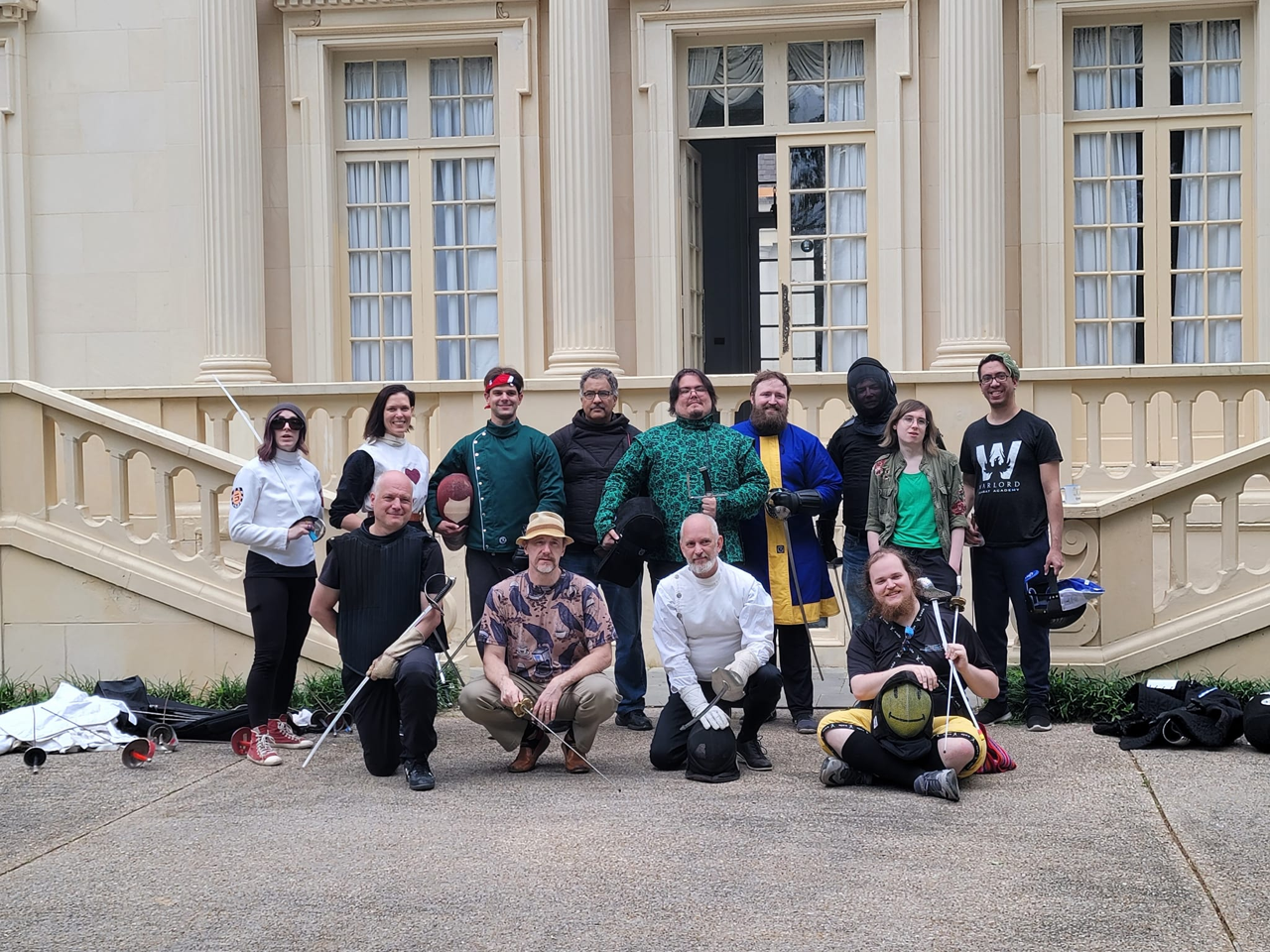
Some of the Attendees late Saturday, 22 April 2023 (photo by Annamarie Kovacs)

Discussion between classes, over meals, and especially at the end of the instruction-day, were as valuable. They were also a chance to get to know one another, share ideas, and increase understanding on the various tangents covered in the topics. For someone as introverted as I am, and who normally has to bow out to recharge, the fact I wasn’t once in need of that recharge should suggest a lot.

Tired, but still in for chatting–Aaron, Michael, and myself

Exhibition of Arms vs. Deeds of Arms

Both have their place, but what an exhibition of arms seeks to do is share a particular style or tradition’s uniqueness within the Art, that is, what makes it what it is. While I cannot say to have represented the Radaellian school particularly well in my own bouts, I will say that my compatriots did a wonderful job. Russ’ students have been studying hussar sabre, which is very different than the profiled styles that predominate; Francois’ early French approach and Jonathan’s debt to English sabre and broadsword were clear as well. The focus in our bouts was to do our best to fight within the body of techniques and tactics of our specific traditions, and, to have fun doing it.

We also had time to explore a venerable Hungarian weapon, the fokos, a shehpard’s axe that the Magyars brought with them from the Steppes in the Early Middle Ages and which was used in the trenches of the Great War. Never have I faced a more challenging weapon sabre in hand than I have that wee axe. Russ made a few converts among us, I’m sure; least, I’m looking into the more than academically now.

Russ arresting a cut with a fokos

Raising the Bar

Winged Sabre’s “St. George’s Day Exhibition of Arms” raises the bar for what we can and should be doing more often in historical fencing. Each of the classes had students drilling. There, I said it, the “d-word,” drill. It’s become a dirty word in “HEMA,” and to the detriment of that community. The garbage posted so often on Youtube as championship sabre is a case in point. The hop and chop, simultaneous single-tempo cuts lauded as the end-all be-all of sabre are to Plato’s cave what shadows on the wall are to the sun outside the cave that creates them.

Drill. Hard work. Effort, time, and sweat. These are what make a decent fencer. One can spend weeks, years even, in study, but if intentional, well-designed drill is missing, there is only far someone will go in that time. Another way to say this is that much of HEMA is doing it wrong, and should seek better methods, better instructors. I’ll not go so far as to list myself among their number, but I will say that I know some people you should talk to.

St. George’s Day Exhibition of Arms

[21-23 April, 2023] Next week the excellent Russ Mitchell and crew at Winged Sabre Historical Fencing, Atlanta, Texas, are hosting the St. George’s Day Exhibition of Arms (see link below). I have the honor to teach at this event and will cover two, related topics in Radaellian sabre.

The first is all things molinelli, that is, an exploration of the powerful, elbow-as-axis cuts fundamental to Radaelli’s approach. They were used not only for exercise and to build the muscles required for these cuts, but had offensive as well as defensive uses too.

The second class covers Masiello’s unmounted cavalry drill and exercises. Since the Radaellian method was primarily developed for cavalry it makes sense to acquaint oneself with this aspect of the tradition. Cavalry troopers not only practiced their style of combat in the saddle, but on foot as if in the saddle, what Masiello called come a cavallo, “as if on horseback.”

For more information, see:

https://chateau-south.ticketleap.com/exhibition-of-arms/details

Alex Spreier on Engaging Sources

Alex is a close friend and colleague, and one of the best students of the Art I know. I’ve learned a lot from him. In this post, he tackles the questions of when and how to question our sources.

Here is the link: https://www.highdesertarmizare.com/2023/04/05/questioning-the-masters/

More Marcelli!

My friend Patrick Bratton recently had Maestro Francesco Loda and Silvia Tomasetti over to teach. Loda has been studying Marcelli, among other works, for a long time and is one of the leading researchers into his system. Enjoy!

Marcelli’s Annervated Lunge Revisited

[NB: this is an updated look at this lunge, one that begins where this one left off: https://saladellatrespade.com/2021/11/09/a-note-on-francesco-marcellis-stoccata-annervata/]

Direct thrust, sword alone, Part I, Bk. II, Ch. VI

On occasion someone will share a video or the like with me and I’m reminded just how difficult it is interpreting historical fencing treatises. In the last few days I’ve had a chance to chat with a few other instructors about a popular interpretation of Saviolo’s system as well as a new video purportedly covering Marcelli. [1] There were many threads in our discussion, but the thing that kept sticking in mind was the Marcelli video. I spend a good part of my week on that master’s text, Rules of Fencing (1686), and despite the qualifications of the instructor sharing that video I saw several things that stood out to me as features of more recent fencing versus what Marcelli taught.

As a caveat, I have a lot of respect for Maestro and Maestra Coblentz, and the student in the video, Justin, clearly has solid training, but I take a different view on Marcelli and think it’s important enough to share. Naturally, if there is something I’ve missed or concluded incorrectly, I invite them to chat and demonstrate how I’ve erred. It’s never my intention with posts like this to attack anyone personally—that sort of thing is nonsensical, unnecessary, and unhelpful. However, as someone who focuses closely on Neapolitan rapier and teaches it, I feel obligated to point out a few things in the video that don’t seem to match what Marcelli taught.

To be clear: what I am evaluating are aspects of their interpretation based on a close reading of the text, both as a fencer and someone trained to read historical texts. Anyone who shares an interpretation is opening the field to evaluation, but there is also a condition on the critic (in this case me) too—they should be fair, back up any criticism, and stay on topic. In what follows I will cover only a few things that stood out to me, because they are critical to understanding Marcelli’s system, and attempt to demonstrate these conclusions with textual support.

Lunge vs. Annervated Lunge

Some months ago I had a post on this stoccata annervata as it’s foreign to most people and difficult to adopt if one is used to the better known lunge. [2] It is not a lunge the way we normally conceive of it. This annervated lunge is used only with rapier and dagger—one doesn’t use it when fencing with rapier alone. The genius of it is that it allows one to extend the point while still maintaining defense, something the longer lunge does not do as well with the pairing of rapier and dagger. The annervated lunge is less a lunge than it is an unwinding—the weapon and arm are propelled by unwinding the torso, not by pushing off the back leg (something Maestro Coblentz makes clear in the video). This is how Chris Holzman and Patrick Bratton explained it to me too when I first started working on the Neapolitan school a few years ago.

If one has fought with rapier and dagger, and importantly with the mindset that one cannot be hit, then the value of that pairing should be not only be obvious, but also attractive. It layers defense and makes an attack all the more dangerous. It is, as my fellow rapier enthusiast Ken Jay remarks frequently, a game-changer. In order for the pair to work one cannot stand in guard as one does sword alone: a dagger, buckler, cloak, etc. does little good if it’s behind us. Thus, the body is more square to the front—we can face someone head on because the dagger is there to aid defense. To lunge out with the trunk still squared would be both short and easy to see, so the solution, a brilliant one, is to twist the body back toward profile and shoot the blade and arm out to target. One can thus reach a little farther but with minimal exposure.

Key to this is the front leg: it remains straight. Unlike the lunge most people know, where the knee is over the heel, calf perpendicular to the ground upon completion, the annervated lunge makes a short step and lands leg straight. Proper use of measure is what determines when to make the lunge, and it is a different measure than when lunging in profile. It’s not an annervated lunge if one is landing as one does today.

In the video, the offhand and dagger are swung dramatically back as the Maestro Coblentz and his student, Julian, lunge. On the surface this appears very much like the image in Bk I, Part II, Ch. V, p. 15, figure 4:

However, what Marcelli explains about this image reveals important information for the feet:


All the movements that I have proposed to be made in performing the thrust are seen marked with the numbers in the present illustration. The number 1 signifies that the aforesaid Cavaliere has started the sword hand first. The number 2, marked near the left knee, denotes that after having brought the hand forward he has violently extended that knee, which was bent. The number 3 that stands at the right foot indicates that it was the third movement of the body, and that after having advanced the hand and extended the knee he has advanced the foot, which is the last movement, because it has to do the least travel of all.

Tutti i moti, che hò proposto da farsi nel tirar la Stoccata, si veggono segnati co’i numeri nella presente figura; dove il nu. 1 significa, che il sopradetto Caval. hà partito prima la mano della spada. Il num. 2., segnato vicino il ginocchio sinistro, dinota, che doppo haver anticipate la mano, hà disteso con violenza quel ginocchio, che stave piegato. Il num. 3., che stà nel pie destro, signitica, che quello e stato il terzo moto del corpo; e doppo haver caminato la mano, & annervato il ginocchio, ha caminato il piede, il quale e l’ultimo moto, perche hà da far camino meno di tutti. [3]

Note that number 3 in the image does not pertain to the dagger, but to the right leg:

number 3 that stands at the right foot indicates that it was the third movement of the body, and that after having advanced the hand and extended the knee he has advanced the foot, which is the last movement, because it has to do the least travel of all.

How does one reconcile this information with the image? One option, and presumably what Maestro Coblentz has concluded, is that since the dagger is shown to the rear in the image, one should do the same upon the lunge. For reasons I have shared ad nauseum on this site I am cautious with images—they can be helpful, but must always be read against the text. Nothing in this passage suggests one should remove the dagger to a position where it can do little good, and if one lunges along more modern lines that is what happens—the dagger is too far back to be of any real use. In the annervated version, however, because it’s shorter, the dagger is easier to bring back into play should it be needed. [4] As shown in the video, the dagger arm is doing the right thing, but the feet are not.

Mezzaluna & Dagger Placement

In similar vein, Marcelli was clear on his expectations for the dagger while on guard. He writes

In all these methods of standing on guard it must be advised to keep the dagger strongly closed in the hand…the dagger arm must stand strong, extended, and annervated, because it must use force and not lightness in defending from all blows that are violently performed by the opponent.

In tutti cotesti Modi di stare in Guardia si deve avvertire à tenere fortemente stretto il pugnale in mano…mà il braccio del pugnale deve start forte, disteso, & annervato, perche deve usar forza, e non leggierezza, nel difendersi da tutti i colpi, che violentemente li sono tirarti dal nemico. [5]

We see this with all four guards, but especially the one I believe they are trying to use in the video, mezzaluna.

Marcelli says that the guard of mezzaluna (fig. 1 in the image below) has one

Extending the foot forward along the straight line meeting the rear foot, and bending the left knee, with the torso counterweighted on this foot, keeping the right knee extended, the right foot metting the opponent, and the rear foot oblique… the sword arm is withdrawn to the rear, with the hand near the pocket. He carries his dagger forward covering all the upper parts in such a way that the opponent only sees the chest below the dagger as target to strike. He cannot wound him in another part than this, and therefore it is called the guard below the weapons.

cioè, stendendo il piede avanti per linea retta incontro al piè di dietro, e piegando il ginocchio sinistro con la vita contrapesata sù questo piede, mantiene il ginocchio destroy disteso, il piè dritto incontro al nemico, e’l pie di dietro per traverso; e ritirando il braccio della Spada a dietro, con la mano vicino la saccoccia, hà portato il Pugnale avanti, coprendosi tutte le parti superiori, di modo che il nemico vedesolo per bersaglio da colpire il petto per le parti do sotto il Pugnale, nè può ferire in altra parte che in questa, e percio si chima Guardia sotto l’armi. [6]

Here, as with the image before, we have a discrepancy between the image and what Marcelli says of it:

Fig 1 is in First Guard/Mezzaluna

In the image, Figure 1 has a clear gap between the weapons in direct contradiction of what Marcelli describes in the passage explaining it. Recall that

He carries his dagger forward covering all the upper parts in such a way that the opponent only sees the chest below the dagger as target to strike. He cannot wound him in another part than this.

Marcelli makes it clear that there is no middle passage to the chest. One can only attack in the low line.

For corroborating evidence we have the testimony of another Neapolitan master, Nicola Terracusa e Ventura, who in True Neapolitan Fencing (1725) claims that this guard is called “half moon” because the tips of the weapons form that shape, that is, are in contact. [7] If both masters are adamant that one can only attack below it, then there cannot be a gap between the sword and dagger. That would open a line in addition to the low line.

Closing the Line: Lesson and Reality

In one portion of the lesson (1:32), Maestro Coblentz has Justin hit him, again with a normal lunge, and then extends to hit him indicating that the student had left the line open. As set up, it’s true that Justin is open because he’s still in the lunge, however nothing, so far I can tell, cued Justin to know that an after-blow was likely. So far as I can tell the master has instructed the student to strike without the expectation that the instructor will parry or counter.

It’s important to note that there are many times, most even, when the instructor allows the student to hit them; in most ways the instructor is a willing target. But throwing a counter or after-blow into the mix is not normally something one does without some cue that it could happen. Ostensibly the maestro is reminding the student to close the line, but in this instance the student is slightly out of measure—they’re not wearing masks—and was told to lunge to target. It’s an occasion for potential confusion—is the student working an aspect of the lunge, doing so but with additional attention to the line, or both? This is to say that when teaching a student a new action, especially something as unusual as the annervated lunge, we tend to break it down into parts to make it easier to learn. Justin’s lunge (though not annervated) was solid and he struck target with his arm in the right place, so punishing him for that again can confuse things.

The solution they devise is to have the student drop the hand upon extending. Not only does this slow the thrust, but it opens the student up to a counter-attack to the arm. This addition would also be unnecessary if the lunge was properly annervated. Focus in most rapier and smallsword texts is on the torso as target, but the arm is a perfectly good target, often easier to hit, and a true liability if disabled. Lowering his arm in this fashion is dangerous. Again, this solution only works if one is using the modern lunge—annervated, one is not in as deep, and with the dagger more easily brought into play (since this lunge is shorter), it’s there to intercept any counter to the inside line by recovery into guard, the rapier there to defend the outside line.

To be fair the audio is not great in the video—it’s hard to hear Maestro Coblentz and there is at least one additional pair talking. It is entirely possible I missed something that would explain this. If the master didn’t provide some cue, then it makes little sense to punish the student when in fact they’ve performed the task they were asked to do correctly. If the student extends first, and their arm is in the right place, their measure good, then more than likely they have control of the line; adding an after blow introduces another layer of complexity that this drill didn’t seem to require.

We spend considerable time on the direct lunge. Marcelli himself says that there is no more important, or difficult, attack that the stoccata dritta. Moreover, he says

I certainly know that the parries are none other than direct thrusts performed either in the same tempo that it is parried, or ripostes to the opponent with it after having parried the blow. [8]

In other words, if the student knows how to attack properly, then they are already working on closing the line. Sure, they must defend against an after-blow, but this is a separate issue. Assuming the student made a good attack, from good measure, then they should be able to recover in such a way to avoid an after-blow. This is all the more true, and easier to do, with rapier and dagger. Regardless, it’s critical to set expectations and then stick within the parameters of them.

Conclusion

We all of us apply what we know to help us make sense of things we do not know. Knowledge and experience of the modern lunge aids us in understanding different versions, even older versions of the same action, but we must be cautious and pay careful attention to the differences. We must approach illustrations with the same diligence—taken alone they mislead us. It is often safer to go with what a master said over what the artist depicted (unless they were one in the same person). The artist may not have been a fencer, may not have been particularly skilled (just inexpensive), or may have been lazy, tired, or distracted. In the examples above, what Marcelli says and what his plates show do not match up 100%, so we have to make our best guess. That guess is going to be far better when we step back and compare what we know against what a text is actually saying.

Context is everything. Marcelli’s environment was very different from our own. We never fence in earnest, and so we are not conditioned to think the way one must when fighting with sharp swords. Even in a program as venerable as that which Sonoma represents, there is a mindset more akin to the sport than the dueling field. The longer, modern lunge puts one in far more danger against rapier and dagger than does the annervated version; this is why Marcelli advocated it. One can lunge as one normally does with rapier alone, but this too makes sense—we have no offhand weapon; we’re more in profile, and lunging this way keeps more of us behind the point and guard.

As a fan of the Neapolitan school, a tradition less popular than the earlier masters like Capo Ferro or those popular in “HEMA” and the SCA, such as Giganti, I’m thrilled to see others working on Marcelli. To have well-trained maestri working on it is a plus too–the Masters Coblentz, Maestro Francesco Loda, not to mention other well-respected researchers, help us bring what we read to life. We may not always agree on how to interpret something, but all of us are best guided by the text, however odd it may seem to us, and opportunities like the video discussed here help us push our collective understanding and with luck to better interpretations. [9]

NOTES:

[1] I’ve not seen the book, but a friend has a copy and we discussed the nomenclature, source, and other influences in the 1595 curriculum.

For the Marcelli video, see Maestro David Coblentz’ post https://youtu.be/jHZ3ynCAwVQ. The maestros Coblentz, David and Dori, are well-respected graduates of the Sonoma program and part of the team behind RASP (Rapier and Sabre Pedagogy), held in Georgia, USA.

[2] Cf. https://saladellatrespade.com/2021/11/09/a-note-on-francesco-marcellis-_stoccata-annervata_/

[3] Francesco Marcelli, Rules of Fencing, Trans. by Christopher A. Holzman (Wichita, KS: Lulu Press, 2019); for this passage, Marcelli, Rules of Fencing, Part II, Bk I, Ch. V, p. 15, fig. 4; Holzman, 288. See also Francesco Loda, Historical Fencing Manual: Rapier-Fencing in the 17th and 18th Centuries (Wheaton, IL: Freelance Academy Press, 2019).

[4] Marcelli, Rules of Fencing, Part II, Bk. I, Ch. V, 14; Holzman, 287:

The body, turned well in profile, must keep the dagger arm to the rear and the sword, advanced with lightness, must be squeezed in termination, and stopped in the right angle in the opponent’s chest.

Il corpo, voltato bene in profile, deve mantenere il braccio del pugnale à dietro; e la spada, caminata con leggierezza, si deve stringer nella termination fermata in angolo retto in petto al bersaglio.

[5] Marcelli, Rules of Fencing, Part II, Bk. I, Ch. IV, 10; Holzman, 281.

[6] Marcelli, Rules of Fencing, Part II, Bk I, Ch. III, p. 4, fig a.; Holzman, 273.

[7] Ibid, n. 113. See also Nicola Terracuse e Ventura, True Neapolitan Fencing, 1725, Trans. by Christopher A. Holzman, Wichita, KS: Lulu Press, 2017, 70.

[8] Marcelli, Rules of Fencing, Part I, Bk II, Ch. VI, p. 75; Holzman, 104.

[9] The annervated lunge is weird. It’s taken me a long time to warm up to it, and, only after a lot of awkward drilling. To someone well-versed in the modern lunge, that odd step onto the straight front leg seems like it will be jarring and unsteady. It was for me, initially, until wiser heads reminded me that the movement is driven by the torso, by unwinding, and that the step is short.