“Silver” as Trigger-word

A few weeks ago the excellent Paul Wagner (Stoccata School of Defense, Australia) posted a video as his answer to a… paper that attempted to reimagine the fight system of George Silver (ca. 1599). [1] I read the paper when it came out, promptly wrote a response, and decided not to do anything with it–to do so would suggest that the paper in question was worth the time and effort of a point-by-point response. It’s not. Save yourself the trouble and just watch Paul’s video.

The authors had asked for Paul’s response, so with his usual step by step process and humor he did, at least the main point of it. To address all the issues would take far too long, and what is more would be an utter waste of time. Here is a link to Paul’s video:

From what friends still braving facebook tell me Silver has once again worked his magic as HEMA’s favorite “trigger-word” in the aftermath of Paul’s review. There are the people who understand universal fight principles backing Paul, and then those who are quick to rush to the defense of their Dunning-Kruger demagogues. The sadness in this is that the latter are fighting an unnecessary fight–the only people likely to lose respect for them in taking the time to learn something of the universals, to acquire basic, fundamental understanding of fencing, are fools.

Like Paul, I don’t want to waste time–mine or anyone else’s–giving the red pen treatment to the paper, but it’s only right I share why I found it lacking. I don’t know the authors of the paper, and from what I’ve seen of them online, in video, and in this paper, I doubt they’d give two figs for what anyone outside their bubble thinks. But when my own students used to see me about a paper that was sure to fail or earn them a D I did all I could to help them, and so on the very off chance that they’d see this and/or care here are a few of the major red flags.

Sources Analysis

The chief criticism is that the authors drew selectively from Silver (and others) in order to support their thesis. One rule of research is that if you set out to find something, you will, meaning that it’s easy to find only what you’re looking for and leave out those aspects that fail to meet that goal. All the evidence must be addressed, especially any evidence that undercuts your thesis. Think of the “Ancient Aliens” crowd–they focus on superficial similarities and ignore evidence or logic against them. In a similar way both what this paper looks at and how affects the outcome. It’s best, hard as it is to do, to let a theory arise from the evidence, and if an old theory, say Hand’s in this case, doesn’t hold up to a reader, then they have some work to do, because the entire argument in this paper rests on some convoluted English that, once broken down, is pretty clear in what it says. Hand has explained it well and more in line with how the text reads. This is to say that it’s clear if you understand universal principles in fencing the way they’re normally imparted and used in fencing sources anyway. To put it bluntly, this paper wrestles with a concept that any first day foil student learns, to wit, that the weapon and hand proceed the feet.

In fairness, M&C think they have done this, and they tried to some degree. Rightly, they contacted Stephen Hand to make sure they understood him correctly. That is to be applauded. There are, however, some underlying assumptions even there that they didn’t address. Hand’s theory has changed over time with his continued study, and in my experience not one person working Silver has advocated this “slow hand” idea they attribute to him [see https://saladellatrespade.com/2021/03/29/note-concerning-george-silver-and-the-notion-of-a-slow-hand/ for the updated discussion about this]. This idea of the hand moving first and then slowing down, for example, is not a notion I’ve heard from anyone, Hand included. Maestro Sean Hayes, among others, doesn’t see it that way, and he’s a fan of the “True Times” model; it holds up just fine with the Italian iteration. Nathan Barnett likewise did not teach it that way the last time I took his class (first year at SwordSquatch, 2016). So, while including Hand’s supposed old theory, which they needed to do, they also needed to examine and consult more current devotees/theories of Silver. Paul Wagner and Nathan Barnett are only two they might have consulted. I’ve not had a chance to see Hand’s 2006 English Swordsmanship: The True Fight of George Silver as yet, so I’m not sure if he actually included the “slow hand” idea or not. No where in his videos on Youtube does Hand say anything of the kind.

Time, Tempo, and Tangents

Second, they introduce a discussion on timing that would be better as a stand-alone paper. They attempt to show the Italian position on timing etc. in Silver’s era, but examine works not necessarily representative of the Italian school or those branches of the Italian school most applicable. Some of the texts were written by Italians, sure, but do they represent some monolithic Italian position or that one author’s view of these ideas? Since the Italian masters disagreed with one another on points large and small, a monolithic “Italian” position isn’t tenable.

For the masters they do mention, the period between 1570 and 1600 is arguably as much “sidesword” as it is rapier so Fabris and Capo Ferro aren’t great examples. Both wrote after Silver–Fabris published in 1606, Capo Ferro in 1610, and while both discuss cutting the core of their systems was the thrust. That’s important to note since Silver, while he employs the thrust, cannot be said to typify a thrust-oriented school. “Downright blows” are his bread and butter. Thrusts are faster than cuts, something Silver tried (and failed) to disprove, so one can compare the two sides as it were in a general way, but one has to realize too that there are significant differences there, just as there are between an onager/catapult and a howitzer. There were contextual differences too.

There is not, oddly, a single mention of Marozzo or anyone else in the Bolognese tradition/Dardi School, easily the closest thing out of Italy to Silver. There is, likewise, no mention of contemporary French authors who treat cut-and-thrust fencing such as St. Didier (1573) and Peloquin (late 16th cen.). The authors also seem to have issues with the Italian school generally; it almost appears in their paper as it does for Silver, as a bugbear, and while I think the goal of gaining a better appreciation for “native” English ideas is a fair one, between mishandling Silver and misrepresenting the Italians they don’t succeed. [2] Some grappling with the fact that Silver includes guards with Italian names might be worth consideration too.

Beyond what Silver’s texts tell us of time, which is precious little save as applied to a fight, we must be careful. Silver’s concern was not an explication of Aristotelian ideas of time, nor that of anyone else, but how to fight according to his principles (in contrast to Thibault, who does discuss Aristotelian time in his 1626 Academy of the Sword, and Camillo Agrippa, Treatise on the Science of Arms, 1559, who spends several chapters discussing time–this last, being Italian and only preceding Silver by 40 years, might have been worth examining too on this specific topic…). [3] Silver doesn’t define time in his work, but uses the word in reference to when one does X or Y. I’m all for examining prevailing theories of time and how that might have influenced his work, but there’s not enough in his texts to do more than suggest what was likely in the big picture. As valuable as understanding the worldview is for understanding Silver’s time, the discussion about concepts of time adds little to the discussion and does even less to illuminate Silver’s use of the word. It throws in big names which sound impressive but have nothing to do with the issue at hand.

Fight Universals

Third, while the Italians and to a lesser extent the French distilled the concepts of measure, timing, and judgment most succinctly, the concepts they so well explained are universal to all fighting. This is to say that whether discussing boxing or using a pole axe, a katana or kris, these factors apply. These ideas aren’t ethnic in and of themselves. To suggest that is akin to saying Newton’s three laws only pertain to physics in England. Maybe that wasn’t their intention, but if so that sort of language needs to be tightened up to make it clear they’re not saying that. This is to say that while there’s a difference in how these concepts (tempo, measure, judgment, speed, etc.) are expressed, that any version will nonetheless reflect these universals. M&C ostensibly accept this since they bring in Japanese swordsmanship briefly as support.

Their treatment of Silver with regard to what moves first, and the “True Times,” illustrate these problems well. They talk around the universals, I think to avoid “Italian” ideas, but again these are not purely Italian. The idea of moving into attack distance is just stating the obvious—you can’t hit someone from 10m away. Every system has ways of navigating that. In this case, the Italians used both passing steps, as did Silver, as well as movement that in time became the advance and retreat of more recent fencing. The salient part, indeed the only part perhaps worth addressing, is which moves first, the hand/weapon or foot. To me, it’s not shocking that they don’t understand this well, since in most areas of US HEMA students lack the benefit provided in even short-term formal study of traditional or Olympic fencing. The general disdain if not outright hatred of both tends to mean that proverbial babies get thrown out with the bath-water, one effect of which we see here, failure to understand elementary fundamentals of distance/measure in fencing.

But, do we mean “first” getting into distance, or, “first” when in distance to strike? Do they believe that Silver’s rivals were advocating sticking the sword out there from forever away and then walking in? That’s hard to believe, especially as not one Italian source advocates throwing the point out half a mile from the opponent before starting to get close. The advance and the attack are not the same thing, though they may coincide. They prove nothing in suggesting one needs to be in distance; of course one does. Water is wet.

So, one passage in question they discuss, here taken directly from Jackson’s Three Elizabethan Fencing Manuals, p. 582/Silver’s p. 82-83 of his Brief Instructions upon my Paradoxes of Defense, Ch. 1, reads thus:

The reason wherof these 4 grownds or prnciples be the syrst and cheefest, are the followinge, because through Judgment, yō kepe yor dystance, through Distance yō take yō Tyme, through Tyme yō safly wyne or gayne the Place of yor adursarie, the Place beinge woon or gayned yō haue tyme safly eyther to stryke, thrust, ward, cloze, grype, slyp or go backe, in the wch tyme yor enemye is disapoynted to hurt yō, or to defend himself, by reason that he hath lost his true Place, the reason yt he hath lost his True place is by the length of tyme through the numbg of his feet, to wch he is of necessytie Dryven to yt wilbe Agent.

In modern English:

The reason why these four grounds or principles are the surest and chiefest, are the following, because through Judgment, you keep your distance, through Distance you take your Time, through Time you safely win or gain the Place of your adversary, the Place being won or gained you have time safely either to strike, thrust, ward, close, grip, slip or go back, in the which time your enemy is disappointed to hurt you, or to defend himself, by reason that he has lost his true Place, the reason that he has lost his True place is by the length of time through the numbering of his feet, to which he is of necessity Driven to that will be Agent.

[I checked my take on this via Nathan B’s site https://backsword.com/bi-trans.html and an older one by Greg Lindhal http://www.pbm.com/~lindahl/brief.html; I also double-checked their use of “yt,” an abbreviation for “that,” and “wilbe,” a way of saying “will be,” and both check out]

Borrowing from Nathan Barnett’s page, here is the next section:


The 4 governors are those that follow

1. The first governor is judgment which is to know when your adversary can reach you and when not, and when you can do the like to him, and to know by the goodness or badness of his lying, what he can do, and when and how he can perform it.

2. The second governor is Measure. Measure is the better to know how to make your space true to defend yourself, or to offend your enemy.

3. The third and forth governors is a twofold mind when you press in on your enemy, for as you have a mind to go forward, so you must have at that instant a mind to fly backwards upon any action that shall be offered or done by your adversary.

[https://backsword.com/bi-trans.html, ch. 2]

Theories to the contrary, there is no great mystery in these passages in terms of movement, or, what comes first, weapon or foot. In short, all that Silver says in the Brief Instructions distills down into manipulating distance cautiously and at the right moment. No specific instructions on how to move are provided there, only general guidelines. The “Place” that M&C make such hay about is just Silver’s equivalent of what today we normally refer to as being “in distance,” that is, where either opponent might hit one another. It’s merely his wording for the same idea that other authors mention too. In this instance it means that so long as one does this right, one will be so situated as to take advantage of that fact, of the ability to strike first. The English is Early Modern and a mouthful, and that last sentence is a mess, but that’s what this section amounts to. Are there nuances within that depending on what an opponent is doing? Sure, but nothing Silver advocates is so divorced from his contemporaries as to comprise a wholly separate theory of fight.

M&C also quote from Silver’s polemical Paradoxes of Defense, section 14:

Of the difference between the true fight & the false. Wherein consists (the Principles being had with the direction of the four Governors) the whole perfection of fight with all manner of weapons.

14

The true fights be these: whatsoever is done with the hand before the foot or feet is true fight. The false fights are these: whatsoever is done with the foot or feet before the hand, is false, because the hand is swifter than the foot, the foot or feet being the slower mover than the hand, the hand in that manner of fight is tied to the time of the foot or feet, and being tied thereto, has lost his freedom, and is made thereby as slow in his motions as the foot or feet, and therefor that fight is false.

[http://www.pbm.com/~lindahl/paradoxes.html]

Silver’s line from the Paradoxes is no different from anything the Italians or others said. He says the “true fight” (i.e. the one that wins) is that wherein the fencer extends the weapon first. Again, a day-one foilist learns this. The false fight, in contrast, is to tie the hand to the actions of the feet, because they’re slower. Thus, assuming both opponents are in range to strike, the one who extends the weapon first, will hit first; the one who moves his hand with his feet is less likely to strike first. It may be somewhat difficult to read, but to suggest that this passage means the opposite or that the feet should precede the hand or even move with the hand are incorrect. One’s opponent may make these mistakes, so Silver provides suggestions for how to exploit them.

Due Diligence

Important in all this is the fact that Paradoxes was published in 1599, but the Brief Instructions, so far as we know, was not published until 1898 when G.R. Matthey found it in the British Museum. [4] As far as we know no one at the time read this work. M&C do not mention this. On this note, the “Additional Notes” they consult, found on the Wiktenauer selection for Silver, appear to have been added by a person named “Thornborow,” but it’s not certain when these were added or how. Are they present in the 1599 edition of Paradoxes? The 1606? The Leuven transcription (1800?) listed on Wiktenauer? [5] As Wiktenauer explains, unless someone can see the placement on the actual manuscript we’re not even sure to which work the “Additional Notes” pertain, Paradoxes or the Brief Instructions. That’s an important point, especially if one is building an argument using them–even a note that one is aware of the issue is important, because it shows one has been as thorough as one can without a trip to the British Museum. Had M&C’s paper been an academic one, it would be prudent sans such a trip to contact the BM and ask for help.

For all the discussion of the Brief Instructions, and important as they are in understanding Silver’s method, since it wasn’t published at the time we can’t be sure how widespread or representative of “native English fencing” it may have been. As a window into Silver, it’s great, but as a window into English fencing we need to be a bit more cautious. In a similar way, Paradoxes of Defense was a polemic written by a guy who was sort of the MAGA dude of his day, an Englishman upset about losing business to people he saw as upstart foreigners (the fear of it anyway). One can sympathize easily with Silver’s disgust with the duel (a portion worth reading), and, with the fact that there was a connection between the practice and Italy, but in large degree his book was a litany of personal woe and attempts to prove his rivals false; it was a proverbial case of sour grapes.

The success of Italian teachers in England no doubt did help popularize the blight of dueling, but few systems last long in any society that fail to work. However good Silver’s fight might be, there was something to be said for di Grassi, Saviolo, and other Italian masters or people would not have joined their ranks. After all, we are talking self-defense systems of that time, how to preserve one’s life, a very different context to our own where the sword is a sport/hobby/research past-time. We can approach the sword as a martial artist, and many of us think we all should, but the mindset, the need to know how to use one, all of that is so removed from our context that we must be careful not to apply our own situation to that of the past. [6]

NOTES:

[1] The paper in question is by Cory Winslow and Michael Edelson, “An Alternative Interpretation of the True Fight of George Silver,” April 13th, 2020, available on a website entitled historicalfencer[dot]com. CAVEAT: you should know that this page, so far as I can tell, is hosted by a known right-wing nationalist/apologist. Make of that what you will, but it does little to bolster the authors’ credibility, at least among anyone of sense or ethics.

[2] I have often wondered if much of the anti-Italian sentiment in HEMA is on account of the importance of Italy in the creation of modern fencing. Were those who take issue with the Italian school to read any of its sources, from Fiore (ca. 1410) down to Pessina-Pignotti (1972) or even Gaugler (2000), they’d see this bias is misplaced. Issues with the modern sport aside, it’s self-defeating to reject such a rich corpus of work because of excesses that really only took deep root in the 1990s.

[3] M&C do bring in Capo Ferro in their “Universality of Theory” portion, but not in CF’s discussion of time. Moreover, they mistake Italian ideas of contra-tempo for basic defense–they’re different.

[4] Matthey’s version is available via Google Books, and is worth a look for what he says about the Ms. history, its discovery in the BM in 1890, and the role Alfred Hutton played in verifying it as having been written by Silver.

[5] Wiktenauer, under the entry for Leuven Transcription, suggests the Brief Instructions were written ca. 1605, but I have not attempted to verify that and the editor of the page does not cite a source. Cf. https://wiktenauer.com/wiki/Bref_instructions_upon_my_Paradoxes_of_defence_(MS_1086)

[6] The idea of weapon-hand-then-feet is not mine, but a widely accepted and well-demonstrated and accepted theory concerning universals in using a sword, from the Walpurgis Ms. and Fiore on down to late 19th, early 20th century military manuals. It’s in pretty much every work on fencing, but we see it in Asian martial arts, boxing, etc. These universal principles of fight are elements that are always there, but which are expressed in different ways according to need, situation, context, time, ability, mindset, and purpose.

It’s also worth noting that the duel was relatively short-lived in England. The practice thrived longer in Ireland, but there too died out before it did on the Continent. France and Italy retained the duel far longer, one reason for the number of works on fencing produced in those two languages, and so it is little wonder that so much of what became the sport was influenced by the two nations where a fight between two opponents to first blood or death was still a possibility into the 20th century.

Romance & the Ridiculous—Historical Fencing, Realism, and the Fringe Element

Last month I set to beating a favored Bucephalus, safety. Important as I think the discussion is—safety features in blade design—I was unhappy with the way it turned out, with my mode of expression. There was too much ire and not enough constructive criticism—while rants sans useful feedback may be de rigueur in modern American social and political life, they shouldn’t be. When we err, we can try to fix it and so this post is my attempt to cover some of the same concerns, but in a more appropriate manner.

We never lack for examples when discussing safety. The issue that came to my attention this week was alarming. It didn’t concern equipment per se, but behavior and outlook. Having left fb I would never have seen it, but my friends still managing the “Military and Classical Sabre” page on fb, a page I used to help admin, were debating what to do about a problematic post. I’m still in that chat group and long story short was asked to weigh in; I had earlier written one of those “oh that sucks, yikes, good luck” messages to show support, but no longer active on fb I didn’t want to usurp anyone. Clever people, they can easily manage without my input, and my butting in would be inappropriate. But the next morning a few of them approached me about strategies for writing a response, so I did my best to help.

When I was working as an admin I spent most of my time doing two things. First, I attempted to establish and foster a culture where polite, evidence-based debate was possible, and where a truly international community could meet and discuss the wonders of the sabre family safely. Second, I handled most problems, not only dealing with whatever the issue was (and the author at times), but also in using such occasions to reenforce the expectations for behavior. It takes a lot of time and energy to do all that, and it’s often unpleasant work. I won’t lie, really relieved I’m not handling this one.

The post in question asked the 6,000 members of the page if they would be interested in seeing live bouts, with sharp swords, and whether they’d be willing to pay to view these gladiatorial tragedies.  Issues of fb policy about such questionable posts aside, this rightly raised concerns for the admins. It seems impossible that anyone would fail to see what a superbly bad idea this is, but judging by the comments the misguided poster has supporters. Maybe it was hypothetical, but the poster admitted that he would watch such a fight, lethal or not, and that he had watched people fight with sharps, though he shared no details. I don’t believe these are bad people. I want to believe, least I hope, that the majority aren’t sociopaths. Most likely they’re simply naïve and apply what they know from an agonistic context to an antagonistic one. [1] This doesn’t make this idea any less dangerous, but it might help explain why some members were all for it.

Romance & the Sword

People get involved in fencing, any fencing, for many reasons. Somewhere in that mix, usually, is a wish to live out or experience, even at a distance, what d’Artagnan, Rassendyll, Scaramouche, Zorro, and Luke Skywalker bring to life. Literature, film, t.v., comic books, most any way we enjoy story has so often involved fencing. It’s as true of Rafael Sabatini’s novels—so many of which became movies—as it is more recent tales like “Star Wars.” The sword is universal; most every culture has some example of it. Richard F. Burton, in his The Book of the Sword, remarked that “The history of the sword is the history of humanity.” [2] Much as Burton got wrong, I suspect he wasn’t too far off with this conclusion.

I have yet to meet anyone who got involved in fencing because they believe they look sexy in tight white polyester and enjoy the sound of buzzers as pretty lights flash. Similarly, no one I’ve met in historical circles joined up because of their love of thick black jackets, loud socks, and the masochistic thrill that is taking multiple Zwerchhaus to a mask not designed for that sort of battery. Okay, so I do know a few who dig the socks, but otherwise, what draws all these fencers—regardless of preference—is the romance around the sword. This is fine, of course, and for some maybe it is a way to live out some fantasy as Lancelot or Captain Blood, but no matter what every fencer should realize the difference between romance and reality.

A German student is patched up post Mensur

This said, because we no longer use swords we have little idea of what life was like when they were typical weapons. Most newsworthy events involving sword injuries are either freak accidents or crimes committed by those with severe behavioral pathologies. The few other modern examples stand out as exceptions—they’re anything but normal. There are the right-wing morons in Hamburg who slice one another up, there are religious sects like the subset among some Shia Muslims who flagellate themselves with sharp swords, a few isolated examples of fencers who thought they’d give it a try in varying degrees of seriousness, and then the one stand-out example with a venerable history regardless of how one feels about it, German fraternity duels, the Mensur.

The sword belongs to the past, and the past can have deep connections to fantasy. This is why it’s perhaps easier for people to ascribe what they’ve read or seen in novels and movies to what was, in truth, a bloody business. In a similar way many fencers view what they’re learning with more wishful thinking than honest assessment. The reality behind “swordfighting” is anything but pretty. Anyone who has experienced accidents from a kitchen or craft knife will understand this. Somehow, though, there can be a disconnection between any such injury and what swords can do. The gulf is widened even farther by the fact that modern safety equipment, most of the time, does keep people safe, even at full speed. Fencers are thus conditioned to fight with a false sense of security all the time.

One outcome of this for some fencers is too great a confidence in their skill set. This is a hard fact to demonstrate, especially to those who believe themselves so dangerous, because the few avenues they have to “test” those skills are false positives. The worst cases are often found among some who win gold medals, but fail to appreciate the contextual differences between mock and actual combat. They are not the same. The weapons may be similar; that trainer may be as real as can be save for an edge, but at the end of the day there is one fact that is inescapable: our psychology pre-match and our psychology pre-dangerous fight are not the same. There is similarity, but only on the surface. Many competitors experience jitters before a match, but what do they worry about? They worry about doing well, about advancing; of disappointing themselves, their instructor, or teammates; they worry they will be embarrassed if they score too few hits or mess up or lose; but what they’re not worried about so much is the very real chance they may be seriously injured, disfigured, crippled, or killed.

To demonstrate the difference, look up most any fencing bout on Youtube. Take your pick of Olympic or historical footage. Note how quickly and from the off one or both fencers rush at the other. Notice how little caution they display. Now, check out the various footage of late period duels, most between 1900-1920, that schlager7 has shared on Youtube:

https://www.youtube.com/user/schlager7/videos

Duel between Jean Gung and Georges Tinet, 1911–still image from https://www.youtube.com/watch?v=czTKm8v-s4U

This was early 20th cen. film, so the speed will be a little quick and the action somewhat staccato, but notice the difference in how most duelists move. Notice the hesitancy, even as each makes small false attacks in hopes of finding an open line. Their hands move fast, but their feet do not, and it isn’t until the feet move that one of the duelists has decided they have a shot. In these duels—most with epee/spada—the concern not to be hit is obvious. One can laugh all one likes at the size of an epee blade, but the damage one can do to a body is anything but laughable, particularly when the person wielding it means to and wants to do harm. Like its ancestor the smallsword, that 30-35 inch spike rushing toward one is powered by the weight, ire, fear, and power of the opponent, and is hardly something to laugh at.

The Ridiculous

This fb post, even if hypothetical, was a bad idea if for no other reason that it will fuel the fires of fools. [3] The well-known maxim “from the sublime to the ridiculous is but a step” enjoys too many manifestations in historical fencing. A few standout examples of the silly include the toe-first lunge (a result of misreading text and image and of misapplying semi-related works, chiefly from dance); the baseball grip for longsword as the one and true way to hold the weapon (despite a legion of period images arguing for a wide variety), the idea that “military” and “dueling” sabre are different (both look to military sources and the difference, such as it is, is one of context), and the idea that all feints are bad (contrary to a plethora of sources where masters cover them and mention the potential dangers). There is a lot of ridiculousness in HEMA. A lot. The interpretative examples just mentioned can be set side by side with similar gems from the tourney world (too much concern about afterblows, not enough about initial strikes), some of the books produced on various topics (from poor translations that are popular to expensive photo-rich works that blind the unwary to how little of substance lies within), and in the unfortunate turn that cutting contests have taken (the goal is to cut through the matts, not to cut within the mechanics of a given text or system). The idea of bloody prize-fights, of what amount to snuff-films, is a step beyond foolish: it is irresponsible, unhealthy, and potentially criminal. No one with any sense should want anything to do with it; those who do need help.

Hieronymus Bosch, “Ship of Fools” (ca. 1490-1500)

As a wise student of mine reminds me often, we all have staterooms on the ship of fools, no exceptions. I will be the last to deny it—if anything I feel my stateroom expands a little too much too often. The saving grace is perhaps realizing our propensity for the foolish and doing what we can to mitigate it. This can be challenging, especially given the degree to which the Dunning-Kruger effect is in play when it comes to martial arts. One aspect of this effect are assorted types of over-confidence. Among these classifications the one most germane here is overestimation,

the discrepancy between someone’s skills and their perception of those skills. People who overestimate themselves frequently engage in wishful thinking with harmful consequences. If someone overestimates their capabilities, they may take dangerous risks and overextend themselves beyond their limits, like an athlete pushing themselves to the point of injury. [4]

Fencers perhaps suffer from this more often than we might think, especially because of the pervasive values in the culture. Among these perhaps the most pernicious is the sense that tournament victories reveal the superior fighter. Winning a match can reveal true skill, but it is not automatic, a fact long recognized before tournaments existed.

For example, Andrew Steinmetz in The Romance of Duelling (1868) wrote “I mention this affair to show that something more than skill is necessary when using a naked weapon or shotted pistol; and the most able fencer and the first-rate shot are not always the best men in the field (61).” The duel in question was between a young officer, known for his skill with the foil, who fell to a “hardy, active, thickset youth, with the eye of a hawk and the nerve of a lion.” The kid had no training, but had nerve. [5] Mark Twain, who wrote about the duel on several occasions, also commented on this fact with his usual humor:

But, don’t you know, there are some things that can beat smartness and foresight? Awkwardness and stupidity can. The best swordsman in the world doesn’t need to fear the second best swordsman in the world; no, the person for him to be afraid of is some ignorant antagonist who has never had a sword in his hand before; he doesn’t do the thing he ought to do, and so the expert isn’t prepared for him; he does the thing he ought not to do; and often it catches the expert out and ends him on the spot. [6]

Even a seasoned duelist who survived multiple, even numerous duels could fall prey to some duffer scared out of their wits. To name one such example Felice Cavallotti, an Italian politician who had fought some thirty duels, died when he failed to be cautious. Aldo Nadi relates the duel in On Fencing, and though short, the description is gripping:

They met. After the usual instructions, the duel began. Seized by the fire of battle, Cavallotti jumped forward, shouting and swinging his sabre. Overwhelmed by this outburst, Macola froze. Instinctively, he stiffened his arm. Cavallotti’s weapon found no target. Macola’s blade passed through Cavallotti’s open mouth and out of the back of his neck. Cavallotti died on the spot. Macola wrote a beautiful obituary. [7]

The advantage the experienced duelist has is more a species of nerve than superior skill. Steinmetz, in referring to the young veterans in France post-Waterloo who sought out young, visiting Englishmen to exterminate, reminds the reader that these men had been “accustomed from their earliest years to face danger in every form, they had the advantage, even when their antagonists were equally skilled in handling the weapon.” (66) He adds that

Few sensations are more delightful than those we enjoy upon finding ourselves secure after our lives have been placed in imminent peril, and men who have once known the pleasure of escaping danger often seek it, or are, at least, careless about exposing their persons, hoping again to experience similar gratification. (66)   

I have known a number of modern veterans who have struggled with this very phenomenon. They got to enjoy combat, the challenge, the risk, the excitement of facing a foe and living another day. Nice as gold medals and trophies are, whatever we feel upon having an award handed to us is nothing like what those exposed to life and death combat experience upon surviving, particularly those who come to enjoy it. [8]

Reality

I have spent most of my life at this point, in some respect, fencing. Teaching fencing and researching its history is currently my daily work, well, one of several jobs, and from experience, research, and observation I am concerned about people who wish to play warrior or duelist when they are grossly unprepared for what that means. It doesn’t matter if one is fencing Olympic or historical—the truth is that neither trains one for actual fighting the way say Krav Maga or boot camp do. In historical fencing, ostensibly, we are trying to be as accurate to fencing-as-a-combat-system as possible, but by the definition we can only do this to a point. [9] We must take safety precautions for reasons of good sense if not potential legal trouble, and mostly so that we don’t kill off the people interested in learning about it or they us. Historical fencing is a past-time. The corners we cut, which we must, do not prepare us for the reality of a naked blade in hand and another pointing at us. It’s a question of mindset, and while we can, and arguably should do all we can to cultivate an artificial awareness of how serious all this would be, by no stretch of the imagination should we train or proceed in such a way that people increase the chances of being hurt.

Bruce Lee, “Enter the Dragon,” 1973

All fencers—instructors, students, whoever—have a responsibility to one another as comrades in arms, as fellow people, to keep one another safe and demonstrate the virtues that the Art can bring out in us. If one works with children this is all the more important. We are not gladiators, and we should never be assassins—if we have learned well then we should know that the best martial artists do what they can to avoid a fight. They find ways to resolve an issue peacefully, and only call upon their skill when this fails. We should all endeavor to be ideal seconds, not duelists, and as such condemn needless danger. This particular danger, if realized, would do more than alarm authorities unlikely to sit idly by as people square off with sharp swords, but very likley damage or end lives. Horrible as this to contemplate for anyone, the damage collectively is worth considering too. Most authorities would condemn any such notion, and so should we.

NOTES:

[1] J. Christoph Amberger, a well-known researcher of fencing history, was the first I read to use this helpful distinction between antagonistic combat, where the potential for hurt is present and one purpose, and agonistic combat, or sport fighting, fencing as a pastime. There is a spectrum between these two poles, however, and I suspect that Amberger, who fenced Mensur in college, might list fencing with sharp schlagers as sort of a mix. The context for the Mensur is different than this pay-per view bloodsport—traditionally the university students who belong to the dueling fraternities observe strict rules and safety precautions. It’s a form of ritual combat, and while injuries are part of it, the target is limited and the action stopped after a hit by the seconds.

[2] Richard F. Burton, The Book of the Sword, London: Chatto and Windus, 1884. Reprint, New York, NY: Dover Publications, 1987, xv.

[3] This quotation has been ascribed to a number of people. For a fun discussion about it see https://quoteinvestigator.com/2015/06/24/sublime/

[4] “Dunning-Kruger Effect,” Psychology Today, https://www.psychologytoday.com/us/basics/dunning-kruger-effect, 12-19-2020. See also Dunning, D., Johnson, K., Ehrlinger, J., & Kruger, J., “Why people fail to recognize their own incompetence,” Current Directions in Psychological Science 12: 3 (2003): 83-87; “Studies in Swollen Heads: What Causes Overconfidence?” March 19, 2018, APS: Association for Psychological Science, https://www.psychologicalscience.org/publications/observer/obsonline/studies-in-swollen-heads-what-causes-overconfidence.html. The seminal article by Dunning and Kruger came out in 1999, J. Kruger and D. Dunning, “Unskilled and Unaware of It: How Difficulties in Recognizing One’s Own Incompetence Lead to Inflated Self-Assessments,” Journal of Personality and Social Psychology 77: 6 (1999): 1121-1134.

[5] Andrew Steinmetz, The Romance of Duelling in All Times and Countries, Vol. 1 (London: Chapman and Hall, 1868), 61.

[6] Mark Twain, A Connecticut Yankee in King Arthur’s Court, 344 [New York: Harper Brothers, 1917; Google Books]. In A Tramp Abroad Twain wrote much about German student dueling. Chapter VIII, “The Recent Great French Duel,” is a tour-de-force of humor if unfair to the valor of the French. The first line sets the tone well: “Much as the modern French duel is ridiculed by certain smart people, it is in reality one of the most dangerous institutions of our day. Since it is always fought in the open air, the combatants are nearly sure to catch cold.”

[7] Aldo Nadi, On Fencing, Sunrise, FL: Laureate Press, 1994, 21. Originally published 1943. The New York Times covered the story March 7, 1898, see https://timesmachine.nytimes.com/timesmachine/1898/03/07/102086820.pdf

[8] Out of respect for these warriors, young and old, who struggle with simultaneously enjoying combat and living in a culture that, supposedly, decries violence, I will mention no names. My heart goes out to them as I’ve seen how this emotional Janus tears them apart. My first encounter with this phenomenon outside my own family was with a young retired marine who was taking my ancient history class. Comments I had made about the motivations of characters like Achilles caught his attention and he stayed after class to ask me about it. I didn’t know he had served, but he shared with me how much it meant to have someone speak about the joy these characters took in fighting, something he had come to like too and really struggled with. His plans were to work for the NOAA (National Oceanic and Atmosphere Administration, USA) on storm ships, chasing hurricanes, etc. because he missed the risk and danger. I’m not alone in finding this theme in works like “The Iliad” where we see the eagerness of Achilles and the hesitation of Hector. See Jonathan Shay, Achilles in Vietnam: Combat Trauma and the Undoing of Character, New York, NY: Scribner, 1994.

[9] Were those who study Armizare, for example, to approach Fiore’s delights more realistically the number of broken elbows and smashed teeth alone would quickly send people packing. Those of us teaching later period systems would run considerable risks were we using sharps. It just doesn’t make any sense. There are those, like Roland Warzecha/Dimicator, who use sharps to train at slow speed and within strict boundaries, but he too is an exception. Most people aren’t Roland and moreover have not trained in environments that prepare them for using sharp weapons.

They Call it “Macaroni”

The Much-Maligned Smallsword and Foil and why it Matters

from Brown University Digital Repository [https://repository.library.brown.edu/studio/item/bdr:244908/]

One of my favorite weapons to fence and teach is smallsword. I started fencing foil—a descendant of smallsword—in the 1980s, and though obviously adapted for safer training and the sport of fencing the fundamental elements of foil impart more than most people in “HEMA” believe. Moreover, my initial training was French, and the smallsword being perhaps the early modern French weapon par excellence there is something familiar and nostalgic (if that is the right word) about it. One benefit of subsequent training in a related, but distinct tradition (in my case Italian with Hungarian elements) is that one gains another view of that previous study, just as studying another language can illuminate one’s native grammar. While modern foil and smallsword are different, it is context more than anything else which separates them. The rebated weapons of two centuries ago, while similar to the tool of today, were used to mimic actual combat safely, not used purely as a game, and in this one key difference everything rests. Because so few people within historical fencing understand or accept this, however, one of the most deadly, sophisticated swords ever devised, and its descendant, is often the object of amusement and mockery. Sad as that is, what is worse is that in discounting smallsword and foil they lose the single greatest method by which to explore the extinct sword arts that do interest them.

Wigs, Lace, and Lorgnettes

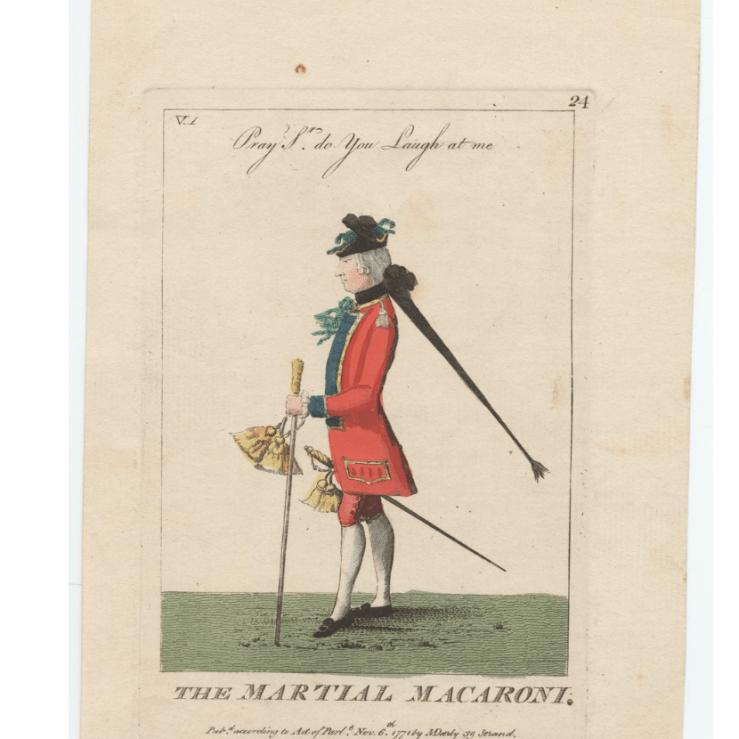
“The Macaroni: A Real Character at the Late Masquerade,” (1773), Philip Dawe

The derision that smallsword suffers in “HEMA” reflects several failures within the community. Arguably it reveals a latent and wide-spread species of bigotry. The abuse aimed at this “dainty” or “tiny” or [insert equally facile insult here] weapon highlights the thinly veiled prejudice in HEMA’s macho culture, far too much of which poisons the community and retards its progress. Aside from compensatory attention devoted to big weapons, go hard or go home, and “I gots brusies bruh!” there is the bigoted notion where sophisticated = weak/effeminate/gay, the idiocy and ignorance of which speaks volumes. Second, dismissal of smallsword, just as with its descendants, indicates a complete failure to grasp the depth and importance of the primary means by which one learns the universals of fencing. This is not merely my opinion, but demonstrable on a number of levels, from the wide array of works on fencing published over the past five hundred years to the gulf in quality one sees in the historical community, not only in terms of performance, but also in terms of translation and teaching.

While fascinating, the parallels between modern disdain for smallsword and 18th century censure of the young people of fashion called “Macaroni” and “Macaronesses” goes beyond the confines of this piece. There are better places to go for the exploration of prejudice in the 18th century as well as the on-going discussion of the battle for equality and civil rights today. My stance on all that, for what it matters, should be obvious from previous posts, but I cannot speak to either issue as appropriately as I can to the second failure, that is, the mistake that most of HEMA makes with regard to anything they define—however poorly or inaccurately—as “sporty” versus what they deem “martial.” [1]

I dtir na Ndall [“In the Land of the Blind…”] [2]

As the old saying goes, in the land of the blind the one-eyed man is king, and if any one maxim summarizes HEMA it’s this one. Examining the usual allegations against smallsword and foil one sees how poorly they are glimpsed without full vision. First, the chief bias appears to be that smallsword (a weapon), because it is related to foil (a training device), is less a weapon than say broadsword. If foil is for sport, then anything like it must be too. Second, for those who see it as a weapon its size, complex method of use, and “late” appearance make it suspect. The logic here, such as it is, suggests that the older a system is, the more legitimate it is; that lighter weapons must be less “martial;” and that anything related to the duel—save rapier—are again less serious than the “heavier” and more manly longsword, axe, etc. The ridiculousness of each of these assertions is underserving of attention, so to be brief:

  • a foil is a practice weapon, be it the modern foil, a feder, or wooden wasters—that Messer you use? Yep, it’s a foil. Ditto your Albion, Regenyi, or Ensifer
  • puncture wounds, made by triangular bayonets or the often triangular smallsword blades, leave really nasty injuries; before the innovations of 20th cen. medicine there was little one could do to repair these wounds or deal with the infections that often resulted (cf. sepsis)
  • fighting in judicial combats with a pole-axe, sword, or anything else was just as formal and bound by convention as late period duels were by the restriction of ground and etiquette

These are all well-established by histories old and new. In truth the bias really has nothing to do with history at all, but with a strong desire to differentiate oneself from “sport.” Anything that is remotely connected to sport, then, is suspect in the eyes of HEMA-Bro. Late 19th century sabres of 650-800g? Too close to the modern sport sabres. Smallsword? Too much like modern foil. That’s it. That’s really all it comes down to, and such short-sightedness cripples not only their research, if they do any, but their own practice and pursuit of the Art.

Why Later Period Systems and Modern Fencing Matter

Misplaced bias against both later period historical systems and modern fencing means, in most cases, that these fencers lack a firm foundation in fencing universals and pedagogy. This lack is what tends to undermine their study most. For example, because they have no idea what actual fencing fundamentals are, they mistake aberrations for norms. When they see the problems that are easy to spot, such as the whip-like strikes from electric foils behind competitors’ heads or the floor-dragging sabre slap to a guard, they assume that what they see is the system. Wrong. Even now, decades into the worst offenses in foil, students are normally taught that extending the weapon proceeds movement of the foot and the body. This is universal and is reflected in literally centuries of treatises and hundreds of modern schools. Thus, when viewing anything in the Olympics, the World Cup, or the local NAC, one must differentiate between how a fencer performs that extension as well as how a director views and calls that same action, and examine it against what is taught. They’re often different. Competition, like it or not, comes down to successful exploitation of a rule-set. One doesn’t have to be the Chevalier de Saint-Georges or the Chevalier d’Éon to win; determination and skillful use of attributes win more fights than most fencers wish to admit.

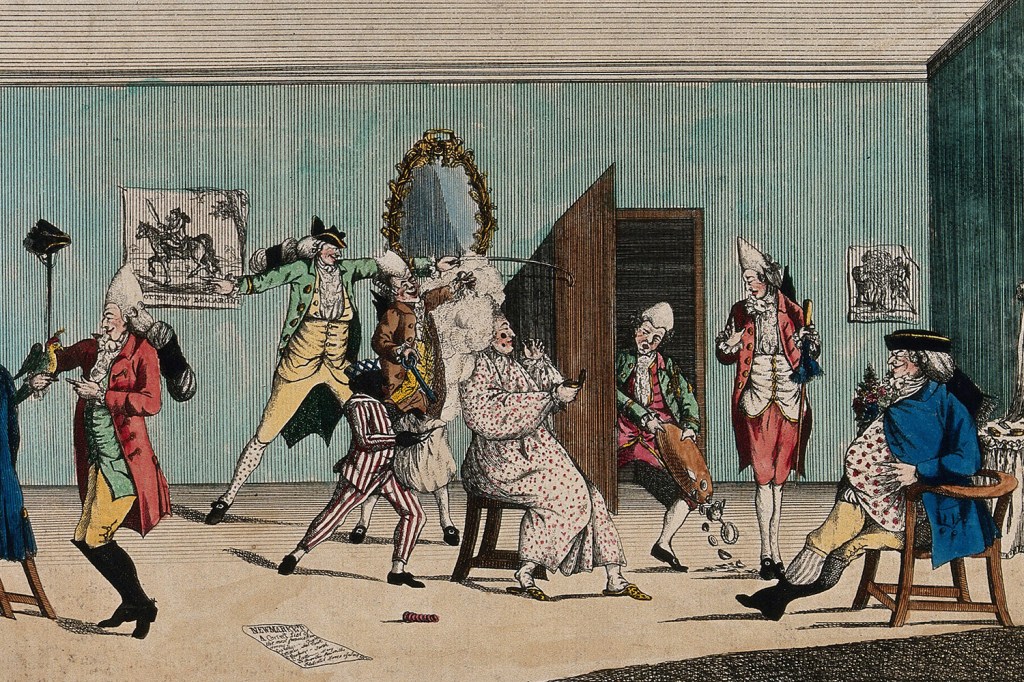
“A macaroni dressing room,” (26 June 1772) by I.W.

Not only do they fail to distinguish between what is taught and how it is used, but HEMAland also rejects traditional and sport pedagogy. They lose far more than they gain from this. Open most any decent work on fencing published in our own time and one will see first, that most do not include the ridiculous point-eating techniques, and those that do often with qualification—that is an admission, by the way, that the authors recognize that the technique is not part of the received tradition. [3] A fencing treatise is more than a collection of “moves;” it is an organized program that orders techniques, drill, and lessons in a meaningful way. It also instructs one in a vocabulary shaped by centuries of development, one benefit of which is that it provides a more effective means to discuss one’s study. Most of all, a year of foil—and this is reflected in the better modern works—imparts fundamentals that transcend foil. Knowing, for example, how the chief universals—time, measure, judgment/method—operate, and how one manipulates and achieves those universals effectively through movement, is crucial in examining any other system of martial arts, but especially those from which the modern version derives. [4] That may not seem important, but for the historical fencer it ought to be, because it is far easier to understand the unknown through the known than to come at the former with nothing or some half-conceived theory of one’s own.

In my last post (Sept. 20, 2020) I mentioned the infamous example of the misreading of Capoferro where the untutored surmised outlandish theories about his lunge. Had they had proper training in the modern lunge, done a bit more digging in the sources between now and Capoferro’s time, then the great mystery of Capoferro’s lunge would not be a mystery to them. Armed with even a nodding acquaintance with modern theory and practice would’ve helped those fencers avoid a grave mistake. Put bluntly, throwing out all that modern fencing has to teach, a system built—again literally—on centuries of work, is stupid and self-defeating. Modern fencing no more exists in a vacuum than did early modern or medieval fencing.

The Problem

For the same reason they poo poo later period weapons and modern fencing, HEMA-Bruhs refuse to listen to those who’ve studied them. Only people with the benefit of that training, or who take the trouble to learn about it, can see how all of this is actually a problem and not just sour-grapes or envy. The HEMA equivalent of anti-vaxers are convinced they have it right, refuse even to entertain that there might be something to learn from late period systems (though they’re ready enough to apply Japanese cutting mechanics and poorly understood kinesiology…), and so dismiss it out of hand. This is not a problem limited to the States either, though it’s perhaps particularly entrenched in American HEMA. We see it in the posers who ape the scholars they denigrate, in the sad attacks on established researchers by people who either deliberately misrepresent their position or are too stupid to understand it, in the idea that a few seminars make one an instructor, and in the odd notion that a 12 page pamphlet contains the same depth and sophistication as the works of Rosaroll & Gristetti or Prevost.

If those with respectable experience in Olympic and traditional fencing are ignored, then the only way to realize the value of later period arts or modern fencing is for the SPES-clad fencer to take that painful step and look at it more closely. Few do, and the results to an informed perspective are disappointing—half-baked theories, ill-conceived approaches, flawed interpretations, and a near complete lack of awareness of the importance of drilling fundamentals. [5] Our interpretations of past combat systems are only as good as the effective use of our research tools—studying extinct sword arts without some knowledge of fencing is akin to entering a bout without a weapon. Together, these flaws mean that much of HEMA is getting it wrong, and for a community supposedly interested in producing as accurate an interpretation of these extinct arts as possible, that makes little sense.

NOTES:

[1] I’m male, middle-aged, white, and hetero, and thus should not and will not speak to the experience of women or LGBT people. Friends and family who fall into either category, however, have shared a LOT with me about their own experience with bigotry so concluding that it juuuuust might bother them doesn’t seem too crazy to me. Just saying.

For related 18th cen. views, interested parties may wish to read some of the literature about notions of “masculine,” “feminine,” and the connections to contemporary ideas about sexuality in the Baroque and Georgian eras:

[2] For the person interested in the full Irish version: I dtir na ndall is rí fear na leathshúile.

[3] Compare for example Maxwell R. Garret, et al., Foil, Sabre, and Épée Fencing: Skills, Safety, Operations, and Responsibilities, University Park, PA: University of Pennsylvania Press, 1994, p. 134 on the “Flick (Cutover)” and Henry de Silva, Fencing: The Skills of the Game, Ramsbury, UK: The Crowood Press, 1997, p. 23, “The Cut-over or French Coupé.” Maxwell presents the flick as a cut-over, a reflection of how it was treated in competition in the mid-90s, where de Silva, writing a few years later, treats only the cut-over sans “flick.” It’s a subtle distinction, but for those of us competing at the time that remember the controversy over the flick and ROW, this reads a certain way.

[4] The universals always include tempo and measure, but the third term varies. Marcelli in The Rule of Fencing (1686) supplies “method” to the first two terms; Terracusa e Ventura, True Neapolitan Fencing (1725), speaks of velocity, tempo, and measure; de Bazancourt in Secrets of the Sword (1862) refers to judgment, control, and speed; Castello in The Theory and Practice of Fencing (1933) prefers distance, timing, calculation. To understand how these relate, why different masters chose different terms, requires reading them, not only for why they say what they do, but for how these terms relate to one another. Without a handle on the universals one’s ability to make sense of most works on fencing is hobbled—Girard (though see Traite des armes, Part III, “Advice for Good Composure when Fencing,” XI), Angelo, and many others assume the reader understands these or explains them within particular sections, so while not spelled out these concepts underlie all that they discuss.

[5] An informed perspective includes but is not limited to professionally trained fencing instructors, experienced fencers, or credible researchers. These is wiggle-room within these terms and I mean for there to be. There are veteran fencers, for example, who know more than many masters and teach as well or better; amateur researchers (vs. university trained researchers) who help us push the boundaries of what we know responsibly; and there are masters and professional scholars who raise the bar higher for our study of historical fencing. However, there are a lot of people who are teaching and shouldn’t be; there are a lot of people playing scholar who haven’t the least idea how to conduct research; and there are professional academics and maestri who don’t play well with others.

It is telling to me, for example, that while details may be in dispute among the maestri, scholars, and veteran fencers I know, none subscribe to the ridiculous theories that plague historical fencing, such as the silly theory of the lunge where the toe/balls of the feet land first. They are, generally, more open to new interpretations when those interpretations are better; less ready to make firm conclusions, especially for the medieval works; and understand the differences in the types of texts, how illustrations can work, and that the less a source contains, the more careful we must be. Most of all, they possess more sophisticated reading skills and realize that what they read or say must be analyzed, not just taken at face value. As a close friend has remarked, the “plates and plays” approach to HEMA is flawed; it fails to take into account all that is not right there in the image.

If you make a Molinello in the Woods…

Masiello, molinello to the head from the left

The question asked of sound and trees falling in the woods works for many situations. It’s especially apt as so many of us work alone thanks to the pandemic, but even in the best of times fencing is—be it conducted within a club, school, or team—a solitary pursuit. Our training partners and opponents are instrumental in our growth, and we cannot progress far without them, but the hours of footwork, conditioning, and drill honing technique is a responsibility on the individual fencer. All the flash and fire, all the joy experienced in flow during a bout, little to none of that does one enjoy advancing, retreating, and lunging, doing point-control drills, or performing molinelli against a pell. At its best it can be meditative, but normally, about as good as it gets is merely the awareness that the dull work matters, that one has successfully executed the necessary discipline, and that it’s all important. Unlike bouting, it is not “fun,” though absolutely crucial in our development.

Solo Drill & Isolation

On a another level, however, there is or can be a loneliness in fencing. In most ways it’s a journey we take alone, so that makes sense, but in the deeper waters of the Art and in trying to find other explorers at that depth the isolation, if we’re not aware of it and careful, can be detrimental to our study. With the pandemic, when most of what we can do safely is solo drill, it’s hard enough to find motivation to do the grunt work let alone fight that added sense of isolation if it assails us. Thanks to the internet this is a problem we can alleviate in some degree—few days pass where I don’t chat with the few people I know who are as keen to plumb the Art’s depths, explore texts, and learn as I am. After all, few people in our community, never mind people outside of it, enjoy the deep dive and can discuss the Art for hours on end. I know I’m not the only one who has watched a hapless friend’s eyes glaze over with the unmistakable look of a person that realizes they should never have asked us about fencing. The ability to chat with people far distant is a lifeline we’ve not always had and we should be grateful for it.

“The IT Crowd,” BBC, on sports

On a public level too fencing can be lonely. Like any more or less obscure pursuits fencing is not one of the typical dinner-party topics or likely to come up at a rave, farmer’s market, or appropriately distanced line at a grocery checkout (the six feet rule protects us not only from the virus, but small talk 😉 ). [1] American football, however, or the other sports-ball games, the latest shows on television, etc. are far more likely as topics of conversation. In short, most fencers have no one else to discuss the Art with apart from other fencers, not all of whom devote the same amount of time to it.

Moreover, with all that is going on in the world, with the dire challenges of climate change, Covid-19, social and political turmoil, and every person’s own trials, devoting time to a complicated, obsolete martial art probably seems silly or irresponsible to many people. Even assuming the fears of the conspiracy-minded sorts out there panned out, it would be a long, long time before anyone needed to use a sword again in earnest–in the US alone it will take centuries to run out of bullets–so in terms of the “practical” side to fencing it’s a hard sell. Not impossible–a cane, umbrella, or stick in the hands of a decent fencer is not something anyone should want to experience. So, maybe studying a dead martial art ranks low among the wines and spirits, but the Art can also be a healthy diversion, decent exercise, and intellectual entertainment, which are reasons enough to pursue it. It can be more than that too. The combination of physical and mental stimulation and exertion can be great stress relief.

Of the various perspectives perhaps one of the hardest is the lack of interest or even censure from other fencers. It’s hard enough to feel isolated generally, but when it comes from seemingly like-minded people it is that much harder. Typically this is something, when I’ve experienced it myself, that comes from either Olympic fencers or from similarly narrow-minded sections within “HEMA.” Truth is that everyone filters things through their own experience; reason, evidence, all that has little to do with it.

For example, in the 1990s when some of us defected from Olympic fencing to explore ways to make fencing about swordplay again, there was little support from our comrades. Impassioned appeals were usually met with laughter or hostility. I know my own disappointment and frustration with the poor decisions the FIE was making were made worse by the near complete lack of sympathy from teammates. Our vocal complaints about the system, especially with newer fencers in the mix, were not conducive to group cohesion, but we wanted those newer fencers to know there was a difference between defense-minded approaches and the slap-happy b.s. then in vogue. This is something that typically hits harder as one has more perspective. As it turns out, those of us upset about some of these changes were correct, and this is maybe one reason that to this day some former teammates haven’t forgiven us. [2]

Scene from “Gaslight,” 1944

It is extremely easy to feel gas-lighted in situations like this. I tend to hate terms like “gas-light,” but having had too much experience with it, even in fencing, it’s appropriate. Like many things, there is a spectrum for gas-lighting, but one of the most difficult to manage and overcome is the particular species wherein people believe that you believe something, but do not believe you’re correct and actively do things, wittingly or unwittingly, that make one feel like they’re losing their mind. [3] They offer what seems like positive reinforcement but which really only confuses everything–one comes away under the false assumption that they agree, when they don’t. We discover that the face they present to us is not the one they share with everyone else, the result of which breeds further confusion when in company with shared associates and it becomes clear there is a difference in what they’ve heard.

For fencing, an illuminating example is where people stand with regard to a silly rule that to this day affects Olympic sabre, t. 70 1 & 2, which states:

METHOD OF MAKING A TOUCH
t.70

  1. The sabre is a weapon for thrusting and cutting with the cutting edge, the flat and the
    back of the blade.
  2. All touches made with the cutting edge, the flat or the back of the blade are counted as
    good (cuts and back-cuts).
    [4]

It should be obvious why this is a problem. The decision to allow the flat of the blade to score was the FIE/USFA’s “solution” to the problem of whip-over in sabre. The logic was apparently that an attack made with right-of-way, even if it hit the guard, was valid if the light went off. Since the director cannot overrule the light (see for example t. 73.1), the only arbiter of the validity of a touch is the box, so despite the idiocy of attacking literally the strongest area of defense, one can–and people do–score by slapping the bell-guard. Because competition reflects responses to a rule-set, the nature of fencing and in time instruction (in some areas) changed.

Those of us unhappy about this were ignored, ridiculed, or told to shut up. Of these the response easiest to manage was ridicule–at least that was honest. We mined older works on fencing and photographs and illustrations of sabres with wider blade profiles. At one point, I collaborated with a close friend and fellow sabreur, an engineer, and we rigged up electric sabre kit with the closest thing we could find to period blades, schlager blades, and demonstrated that fixing the problem was as simple as returning to an earlier blade style. Whip-over disappeared. We even had one of our master’s assistant coaches try it, and while he agreed that it was better, he shrugged it off. It didn’t affect him at his level of competition–where training reflected a pre-electric mindset–so he didn’t see the issue. In his mind, the problem with whip-over wasn’t anything other than the fact that most people experiencing it were just “bad fencers.” To those of us trained as he was, but having to fence people increasingly taught to exploit this rule, it was maddening. One either adapted and did the same or quit.

The facts, evidence, the goal of helping the community fix an error meant nothing. A lot of us, myself included, felt abandoned, and it was easy to feel like it was all in one’s head. Rationally we knew the evidence supported us, but it didn’t matter to anyone else. What does one do when that happens? Our solution was to press on, and apparently a lot of other people did too, because now there are multiple companies making blades along earlier lines. There is also the classical/historical community that mushroomed in the wake of the exodus from Olympic competition.

So What?

The take away lesson is this: pursue the Art for you, for the reasons that make sense to you, and close your ears to those who mock, attack, or play Janus with you. If Olympic is your thing, do that; if classical/historical is, do that; if it’s bohurt, LARP, SCA, or anything else, go for it. So long as you’re honest in your study, with yourself, and with everyone else it’s hard to go wrong. Not everyone will see it that way, but the right people will and they are the ones who matter. They are your community even if they live half way around the world. As the pandemic continues, as we are forced to train more or less in isolation, we may as well do that the best way possible, and use this time to examine our study more closely, more honestly, and separate wheat from chaff, not only in terms of the Art, but of those who help or hinder us in our pursuit of it.

NOTES:

[1] Yes, I know, no one is going to raves or anything, but still.

[2] One of the hardest parts about owning one’s own share of the responsibility in a bad situation is that other parties will take advantage of it even so far as to use your admission against you. In this instance, both my close friend and I apologized for “souring” younger sabre fencers, but it did no good. It doesn’t matter that we were correct, it doesn’t matter that we did the right thing in owning our share of things, it changed nothing. It neither fixed that relationship or any other, and arguably it made some worse. This said, it was still the right thing to do.

[3] https://www.psychologytoday.com/us/blog/here-there-and-everywhere/201701/11-warning-signs-gaslighting

[4] See Fencing Rules (June 2018), USA Fencing, p. 42, section t. 71: 1 & 2, https://www.ncaa.org/sites/default/files/2018FENC_USA_Fencing_Rules_20180918.pdf

Historical Fencing–Definitions & Disparagement

In a recent conversation with an old friend and fellow fencer, one on the Olympic side of things, I realized just how poorly understood “historical” fencing is. To be fair, what most people consider to be historical is horribly inaccurate—it takes a part for the whole. This is not completely their fault; it’s mostly a result of what they’ve seen. The most publicized and well-known aspect of it is the black-clad longsword tournament sect, and balk at it though the SPES-donned might, they’re not representative. Much of what falls under the umbrella term of “HEMA” is much older than that; as much rests on better premises as well. [1]

Trying to explain to this friend what historical fencing is (or ought to be) was difficult. It was not only that historical fencing encompasses so much, over so long a time, but also that his preconceived notions were hard to refute given the one example he knows. Reflecting on that conversation I’ve been devising a short list of features to help round out the limited picture my friend and others have of historical fencing.

If you are easily offended it may be best if you stop reading here, for what I am about to say, however true, might upset some people. Happily, my readership is small, more inclined to agree than whine, and realistically what one obscure fencer thinks about HEMA makes no never-mind to those most likely to take umbrage.

HEMA to Your Standard Olympic Fencer

Silly meme made for some others in no-man’s land

Much of competitive longsword is bad. To a trained fencer it looks like apes with sticks whacking away at one another with little regard for art or safety. There are several reasons for this. Too many people begin competing too soon. Coaching is inconsistent and sometimes outright horrible. Rulesets, though they continue to evolve, tend to reveal the state of current opinion in re some pet concern (e.g. the “after-blow”) more than they do the logic of not being hit. Directing and judging, so often staffed by the same new folk, is dicey. Put together, to anyone who has fought within the Olympic world competitive longsword is one codpiece away from LARP and more closely resembles bohurt save that for some reason longsworders detest metal armor.

This is not to say that there are not skilled fencers among competitive longsworders. There definitely are. I know a few and know others by repute from credible witnesses and mutual friends. Likewise, this is not to say that competitive “sport” fencing is devoid of problems—nothing could be farther from the truth. HEMA, as such, would not have grown as it has from the late 1990s on had the Olympic world had its act together. Among the many similarities between competitive “sport” and “historical” fencers is that too many of them either fail or refuse to see the problems within their own camp. It’s a lot easier to point at the flaws in the other and count oneself and one’s view as the correct one.

So, what is “Historical Fencing” then?

Setting aside, for now, the mutual dislike and focusing instead on the easily demonstrable, here is what my Olympic friends tend to miss about historical fencing:

  • it is not just competitive longsword (skilled or apish)
  • it is source-based
  • it attempts to approach the Art as a martial art more than a sport
  • it encompasses sources from the High Middle Ages to the early 20th cen. [2]
  • it increasingly incorporates more than European systems [3]
  • modern fencing would not exist without some of these sources/systems
  • like anything some of it is really good; some of it really bad

This is a short list, but it’s important and contains most of the key details my Olympic friends miss.

HEMA ≠ longsword

This view again mistakes a tree for the forest. While arguably the most popular weapon among those interested in competition, longsword is merely one weapon and maybe the most visible of those systems people tend to see. Many if not most of the surviving sources which cover longsword also cover other weapons, such as spear, pole-axe, sword in one-hand (or single-sword), dagger, wrestling, dussack, Messer (a large, usually single-edged knife), agricultural tools turned weapons (e.g. sickles and scythes), and sword and buckler; some include material for fighting in armor as well as out of it. Many if not most of these have their competitive side too, though with allowances necessary for safety—fighting in armor, for example, and with weapons like poleaxes which greatly multiply force, requires excising those maneuvers intended to end fights. [4]

There is no “HEMA” without Sources

Unlike traditional and competitive fencing, historical fencing—by and large—focuses on extant sources. These can, however, take many forms. Not all are crusty old manuscripts or obscure books. The techniques one sees within any weapon class are—or should be—interpretations of techniques, ideas, and plays found in these sources. Due to the difficulties and vagaries inherent in interpretation there are often differences of opinion about even seemingly simple things. A researcher’s background and training have a significant effect on what they see, and thus in how they interpret what they find. The disdain many Olympic fencers have toward sources is, oddly enough, not uncommon among people in HEMA either, at least as expressed in the wide-spread dislike and distrust of formal academics. [5]

Not everyone in historical fencing reads the source material. Ideally, they would, but to be fair some of it is challenging to read, some poorly written, and much of it dull to modern eyes and ears. To name one example, long expositions on geometry couched as a discussion between a learned master and an eager student tend to be tedious to modern readers. Moreover, not all translations are equal, and there is little formal training or attention paid to teaching students how to separate wheat and chaff. [6] As in most things, politics and cliques often attend one’s choice of translation—it’s ridiculous, but remember while based on sources historical fencing is not populated by scores of trained historians or paleographers. Most people, probably 99%, “do HEMA” as a hobby, for fun; doing homework for a hobby after a long day at school or work doesn’t appeal to most of them. These students look instead to an instructor for guidance, drills, and a chance to try out what they’ve learned with others. This is a major difference from Olympic fencing where an instructor, most often certified, hands down a tradition passed on to them the same way. [7]

Combat Art vs. Combat Sport

Historical fencing is, depending with whom you speak, one or the other, or, both. There is a competitive wing, but being competitive is by definition less combat oriented. This is true however much one desires for it to be “martial.” It’s the nature of the beast. One cannot use, for example, all of Fiore’s Armizare or people would be maimed or killed (Master Fiore really liked breaking joints and thrusting the pommel and cross into people’s faces). This said, for the most part historical fencers try to approach these old fight systems as a martial art. Some attempts are more successful than others. Not everyone competes either, and this is an important point—”HEMA” is far more recreational than it is competitive.

MS Ludwig XV 13 28v-a

In Olympic fencing, just to illustrate the difference a little more clearly, the rules and training reflect a sport based on a former martial art. Off-target touches, some uses and interpretations of ROW (“right of way”), and the weapons themselves all demonstrate this well. There is no off-target in historical fencing—if one is hit, one is hit. [8] Hitting first or with priority—depending on rule-set—tends to take second place to being hit at all. Lastly, the weapons, while blunt, are meant to approximate more closely their historical predecessor. So, rather than foils we use smallswords or spada, which are still light and quick; in sabre we use 16mm wide blades or larger that weigh anywhere from 650g to 1000g. [9] Then there are the weapons that didn’t survive into the modern world, such as rapier, longsword, the knightly sword, the so-called “side-sword” and buckler, and pole-arms.

Historical Fencing & Non-European Systems

Strictly speaking HEMA, as named, refers to “historical European martial arts,” thus the acronym. This is one reason I do not favor this term, but instead use “historical fencing” or “historical martial arts.” As someone who values and incorporates the research that colleagues are producing in the study of various African, Persian, or Asian systems, I prefer a more inclusive term. In addition, as in so many fields, “European” can be and is defined a variety of ways. Most of our extant medieval works are in Latin, early German, French, Italian, or Spanish, so what about those in other languages that are less well-known? What about those from regions that are partly European, but heavily influenced by non-European peoples, such as the Republic of Georgia? [10] Happily, aside from the fools within the community who embrace ultra-nationalist notions, most people are pretty open, even excited to see what students of other regions are discovering.

Even within “HEMA,” however, there is a wide variety of difference in source type and purpose. Some works were hand-made and illustrated where later period ones were printed; some were meant for the aristocratic warrior caste, others for civilians; some were personal gifts to a patron, some mass-produced manuals from a government print house; some cover one weapon and context, some a multitude of weapons for a variety of contexts. We have some complete works, and some that are fragmentary. We have groups that identify a master or school, such as the Mss. that cover aspects of Fiore’s Armizare or the various masters associated with the later Dardi School. There are works written in simple language such as most 18th and 19th century sabre manuals, and then there are those written in purposefully obscure language to protect a master’s ideas from non-students, like “The Zettel.” To these we can add some rather poorly written works as well.

Modern and Ancient

Guard positions, Del Frate 1876; photo by Sarahorsomeone, Deviant Art, from the 2012 Olympics

Like it or not Olympic fencers learn and use a system that was the product of those that came before, especially those from 18th and 19th century Italy and France. Today’s foil and epee look back, each in its own way, to smallsword; sabre to 19th century works. It’s obvious to anyone watching modern fencing that a lot has changed, and not always for the best.

An explanation for how these changes occurred is lengthy and not one we need to dwell on here. In short, the requirements of sport are different than those for the dueling ground or battle field, and that meant changes in the rules, in the very weapons, that allowed for and in some ways created fencing today, good and bad. Competition, especially between nations, meant not only cheating but mutations in technique to exploit vulnerabilities and loopholes in the ruleset. Ridiculous attacks like the “flick” in foil a while back and the still undeniably stupid ability to score with the flat of the sabre blade are two such examples.

I urge anyone I know interested in fencing, really interested, to start with foil. It’s one reason I normally start my own students with foil. A good sport coach will provide any fencer with the fundamentals they need to pursue any other branch of fencing. Foil imparts the universals of swordplay and develops the core principles upon which all hand-to-hand fighting rests, distance/measure, timing, and judgment.

The Good, the Bad, the Ugly, and People

Olympic fencers may look down their noses at some interpretations within historical fencing (historical fencers certainly do), but they should understand that more often than not that smallsword or sabre fencer is working from texts either directly or indirectly related to what they themselves have learned and fence. Not all interpretations are equally good. Some are flat-out bad. This is to say that if some meathead is doing something that seems odd, it may be that meathead and not the system which is at fault. Don’t make the mistake of assuming all historical fencing is bad based on one practitioner or one clip of longsword tourney footage. There are many people who’ve made names for themselves and inspired a following who have some things demonstrably incorrect.

My caution to any fencer, especially my Olympic friends, is to ask questions before passing judgment. This list should help a little—if nothing else one can ask what sources that historical fencer is using and look into their instructor’s background. Unlike “sport” historical fencing is largely an amateur pursuit, in the best sense, which is to say that most instructors are not certified maestri. HEMA has no such program, and the attempts to create them have come to little in part due to the variety of sources and interpretation that make up HEMA and in part because of a lack of leadership. [11] The historical fencing community, as such, is decentralized, fragmented, and outside of a few major events most clubs work in isolation from others.

Just as in the Olympic world the historical community can claim some gifted fencers and some clowns. As someone who has lived in both populations, and currently occupies some strange no-man’s land in between them, I work hard to explain both sides to both branches. To be honest I don’t believe this has been particularly successful either way—the historical fencers who agree with me either have similar backgrounds to my own or some analogous path; those who disagree most likely don’t really care what the other camp does or thinks; they’re content with their own view. It’s the same for Olympic fencers.

Multae Viae, Una Ars
The Art is one, but there are many roads that lead to it. None of this may matter to you. That’s okay. I believe, however, that any true student of the Art will look for wisdom and help wherever it may be found. We have, potentially, a lot we might learn from one another, but it requires humility, curiosity, and a willingness to retain a beginner’s mind.

It means setting aside the concerns of affiliation or what one’s peers think. I hate to say it, but fencers, wherever they are, could give most middle schools a run for the money when it comes to cliques, cattiness, and drama. All that rot just gets in our way. The Art is hard enough to chase without those added pressures. They add little, detract a lot.

I’m due to have another Zoom call with my old comrade from our college fencing team. He may likely fire another shot at me for my “LARPing,” but that’s okay—this time I’m a little better prepared to set him right 😉

NOTES:

[1] Ignoring earlier efforts at recreating historical arts, such as those that took place in the Victorian Age with people like Hutton, much of todays’ “HEMA” derives from two things, the exodus of Olympic fencers in the 90s unhappy with changes in competition and the creation of the internet. HACA, ARMA, etc. all came about in the late 90s and started sharing texts. Those of us already doing that research were thrilled—in what felt like a change overnight many of the works we had read about in Thimm’s bibliography were suddenly available in pdf.

[2] The sources for HEMA are legion. Some are medieval, many renaissance and early modern, and still more produced in the last two or three centuries. Though it must be used with caution, one can gain some sense of this from a visit to Wiktenauer, a wiki attempting to collate and share many past works on martial arts. Some translations shared there are good, others less so. It is popular because it is free, which is great, but the lack of academic rigor means that it’s best used like most wikis, as a place to start.

[3] Two standout, non-European projects include the excellent work of Dr. Manouchehr Moshtagh Khorasani, researcher, author, instructor, and the force behind Razmafzar, a world-wide group of practitioners who rely on his work (see for example https://www.moshtaghkhorasani.com/books/persian-archery-and-swordsmanship/). There are also the various projects under HAMAA, the “Historical African Martial Arts Association.” One of the best places to go for current research within HAMAA is its fb page, but Da’Mon Stith’s school site, http://www.silentsword.org/, is also a great resource.

[4] Polearms, because of the physics involved, are dangerous, and any researcher working on them should be quick to say this. Even in harness, never mind within a class where people are in workout clothing, there are risks. Be wary of anyone or any school that doesn’t take these dangers seriously.

[5] Yes, I know, there are many people in “HEMA” who do value the work and contributions from academics. However, this said, if social media is any guide, there is a sizable voice within the community that not only thinks little of academic training, but also dismisses any criticism they don’t agree with, however correct. I’ve encountered this hostility myself from people popular within HEMA’s ranks. To borrow an analogy from “Firefly,” it’s like Patience running her little moon: they’re rather impressed with themselves and do not want anyone from “off-world” meddling in the fantasy. The difference is that unlike a tv show, assuming that they have the same skill as someone who spent a decade learning how to handle and interpret historical sources is as prone to error as it is presumptuous. I’ve watched shows about doctors, read books by them, and have had to use first aid, but I don’t think that qualifies me as a cardiologist. Training matters.

[6] Most students of historical fencing rely on translations or someone else reading translations. Any translator will tell you that the work is as much art as science, and the uncritical too often assume that a translation is good merely because it exists. This isn’t so. To name one example, there are two major translations of Giganti’s rapier text. One is really bad, and the other is Tom Leoni’s. Those who favor the former do so out of misplaced loyalty, not based on rigor or skill. Locally, I’ve worked with Mike Cherba of Northwest Armizare, who shares this concern about translations, to help people in selecting and using translations. I have transcripts of these lectures, with slides, on my academia.edu site, but will happily share them with anyone if they want them and don’t have access to that one.

[7] HEMA is mostly amateur led, that is to say that most people instructing are people who have spent more time with the material than others rather than certified fencing masters or experts in that time period or source tradition. One reason that HEMA has retained its appeal is because this diversity of expertise is more inclusive than exclusive. Had only a bunch of academics been in charge, fewer people would be working on this stuff and we’d make less progress. We need both, experts and amateurs, and we need them to work together better. In contrast, within the Olympic world there are very few people teaching fencing, at least teaching it well, who have not been to coaching school or who haven’t spent decades learning and teaching.

[8] I’m giving this complex issue short shrift for the sake of brevity, but for those interested there is a sizable collection of articles, books, and diatribes bemoaning or celebrating ROW and the use and abuse of the FIE/USFA rule book. Ping me if you’re interested.

[9] Despite a plethora of historical examples, there is a dedicated section within historical sabre that idolizes ridiculously heavy sabres. Most—not all, just most—meant for use on foot fall into the 650-900g range. Those at the top-end, however, more often than not are weighted for horsemen or systems of combat that were as simple. While one “can” make more sophisticated actions with a 1000g sabre, one cannot do so for long, and so the use of such a weapon for much beyond a sharp club is limited. There is an ever-growing list of extant sabres with specs that Chris Holzman, Kevin Murakoshi, and others maintain that I can share with you if you’re interested. There is also an excellent, but difficult to find article by Christoph Amberger on sabre weights.

[10] This is a shameless plug for my friend Mike’s hard work on a Georgian system that survived, no kidding, into the 1990s. Mike shares his research freely—you can find some of it here:

Site blog: http://www.nwarmizare.com/parikaoba/
Article on Elashvili’s text: http://www.nwarmizare.com/parikaoba/index.php?controller=post&action=view&id_post=6
Translation of Elashvili’s Parikaoba: http://www.nwarmizare.com/parikaoba-translation-direct.pdf

[11] There are a number of organizations that attempt to organize the community, such as the HEMA Alliance (https://www.hemaalliance.com/), but not everyone follows their lead or accepts their decisions. Fb is one of the best places to look for these groups, but many have webpages too. Some are specific to one area, like IAS, the “International Armizare Society” (www.armizare.org, though as of today the site seems to be down), and for most anyone not interested primarily in competitive longsword it is to these smaller groups that they should probably look to.

Conan the Barbarian, Sir Percival Blakeney, and the Cult of Machismo in Historical Fencing

C91Vzz0WsAA_8_w

There are times when our lives in and outside the sala intersect. Recently I experienced this with regard to advocacy for women’s rights, equality, and representation. Whatever one’s politics—mine are apparently less clear than I thought—this is an issue not only as an instructor and fencer, but as a human being, especially one living in the topsy-turvy world of the United States in 2019. There’s no middle-ground—either you believe in equality and fight for it, or, you don’t. There’s no fence-sitting, because by definition—in this case—inaction is tantamount to action: it is to be complicit in those customs, laws, and attitudes that are prejudicial. As a middle-aged white male, though, it’s often difficult to appear to be an advocate; I look like “the enemy,” after all, and though I do my best to support anyone really who’s not an a-hole, only continuous action might convince those who think otherwise.

In fairness, our attempts to advocate for others can fail, we can be taken for what we’re not, but that doesn’t mean one shouldn’t try. It’s all the more important to me as an instructor, because in my own, small way I have a chance to make a difference. The adults who train with me are, not surprisingly, on much the same page.[1] Preaching to the chorus is affirming, but it’s work already accomplished. With my younger students, however, I can do a lot of good, or, a lot of harm. I have an opportunity to make a difference, but I also feel I have a duty to make that difference, to create a safe, encouraging, and supportive spot for everyone. This I try my best to do. In part this is a carry-over from parenting—my wife and I are keen to raise our boys to be part of the solution, not the problem—but it also comes of seeing the damage bad coaches can do over a life-time of watching it happen.

From the adults, feedback is constant, and I’m thankful for that. At present we have one adult woman who regularly attends and happily she’s a good gauge for how well we’re doing, how well I’m doing, to create a safe spot. She has suffered a lot of abuse at the hands of men in fencing, from disregard to the actual threat of violence, and it’s a testimony to her strength and passion that she didn’t just quit. A long-time friend, she has been a good guide for me, not only from what I’ve picked up in trying to help her through so much b.s., but also in the fact the she has shared her ideas, experiences, and feedback. She speaks her mind; she will call me on poor choices and then it is up to me to be a large enough human to consider what she says. My younger students, most of whom are between the ages of 9 and 16, are less forthcoming with feedback, less capable of that insight as yet, and so I have to do the heavy-lifting for them.

Conan and Sir Percy

Sir Percy
Anthony Andrews as Sir Percy in the 1982 “Scarlet Pimpernel”

Anyone who spends much time in historical fencing is going to run into the Janus-faced Macho “HEMA Bruh.” He isn’t confined to our community; wherever there are combat-related past-times you’ll find this guy.[2] On the one hand he exemplifies the most facile, shallow notions of western masculinity—one sees this in the focus on victory above all, physical strength and size, his romanticism of violence, and a misplaced sense of his own ability. On the other hand, the second face is often more subtle. It’s homophobia expressed in humorous attempts to belittle other fencers. The math here, such as it is, reads like this: smaller sword = weak, “gay,” lesser, etc. If HEMA Bruh is Conan the Barbarian, then as far as Bruh is concerned smaller men, especially if they fail the big-sword test, are all the public persona of Sir Percy Blankeney-as-dandy, i.e. cowardly snobs who hide their weakness behind fancy dress and witticisms, or in this case, avoid “real” sword-fighting by using less scary weapons.[3] Wimps like that, so Conan thinks, have as much business pursuing “MAN” activities as women do. The 1950s middle-school nature of this thinking is sad, but they’re telling too coming from grown men. For those of us teaching later aspects of the Art, for example, the fact we don’t wrestle or use big swords makes us easy marks. Teach foil or smallsword in HEMA-land and you’ll see what I mean. Among adults it’s easy to see this and avoid such people, but what about for kids?

Instructor as Role Model

Like it or not, if you coach younger people you’re a role model; not the most important one in most cases, but one example of an authority figure that can have significant influence on a young person’s development. Acting the part of Conan the Barbarian, even making room for the HEMA Bruh or similar clowns, are all detrimental to any training program—the best such programs create are future HEMA Bros and considerably more people turned off to the Art. That is a net loss for everyone. I’ve watched this happen. [4]

Instructors must be ever mindful of how they act, what they say and how they say it, of the example they set. One of the ways this is made easier in fencing (of any kind) are the niceties and cult of manners inherent in the tradition. We salute in and out of class, we address people politely, we comport ourselves in the sala with self-respect and respect for others. All these things help but on their own are not enough. Just as old as the salute are double-standards, and though these are less evident today than they once were, they’re still around. For example, there are still instructors out there that either believe or unwittingly apply double-standards to female fencers, who think they can’t or shouldn’t do X. Claptrap. They can do whatever they want, and like anyone who applies themselves, do well.

Is Conan Really so Bad?

Arnie as Conan (1982)

How is the Cult of He-Man detrimental? Starting with the less pernicious effects, focus on facile notions of masculinity—strength, aggression, dominance, power, fame, victory, etc.—undermines the value of these concepts and removes them from what they should be.

  • Strength one develops for health and to practice the Art
  • Aggression, in a sportive context, is better developed as appropriate offensive strategy
  • Dominance of self outweighs any other version
  • Power should be a measure of control over the weapon and ourselves, so modulating not only one’s strikes, but oneself
  • Fame, like anything that serves ego alone, takes one’s attention away from the Art—if you bump into it, fine, enjoy it, but keep it in check
  • Victory is a diagnostic tool for measuring growth, tactics, and identifying areas for work.

I’m not trying to take the joy out of a win or suggest we all meditate in the ring or on the piste rather than fight. I’m suggesting that we get far more out of the Art, out of all our hours and training and hard work, if we look deeper.

Another issue is that these same He-Man values favor only one type of fencer—the larger, stronger, brutal fighter. Is there room for him? [5] Yes, but only if that same fencer is keen to grow beyond what nature provided him. He will be a liability otherwise. The instructor’s job with this fencer is to impart more of the Art to him, to round the corners off him, and teach him to harness and make the best use of those natural gifts (if he’s up for it). This is, in essence, what the instructor should be doing with each student, but that’s easier to do if one’s values extend beyond the physical. Focus on the big guy as a way to gain tourney gold and reputation at the expense of also putting in as much time with smaller, less powerful fencers might bring short-term gains, but at great cost.

To name one current example from one of my kids’ classes, there are two elementary school girls who are picking up technique quickly, but also who understand what they’re doing and why. Will they continue to fence? I don’t know, but my job is to give them all I can to help them find out, to encourage them, improve what they do well, and help them build those parts of the game they are struggling with. I also have a male middle-schooler in that class as tall as I am, and while strong that asset is little use to him in foil. With him my job is to help him channel his size and strength into more effective uses, in this case reach and stamina. Whatever size they are, whatever sex or gender, they’re my students and my task is to share the Art with them, to help them grow.

Put short, whatever a student’s gifts, whatever their challenges, we work with them—we do not favor one type over another. To do so limits us, limits the students, and sets a poor example. The motto of my school is Vis enim vincitur Arte, “For strength is conquered by Art,” because the Art can aid the powerful, but it can make the weak fencer overcome the powerful one.

How I treat them individually, but also as a class, is important too. I’m an adult teaching them something very complicated and difficult to do–that is challenge enough without inane ideas about boys being better at this, girls better at that. To me they’re potential fencers, fellow students only younger, and I must strive to set the best example I can for them.

The Truth about Attribute Fencers

The truth is that one can go far embracing the Conan the Barbarian approach—not everyone responds to them well and they can easily overwhelm many opponents. That doesn’t mean one is successfully expressing the Art, however, and while that can correlate with skill, they’re not one in the same. This is to say just because one is fast and powerful doesn’t mean one has good technique or understanding—you can win through intimidation and power too.

The half-life with this approach is short. If injury doesn’t take one out of things, burn-out will. Some experience that burn-out as frustration when they reach an opponent who’s a better Conan than themselves. Others quit at whatever it is they consider the top of their game convinced there is no one left to beat. The first can be fixed, the second is a sign of deeper problems. This same type of fencer is demoralized or becomes convinced things are rigged if a smaller, but more skilled opponent beats them. This is much the instructor’s failure as the fencer’s, more so for it shows the instructor failed to teach them one of the more important lessons we learn in the study of arms—how to lose with grace and use that loss to improve.

Attribute fencers often do well, for a time, but the longer they stay in the game the more they’ll discover that reliance on their speed or strength is limiting. Skill will win out in the end. One doesn’t stay strong and fast forever. This will sound funny to anyone who hasn’t experienced it, but if you face an opponent over 70 you’re in trouble—no matter how fast you are, how strong, etc., if that person is still fencing at that age then they know something, a lot of somethings, and you’re going to have your work cut out for you. The best losses I’ve experienced were to opponents over 70—they were great lessons. He would be 106 now if he is still alive, but being bagled 5-0 by the then 80 year old Fred Razor in 1993’s Hack und Slasch tournament in Victorville, California, was an indelible lesson for me.

The Deeper Danger of Conan

Robert Mark Kamen as “Johnny” from Cobra Kai in the 1984 “Karate Kid”

The real evil in this Cult of MAN is that it fosters unhealthy attitudes and beliefs. It provides an arena for those to grow. When this happens, people get hurt, but more than that, the same fragile notions of masculinity carry over into other areas of life. If the example we set for younger fencers is that might makes right, that our genitals determine our success or suitability for X, and that the gifts of nature in terms of size or strength outweigh the hard road of study, then we do more than create Cobra Kai fencers—we help shape, even if in small ways, the same monsters who plague our society at large. This is as true if we ignore it–it’s tacit approval.

This is not just “liberal propaganda” either—there is science here (nb: science, contrary to public opinion, is not a liberal conspiracy). Reinforcing pernicious social mores across activities, locations, and populations helps solidify those ideas. With fewer areas of life demonstrating competing views it is easier, especially for the very young, to accept those ideas as normal. Each of us in our own way, to the degree that we can, is responsible for the world we live in; we have a choice in how we engage others, what we accept and reject, and if we truly believe that equality matters, that respect for others and ourselves is worth cultivating, and that these values make for a better society, then everything we do, from how we vote to how we approach a sabre lesson echoes. This isn’t to say a fencing instructor makes or breaks things, but it is to say that it matters—if the Art is more than a body of technique and tactics, if it does relate to our growth as individuals, then it matters. [6]

I’m not an enemy of big dudes–some of my closest friends are big dudes. I also value the role that wrestling and grappling have played in the Art; more than that, I like to dabble in longsword too, and if the chance came up to take a class on spadone/montante, I would. Interest and pursuit of these is fine, perfectly awesome really, but like anything it is how we go about it, how we treat others, and all of these aspects of the Art can be approached sans Conan’s fur speedo.

———–

Notes:

*Photo of Dodgers player Kiké Hernandez and reporter Kelli Tennant. This photo was widely shared and the subject of a popular meme. It’s been cited as classic example of “fragile masculinity,” but there is evidence–in this case–to suggest that Kiké, a notorious prankster, might have been up to something else. At the very least he shared the same photo himself in 2017 as a short-person joke.   For the initial photo–see https://www.washingtonpost.com/news/the-intersect/wp/2018/07/13/a-baseball-player-stood-on-a-bucket-and-sparked-an-online-debate-about-masculinity/

See also, https://www.chicagotribune.com/columns/heidi-stevens/ct-life-stevens-tuesday-kike-hernandez-bucket-masulinity-0710-story.html

[1] I’m lucky to work with good people. Among the many civic and socially minded examples of their excellence, one even serves as an escort/guard for any woman fearful of protestors wishing to go to Planned Parenthood.

[2] “Bro” culture is rife in sports as it is in most places. Historical fencing, because it has larger weapons, because so many of the traditions dealt with war as well as the duel, and because physical size can make more of a difference in grappling is perhaps more prone to this sort of machismo where other branches of fencing—saving perhaps Bohurt—are less likely to see it.

[3] For those unfamiliar with the character, Sir Percy is the hero of Baroness Orczy’s The Scarlet Pimpernel (1905), a wonderful tale of an English aristocrat who hides his heroic rescue of the French noblesse from the guillotine behind the mask of a dandy among other personas. There are a number of film versions of the book as well (my favorite remains the portrayal by Leslie Howard’s from 1934). There was, it seems, a popular trope in swashbuckling literature of the inept, questionably hetero hero who adopts this persona to hide his more “manly” heroics. The other classic example being Zorro. It is telling that in 1981 “Zorro the Gay Blade” made this suggestion overt. Conan the Barbarian was the creation of Robert E. Howard whose series of stories first appeared in 1932. The most famous film version, recently remade, is the 1982 “Conan the Barbarian” starring Arnold Schwartzenegger. Both big-bad-ass-barbarian and sly-dandy films reflected, and helped cement, ideas about masculinity, sexual orientation, and what was and wasn’t acceptable: modern audiences (hopefully) will experience these older movies differently.

[4] It can be easy to forget how long childhood extends. Teens can look older, present older, but are nonetheless kids; even those in their early twenties have brains still in development. In the few instances where I’ve seen adults forget this, I’ve tried to help both the child and the coach, but sometimes the issues those adults face can blind them to the reality of the situation—kids, even 17 or 18 year olds, do not think or act like adults, so expecting from them what one does from a 30 year old is misguided at best.

There are also schools, some infamous in the States, for encouraging “Bruh” culture, but not so surprisingly they’ve run into more and more trouble. If you don’t play nice, people won’t want to play with you. Guess they never learned that.

[5] Yes, “him.” I try to use gender/sex neutral language as much as possible, but in my experience to date the worst offenders of macho-man syndrome have been male. Naturally there are fencers who identify in other ways that may be just as annoying to deal with.

[6] One standout example of a fencer’s moral choice during trying times is Nedo Nadi who repeatedly refused to join, represent, or work with Mussolini’s fascist regime. See Richard Cohen, By the Sword, New York, NY: Random House, 2002, 326 ff.

NB: My friend, and a gracious Big-Dude, Mike Cherba of Northwest Armizare, is using this post in class, so I have edited some of it, mostly removing excess words, repetition, and trying to tighten up the sentences a bit. What, I’m long-winded, I like long sentences…. I blame Latin. [4-8-2020]

What to Look for (and Avoid) in HEMA Instructors

early hema

In the world of sword-arts, HEMA (Historical European Martial Arts) occupies a unique place as it is, by and large, an amateur pursuit. “Amateur” here is not a put-down, just the appropriate word to use, because apart from the few accredited fencing maestri out there who represent living traditions and work on the older stuff, most everyone else comes to HEMA as an interested enthusiast. Many if not most of us started in sport or classical fencing or other martial arts (e.g. Asian martial arts), but unless you’re young and a more recent student of historical fencing, chances are good that you learned from someone who has just been working on something longer than you have. That is okay, it’s just how it is, but not all instructors are equal and it pays to do your homework.

This is an important consideration as there are increasingly more people setting themselves up as instructors and without a viable certification program how is one to know if they’re worth visiting? While in time some qualification process might be in place, and as nice as a certification program might be, it would still be wise to have some guidelines for judging potential teachers as even some qualified instructors, no matter the field of study, can be stinkers. [1] One needs to have some measure by which to evaluate them as well as a handy list of red-flags.

The following check-list is a place to start—you may have individual concerns to add to the basic list. However, if a person or school fails most of this list, I’d recommend you keep looking:

School/Group Culture: The general feel of a place can tell you a lot about the person or people running a school. How open and friendly are they? When you call, email, or visit them, how quick are they to respond and how openly? How inclusive is the school—are there women there, younger students, older students, people in different states of fitness? What is the school’s focus? Does it tend toward the scholarly (source-driven, play oriented); is it purely tourney centered, is it a mix?

A lot comes down to what you want. If your interest is to fight in tourneys, then you should look for a school that does that and an instructor who has that as one goal for their program. There’s no wrong answer in terms of what you want—some people just want to fight, some people want to build a more complete skill set and understanding regardless of tourneys, and still others want the SCA without all the rules. Find the culture that appeals to you. This said, any version of these schools is probably going to be a better fit if they’re friendly and open to a diversity of students.

Personality: Tied to culture, the instructor’s personality has a lot to do with a school’s culture—people gravitate to people they relate to. Whatever an instructor’s focus within HEMA there are some things to look for and not surprisingly they’re tied pretty closely to the same openness, friendliness, and sense of community mentioned above. Is the instructor arrogant? Do they build students up or tear them down? Do they praise and encourage when making corrections or embarrass students? How do they respond to questions? You’re spending time and money, and unless being abused is your thing it’s probably best to keep looking.

Forgeng I 33

Experience/Qualifications: This is one of the hardest things to assess and because of the diversity of sources, not to mention instructor experience, it will vary. A lot. This said, there are again some general guidelines. Some instructors may know a lot, but be poor teachers; others may be good fighters, but know little of the source material; still others might be a decent mix of both. Many think they know a lot or have a lot of skill, but are really little more than attribute fencers with deep ego needs. If you can find a healthy balance of knowledge and skill, great, but you may need to compromise and that is okay. It may take a few visits to see what sort of person you’re working with too.

If you have no previous background in fencing or related arts, it can be extremely difficult to judge an instructor’s knowledge and skill. But there are some tells—any instructor who has spent serious time studying martial arts will have a degree of humility and will acknowledge the skill of his or her peers. Generally, they are cautious and tentative in presenting new material—all HEMA is interpretation and some interpretations are better than others.  Anyone telling you “no, this is how they did it” without decent evidence is someone to avoid.[2] Likewise avoid anyone pretending to have learned something in secret–more often than not this is going to be pure bull-shido.

If you find someone who is at constant pains to brag while putting down their peers, that’s not a good sign. A good instructor will be able to explain where something comes from, say a particular move, why we do it, and how. They’re open to questions and different points of view. They should be able to point to the sources they use too. A good instructor will also admit when they don’t know something; even better instructors will then help you find an answer. A good instructor will push you to improve, but will be supportive and encouraging in doing so. This stuff is hard enough without some jerk making you feel bad about it.

Akademia Szermierz still
Some of the crew from Akademia Szermierz, Poland–they clearly approach Fiore dei Liberi’s _armizare_ as a martial art. See http://www.akademia-szermierzy.pl/

Approach: Since we’re talking HEMA, there should be a fairly large emphasis on the H and the MA side of the acronym. Ostensibly any instructor in HEMA is looking at the sources—if not, I’m not really sure what they’re doing.

We know the little we know and we build our interpretations of past combat arts from surviving sources.

The martial arts aspect is important too—the goal should be “don’t get hit” followed by “hit and don’t be hit.” If either of these is missing, you’re in the wrong place.

Remuneration: Different schools and instructors have different rates. Comparative shopping is important. Most schools struggle to stay open, so what you pay generally goes to rent and gear. Few people make a living teaching historical fencing.

Look at their pay structure against what they teach. Do they have options for payment? HEMA is expensive, make no mistake, and many instructors will work with you to find a way to make dues less onerous. Floor fees are common, but many schools will also give you a first visit or two free. That can be a good indication of what to expect. If someone offers individual lessons, ask them how they run their lessons, what they generally teach, and how much they ask.

Safety: Better instructors will have a culture of safety and enforce it; they will seek to prevent injury, not encourage it. There’s a fair amount of macho, HEMA-bro-culture out there, sadly, so if you’re into that nonsense, go for it. It won’t be hard to find. It seems silly to have to list this, but given the general machismo when it comes to safety it needs to be said: find someplace safe. Does your instructor require the basic safety equipment? Do you see people fencing without it? How well do they take care of the masks, gloves, jackets, etc.? How courteous are fencers with one another? How courteous is the instructor?  Are they using insufficient equipment for the weapons they train, and if so, do they have protocols for how to do that safely? [3] Do they have insurance? Have you signed a waiver?

Everyone wants to get fighting as quickly as possible, but jumping in, full bore, on the first day is not wise. Learning how to fight with swords takes time, drill, patience, and dedication—you don’t make progress over night, but over years. Be wary of any program ready to throw you into the mix with no to very little training. The truth is that any fencing school must consider the lowest common denominator when it comes to safety, not the best case scenario.

In summary, here are the basic red-flags. If you see any of these, walk. Your time, money, and safety are worth more.

Common Red-flags:

  • arrogance
  • poor ability to take criticism or correction
  • narrow-minded, bigoted, or predatory
  • lack of qualifications (this includes appeals to secret knowledge or training or connections to dubious “experts”)
  • incapable of or unwilling to work with others
  • incapable of or unwilling to appreciate student ability/gifts/credentials/questions
  • problem child in larger community
  • dangerous and unconcerned with safety
  • discomfort with students visiting other schools or instructors; cultish possessiveness

To be honest, sometimes you can’t see all the red flags right away, especially if you’re an occasional visitor and/or if the problem instructor is good at hiding it, but it will out. The community, wherever you are, generally has a decent notion of where not to go.

All of this assumes you want to learn swordplay in earnest and well. It’s a long, difficult path to proficiency, and you have to be willing to put in the time. Find an instructor who can not only impart technique and passion for this complex field of study, but also one who will be there to help you and keep you going when you’re ready to quit. Any such instructor is, by definition, not going to have a lot of these foibles.

Notes:

[1] The HEMA Alliance has such a program, but not everyone in HEMA is part of the alliance and their program is not universally accepted. See https://www.hemaalliance.com/instructor-certification

[update 10-4-19: There are some organizations I forgot about and share here. One is AIMA (Associazione Italiana Maestri d’Arme) and the other is one branch of the sport org AIMS (Associazione Italiana Maestri di Scherma), which has certified a number of Maesti di Scherma Storica (historical fencing).

[2] There’s a difference between “this is how we interpret this passage” and “because I say so.” Context is everything, and some sources are much more difficult to work with, and thus, force us to be more tentative.

[3] Most clubs use normal fencing masks. They’re the most available, most affordable option, but they’re not designed for anything heavier than epee most of the time. So, if your interest is longsword, overly heavy sabre (i.e. trooper weight meant for use in the saddle), pole-arms, etc., be sure to ask how the school mixes these weapons with fencing masks. It can be done more safely, but any mask can fail. One of my favorite examples of just how easily a fencing mask can be crunched is here: https://www.youtube.com/watch?v=eW1Imv7yHig

Gang Affiliation or Natural Allies? Fencers and their Camps

fencer-delmar-calvert from west coast fencing archive
Maitre Delmar Calvert, 1924-2019; photo from Westcoast Fencing Archive

This past weekend I attended the memorial for one of my instructors, Matire Delmar Calvert, and among the many thoughts that assailed me while there was a realization that despite the fact I was surrounded by mostly Olympic fencers I was with “family.” I didn’t expect that. These are all people I like, but I’ll be honest, I often have felt like I don’t belong with them.

More often than not I’ve felt like an outsider in fencing. When I stopped competing, many of my fellow fencers thought I was over-reacting or was just full of sour grapes, and when I started doing research into fencing, technique, etc. the kindest thing I was called was “nerd.” When I started trying to find and use more historically appropriate blades a fair number of people thought I was crazy (the historical community as we know it didn’t exist then). Working from books was bad enough. It didn’t get better.

1801366_10203266909176461_1837749499_o (1)
Jon Tarantino and I doing a photo-shoot, Oaks Park, Santa Barbara, for a friend in 1997–aside from schlager blades, these crappy Indian-made repro cavalry blades were all we had, and yes, they were rubbish.

I left the competitive world in 1996—I was disgusted with the band-aid vs. cure approach of the FIE/USFA to the issues in electric sabre. It just wasn’t fun anymore, not for me, and so I left. I began pursuing “Classical” or “Traditional” fencing, but understand that in saying that I don’t mean the artful dance variety—I wanted to return to sabre pre-electric, and that led me further and further back, ultimately to the core texts that created what I knew as sabre. Labeled “too sporty” and failing to pay homage to what has become the established “Classical” community, there was no welcome there either. It’s just as cliquish as the Olympic world, maybe more so for being smaller, though I’m happy to say that in more recent months I’ve had the pleasure to get to know more people within that community and hope it’s a sign that we’ll communicate more.

Time in historical fencing has proved just as difficult, if in different ways. The first historical club I attended, off and on, I entered at a difficult time for me and my family. I needed an out, something that wasn’t standing uselessly next to a pregnant spouse undergoing treatment for cancer and trying to keep a four-year old’s world as normal as possible. I should’ve done more research. I knew of Maestro Hayes’ school in Eugene, but with my schedule at the time I couldn’t make that drive. I did what anyone might do instead—I saw the need at the club I was in and decided I’d try to help. It was an utter and complete failure—fragile egos too often see help as a threat. This proved the case at this school.

abject failure of a seminar
Alex Spreier of High Desert Armizare, vs. Velah Gilbert (Military and Classical Sabre page, FB), with Christopher Bigelow (Northwest Fencing Academy) in green and Mike Cherba (Northwest Armizare) in blue, both in the background, 2015, at the ill-fated seminar on Angelo’s sabre and broadsword I put together

My last event there, one I put together to help them, but which ended up being micromanaged by the guy in charge of sabre there (first by planting his student in the seminar to keep an eye on me, and then, at the last minute, by showing up himself and taking over the seminar), was the last straw. After sharing my thoughts about it with him, I left and never looked back, though happily and ironically, became the best of friends with his student, and, met two people better connected with the larger historical community. I visited one of their schools, one super close to my house as it turns out, and was there for several years.

IMG_4385
Swordsquatch 2017, class I co-taught with a friend, covering Parise’s “On the Ground”

Having spent time in each camp’s turf, having fought side by side with each gang, hearing what they have to say about one another, themselves, all that, is illuminating. More than ever I think that despite the differences there’s more that we have in common that we think. This is a hard sell—group identity, misunderstanding, envy, ignorance, all work together to prevent more interaction. We are all the sorrier for it.

1-fencing-at-dickels-academy-frederic-remington
Fencing at- Dickels Academy, by Frederic-Remington

One of my goals with Sala delle Tre Spade is, to the degree possible, to bridge these divides. ALL fencers, whatever gang affiliation, are welcome—our turf is their turf. We are all united by study of the sword, and, we might learn a lot from one another. It makes me happy to know that in our tiny group we have historical, classical, and Olympic fencers; some have been or are in the SCA; some pursue several “styles” of fencing at different times in the week. We’re a small school, and so have very little influence in the larger fencing world, any of those worlds, but it’s a worthy goal trying to get people together to share what they know, because it builds ties and expands the parameters for what we might learn. We’re the richer for it, and while it’s anyone’s guess how long we’ll last, I know in a way that I know few things that it will have been worth it. We’ll all keep fencing regardless.

Of Medals and the Illusion of Mastery

With our tourney coming up—an invitational sabre match—I’m always conscious of how difficult these things are to do. I’ve either fenced in or judged a lot of tournaments, both Olympic and HEMA, and with each new historical tourney I’m struck by a disturbing fact—pound for pound, a tournament in HEMA and one in Olympic circles are not so very different. In both, too many fighters are playing the system, and worse, too many have zero regard for being hit. In both tournament worlds there is also a tendency to take medaling as the litmus test for excellence. Placing well can correlate with skill, but it’s not a sure thing. There are a number of reasons why this is so.

Everyone likes to win. Emerging the victor in a bout, or better still a tournament, is a nice feeling. It’s validating. It is important, however, to put any such victory in context and remember that however well one does, victory on its own does not mean mastery. There are several reasons for this and if you’re serious about your development as a fencer you need to know this. You ignore it at your peril, at the risk of further improvement, and it can easily lead to a false sense of ability with all the ego problems that creates.

There is always someone out there better than you are. This is just true. Theoretically, out there somewhere, there is one fencer who truly is better than everyone else, but see point two 😉  A prime example of this is a close friend of mine—we’ll call him “Dennis.” He’s a beautiful fencer, tactically brilliant, graceful, powerful, the kind of fighter who makes you look even better than you are when you fight him and he’s destroying you. Yes, that good. In the early 00’s, he entered an epee event open only to fencers ranked B or higher; most everyone there was an A-rated fencer. As this was epee, that ranking actually meant something too–epee is the only weapon of the three to have retained much of its martial ethos. No one there knew Dennis, and they expected to clean the floor with him. He beat every single one of them, badly, and they were really ticked when they realized that this was just something he did for fun, that he wasn’t a “normal” tournament guy; he fenced enough to keep his rating, but otherwise he’d just as soon be working on other hobbies. Dennis is a good example of the unknown ego-check, of the truly gifted fencer out there who is, quite literally, better than you or me.

Great fencers have bad days; poor fencers good days. No matter how good someone might be, even the best fencers have an off day. If this day happens to be on a tournament day, chances are good they may not clear the pools. In like guise, the poorest noob may end up taking the day. It just depends. Maybe they just had more fire and the better fencers either underestimated them or misapplied their skill. Maybe the directing was crap. Maybe it was a combination. One can’t take anything for granted.

Tournament victory is only as good as the quality of the pools. Not all gold medals are the same. Medaling in a minor tournament with twenty fencers of basic skill is not the same as medaling in a tournament where half or more of the fifty competitors are truly skilled. Herein is one major problem for WMA—what defines skill? Many people equate tournament victory with it, but that’s a false equivalency, one only embraced by people who don’t know better or who benefit from the fallacy. This is hard to combat because the same egos that benefit from this, who derive their value from it, are quick to say any naysayer is suffering sour grapes. Sort of makes discussing and fixing that, demonstrating the problem, difficult.

Skill vs. Attribute Fencing One of the elephants in the ring is the issue of attribute fencing versus a more comprehensive skill-set well-applied. To be fair, most attribute-fencers have skill, but often this is a specific set of skills that exploit their reach, speed, etc. to the exclusion of a more comprehensive game. The thing is it works. If you’re fast, if you have reach, if you hit harder and intimidate people, it will take you pretty far. People medal and win tournaments all the time armed only with a few tricks that they have optimized. The confidence that comes with that cannot be underestimated. The test though, for those fencers, is what happens when they run into someone whose skill-set is broader, whose experience is deeper, and who knows how to nullify the advantages their opponent’s attributes offer. If attribute fencers are lucky, they’ll meet that opponent; if they’re smart, they’ll learn something from it.

Gaming the Tourney is another major issue. This isn’t new and it’s not confined to WMA, but a major problem for Olympic fencing as well other sports. There are advantages to winning, and so, some people are willing to do whatever it takes to make it happen. For just a few examples, be wary of anyone hosting a tournament that only enlists directors and/or judges from their school or who stack staffing in their favor.[i]

Related tactics include attempting to intimidate officials and other competitors, arguing for rule changes that favor one’s approach and fencers, and hard-hitting. These kids don’t play with others, and worse, can give a tournament, even a region, a bad rep. You don’t want that.

I’m not saying don’t fence in tourneys—you should if you want, they’re fun, but, you should go into them with your eyes open and for the right reasons. Not to wax too Miyagi, but primarily a tourney is a place to test, in real-time, your skills and tactics; it’s a lesson, a chance to learn, an opportunity to see what works and what doesn’t. It should also be fun. The illusion of mastery, and especially of tourney gold as evidence of it, is a problem for any fencer who truly wishes to improve. Mastery is less a destination than it is a goal which pushes our training, which keeps us honest, which keeps us striving.[ii]

This doesn’t mean don’t do your best, that you’re not trying to win—you can’t test what you know if you’re going through the motions. The pressure, the chance to think on your feet, to adapt, and all within seconds is a fantastic way to see how well we apply what we’ve learned. If it all works, and you grab that trophy, great! It is healthy, maybe after celebratory beers, to reflect on the nature of the competition, to weight that against the heft of the medal around your neck. That awareness shouldn’t detract from victory, but merely inform it, and, better prepare you for the next one.


[i] This isn’t universally true of course. In small tournaments, especially where there is no one else to staff, one has little choice but to use who is on hand. Whenever possible, SdTS tries to enlist friends from other salas to help direct–our judges are pulled from the competitors.

[ii] A black belt in TKD, for example, has demonstrated that they are now ready to begin to study in earnest; a fencing master, in a slightly different way, isn’t necessary the best fighter, but a teacher, someone who has command of a particular pedagogical approach and is capable of teaching other teachers.